Interviews are more than just a Q&A session—they’re a chance to prove your worth. This blog dives into essential Precision Equipment Calibration interview questions and expert tips to help you align your answers with what hiring managers are looking for. Start preparing to shine!
Questions Asked in Precision Equipment Calibration Interview
Q 1. Explain the difference between calibration and verification.
Calibration and verification are closely related but distinct processes in ensuring the accuracy of measurement equipment. Think of it like this: verification is like a quick health check, while calibration is a thorough medical examination.
Verification confirms that an instrument is within its specified tolerances without adjusting it. It’s a pass/fail test. For example, verifying a scale might involve placing a known weight and seeing if the reading falls within an acceptable range. If it fails, a calibration is needed.
Calibration, on the other hand, involves adjusting the instrument to meet a known standard. It involves comparing the instrument’s readings against a traceable standard and then adjusting it (if necessary) to minimize the difference. Using the scale example, calibration would involve making adjustments to the scale’s mechanism to ensure it accurately displays the known weight.
Q 2. Describe the process of calibrating a digital multimeter.
Calibrating a digital multimeter (DMM) involves comparing its readings against a known standard, typically another high-accuracy DMM or a precision voltage source and resistance standard. The process typically involves these steps:
- Preparation: Gather necessary equipment: high-accuracy standard DMM or precision sources, calibration standards (resistors, voltage sources), appropriate test leads, and a calibration procedure.
- DC Voltage Calibration: Compare the DMM’s readings against the standard for various voltage levels (e.g., 1V, 10V, 100V). Record deviations and apply any necessary corrections if the DMM allows for adjustments. This involves connecting the standard source to the DMM and comparing readings.
- AC Voltage Calibration: Similar to DC, but using AC voltage sources and standards. Frequency considerations are crucial here.
- Resistance Calibration: Use precision resistors of known values to compare the DMM’s resistance measurements. This will involve a range of resistances.
- Current Calibration: Calibrate current measurement functions (amps) using precision current sources and shunts.
- Documentation: Record all readings, deviations, and adjustments in a calibration log. This is crucial for traceability.
Example: To calibrate the 10V DC range, we might connect a 10.000V precision voltage source to the DMM. If the DMM reads 9.995V, there’s a small deviation which needs to be documented. In many DMMs, this deviation cannot be directly corrected, but it becomes crucial in understanding its error band for future measurements.
Q 3. What are the common types of calibration uncertainties?
Calibration uncertainties arise from various sources and contribute to the overall uncertainty of a measurement. Common types include:
- Standard Uncertainty: Uncertainty associated with the reference standard used during calibration. High-quality standards minimize this.
- Measurement Uncertainty: Uncertainty due to limitations in the calibration equipment or the operator’s skill. This includes repeatability and reproducibility of measurements.
- Environmental Uncertainty: Uncertainty caused by changes in temperature, humidity, or other environmental factors that affect the measurement process.
- Resolution Uncertainty: Uncertainty resulting from the instrument’s limited display resolution. A DMM with 3.5 digits has a higher resolution uncertainty than one with 6.5 digits.
- Linearity Uncertainty: Uncertainty caused by non-linearity in the instrument’s response over its measurement range.
It’s crucial to quantify and combine these uncertainties to arrive at the overall uncertainty of the calibration result. This often involves statistical methods.
Q 4. How do you handle calibration discrepancies?
Handling calibration discrepancies requires a systematic approach. The first step is to investigate the source of the discrepancy. Here’s a breakdown:
- Review the Procedure: Ensure the calibration procedure was followed correctly. Were there any errors in the setup, reading, or recording of data?
- Check Equipment: Verify the integrity of the calibration equipment (standard, leads, etc.). Were they functioning properly?
- Investigate Environmental Factors: Examine if environmental conditions (temperature, humidity) deviated significantly from specified conditions and could affect the results.
- Re-calibration: If the discrepancy cannot be explained, repeat the calibration. If the discrepancy persists, the instrument may require repair or replacement.
- Documentation: Thoroughly document all investigations, findings, and corrective actions taken.
Example: If a thermometer consistently reads 2°C lower than the standard, investigate if the thermometer was properly immersed in the calibration bath, if the bath temperature was stable, and if the thermometer itself is faulty.
Q 5. Explain the importance of traceability in calibration.
Traceability in calibration ensures that the accuracy of a measurement can be linked back to internationally recognized standards, typically national metrology institutes (NMIs) like NIST (USA) or NPL (UK). It establishes a chain of custody for the calibration process, ensuring confidence in the results.
Imagine a chain. Each link represents a calibration step. The bottom link is the final equipment that we’re calibrating. The next link above it is the standard used to calibrate this equipment. The next link above that is the standard used to calibrate the previous standard, and so on. This chain goes all the way to the top, which is the primary standard maintained by a NMI. Traceability ensures that this unbroken chain exists.
Without traceability, the accuracy of our measurements is questionable. Traceability provides confidence and allows for comparisons of results across different labs and instruments.
Q 6. What are the key elements of a calibration certificate?
A complete calibration certificate should include these key elements:
- Equipment Identification: Unique identifier of the calibrated equipment (model number, serial number).
- Calibration Date and Time: The exact date and time the calibration was performed.
- Calibration Standards Used: Identification and calibration details of the standards used.
- Calibration Method: Description of the procedures used.
- Measurement Results: Recorded measurements, including uncertainties.
- Deviations from Standards: The difference between the equipment’s readings and the standard values. This often presented as an error band.
- Calibration Uncertainty: The overall uncertainty of the calibration results, reflecting the combined uncertainties of the various sources.
- Test Conditions: Environmental conditions during calibration (temperature, humidity).
- Expiry Date: Date when the calibration is no longer valid.
- Calibration Laboratory Accreditation: Information on the accreditation of the laboratory that performed the calibration (ISO 17025 is a common accreditation).
- Technician Signature and Identification: Details of the calibration technician.
Q 7. Describe your experience with different calibration methods (e.g., comparison, substitution).
I have extensive experience with various calibration methods, primarily comparison and substitution methods. Both are widely used, and the choice depends on the instrument and the desired accuracy.
Comparison Calibration: This method involves directly comparing the readings of the instrument under test (IUT) with a known standard under the same conditions. It’s straightforward and commonly used for simple instruments. For example, comparing the reading of a thermometer to a precision thermometer immersed in the same bath.
Substitution Calibration: This method involves substituting the IUT with the standard in the same measurement setup. The standard’s response is measured, then the IUT’s response is measured in the same exact setup. It helps to minimize systematic errors that might arise from variations in the measurement setup. This method is often used in more sensitive calibrations involving current or voltage sources.
In addition to these, I’m familiar with other techniques such as direct measurement (using a known input and comparing the output) and multi-point calibration (performing calibrations at multiple points across the measurement range to establish a more complete calibration curve). The selection of the best method is a crucial step to minimize errors and maximize reliability.
Q 8. How do you maintain calibration equipment?
Maintaining calibration equipment is crucial for ensuring accuracy and reliability. It’s a multi-faceted process involving preventative maintenance, regular checks, and proper storage. Think of it like maintaining a high-precision instrument – a poorly maintained instrument will give inaccurate readings, just like a poorly maintained calibration standard.
- Preventative Maintenance: This includes regularly cleaning the equipment according to manufacturer’s instructions, lubricating moving parts (if applicable), and checking for any signs of damage or wear. For example, a digital multimeter might require cleaning its probes and checking the battery regularly.
- Regular Checks: Even when not actively in use, calibration standards should be periodically checked for drift or damage. This might involve comparing the standard to a higher-order standard or conducting a self-diagnostic test if the equipment allows. Consider temperature-sensitive equipment – storing it in a stable environment is crucial to its longevity.
- Proper Storage: Storing equipment correctly prevents damage and degradation. This includes keeping it in a clean, dry, and stable temperature environment, away from sources of vibration or magnetic fields. For example, delicate optical instruments need to be stored in dust-free cabinets and protected from shock.
Implementing a robust preventative maintenance schedule, documented and tracked, ensures equipment remains in top condition and reduces the risk of unexpected failures during calibration activities.
Q 9. What is the significance of ISO 17025 in calibration?
ISO 17025, or “General requirements for the competence of testing and calibration laboratories,” is an internationally recognized standard that sets out the requirements for the operation of competent calibration laboratories. It’s essentially a gold standard that assures clients that the calibration results they receive are trustworthy and reliable.
The significance lies in its emphasis on:
- Technical Competence: The standard mandates that laboratories demonstrate their competence through documented procedures, qualified personnel, and traceability to national or international standards. This ensures accurate and reliable calibrations.
- Quality Management System: ISO 17025 requires a robust quality management system to ensure consistent performance and ongoing improvement. This includes aspects like calibration record keeping, internal audits, and corrective actions.
- Traceability: This is vital. The standard ensures all measurements are traceable to national or international standards, establishing a clear chain of custody for calibration data. This traceability is what guarantees the reliability of calibration certificates.
- Independence and Impartiality: ISO 17025 necessitates impartiality to ensure that calibration results are not influenced by external factors. This fosters trust and confidence in the calibration process.
Accreditation to ISO 17025 provides a mark of confidence for clients, demonstrating that a calibration laboratory meets stringent quality requirements and produces reliable results. It’s often a mandatory requirement for certain industries, such as aerospace or pharmaceuticals.
Q 10. Explain the concept of measurement uncertainty and its impact on calibration.
Measurement uncertainty is an expression of the doubt associated with a measured value. It quantifies the range within which the true value of the measurand likely lies. Think of it as a margin of error – no measurement is ever perfectly precise. For instance, if a calibrated weight is reported as 100g ± 0.05g, the ± 0.05g represents the measurement uncertainty.
Impact on Calibration:
- Confidence Interval: Uncertainty directly impacts the confidence interval of a calibration result. A smaller uncertainty indicates greater confidence in the accuracy of the measurement.
- Decision Making: Uncertainty helps in making informed decisions about whether an instrument is still within acceptable tolerances or needs recalibration. Exceeding the acceptable uncertainty level necessitates recalibration.
- Comparability: Uncertainty facilitates the comparison of calibration results from different laboratories or even different measurements on the same instrument. Consistent uncertainty reporting improves data comparability.
- Data Analysis: Correctly quantifying uncertainty is crucial for statistically valid data analysis and subsequent interpretation. Without proper uncertainty assessment, any conclusions drawn may be questionable.
In practice, the calibration report clearly states the measurement uncertainty associated with each calibration point. This allows users to understand the limits of the calibration result and use this information to evaluate the quality of their measurements.
Q 11. How do you manage calibration schedules and deadlines?
Managing calibration schedules and deadlines requires a systematic approach. We typically use a combination of software and established procedures. Imagine it like managing a complex project with multiple tasks and dependencies.
- Calibration Database: A dedicated software system or spreadsheet tracks all equipment, its calibration history, scheduled dates, and any relevant personnel. This system often generates automatic alerts and reminders as calibration due dates approach.
- Prioritization: Critical equipment with higher risk or greater impact on product quality receives priority. For example, equipment used in manufacturing critical components might have more frequent calibrations than less critical tools.
- Workflow Management: A clearly defined workflow ensures smooth processing, from initial scheduling to the final documentation and archive. This might involve check-out/check-in processes for equipment.
- Regular Review: Schedules are reviewed periodically (e.g., annually) to identify opportunities for improvement and adjust the calibration frequency based on actual usage and stability data. This prevents unnecessary calibrations while ensuring adequate coverage.
By implementing this system, we avoid missed deadlines, ensure timely calibrations, and maintain a complete historical record of all equipment calibration activities. This system prevents downtime and ensures compliance with regulatory requirements.
Q 12. How do you identify and address potential calibration errors?
Identifying and addressing calibration errors requires a multi-pronged approach that combines preventative measures with robust error detection and analysis. This is like investigating a crime scene, using clues to identify and rectify the cause of the error.
- Regular Audits: Internal audits identify potential weaknesses or inconsistencies in the calibration processes. This includes checks on calibration records, procedures, and equipment maintenance.
- Control Charts: Statistical Process Control (SPC) techniques, using control charts, help to identify trends or patterns that may indicate developing errors before they become significant problems.
- Root Cause Analysis: When an error occurs, a thorough investigation using techniques such as the 5 Whys or fishbone diagrams helps identify the root cause, not just the symptom. This prevents recurrence.
- Corrective Actions: Once the root cause is determined, corrective actions are implemented to prevent similar errors in the future. These are documented, reviewed, and implemented, often including process improvements and staff training.
- Verification: After implementing corrective actions, verification is done to confirm their effectiveness and ensure the error is eliminated.
The goal is to create a continuous improvement cycle where error identification leads to process refinement, resulting in higher accuracy and fewer calibration errors over time.
Q 13. What software or tools are you familiar with for managing calibration data?
I’m familiar with several software and tools for managing calibration data. The choice depends on the scale of operations and specific needs. For example, a small lab might use a spreadsheet, while a large organization would leverage a dedicated calibration management system (CMS).
- Spreadsheet Software (e.g., Excel, Google Sheets): For simpler applications, spreadsheets can track calibration records, but they lack the robust features of dedicated CMS.
- Calibration Management Systems (CMS): These systems offer comprehensive features such as automated scheduling, workflow management, reporting, and audit trails. Examples include LIMS (Laboratory Information Management Systems) with calibration modules and specialized CMS software packages.
- Database Management Systems (DBMS): DBMS such as MySQL or SQL Server can be used to create custom calibration databases, providing flexibility and scalability but requiring expertise to develop and maintain.
Regardless of the tool used, the key is having a system that ensures data integrity, traceability, and efficient access to information. This includes features for version control and secure data storage.
Q 14. Explain your understanding of statistical process control (SPC) in calibration.
Statistical Process Control (SPC) in calibration involves using statistical methods to monitor and control the calibration process. Think of it as using data to monitor the health of the calibration system itself. It’s not just about calibrating equipment, it’s about ensuring the calibration *process* is stable and reliable.
In calibration, SPC is used to:
- Monitor Calibration Stability: Control charts track calibration data over time to detect any trends or shifts indicating a potential problem with the equipment, the calibration process, or even the environment. For instance, a control chart plotting the results of calibrating a pressure gauge can reveal if the gauge is drifting.
- Reduce Variation: SPC helps identify and reduce sources of variation in calibration results, leading to more precise and reliable calibrations. This might involve investigating variations in ambient temperature or operator technique.
- Improve Calibration Efficiency: By understanding the variability of the process, calibration intervals can be optimized. If the data shows the equipment is very stable, the calibration interval can be extended safely.
- Prevent Out-of-Control Situations: Control charts provide early warning signals of problems, allowing for timely corrective action before they affect the accuracy of calibration results. This prevents invalid calibrations.
By applying SPC techniques, calibration laboratories can demonstrate the stability and control of their processes, leading to increased confidence in the accuracy and reliability of their calibration results and improved overall quality.
Q 15. Describe your experience with different types of calibration standards.
My experience encompasses a wide range of calibration standards, from national and international standards like NIST (National Institute of Standards and Technology) and ISO 17025, to manufacturer-specific standards. I’ve worked extensively with standards for various physical quantities, including:
- Temperature: Using calibrated thermometers, thermocouples, and resistance temperature detectors (RTDs) traceable to national standards to ensure accuracy in ovens, refrigerators, and other temperature-controlled environments.
- Mass: Utilizing calibrated weights, from micrograms to kilograms, for the calibration of balances and scales used in analytical chemistry, manufacturing, and quality control.
- Length/Dimension: Employing calibrated gauge blocks, micrometers, and other dimensional measuring equipment for the calibration of instruments used in machining, metrology, and quality assurance.
- Pressure: Working with calibrated pressure gauges, transducers, and deadweight testers for applications in industrial processes, HVAC systems, and medical devices.
- Electrical: Utilizing calibrated multimeters, oscilloscopes, and other electrical measurement devices for calibrating electronic instruments and circuits.
Understanding the specific requirements of each standard and its traceability to a higher-order standard is crucial for ensuring the reliability of our calibration results. For example, when calibrating a high-precision pressure gauge used in aerospace applications, the traceability chain back to the national standard is paramount, and meticulous documentation is required.
Career Expert Tips:
- Ace those interviews! Prepare effectively by reviewing the Top 50 Most Common Interview Questions on ResumeGemini.
- Navigate your job search with confidence! Explore a wide range of Career Tips on ResumeGemini. Learn about common challenges and recommendations to overcome them.
- Craft the perfect resume! Master the Art of Resume Writing with ResumeGemini’s guide. Showcase your unique qualifications and achievements effectively.
- Don’t miss out on holiday savings! Build your dream resume with ResumeGemini’s ATS optimized templates.
Q 16. How do you ensure the accuracy of calibration results?
Accuracy in calibration is paramount. We ensure this through a multi-faceted approach:
- Traceability: All our standards are traceable to national or international standards, creating an unbroken chain of comparison. This ensures our measurements are reliable and consistent.
- Calibration of Standards: Our calibration standards themselves undergo regular calibration by accredited laboratories, ensuring their continued accuracy. Think of it like a chain: each link must be strong to support the whole.
- Environmental Control: Calibration procedures are often conducted in controlled environments to minimize the effects of temperature, humidity, and other environmental factors. This is especially vital for sensitive instruments.
- Proper Equipment and Techniques: We use high-quality equipment, follow established procedures meticulously, and ensure our technicians are highly skilled and well-trained. Consistent application of methods is key.
- Statistical Analysis: We use statistical methods to analyze our results, identify potential sources of error, and ensure that the uncertainty associated with the calibration is within acceptable limits. This allows us to quantify the reliability of our findings.
- Regular Audits and Checks: We perform regular internal audits and quality control checks to ensure that our procedures are followed correctly and our equipment is functioning properly.
For example, if a discrepancy arises, we conduct a thorough investigation, which may involve checking the calibration of our standards, reviewing the calibration procedure, and assessing the condition of the equipment. This rigorous approach ensures the highest level of accuracy.
Q 17. What is your experience with different types of measuring instruments?
My experience encompasses a broad spectrum of measuring instruments, including:
- Dimensional Measuring Equipment: Micrometers, calipers, gauge blocks, coordinate measuring machines (CMMs).
- Electrical Instruments: Multimeters, oscilloscopes, signal generators, power meters.
- Temperature Measurement Devices: Thermocouples, RTDs, thermometers (various types).
- Pressure Measurement Devices: Pressure gauges, transducers, manometers.
- Mass Measurement Devices: Analytical balances, precision balances, load cells.
- Specialized Instruments: Depending on the client’s needs, I’ve worked with specialized instruments in various fields, including medical, aerospace, and automotive.
Understanding the operating principles and limitations of each instrument is critical for effective calibration. For instance, knowing the sensitivity and resolution of an instrument allows us to select the appropriate calibration standard and method to ensure the accuracy and reliability of the measurement. It’s not just about the instrument, but also the complete measurement system. Each component needs attention.
Q 18. How do you handle non-conformances during the calibration process?
When non-conformances occur during the calibration process – which is an inevitable aspect of precision work – we follow a structured approach:
- Identification and Documentation: The non-conformity is carefully identified, documented with precise details, including the instrument, the observed deviation, and the date and time.
- Investigation: A root cause analysis is conducted to determine the underlying reason for the non-conformity. This could involve checking the calibration of standards, equipment malfunctions, operator error, or environmental influences.
- Corrective Action: Based on the root cause analysis, appropriate corrective actions are implemented. This might involve repairing the instrument, retraining personnel, or improving environmental controls.
- Verification: After corrective actions are implemented, the instrument is recalibrated to verify that the non-conformity has been addressed.
- Reporting: The non-conformity, investigation, corrective actions, and verification are meticulously documented and reported to the client. Transparency is crucial.
For example, if a pressure gauge fails to meet its specified accuracy, we might investigate if it’s due to a faulty sensor, incorrect calibration procedure, or environmental factors affecting its reading. The solution is tailored to the specific cause. It’s a process of continuous improvement; each issue informs future practice.
Q 19. Explain your understanding of root cause analysis in calibration.
Root cause analysis (RCA) in calibration is essential for preventing future non-conformances and improving overall process efficiency. We typically use techniques such as:
- 5 Whys: This iterative technique involves repeatedly asking ‘why’ to progressively drill down to the root cause of a problem. For example: ‘Why did the balance fail calibration?’ (Because its internal calibration weight was damaged.) ‘Why was the weight damaged?’ (Because it was dropped.) And so on until the root cause is identified.
- Fishbone Diagram (Ishikawa Diagram): This visual tool helps to systematically identify potential contributing factors (people, methods, materials, equipment, environment) to a problem.
- Pareto Analysis: This statistical method helps identify the ‘vital few’ causes responsible for most of the effects. Focusing on these allows for efficient allocation of corrective measures.
The goal of RCA is not just to fix the immediate problem, but to understand the underlying systemic issues and prevent recurrence. It’s about learning from mistakes and strengthening the entire calibration process. A well-executed RCA leads to lasting improvements in accuracy and reliability.
Q 20. What are your experiences with different calibration procedures?
My experience with calibration procedures is extensive and covers a wide range of instruments and industries. I’m proficient in:
- ISO 17025 compliant calibration procedures: This is fundamental to ensuring the accuracy, traceability, and reliability of calibration results.
- Manufacturer-specific calibration procedures: Many instruments require specific calibration methods outlined by their manufacturers. Following these precisely ensures optimal performance and avoids damage to the equipment.
- On-site and in-house calibrations: I’m experienced with performing calibrations at client sites as well as within a controlled laboratory environment.
- Calibration of various types of sensors: From simple analog gauges to advanced digital sensors.
Adapting procedures to specific equipment and client requirements is key. Each situation presents its own unique set of parameters, from the type of instrument to environmental conditions, which must be carefully considered for precise results. A well-defined procedure is essential, even for routine calibrations.
Q 21. How do you ensure the safety and proper handling of calibration equipment?
Safety and proper handling of calibration equipment are paramount. Our approach incorporates:
- Training: All our technicians receive comprehensive training on safe handling procedures, including the proper use of personal protective equipment (PPE), such as safety glasses and gloves where appropriate.
- Equipment Maintenance: Regular maintenance of calibration equipment is crucial for ensuring its safety and continued accuracy. This includes regular cleaning, inspection, and repair as needed. This proactive approach prevents unexpected failures.
- Environmental Considerations: Calibration equipment should be stored and used in appropriate environmental conditions to prevent damage and ensure accuracy. This often includes climate control for temperature and humidity.
- Safe Handling Procedures: Specific safe handling procedures are developed and followed for each type of equipment, taking into account potential hazards such as electrical shock, sharp objects, or hazardous materials.
- Risk Assessment: A formal risk assessment is done prior to any calibration work to identify potential hazards and develop safe work practices to mitigate risks.
For instance, when handling delicate or high-voltage equipment, specialized handling tools and techniques are employed to prevent damage or injuries. The safety of our personnel and the integrity of the equipment are inseparable; one cannot be assured without the other.
Q 22. Describe your experience with documenting calibration procedures.
Documenting calibration procedures is crucial for ensuring traceability, repeatability, and compliance. A well-documented procedure acts as a blueprint, guiding technicians through each step consistently. My experience encompasses creating and maintaining calibration procedures for a wide range of equipment, from simple pressure gauges to complex analytical instruments.
- Procedure Development: I begin by meticulously defining the scope, specifying the equipment model, relevant standards (e.g., ISO 17025), and acceptance criteria. This includes detailed steps, including how to prepare the instrument, the calibration method (e.g., comparison to a traceable standard), data recording, and calculations.
- Revision Control: All procedures are version-controlled. Changes are documented, approved, and distributed to all relevant personnel. We use a system of numbered revisions to clearly identify the most current version.
- Clarity and Accessibility: I strive for clarity and conciseness, using visuals like diagrams and flowcharts to enhance understanding. Procedures are stored in a readily accessible, centralized system for easy retrieval.
- Example: For a digital multimeter calibration, the procedure would detail the specific test points, reference standards used, the method for calculating uncertainties, and the criteria for passing or failing. Specific instructions would be provided for connecting the equipment and operating the software, if any.
Q 23. How do you stay current with advancements in calibration technologies and standards?
Staying current in precision equipment calibration requires continuous learning. I achieve this through a multi-faceted approach:
- Professional Organizations: Active membership in organizations like the American Society for Testing and Materials (ASTM) and the Institute of Electrical and Electronics Engineers (IEEE) provides access to publications, conferences, and networking opportunities with peers.
- Industry Publications and Journals: Regularly reviewing journals like Metrologia and Measurement Science and Technology keeps me informed about new calibration techniques and standards.
- Manufacturer Training: I participate in vendor-specific training programs to gain in-depth knowledge of the latest equipment and calibration methods. This often involves hands-on training with new technologies.
- Workshops and Seminars: Attending workshops and seminars allows me to learn best practices from industry experts and gain insights into emerging trends.
- Standards Bodies: I closely follow updates from national and international standards organizations like NIST (National Institute of Standards and Technology) and ISO (International Organization for Standardization) to ensure compliance and utilize the latest recommended practices. Understanding changes in standards (e.g., updates to ISO 17025) is crucial for maintaining accreditation and ensuring the quality of our work.
Q 24. Describe a challenging calibration problem you solved.
One challenging calibration I tackled involved a high-precision spectrophotometer exhibiting unpredictable drift in readings. Initial troubleshooting suggested a potential problem with the instrument’s internal lamp, but replacement didn’t resolve the issue. This raised a need to consider a broader range of possible causes.
My approach was systematic:
- Detailed Data Analysis: I meticulously reviewed the calibration data, noting patterns and anomalies. We found the drift was temperature-dependent.
- Environmental Factors Investigation: This led us to carefully consider environmental conditions such as the ambient temperature, humidity, and even air currents around the instrument.
- System Calibration Check: We also verified the calibration of the temperature sensors controlling the instrument itself and checked the temperature stability of the laboratory environment.
- Solution: It turned out the temperature control system of the spectrophotometer was malfunctioning, causing significant temperature fluctuations that impacted the readings. After repair and recalibration with a focus on stable, controlled temperatures, the instrument performed within acceptable tolerances. The improved procedure now includes tighter control of temperature and humidity.
Q 25. What are the legal and regulatory requirements related to calibration in your experience?
Legal and regulatory requirements for calibration vary depending on the industry and the type of equipment being calibrated. However, some common threads include:
- Traceability to National Standards: Calibration results must be traceable to national standards (e.g., NIST in the US), providing evidence that measurements are reliable and accurate.
- ISO 17025 Accreditation: Many industries require calibration labs to be accredited to ISO/IEC 17025, demonstrating competence and quality management.
- Industry-Specific Regulations: Certain industries, such as pharmaceuticals and aerospace, have specific regulations governing calibration procedures and documentation. For example, pharmaceutical manufacturing often requires compliance with GMP (Good Manufacturing Practice) guidelines, which include strict calibration requirements.
- Documentation and Record Keeping: Detailed records of calibration activities, including certificates, procedures, and instrument history, must be maintained for a defined period. This is critical for auditing and demonstrating compliance.
- Legal Liability: Accurate calibration is crucial to ensure product safety and regulatory compliance; inaccurate calibration can result in significant legal and financial consequences.
Q 26. How do you prioritize calibration tasks when dealing with multiple instruments and deadlines?
Prioritizing calibration tasks requires a strategic approach that balances urgency, criticality, and resource availability. I utilize a system that combines several factors:
- Risk Assessment: I assess the risk associated with each instrument. Instruments critical for safety or product quality (e.g., safety interlocks, analytical balances in a pharmaceutical lab) are prioritized. This is a critical step in minimizing potential impact.
- Calibration Due Dates: Instruments approaching their due dates are given priority. I maintain a calendar showing all calibration due dates, allowing for proactive scheduling.
- Instrument Usage Frequency: More frequently used instruments need more frequent calibration. A high-usage instrument may require more frequent calibration and therefore jump ahead in the queue.
- Workflow Management Software: We leverage software to manage calibration schedules, track instrument history, and generate reports. This aids in efficient task allocation and tracking progress.
- Communication: Open communication with stakeholders, such as engineers and operations personnel, is essential to manage expectations and adjust priorities when unexpected issues arise.
Q 27. Describe your experience working in a team environment on calibration projects.
Teamwork is essential in calibration. My experience involves collaborating with technicians, engineers, and quality control personnel on various calibration projects. Successful teamwork hinges on clear communication, shared responsibility, and mutual respect for expertise.
- Collaborative Problem Solving: When tackling complex calibrations, we brainstorm solutions collaboratively. Each team member contributes their unique skills and experience, leading to faster and more effective solutions.
- Knowledge Sharing: I actively share my knowledge with team members, mentoring junior technicians and assisting with training on new equipment or techniques. This develops capabilities within the team.
- Efficient Workflow: We establish clear roles and responsibilities to optimize workflow. Coordination is key to streamline the process, avoiding bottlenecks and delays. We often break down complex tasks and assign them based on individual expertise.
- Constructive Feedback: Open and constructive feedback ensures that calibrations are performed correctly and to the highest standards. Regular team meetings allows everyone to provide and receive feedback constructively.
- Example: A recent project involved calibrating a complex robotic system. We worked in a team, with one member responsible for mechanical alignment, another for the electrical systems, and myself focusing on the overall accuracy and repeatability of the robot’s movements. Clear communication and coordinated testing were essential for successful completion.
Key Topics to Learn for Precision Equipment Calibration Interview
- Measurement Uncertainty and Error Analysis: Understanding sources of error, propagation of uncertainty, and methods for minimizing errors in calibration processes. Practical application: Analyzing calibration data to identify and quantify uncertainty.
- Calibration Standards and Traceability: Knowledge of national and international standards, traceability chains, and the importance of using certified reference standards. Practical application: Selecting appropriate standards for a specific calibration task and documenting traceability.
- Calibration Procedures and Methods: Familiarity with various calibration techniques, including direct comparison, substitution, and functional methods. Practical application: Developing and implementing calibration procedures for different types of equipment.
- Calibration Equipment and Instrumentation: Understanding the principles of operation and limitations of various calibration instruments, such as multimeters, oscilloscopes, and pressure gauges. Practical application: Selecting and properly using appropriate calibration equipment.
- Data Acquisition and Analysis: Proficiency in using data acquisition systems and software for collecting and analyzing calibration data. Practical application: Interpreting calibration results and generating reports.
- Calibration Software and Databases: Familiarity with calibration management software and databases for tracking calibration records and managing certificates. Practical application: Utilizing software to streamline the calibration process and ensure compliance.
- Good Calibration Practices (GCP): Understanding and adhering to established best practices for maintaining accuracy, integrity, and traceability in calibration processes. Practical application: Implementing GCP to ensure the reliability of calibration results.
- Troubleshooting and Problem Solving: Ability to identify and resolve common calibration problems, such as equipment malfunctions or inconsistencies in data. Practical application: Diagnosing and correcting issues to ensure accurate and reliable calibrations.
Next Steps
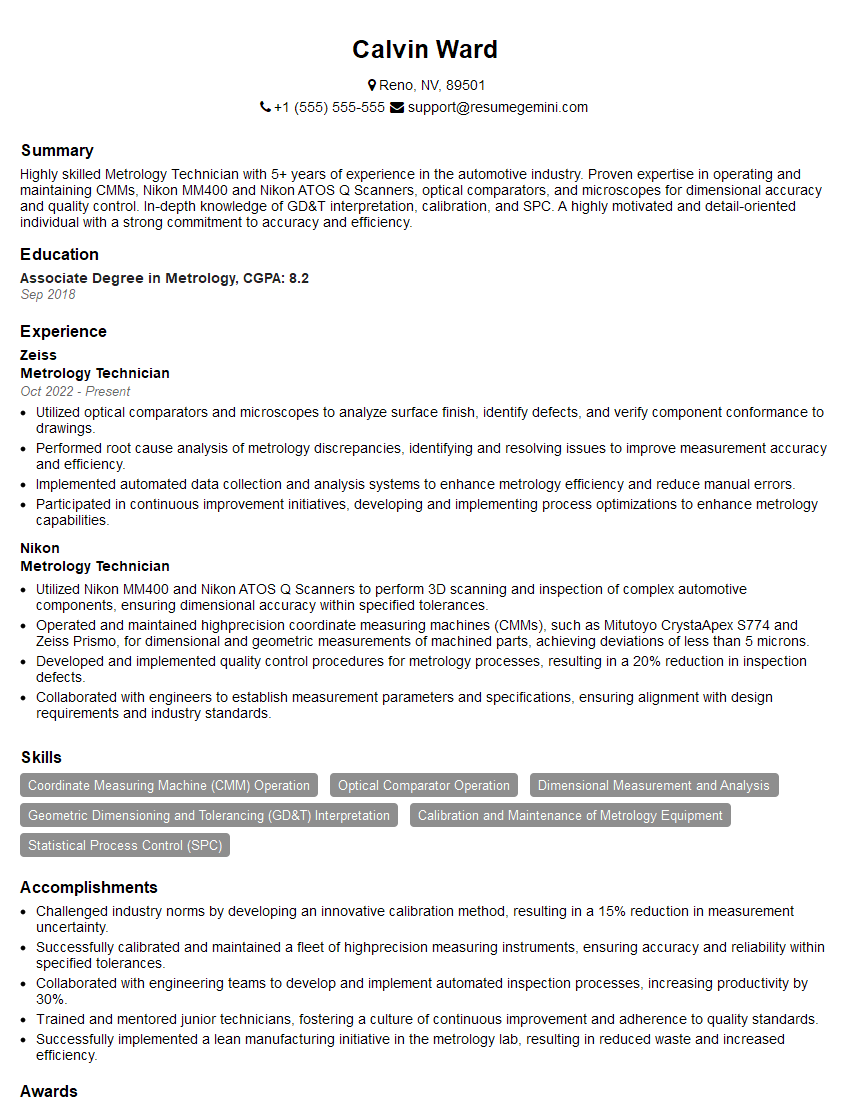
Mastering Precision Equipment Calibration opens doors to rewarding and challenging careers in various industries. Demonstrating your expertise effectively is crucial, starting with a strong resume. An ATS-friendly resume significantly increases your chances of getting your application noticed by recruiters. To enhance your resume and present yourself as the ideal candidate, we strongly recommend using ResumeGemini. ResumeGemini offers a user-friendly platform to create professional resumes tailored to your specific skills and experience. Examples of resumes tailored to Precision Equipment Calibration are available to help you get started.
Explore more articles
Users Rating of Our Blogs
Share Your Experience
We value your feedback! Please rate our content and share your thoughts (optional).
What Readers Say About Our Blog
Very informative content, great job.
good