The thought of an interview can be nerve-wracking, but the right preparation can make all the difference. Explore this comprehensive guide to Musical Theory interview questions and gain the confidence you need to showcase your abilities and secure the role.
Questions Asked in Musical Theory Interview
Q 1. Explain the difference between major and minor keys.
Major and minor keys are the foundational building blocks of Western music, distinguished primarily by their characteristic melodic and harmonic profiles. The difference boils down to the intervallic structure between the root and third degree of the scale. In a major key, the interval between the root and the third is a major third (four half steps), creating a bright, uplifting sound. In a minor key, this interval is a minor third (three half steps), resulting in a darker, more somber mood.
Think of it like this: major keys are like sunshine – bright and cheerful. Minor keys are like twilight – more mysterious and reflective. For example, C major (C-D-E-F-G-A-B-C) sounds distinctly different from C minor (C-D-Eb-F-G-Ab-Bb-C) due to that crucial difference in the third degree.
This difference impacts not only the melody but also the chords built within the key. Major chords are typically perceived as consonant and stable, while minor chords often carry a sense of tension or instability, leading to different harmonic possibilities and emotional impact.
Q 2. Describe the circle of fifths and its significance.
The circle of fifths is a visual representation of the relationships between the 12 major and 12 minor keys. It’s arranged in a circle, with each key progressing to the next by a perfect fifth (seven half steps). Moving clockwise, you’re ascending through the circle of fifths; moving counter-clockwise, you descend.
Its significance lies in demonstrating the close harmonic relationships between keys. Keys that are close together on the circle share many chords, making transitions between them smoother and more natural. Composers utilize this to create key changes that are both musically satisfying and emotionally effective. For instance, modulating from C major to G major (a perfect fifth relationship) feels very natural because they share many chords in common.
The circle of fifths is invaluable for understanding key signatures, chord progressions, and modulation. It’s a fundamental tool for any composer or musician striving for harmonic fluency.
Q 3. What are the diatonic functions of chords in a key?
Diatonic functions refer to the role chords play within a specific key. In a major key, we typically identify seven chords – I, ii, iii, IV, V, vi, and vii° – each with a distinct function. These Roman numerals represent the chord’s relationship to the tonic (I) – the foundational chord of the key.
I(Tonic): Provides stability and resolution. It’s the home base.ii(Supertonic): Creates a feeling of anticipation or suspension.iii(Mediant): Offers a more delicate and less stable sound than I or IV.IV(Subdominant): Creates a sense of preparation or movement towards the tonic.V(Dominant): The strongest chord in the key, generating a strong pull towards the tonic. It’s the most common chord used for leading into the tonic.vi(Submediant): Adds a touch of melancholy or reflection.vii°(Leading-tone): Generates a powerful pull towards the tonic due to its leading tone.
Understanding diatonic functions allows for creating sophisticated and meaningful chord progressions. For instance, a common progression might be I-IV-V-I, providing a feeling of stable resolution, anticipation, strong pull, and finality.
Q 4. Identify the different types of scales (e.g., major, minor, pentatonic, etc.).
Many scales exist beyond the basic major and minor scales. Here are a few examples:
- Major Scale: Characterized by the interval pattern W-W-H-W-W-W-H (W = whole step, H = half step). It’s bright and cheerful.
- Natural Minor Scale: W-H-W-W-H-W-W. It’s darker and more melancholic than the major scale.
- Harmonic Minor Scale: W-H-W-W-W-H-W. A raised 7th degree creates a stronger pull to the tonic.
- Melodic Minor Scale: W-H-W-W-W-W-H (ascending) and W-H-W-W-H-W-W (descending). The ascending scale is brighter, the descending more similar to natural minor.
- Pentatonic Scale: A five-note scale, often used in folk music and blues. There are major and minor pentatonic scales, offering a simpler, more modal sound.
- Chromatic Scale: Composed entirely of half steps, it contains all 12 notes within an octave.
- Modal Scales (e.g., Dorian, Phrygian, Lydian, Mixolydian, Aeolian, Locrian): These are variations of the diatonic scale, each with its own characteristic sound and feel. They offer a rich palette of color beyond major and minor.
Each scale type provides a unique sonic palette and emotional character, influencing the melodic and harmonic possibilities within a composition.
Q 5. Explain the concept of harmony and its role in music.
Harmony in music refers to the simultaneous sounding of notes, creating chords and chord progressions. It’s the element that provides depth, richness, and emotional impact to a melody. While melody can be seen as the horizontal aspect of music, harmony is the vertical dimension.
Harmony’s role is multifaceted. It provides structural support to the melody, creating a sense of movement and direction. It can establish a key or mode, creating a tonal center. It can build tension and release, leading to satisfying resolutions. Different harmonic styles – from simple triads to complex clusters – evoke different emotions and aesthetics.
Consider a simple song. The melody might be beautiful, but the addition of chords (harmony) significantly enhances the emotional impact and overall listening experience. Without harmony, music would be significantly less expressive and engaging.
Q 6. What is counterpoint, and how is it used in composition?
Counterpoint is a compositional technique where two or more independent melodic lines are combined to create a harmonious whole. Unlike homophonic texture (where one melody is dominant with supporting chords), counterpoint emphasizes the equal importance of multiple melodies.
In counterpoint, the individual melodic lines, or voices, are designed to interact in interesting and often complex ways. Composers pay close attention to voice leading (how the individual lines move), ensuring they remain independent yet harmonically compatible. Rules of counterpoint, often involving voice spacing and avoidance of parallel fifths or octaves, guide the process to maintain clarity and avoid muddiness.
Famous examples of counterpoint can be found in the works of J.S. Bach, whose fugues are masterclasses in the art form. Counterpoint adds depth, complexity, and intellectual stimulation to a composition; it showcases the composer’s skill in balancing independent melodic lines.
Q 7. Describe the different types of cadences.
Cadences are the points of arrival or rest in a musical phrase or section, marking a sense of closure. They are typically characterized by specific chord progressions and harmonic resolutions.
- Authentic Cadence: The most common type, typically involving a V-I progression (dominant to tonic). This creates a strong sense of finality and resolution.
- Plagal Cadence: Uses a IV-I progression (subdominant to tonic). It’s often considered gentler and less decisive than an authentic cadence. The ‘Amen’ cadence in hymns is a well-known example.
- Deceptive Cadence: Creates a sense of false resolution, often employing a V-vi progression instead of the expected V-I. This adds surprise and intrigue.
- Half Cadence: Ends on a dominant chord (V), leaving a sense of incompleteness and expectation for a continuation.
- Imperfect Cadence: Any cadence that doesn’t fall neatly into the above categories; it might be more ambiguous in its sense of resolution.
Composers strategically use different types of cadences to shape the overall structure and emotional arc of their compositions, guiding the listener’s experience through tension and release.
Q 8. Explain the concept of modulation.
Modulation is the process of changing from one key (tonality) to another in a musical composition. Think of it like changing the ‘home base’ of the melody. Instead of staying centered around a single tonic (the ‘home’ note), the music shifts its tonal center to a new key, often related but sometimes quite distant. This shift can be gradual or abrupt, and it adds richness, variety, and emotional depth to the music.
For example, a piece might start in C major and modulate to G major, a closely related key. This is a relatively smooth transition, often achieved through a series of chords that share notes between the two keys, creating a sense of progression. A more dramatic modulation might be from C major to A minor, a more distant key, creating a significant change in mood and atmosphere. The effectiveness of a modulation hinges on the composer’s skill in making the transition logical and musical, rather than jarring or confusing to the listener.
Modulation is crucial for larger-scale musical works, allowing composers to explore different emotional landscapes and create dynamic musical narratives.
Q 9. What are the common types of musical form (e.g., sonata form, rondo, etc.)?
Musical forms provide a framework for organizing musical ideas. They’re essentially blueprints that guide the composer in structuring their piece. Several common forms exist, each with its unique characteristics:
- Sonata Form: This classic form often found in symphonies and sonatas consists of three main sections: Exposition (presenting two contrasting themes), Development (elaborating on and transforming those themes), and Recapitulation (restatement of the themes, typically in the tonic key). It’s a dynamic form that allows for exploration and contrast.
- Rondo Form: Characterized by a recurring main theme (the ‘A’ section) interspersed with contrasting episodes (the ‘B’, ‘C’, etc. sections). Think of it like a musical round; the main theme returns consistently, providing a sense of unity and familiarity amid the variations. It’s often used in lighter, more playful pieces.
- Theme and Variations: A single melody (the theme) is presented and then repeated, each time with variations in rhythm, harmony, or melody. This form highlights the versatility of a single musical idea.
- Binary Form: A simple structure divided into two main sections (A and B). The second section often contrasts with the first in character and key.
- Ternary Form (ABA): Consists of three sections, with the first section (A) repeated after a contrasting middle section (B). It’s a balanced and satisfying structure often found in smaller pieces.
Many works blend these forms or utilize variations of them, resulting in unique and engaging structures.
Q 10. How do you analyze a piece of music using musical theory concepts?
Analyzing a piece of music involves systematically dissecting its components to understand its structure and meaning. It’s like performing a musical autopsy! We use several theoretical tools:
- Melody: Analyze the main melodic lines, identifying their range, contour, intervals, and rhythmic patterns. Are there recurring motives? What’s the overall shape of the melody?
- Harmony: Examine the chord progressions, identifying the key, chord types (major, minor, seventh chords, etc.), and functional roles of the chords (tonic, dominant, subdominant). Are there interesting harmonic surprises or modulations?
- Rhythm: Analyze the rhythmic patterns and meter, identifying syncopation, rhythmic motifs, and changes in tempo. How does the rhythm contribute to the overall feel of the piece?
- Form: Determine the overall structure of the piece. Does it follow a specific form (sonata, rondo, etc.)? How are the different sections related?
- Texture: Consider the interplay between different musical lines. Is it monophonic (single melody), polyphonic (multiple independent melodies), or homophonic (melody with accompaniment)?
By examining these elements individually and how they interact, you can build a comprehensive understanding of a piece’s musical language, emotional expression, and overall design.
Q 11. Explain the difference between consonance and dissonance.
Consonance and dissonance describe the perceived stability or instability of musical sounds when heard together. Think of it like a feeling of musical ‘rest’ versus ‘tension’.
Consonance refers to a combination of notes that sounds stable and pleasing to the ear. These combinations generally involve simple intervals (like perfect fifths or octaves) and create a sense of resolution. They often feel ‘complete’ or ‘settled’.
Dissonance, conversely, refers to a combination of notes that sounds unstable and often requires resolution to a consonant chord. These combinations often involve more complex intervals or clashes between notes. They create a sense of tension that needs to be released. This tension-release dynamic is a cornerstone of musical expression.
The perception of consonance and dissonance can be culturally influenced and has changed throughout musical history. What might have been considered dissonant in the Baroque period, for example, could be completely consonant in contemporary music.
Q 12. What is a chromatic scale, and when is it used?
A chromatic scale is a sequence of all twelve notes within an octave, including all the half-steps. Unlike diatonic scales (like major or minor scales), which have a pattern of whole and half steps, a chromatic scale contains only half steps, making it sound very smooth and often dramatic. It has no tonic.
It’s used to create:
- Chromatic passing tones: Non-chord tones that add color and movement within a chord progression.
- Chromatic approaches: Notes that approach a chord tone by half step, creating anticipation and resolution.
- Chromatic mediants: The third of a related key, creating a surprising effect that adds harmonic richness.
- Modulation: Creates a bridge between different keys.
- Special harmonic effects: Adds a sense of mystery, tension, or ambiguity.
Think of a dramatic film score using a chromatic melody; it immediately conveys heightened emotion or suspense.
Q 13. Describe the different types of intervals.
Intervals describe the distance between two notes. They are classified by their size (number of half steps) and their quality (perfect, major, minor, augmented, diminished).
Here’s a breakdown:
- Perfect intervals: Unison (0 half steps), octave (12 half steps), perfect fourth (5 half steps), perfect fifth (7 half steps).
- Major intervals: Major second (2 half steps), major third (4 half steps), major sixth (9 half steps), major seventh (11 half steps).
- Minor intervals: Minor second (1 half step), minor third (3 half steps), minor sixth (8 half steps), minor seventh (10 half steps).
- Augmented intervals: One half-step larger than the major or perfect intervals (e.g., augmented fourth, augmented fifth).
- Diminished intervals: One half-step smaller than the minor or perfect intervals (e.g., diminished fifth, diminished seventh).
Understanding intervals is fundamental because they form the basis of chords, melodies, and harmonic progressions.
Q 14. How do you identify inversions of chords?
Chord inversions change the order of notes within a chord, altering its bass note without changing its root. The root is the note that defines the chord’s identity. For example, a C major chord (C-E-G) has C as its root. Inversions involve moving notes from the top to the bottom of the chord to create new voicings.
Here’s how it works:
- Root Position: The root is the lowest note (e.g., C-E-G).
- First Inversion: The third is the lowest note (e.g., E-G-C).
- Second Inversion: The fifth is the lowest note (e.g., G-C-E).
Inversions affect the bass line and the overall sound of the chord. They provide variety and can create specific harmonic effects. Identifying inversions requires recognizing the root of the chord despite the bass note.
Q 15. Explain the concept of voice leading.
Voice leading is the smooth and logical progression of individual melodic lines or voices within a musical composition. Think of it as the choreography of individual musical parts, ensuring a pleasing and coherent sound. Effective voice leading avoids awkward leaps, parallel fifths or octaves (unless intentionally used for a specific effect), and strives for a sense of melodic direction and continuity. It’s a crucial element in creating a satisfying harmonic progression and overall musical flow.
For example, consider a simple chord progression in C Major: C Major – G Major – Am – F Major. Good voice leading in this progression might involve the bass line moving stepwise (C-G-A-F), while the soprano line might gracefully move between notes that are harmonically connected, avoiding large, jarring leaps. Poor voice leading might involve abrupt jumps and parallel intervals, resulting in a disjointed and unpleasant sound.
In practice, understanding voice leading is crucial for composers, arrangers, and orchestrators. It’s the difference between a piece that sounds smooth and logical, and one that sounds dissonant and clunky.
Career Expert Tips:
- Ace those interviews! Prepare effectively by reviewing the Top 50 Most Common Interview Questions on ResumeGemini.
- Navigate your job search with confidence! Explore a wide range of Career Tips on ResumeGemini. Learn about common challenges and recommendations to overcome them.
- Craft the perfect resume! Master the Art of Resume Writing with ResumeGemini’s guide. Showcase your unique qualifications and achievements effectively.
- Don’t miss out on holiday savings! Build your dream resume with ResumeGemini’s ATS optimized templates.
Q 16. What are the characteristics of different musical periods (e.g., Baroque, Classical, Romantic)?
Different musical periods are characterized by distinct stylistic traits in melody, harmony, rhythm, form, and instrumentation. Let’s explore some key features:
- Baroque (roughly 1600-1750): Think grandeur and ornamentation. Characteristics include elaborate counterpoint (multiple independent melodic lines interwoven), basso continuo (a continuous bass line supporting the harmony), terraced dynamics (sudden shifts in volume), and the use of ornamentation like trills and mordents. Composers like Bach and Handel exemplify this period.
- Classical (roughly 1730-1820): Emphasizes clarity, balance, and structural formality. Key features include homophonic texture (a melody with harmonic accompaniment), clearer melodic lines, sonata form (a common structure in instrumental pieces), and a more restrained use of ornamentation compared to the Baroque. Haydn, Mozart, and Beethoven are prominent figures.
- Romantic (roughly 1820-1900): This period is marked by intense emotion, expressive melodies, and expanded harmonic vocabulary. Characteristics include chromaticism (frequent use of notes outside the key), wider dynamic range, expressive rubato (flexible tempo), and a focus on individual expression. Think of composers like Chopin, Schubert, Schumann, and Wagner.
Understanding these differences helps in interpreting and analyzing music from various eras. For instance, the harmonic complexity of a Romantic piece might differ significantly from the simpler harmonies of a Classical piece.
Q 17. How do you analyze a piece of music for its rhythmic structure?
Analyzing a piece’s rhythmic structure involves identifying the basic rhythmic units, patterns, and their organization. It’s like deciphering the rhythmic ‘skeleton’ of the music. Here’s a step-by-step approach:
- Identify the Meter: Determine the time signature (e.g., 4/4, 3/4). This indicates the basic rhythmic pulse and the number of beats per measure.
- Analyze Beat Subdivision: Observe how the beats are subdivided (e.g., into two, three, or more smaller units). This helps identify rhythmic patterns and motifs.
- Identify Rhythmic Motifs and Phrases: Note recurring rhythmic patterns or short melodic sequences that form the building blocks of the piece’s rhythm. These motifs often contribute significantly to the musical character.
- Analyze Rhythmic Relationships: Examine how the different rhythmic motifs and phrases interact with each other. Do they create a sense of contrast or repetition? Do they build to a climax?
- Consider Syncopation and Displacement: Identify any accents or rhythmic emphasis that fall on weak beats or between beats (syncopation). This adds complexity and interest to the rhythm.
For example, in a simple folk song, you might find a consistent rhythmic pattern repeated throughout. A more complex piece might have multiple interacting rhythmic patterns, creating a rich and dynamic rhythmic landscape.
Q 18. Explain the concept of meter and time signature.
Meter refers to the regular grouping of beats into units called measures or bars. It provides the underlying framework for rhythm in music. The time signature is a notation that indicates the meter. It consists of two numbers: the top number shows how many beats are in each measure, and the bottom number indicates the type of note that receives one beat.
For example, a time signature of 4/4 (common time) means there are four beats per measure, and a quarter note gets one beat. A time signature of 3/4 (waltz time) indicates three beats per measure, with a quarter note receiving one beat. The time signature gives the performer and listener a basic framework for understanding the rhythmic organization of the piece. The meter can be simple (e.g., 2/4, 3/4, 4/4), where each beat is typically divided into two, or compound (e.g., 6/8, 9/8, 12/8), where each beat is divided into three.
Q 19. What is a syncopation, and how does it impact rhythm?
Syncopation is a rhythmic device where an unexpected accent or emphasis is placed on a weak beat or between beats. It creates a rhythmic surprise or interruption of the expected pattern. This creates a sense of rhythmic tension and release. It can make a rhythm feel more dynamic and interesting.
For instance, in a 4/4 time signature, the typical strong beats are 1 and 3. A syncopation might involve emphasizing beat 2 or 4, or even placing an accent between beats 1 and 2. This unexpected emphasis can make the rhythm feel more lively and engaging, creating a sense of rhythmic ‘groove’. Many popular music genres heavily utilize syncopation to achieve a danceable feel.
Q 20. Describe the different types of musical texture (e.g., monophonic, homophonic, polyphonic).
Musical texture refers to the way different melodic and harmonic lines are combined to create a musical sound. Here are the main types:
- Monophonic: A single melodic line without accompaniment. Think of a simple folk melody sung without harmony.
- Homophonic: A single melody with harmonic accompaniment. This is the most common texture in Western music, like a simple song with chords played on a piano or guitar. The accompaniment supports the melody.
- Polyphonic: Multiple independent melodic lines interwoven. This creates a rich, complex texture. Counterpoint in Baroque music is a prime example. Each line has its own melodic character, yet they work together harmoniously.
- Heterophonic: Similar to monophonic but with slight variations in the melodic line, almost as if multiple instruments are playing the same melody with slight ornamentation. Common in some folk traditions.
Understanding texture is crucial for analyzing a piece’s overall character and structure. A piece with a primarily homophonic texture might sound clear and direct, while a polyphonic piece might sound dense and complex.
Q 21. What is a fugue, and what are its characteristics?
A fugue is a contrapuntal compositional technique where a single melodic idea (the subject) is introduced in different voices, creating a complex and interwoven texture. It’s a sophisticated form of polyphony.
Key characteristics of a fugue include:
- Subject: The main melodic idea, presented in each voice successively.
- Answer: A variation of the subject, usually transposed to the dominant or relative key.
- Exposition: The initial section where the subject and answer are presented in different voices.
- Episode: Sections of music that don’t contain the subject or answer, providing harmonic contrast and development.
- Counter-Subject: A melodic line that accompanies the subject in some instances.
- Stretto: Overlapping entrances of the subject in different voices, adding density and energy.
Bach’s works are renowned for their masterful use of the fugue form. Understanding the structure and components of a fugue allows for a deeper appreciation of its intricate musical architecture and harmonic complexity. It requires careful study of the interplay of voices and the development of the musical ideas.
Q 22. Explain the concept of dynamics and their notation.
Dynamics refer to the volume or intensity of sound in music. They are crucial for shaping musical expression and conveying emotion. Think of dynamics as the ebb and flow of a conversation – sometimes quiet and intimate, sometimes loud and boisterous. In musical notation, dynamics are indicated by various symbols and terms.
- pianissimo (pp): very soft
- piano (p): soft
- mezzo piano (mp): moderately soft
- mezzo forte (mf): moderately loud
- forte (f): loud
- fortissimo (ff): very loud
- crescendo (cresc.): gradually getting louder (often indicated by a < symbol)
- diminuendo (dim.): gradually getting softer (often indicated by a > symbol)
Composers use a range of dynamic markings to create contrast and build tension. For example, a piece might start piano, gradually crescendo to a powerful fortissimo climax, then diminuendo back to a quiet ending. This dynamic variation adds depth and emotional impact to the music.
Q 23. Describe different types of musical articulation.
Musical articulation refers to how individual notes or groups of notes are played or sung. It dictates the character and phrasing, adding nuance and expression beyond just pitch and rhythm. Think of it like the punctuation of music, adding emphasis and shaping the flow.
- Staccato: Short and detached notes. Imagine a bouncing ball.
- Legato: Smooth and connected notes. Think of a flowing river.
- Accent: Emphasizing a single note, playing it slightly louder or longer.
- Tenuto: Holding a note for its full value, without rushing or shortening it.
- Marcato: Playing each note with distinct emphasis, often detached but not as short as staccato.
- Slur: A curved line connecting notes, indicating legato phrasing.
Different articulations are indicated through symbols above or below the notes, or through specific instructions given in the score. The use of articulation is crucial in bringing musical expression to life; a phrase played legato can sound entirely different from the same phrase played staccato.
Q 24. What are the elements of musical form?
Musical form refers to the overall structure and organization of a piece of music. It’s the architecture of the composition, providing a framework for presenting musical ideas. While many forms exist, common elements include:
- Theme: A central melodic idea or motif that recurs throughout the piece.
- Motif: A short, distinctive melodic or rhythmic figure.
- Section: A self-contained unit within the larger structure. Sections often contrast in mood or character.
- Repetition: The return of themes or sections, providing unity and structure.
- Variation: Changes in a theme or motif, such as melodic alteration, rhythmic variation, or harmonic changes.
- Development: Exploration of thematic material, often involving fragmentation, transformation, or sequence.
Understanding musical form allows listeners to follow the narrative arc of a piece, appreciating how the composer builds tension, creates contrast, and achieves a satisfying resolution. Common forms include sonata form, rondo form, theme and variations, and binary and ternary forms. Each employs these elements in different ways to create a unique structural landscape.
Q 25. How would you teach the concept of melody to beginners?
Teaching melody to beginners is best achieved through a hands-on, experiential approach. I would begin by introducing the concept of melody as a sequence of notes that create a tune. A simple analogy would be a story— each note is a word, and the sequence of notes creates a musical narrative.
I’d use simple songs with stepwise motion (notes close together) and a clear, memorable tune. We could start with singing familiar children’s songs, focusing on matching pitch and rhythm. Then, we’d progress to creating simple melodies using instruments like recorders or xylophones. Visual aids, like charts showing the notes on a staff, would be employed gradually as they begin to understand the concept of pitch. Emphasis would be placed on listening and recognizing patterns in melodies. Games and activities like creating melodies based on short rhythmic patterns will engage them and help them to internalize the concept. The goal is to foster a natural connection with music, not just technical skill.
Q 26. Explain the difference between absolute and relative pitch.
Absolute pitch (perfect pitch) is the ability to identify or reproduce any musical note without reference to another. Someone with absolute pitch can hear a note and immediately name it (e.g., ‘That’s a C sharp’). Relative pitch, on the other hand, is the ability to hear the interval between two notes— the distance between them— without necessarily knowing the absolute pitch of either. Someone with good relative pitch can hear a melody and recognize it regardless of which key it’s played in.
Absolute pitch is rare, whereas relative pitch is a more common skill and arguably more important for musicianship, especially when playing in ensembles or improvising. Relative pitch is crucial for understanding harmony and for transposing music.
Q 27. How do you transpose a melody from one key to another?
Transposing a melody involves shifting it to a different key while maintaining the same intervals between notes. This is done by moving every note up or down by the same number of half steps or whole steps. To transpose a melody from one key to another:
- Determine the interval: Identify the interval between the original key and the target key. For example, if you’re transposing from C major to G major, the interval is a perfect fifth (7 half steps).
- Apply the interval to each note: Raise or lower each note in the original melody by the determined interval. If the interval is a perfect fifth (7 half steps up), then every note in the melody will be raised by 7 half steps.
- Maintain the rhythm and articulation: Ensure that the rhythm and articulation markings remain the same in the transposed melody.
- Adjust for enharmonic equivalents: In some cases, you may need to substitute enharmonic equivalents (notes with the same pitch but different names, like C sharp and D flat). For example if a note is raised by 7 half steps and exceeds the range of the instrument, an enharmonic equivalent could be used.
Using music notation software can significantly simplify this process, as it can automatically transpose melodies. Understanding the underlying principles, however, allows for a more nuanced understanding of musical relationships.
Q 28. Describe your experience with music notation software (e.g., Sibelius, Finale).
I have extensive experience with Sibelius and Finale, two leading music notation software packages. My proficiency encompasses all aspects, from inputting notes and creating scores to advanced tasks such as engraving, creating custom templates, and using advanced features like audio playback and score-exporting options.
Sibelius’s intuitive interface and powerful scripting capabilities are particularly useful for creating complex scores and managing large projects. Finale’s robust features and extensive library of sounds are valuable for creating high-quality scores and generating practice materials. I’ve used both programs for various tasks, from composing original works to preparing transcriptions and editing scores for ensembles. My experience extends to teaching others the use of these programs in a classroom setting.
Key Topics to Learn for Your Musical Theory Interview
Ace your upcoming interview by focusing on these core areas of musical theory. Understanding these concepts not only demonstrates your knowledge but also your ability to apply theory in practical musical settings.
- Harmony: Mastering functional harmony (e.g., Roman numeral analysis, chord progressions, voice leading) is crucial. Be prepared to analyze and discuss harmonic structures in various musical styles.
- Counterpoint: Understand the principles of two-part and multi-part counterpoint, including species counterpoint and free counterpoint. Practice writing and analyzing contrapuntal examples.
- Form and Analysis: Familiarize yourself with common musical forms (sonata form, rondo, theme and variations, etc.) and be prepared to analyze musical works based on their structural elements.
- Melody and Rhythm: Develop a strong understanding of melodic contour, rhythmic patterns, and their expressive capabilities. Be ready to discuss the relationship between melody and harmony.
- Scales and Modes: Demonstrate a comprehensive understanding of various scales (major, minor, modal scales) and their characteristics. Be able to identify and analyze modes within musical passages.
- Instrumentation and Orchestration: (If applicable to the role) Understand the capabilities and limitations of different instruments and how they contribute to the overall texture and sound of a composition.
- Musical History and Context: While not always strictly “theory,” understanding the historical context of different musical styles and composers can greatly enhance your analysis and discussion.
Next Steps: Unlock Your Career Potential
A strong foundation in musical theory is essential for advancement in the music industry. It demonstrates a deep understanding of musical principles and the ability to apply them creatively and critically. To maximize your job prospects, craft a compelling resume that highlights your skills and experience effectively.
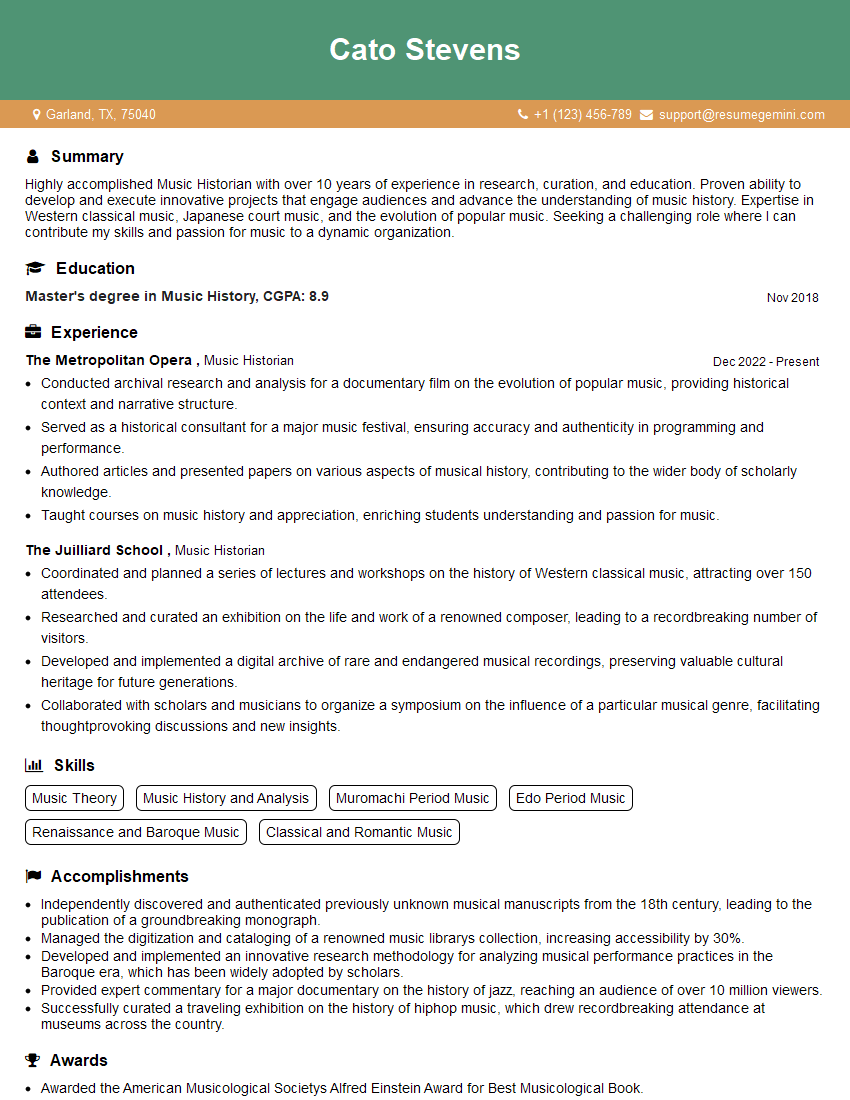
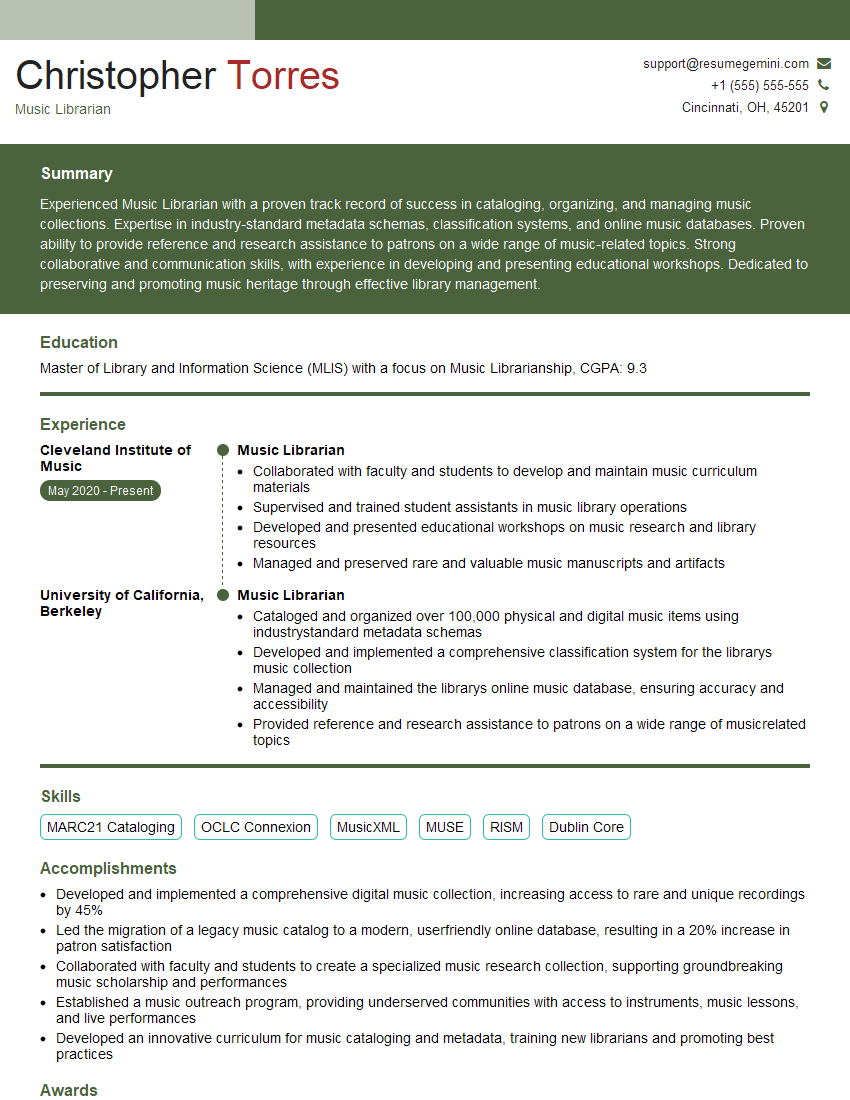
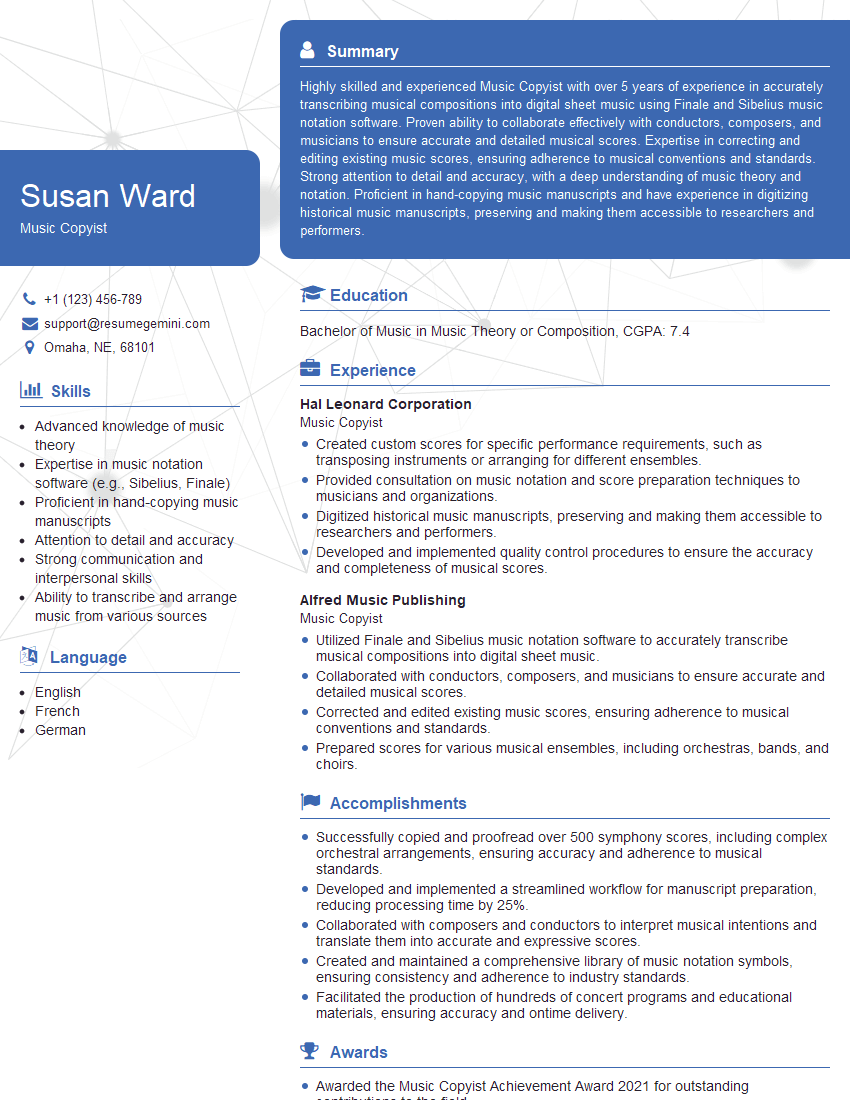
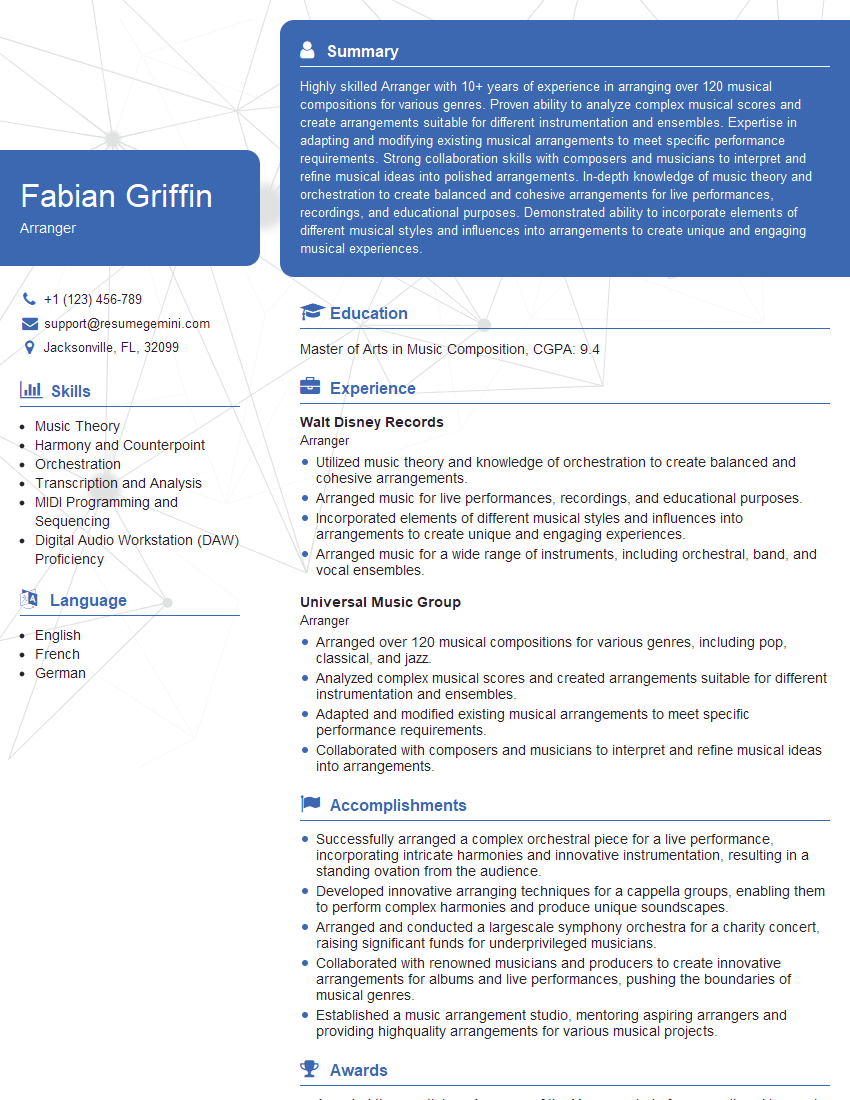
An ATS-friendly resume is crucial for getting your application noticed by employers. Using a tool like ResumeGemini can significantly improve your chances of success. ResumeGemini offers a streamlined process for creating professional resumes, and it includes examples tailored to musical theory roles. Invest in creating a strong resume—it’s your first impression.





Explore more articles
Users Rating of Our Blogs
Share Your Experience
We value your feedback! Please rate our content and share your thoughts (optional).
What Readers Say About Our Blog
Very informative content, great job.
good