Cracking a skill-specific interview, like one for Name Plate Stamping, requires understanding the nuances of the role. In this blog, we present the questions you’re most likely to encounter, along with insights into how to answer them effectively. Let’s ensure you’re ready to make a strong impression.
Questions Asked in Name Plate Stamping Interview
Q 1. Explain the different types of name plate stamping processes.
Name plate stamping employs several processes, each chosen based on factors like material, desired finish, and production volume. The most common methods include:
- Embossing: This process creates a raised image on the plate. Think of it like pushing a design from the back of a metal sheet to create a 3D effect. It’s ideal for creating a tactile, elegant look. We often use this for aluminum or brass plates.
- Debossing: The opposite of embossing; this technique creates a recessed image. It’s similar to pressing a stamp into soft clay, resulting in an indented design. This is a robust method and commonly used for durability.
- Stamping (or Coining): This high-pressure process creates a sharp, clear image with excellent detail. It works by forcing the metal to flow into the die cavity, creating a very precise impression. This is particularly effective for harder metals like stainless steel.
- Photochemical Etching: This method uses chemicals to etch a design onto a metal plate, offering superior detail and flexibility for intricate designs. It’s less about forceful stamping and more about controlled chemical removal of material.
The choice of process significantly impacts the final product’s appearance and durability. For example, embossing is great for a soft, elegant look, while stamping is better for high-detail, long-lasting plates.
Q 2. Describe your experience with various stamping dies and their applications.
My experience encompasses a wide range of stamping dies, each tailored to a specific application. I’ve worked extensively with:
- Progressive Dies: These dies perform multiple operations in a single stroke, increasing efficiency. Imagine a series of steps all completed as the material passes through. This is excellent for high-volume production.
- Compound Dies: Combining multiple operations, but unlike progressive dies, these don’t need the material to move sequentially through stages. We utilize these when multiple features are needed in a single location on the part.
- Single-Stroke Dies: Simpler dies performing only one operation per stroke, often used for lower-volume production or unique designs. It’s a more straightforward and easily adaptable setup.
- Blanking Dies: These are used for cutting out shapes from a sheet of metal; a vital preliminary step before other stamping operations. This is the process of creating the basic shape of the nameplate from a larger sheet.
The selection depends on the complexity of the nameplate design, the material being stamped, and the desired production rate. For instance, a complex design with intricate details might require a more sophisticated die like a progressive die for high-volume production to maintain cost-effectiveness. A simple design on a softer material might use a single-stroke die.
Q 3. How do you ensure the accuracy and precision of stamped name plates?
Accuracy and precision in name plate stamping are paramount. We achieve this through a multi-faceted approach:
- Precise Die Design and Manufacturing: High-precision Computer Numerical Control (CNC) machining is crucial for creating dies with tolerances down to thousandths of an inch. This guarantees the stamped image matches the design perfectly.
- Regular Die Maintenance: Regular inspection and sharpening of dies are essential to prevent wear and tear, which can compromise accuracy. We have a scheduled preventative maintenance program for all dies.
- Material Selection: Choosing a consistent and appropriate material is crucial. Inconsistencies in material thickness can lead to variations in stamping depth.
- Press Settings: Careful calibration of the stamping press is essential to ensure consistent pressure and stroke length. Inconsistent pressure can lead to poorly defined impressions. This is achieved using precise sensors and monitoring systems.
- Quality Control Checks: We conduct thorough inspections at each stage of the process, including visual checks and dimensional measurements using advanced tools like CMM machines (Coordinate Measuring Machines), to ensure consistent accuracy.
Through this integrated approach, we consistently produce high-precision nameplates that meet our client’s exacting specifications.
Q 4. What are the common causes of defects in name plate stamping, and how do you address them?
Several factors can cause defects in name plate stamping. Common issues include:
- Burrs: These are small pieces of excess material left after stamping. We mitigate this through proper die design and lubrication.
- Fractures: Cracks or breaks in the material can result from excessive pressure or flaws in the material. Careful material selection and press settings minimize this risk.
- Incomplete Impressions: Insufficient pressure or a damaged die can cause a blurry or incomplete image. Regular die maintenance and precise press settings are vital.
- Dimensional Inaccuracies: Variations in material thickness or die wear can lead to inconsistent size. Strict quality control and material verification address this.
Addressing these defects involves a systematic approach. We first identify the root cause, whether through visual inspection or data analysis. Then, we implement corrective actions, such as adjusting press parameters, replacing worn dies, or improving material handling procedures.
Q 5. Explain your experience with troubleshooting stamping machine malfunctions.
Troubleshooting stamping machine malfunctions requires a methodical approach. My experience involves:
- Systematic Inspection: I start with a thorough visual inspection of the machine, checking for loose connections, leaks, or any obvious damage. This is our first line of defence in pinpointing the issue.
- Diagnostic Tests: For more complex issues, I employ diagnostic tools to identify the source of the problem. This might include checking pressure sensors, electrical circuits, or hydraulic systems.
- Component Replacement: If a specific component is faulty, we’ll replace it with a verified working part. We maintain a robust inventory of spare parts to minimise downtime.
- Calibration and Adjustment: Once the problem is resolved, the machine is recalibrated and adjusted to ensure optimal performance.
For example, I once dealt with a machine repeatedly producing inconsistent stamping depth. Through systematic troubleshooting, I found that a pressure sensor was malfunctioning, leading to inaccurate pressure readings. Replacing the sensor resolved the issue, and it highlighted the importance of regular sensor calibration.
Q 6. How do you maintain and optimize stamping machine performance?
Maintaining and optimizing stamping machine performance involves a proactive approach:
- Preventive Maintenance: Regular lubrication, cleaning, and inspection of all machine components are critical. This helps identify and address minor issues before they escalate into major problems. We adhere to a strict preventative maintenance schedule.
- Operator Training: Proper operator training is essential to ensure the machines are used correctly and maintained to avoid damage.
- Data Monitoring: We use data monitoring systems to track machine performance, identifying potential issues before they impact production. Anomaly detection can be easily set up in such a system.
- Die Maintenance: As mentioned earlier, regular die inspection, sharpening, and replacement are crucial for consistent output quality.
- Process Optimization: Continuously evaluating and improving the stamping process, including parameters like speed and pressure, can lead to increased efficiency and reduced waste.
By focusing on preventative measures and continuous improvement, we ensure the stamping machines operate at peak efficiency, minimizing downtime and maximizing output quality.
Q 7. Describe your experience with different materials used in name plate stamping.
My experience extends across various materials used in nameplate stamping. The choice of material depends largely on the application’s requirements for durability, aesthetics, and cost-effectiveness:
- Aluminum: A lightweight and versatile option, often anodized for corrosion resistance and a range of colors. It’s a common choice for its good balance between cost and durability.
- Brass: Known for its elegant appearance and corrosion resistance, often used where a more premium look is desired. It is excellent for etching and embossing, giving it a timeless quality.
- Stainless Steel: Highly durable and resistant to corrosion, ideal for applications in harsh environments. Its robustness makes it a good option for products in heavy use.
- Zinc Alloy: A cost-effective alternative offering good durability and the possibility of plating for various finishes. A good compromise in balancing budget and quality.
- Plastics: Used for less demanding applications, offering flexibility in design and color options. Often used where weight and cost are critical factors.
Material selection is a critical decision that impacts the final product’s properties and cost. We carefully consider the application’s specific needs before choosing the optimal material.
Q 8. How do you ensure the quality and consistency of stamped name plates?
Ensuring quality and consistency in stamped name plates requires a multi-faceted approach, starting from the design stage and continuing through production and inspection. It’s like baking a cake – you need the right ingredients (materials), the correct recipe (design), and precise execution (process) to achieve the perfect result.
- Material Selection: Choosing high-quality materials, like durable metals or plastics, is crucial. The material must withstand the stamping process without cracking or warping and possess the necessary properties for the intended application (e.g., corrosion resistance).
- Die Design and Maintenance: The stamping die is the heart of the process. Precise design and regular maintenance, including sharpening and polishing, prevent defects like burrs, inconsistencies in lettering depth, or misaligned characters. A worn die is like a dull knife – it won’t create a clean cut.
- Process Control: Maintaining consistent stamping pressure, speed, and temperature ensures uniform results. Regular calibration of the stamping machine is vital. Think of it like setting the oven temperature for baking – consistent heat leads to consistent results.
- Inspection and Quality Assurance: Regular visual inspection of stamped plates, often aided by automated systems, ensures each plate meets the specifications. This includes checking for defects such as scratches, burrs, incomplete stamping, or incorrect lettering. A final quality check is like tasting the cake before serving – it catches any last-minute imperfections.
Q 9. What are your experience with quality control procedures in name plate stamping?
My experience with quality control procedures in name plate stamping involves implementing and adhering to a comprehensive system. This includes:
- First Article Inspection (FAI): A meticulous examination of the first stamped name plate from a new die or material batch to ensure it conforms to specifications. This is critical in identifying any potential problems early.
- In-Process Inspection: Regular checks during the stamping process to detect defects immediately and prevent producing a large batch of faulty plates. This could involve visual checks, dimensional measurements using calipers, and even microscopic inspection depending on the application.
- Statistical Process Control (SPC): Using statistical methods like control charts to monitor process parameters (pressure, speed, temperature) and identify trends that might signal an impending quality issue. Think of this as predictive maintenance – catching potential problems before they arise.
- Final Inspection: A final check on every single finished name plate before packaging, encompassing visual inspection, dimensional checks, and sometimes functional tests. This assures complete quality.
- Documentation and Record Keeping: Meticulous record-keeping of all inspection data, including any defects found and corrective actions taken. This information is vital for continuous improvement.
I’ve found that a well-defined quality control process not only improves product quality but also enhances efficiency by reducing waste and rework.
Q 10. How familiar are you with safety regulations and procedures in a stamping environment?
Safety is paramount in a stamping environment. My experience includes a thorough understanding of and adherence to all relevant safety regulations, including OSHA guidelines (or equivalent international standards). This includes:
- Lockout/Tagout Procedures: Strict adherence to lockout/tagout procedures before performing any maintenance or adjustments on stamping machines to prevent accidental activation.
- Personal Protective Equipment (PPE): Consistent use of appropriate PPE, including safety glasses, hearing protection, and gloves, to mitigate risks.
- Machine Guarding: Ensuring all stamping machines are equipped with appropriate guards to prevent accidental contact with moving parts. This is crucial for worker safety.
- Emergency Procedures: Familiarity with emergency procedures, including how to respond to injuries, equipment malfunctions, and fires.
- Regular Safety Training: Participation in regular safety training programs to stay updated on best practices and new regulations.
I believe in a proactive safety culture where everyone is responsible for their own safety and the safety of others. Safety isn’t just a set of rules; it’s a mindset.
Q 11. Describe your experience with setting up and operating stamping machines.
I have extensive experience setting up and operating a variety of stamping machines, from simple hand-operated presses to complex automated systems. My experience encompasses:
- Die Setup: Accurately mounting and aligning dies in the press, ensuring proper fit and function. This requires precision and attention to detail.
- Machine Parameter Adjustment: Setting up the machine’s parameters, including pressure, speed, and stroke length, based on the material, die design, and desired results. This is like fine-tuning an instrument for optimal performance.
- Troubleshooting and Maintenance: Identifying and resolving minor mechanical issues, such as lubrication problems or minor adjustments, to maintain optimal machine performance. This prevents major downtime.
- Material Handling: Safe and efficient handling of metal sheets or plastic blanks to avoid damage and ensure smooth operation of the machine.
- Production Monitoring: Monitoring the stamping process to ensure quality and efficiency. This might involve checking for defects and ensuring the production rate is within the expected range.
I’m comfortable working with both mechanical and hydraulic presses and have experience with different stamping processes, including blanking, punching, and embossing.
Q 12. What is your experience with preventative maintenance on stamping equipment?
Preventative maintenance is key to ensuring the longevity and efficiency of stamping equipment. My experience involves a proactive approach focusing on:
- Regular Lubrication: Regular lubrication of moving parts to reduce friction and wear, extending the life of the machine. This is like oiling a bicycle chain to prevent rust and ensure smooth operation.
- Inspection of Wear Parts: Regular inspection of dies, punches, and other wear parts to identify potential problems early. Replacing worn parts before they fail prevents costly downtime.
- Cleaning and Debris Removal: Regular cleaning of the machine to remove metal shavings, debris, and other contaminants that can hinder performance and cause damage. This ensures efficient and clean operation.
- Calibration of Controls: Regular calibration of pressure gauges, speed controls, and other critical parameters to ensure accurate operation. This ensures that the machine is producing parts to the correct specifications.
- Record Keeping: Maintaining detailed records of all maintenance activities, including dates, tasks performed, and any issues identified. This provides a valuable history of the machine’s performance and helps identify potential problems.
I believe that a well-structured preventative maintenance program significantly reduces downtime, extends the life of equipment, and improves overall productivity.
Q 13. How do you handle production delays or unexpected issues during stamping operations?
Handling production delays or unexpected issues requires a calm and methodical approach. My strategy involves:
- Immediate Assessment: Quickly assess the nature and extent of the problem to understand its impact on production.
- Troubleshooting: Systematically troubleshoot the issue, using my expertise and available resources to identify the root cause. This might involve checking machine settings, inspecting the die, or examining the material.
- Communication: Clear and timely communication with supervisors and other relevant personnel to keep everyone informed of the situation and the steps being taken to resolve it.
- Prioritization: Prioritize tasks to minimize downtime and get production back on track as quickly as possible. This might involve finding alternative solutions or reassigning resources.
- Corrective Action: Implement corrective actions to prevent the issue from recurring. This could involve adjusting machine parameters, replacing worn parts, or improving work processes.
- Documentation: Documenting the entire incident, including the root cause, corrective actions taken, and lessons learned. This helps prevent similar issues from happening in the future.
I believe in a proactive approach to problem-solving, focusing on finding efficient and effective solutions to minimize the impact of unexpected events.
Q 14. Describe your experience with reading and interpreting engineering drawings and specifications.
Reading and interpreting engineering drawings and specifications is fundamental to my work. I’m proficient in understanding various types of drawings, including:
- Part Drawings: Understanding dimensions, tolerances, materials, and surface finishes specified in part drawings to ensure the stamped name plate meets the design requirements. This involves paying close attention to details like lettering size, font, and placement.
- Assembly Drawings: Understanding how the stamped name plate integrates into the final assembly to ensure proper fit and function. This might involve considering the relationship between the name plate and other components.
- Die Drawings: Understanding the design of the stamping die, including the layout of punches, dies, and other components, to facilitate setup and maintenance. This ensures correct die setup for efficient production.
- Material Specifications: Understanding material specifications, including chemical composition, mechanical properties, and surface treatments, to ensure the selection of appropriate materials for the stamping process. This helps ensure durability and quality.
I’m comfortable using various tools and techniques to interpret engineering drawings and specifications, ensuring that the final product accurately reflects the design intent. My experience includes working with both 2D and 3D drawings and various CAD software.
Q 15. Explain your knowledge of different types of stamping presses.
Stamping presses come in various types, each suited for different production needs and material thicknesses. The key distinctions lie in their mechanisms and capabilities.
- Mechanical Presses: These are the most common and rely on a flywheel and crankshaft to generate the force needed for stamping. They’re robust, reliable, and versatile, ideal for high-volume production. Think of them as the workhorses of the industry. Different sizes exist, ranging from smaller presses for intricate details to massive ones for thick metal sheets.
- Hydraulic Presses: These use hydraulic cylinders to generate the stamping force. They offer more precise force control and are excellent for deep drawing or forming operations requiring even pressure distribution across the workpiece. Imagine a hydraulic press as a much more adaptable tool, capable of nuanced adjustments to the pressure applied.
- Pneumatic Presses: These presses use compressed air to power the stamping action. They’re often preferred for smaller-scale operations or specialized tasks due to their speed and ease of operation. Think of them as a handy tool for smaller jobs, or places where precise force isn’t as critical.
- Servo Presses: These advanced presses use a servo motor for precise control of the stamping force and speed. They’re energy-efficient and can significantly improve the quality and consistency of stamped parts. They’re like having a computer controlling your stamping action, allowing for highly optimized processes and reduced waste.
The choice of press depends heavily on factors like the material being stamped, the complexity of the design, the required production volume, and the budget.
Career Expert Tips:
- Ace those interviews! Prepare effectively by reviewing the Top 50 Most Common Interview Questions on ResumeGemini.
- Navigate your job search with confidence! Explore a wide range of Career Tips on ResumeGemini. Learn about common challenges and recommendations to overcome them.
- Craft the perfect resume! Master the Art of Resume Writing with ResumeGemini’s guide. Showcase your unique qualifications and achievements effectively.
- Don’t miss out on holiday savings! Build your dream resume with ResumeGemini’s ATS optimized templates.
Q 16. How do you calculate the required tonnage for a specific stamping operation?
Calculating the required tonnage for a stamping operation isn’t a simple formula; it’s an estimation based on several factors. There’s no single equation that works universally. However, a general approach involves considering:
- Material Shear Strength: This is the most critical factor. The stronger the material, the more force required to shear it. This strength varies greatly depending on the material type (steel, aluminum, etc.) and its heat treatment.
- Die Design: The geometry of the die, especially the shape and size of the cut, directly influences the required tonnage. Complex shapes or sharp corners demand higher tonnage.
- Blank Size and Thickness: Larger and thicker blanks need significantly more force to be shaped or cut.
- Lubrication: Proper lubrication reduces friction and thus the overall required tonnage.
- Safety Factor: It’s crucial to include a safety factor (typically 1.2 to 1.5) to account for variations in material properties and unexpected conditions.
Experienced engineers often use empirical data, software simulations, and past experience to determine the required tonnage. A rule of thumb is to start with a conservative estimate and gradually increase the press tonnage during trial runs until optimal performance is achieved without compromising quality or die life. Underestimating tonnage can lead to die breakage, while overestimating it can lead to unnecessary costs.
Q 17. What is your experience with die maintenance and repair?
Die maintenance and repair are crucial for maximizing die life and ensuring consistent part quality. My experience includes:
- Regular Inspections: This involves checking for wear and tear, cracks, chips, or other damage after each production run.
- Sharpening and Grinding: Regular sharpening maintains the sharpness of cutting edges, preventing burrs and improving part finish.
- Repairing Damaged Components: This can involve welding broken parts, replacing worn-out bushings, or re-machining damaged sections.
- Die Cleaning and Lubrication: Keeping the die clean and properly lubricated minimizes friction and wear, extending its lifespan.
- Preventive Maintenance: A proactive approach involves regular servicing, following manufacturer recommendations, and proactively addressing potential issues before they become critical problems.
I’ve worked on various die types and materials, including progressive dies, compound dies, and transfer dies. My experience allows me to identify problems quickly, plan effective repairs, and minimize downtime.
For example, I once identified a minor crack in a punch early during inspection, which prevented a catastrophic failure that would have shut down production for days. It demonstrated the importance of regular and vigilant die maintenance.
Q 18. How familiar are you with different types of stamping die materials?
Stamping dies are typically made from tool steels selected based on their hardness, toughness, wear resistance, and machinability. I’m familiar with a wide range of materials:
- High-Speed Steels (HSS): These offer excellent wear resistance and are suitable for high-volume production but can be brittle.
- Powder Metallurgy Tool Steels: These provide enhanced properties like uniformity and high hardness, leading to longer die life.
- Carbide Dies: Extremely hard and wear-resistant, carbides are used for stamping extremely hard materials or high-volume applications. However, they are brittle and require careful handling and maintenance.
- Ceramic Dies: Ideal for very high-temperature applications and some specific materials, though they are relatively expensive.
The selection of die material depends heavily on the application. For example, a high-volume production run of aluminum parts might use HSS, whereas a low-volume run of high-strength steel parts might opt for a carbide die. Understanding material properties and their interaction with the stamping process is crucial for successful operations.
Q 19. Describe your experience with using measuring instruments (e.g., calipers, micrometers).
Accurate measurements are critical in stamping to ensure part quality and die life. I have extensive experience using various measuring instruments, including:
- Vernier Calipers: For measuring linear dimensions with high accuracy (typically to 0.01 mm or 0.0005 inches).
- Micrometers: These provide even higher accuracy, often measuring to 0.001 mm or 0.00005 inches.
- Height Gauges: For precise measurements of height and depth.
- Dial Indicators: To check for parallelism, flatness, and other geometric properties of dies and parts.
- Coordinate Measuring Machines (CMMs): For complex part measurements, these offer high precision and automate the measurement process.
Understanding the limitations and proper usage of each instrument is vital. For instance, using a micrometer on a rough surface will lead to inaccurate readings. Proper techniques, including clean surfaces and appropriate measuring force, ensure accurate and reliable measurements. This proficiency in measurement ensures consistently high-quality stamped products.
Q 20. How do you ensure the proper alignment of dies in a stamping press?
Precise die alignment is essential for consistent part quality and preventing die damage. The process involves:
- Using Alignment Pins and Bushings: These precisely machined components ensure accurate alignment between the punch and die.
- Checking for Parallelism: Dial indicators or other precision measuring tools are used to verify that the punch and die are parallel.
- Adjusting the Die Set: The die set screws and shims allow for fine adjustments to achieve perfect alignment.
- Using Alignment Fixtures: Complex dies might need specialized fixtures for accurate alignment during setup.
- Test Runs: Small test runs are conducted to check the alignment and make minor adjustments before full production.
Misalignment can lead to poorly formed parts, increased wear on the die, and even damage to the press. A systematic approach and the right tools are essential for ensuring perfect alignment.
In one instance, I had to work with a very complex die and used an optical alignment system to achieve the required precision and significantly shortened the setup time.
Q 21. Explain your experience with different types of lubricants used in stamping.
Lubrication is crucial in stamping to reduce friction, improve part quality, and extend die life. The choice of lubricant depends on several factors, including the material being stamped, the stamping process, and the die material.
- Water-Based Lubricants: These are environmentally friendly and commonly used for many stamping operations. They’re easy to clean up and less likely to cause fire hazards.
- Oil-Based Lubricants: Often provide better lubrication than water-based solutions, particularly for high-speed or high-pressure applications. However, they require more stringent environmental controls.
- Emulsions: These are mixtures of oil and water offering a balance between lubrication and environmental friendliness.
- Dry Lubricants: Such as graphite or molybdenum disulfide, are used in specialized applications where liquid lubricants aren’t desirable.
The application method is also important. Some lubricants are applied directly to the workpiece, while others are applied to the die itself. Choosing the right lubricant and application method significantly impacts the quality and efficiency of the stamping process. For instance, an improperly chosen lubricant can lead to increased friction and reduced die life.
Q 22. How do you address issues related to material deformation or tearing during stamping?
Material deformation and tearing during name plate stamping are significant concerns, often stemming from improper process parameters or material selection. Addressing these issues requires a multi-pronged approach focusing on both preventative measures and corrective actions.
- Material Selection: Choosing a material with appropriate ductility and tensile strength is crucial. For example, using a softer, more malleable metal like brass instead of a brittle material like cast iron will significantly reduce tearing. The thickness of the material also plays a vital role; thinner materials are more prone to tearing.
- Die Design: The die’s geometry significantly impacts deformation. Sharp corners or insufficient radii can lead to stress concentrations and tearing. Properly designed dies with smooth transitions and generous radii minimize these issues. We often use Finite Element Analysis (FEA) to simulate the stamping process and optimize die design before physical production.
- Press Parameters: Incorrect stamping pressure, speed, or hold time can cause excessive deformation or tearing. Careful calibration of these parameters is vital. For instance, a slower stamping speed can allow the material to flow more smoothly into the die cavity, reducing stress.
- Lubrication: Adequate lubrication reduces friction between the material and the die, minimizing both wear and tear on the die and the risk of tearing or deformation in the name plate. We use specialized lubricants designed to withstand high pressures and temperatures.
- Blank Holding Force: Insufficient blank holding force can cause wrinkles or tearing, especially in complex shapes. Optimizing this force prevents material movement during the stamping process.
In one instance, we experienced excessive tearing on a particular nameplate design. Through FEA analysis, we identified a sharp corner in the die as the culprit. By modifying the die to include a larger radius at that point, we eliminated the tearing problem entirely.
Q 23. What is your understanding of the relationship between stamping parameters and final product quality?
The relationship between stamping parameters and final product quality is paramount. Each parameter significantly impacts the final product’s dimensional accuracy, surface finish, and overall integrity. Think of it like baking a cake; precise measurements and timing are crucial for a successful outcome. In stamping, these parameters include:
- Punch and Die dimensions: Directly impact the nameplate’s size and shape. Inaccuracies lead to scrap.
- Press force and speed: Affect the material’s flow and final shape, and can cause excessive deformation or cracking if not properly controlled.
- Blankholder force: Controls the material’s behaviour during forming; improper force causes wrinkles or tearing.
- Lubrication: Ensures smooth material flow and protects the die from wear, directly influencing surface finish.
For instance, a high press force with a fast speed might produce a part with acceptable dimensions but may also induce cracks or excessive deformation. Conversely, a low press force and slow speed might prevent cracking but could result in poorly formed parts that do not meet the required specifications. We carefully design our process parameters using Design of Experiments (DOE) to find the optimal settings for consistent quality.
Q 24. How do you ensure the consistent flow of material through the stamping process?
Consistent material flow is crucial for efficient and high-quality stamping. Several techniques ensure this:
- Automated Material Handling: Using automated feed systems, such as coil feeders or robotic arms, eliminates variability associated with manual feeding. This ensures a constant supply of material to the stamping press.
- Material Straightening: Coil materials can have some degree of curvature. Straightening the material before feeding it into the press is critical for consistent feeding and prevents wrinkles or misalignment during stamping.
- Proper Die Design: The die’s design must facilitate smooth material flow. This includes considerations such as proper material guides and clearance between the punch and die.
- Regular Maintenance: Keeping the feeding mechanism clean and properly lubricated ensures smooth operation and prevents jams or interruptions in material flow.
- Material monitoring: Ensuring that coils are the correct thickness and free of defects.
In a previous role, we implemented a new coil-feeding system that significantly reduced downtime and improved the consistency of material flow. This resulted in a notable increase in productivity and reduced scrap rates.
Q 25. Describe your experience with implementing process improvements in name plate stamping.
Implementing process improvements is a continuous effort in any manufacturing environment. In name plate stamping, I’ve focused on several key areas:
- Die Optimization: We utilized FEA to redesign several dies, resulting in reduced deformation and improved part consistency. This approach reduced scrap significantly.
- Automation: Implementing robotic material handling reduced manual handling errors and increased overall efficiency.
- Statistical Process Control (SPC): Implementing SPC charts helped us identify and address variations in the process, leading to improved process stability and reduced defects. For instance, we tracked the thickness of the stamped plates using control charts to promptly identify any deviations from specification.
- Lean Manufacturing principles: Implementing 5S (Sort, Set in Order, Shine, Standardize, Sustain) dramatically improved workplace organization, reducing waste and improving workflow.
One example involved a recurring issue with burrs on the edges of the stamped name plates. By analyzing the process and making minor adjustments to the die’s design, we were able to almost completely eliminate this defect.
Q 26. How familiar are you with statistical process control (SPC) techniques?
I’m highly familiar with Statistical Process Control (SPC) techniques. SPC uses statistical methods to monitor and control manufacturing processes, ensuring consistency and identifying potential problems early on. I have extensive experience utilizing control charts (X-bar and R charts, p-charts, c-charts, etc.) to monitor key process parameters, such as thickness, dimensions, and defect rates. This allows us to identify trends, detect outliers, and make necessary adjustments before defects accumulate.
For example, we implemented control charts to monitor the thickness of stamped name plates. This allowed us to identify a gradual increase in variation, prompting a review of the press’s maintenance schedule and ultimately preventing significant material waste.
Q 27. What is your experience with lean manufacturing principles in a stamping environment?
Lean manufacturing principles are deeply ingrained in my approach to stamping operations. I have successfully implemented various lean techniques, including:
- 5S: A cornerstone of lean manufacturing, resulting in a much cleaner and more organized workplace, which reduced waste, improved safety, and increased efficiency.
- Value Stream Mapping: Analyzing the entire process to identify and eliminate waste (muda), such as unnecessary steps or excessive inventory.
- Kaizen (Continuous Improvement): A culture of continuous improvement through regular reviews and problem-solving sessions, focused on reducing waste and improving efficiency.
- Kanban: Utilizing visual cues to signal material needs and optimize production flow, leading to reduced inventory and improved response time.
In one project, we used value stream mapping to identify bottlenecks in the production line. This led to redesigning the workflow and implementing Kanban, which resulted in a 15% increase in output with the same number of employees.
Q 28. Describe your experience with working in a team environment in a stamping facility.
Teamwork is essential in a stamping facility. I’ve consistently worked effectively in collaborative environments, contributing to projects and fostering positive team dynamics. My experience includes:
- Cross-functional collaboration: I’ve worked closely with engineers, technicians, and operators to solve problems and improve processes. For example, we recently worked together to implement a new preventative maintenance program for the stamping presses, significantly reducing downtime.
- Mentoring and training: I’ve mentored junior team members, providing guidance and training on various stamping techniques and processes. This ensures knowledge transfer and improved team skills.
- Conflict resolution: I’ve been able to effectively mediate disagreements and find common ground between team members with conflicting perspectives.
- Communication: I effectively communicate technical information to both technical and non-technical audiences. This is crucial for ensuring everyone is on the same page.
I believe that a strong team dynamic is critical for achieving success in a demanding manufacturing environment like name plate stamping, and I actively strive to foster this environment.
Key Topics to Learn for Name Plate Stamping Interview
- Material Selection: Understanding the properties of various metals (brass, aluminum, stainless steel, etc.) and plastics used in name plate stamping, and their suitability for different applications and desired finishes.
- Stamping Processes: Deep knowledge of different stamping techniques (e.g., embossing, debossed, engraving) and their impact on the final product’s quality and cost-effectiveness. Understanding limitations and capabilities of each method.
- Die Design and Manufacturing: Familiarity with the design principles and manufacturing processes involved in creating stamping dies. This includes understanding tolerances, material selection for dies, and die maintenance.
- Quality Control and Inspection: Understanding quality control measures throughout the process, from raw material inspection to final product verification. Knowledge of common defects and methods for their detection and prevention.
- Production Planning and Efficiency: Knowledge of optimizing production workflows, minimizing waste, and managing production schedules to meet deadlines and production targets. Understanding lean manufacturing principles as applied to nameplate stamping.
- Safety Procedures and Regulations: Familiarity with relevant safety protocols and regulations related to operating stamping machinery and handling materials. Understanding risk assessment and mitigation.
- Finishing Techniques: Understanding various finishing techniques like plating, painting, powder coating, and their impact on the final product’s aesthetics and durability. Knowing which finishes are suitable for which materials.
- Cost Estimation and Budgeting: Ability to estimate production costs based on factors like material usage, labor, and machine time. Understanding cost-saving strategies without compromising quality.
Next Steps
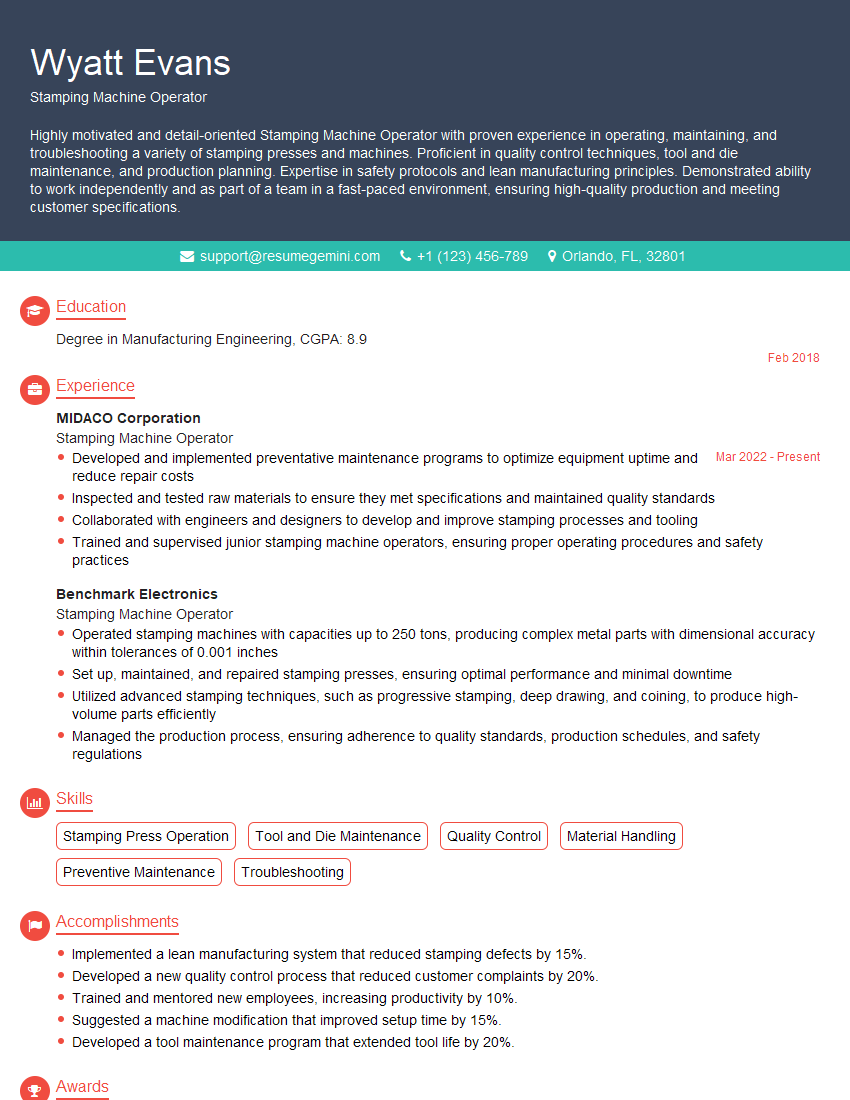
Mastering the intricacies of name plate stamping opens doors to exciting career opportunities in manufacturing, engineering, and design. To significantly improve your job prospects, focus on creating a compelling and ATS-friendly resume that highlights your skills and experience. ResumeGemini is a trusted resource that can help you build a professional resume that stands out. They provide examples of resumes tailored specifically to the Name Plate Stamping industry, giving you a head start in crafting your own. Invest time in perfecting your resume – it’s your first impression on potential employers.

Explore more articles
Users Rating of Our Blogs
Share Your Experience
We value your feedback! Please rate our content and share your thoughts (optional).
What Readers Say About Our Blog
Very informative content, great job.
good