Unlock your full potential by mastering the most common Navigational Charts and Publications interview questions. This blog offers a deep dive into the critical topics, ensuring you’re not only prepared to answer but to excel. With these insights, you’ll approach your interview with clarity and confidence.
Questions Asked in Navigational Charts and Publications Interview
Q 1. Explain the difference between paper charts and Electronic Navigational Charts (ENCs).
Paper charts and Electronic Navigational Charts (ENCs) both serve the purpose of depicting navigable waters, but differ significantly in their format, update mechanisms, and capabilities. Paper charts are traditional, printed nautical charts that provide a visual representation of water depths, hazards, and navigational aids. ENCs, on the other hand, are digital charts stored electronically on a computer system, typically integrated within an Electronic Chart Display and Information System (ECDIS).
- Paper Charts: Require manual plotting, updates via Notices to Mariners, and are prone to damage and wear. They offer a readily available visual reference, even without power, but are static between updates.
- ENCs: Offer dynamic features like automatic position plotting, route planning, and integration with other navigational sensors. Updates are electronic, making them inherently more current. However, they require power and specialized equipment, and may be more challenging to interpret in an emergency without power.
Imagine this: You’re sailing a small yacht. A paper chart allows you to easily see your position and plan a course, even in a power outage. An ECDIS gives you all of that plus additional information and safety features, but requires a functioning computer and power source. Both tools are valuable, and the best choice depends on the voyage and available resources.
Q 2. Describe the various types of navigational publications.
Navigational publications are essential supplements to charts, providing crucial information for safe navigation. These publications provide details not easily shown on the chart itself due to space constraints or dynamic nature of the information. They fall into several categories:
- Sailing Directions (Pilots): These provide detailed descriptions of coastlines, harbors, anchorages, and navigational hazards. They are regionally organized (e.g., ‘Sailing Directions, North American West Coast’).
- Coast Pilots: Similar to Sailing Directions, these publications provide comprehensive details of a specific coastal region, covering aspects like depths, currents, tides, and local regulations.
- Notices to Mariners (NTMs): These are essential weekly publications detailing chart corrections, newly established hazards, and changes in navigational aids. They are crucial for keeping charts current and are usually available online and through the relevant national hydrographic office.
- Tide and Current Tables: These tables provide predictions of high and low water times, as well as current speeds and directions, essential for planning safe passage times and avoiding dangerous currents.
- Light Lists: These list all navigational lights, along with their characteristics (color, pattern, range), locations, and operational status.
- Radio Aids to Navigation (RAcon) Lists: These publications detail the locations, frequencies, and characteristics of radio beacons and other electronic aids to navigation.
Think of navigational publications as the instruction manual for using the chart: they provide the necessary context, warnings, and detailed information to make safe and informed navigation decisions.
Q 3. How do you correct a navigational chart?
Correcting a navigational chart, whether paper or electronic, is crucial for safe navigation. It ensures that your chart reflects the latest information and prevents potential hazards.
- Paper Charts: Corrections are applied using Notices to Mariners (NTMs). Each NTM provides specific instructions on how to make the correction, including location on the chart and the correction itself. This may involve removing obsolete information, adding new information (e.g., a newly discovered wreck), or modifying existing data.
- ENCs: ECDIS automatically applies corrections through electronic updates, either manually downloaded or automatically via satellite connection. The ECDIS software manages the chart updates, ensuring the chart data remains current. You also need to check for any updates through the Notice to Mariners to supplement the electronic updates.
The process always involves careful attention to detail, using the provided instructions precisely and verifying the accuracy of the corrections. Incorrectly applied corrections can have serious consequences, potentially leading to grounding or collisions. A well-maintained chart is a cornerstone of safe navigation.
Q 4. What are the limitations of using Electronic Navigational Charts (ENCs)?
While ENCs offer significant advantages, they also have limitations:
- System Failure: Reliance on electronic systems means that a power failure, software malfunction, or equipment failure can render the ECDIS useless, leaving the navigator without a chart.
- Data Errors: Like any digital system, ENCs can contain errors in the data. Regular updates and verification are crucial to minimize this risk. Incorrect or missing data can lead to misjudgment and hazards.
- Cybersecurity Threats: ENCs are vulnerable to cybersecurity threats, potentially leading to data corruption or manipulation. Robust security measures are necessary to mitigate this risk.
- Complexity: ECDIS systems can be complex to use, requiring significant training and understanding to operate effectively. Misunderstanding of the system can lead to incorrect interpretation of information.
- Human Error: Incorrect setting of parameters or failure to properly monitor the system can lead to navigation errors, despite the advantages of electronic charting.
Therefore, even with ENCs, skilled seamanship, backup paper charts, and understanding of the limitations are crucial for safe navigation. Always have a backup plan, understanding that technology is a tool, and human decision making remains paramount.
Q 5. Explain the importance of chart datum.
Chart datum is the reference level to which all depths and elevations on a nautical chart are referenced. It’s typically the lowest astronomical tide (LAT), which is the lowest tide predicted to occur at a given location under average meteorological conditions.
Understanding chart datum is critical because it defines the vertical reference for safe navigation. Depths shown on the chart are relative to this datum. If the water level is higher than the chart datum (due to high tide or storm surge), the actual water depth will be shallower than what is shown on the chart. Conversely, if the water level is lower, the actual water depth will be deeper. Failing to account for chart datum can lead to grounding, especially in shallow waters. For example, a chart shows a depth of 10 meters, but the actual water depth is only 7 meters because the tide is unusually low. This difference could easily lead to a grounding incident.
Different charts may use different datums, so it’s crucial to note which datum is used for a given chart to ensure accuracy in navigation.
Q 6. What are the different types of chart projections?
Chart projections are mathematical methods used to represent the three-dimensional surface of the Earth on a two-dimensional chart. The choice of projection depends on the area being charted and the intended use of the chart. Several common projections are:
- Mercator Projection: This is commonly used for nautical charts because it represents rhumb lines (lines of constant bearing) as straight lines. This is extremely useful for plotting and following courses, especially for long-distance navigation. However, it significantly distorts areas at higher latitudes.
- Gnomonic Projection: This projection accurately portrays great circles (the shortest distance between two points on a sphere) as straight lines. This is valuable for planning long-distance voyages, but it suffers from extreme distortion at the edges of the chart.
- Lambert Conformal Conic Projection: This projection is used for charts covering larger areas at mid-latitudes. It minimizes distortion and is useful for land-based navigation and charting.
- Polyconic Projection: This projection is useful for charting areas extending along a meridian. It minimizes distortion along the central meridian but increases it further from the central meridian.
The choice of projection is crucial because it impacts the accuracy of distance and direction measurements on the chart. Navigators need to understand the characteristics of the projection being used on their chart to properly interpret the information.
Q 7. How do you determine your position using a sextant?
Determining your position using a sextant involves measuring the altitude (angle) of a celestial body (sun, moon, star) above the horizon. This measurement, combined with the celestial body’s calculated position (obtained from a nautical almanac or similar source), allows you to establish a line of position (LOP).
Here’s a simplified overview of the process:
- Identify the celestial body: Identify the celestial body you’ll use based on its visibility and your ability to identify it accurately.
- Measure the altitude: Use the sextant to carefully measure the altitude of the celestial body above the horizon. This requires careful technique to minimize errors.
- Note the time: Record the exact time of the altitude measurement using a precise timepiece synchronized to Greenwich Mean Time (GMT).
- Compute the celestial body’s position: Use a nautical almanac or astronomical software to determine the celestial body’s declination (angular distance north or south of the celestial equator) and Greenwich Hour Angle (GHA).
- Draw the LOP: Using navigational tables or software, plot your LOP on the chart based on the measured altitude, time, and celestial body’s calculated position. This LOP is a line on the chart representing all possible positions where the celestial body would have that altitude at that time.
- Obtain at least two LOPs: To determine your position, you need at least two LOPs from different celestial bodies. The intersection of these LOPs gives your fix (your estimated position).
The process requires knowledge of celestial navigation, precise instruments, and the ability to interpret navigational tables or software. While less common now due to GPS, sextant navigation remains a crucial backup skill, particularly in situations where GPS is unavailable.
Q 8. How do you interpret a tide table?
Tide tables predict the height and time of high and low tides at specific locations. Understanding them is crucial for safe navigation, especially in shallow waters or areas with significant tidal ranges. They are typically presented in a tabular format, showing the predicted times and heights for each high and low tide throughout a specific period, usually a month.
Interpreting a Tide Table: Let’s say you’re looking at a table for a particular port. You’ll find columns for the date, time of high water (HW), height of high water, time of low water (LW), and height of low water. To plan a passage, you’d identify the times and heights relevant to your schedule and determine the water depth available at your planned transit time. You would also account for the depth of your vessel’s draft and any additional considerations like the depth of the channel or the presence of underwater obstructions. For example, if a chart shows a channel depth of 10 meters and the tide table shows a low water height of 2 meters, then a vessel with a draft of 6 meters could only transit this channel safely around high tide.
Example: A tide table shows a high tide of 4 meters at 2:00 PM and a low tide of 1 meter at 8:00 PM. If your boat has a 2-meter draft and you need at least 1 meter of clearance, you must transit the area sometime between approximately 1:00 PM and 3:00 PM.
Q 9. Explain the concept of a tidal current.
Tidal currents are the horizontal movement of water caused by the rise and fall of tides. Think of them as rivers of water moving in predictable patterns. They are not constant; their speed and direction change throughout the tidal cycle. Understanding tidal currents is paramount for safe navigation, especially in narrow channels or areas with strong currents, as they can significantly affect a vessel’s speed and course.
Types of Tidal Currents: There are two main types: flood currents (water moving towards the shore) and ebb currents (water moving away from the shore). There are also slack water periods when the current is at its minimum speed, occurring between the flood and ebb currents. The strength of the current can vary greatly depending on location, tidal range, and the shape of the coastline. Some areas might experience very strong tidal races, making navigation hazardous.
Practical Application: Navigating a narrow channel with a strong ebb current requires careful planning. You need to account for the current’s speed and direction, adjusting your course and speed to compensate. Failure to account for currents can lead to delays, grounding, or even collisions.
Q 10. Describe the different types of navigational aids.
Navigational aids are markers, signs, and signals that help vessels safely navigate. They range from simple buoys to complex electronic systems. They’re essential for safe passage, especially in challenging waters.
- Buoys: Floating markers, identified by shape, color, and light characteristics, indicating channels, hazards, or other information.
- Beacons: Fixed structures, often light beacons, providing navigational information, similar to buoys but are land-based or fixed to the seabed.
- Lighthouses: Tall structures with powerful lights, often located on shore or on islands, providing range and bearing information, especially important in coastal navigation.
- Lightvessels: Floating lighthouses, anchored in strategic positions to mark hazards or provide direction. Less common now due to advanced technology.
- Radio Aids to Navigation (AtoN): Electronic systems, such as GPS, differential GPS (DGPS), and others, broadcasting navigational signals for precise positioning.
- Radar Reflectors: Placed on structures or vessels to enhance radar detection.
Each aid has a specific purpose and meaning. Their proper identification is crucial for avoiding hazards and ensuring a safe voyage.
Q 11. How do you use a compass to determine your heading?
To determine your heading using a magnetic compass, you first need to ensure the compass is properly compensated for deviation and that it’s level. Then, point the lubber’s line (the line on the compass housing indicating the direction of the vessel’s bow) in the direction you wish to travel. The compass card will indicate your desired heading in degrees magnetic. This process must account for both magnetic variation and deviation, otherwise, you may be significantly off course.
Example: If you want to travel north and the compass shows a heading of 000° (magnetic), and you have a deviation of 2° east and a variation of 10° west, then your true heading is 358° (000° – 2° + 10°).
Important Note: It is crucial to understand the concepts of magnetic variation and deviation (explained in the next question) to accurately determine your true heading.
Q 12. Explain the concept of magnetic variation and deviation.
Magnetic Variation: This is the angle between true north (geographic north) and magnetic north (the direction a compass needle points due to the Earth’s magnetic field). Magnetic north is not fixed and varies over time and location. This variation is shown on nautical charts and is essential for converting magnetic headings to true headings and vice-versa.
Deviation: This is the error in a compass reading caused by magnetic interference from the ship itself – its metallic structure, equipment, and electrical systems. This can be significant and varies depending on the vessel’s heading. Deviation is corrected by compensating the compass or by using a deviation table.
Importance: Both variation and deviation must be accounted for to obtain your true heading. Ignoring them can lead to significant navigation errors, particularly over long distances. Charts provide information about local variation, while deviation is usually determined by a compass adjustment procedure.
Q 13. How do you identify and interpret symbols on a nautical chart?
Nautical charts are packed with symbols representing various features, hazards, and navigational information. The International Regulations for Preventing Collisions at Sea (COLREGs) defines many of the symbols. Charts include a legend explaining the symbols used. Familiarity with these symbols is vital for safe navigation. It allows for a quick assessment of hazards like shoals, rocks, wrecks, and other obstructions. It also indicates navigable channels, aids to navigation, and other relevant information.
Example: A small circle with a cross inside typically represents a submerged wreck. A red triangle often denotes a danger area, while a dotted line might represent a depth contour. A symbol depicting a light structure indicates the presence of a navigational beacon. Detailed explanations of the various symbols can be found in chart legend found on the charts themselves.
Practical Application: When planning a voyage, a thorough interpretation of chart symbols is fundamental to identifying safe water depths, understanding any potential dangers, and establishing a suitable route. Misinterpretation can have severe consequences.
Q 14. What is the importance of using the latest chart updates?
Using the latest chart updates is crucial for safe navigation because charts are constantly being revised to reflect changes in waterways, depths, navigational aids, and other crucial information. Changes can include newly discovered hazards, altered channel depths due to dredging or natural processes, the addition or removal of navigational aids, and many other changes that significantly affect safe passage.
Consequences of Using Outdated Charts: Navigating with outdated charts might lead to grounding, collisions, and other potentially dangerous situations. A small change in depth might be the difference between safe passage and a grounding incident.
Staying Updated: Mariners are responsible for ensuring their charts are current and up to date. Corrections and updates are made available through Notice to Mariners (NOTAMs), which provide details on changes to charts and other important nautical information. Regular checking of NOTAMs is a professional responsibility that cannot be overlooked.
Q 15. Describe the process of chart correction using Notices to Mariners.
Chart correction using Notices to Mariners (NMs) is a crucial process for maintaining the accuracy and safety of navigational charts. Notices to Mariners are official publications issued by national hydrographic offices, detailing changes to navigational features, such as new or altered buoys, changes to depths, or the appearance of obstructions. The process involves systematically applying these corrections to your charts to ensure they reflect the current situation.
- Obtain the latest Notices to Mariners: Subscribe to your relevant NM service, usually online, to receive regular updates.
- Review the Notices: Carefully read each NM, paying close attention to the chart number(s) affected, the geographic location, and the nature of the correction.
- Locate the affected area on your chart: Use the chart’s latitude and longitude coordinates to find the precise location mentioned in the NM.
- Apply the correction: This might involve adding new information, deleting outdated information, or modifying existing features on the chart. It’s essential to use the appropriate symbols and notations as specified in the NM. Many offices provide online tools to help with this.
- Verify the correction: Once the correction is applied, review your work to ensure accuracy and consistency. Incorrect corrections can be extremely dangerous.
- Record the correction: Note the NM number and date on the chart margin next to the corrected area. This allows for a proper audit trail.
Imagine a scenario where a new wreck is discovered. The NM would describe its location and characteristics. You would then mark its position on your chart, possibly adding a symbol to denote its danger to navigation. Failing to do so could lead to a collision.
Career Expert Tips:
- Ace those interviews! Prepare effectively by reviewing the Top 50 Most Common Interview Questions on ResumeGemini.
- Navigate your job search with confidence! Explore a wide range of Career Tips on ResumeGemini. Learn about common challenges and recommendations to overcome them.
- Craft the perfect resume! Master the Art of Resume Writing with ResumeGemini’s guide. Showcase your unique qualifications and achievements effectively.
- Don’t miss out on holiday savings! Build your dream resume with ResumeGemini’s ATS optimized templates.
Q 16. How do you determine the set and drift of a current?
Determining the set and drift of a current involves observing its effect on a vessel’s movement over time. ‘Set’ refers to the direction the current is flowing, and ‘drift’ refers to its speed.
There are several methods:
- Using a current meter: The most accurate method, though impractical for most vessels, this directly measures current speed and direction.
- Comparing GPS positions: With the vessel’s engine stopped or running at minimum speed, note your position using GPS at two points in time. The change in position and the time elapsed allows you to calculate both set and drift. This is often done using a navigational plotter or software.
- Visual observations: By observing floating objects like driftwood or other vessels that are relatively stationary (using their reported speed and course), you can estimate the current’s effect on the objects’ movement. This is the least precise method but can provide a rough estimate.
- Using a log: A traditional method, recording the speed and heading of the vessel, then measuring position changes with a sextant, can yield set and drift after applying corrections for speed and heading changes due to course and speed adjustments.
For example, if your vessel drifts 1 nautical mile East in 1 hour with the engine off, the set is East and the drift is 1 knot (1 nautical mile per hour).
Q 17. What are the key elements of a safe navigation plan?
A safe navigation plan is paramount for any voyage. It should incorporate several key elements:
- Destination and route planning: Define the desired destination and plot a safe and efficient route, considering factors like water depths, traffic separation schemes, and potential hazards.
- Weather forecasting: Obtain up-to-date weather forecasts and consider the possible impact of weather conditions on your journey. This may involve adjusting the route or delaying departure.
- Contingency planning: Develop a plan for various potential emergencies, including engine failure, navigational errors, or bad weather. This might involve identifying alternate courses or shelter locations.
- Navigation equipment check: Before departure, ensure all navigational equipment (GPS, radar, charts, etc.) is functional and properly calibrated. This involves routine maintenance and backups, especially in critical equipment.
- Dead reckoning (DR): While relying on electronic navigation, maintaining a DR plot (which is manual navigation) as a backup is a good practice.
- Communication plan: Establish communication protocols with shore stations, other vessels, or other crew members to maintain situational awareness and report any emergencies.
- Legal requirements: Understand and comply with all relevant international and national regulations, including those concerning vessel traffic services (VTS) or restricted areas.
A well-structured plan helps anticipate problems, allowing for appropriate responses and reducing the likelihood of accidents.
Q 18. Explain the importance of understanding different types of weather patterns.
Understanding different weather patterns is essential for safe navigation because weather significantly impacts visibility, sea state, and wind conditions, all of which directly affect vessel handling and safety.
- Tropical Cyclones (Hurricanes/Typhoons): These intense storms feature high winds, heavy rainfall, and storm surges, posing severe threats to vessels. Understanding their formation, track, and intensity is crucial for avoiding them.
- Cold Fronts: Associated with rapid changes in wind direction and speed, temperature, and pressure, cold fronts can lead to strong gusts and poor visibility.
- Fog: Significantly reduces visibility, necessitating the use of navigational aids like radar and foghorns. Understanding fog formation and dissipation patterns is crucial for safe navigation in foggy conditions.
- Sea State: The roughness of the sea is highly influenced by wind and weather systems. Understanding wave heights and periods allows for safe vessel operation, by avoiding conditions that might overload or cause damage to the hull.
For instance, a mariner caught in a sudden squall might need to reduce speed, change course, or seek shelter. Understanding weather patterns allows the mariner to anticipate this and take preventive measures.
Q 19. What is the difference between a bearing and a range?
Both bearings and ranges are used in navigation to determine a vessel’s position, but they differ in how they are measured and represented:
- Bearing: A bearing is the horizontal angle between the vessel’s heading (or any other reference direction) and the line of sight to a landmark or navigational aid. It’s typically measured in degrees, with 0° being North and increasing clockwise. For example, a bearing of 090° means the object is East of the vessel.
- Range: A range is a line of position (LOP) determined by two or more objects whose bearings are aligned to give a straight line. In simple terms, it’s the distance between two points. A vessel on the range will have the same bearings to both objects. They often are used in harbors or channels.
Imagine you have two beacons. A range is the line between these two beacons. Any ship on that line will see both beacons lined up. A bearing to one beacon might be 30 degrees.
Q 20. How do you calculate the speed of a vessel?
A vessel’s speed can be calculated in several ways:
- Using a speed log: Traditional speed logs measure the vessel’s speed through the water. Modern electronic logs use Doppler radar or similar technology for accurate measurements.
- GPS: Comparing two consecutive GPS positions over a measured time interval gives the vessel’s speed over ground (SOG). This takes into account the effects of currents and winds.
- By using a measured distance and time: If you know the distance traveled (e.g., using range measurements to a landmark) and the time taken to cover that distance, you can calculate the speed using the formula: Speed = Distance / Time.
For example, if a vessel travels 10 nautical miles in 2 hours, its speed is 5 knots (1 knot = 1 nautical mile per hour).
It’s crucial to understand the difference between speed through the water and speed over ground. Speed through the water is how fast the vessel is moving in the water, and speed over ground is how fast it’s moving relative to the Earth’s surface. Currents and winds can alter the latter significantly.
Q 21. Explain the concept of GPS and its limitations in navigation.
The Global Positioning System (GPS) is a satellite-based radio-navigation system that provides precise positioning data anywhere on Earth. It works by receiving signals from multiple satellites to determine latitude, longitude, and altitude.
How it works: GPS receivers calculate the distance to several satellites by measuring the time it takes for their signals to arrive. Using trilateration (finding a point based on its distance from three points), it determines the receiver’s location.
Limitations: While incredibly useful, GPS has limitations:
- Signal blockage: Tall buildings, dense foliage, or atmospheric conditions can block or weaken GPS signals, leading to inaccurate or unavailable positions.
- Multipath error: Signals can bounce off objects before reaching the receiver, causing errors in position calculations.
- Atmospheric delays: The ionosphere and troposphere can delay the signals, causing slight inaccuracies in position.
- Selective Availability (SA): Although no longer active, SA was a deliberate degradation of GPS accuracy for civilian users.
- Receiver limitations: The quality and accuracy of a GPS position are also affected by the quality and type of receiver used.
It’s crucial for mariners to understand these limitations and use complementary navigation systems (such as charts, compass, and radar) to ensure a safe voyage. Over-reliance on GPS alone can be dangerous.
Q 22. How do you deal with discrepancies between different navigation systems?
Discrepancies between navigation systems are unfortunately common, arising from variations in data sources, update cycles, and sensor inaccuracies. My approach involves a systematic process of verification and prioritization. I first identify the nature of the discrepancy – is it a minor difference in position, a conflicting course recommendation, or a more significant navigational hazard? Then, I consult multiple sources: the official paper charts (which are the ultimate authority), electronic chart display and information systems (ECDIS), GPS data, and other independent navigational aids like radar or AIS. I cross-reference this information, looking for patterns and identifying which system likely contains the most accurate or reliable data. For instance, if my ECDIS and GPS show slight positional differences, I might favour the ECDIS data, assuming it’s been properly updated. However, if the discrepancy involves a major navigational hazard, I will use extreme caution and prioritize the most conservative course of action, perhaps even slowing down or altering course until the discrepancy can be resolved. Ultimately, sound judgment and a thorough understanding of the limitations of each system are key to effectively resolving these discrepancies.
Q 23. Describe different methods of dead reckoning.
Dead reckoning (DR) is a method of estimating a vessel’s position by using its last known position and accounting for course and speed over time. While less precise than GPS, it’s a critical fallback. There are several methods:
Simple Dead Reckoning: This involves taking the known position, course, and speed, then calculating the new estimated position using basic trigonometry. Imagine sailing due north at 10 knots for two hours. A simple calculation places the vessel 20 nautical miles north of the starting point. This method is highly susceptible to errors in speed and course.
Vector Dead Reckoning: This refines the process by incorporating course and speed changes throughout the voyage. Each leg of the journey is considered as a separate vector, allowing for a more accurate estimate, particularly when the course is altered several times.
Advanced Dead Reckoning (incorporating other inputs): Modern DR systems often integrate data from other sources such as current and wind data to improve accuracy. For example, strong currents could significantly affect the ship’s progress. These sophisticated methods are built into some ECDIS systems.
The accuracy of any DR method depends entirely on the accuracy of the input data. Errors accumulate over time, so regular fixes using other navigational methods (like GPS or celestial navigation) are crucial to maintain an accurate position.
Q 24. What are the responsibilities of a navigating officer?
The navigating officer’s responsibilities are paramount to safe navigation. They include:
Voyage Planning: This involves studying nautical charts, publications, and weather forecasts to develop a safe and efficient route.
Chart Work and Position Fixing: Continuously monitoring the vessel’s position using various navigational tools (GPS, radar, etc.) and plotting it on the charts.
Collision Avoidance: Maintaining a proper lookout, using radar and AIS to monitor surrounding vessels and prevent collisions.
Navigational Calculations: Performing dead reckoning, calculating estimated times of arrival (ETAs), and adjusting course as needed.
Maintaining Navigational Equipment: Ensuring all navigational instruments are functioning correctly and properly calibrated.
Bridge Resource Management: Working effectively as part of the bridge team, maintaining effective communication, and adhering to safety procedures.
Compliance: Ensuring compliance with all relevant international and national regulations.
Essentially, the navigating officer is responsible for the safe and efficient passage of the vessel. Their vigilance and expertise are critical to preventing accidents.
Q 25. What are the international regulations related to navigational charts and publications?
International regulations concerning navigational charts and publications are primarily governed by the International Maritime Organization (IMO). Key regulations include the SOLAS Convention (Safety of Life at Sea), which mandates the carriage of up-to-date charts and publications relevant to the intended voyage. The IMO also sets standards for the content and format of charts, ensuring consistent information globally. Specific regulations dictate the need for corrections, the method of applying these corrections, and the availability of electronic charting systems (ECDIS). The International Hydrographic Organization (IHO) plays a crucial role by setting standards for hydrographic surveying and charting, ensuring a uniform standard of quality worldwide. Non-compliance with these regulations can lead to severe penalties, including detention of vessels.
Q 26. Describe the process of planning a voyage using navigational charts and publications.
Voyage planning using navigational charts and publications is a multi-step process:
Determine the Voyage Parameters: Define the origin and destination ports, desired route, and estimated time of arrival (ETA).
Chart Selection: Choose appropriate charts based on the planned route, including scale, coverage, and type (general, harbour, approach).
Route Planning: Identify a safe and efficient route, considering factors like water depths, navigational hazards (rocks, wrecks, etc.), traffic separation schemes, and potential weather conditions.
Publication Review: Consult navigational publications (sailing directions, Notices to Mariners, tide tables, light lists, etc.) to gather additional information about the route and any potential hazards or restrictions.
Check for Notices to Mariners (NMs): Apply all relevant corrections from the latest NMs to the charts.
Calculate ETA: Estimate the time required to complete the voyage, accounting for speed, course changes, tides, and currents.
Contingency Planning: Develop alternative routes and plans to address unforeseen circumstances, such as adverse weather or equipment malfunctions.
Throughout the entire process, attention to detail is critical. Errors in planning can have serious consequences, and regular updates based on current conditions and navigational warnings are essential for a successful and safe voyage.
Q 27. Explain your experience with specific chart software or systems.
My experience encompasses extensive work with various chart software and systems, including both ECDIS (Electronic Chart Display and Information System) and traditional paper charts. I’m proficient in using several ECDIS systems, including those from companies such as [mention specific brands if you want to, otherwise remove this part]. I’m familiar with their functionality, including route planning features, navigational warnings integration, and their ability to provide real-time position updates. My experience with paper charts involves not just chart reading, but also the meticulous process of applying corrections, performing calculations, and maintaining accurate records. I’ve found that integrating paper and electronic systems enhances navigational safety by providing redundancy and cross-referencing capabilities. In a real-world scenario, I once used an ECDIS to plan a route but verified all critical waypoints and depths against my paper charts. This ensured a backup system in case of ECDIS malfunction, enhancing safety during a night transit of a busy shipping channel.
Q 28. How do you stay up-to-date with chart corrections and new publications?
Staying updated on chart corrections and new publications is a continuous process. I subscribe to official Notices to Mariners (NMs) services, either electronic or printed. I regularly check for updates and promptly apply corrections to both my paper charts and ECDIS. Many ECDIS systems provide automated update services, which greatly simplify the process. I also rely on regular updates from the relevant Hydrographic Offices, and I attend industry conferences and training sessions to stay informed about new publications and best practices. Think of it like getting regular software updates; these corrections are vital for safety and accuracy, and neglecting them could lead to potentially dangerous situations.
Key Topics to Learn for Navigational Charts and Publications Interview
- Chart Types and Symbols: Understand the different types of navigational charts (paper and electronic), their symbology, and how to interpret chart information accurately. This includes understanding chart projections and datums.
- Navigation Techniques: Master various navigation techniques, including pilotage, dead reckoning, electronic charting systems (ECDIS) operation, and GPS utilization. Be prepared to discuss the practical application of these methods in real-world scenarios, including error mitigation and safety procedures.
- Publication Interpretation: Demonstrate proficiency in interpreting nautical publications like sailing directions, light lists, tide tables, and Notices to Mariners. Understand how this information complements chart data for safe and efficient navigation.
- Chart Corrections and Updates: Explain the importance of keeping charts and publications current. Describe the process of applying corrections and updates, including utilizing online resources and ensuring chart accuracy.
- Safety and Regulations: Discuss relevant safety regulations, collision avoidance rules (COLREGs), and best practices for safe navigation. Highlight your understanding of risk assessment and decision-making in challenging navigational situations.
- Electronic Chart Display and Information Systems (ECDIS): If applicable to the role, demonstrate a deep understanding of ECDIS functionality, including performance standards, data management, and the integration of various sensor inputs.
- Chart Datum and Projections: Explain the different chart datums and map projections and their impact on position determination and navigation.
Next Steps
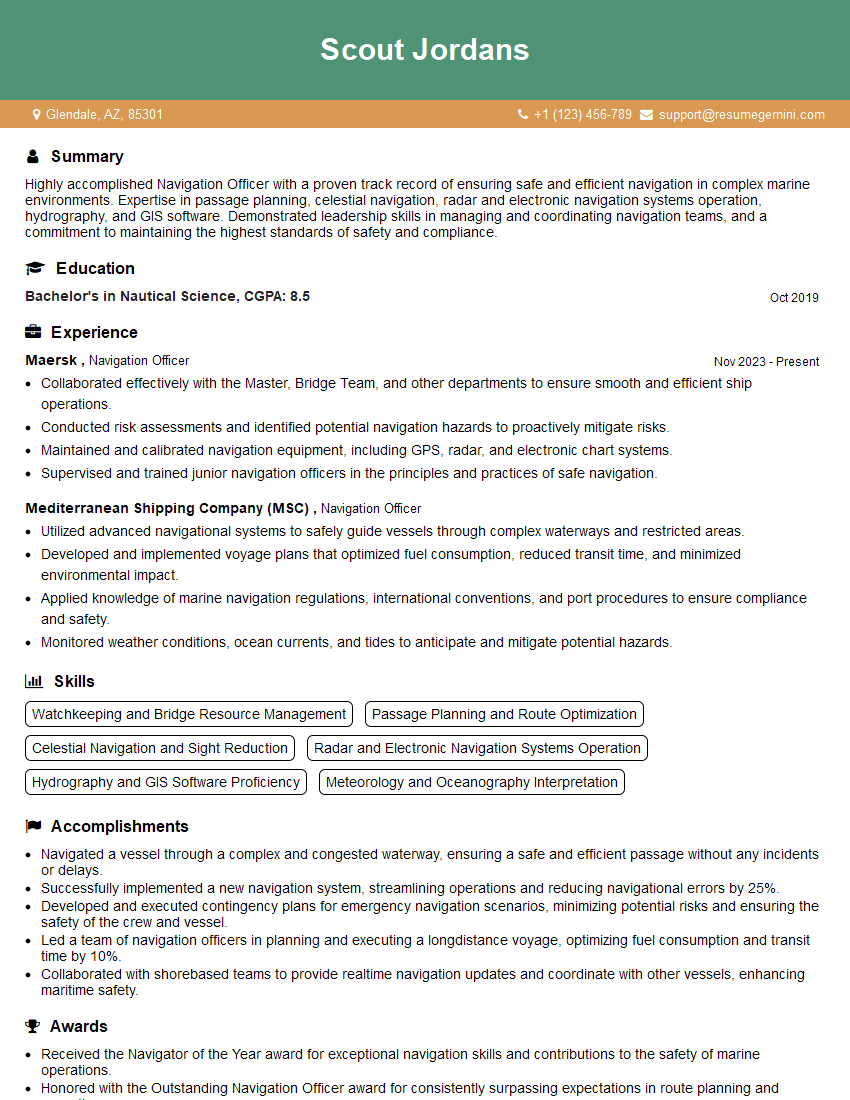
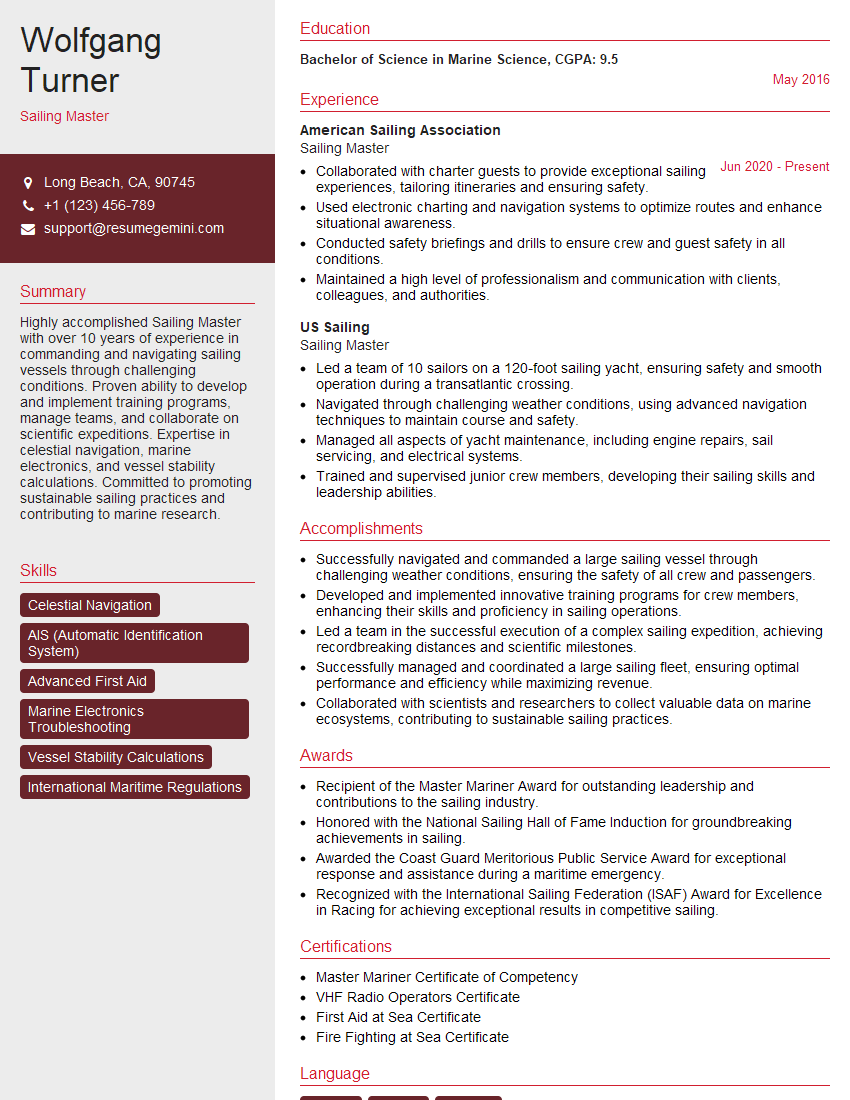
Mastering Navigational Charts and Publications is crucial for a successful and rewarding career in maritime industries. A strong understanding of these topics demonstrates competence, enhances safety, and opens doors to diverse opportunities. To maximize your job prospects, crafting a compelling and ATS-friendly resume is essential. ResumeGemini is a trusted resource that can help you build a professional resume that highlights your skills and experience effectively. ResumeGemini provides examples of resumes tailored to Navigational Charts and Publications, ensuring your application stands out from the competition. Take the next step towards your dream career today!
Explore more articles
Users Rating of Our Blogs
Share Your Experience
We value your feedback! Please rate our content and share your thoughts (optional).
What Readers Say About Our Blog
Very informative content, great job.
good