Unlock your full potential by mastering the most common Nonlinear Control Theory interview questions. This blog offers a deep dive into the critical topics, ensuring you’re not only prepared to answer but to excel. With these insights, you’ll approach your interview with clarity and confidence.
Questions Asked in Nonlinear Control Theory Interview
Q 1. Explain the concept of Lyapunov stability.
Lyapunov stability is a powerful concept in nonlinear control theory that allows us to assess the stability of a system’s equilibrium point without explicitly solving the system’s equations. Instead of directly analyzing the system’s trajectories, we utilize a Lyapunov function, a scalar function that acts like a ‘potential energy’ measure. If this function decreases along all system trajectories, and is zero only at the equilibrium point, we can conclude that the equilibrium is stable.
Imagine a ball at the bottom of a bowl. The bowl’s shape represents the Lyapunov function. If the ball is disturbed slightly, it will roll back to the bottom (the equilibrium). The energy (analogous to the Lyapunov function) continually decreases as the ball moves towards the bottom. Similarly, if a Lyapunov function decreases along system trajectories, the system’s state will approach the equilibrium point, indicating stability.
Formally, an equilibrium point x = 0 is Lyapunov stable if, for any small positive number ε, there exists a positive number δ such that if the initial condition ||x(0)|| < δ, then ||x(t)|| < ε for all t ≥ 0. This means that if we start close enough to the equilibrium, we will stay close to it for all future time.
Q 2. Describe different methods for feedback linearization.
Feedback linearization is a technique to transform a nonlinear system into an equivalent linear system, which allows us to apply linear control design methods. There are two main approaches: input-state linearization and input-output linearization.
Input-State Linearization: This method aims to find a transformation of the state variables and a feedback control law that transforms the nonlinear system into a fully linear controllable system. It requires the system to be differentially flat, meaning that all state variables can be expressed as functions of the input and its derivatives.
Input-Output Linearization: This is a less restrictive approach, aiming to linearize only the input-output behavior of the system. It's particularly useful when full state feedback isn't available or desirable. The system is transformed into a linear system with a possibly nonlinear internal dynamics part. We need to ensure that the zero dynamics (internal dynamics when the output is zero) are stable to guarantee overall stability.
Consider a simple nonlinear system: ẋ = x² + u. Input-state linearization in this case is straightforward. By choosing u = v - x², where v is a new input, the system becomes ẋ = v, a simple linear system.
Q 3. What are the limitations of linear control techniques when applied to nonlinear systems?
Linear control techniques, while elegant and well-understood, struggle with nonlinear systems due to their inherent limitations. These limitations include:
Limited Applicability: Linearization techniques often only accurately represent the system's behavior in a small neighborhood around an operating point. Moving away from this point can result in significant discrepancies and even instability.
Inability to Handle Complex Phenomena: Nonlinear systems exhibit phenomena like bifurcations, limit cycles, and chaos, which are not captured by linear models. Linear control design might not prevent these undesirable behaviors.
Performance Degradation: Linear controllers designed at one operating point may perform poorly or even destabilize the system at other operating points. Nonlinear controllers, on the other hand, can adapt to changing operating conditions.
For instance, a simple pendulum can be linearized near its equilibrium (straight down), but this linear model fails to accurately predict its behavior when significantly displaced. A linear controller designed for small angles won't be effective for large swings.
Q 4. Explain the concept of a control Lyapunov function.
A Control Lyapunov Function (CLF) is a Lyapunov function tailored specifically for control design. Unlike a standard Lyapunov function, which is used to *analyze* stability, a CLF is used to *synthesize* a stabilizing controller. A CLF, V(x), is a positive definite function such that there exists a control law u(x) that makes the derivative of V(x) along the system trajectories negative definite. This guarantees that the controller u(x) stabilizes the system, driving the state towards the equilibrium.
This differs from a standard Lyapunov function because it actively seeks a control policy that ensures a decrease in the Lyapunov function. The challenge lies in finding both a suitable CLF and the associated control law, often solved using techniques like Sontag's formula or backstepping.
Q 5. How do you design a controller for a nonlinear system using backstepping?
Backstepping is a recursive design method for nonlinear systems. It systematically constructs a controller by treating subsystems as virtual systems, designing controllers for these virtual systems, and then adding integrators to the system until the full system is controlled. The approach is iterative and proceeds step-by-step.
Steps:
Define Subsystems: Break the nonlinear system into smaller subsystems.
Design Virtual Controllers: For each subsystem, design a virtual controller that treats the next subsystem's state as the input. This ensures that the Lyapunov function for that subsystem decreases.
Add Integrators: Introduce integrators to the system to represent the error between the actual states and the desired states.
Update Lyapunov Function: Update the Lyapunov function to include the error introduced by the integrators.
Repeat: Repeat steps 2-4 until you reach the final subsystem. The final step generates the actual control law.
Backstepping guarantees stability by systematically decreasing the Lyapunov function at each step. The method is particularly suited for systems with a cascade structure, where one subsystem's output feeds into another.
Q 6. Discuss the advantages and disadvantages of sliding mode control.
Sliding mode control (SMC) is a robust nonlinear control technique that uses a discontinuous control law to force the system's trajectories onto a sliding surface, a manifold where the system's behavior is desirable.
Advantages:
Robustness: SMC is inherently robust to disturbances and uncertainties in the system model. The discontinuous control law ensures that the system remains on the sliding surface despite external disturbances.
Fast Response: SMC can achieve fast response and accurate tracking due to its switching action.
Disadvantages:
Chattering: The discontinuous nature of the control law can cause high-frequency oscillations (chattering) in the system's output. This can damage actuators and reduce performance.
Implementation Challenges: Implementing SMC in real systems can be challenging due to the need for precise switching and the potential for chattering.
Sensitivity to Noise: The switching control law can be sensitive to measurement noise, which can exacerbate chattering.
Despite its disadvantages, SMC's robustness makes it suitable for applications requiring high performance in uncertain environments, like robotic manipulators and flight control.
Q 7. Explain how to use the LaSalle's invariance principle to prove stability.
LaSalle's invariance principle is a powerful tool for proving Lyapunov stability, particularly when the Lyapunov function's derivative is only semi-negative definite (meaning it's non-positive but not strictly negative everywhere except at the equilibrium). It states that if the Lyapunov function V(x) is positive definite and its derivative dV/dt is negative semi-definite, all trajectories converge to the largest invariant set contained within the set where dV/dt = 0.
To prove stability using LaSalle's invariance principle:
Find a Lyapunov Function: Identify a positive definite function
V(x)that satisfiesV(0) = 0.Analyze the Derivative: Compute the time derivative of
V(x)along the system's trajectories,dV/dt. If it is negative semi-definite, proceed to the next step.Identify the Invariant Set: Determine the set
E = {x | dV/dt = 0}. This is the set of points where the Lyapunov function's derivative is zero.Find the Largest Invariant Set: Find the largest invariant set contained within
E. This is the set of points such that any trajectory starting in this set remains within the set for all time.Conclusion: If the largest invariant set within
Eis just the equilibrium pointx = 0, then the equilibrium is asymptotically stable by LaSalle's invariance principle. This means that all trajectories will converge to the equilibrium point ast → ∞.
This principle is useful in situations where a stricter condition (dV/dt being strictly negative definite) cannot be easily verified.
Q 8. Describe different methods for nonlinear system identification.
Nonlinear system identification aims to determine a mathematical model representing the behavior of a nonlinear system from input-output data. This is crucial for control design, simulation, and prediction. Several methods exist, each with its strengths and weaknesses:
- Black-box models: These don't rely on prior knowledge of the system's internal structure. Popular choices include neural networks, which can approximate complex nonlinear relationships, and support vector machines (SVMs), effective for high-dimensional data. For example, a neural network can be trained on sensor data from a robotic arm to learn its complex dynamics.
- Grey-box models: These combine prior knowledge (e.g., physical laws) with experimental data. This approach often employs parameter estimation techniques like least squares or maximum likelihood estimation within a pre-defined model structure. For instance, one might use a known physical model of a chemical reactor but estimate unknown parameters from experimental data.
- White-box models: These models are entirely derived from first principles. However, this often necessitates deep understanding of the underlying physics and can be complex to develop for highly intricate systems. A simple example is modeling a pendulum's motion using Newtonian mechanics.
- Volterra series: This method represents the system's output as a weighted sum of input terms and their convolutions, providing a systematic approach to model nonlinear behavior. However, it can become computationally expensive for high-order nonlinearities.
The choice of method depends on the available data, prior knowledge of the system, computational resources, and the desired accuracy of the model.
Q 9. Explain the concept of input-output linearization.
Input-output linearization, also known as feedback linearization, aims to transform a nonlinear system into an equivalent linear system through a clever choice of feedback control. This allows us to design linear control techniques for the linearized system, which is much easier to handle.
Consider a nonlinear system described by:
ẋ = f(x) + g(x)uwhere x is the state, u is the input, and f and g are nonlinear functions. If we can find a transformation z = T(x) and a feedback control law u = α(x) + β(x)v, then we can often achieve a linear system representation of the form:
ż = Az + Bvwhere A and B are constant matrices, and v is a new input. This linear system can then be controlled using standard linear control techniques. A classic example involves the control of a pendulum, where this transformation helps simplify the nonlinear dynamics of the system. The choice of α(x) and β(x) is crucial and requires careful design to ensure stability and performance.
Q 10. Discuss the challenges in applying model predictive control to nonlinear systems.
Model Predictive Control (MPC) is a powerful technique, but applying it to nonlinear systems presents several challenges:
- Computational cost: Solving the optimization problem at each time step can be computationally expensive, especially for complex nonlinear systems with many states. This might necessitate real-time optimization algorithms and powerful hardware.
- Model accuracy: The effectiveness of MPC heavily relies on an accurate model of the nonlinear system. If the model is inaccurate, the controller's performance can suffer, leading to instability or poor tracking. Robust MPC methods help mitigate this issue.
- Constraints handling: Nonlinear systems often involve constraints on states and inputs. These constraints must be considered in the optimization problem, adding complexity to the solution process. Advanced optimization techniques, such as interior point methods, can handle these constraints.
- Stability analysis: Guaranteeing stability in nonlinear MPC is more challenging than in linear MPC. Advanced techniques like Lyapunov-based stability analysis are required for rigorous stability guarantees.
These challenges highlight the need for careful model selection, efficient optimization algorithms, and robust design techniques when applying MPC to nonlinear systems. Real-world examples include the control of chemical processes or autonomous vehicles, where the highly nonlinear nature of the system demands careful consideration of these complexities.
Q 11. How do you handle uncertainties and disturbances in nonlinear control systems?
Handling uncertainties and disturbances in nonlinear control systems is paramount for robust performance. Several strategies are employed:
- Robust control techniques: These methods explicitly incorporate uncertainty in the design process. H∞ control minimizes the influence of disturbances on the system output. Sliding mode control provides robustness against matched uncertainties (uncertainties affecting the same input channels).
- Adaptive control: Adaptive controllers adjust their parameters in real-time to compensate for uncertainties or changing system dynamics. For example, in a robot manipulator, the system parameters like inertia could change based on the payload. This approach would continuously update the control parameters to track the desired trajectory.
- Nonlinear observers: These estimate unmeasurable states or parameters to improve control performance in the presence of disturbances. Examples include Kalman filters adapted for nonlinear systems (Extended Kalman Filter, Unscented Kalman Filter) or high-gain observers.
- Stochastic control: Methods based on probability theory, such as stochastic optimal control, can handle probabilistic descriptions of uncertainty and disturbances.
The best approach depends on the type and level of uncertainty present in the system. Often a combination of these techniques is used to achieve robustness and satisfactory performance. For instance, in aerospace applications, the uncertainties in aerodynamics and atmospheric conditions necessitate the use of robust or adaptive control strategies.
Q 12. Explain the concept of passivity-based control.
Passivity-based control leverages the concept of passivity, which essentially means that the system doesn't generate energy internally. It relies on the inherent energy properties of the system to design a stable controller. The idea is to shape the energy flow in the system to achieve desired behavior.
A passive system satisfies a certain energy dissipation inequality. By designing a controller that is also passive and connecting it to the system in a specific way, one can guarantee stability. This approach is particularly useful for systems with inherent energy storage mechanisms, such as mechanical systems or electrical circuits. Passivity-based control is often used in robotics and power systems because it provides inherent stability properties and can handle uncertainties more effectively than some other methods. For instance, it's suitable for controlling robotic manipulators, where the energy stored in the joints can be managed to ensure stable and coordinated motion.
Q 13. What are some common nonlinear phenomena in control systems?
Nonlinear phenomena are ubiquitous in control systems and often complicate control design. Some common examples include:
- Saturation: Actuators have limited ranges. When the control signal exceeds this range, saturation occurs, leading to performance degradation and potential instability.
- Dead zone: A region around the zero input where the output remains unchanged. This can impede accurate control near the setpoint.
- Hysteresis: The output depends not only on the current input but also on the past history of inputs. This is frequently observed in magnetic systems and mechanical components.
- Nonlinear friction: Friction forces in mechanical systems often exhibit nonlinear characteristics, making accurate modeling and compensation challenging.
- Limit cycles: Self-sustained oscillations that can occur in nonlinear systems due to inherent feedback mechanisms.
- Chaos: Highly sensitive dependence on initial conditions, leading to unpredictable behavior. This is less common but can be crucial in some systems.
These nonlinearities need to be carefully considered during the design and analysis of control systems. Control strategies need to be designed to compensate or mitigate the effects of these phenomena to ensure acceptable performance.
Q 14. Describe different methods for analyzing the stability of nonlinear systems.
Analyzing the stability of nonlinear systems is more complex than linear systems. Several methods exist:
- Lyapunov's direct method: This method doesn't require solving the system's equations directly. Instead, it constructs a Lyapunov function, a scalar function whose properties can be used to infer the stability of the system's equilibrium points. If a suitable Lyapunov function can be found, it guarantees stability. This is a powerful tool, but finding a suitable Lyapunov function can be challenging.
- Linearization: The system is linearized around an equilibrium point. Linear stability analysis techniques are then used. This method is only valid locally, near the equilibrium point.
- Poincaré maps: For systems with periodic behavior, Poincaré maps can reduce the analysis to a lower-dimensional system. This approach is helpful in understanding limit cycles and bifurcations.
- Numerical methods: Simulation and numerical analysis can be used to explore the system's behavior and assess stability. Phase portraits are visually informative.
- Input-to-state stability (ISS): A framework that addresses the stability of nonlinear systems under external disturbances. It provides conditions for stability even in the presence of unbounded inputs.
The choice of method depends on the system's characteristics and the level of detail required. Often, a combination of methods is used to obtain a comprehensive understanding of stability.
Q 15. Explain the concept of bifurcation in nonlinear systems.
Bifurcation in nonlinear systems refers to a qualitative change in the system's behavior as a parameter is varied. Imagine a river's flow: at low water levels, it flows smoothly in one channel. But increase the water (the parameter), and it might suddenly split into two channels, or even develop whirlpools – these are bifurcations. Mathematically, it's a point where the system's equilibrium points, periodic orbits, or other attractors change their stability or even disappear. Common types include saddle-node bifurcations (where a stable and unstable equilibrium collide and annihilate), transcritical bifurcations (where two equilibria exchange stability), and Hopf bifurcations (where a stable equilibrium becomes unstable, giving rise to a limit cycle – think of a pendulum starting to oscillate instead of staying still). Understanding bifurcations is crucial for predicting and controlling sudden changes in system behavior, such as the onset of oscillations or chaos in a power grid or the unpredictable behavior of a robot arm near its limits of movement.
Career Expert Tips:
- Ace those interviews! Prepare effectively by reviewing the Top 50 Most Common Interview Questions on ResumeGemini.
- Navigate your job search with confidence! Explore a wide range of Career Tips on ResumeGemini. Learn about common challenges and recommendations to overcome them.
- Craft the perfect resume! Master the Art of Resume Writing with ResumeGemini's guide. Showcase your unique qualifications and achievements effectively.
- Don't miss out on holiday savings! Build your dream resume with ResumeGemini's ATS optimized templates.
Q 16. Discuss the role of nonlinear control in robotics.
Nonlinear control is essential in robotics because robot dynamics are inherently nonlinear. Linear control techniques often fail to accurately model and control complex robotic systems, especially when dealing with significant changes in configuration or external forces. For instance, consider a robotic arm: its dynamics change drastically depending on the arm's pose and the mass it carries. Nonlinear control techniques, such as feedback linearization, sliding mode control, and model predictive control, provide the flexibility to handle these complexities. Feedback linearization transforms the nonlinear system into a simpler linear one that is easier to control. Sliding mode control provides robustness to uncertainties and disturbances. Model predictive control allows us to optimize the robot's trajectory over a certain prediction horizon, ensuring efficient and safe motion. Nonlinear control also allows for exploiting the unique properties of nonlinear systems, for example, to create more agile and robust movements.
Q 17. Explain how to design a controller for a chaotic system.
Designing a controller for a chaotic system is challenging because of its extreme sensitivity to initial conditions and unpredictable behavior. The goal isn't necessarily to eliminate chaos entirely, as some applications might benefit from it, but rather to control the system's behavior within a desired range or to stabilize it to a specific attractor. Techniques include:
- Feedback control: Using carefully designed feedback loops to steer the system away from undesirable chaotic states and towards a stable or periodic behavior. This often involves careful tuning of control parameters.
- Optimal control: Employing optimization methods to find control inputs that minimize a cost function, such as minimizing the distance from a desired trajectory.
- Adaptive control: Designing a controller that adjusts itself in response to the chaotic system's unpredictable changes. This requires building a model that can estimate the system's dynamics in real-time.
- Synchronization techniques: If the chaotic system is coupled with another system, it is sometimes possible to synchronize their behaviors using suitable controllers, leading to predictable outcomes.
The choice of controller depends greatly on the specific chaotic system and control objectives. A well-designed controller can suppress chaos or exploit its characteristics to achieve a specific goal.
Q 18. How do you handle actuator saturation in nonlinear control systems?
Actuator saturation is a common problem in nonlinear control systems where actuators can only produce a limited force or torque. Ignoring it can lead to poor performance or even instability. Handling actuator saturation involves:
- Anti-windup schemes: These techniques prevent the controller from integrating errors during saturation, reducing the risk of large overshoots when the actuator recovers from saturation. They often involve modifying the controller's integrator to reset or limit its output during saturation events.
- Saturation functions: Explicitly incorporating saturation limits into the control design, often by using saturation functions (e.g., a bounded piecewise linear function) to constrain the control signal before it's applied to the actuator.
- Model predictive control (MPC): MPC explicitly accounts for constraints, including actuator saturation, during the optimization process. This leads to control signals that are feasible and satisfy all constraints.
Choosing the best approach depends on the specific system and control objectives, and often a combination of these methods is used to achieve effective saturation handling.
Q 19. Describe different methods for designing observers for nonlinear systems.
Designing observers for nonlinear systems is more complex than for linear systems due to the lack of general methods applicable to all cases. Popular approaches include:
- Extended Kalman filter (EKF): Linearizes the nonlinear system around the current state estimate and uses a Kalman filter to estimate the states. It's widely used but its performance depends on the accuracy of the linearization. The EKF assumes Gaussian noise and that linearization is a good approximation.
- Unscented Kalman filter (UKF): Uses a deterministic sampling approach to capture the mean and covariance of the nonlinear transformation of the state without relying on linearization. It's generally more accurate than the EKF for highly nonlinear systems.
- High-gain observer: Uses high-gain feedback to estimate the states, making it robust to uncertainties and disturbances but potentially sensitive to noise. It is particularly effective for systems with known structures.
- Sliding mode observer: A robust observer that uses a sliding mode to estimate the states. It's known for its robustness against model uncertainties and disturbances, but can suffer from chattering effects.
- Nonlinear observer design using Lyapunov functions: This method uses a Lyapunov function to design an observer that guarantees the convergence of the estimation error to zero. It offers strong stability guarantees, but finding a suitable Lyapunov function can be challenging.
The choice of observer depends on the specific nonlinear system, desired performance, and available resources. Often, a trade-off needs to be made between accuracy, robustness, and computational complexity.
Q 20. Explain the concept of adaptive control for nonlinear systems.
Adaptive control for nonlinear systems is used when the system's parameters are unknown or vary over time. The controller adapts its parameters to maintain good performance despite these uncertainties. Imagine a robot arm carrying a payload of unknown weight; an adaptive controller would adjust its control law to compensate for the changing load. Key elements of adaptive control include:
- Parameter estimation: Algorithms (like least squares or gradient descent) are used to estimate the unknown parameters of the system based on available measurements.
- Control law design: The control law is designed such that the system's behavior remains acceptable even with parameter uncertainties. Common designs include model reference adaptive control (MRAC) or self-tuning regulators.
- Stability analysis: Ensuring the overall adaptive system is stable is crucial; Lyapunov theory is often used to establish stability guarantees.
Adaptive control provides robustness against parameter variations and uncertainties, making it suitable for a wide range of nonlinear systems operating in uncertain environments.
Q 21. Discuss the applications of nonlinear control in aerospace systems.
Nonlinear control plays a vital role in aerospace systems due to the inherent nonlinearities in aircraft and spacecraft dynamics. Examples include:
- Flight control: Nonlinear control techniques are essential for controlling aircraft attitude and trajectory, especially during maneuvers or in turbulent conditions. These techniques account for nonlinearities like aerodynamic forces, engine dynamics, and flexible structures.
- Spacecraft attitude control: Precise attitude control is crucial for pointing telescopes, communication antennas, and solar panels. Nonlinear control handles the complex dynamics of spacecraft, accounting for factors like inertia changes, disturbances from gravity gradients, and thruster saturation.
- Rocket trajectory control: Guiding rockets precisely to their targets requires robust control systems that handle the highly nonlinear dynamics of rocket propulsion and atmospheric forces.
- Unmanned Aerial Vehicle (UAV) control: Controlling UAVs in challenging environments necessitates robust nonlinear control algorithms that cope with variable winds, unpredictable terrain, and limitations in sensor information.
The application of nonlinear control in aerospace systems ensures safety, precision, and efficiency, resulting in improved performance and mission success.
Q 22. How do you verify the stability of a nonlinear control system using numerical methods?
Verifying the stability of a nonlinear system numerically often relies on approximating the system's behavior and analyzing its response. Linearization around operating points, while limited, provides a starting point. We can use linearization to obtain a Jacobian matrix and then apply linear stability analysis techniques like eigenvalue analysis to assess stability locally. However, for truly nonlinear systems, we need more robust methods.
More sophisticated approaches include:
- Numerical Simulation: Simulating the system's response to various initial conditions and disturbances. If the system consistently converges to an equilibrium point or a bounded region, it suggests stability. Software like MATLAB/Simulink is invaluable for this. We'd often plot state trajectories to visualize stability.
- Lyapunov Methods (Numerical): While Lyapunov's direct method is typically an analytical approach, numerical methods can help find Lyapunov functions, especially for complex systems. Software can assist in searching for a function that satisfies the Lyapunov conditions (negative definite derivative along system trajectories).
- Harmonic Balance: For systems with periodic behavior or oscillations, Harmonic Balance is a powerful numerical tool. It approximates periodic solutions and their stability using a truncated Fourier series representation.
- Bifurcation Analysis: Numerical continuation methods can be used to trace bifurcations – points where the system's stability changes qualitatively. Identifying these points helps understand the system's behavior under varying parameters.
For example, consider a robotic arm. We might use numerical simulation to test its stability under different payloads and control gains, visualizing the arm's position over time to check for convergence or oscillations.
Q 23. Explain the concept of gain scheduling in nonlinear control.
Gain scheduling is a powerful technique for controlling nonlinear systems by designing a family of linear controllers and switching between them based on the system's operating point. Imagine you're driving a car – you wouldn't use the same control strategy at low speeds as you would at high speeds. Gain scheduling mirrors this concept.
The process involves:
- Identifying Scheduling Variables: These variables capture the system's operating regime. For example, in a car, speed or engine load might be scheduling variables.
- Linearization: Linearizing the nonlinear system around multiple operating points defined by the scheduling variables. Each operating point yields a different linearized model.
- Controller Design: Designing a separate linear controller for each linearized model. This could be a PID controller, LQR controller, or any other suitable linear technique.
- Scheduling Logic: Implementing a mechanism to smoothly transition between controllers based on the value of the scheduling variable. This typically involves interpolation or switching logic.
Gain scheduling is particularly effective when the nonlinearities are relatively mild and the system's behavior can be well-approximated by piecewise linear models. A practical example is the flight control system of an aircraft where different control gains are used for different flight regimes (take-off, cruise, landing).
Q 24. Discuss the challenges in implementing nonlinear controllers in real-time systems.
Implementing nonlinear controllers in real-time systems presents several challenges. The computational complexity is often higher than linear controllers, demanding significant processing power and fast algorithms. The real-time constraints mean computations must complete within strict time limits, otherwise, the system's response can be delayed or unstable.
Other challenges include:
- Computational Burden: Many nonlinear control algorithms, like model predictive control (MPC), are computationally intensive, demanding high-performance hardware and efficient algorithms to meet real-time requirements.
- Sensor Noise and Uncertainty: Nonlinear controllers are often sensitive to noise in sensor measurements. Robust control techniques are essential to mitigate the impact of noise and uncertainties.
- Parameter Variations: System parameters might vary over time (e.g., temperature changes affecting a motor's characteristics). Adaptive control techniques are necessary to handle these variations.
- Software Complexity: Implementing sophisticated nonlinear control algorithms can be complex, requiring skilled programmers and rigorous testing to ensure reliability and safety.
In an industrial robot control application, for instance, the computational time to solve a nonlinear optimization problem within the MPC controller must be far shorter than the robot's sampling time to prevent delays and instability.
Q 25. How do you choose an appropriate control strategy for a given nonlinear system?
Choosing the right control strategy for a nonlinear system depends on several factors, including the system's dynamics, the control objectives, and the available resources. There's no one-size-fits-all solution.
Here's a systematic approach:
- System Analysis: Thoroughly analyze the system's nonlinear dynamics, identifying dominant nonlinearities and their characteristics. This may involve creating a nonlinear model using physical principles or system identification techniques.
- Control Objectives: Clearly define the desired performance, including tracking accuracy, stability margins, robustness to disturbances, and energy efficiency.
- Controller Selection: Based on system analysis and control objectives, select an appropriate control strategy. For example:
- Feedback Linearization: For systems that can be transformed into a linear form through a nonlinear coordinate transformation.
- Sliding Mode Control: For systems with uncertainties and disturbances; known for its robustness but potentially leading to chattering.
- Adaptive Control: When system parameters are unknown or vary over time.
- Backstepping: For systems with cascade structure.
- Model Predictive Control (MPC): For systems with constraints and complex dynamics; computationally intensive.
- Implementation and Testing: Implement the chosen controller and thoroughly test its performance using simulation and, ultimately, real-world experiments. Refinement is usually needed based on the test results.
For instance, a robot manipulator might benefit from feedback linearization for precise trajectory tracking if a suitable transformation can be found. However, if the system is subject to significant disturbances, sliding mode control might be more robust, despite the potential for chattering.
Q 26. Explain the trade-offs between different nonlinear control techniques.
Different nonlinear control techniques offer trade-offs among performance, robustness, and computational complexity. There is no universally superior method.
Here's a comparison:
- Feedback Linearization vs. Sliding Mode Control: Feedback linearization provides excellent performance if the system can be linearized perfectly, but lacks robustness to modelling errors or disturbances. Sliding mode control is robust to uncertainties, but can suffer from chattering (high-frequency oscillations) which can damage actuators.
- Adaptive Control vs. Gain Scheduling: Adaptive control automatically adjusts controller parameters to compensate for uncertainties, but can be complex to design and implement. Gain scheduling offers a simpler implementation, but its performance depends on the accuracy of the linearized models and the selection of scheduling variables.
- Model Predictive Control (MPC) vs. other methods: MPC excels in handling constraints and complex dynamics, delivering optimal performance. However, it's computationally intensive, limiting its applicability in real-time systems with strict constraints.
The choice depends on the specific application. For example, in a high-precision manufacturing process, feedback linearization might be preferable, accepting a lower robustness to disturbances in favour of high tracking accuracy. In contrast, an autonomous vehicle might need the robustness of sliding mode control or adaptive control to deal with changing road conditions and unpredictable obstacles.
Q 27. Describe your experience with nonlinear control system simulation tools.
I have extensive experience using various nonlinear control system simulation tools, including MATLAB/Simulink, which is my primary environment. I'm proficient in utilizing its various toolboxes, including the Control System Toolbox and the Simulink environment for model development, simulation, and analysis. This includes building nonlinear models, designing controllers (PID, LQR, MPC, etc.), and analyzing the system's response through simulations and visualizations.
Beyond MATLAB, I have familiarity with other tools, including:
- Python with control libraries (e.g., controlpy): Useful for prototyping and implementing custom control algorithms, often leveraging numerical libraries like NumPy and SciPy.
- Specialized robotics simulation software (e.g., Gazebo, ROS): Used for simulations involving robotic systems, integrating with control algorithms and providing realistic sensor and actuator models.
My experience involves building detailed models of dynamic systems, including mechanical systems, electrical circuits, and fluid systems, then designing and tuning nonlinear controllers within these simulation environments. I frequently use simulations to verify controller performance, conduct parameter sensitivity analysis, and test the system's behavior under various operating conditions before physical implementation.
Q 28. What are some current research areas in nonlinear control theory?
Nonlinear control theory is an active research area, with many exciting advancements. Current research focuses include:
- Robust Nonlinear Control: Developing control strategies that are resilient to uncertainties, disturbances, and model inaccuracies. This is critical for real-world systems where perfect models are impossible to obtain.
- Data-Driven Control: Utilizing data from system operation to learn models and design controllers, particularly useful when explicit analytical models are difficult to obtain.
- Learning-Based Control: Combining traditional control techniques with machine learning algorithms (e.g., reinforcement learning, neural networks) to create adaptive and robust controllers.
- Networked Control Systems: Designing control strategies for systems where the controller and plant communicate over a network, considering communication delays and bandwidth limitations.
- Hybrid Systems and Switched Systems: Analyzing and controlling systems that exhibit both continuous and discrete dynamics, arising in applications involving switching and logical decisions.
- Safety-Critical Nonlinear Control: Designing controllers that guarantee safety and stability despite uncertainties and disturbances, particularly important in aerospace and automotive applications.
These research directions are transforming various industries, from robotics and aerospace to automotive and energy systems. For example, research on learning-based control is creating more autonomous robots and driving advancements in autonomous driving.
Key Topics to Learn for Nonlinear Control Theory Interview
- Lyapunov Stability: Understand the concepts of stability, asymptotic stability, and Lyapunov functions. Be prepared to apply these to analyze the stability of nonlinear systems.
- Feedback Linearization: Learn how to design controllers that transform nonlinear systems into equivalent linear systems, simplifying control design. Consider applications in robotics and aerospace.
- Sliding Mode Control: Grasp the principles of sliding mode control and its robustness to uncertainties and disturbances. Be ready to discuss its applications in areas like power systems and automotive engineering.
- Nonlinear Model Predictive Control (NMPC): Familiarize yourself with the optimization-based approach of NMPC and its advantages in handling constraints and nonlinearities. Explore applications in process control and chemical engineering.
- Adaptive Control: Understand how adaptive control techniques address uncertainties and variations in system parameters. Consider applications in areas like flight control and robotic manipulation.
- Bifurcation Theory and Chaos: Develop an understanding of how changes in system parameters can lead to qualitative changes in system behavior, including chaotic dynamics. Discuss the implications for control design.
- Passivity-Based Control: Learn the concepts of passivity and how they can be used to design stable nonlinear controllers. Consider applications in areas like power electronics and mechanical systems.
- Backstepping Design: Understand the recursive design methodology of backstepping for stabilizing nonlinear systems. Discuss its application in systems with strict feedback form.
- Practical Problem-Solving: Practice applying your theoretical knowledge to solve real-world problems. Develop your ability to model nonlinear systems and design appropriate control strategies.
Next Steps
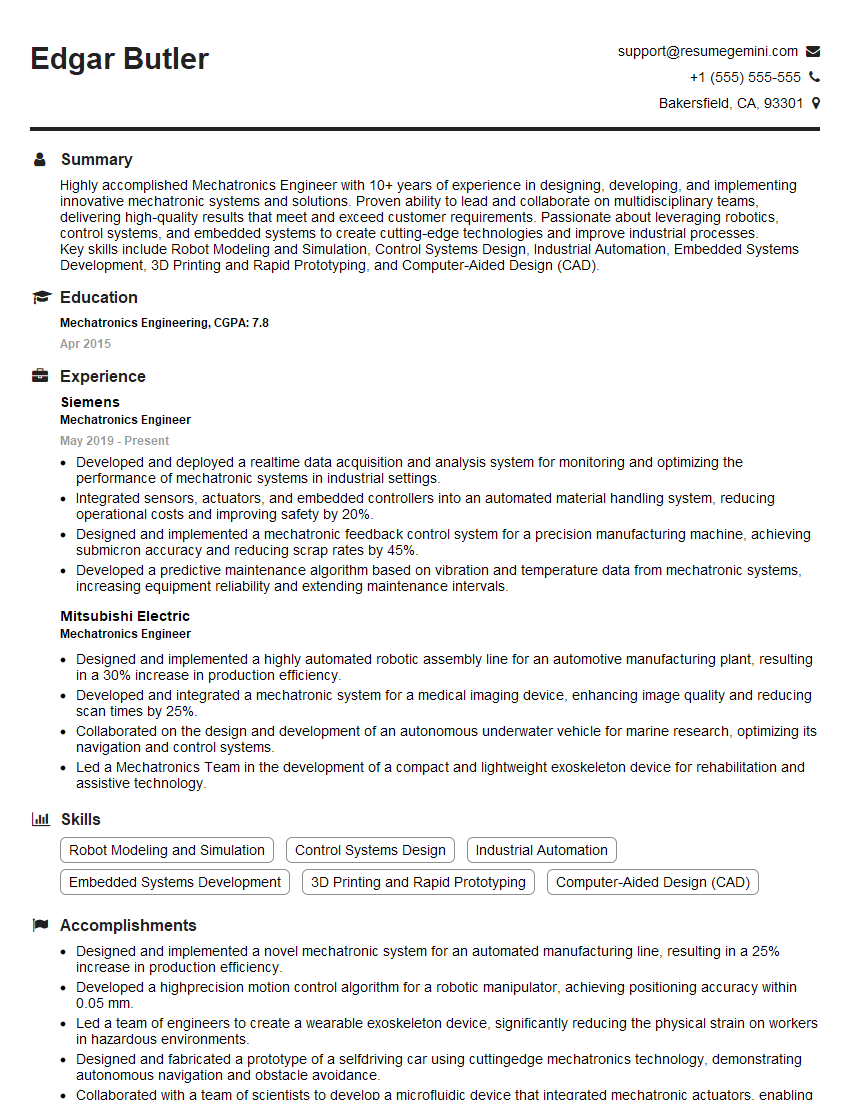
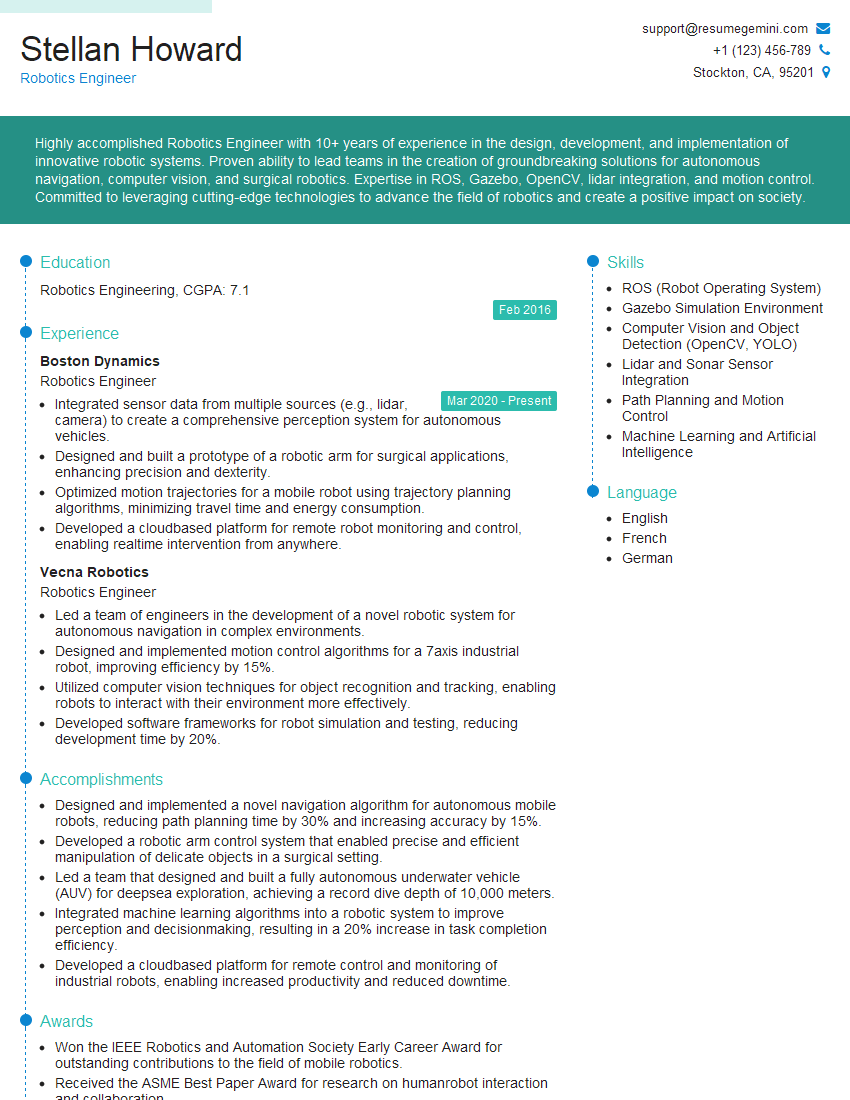
Mastering Nonlinear Control Theory opens doors to exciting careers in diverse fields like robotics, aerospace, automotive engineering, and process control. A strong understanding of these concepts is highly valued by employers. To maximize your job prospects, focus on crafting an ATS-friendly resume that effectively showcases your skills and experience. ResumeGemini is a trusted resource to help you build a professional and impactful resume. They provide examples of resumes tailored to Nonlinear Control Theory, ensuring your application stands out.
Explore more articles
Users Rating of Our Blogs
Share Your Experience
We value your feedback! Please rate our content and share your thoughts (optional).
What Readers Say About Our Blog
Very informative content, great job.
good