Interviews are more than just a Q&A session—they’re a chance to prove your worth. This blog dives into essential Operating Tillage Equipment interview questions and expert tips to help you align your answers with what hiring managers are looking for. Start preparing to shine!
Questions Asked in Operating Tillage Equipment Interview
Q 1. Describe the different types of tillage equipment and their applications.
Tillage equipment broadly categorizes into primary and secondary tillage tools. Primary tillage, like moldboard plowing, deeply inverts the soil, burying crop residues and improving soil structure. However, this is energy-intensive and can be detrimental to soil health. Secondary tillage, conversely, performs shallower operations. Examples include harrowing, disking, and cultivating. These tools refine the seedbed, controlling weeds and improving the soil’s tilth. Specific examples include:
- Moldboard Plow: Deep tillage for soil inversion, ideal for heavy clay soils.
- Chisel Plow: Subsoiling, improving water infiltration in compacted soils. Less soil inversion than a moldboard plow.
- Disk Harrow: Fragmenting soil clods, incorporating residues, and weed control. Versatile and widely used.
- Spring-tooth Harrow: Smoothing soil, removing clods, good for seedbed preparation.
- Cultivator: Controls weeds between crop rows, often used in row-crop farming.
- Roller/packer: Compacts the soil, creating a firm seedbed for uniform planting.
The choice of equipment depends heavily on the soil type, climate, and the crop being planted. For instance, a moldboard plow might be suitable for heavy clay soil, while a lighter disk harrow is preferred for lighter sandy loam.
Q 2. Explain the principles of conservation tillage and its benefits.
Conservation tillage minimizes soil disturbance, leaving significant crop residues on the soil surface. The key principles involve reducing soil inversion and minimizing the number of tillage passes. This contrasts sharply with conventional tillage’s extensive soil disturbance. Examples include:
- No-till farming: Planting directly into the residue from the previous crop, using specialized planters.
- Strip-till: Tilling only narrow strips where seeds will be planted, leaving the rest of the soil undisturbed.
- Ridge-till: Planting on raised ridges, leaving furrows undisturbed between the rows.
Benefits include reduced soil erosion, improved water infiltration, enhanced soil health (including better carbon sequestration), reduced fuel consumption, lower labor costs, and potentially increased biodiversity. Think of it like leaving a protective blanket of residue on the soil – it shelters the soil from harsh weather, reduces evaporation, and encourages beneficial soil organisms.
Q 3. What are the factors to consider when selecting tillage equipment for a specific soil type?
Soil type is paramount when choosing tillage equipment. Consider these factors:
- Soil texture: Clay soils require stronger equipment (e.g., moldboard plow) to break up hard clods, while sandy soils might only need lighter implements.
- Soil structure: Compacted soils need subsoiling tools like chisel plows to improve drainage and aeration. Well-structured soils might only need minimal tillage.
- Soil moisture: Working excessively wet soils can lead to compaction and damage. Conversely, dry soils can be difficult to till effectively. Timing is key.
- Rock content: High rock content necessitates equipment with robust construction and the ability to handle obstacles. A chisel plow might be more suitable than a moldboard plow in rocky conditions.
- Organic matter content: Soils high in organic matter can be easier to till, requiring less aggressive implements. However, heavy residue can clog some tools.
For example, a farmer with heavy clay soil prone to compaction would need a chisel plow followed by a harrow to create an appropriate seedbed, unlike a farmer with sandy loam soil that may only require a light disking.
Q 4. How do you determine the appropriate depth and speed for tillage operations?
Depth and speed are interconnected and depend on several factors:
- Soil type: Clay soils typically require shallower tillage at slower speeds to prevent compaction. Sandy soils can tolerate deeper and faster tillage.
- Type of tillage operation: Primary tillage (plowing) requires deeper depths than secondary tillage (harrowing). Depth is also governed by the specific goal, such as breaking up hardpan or preparing a seedbed.
- Crop to be planted: Deep tillage might be needed for root crops, whereas shallower tillage suffices for small-grain crops.
- Equipment capabilities: Each piece of equipment has recommended depth and speed ranges specified by the manufacturer. Exceeding these limits can lead to damage or poor performance.
Determining the optimal depth often involves soil testing and observation. Too shallow, and weed control might be insufficient. Too deep, and soil structure can be damaged, leading to compaction. Speed is best determined by considering soil conditions and the desired outcome. Slow speeds may increase fuel consumption but provide better tilling, while faster speeds are efficient for lighter operations but can compromise quality.
Q 5. Describe the proper maintenance procedures for tillage equipment.
Proper maintenance ensures equipment longevity and optimal performance. Key aspects include:
- Regular cleaning: Remove soil buildup after each use to prevent corrosion and damage. Pay special attention to moving parts.
- Lubrication: Regular lubrication of bearings, gears, and other moving parts is critical to prevent wear and tear. This is often specified in the manufacturer’s manual with recommendations on the frequency and type of grease.
- Sharpening and replacement of parts: Sharpen or replace worn blades, disks, and other cutting edges to maintain effectiveness. Inspect for wear and tear regularly and replace as needed.
- Inspection of structural components: Check for cracks, bends, or other damage to the frame, hitch, and other structural elements. Address any issues immediately to avoid failure.
- Storage: Proper storage prevents corrosion and damage. Store equipment in a sheltered area, and consider using protective covers.
A simple visual inspection before and after each use can save you from larger problems down the line. Regular scheduled maintenance based on usage hours, often detailed in an owner’s manual, should also be performed.
Q 6. How do you troubleshoot common problems with tillage equipment?
Troubleshooting involves systematically identifying and resolving issues. Common problems and solutions include:
- Poor tilling quality: Check for dull blades or improperly adjusted equipment. Ensure proper depth and speed settings.
- Equipment malfunction: Investigate hydraulic leaks, broken belts, or other mechanical problems. Refer to manuals for diagnostics and repair procedures.
- Excessive fuel consumption: Check for worn bearings, improper lubrication, or excessive tilling depth. Proper maintenance is key.
- Clogging: This can occur with heavy residue. Use appropriate equipment for the conditions or adjust the settings.
Systematic approaches, such as checking the simplest factors (like a dull blade) first, are crucial. Keeping detailed maintenance logs is helpful for pinpointing recurring issues. If the problem is persistent, consulting a mechanic is recommended.
Q 7. What safety precautions should be taken when operating tillage equipment?
Safety is paramount when operating tillage equipment. Key precautions include:
- Pre-operational checks: Inspect equipment for any damage or loose parts before starting. Ensure all safety guards are in place.
- Proper attire: Wear sturdy clothing, safety glasses, hearing protection, and gloves. Long hair should be tied back.
- Awareness of surroundings: Be aware of obstacles, bystanders, and other hazards. Avoid operating near power lines or other dangers.
- Safe operating procedures: Follow all manufacturer’s instructions and safety regulations. Never operate equipment while fatigued or under the influence of drugs or alcohol.
- Emergency procedures: Know how to operate the equipment’s safety features, including the emergency shut-off system.
- Maintenance of equipment: Regular maintenance helps avoid breakdowns that could lead to accidents.
Thinking about safety in every aspect of your work, from initial planning to post-operation maintenance, is essential for preventing accidents and ensuring safe work practices.
Q 8. Explain the importance of proper soil compaction management in tillage.
Proper soil compaction management is crucial in tillage because soil compaction significantly impacts plant growth and overall agricultural productivity. Compacted soil restricts root penetration, limits water infiltration, and reduces aeration, leading to poor nutrient uptake and reduced yields. Think of it like trying to grow plants in a concrete pot – the roots can’t spread, and the plant struggles to thrive.
Effective management involves understanding the factors contributing to compaction (e.g., heavy machinery, excessive tillage, and weather conditions) and implementing strategies to mitigate it. These strategies can include reducing the number of tillage passes, using lighter equipment, employing conservation tillage practices (like no-till or reduced tillage), and strategically timing tillage operations to avoid working the soil when it’s too wet or dry.
For example, a farmer might choose to use a lighter weight cultivator instead of a heavy plow on a field with a history of compaction issues. Additionally, they might incorporate cover crops to improve soil structure and reduce compaction naturally.
Q 9. How does soil moisture content affect tillage operations?
Soil moisture content dramatically affects tillage operations. The ideal soil moisture level for tillage is typically described as the ‘optimum moisture content,’ which allows for efficient soil manipulation without excessive clodding or smearing. Too dry, and the soil becomes hard and difficult to work, requiring more energy and potentially damaging equipment. Imagine trying to work with dry clay – it’s very hard and brittle.
Conversely, if the soil is too wet, the tillage tools will compact the soil, creating even more problems. Wet soil sticks to equipment, reducing its effectiveness and leading to smearing, which hinders aeration and root growth. It’s like trying to knead dough that’s too wet – it becomes sticky and messy.
Farmers often utilize soil moisture sensors and weather forecasts to determine the best time for tillage. Working the soil when it is at its optimum moisture content leads to better seedbed preparation and reduced energy consumption.
Q 10. Describe the impact of tillage on soil erosion.
Tillage can significantly impact soil erosion, both positively and negatively. Conventional tillage methods, particularly those involving moldboard plowing, leave bare soil exposed to the elements. This greatly increases the risk of wind and water erosion, leading to loss of topsoil, nutrients, and organic matter. Imagine a freshly plowed field after a heavy rainfall – the soil can be easily washed away.
However, carefully managed tillage can also reduce erosion in certain situations. For instance, creating ridges or terraces can help to slow down the flow of water and reduce runoff. In contrast, no-till farming significantly reduces erosion because the soil remains covered with crop residue, which acts as a protective layer. Cover crops also offer similar protection.
Proper planning, including the use of cover crops, contour plowing, and conservation tillage techniques, is essential to minimizing soil erosion during and after tillage operations.
Q 11. What are the advantages and disadvantages of no-till farming?
No-till farming is a conservation tillage method where the soil is not plowed or tilled before planting. It offers several advantages, including reduced soil erosion, improved soil structure, increased water infiltration, and enhanced biodiversity. The reduced disturbance helps retain soil moisture and organic matter, leading to healthier soil.
- Advantages: Reduced erosion, improved soil structure, increased water infiltration, enhanced biodiversity, lower fuel costs, reduced labor costs.
- Disadvantages: Increased weed pressure, potential challenges with residue management, requires specialized equipment, potential initial yield reductions in some cases, possible pest and disease buildup.
For example, a farmer might transition to no-till to reduce erosion on a sloping field. However, they would need to invest in specialized planting equipment and potentially implement a comprehensive weed management strategy.
Q 12. How do you adjust tillage equipment settings for varying field conditions?
Adjusting tillage equipment settings for varying field conditions is critical for optimal performance and to prevent soil damage. Factors like soil type, moisture content, and the desired tillage depth must be considered. Most modern tillage equipment offers adjustable settings for depth, width, and angle of operation.
For example, in heavy clay soils, shallower tillage depths might be needed to avoid excessive compaction. Conversely, lighter soils might require deeper tillage to achieve adequate seedbed preparation. Moisture content will also influence the settings; drier soils might require more aggressive settings compared to moist soils. Additionally, the type of implement, whether it’s a disk harrow, chisel plow, or cultivator, will have a specific set of adjustable parameters.
Many modern machines utilize GPS and sensors to adjust settings automatically, based on real-time field conditions. This precision management helps optimize efficiency and minimize soil disturbance.
Q 13. Explain the difference between moldboard plowing and chisel plowing.
Moldboard plowing and chisel plowing are both primary tillage methods, but they differ significantly in their action and effect on the soil. Moldboard plows completely invert the soil, turning it upside down and burying crop residue. This process mixes the soil thoroughly and can effectively control weeds, but it can also lead to significant soil disturbance and erosion.
Chisel plows, on the other hand, only loosen the soil without inverting it. They create vertical channels in the soil, improving drainage and aeration. They leave much of the crop residue on the surface, reducing erosion and improving soil health. Chisel plows are often used in conservation tillage systems because they minimize soil disturbance compared to moldboard plowing.
Think of it like this: moldboard plowing is like completely rebuilding a room, while chisel plowing is more like making some repairs and improvements without a full demolition.
Q 14. What is the role of a subsoiler in soil preparation?
A subsoiler is a tillage implement designed to break up compacted subsoil layers without inverting the topsoil. It’s primarily used to improve drainage, aeration, and root penetration in deeper soil layers. Subsoilers typically have deep-penetrating shanks that fracture the compacted soil, creating channels for water and root growth. This is especially beneficial in areas with hardpans or other compacted subsoil layers that restrict root development.
The role of a subsoiler is to alleviate compaction issues that limit the growth of deep-rooted crops like corn or alfalfa. By breaking up the hardpan, the subsoiler allows the roots to access more water and nutrients, increasing overall crop yield and resilience to drought conditions. It’s less about preparing a seedbed directly and more about creating a healthier, more hospitable environment for the roots.
For instance, on fields with a history of compaction due to heavy machinery use, a subsoiler can be used to improve the long-term health and productivity of the soil without the negative effects of inverting the topsoil.
Q 15. How do you prevent damage to tillage equipment during operation?
Preventing damage to tillage equipment hinges on a multi-pronged approach encompassing pre-operational checks, mindful operation, and proper maintenance. Think of it like regularly servicing your car – neglecting it leads to breakdowns.
Pre-Operational Checks: Before each operation, a thorough inspection is crucial. This includes checking for loose bolts, worn parts (like plowshares or disc blades), and ensuring proper hydraulic fluid levels. I always make a point of visually inspecting the entire machine for any signs of damage from previous use.
Mindful Operation: Operating at the recommended speed and depth is vital. Going too fast or too deep can lead to excessive stress on the equipment, bending or breaking components. Knowing your soil type and adjusting accordingly is key; rocky soil requires slower speeds and potentially shallower passes than looser soil. I’ve seen firsthand how exceeding recommended speeds can lead to a bent cultivator shank.
Regular Maintenance: Regular lubrication, sharpening of blades, and replacement of worn parts are non-negotiable. Think of it as preventative medicine for your equipment. A scheduled maintenance program that includes cleaning and inspection helps identify issues before they escalate into costly repairs. I always adhere to the manufacturer’s recommended maintenance schedules.
Avoiding Obstacles: Being vigilant about potential obstacles in the field, like rocks or buried debris, can significantly reduce the risk of damage. Employing appropriate safety measures, like using a metal detector in particularly challenging fields, is paramount. I once had a rock severely damage a disc harrow, emphasizing the importance of careful observation.
Career Expert Tips:
- Ace those interviews! Prepare effectively by reviewing the Top 50 Most Common Interview Questions on ResumeGemini.
- Navigate your job search with confidence! Explore a wide range of Career Tips on ResumeGemini. Learn about common challenges and recommendations to overcome them.
- Craft the perfect resume! Master the Art of Resume Writing with ResumeGemini’s guide. Showcase your unique qualifications and achievements effectively.
- Don’t miss out on holiday savings! Build your dream resume with ResumeGemini’s ATS optimized templates.
Q 16. Describe your experience with GPS-guided tillage systems.
My experience with GPS-guided tillage systems is extensive. They’ve revolutionized precision agriculture, allowing for significantly increased efficiency and reduced overlap. Imagine trying to plow a field perfectly straight without GPS – it’s nearly impossible to maintain consistent rows over large areas.
I’ve worked with various systems, from basic auto-steering to more sophisticated variable-rate technology. Auto-steering reduces operator fatigue and ensures straight passes, minimizing overlaps and fuel wastage. Variable-rate technology allows for precise adjustments to tillage depth and intensity based on real-time soil conditions, leading to optimized soil health and improved yields. For instance, we used a system that varied the depth of tillage based on soil compaction maps, reducing fuel consumption and improving the overall efficiency of the operation.
I’m proficient in using various GPS systems and software for data analysis, allowing me to fine-tune tillage operations for maximum efficiency and effectiveness. The data gathered offers invaluable insights into the field’s variability, informing future tillage decisions and optimizing farm management strategies.
Q 17. How do you ensure optimal fuel efficiency during tillage operations?
Optimizing fuel efficiency during tillage involves a holistic approach encompassing machine selection, operational techniques, and proper maintenance.
Proper Machine Selection: Choosing equipment appropriate for the task and soil conditions is essential. Oversized equipment for a small field is inefficient. Also, consider fuel-efficient models with features like advanced engine management systems.
Operational Techniques: Maintaining optimal working speeds and depths minimizes fuel consumption. Overlapping passes should be kept to a minimum, and ensuring the equipment is properly calibrated to prevent excessive workload on the engine is key. Proper field preparation, removing large rocks or obstacles beforehand, will help reduce resistance and improve fuel efficiency.
Regular Maintenance: Well-maintained equipment runs more efficiently. Regular servicing, including engine tune-ups, ensures optimal performance and fuel economy. Proper tire inflation is also vital, as underinflated tires increase rolling resistance and fuel consumption.
Field Conditions: Tilling when the soil is too wet increases fuel consumption significantly due to increased resistance. Choosing appropriate time window based on soil moisture is crucial.
Q 18. What are the environmental considerations related to tillage practices?
Environmental considerations in tillage are paramount. Excessive tillage has significant negative impacts on soil health and the environment. Think of soil as a living organism; excessive disturbance harms it.
Soil Erosion: Intensive tillage increases soil erosion, leading to loss of topsoil and nutrient depletion. This can contaminate waterways and reduce agricultural productivity.
Greenhouse Gas Emissions: Tillage releases carbon dioxide stored in the soil, contributing to climate change. No-till farming, for example, helps sequester carbon in the soil.
Water Quality: Soil erosion caused by tillage can lead to increased sedimentation in water bodies, impacting aquatic life and water quality. Runoff from fields can also carry pesticides and fertilizers into waterways.
Biodiversity: Intensive tillage disrupts soil biodiversity, affecting beneficial microorganisms and soil organisms crucial for soil health.
Alternatives: Conservation tillage practices, such as no-till or reduced tillage, mitigate many of these environmental concerns.
Q 19. How do you manage residue in no-till farming systems?
Managing residue in no-till farming is crucial for successful crop production and soil health. Residue management techniques aim to balance the benefits of soil cover with ensuring proper seedbed preparation. It’s a delicate balance – too much residue can hinder planting, while too little fails to provide sufficient soil protection.
Residue Management Tools: Specialized equipment is often used, such as roller-crimpers that flatten residue for easier planting. In some cases, planting directly into standing residue is used. I’ve worked with various residue managers, including those that chop and distribute the residue evenly across the field.
Crop Rotation: Strategic crop rotation can influence residue management. Certain crops leave more residue than others. Planning the rotation to manage residue levels is beneficial.
Cover Crops: Cover crops can be incorporated into the system to further add to residue and improve soil health.
Chemical Control: In some cases, herbicides are used to control excessive residue before planting, but this should be used minimally and carefully.
Q 20. Explain your experience with different types of tillage implements (e.g., discs, harrows, rollers).
My experience spans a wide range of tillage implements. Each has its own strengths and weaknesses, making the choice dependent on soil conditions, crop requirements, and budget. Understanding the nuances of each tool is critical for effective tillage.
Discs: Discs are excellent for incorporating residue, leveling the soil, and controlling weeds. However, they can cause soil compaction if used excessively or improperly.
Harrows: Harrows are used for smoothing the soil surface and breaking up clods. They are generally less aggressive than discs and are better suited for lighter soils. Different types, like spring-tines and spike harrows, offer varied levels of aggressiveness.
Rollers: Rollers compact the soil, creating a firm seedbed. They are often used after other tillage operations to prepare for planting. Different roller types, such as smooth rollers, cage rollers, and ring rollers offer varied levels of soil compaction and surface finish.
Chisels: Chisels are used for deep tillage, breaking up compacted layers. They are useful in improving drainage and aeration but can increase the risk of soil erosion if not used cautiously.
I’ve worked with both conventional and conservation tillage implements, always striving to find the optimal balance between soil health and effective tillage.
Q 21. Describe your understanding of soil structure and its impact on tillage.
Soil structure is the arrangement of soil particles into aggregates, and understanding it is fundamental to effective tillage. Soil structure significantly impacts water infiltration, aeration, root growth, and overall soil health. Imagine soil as a sponge – a well-structured soil is like a fluffy sponge, allowing for good water and air flow, whereas a poorly structured soil is like a compacted sponge, restricting these essential elements.
Impact on Tillage: Compacted soils require more aggressive tillage to break up the hardpan layers, but excessive tillage can worsen the structure over time. Conversely, well-structured soils require less tillage, reducing fuel costs, erosion, and environmental impact.
Improving Soil Structure: Improving soil structure involves practices like cover cropping, reducing tillage intensity, and incorporating organic matter. These practices promote aggregation, leading to better water infiltration and aeration. I have used cover crops to effectively improve soil structure in previous projects.
Soil Testing: Regular soil testing is crucial to understand the soil structure. Soil structure is usually assessed visually during field observations and combined with laboratory analysis of soil aggregate stability.
Tillage Techniques: Different tillage tools impact soil structure differently. For example, chisel plowing breaks up compacted layers, while discs can cause compaction if used inappropriately.
Q 22. How do you monitor the effectiveness of your tillage operations?
Monitoring the effectiveness of tillage operations involves a multi-faceted approach, combining visual inspection with data-driven analysis. Initially, I visually assess the field after tillage, checking for uniformity in soil texture and the desired level of residue incorporation. Are there clods left? Is the residue evenly distributed? This gives me a quick, qualitative assessment.
Beyond visual inspection, I rely heavily on data. This could involve measuring soil moisture content pre- and post-tillage using probes or sensors. Penetration resistance measurements, taken with a penetrometer, indicate soil compaction levels. Yield maps from previous harvests, in conjunction with tillage practices, reveal correlations between tillage and crop productivity. For example, if a specific area consistently shows lower yields despite similar planting and fertilization, it might indicate the need for adjusted tillage practices in that zone.
Finally, I carefully document all tillage parameters – depth, speed, implement type, and tractor settings – to identify optimal configurations for different soil types and field conditions. This data helps fine-tune future operations for maximum efficiency and effectiveness.
Q 23. What are some common challenges you’ve faced while operating tillage equipment?
Operating tillage equipment presents various challenges. One common issue is dealing with variable soil conditions within a single field. Differences in soil type, moisture content, and organic matter can significantly impact tillage operations, requiring adjustments to implement settings and speed. For instance, very wet soil can lead to clogging of the equipment, while very dry soil can result in poor incorporation of crop residue.
Another challenge is managing soil erosion, especially on slopes. Aggressive tillage can leave the soil exposed to wind and water, leading to significant losses of topsoil and nutrients. This necessitates careful planning, employing conservation tillage methods, and potentially implementing erosion control measures like cover crops.
Equipment maintenance and repair are also significant concerns. Tillage implements can experience wear and tear, particularly under harsh conditions. Regular maintenance, including sharpening discs, replacing worn parts, and conducting routine inspections, is crucial to avoid breakdowns and ensure efficient operation.
Q 24. How do you address soil compaction issues related to tillage?
Addressing soil compaction requires a strategic approach that often involves minimizing the use of heavy machinery and incorporating practices that improve soil structure. Reducing tillage intensity is key; no-till or reduced-till farming methods significantly lessen compaction. If tillage is necessary, using lighter implements or performing tillage operations when the soil moisture content is optimal helps reduce the impact.
Cover crops can play a vital role. Their roots help break up compacted layers, improving aeration and water infiltration. Additionally, incorporating deep-rooted plants, such as alfalfa, into crop rotations can further alleviate compaction. In severe cases, subsoiling, a deep tillage technique, might be necessary to break through hardpans that hinder root penetration. However, subsoiling should be used judiciously as it can negatively affect soil structure if not implemented properly.
Finally, monitoring soil health indicators, such as penetration resistance and water infiltration rates, provides invaluable feedback to assess the success of compaction-reducing strategies.
Q 25. Explain your experience with precision agriculture techniques in tillage.
My experience with precision agriculture in tillage involves using GPS-guided equipment and variable-rate technology to optimize tillage operations based on site-specific conditions. This includes utilizing GPS-guided tractors and implements to ensure consistent tillage depth and width across the entire field, minimizing overlap and reducing fuel consumption.
Variable-rate technology allows for adjusting tillage intensity based on real-time soil conditions. For example, sensors that measure soil compaction or moisture content can automatically control the depth and intensity of tillage, ensuring that areas requiring more aggressive tillage receive it, while areas needing less get gentler treatment. This approach reduces fuel and time usage and avoids unnecessary soil disturbance.
I’ve found that using precision agriculture techniques results in significant improvements in operational efficiency and reduces environmental impact by optimizing resource utilization.
Q 26. What are the best practices for minimizing soil degradation during tillage?
Minimizing soil degradation during tillage focuses on adopting conservation tillage practices that reduce soil disturbance. No-till farming is the most extreme example, leaving crop residues on the soil surface to protect it from erosion and improve soil health. Reduced tillage, such as using strip-till or chisel plowing, involves minimizing the area tilled while still providing adequate seedbed preparation.
Careful selection of tillage implements is crucial. Tools that minimize soil inversion, like chisel plows and cultivators, are preferable to moldboard plows that completely overturn the soil. Maintaining optimal soil moisture during tillage operations prevents excessive soil erosion and compaction. The timing of tillage operations also has to take into account the weather conditions, to avoid heavy rain and strong winds.
Cover cropping and crop rotation further enhance soil health and resilience, reducing susceptibility to degradation from tillage. By diversifying plant species and promoting healthy root systems, these practices support robust soil structure and stability.
Q 27. How do you calibrate tillage equipment to ensure accurate operation?
Calibrating tillage equipment is crucial for accurate and consistent operation. The process typically starts with verifying the implement’s working width. Accurate measurements are made to confirm it matches the manufacturer’s specifications. Next, I check the depth settings by using calibrated gauges or markers on the implement itself, ensuring uniformity across the full width.
For depth control, I often conduct test runs in a designated area to fine-tune the settings based on visual observation and measurements of the tillage depth. This may involve adjusting hydraulic or mechanical controls to achieve the desired depth. I will also check the functionality of any depth-sensing or automatic control systems.
Furthermore, I ensure that the tractor’s PTO (Power Take-Off) speed is set correctly to match the implement’s specifications and ensure proper operation of the driven components. Regular calibration checks throughout the season, particularly after equipment maintenance, are vital for maintaining accuracy and consistent results.
Q 28. Describe your experience working with different types of tractors.
My experience encompasses working with a variety of tractors, ranging from smaller, compact tractors ideal for smaller fields or specialized tasks to large, high-horsepower machines suited for extensive tillage operations. I’ve worked with both wheeled and tracked tractors. Tracked tractors offer superior traction, particularly in wet or muddy conditions, minimizing soil compaction compared to wheeled tractors, which can cause significant soil damage in some conditions. The choice of tractor largely depends on the size of the field, soil conditions, the implement being used, and the overall tillage intensity required.
Differences in tractor features, such as horsepower, hydraulic capacity, and electronic control systems, influence the choice of implement and the efficiency of operations. For instance, tractors with advanced GPS guidance systems and automated control systems enhance precision and efficiency, optimizing the process significantly. Regular maintenance and familiarity with the specific operating features of each tractor are crucial for safe and efficient operations.
Key Topics to Learn for Operating Tillage Equipment Interview
- Types of Tillage Equipment: Understanding the differences between various tillage implements (e.g., moldboard plows, disc harrows, chisel plows, subsoilers) and their respective applications.
- Soil Mechanics and Tillage Principles: Grasping the impact of tillage on soil structure, water infiltration, and nutrient availability. Knowing the principles behind different tillage methods and their effects on soil health.
- Equipment Operation and Maintenance: Demonstrating familiarity with the safe and efficient operation of different tillage machines, including pre-operation checks, routine maintenance procedures, and troubleshooting common malfunctions.
- Precision Tillage Techniques: Understanding the principles and benefits of GPS-guided tillage, variable-rate technology, and other precision agriculture practices related to tillage.
- Safety Procedures and Regulations: Knowledge of relevant safety protocols for operating tillage equipment, including personal protective equipment (PPE) requirements and hazard awareness.
- Environmental Considerations: Understanding the environmental impact of tillage practices, including soil erosion, water runoff, and greenhouse gas emissions. Knowledge of conservation tillage techniques.
- Yield Optimization and Economic Factors: Analyzing the relationship between tillage practices, crop yields, and overall farm profitability. Understanding cost-benefit analyses related to tillage choices.
Next Steps
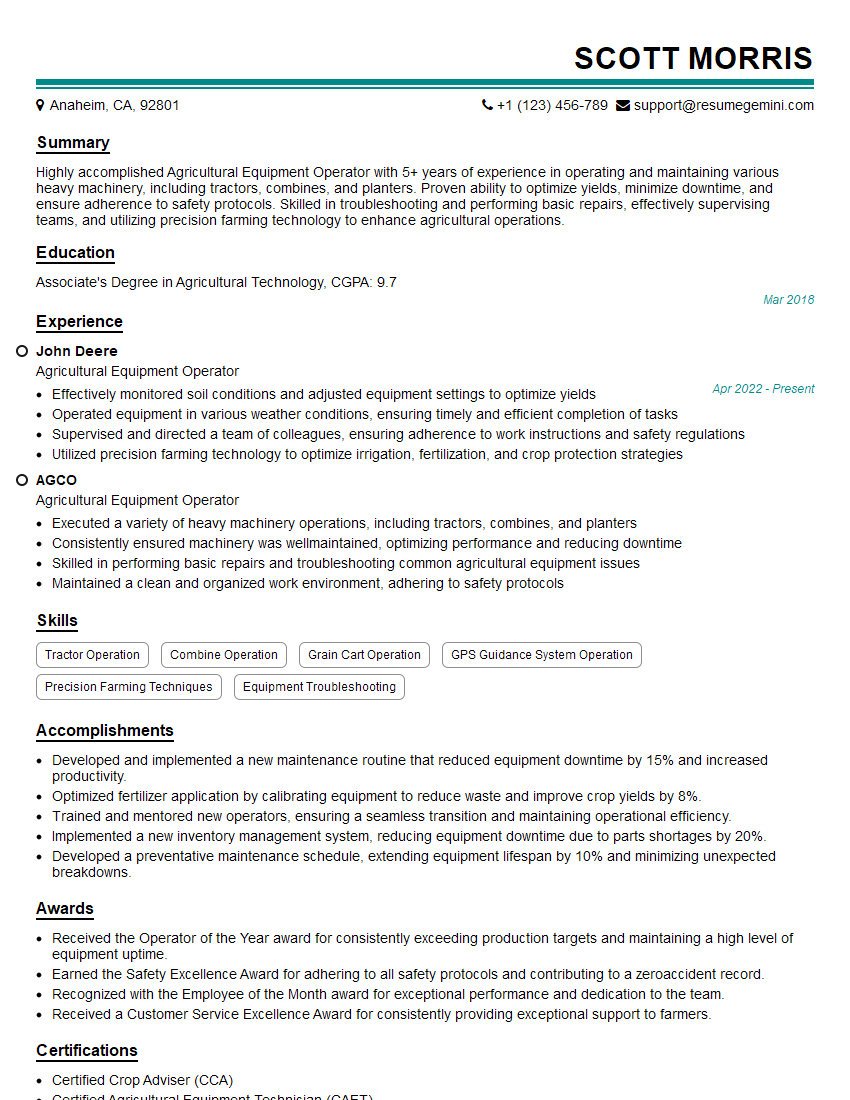
Mastering the operation of tillage equipment is crucial for career advancement in the agricultural sector. Proficiency in this area demonstrates valuable skills and knowledge sought after by employers. To significantly boost your job prospects, creating a strong, ATS-friendly resume is essential. ResumeGemini is a trusted resource that can help you craft a professional and impactful resume, highlighting your skills and experience in operating tillage equipment. Examples of resumes tailored to this field are available to help you get started.
Explore more articles
Users Rating of Our Blogs
Share Your Experience
We value your feedback! Please rate our content and share your thoughts (optional).
What Readers Say About Our Blog
Very informative content, great job.
good