Interviews are more than just a Q&A session—they’re a chance to prove your worth. This blog dives into essential Operation of Cutting/Embossing Machines interview questions and expert tips to help you align your answers with what hiring managers are looking for. Start preparing to shine!
Questions Asked in Operation of Cutting/Embossing Machines Interview
Q 1. Describe your experience operating different types of cutting machines.
Throughout my career, I’ve operated a wide range of cutting machines, from simple hand-crank models to fully automated, computer-controlled systems. This includes experience with flatbed die-cutting machines, rotary die-cutting machines, and kiss-cutting machines. Each machine type presents unique challenges and opportunities. For instance, hand-crank machines demand precision and patience, while automated systems require a strong understanding of programming and digital workflows. I’ve worked with machines using various materials, from paper and cardstock to thicker materials like leather and plastics, each requiring adjusted machine settings and techniques.
- Flatbed Die-Cutting Machines: These are versatile and ideal for smaller-scale projects or intricate designs. I’m proficient in setting up the die, adjusting pressure, and ensuring clean cuts.
- Rotary Die-Cutting Machines: These machines excel at high-volume production runs. My experience includes setting up the rotary die, monitoring speed and pressure, and managing the continuous feed of materials.
- Kiss-Cutting Machines: I’m familiar with the nuances of kiss-cutting, crucial for applications requiring partial cuts, like sticker sheets or labels. I understand how to adjust blade depth and pressure for optimal results.
Q 2. Explain the process of setting up a cutting die on a machine.
Setting up a cutting die involves a series of precise steps to ensure a clean and accurate cut. Think of it like setting up a stage for a performance – everything needs to be in its perfect place. First, you carefully inspect the die for any damage or defects. Then, you securely mount the die onto the machine’s platen, ensuring it’s perfectly aligned and firmly fixed. This often involves using precision tools and ensuring the correct orientation. Next, you adjust the machine’s pressure settings based on the material’s thickness and the die’s design – too much pressure can damage the material or the die itself, while too little will result in incomplete cuts. Finally, a test run is essential to verify the setup’s accuracy before proceeding with the full production run.
For example, when setting up a complex die with multiple cutting elements and embossing sections, I would start by mounting the most critical elements first, meticulously aligning them before proceeding with the others. A slight misalignment can lead to significant errors in the final product.
Q 3. How do you ensure accurate registration on a cutting/embossing machine?
Accurate registration is crucial to ensure consistent and precise results, especially when dealing with multi-color printing or complex designs. It’s like perfectly aligning the puzzle pieces to create a complete picture. Several techniques are employed. Firstly, many machines have registration marks (small printed guides) that allow the machine to accurately align the material. I ensure these marks are correctly positioned and aligned with the machine’s sensors. Secondly, careful attention to the material’s feed and alignment throughout the cutting process is essential. Thirdly, maintaining the machine’s calibration and ensuring consistent material feed are crucial factors. For more complex projects, I might use specialized registration systems or software that automatically adjusts the alignment based on digital data.
For instance, when working on a project that requires precise alignment of printed images and die-cut shapes, I would use a combination of registration marks and visual inspection to ensure flawless registration before initiating the cutting process.
Q 4. What safety precautions do you follow when operating cutting/embossing machinery?
Safety is paramount when operating cutting and embossing machines. These are powerful machines with sharp blades and moving parts that can cause serious injury. My safety practices include always using appropriate personal protective equipment (PPE) like safety glasses, gloves, and hearing protection. I meticulously inspect the machine before each use, checking for any loose parts, damage, or malfunction. I never operate the machine if it’s damaged or malfunctioning. I always ensure that the machine is properly shut down and cleared of materials before any maintenance or adjustments are made. I also follow all lockout/tagout procedures to prevent accidental startup. Finally, I keep the work area clean and organized to prevent accidents.
Think of it like working with a finely tuned instrument – careful handling and respect for its power are essential.
Q 5. How do you troubleshoot common issues like jams or miscuts?
Troubleshooting is a critical skill. Jams are usually caused by material build-up or misfeeding. I systematically investigate the problem, starting with checking the material’s feed path for obstructions. Miscuts are often due to improper die setup, incorrect pressure, or dull blades. My approach involves examining the die for damage, verifying the pressure settings, and checking for blade sharpness. If it’s a persistent issue, I’ll consult the machine’s manual and might even contact the manufacturer for support. I document all troubleshooting steps and solutions to help prevent similar issues in the future. I maintain a detailed log of maintenance and repairs for each machine.
For example, if I encounter repeated jams, I would systematically check the material for wrinkles, the rollers for debris, and the die for any misalignment before considering more complex issues.
Q 6. Describe your experience with different types of cutting dies.
My experience encompasses a wide variety of cutting dies, each suited for specific applications and materials. I’ve worked with steel rule dies, which are robust and suitable for large-scale production; composite dies, offering a balance between durability and cost-effectiveness; and laser-cut dies, providing intricate designs and flexibility for small-scale or prototype work. Furthermore, I have experience with embossing dies, creating raised or indented designs on materials. The choice of die depends on factors like the material being cut, the complexity of the design, and the production volume.
- Steel Rule Dies: Durable and precise for high-volume production.
- Composite Dies: Cost-effective for moderate-volume production.
- Laser-Cut Dies: Ideal for intricate designs and prototypes.
- Embossing Dies: Used to create raised or indented designs.
Q 7. How do you maintain the sharpness and condition of cutting dies?
Maintaining the sharpness and condition of cutting dies is essential for consistent and clean cuts. Regular inspection is key – I check for burrs, damage, and wear and tear. I use appropriate cleaning methods to remove any debris or material residue. For steel rule dies, I might use specialized sharpening tools or send them to a professional sharpening service. Proper storage is also crucial; dies are often stored in protective cases to prevent damage and corrosion. This proactive maintenance extends the die’s lifespan and ensures the quality of the final product. It’s like regularly servicing a finely tuned machine; consistent maintenance ensures optimum performance and longevity.
Ignoring this maintenance can lead to poor quality cuts, increased material waste, and eventually, the need for premature die replacement, resulting in increased costs.
Q 8. Explain your experience with different types of embossing techniques.
My experience encompasses a wide range of embossing techniques, from the classic blind embossing, where pressure creates a raised design without ink, to the more sophisticated registered embossing, which aligns the embossing with a printed design for a highly refined look. I’m also proficient in foil embossing, which adds a metallic or colored foil to the raised design for an elegant finish.
- Blind embossing: Think of the texture on a high-quality business card. It adds depth and sophistication without extra color.
- Registered embossing: Imagine a beautifully embossed wedding invitation where the intricate design is perfectly aligned with the printed text and imagery. This requires precise machine calibration and setup.
- Foil embossing: This is commonly seen on luxury packaging or certificates, adding a touch of luxury and visual interest.
I’ve worked with various embossing dies, from simple to intricately designed, and understand the nuances of adjusting pressure and temperature to achieve the desired effect on different materials.
Q 9. How do you adjust machine settings for different materials?
Adjusting machine settings depends heavily on the material being processed. Think of it like baking – you wouldn’t use the same recipe for a cake as for a cookie.
For instance, when working with thin paper, I’d use a lower pressure and speed to avoid tearing. With thicker card stock, I’d increase the pressure to create a deeper emboss. Similarly, materials like fabric or leather require entirely different settings to avoid damaging them. I usually start by consulting the machine’s manual for baseline settings for each material type and then fine-tune them based on test runs. This iterative process is crucial to achieving the desired outcome.
Factors I adjust include:
- Pressure: This dictates the depth of the cut or emboss.
- Speed: Slower speeds provide more control and precision, especially for intricate designs.
- Temperature (if applicable): Heat is crucial for certain embossing techniques, like foil embossing, and needs precise control to prevent burning or uneven results.
- Die selection: Choosing the right die is fundamental. A poorly chosen die can lead to damaged materials or subpar results.
Q 10. Describe your experience with quality control procedures for cutting and embossing.
Quality control is paramount in cutting and embossing. My procedures begin with a thorough inspection of the materials for defects and consistency. Before the actual run, I perform test runs to verify the settings and check for any issues with the dies or the machine. Throughout the production process, I regularly monitor the output, checking for any inconsistencies, imperfections, or defects. This includes verifying the accuracy of cutting and embossing, checking for misalignment, and ensuring consistent depth and sharpness.
Post-production, a final inspection is carried out to ensure that the entire batch meets the required quality standards. Any rejected pieces are documented and analyzed to identify potential causes for future improvement. Statistical Process Control (SPC) charts are utilized to track key quality metrics and identify trends. For example, we might track the number of defects per 100 pieces to monitor machine performance and die wear.
Q 11. How do you calculate the production time for a cutting/embossing job?
Calculating production time involves several factors. First, the size and complexity of the design significantly impact the processing time. An intricate design requires more time per piece than a simple one. The number of pieces also plays a vital role: a larger quantity naturally takes longer. The material thickness and type also matter; thicker materials need more time for processing. Machine speed and setup time are additional factors.
For instance, a large batch of simple business cards might take significantly less time than a small run of complex, foil-embossed invitations. I typically create a production schedule factoring all of these variables and incorporate buffer time for unexpected delays. A formula I often use is:
Production Time = (Number of Pieces * Time per Piece) + Setup Time + Buffer TimeThe ‘Time per Piece’ is determined through testing and experience and is adjusted based on material and design complexity.
Q 12. What is your experience with preventative maintenance on these machines?
Preventative maintenance is critical for maintaining the efficiency and longevity of cutting and embossing machines. My routine includes daily checks of the machine’s operational status, lubricating moving parts, and cleaning the work area. Weekly tasks involve more thorough inspections of the dies for wear and tear and cleaning of any accumulated debris.
Monthly maintenance might include a more comprehensive check of the machine’s electrical components and pressure systems. Scheduling regular servicing by qualified technicians is also essential to identify and address potential issues early on. This proactive approach prevents costly repairs and downtime, ensuring consistent and reliable machine operation. A well-maintained machine also minimizes the risk of producing faulty items.
Q 13. How do you handle material waste and disposal?
Material waste and disposal are handled responsibly and efficiently. We strive to minimize waste by optimizing material usage and planning production runs effectively. Scrap materials are carefully segregated according to their type (paper, cardstock, fabric, etc.) for proper recycling or disposal. We adhere to all relevant environmental regulations and partner with recycling facilities for responsible disposal of waste materials. Accurate tracking of waste is essential for identifying areas for improvement and reducing our environmental footprint. Regular training on waste reduction strategies ensures that all team members are well-informed and contribute to environmentally sound practices.
Q 14. Describe your experience working with different materials (paper, cardboard, fabric, etc.)
My experience spans a wide range of materials, including various paper weights and types (coated, uncoated, textured), different cardboard thicknesses and compositions, various fabrics (cotton, linen, synthetic), and even leather. Each material presents unique challenges and requires adjustments in machine settings and cutting/embossing techniques. For example, working with delicate fabrics requires significantly lower pressure than working with thick cardboard. The choice of die material is also crucial; certain dies are better suited for certain materials. I possess a strong understanding of the properties of each material and can select the optimal settings and dies to achieve the best results while avoiding material damage. I’ve worked on projects from intricate fabric embossing for apparel to precise die-cutting of cardboard for packaging, developing expertise in handling the unique characteristics of each material.
Q 15. How do you identify and solve problems related to material feed and alignment?
Material feed and alignment issues are common in cutting and embossing. Think of it like trying to perfectly stack pancakes – if they’re not aligned, the final result will be messy. Troubleshooting begins with observation. Is the material bunching? Is it feeding unevenly? Is there a gap between the material and the cutting/embossing element?
- Bunching: This often points to issues with the feed rollers. Check for wear, debris, or misalignment. Proper tension adjustment is crucial here. Imagine the rollers as a conveyor belt – if the belt is too tight or loose, the items won’t move smoothly.
- Uneven feeding: This might stem from inconsistent material thickness or imperfections in the material itself. Carefully examine the material before processing, and consider using a more consistent material supply. Sometimes, adjusting the feed speed can help.
- Gaps: Gaps indicate a problem with material guides or the machine’s alignment. Check for wear or damage on these guides. Precise adjustment and regular maintenance prevent this.
Solving these problems requires a systematic approach. I start by visually inspecting the entire feed system, then check the machine’s settings, and finally, consider potential material-related issues. If the problem persists, more in-depth troubleshooting involving the machine’s mechanics might be necessary.
Career Expert Tips:
- Ace those interviews! Prepare effectively by reviewing the Top 50 Most Common Interview Questions on ResumeGemini.
- Navigate your job search with confidence! Explore a wide range of Career Tips on ResumeGemini. Learn about common challenges and recommendations to overcome them.
- Craft the perfect resume! Master the Art of Resume Writing with ResumeGemini’s guide. Showcase your unique qualifications and achievements effectively.
- Don’t miss out on holiday savings! Build your dream resume with ResumeGemini’s ATS optimized templates.
Q 16. What is your experience with different types of cutting machine controls (manual, automated, PLC)?
I’m proficient with various cutting machine controls. I’ve worked extensively with manual, automated, and PLC-controlled systems. Manual controls are ideal for simple tasks and allow for precise, hands-on adjustments, like fine-tuning the pressure on a smaller embossing press. Automated systems, on the other hand, excel at high-volume, consistent production – think of automated die-cutting machines in a packaging factory. They offer pre-programmed settings for various materials and operations. Finally, PLC (Programmable Logic Controller) systems offer the most sophisticated control, enabling complex sequences, monitoring, and feedback mechanisms for optimal efficiency and quality control in large scale operations.
My experience includes programming PLC systems to manage parameters like cutting depth, speed, and pressure based on feedback from sensors measuring material properties or machine status. This automation improves quality and reduces operator intervention.
Q 17. How familiar are you with the safety regulations for operating this type of equipment?
Safety is paramount. I’m fully aware of and strictly adhere to all relevant safety regulations for operating cutting and embossing machines. This includes:
- Lockout/Tagout procedures: Always ensuring the machine is completely powered down and locked out before performing maintenance or repairs.
- Personal Protective Equipment (PPE): Consistent use of safety glasses, gloves, and hearing protection.
- Machine guards: Verifying all guards are in place and functioning correctly before operation.
- Emergency stop procedures: Knowing the location and operation of emergency stop buttons and understanding when to use them.
- Material handling: Properly handling materials to prevent injuries from sharp edges or heavy loads.
I’ve participated in regular safety training and am comfortable conducting risk assessments before starting any operation. Safety is not just a checklist but a mindset ingrained in my work practices.
Q 18. Describe your experience with different types of embossing plates/dies.
My experience encompasses a wide range of embossing plates and dies. The choice of plate or die depends heavily on the desired embossing effect, material being used, and production volume. For instance:
- Steel rule dies: These are very precise and durable, often used for high-volume production of intricate designs in materials like cardstock or paper.
- Photopolymer plates: Flexible and suitable for creating a variety of textures and designs; ideal for smaller production runs and prototyping on less rigid materials.
- Brass dies: Known for their durability and longevity, often used for detailed embossing on metals and thicker materials.
- Rotary embossing cylinders: These are for high-speed, continuous embossing on larger volumes of thinner materials, often seen in industrial applications like paper and foil embossing.
I’m familiar with the maintenance and care of each type, understanding how factors like temperature and pressure affect the quality of the embossing. I can also assess the condition of a die to determine its suitability for a given job and predict potential issues before they occur.
Q 19. How do you clean and maintain the embossing rollers?
Cleaning and maintaining embossing rollers is crucial for preventing damage to the rollers themselves and ensuring consistent embossing results. It’s a bit like cleaning a paint roller after a painting job to ensure the next project gets a fresh start. My process involves:
- Powering down and locking out the machine: Safety first!
- Removing debris: Using appropriate tools like brushes and compressed air to remove loose debris.
- Cleaning: Applying a suitable cleaning agent, such as a specialized roller cleaner, and carefully wiping or brushing the rollers. The cleaning agent should be compatible with the roller material.
- Inspecting for damage: Checking for any signs of wear, scratches, or damage. Minor scratches can often be polished out.
- Lubrication: Applying a recommended lubricant (if needed) to the bearings and other moving parts to ensure smooth operation and extend the lifespan of the rollers.
Regular cleaning and maintenance are essential to maintaining high-quality embossing and preventing costly repairs or replacements.
Q 20. What’s your experience with different types of cutting blades and their applications?
Cutting blades are the heart of any cutting machine, and the selection depends on the material and the desired cut. Imagine choosing the right knife for different tasks – a butter knife for soft butter and a steak knife for meat.
- Steel blades: These are common for general-purpose cutting across various materials, offering a balance of sharpness, durability, and cost-effectiveness.
- Rotary blades: Typically used in rotary cutting machines for high-speed, continuous cutting of materials like paper, fabric, or thin plastics.
- Laser blades: Utilized for extremely precise and intricate cutting, especially in materials sensitive to pressure or heat.
- Punching blades: For clean, precise cuts of specific shapes through thicker materials, these are frequently employed in specialized die cutting.
Choosing the right blade for a given material and design is crucial for obtaining a consistent, clean cut. I can assess the material properties and determine the optimal blade type, as well as recognize signs of blade wear and dullness. This prevents poor quality cuts and machine damage.
Q 21. How would you address inconsistent cuts or embossing results?
Inconsistent cuts or embossing indicate underlying problems that demand careful investigation. Think of baking a cake – inconsistent results point to variations in ingredients or baking time. Here’s how I approach it:
- Blade/Die Condition: Check for dullness, damage, or misalignment in the cutting blades or embossing dies. A dull blade will create ragged cuts, while a misaligned die will produce uneven embossing.
- Machine Settings: Review the machine settings, including pressure, speed, and depth. Inconsistent settings lead to inconsistent results. For example, insufficient pressure will produce light embossing.
- Material Consistency: Inspect the material for inconsistencies in thickness, moisture content, or texture. Materials with variations might respond differently to the cutting or embossing process.
- Machine Maintenance: Ensure that the machine is properly lubricated and maintained. Poor maintenance can lead to inconsistent performance.
Addressing this involves systematically checking each of these potential causes. I’d start with the simplest – visually inspecting the tools – before moving to more complex adjustments or maintenance tasks. The goal is to identify the root cause to prevent recurrence.
Q 22. How do you perform a routine inspection of the cutting/embossing machine?
A routine inspection of a cutting/embossing machine is crucial for safety and consistent performance. Think of it like a pre-flight check for an airplane – you wouldn’t want to take off without one! My inspection process is thorough and follows a checklist.
- Visual Inspection: I start with a visual check for any loose parts, damage to the machine’s frame or tooling, or signs of wear and tear on the cutting or embossing dies. This includes checking belts, rollers, and the overall cleanliness of the machine.
- Pressure System Check: I verify the pressure gauge readings are accurate and within the recommended operating range for the material being processed. This is particularly important for embossing, where consistent pressure is critical for achieving the desired effect.
- Safety Mechanisms: I test all safety mechanisms, such as emergency stops, light curtains, and interlocks, ensuring they function correctly. This is paramount for worker safety.
- Material Feed System: I inspect the material feed system, making sure there are no blockages or malfunctions. A smooth feed system prevents material jams and ensures consistent cutting or embossing.
- Lubrication: I check lubrication points and ensure proper lubrication of moving parts, according to the manufacturer’s instructions. This helps prevent wear and tear and keeps the machine running smoothly.
For instance, during a recent inspection, I discovered a slightly loose bolt on the pressure adjustment lever. Addressing this minor issue prevented potential damage and ensured consistent embossing pressure.
Q 23. What’s your experience with using different software for designing cuts and embossing?
I’m proficient in several design software packages for creating cutting and embossing designs. My experience spans from industry-standard software like Adobe Illustrator and CorelDRAW to specialized programs tailored for die-cutting machines.
- Adobe Illustrator: I use Illustrator extensively for creating intricate vector designs with precise paths for both cutting and embossing lines. Its capabilities for complex shapes and intricate details are invaluable.
- CorelDRAW: CorelDRAW offers similar functionalities to Illustrator, and I frequently use it for its excellent compatibility with different die-cutting machine software.
- Specialized Software: I’ve also worked with software directly integrated with specific die-cutting machines, such as those provided by manufacturers like Cricut or Silhouette. These often offer user-friendly interfaces with features for creating and manipulating designs specifically optimized for their machines.
For example, when designing a complex layered die-cut card, Illustrator’s ability to create and manipulate individual layers allowed me to perfectly align intricate cutting lines with embossed elements. Using specialized software allowed me to directly upload and process the designs with minimal conversion issues.
Q 24. Describe your experience with the setup and use of different pressure systems on the machine.
My experience with pressure systems is extensive. Different machines utilize various pressure systems – pneumatic, hydraulic, or even mechanical – each requiring a different approach to setup and operation.
- Pneumatic Systems: These use compressed air to generate pressure. Setting up involves adjusting air pressure regulators to achieve the desired force for cutting or embossing. Accurate gauge readings and consistent air supply are crucial.
- Hydraulic Systems: These systems use oil under pressure. Setup usually involves adjusting valves to control the hydraulic fluid pressure, requiring careful calibration to avoid damage to the machine or materials.
- Mechanical Systems: These rely on mechanical levers and adjustments, offering a more hands-on approach to pressure control. Precise adjustments are key to achieving consistent results.
For instance, when working with a delicate material like vellum, I meticulously adjusted the pneumatic pressure to a lower setting to prevent tearing during the embossing process. Conversely, thicker materials require higher pressures, and I always ensure the system can safely handle the increased load.
Q 25. How do you handle variations in material thickness during the cutting process?
Handling variations in material thickness is a crucial skill. Inconsistent material thickness can lead to uneven cuts or embossing and even damage to the tooling. My approach involves a combination of strategies:
- Material Pre-Inspection: Before starting a job, I thoroughly inspect the material batch for thickness variations. This helps me anticipate potential issues and adjust the machine accordingly.
- Adjustable Pressure Settings: Many machines allow for fine-tuning of pressure. I use this feature to compensate for slight thickness variations. For thicker sections, I might increase the pressure slightly, while for thinner sections, I reduce it.
- Multiple Passes: In some cases, multiple passes with adjusted pressure settings might be necessary to achieve a consistent result on materials with significant thickness variations.
- Tooling Selection: The choice of cutting or embossing die plays a crucial role. Dull or improperly maintained dies will exacerbate problems caused by inconsistent material thickness. Sharp, well-maintained tooling helps mitigate variations.
For example, when working with a batch of cardstock that had noticeable thickness variations, I used a combination of adjustable pressure settings and multiple passes to ensure the cuts were clean and consistent across the entire sheet.
Q 26. Explain your experience with troubleshooting electrical or mechanical issues.
Troubleshooting electrical or mechanical issues is a regular part of my job. I approach it systematically, combining my practical experience with safety protocols.
- Safety First: Always disconnect the power before attempting any repairs or troubleshooting. Safety is paramount.
- Systematic Approach: I follow a logical process of elimination, starting with the most likely causes. For electrical issues, I check power supply, fuses, wiring, and motor connections. For mechanical problems, I examine belts, gears, rollers, and other moving parts for wear, damage, or misalignment.
- Documentation: I maintain detailed records of repairs and maintenance, including dates, issues encountered, and solutions implemented. This helps prevent recurring problems and provides valuable data for future maintenance planning.
- Seek Expert Help: When facing complex or persistent problems beyond my expertise, I don’t hesitate to contact qualified technicians or the machine manufacturer for support.
Once, I encountered a recurring electrical fault causing the machine to shut down intermittently. Through systematic troubleshooting, I identified a loose connection in the control panel, which I repaired, resolving the issue. Documentation of the problem and its solution helped us avoid similar issues in the future.
Q 27. How would you train a new operator on the safe and effective operation of the machinery?
Training new operators is crucial for safety and productivity. My training approach is comprehensive and emphasizes both theoretical knowledge and hands-on practice.
- Safety Briefing: I start with a thorough safety briefing covering all safety protocols, emergency procedures, and the use of personal protective equipment (PPE).
- Machine Overview: I provide a detailed overview of the machine’s components, functions, and operating procedures.
- Hands-on Training: I guide new operators through a series of practical exercises, starting with simple tasks and gradually increasing complexity. This allows for supervised practice and immediate feedback.
- Troubleshooting: I teach them basic troubleshooting techniques and how to identify common problems.
- Continuous Evaluation: I regularly assess their progress and provide additional training or support as needed.
For example, when training a new operator, I start with simple cutting tasks on scrap materials, gradually increasing the complexity and introducing embossing techniques once they demonstrate proficiency with basic cutting operations. This ensures a safe and effective learning experience.
Q 28. How do you ensure the efficient use of materials to minimize waste?
Efficient material usage and waste minimization are critical for both cost savings and environmental responsibility. I employ several strategies:
- Precise Design: Careful design is paramount. I optimize designs to minimize material usage while maintaining the desired quality and aesthetics. This involves efficient nesting of designs and utilizing the available material space to its fullest extent.
- Accurate Measurement & Cutting: Precise measurement and cutting techniques are crucial. I utilize the machine’s features for accurate material alignment and cutting to minimize waste due to inaccuracies.
- Material Selection: I choose materials that are appropriate for the job and minimize waste. This may involve selecting pre-cut sheets or rolls in sizes appropriate for the project.
- Waste Recycling: I implement a waste management system to sort and recycle appropriate materials. This reduces landfill waste and contributes to environmental sustainability.
For example, when designing a series of business cards, I carefully nested the design to minimize material waste. By optimizing the arrangement of cards on the sheet, we reduced waste by 15% compared to a less efficient arrangement.
Key Topics to Learn for Operation of Cutting/Embossing Machines Interview
- Machine Operation & Safety: Understanding the various controls, safety protocols, and emergency procedures specific to cutting and embossing machines. This includes pre-operation checks and routine maintenance.
- Material Handling & Selection: Knowing the properties of different materials (paper, cardstock, plastics, etc.) and selecting the appropriate materials and machine settings for optimal results. This also includes safe and efficient material loading and unloading techniques.
- Die Setup & Adjustment: Mastering the precise setup and adjustment of cutting and embossing dies, ensuring accurate registration and consistent results. Troubleshooting common die-related issues is crucial.
- Quality Control & Troubleshooting: Identifying and resolving common issues such as jams, miscuts, and inconsistencies in embossing depth. Understanding quality control measures and implementing corrective actions are key.
- Maintenance & Cleaning: Knowing the proper procedures for routine maintenance, cleaning, and lubrication of cutting and embossing machines to ensure optimal performance and longevity. This also includes recognizing signs of wear and tear.
- Production Processes & Efficiency: Understanding the workflow involved in cutting and embossing operations, optimizing speed and efficiency while maintaining quality standards. This may involve knowledge of production scheduling and workflow management.
- Technical Specifications & Terminology: Familiarity with technical specifications, industry terminology, and relevant safety regulations related to cutting and embossing machines.
Next Steps
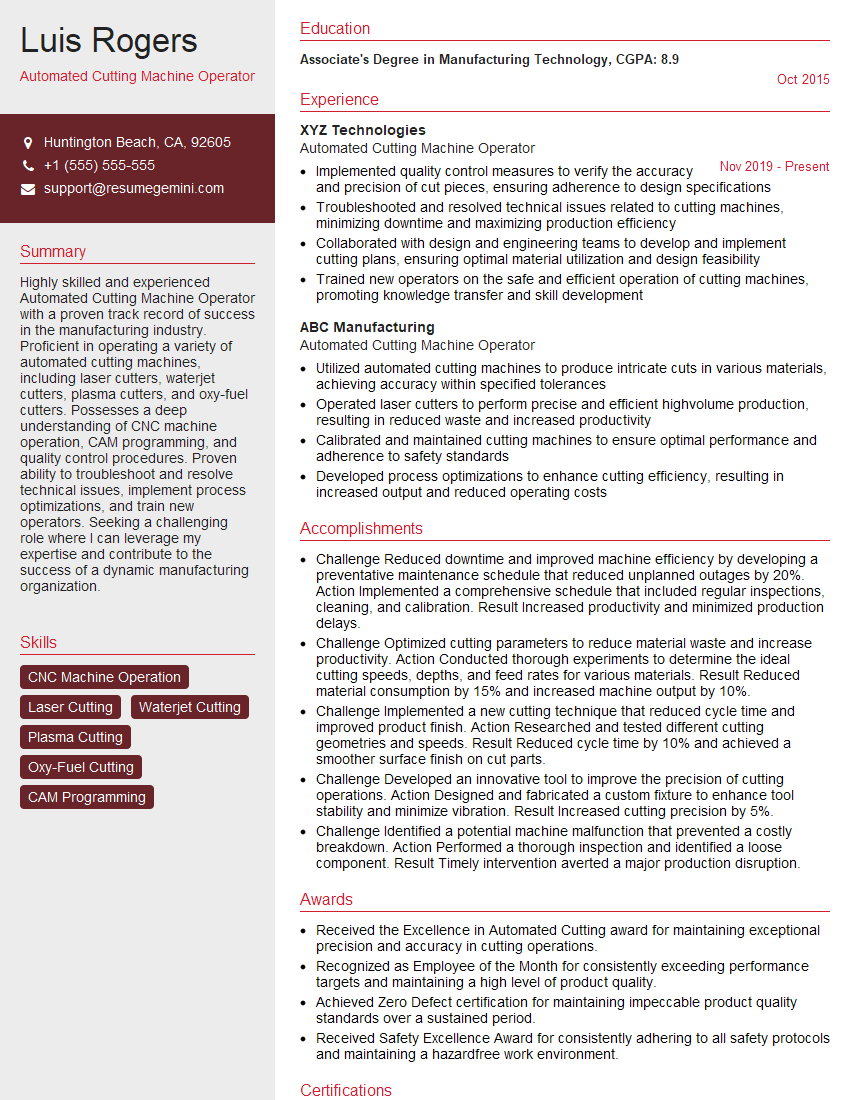
Mastering the operation of cutting and embossing machines opens doors to exciting career opportunities within manufacturing, print finishing, and related industries. Your expertise in this area is highly valued, and showcasing your skills effectively is crucial for securing your dream role. Creating an ATS-friendly resume is vital for getting your application noticed by recruiters and hiring managers. ResumeGemini is a trusted resource that can help you build a professional and impactful resume tailored to your specific skills and experience. Examples of resumes tailored to Operation of Cutting/Embossing Machines are available to help guide you. Invest time in crafting a compelling resume – it’s your first impression, make it count!


Explore more articles
Users Rating of Our Blogs
Share Your Experience
We value your feedback! Please rate our content and share your thoughts (optional).
What Readers Say About Our Blog
Very informative content, great job.
good