Every successful interview starts with knowing what to expect. In this blog, we’ll take you through the top Optical Component Design interview questions, breaking them down with expert tips to help you deliver impactful answers. Step into your next interview fully prepared and ready to succeed.
Questions Asked in Optical Component Design Interview
Q 1. Explain the difference between paraxial and non-paraxial ray tracing.
Paraxial ray tracing and non-paraxial ray tracing are two distinct approaches to modeling the propagation of light through an optical system. The key difference lies in the assumptions made about the angles of the rays.
Paraxial ray tracing employs the paraxial approximation, which assumes that all rays are close to the optical axis (the central axis of symmetry of the system). This simplification allows for the use of linear equations, making calculations significantly easier. Angles are assumed to be small enough that sin θ ≈ θ and cos θ ≈ 1. This is a good approximation for systems with small apertures and small field angles.
Non-paraxial ray tracing, on the other hand, doesn’t make the small angle approximation. It utilizes the exact trigonometric relationships for ray propagation and accurately accounts for the effects of large angles, especially important in wide-angle systems or systems with high numerical apertures. It’s more computationally intensive but necessary for accurate modeling of aberrations in such systems.
Think of it like this: paraxial ray tracing is like drawing a map using a simplified, small-scale representation, while non-paraxial ray tracing is like creating a detailed 3D model, capturing every nuance of the terrain. Paraxial ray tracing is a great starting point for initial design and analysis, but non-paraxial ray tracing is crucial for final optimization and accurate performance prediction.
Q 2. Describe your experience with different optical design software (e.g., Zemax, Code V).
Throughout my career, I’ve extensively utilized both Zemax and Code V, two leading optical design software packages. My experience spans from basic lens design to complex system optimization, including freeform surfaces and diffractive optics.
In Zemax, I’m proficient in using various optimization algorithms, tolerance analysis, and the creation of detailed performance reports. I’ve successfully used Zemax’s non-sequential mode to model systems with complex geometries and scattering effects, such as those found in illumination systems. A recent project involved using Zemax to design a high-precision imaging system for a satellite application, where minimizing aberrations and maximizing throughput was paramount. This required a deep understanding of the software’s capabilities and optimization techniques.
With Code V, I’ve gained expertise in its powerful macro language for automating design tasks and performing custom analyses. I’ve used it extensively for tolerancing studies, where I’ve developed custom scripts to analyze the sensitivity of the system’s performance to manufacturing variations. I remember one instance where Code V’s robust tolerancing capabilities helped us identify a critical manufacturing tolerance that would greatly impact the final system performance; identifying this early saved significant costs.
Both software packages have their strengths; Zemax is perhaps slightly more intuitive for beginners, while Code V provides greater flexibility and control for advanced users. My proficiency in both allows me to choose the best tool for the task at hand.
Q 3. How do you optimize an optical system for minimum aberrations?
Optimizing an optical system for minimum aberrations is a multifaceted process, typically involving iterative design and analysis. The goal is to minimize various aberrations like spherical aberration, coma, astigmatism, field curvature, and distortion.
My approach involves a combination of techniques:
- Initial Design: Starting with a suitable initial design based on established lens formulas or previous designs with similar specifications.
- Aberration Analysis: Using ray tracing software (like Zemax or Code V) to analyze the aberrations and identify the dominant contributors.
- Optimization Algorithms: Employing optimization algorithms like damped least squares or global optimization techniques to systematically adjust design parameters (radii of curvature, thicknesses, lens separations, etc.) to reduce aberrations. Careful selection of the merit function (a mathematical expression quantifying the aberrations) is crucial for successful optimization.
- Aspheric Surfaces: Utilizing aspheric surfaces to correct aberrations more effectively than with purely spherical surfaces. Aspheric surfaces offer greater design freedom.
- Diffractive Optical Elements (DOEs): Integrating DOEs to provide additional control over wavefront shaping and aberration correction.
- Iterative Refinement: Repeatedly analyzing and optimizing the design to achieve the desired level of performance. This often involves trade-offs between different aberrations.
For instance, designing a high-resolution camera lens might involve prioritizing the correction of spherical aberration and coma for optimal image quality across the field of view. A careful balance is needed, as optimizing one aberration may sometimes worsen another. Experienced judgment and knowledge are essential in navigating these trade-offs.
Q 4. What are the common types of optical coatings and their applications?
Optical coatings are thin layers of material deposited on the surface of optical components to modify their optical properties. Different coatings serve various purposes, impacting reflectivity, transmission, and other crucial aspects.
Common types include:
- Anti-reflection (AR) coatings: These minimize reflection at specific wavelengths, increasing transmission. They’re crucial for reducing stray light and improving image contrast. Examples include single-layer MgF2 coatings and multi-layer coatings using materials like SiO2 and TiO2.
- High-reflection (HR) coatings: These maximize reflection at specific wavelengths, often used in mirrors and laser cavities. They usually consist of multiple layers designed for high reflectivity at the desired wavelengths.
- Dichroic coatings: These selectively transmit or reflect specific wavelengths of light, creating color separation effects. They’re extensively used in various applications such as filters and beamsplitters.
- Polarizing coatings: These preferentially transmit or reflect light with a specific polarization, finding applications in polarimeters and polarization-sensitive imaging systems.
The choice of coating depends on the specific application. For example, a high-power laser system might require a coating optimized for high damage threshold and high reflectivity, whereas a camera lens would benefit from low-reflection coatings to minimize ghosting and improve image quality.
Q 5. Explain the concept of diffraction and its impact on optical system performance.
Diffraction is a wave phenomenon where light bends around obstacles or spreads out after passing through an aperture. It’s a fundamental aspect of light that impacts the performance of any optical system, especially at high resolutions or with small apertures.
In optical systems, diffraction limits the ability to perfectly focus light into an infinitesimally small point. Instead, the light forms a diffraction pattern, characterized by a central Airy disk surrounded by concentric rings. The size of the Airy disk determines the resolution limit of the system.
The impact on performance includes:
- Resolution Limit: Diffraction sets a fundamental limit on the smallest detail that an optical system can resolve. This is expressed by the Rayleigh criterion, which states that two point sources can be resolved if the center of the Airy disk of one source coincides with the first minimum of the Airy disk of the other.
- Spot Size: The diffraction pattern contributes to the overall spot size of an image, impacting image sharpness and quality.
- Strehl Ratio: The Strehl ratio quantifies the quality of the focused spot in comparison to an ideal diffraction-limited spot, indicating the presence of aberrations beyond diffraction effects.
Diffraction is particularly important in high-resolution imaging systems like microscopes and telescopes, where minimizing the size of the Airy disk is crucial for achieving optimal resolution. In these systems, the design aims to control diffraction effects and minimize their impact on image quality.
Q 6. How do you choose the appropriate lens material for a specific application?
Choosing the right lens material is crucial for optimal optical system performance. The selection process considers several key factors:
- Refractive Index (n): The refractive index determines how much the light bends when passing through the material. Higher refractive indices allow for more compact designs but can also introduce higher levels of chromatic aberration.
- Dispersion (dn/dλ): Dispersion describes how the refractive index varies with wavelength. Lower dispersion leads to reduced chromatic aberration, which is crucial for achromatic lenses.
- Transmission Characteristics: The material’s transmission across the relevant wavelength range is critical. Different materials have different transmission windows; for example, fused silica is highly transparent in the ultraviolet, visible, and near-infrared regions, while certain glasses exhibit higher absorption in the ultraviolet.
- Abbe Number (ν): The Abbe number is a measure of a material’s dispersion and is often used for comparing different glasses for chromatic aberration correction. A higher Abbe number indicates lower dispersion.
- Mechanical Properties: Factors like hardness, scratch resistance, and thermal expansion coefficient are important for practical considerations, including durability and environmental stability.
- Cost: Some materials are more expensive than others.
For example, when designing a telescope objective lens for visible light, a low-dispersion glass like BK7 might be chosen to minimize chromatic aberration, while for an infrared system, a material with high transmission in the infrared region would be necessary. The final decision often involves trade-offs between these various factors.
Q 7. Describe your experience with tolerancing optical systems.
Tolerancing optical systems is crucial for ensuring that the manufactured system meets its performance specifications. It involves determining acceptable variations in manufacturing parameters (e.g., lens radii, thicknesses, surface irregularities) while maintaining acceptable optical performance.
My approach typically involves:
- Identifying Critical Parameters: Determining which design parameters are most sensitive to manufacturing variations and have the greatest impact on the system’s performance.
- Tolerance Analysis: Using software tools (such as Zemax or Code V) to perform tolerance analysis, assessing the impact of individual parameter variations and their combinations on performance metrics (like spot size, wavefront error, and MTF). Monte Carlo analysis is frequently used to simulate the effect of random variations.
- Defining Tolerances: Assigning realistic tolerances to each parameter based on the analysis. This often involves considering manufacturing capabilities and costs.
- Sensitivity Analysis: Investigating the sensitivity of the optical performance to each tolerance to identify potential design weaknesses.
- Design Optimization for Manufacturing: In some cases, redesigning the system to reduce sensitivity to manufacturing variations may be necessary.
I’ve encountered situations where a seemingly minor manufacturing tolerance could lead to a significant degradation of system performance. Careful tolerancing analysis and sensitivity studies are therefore crucial for ensuring a successful and cost-effective manufacturing process. A good tolerancing strategy not only helps to ensure the system functions as expected but also minimizes manufacturing costs by enabling the use of cost-effective manufacturing processes.
Q 8. How do you perform optical system analysis and simulation?
Optical system analysis and simulation are crucial for designing and optimizing optical components and systems. I typically employ a combination of techniques, starting with ray tracing for a first-order approximation of the system’s performance. This involves tracing the path of light rays through the optical elements, considering refraction and reflection at each interface. Software like Zemax or Code V are indispensable tools for this. Ray tracing allows us to quickly evaluate key parameters like spot size, focal length, and aberrations.
For more precise analysis, especially when dealing with diffraction effects or complex optical phenomena, I rely on physical optics propagation (POP) methods. These methods solve Maxwell’s equations numerically, providing a wave-based description of light propagation. This is particularly important for characterizing the performance of diffractive optical elements or systems with sub-wavelength features. Finally, I use finite-element analysis (FEA) to model the mechanical and thermal behavior of the optical components, ensuring structural integrity and stability under operating conditions.
For example, in designing a high-precision telescope objective, I would initially use ray tracing to define the basic lens configuration and then employ POP to analyze wavefront errors and optimize the design for minimum aberration. FEA would then be employed to ensure the lens structure can withstand environmental stress without causing distortions affecting the image quality.
Q 9. What are the different types of optical fibers and their properties?
Optical fibers are the backbone of modern communication networks, classified primarily by their refractive index profile and material composition. The most common types are:
- Single-mode fibers: These fibers have a small core diameter (around 9 µm) supporting only one propagation mode. This leads to low dispersion and allows for transmission over very long distances with minimal signal degradation. Think of them as single lanes on a highway, leading to less congestion and faster travel.
- Multi-mode fibers: These fibers have larger core diameters (50 µm or 62.5 µm) allowing multiple modes to propagate simultaneously. This leads to higher dispersion and limits the transmission distance compared to single-mode fibers. This is like having multiple lanes on a highway; while it can handle more traffic initially, congestion can arise over long distances.
- Step-index fibers: The refractive index changes abruptly at the core-cladding boundary. These are simple to manufacture but have relatively high dispersion.
- Graded-index fibers: The refractive index gradually decreases from the center of the core to the cladding. This minimizes dispersion by equalizing the travel times of different modes.
Fiber properties such as attenuation (signal loss), numerical aperture (light-gathering ability), and dispersion (pulse broadening) are crucial parameters determining the fiber’s suitability for a particular application. For instance, single-mode fibers are preferred for long-haul telecommunications, while multi-mode fibers are often used in shorter-distance applications like local area networks.
Q 10. Explain the principles of optical interferometry.
Optical interferometry relies on the principle of superposition of light waves. When two or more coherent light waves meet, they interfere with each other, creating an interference pattern of bright and dark fringes. The location and intensity of these fringes depend on the phase difference between the waves. This phase difference is directly related to the path difference traveled by the light waves.
Imagine dropping two pebbles into a still pond; the resulting ripples overlap and interfere, creating a complex pattern. Similarly, in optical interferometry, the interference pattern reveals information about the optical path difference, which can be used to measure various parameters.
Different types of interferometers exist, such as Michelson, Mach-Zehnder, and Fabry-Perot interferometers, each designed for specific applications. For example, Michelson interferometers are used for precise measurements of distances and wavelengths, while Fabry-Perot interferometers are employed for high-resolution spectroscopy. In practice, interferometry finds applications in precision metrology, optical testing, and sensing.
Q 11. Describe your experience with optical testing and measurement techniques.
My experience encompasses a wide range of optical testing and measurement techniques. I am proficient in using various instruments including optical spectrum analyzers to characterize the spectral properties of light sources and optical fibers, power meters for measuring optical power, and optical time-domain reflectometers (OTDRs) for locating faults in optical fibers. I also have extensive experience with interferometric techniques such as those mentioned earlier, along with techniques like scattering measurements to assess the surface quality of optical components.
I’ve worked with automated testing setups and have developed custom software for data acquisition and analysis. A specific example from my previous role involved developing a high-throughput testing system for optical modulators, using a combination of interferometry and electrical measurements to characterize their performance over a wide range of operating conditions. This required meticulous attention to calibration and error analysis, critical for ensuring the accuracy and reliability of the measurements.
Q 12. How do you design for manufacturability in optical component design?
Designing for manufacturability in optical component design is crucial for ensuring both high yield and cost-effectiveness. It requires careful consideration of various factors throughout the design process. This includes choosing readily available materials and fabrication techniques, avoiding overly complex geometries, and designing for tolerances that can be easily achieved by manufacturing processes.
For instance, instead of designing a freeform lens with highly complex surface profiles, I might opt for a simpler aspheric lens that is easier to manufacture using existing diamond turning or molding techniques. Tolerance analysis is also critical, determining the acceptable variations in dimensions and surface quality that won’t significantly affect the component’s performance. This involves using statistical methods and Monte Carlo simulations to predict the impact of manufacturing variations. Furthermore, I always collaborate closely with manufacturing engineers to ensure the design is feasible and cost-effective.
A successful example involved a project where we replaced a complex multi-element lens with a single, optimized aspheric lens. This simplification significantly reduced the manufacturing costs and improved the yield while maintaining comparable optical performance.
Q 13. What are the challenges in designing high-power laser systems?
Designing high-power laser systems presents unique challenges, primarily due to the intense thermal loads and potential for damage to optical components. The key concerns include:
- Thermal management: High-power lasers generate significant heat, requiring effective cooling systems to prevent damage to the optical components and maintain stable operation. This often involves sophisticated thermal simulations and the use of materials with high thermal conductivity.
- Nonlinear effects: At high intensities, nonlinear optical effects like self-focusing and stimulated Raman scattering can occur, leading to beam distortion and energy loss. Careful design of the optical system and the use of appropriate materials are crucial to mitigate these effects.
- Damage thresholds: Optical components have damage thresholds, the maximum intensity they can withstand without being damaged. Careful selection of materials and coatings with high damage thresholds is essential. This often involves material science expertise and detailed characterization of the materials.
- Beam quality: Maintaining good beam quality at high powers is critical for many applications. This requires precise control of the laser beam’s spatial and temporal properties, demanding sophisticated beam shaping techniques and precise alignment of optical components.
In designing such systems, I extensively employ thermal simulations, nonlinear optical modeling, and damage threshold analysis to ensure the system’s safety and reliability. For example, a recent project involving a high-power fiber laser system required detailed thermal analysis to design a cooling system capable of dissipating the substantial heat generated.
Q 14. Explain the concept of polarization and its impact on optical systems.
Polarization refers to the orientation of the electric field vector of light. Light can be linearly polarized (electric field oscillates along a single plane), circularly polarized (electric field vector rotates in a circle), or elliptically polarized (a combination of linear and circular polarization). The polarization state of light can significantly impact the performance of optical systems.
Many optical components are polarization-sensitive; their properties depend on the input polarization state. For example, polarizing beam splitters separate light into different polarization components, while waveplates alter the polarization state of light. Failure to account for polarization effects can lead to significant performance degradation. In some applications, maintaining a specific polarization state is crucial; for instance, in fiber optic communication systems, polarization-maintaining fibers are used to prevent polarization-dependent loss.
Polarization effects need careful consideration during the design and analysis of optical systems. This often involves using polarization ray tracing tools, which simulate the evolution of the polarization state as light propagates through the system. I utilize Jones calculus or Mueller calculus for a mathematical representation of polarization transformations.
Consider a fiber optic gyroscope, a device that uses the Sagnac effect to measure rotation. Its sensitivity depends critically on maintaining a specific polarization state in the optical fiber coil. Improper handling of polarization effects would significantly compromise the device’s accuracy.
Q 15. How do you design for thermal stability in optical components?
Thermal stability in optical components is crucial for maintaining consistent performance. Temperature fluctuations can cause changes in refractive index, leading to shifts in wavelength and power, and even physical deformations that affect alignment. Designing for thermal stability involves several key strategies:
- Material Selection: Choosing materials with low coefficients of thermal expansion (CTE) is paramount. Materials like Invar (a nickel-iron alloy) or certain ceramics are preferred for their dimensional stability over a wide temperature range.
- Thermal Modeling and Simulation: Sophisticated software packages like COMSOL or ANSYS are used to simulate the thermal behavior of the component under various operating conditions. This allows engineers to predict temperature gradients and hotspots, informing design modifications.
- Thermal Management Techniques: These can include adding heat sinks, incorporating thermal vias for better heat dissipation, or using thermally conductive adhesives and encapsulants to improve heat transfer. For example, a laser diode might be mounted on a copper heat sink to rapidly dissipate heat generated during operation.
- Hermetic Sealing: In some applications, hermetically sealing the component protects it from environmental temperature changes and humidity which can affect performance.
- Temperature Compensation Techniques: In certain precision applications, active temperature control systems might be employed, or the design might incorporate components that compensate for temperature-induced changes in other components, such as using a temperature-dependent element to counteract wavelength shifts.
For example, in the design of a fiber optic gyroscope, maintaining stable temperature is critical to minimizing drift in the output signal. We would carefully choose low-CTE materials for the fiber coil housing and incorporate a thermoelectric cooler (TEC) for precise temperature control.
Career Expert Tips:
- Ace those interviews! Prepare effectively by reviewing the Top 50 Most Common Interview Questions on ResumeGemini.
- Navigate your job search with confidence! Explore a wide range of Career Tips on ResumeGemini. Learn about common challenges and recommendations to overcome them.
- Craft the perfect resume! Master the Art of Resume Writing with ResumeGemini’s guide. Showcase your unique qualifications and achievements effectively.
- Don’t miss out on holiday savings! Build your dream resume with ResumeGemini’s ATS optimized templates.
Q 16. What are the different types of optical sensors and their applications?
Optical sensors utilize the interaction of light with matter to measure various physical parameters. Here are some key types:
- Photodiodes/Phototransistors: These convert light intensity into an electrical signal. Applications include light meters, optical encoders, and smoke detectors.
- Photomultiplier Tubes (PMTs): Highly sensitive detectors that amplify weak light signals. Used in scientific instruments like spectrometers and medical imaging.
- Charge-Coupled Devices (CCDs) and Complementary Metal-Oxide-Semiconductor (CMOS) Sensors: These are array detectors capturing images. Used in digital cameras, telescopes, and medical imaging systems.
- Fiber Optic Sensors: These utilize changes in light propagation through an optical fiber to measure parameters like strain, temperature, or pressure. Widely used in structural health monitoring and industrial process control.
- Interferometric Sensors: Based on the interference of light waves. Highly sensitive to changes in refractive index, making them suitable for measuring displacement, strain, and other minute changes.
The choice of sensor depends heavily on the application’s sensitivity, bandwidth, and environmental requirements. For instance, a low-cost photodiode might suffice for a simple light switch, while a highly sensitive interferometric sensor would be necessary for precise strain measurements in a bridge.
Q 17. Describe your experience with optical system integration.
My experience with optical system integration encompasses the entire process, from component selection and design to assembly, testing, and alignment. I’ve worked on various projects, ranging from compact spectroscopic systems for biomedical applications to larger free-space optical communication systems. A key aspect of my approach is thorough planning and understanding the trade-offs between different component choices. For example, a smaller, more compact system might require higher precision components, resulting in a higher cost. Conversely, using larger components can ease assembly but increase the overall size and weight of the system.
During integration, I employ careful mechanical design practices to ensure accurate component placement and minimize stress on sensitive optical elements. I also utilize robust testing protocols to validate the performance of the integrated system, identifying and mitigating any issues before deployment. For example, in one project, we integrated a complex laser scanning system using multiple mirrors, lenses, and detectors. We employed a rigorous alignment procedure involving laser interferometry to ensure the precise positioning of all components to achieve the required scan resolution and accuracy.
Q 18. How do you handle optical system alignment and adjustment?
Optical system alignment and adjustment is a crucial step in ensuring optimal performance. It’s an iterative process involving precise positioning of optical components to achieve the desired optical path. Techniques employed include:
- Mechanical Alignment: Using precision stages, kinematic mounts, and other mechanical fixtures to position components accurately.
- Autocollimation: A technique utilizing a collimated beam reflected back onto its source to align optical elements with high precision.
- Laser Alignment: Using a laser beam to trace the optical path and identify misalignments.
- Interferometry: Precisely measuring wavefront distortions to assess the quality of alignment and identify aberrations.
- Shack-Hartmann wavefront sensors: These sensors measure the wavefront shape and provide detailed information about aberrations, allowing for highly accurate alignment adjustment.
A common challenge involves dealing with thermal drift, which can cause misalignment over time. Incorporating thermal management strategies and designing robust mechanical mounts that minimize thermal effects are crucial for long-term stability.
For example, in aligning a telescope, we would use autocollimation to align the primary and secondary mirrors, followed by laser alignment to ensure the optical path is accurately focused on the detector. Interferometry would be used for final fine-tuning and to verify the overall system performance.
Q 19. What are the different types of optical filters and their applications?
Optical filters selectively transmit or reflect specific wavelengths of light. Types include:
- Bandpass Filters: Transmit light within a specific wavelength range, blocking light outside this range. Used in spectroscopy, imaging, and laser systems to select specific wavelengths.
- Longpass Filters (High-pass): Transmit light above a certain wavelength, blocking shorter wavelengths. Used in fluorescence microscopy and laser safety.
- Shortpass Filters (Low-pass): Transmit light below a certain wavelength, blocking longer wavelengths. Often used in conjunction with longpass filters.
- Notch Filters: Block a narrow band of wavelengths while transmitting light outside this band. Used to remove unwanted wavelengths, such as laser lines or stray light.
- Neutral Density (ND) Filters: Attenuate light intensity uniformly across a broad wavelength range. Used in photography and microscopy to control light levels.
The choice of filter depends on the specific application and the desired spectral characteristics. For example, a bandpass filter centered at 633 nm would be used to isolate the red light from a He-Ne laser, while a notch filter might be used to remove a specific emission line from a spectrum.
Q 20. Explain the concept of chromatic aberration and how to correct it.
Chromatic aberration is a common optical defect where different wavelengths of light are refracted differently by a lens, resulting in a blurred or color-fringed image. This occurs because the refractive index of a lens material varies with wavelength.
There are two main types:
- Axial (Longitudinal) Chromatic Aberration: Different wavelengths focus at different distances from the lens.
- Lateral (Transverse) Chromatic Aberration: Different wavelengths focus at different points in the image plane, causing color fringing around the edges of objects.
Correction methods involve:
- Achromatic Doublets: Combining two lenses made of different materials with different dispersive properties (e.g., crown and flint glass). This design minimizes chromatic aberration over a limited wavelength range.
- Apochromatic Lenses: More complex designs that use three or more lens elements to minimize chromatic aberration over a wider wavelength range. These are more expensive but offer superior performance.
- Diffraction Gratings: These can be used as an alternative to lenses, particularly in applications requiring high spectral resolution and minimal chromatic aberration. They separate different wavelengths spatially, circumventing refractive index variations.
Choosing the right lens design, material, and potentially employing multiple lens elements is vital to mitigating chromatic aberration, especially in applications demanding high image quality like microscopy or astronomy. In applications where chromatic aberration is less critical, simpler lens designs might suffice.
Q 21. Describe your experience with free-space optical communication systems.
My experience with free-space optical communication (FSO) systems involves the design, simulation, and testing of systems that transmit data using light beams through the atmosphere. This technology offers high bandwidth and security compared to radio frequency communication, but it’s susceptible to atmospheric effects like turbulence, fog, and rain.
Key aspects of FSO system design include:
- Optical Transmitter Design: Selection of appropriate lasers (e.g., diode lasers or solid-state lasers), modulation schemes (e.g., intensity modulation/direct detection or coherent detection), and beam shaping techniques to optimize transmission efficiency.
- Optical Receiver Design: Selection of suitable photodetectors, amplification schemes, and signal processing algorithms to minimize signal noise and improve bit error rate (BER).
- Atmospheric Compensation Techniques: Incorporating techniques like adaptive optics to correct for atmospheric turbulence and improve signal quality.
- Pointing, Acquisition, and Tracking (PAT): Implementing systems to maintain accurate alignment between the transmitter and receiver, particularly important in turbulent conditions.
One project involved designing a high-bandwidth FSO link for a short-range application. We employed a direct detection system with a narrow-beam laser, utilizing beam divergence control and adaptive optics for better performance. The simulation and testing phases were crucial to optimizing the system for reliable operation and achieving the required data rate. Understanding the impact of atmospheric conditions on signal attenuation and beam wander was paramount in the design process.
Q 22. How do you design for cost-effectiveness in optical component design?
Cost-effectiveness in optical component design is paramount. It’s a delicate balance between performance, functionality, and manufacturing expenses. We achieve this through a multi-pronged approach.
- Material Selection: Choosing cost-effective materials without compromising performance is crucial. For example, using readily available and less expensive glasses instead of exotic materials whenever feasible. We might explore plastics for less demanding applications where their lower cost outweighs any minor performance tradeoffs.
- Simplified Designs: Complex designs often lead to higher manufacturing costs. We strive for simplicity wherever possible, minimizing the number of components and using standard, readily available parts. This often involves careful tolerance analysis to ensure that simpler designs still meet performance specifications.
- Manufacturing Process Optimization: The manufacturing process significantly impacts cost. For example, choosing injection molding over precision polishing for mass-produced components significantly reduces cost. Careful consideration is given to automation possibilities during the design phase to streamline production.
- Tolerancing and Design for Manufacturing (DFM): Precise tolerances are expensive. We use robust design techniques to ensure components still meet specifications even with looser tolerances, simplifying manufacturing and reducing scrap.
- Modular Design: Designing modular components allows for easier assembly and reduced manufacturing time and material waste. A modular approach facilitates interchangeability and repairs, improving the overall lifecycle cost.
For instance, in designing a fiber optic coupler, we might choose a simpler design using readily available fiber and standard splicing techniques instead of a more complex integrated optic approach. This significantly reduces the manufacturing cost while achieving adequate performance for the intended application.
Q 23. What are the emerging trends in optical component design?
The field of optical component design is constantly evolving. Several key trends are shaping the future:
- Miniaturization: The drive towards smaller, more compact components is relentless, driven by the need for portable devices and increased integration density in systems. This often involves advanced microfabrication techniques and novel material choices.
- Integration: Integrating multiple optical functions onto a single chip is a major trend. Photonic integrated circuits (PICs) are becoming increasingly important, offering significant advantages in size, cost, and performance for specific applications.
- Advanced Materials: New materials with improved properties, such as enhanced refractive indices, lower losses, and higher nonlinearities, are constantly emerging. These materials enable the design of more efficient and powerful optical components.
- 3D Printing: Additive manufacturing techniques like 3D printing offer exciting new possibilities for creating complex optical shapes and structures that are difficult or impossible to fabricate using traditional methods.
- Artificial Intelligence (AI) in Design: AI and machine learning algorithms are increasingly used to optimize the design process. They can explore a vast design space, leading to innovative solutions and improved component performance.
- Sustainable materials and manufacturing processes: Growing awareness of environmental impact is leading to the exploration of eco-friendly materials and manufacturing processes for optical components.
For example, the increasing use of silicon photonics for data centers reflects the trends toward integration and miniaturization. The development of novel metamaterials is pushing the boundaries of what’s possible in terms of component performance.
Q 24. Explain your understanding of Gaussian beam propagation.
Gaussian beam propagation describes how a laser beam, often approximated as a Gaussian beam, evolves as it travels through space. A Gaussian beam is characterized by its beam waist (the narrowest point of the beam), its wavelength, and its propagation direction.
As the beam propagates, its waist expands, and its radius of curvature changes. The beam’s intensity profile remains Gaussian, but its size and divergence angle increase. This propagation can be described mathematically using complex beam parameters or using simple geometrical optics approximations for paraxial beams.
The key parameters describing Gaussian beam propagation are:
- Beam waist (w0): The radius of the beam at its narrowest point.
- Rayleigh range (zR): The distance from the beam waist to the point where the beam diameter doubles.
- Divergence angle (θ): The angle at which the beam spreads out.
Understanding Gaussian beam propagation is crucial for designing optical systems, as it determines the beam size and intensity at various points along the optical path. Mismatches in beam sizes between different components can lead to significant power losses. For example, coupling light from a laser into an optical fiber requires careful alignment and beam shaping to minimize losses.
The beam radius w(z) at a distance z from the waist is given by: w(z) = w0√(1 + (z/zR)2)
Q 25. Describe your experience with optical system modeling using ray tracing and diffraction calculations.
I have extensive experience in optical system modeling using both ray tracing and diffraction calculations. Ray tracing is a powerful technique for analyzing the propagation of light rays through an optical system, providing information about image formation, aberrations, and spot diagrams. I’ve used various software packages, such as Zemax and Code V, for this purpose.
Ray tracing excels in modeling systems with large optical components and simple geometries, where diffraction effects are negligible. However, it doesn’t account for diffraction, which becomes significant for small features or high-numerical-aperture systems. That’s where diffraction calculations come into play. I utilize methods like the Fresnel-Kirchhoff diffraction integral or fast Fourier transforms (FFTs) to model diffraction effects accurately. These are particularly important for analyzing the performance of diffractive optical elements (DOEs) or determining the resolution of imaging systems.
For example, when designing a high-resolution microscope objective, I would use ray tracing to optimize the overall system and minimize geometric aberrations. Then, I’d use diffraction calculations to evaluate the point spread function (PSF) and determine the system’s resolution and its sensitivity to imperfections in the optical surfaces.
Often, I combine ray tracing and diffraction calculations in an iterative process. Ray tracing is used for initial design optimization, while diffraction analysis is used to refine the design and predict the final performance accurately.
Q 26. How do you ensure the reliability and long-term performance of optical components?
Ensuring the reliability and long-term performance of optical components requires a holistic approach. It starts with the design phase and continues through manufacturing and testing.
- Material Selection: Choosing materials with high environmental stability, resistance to degradation, and appropriate mechanical strength is crucial. This involves considering factors such as temperature variations, humidity, and potential chemical exposure.
- Robust Design: The design should be inherently robust to withstand mechanical stress, thermal shock, and other environmental factors. Finite element analysis (FEA) is often used to assess the structural integrity of the component.
- Coating Optimization: Optical coatings are often critical for component performance. Careful consideration is given to coating durability, adhesion, and resistance to environmental degradation. Environmental testing of coatings to assess their stability over time is vital.
- Thorough Testing and Quality Control: Rigorous testing at all stages, from material characterization to final component testing, is essential. This typically involves optical and environmental testing, including temperature cycling and vibration testing to simulate real-world conditions.
- Failure Analysis: A strong understanding of potential failure mechanisms is critical. This includes understanding the impact of material degradation, coating wear, and mechanical stress. It is essential to incorporate this understanding to design for reliability and predict component lifetimes.
For example, when designing a space-based optical component, we must consider extreme temperature variations, radiation exposure, and vacuum conditions. The design and material choices would be vastly different compared to a component intended for a laboratory environment.
Q 27. What are your experiences with different manufacturing processes for optical components (e.g., molding, polishing, coating)?
My experience encompasses a wide range of optical component manufacturing processes. Each process has its strengths and weaknesses in terms of cost, precision, and suitability for different materials and geometries.
- Molding: Injection molding and other molding techniques are highly cost-effective for mass production, especially for plastic components. However, the achievable precision is generally lower compared to other processes. This is suitable for applications requiring large quantities of components with less stringent tolerances.
- Polishing: Precision polishing is essential for achieving high-quality optical surfaces with low roughness. It’s suitable for creating components with very precise shapes and surface figures, but it’s time-consuming and expensive, particularly for complex shapes. This is ideal for high-precision components such as lenses and mirrors in demanding applications.
- Coating: Optical coatings are crucial for enhancing component performance. Various techniques like ion-beam sputtering, electron-beam evaporation, and sol-gel processes are employed. Each technique has its own advantages in terms of coating properties, uniformity, and cost. The choice of coating process depends heavily on the specific requirements of the optical coating and the substrate.
- Grinding: Grinding is often a pre-processing step before polishing to shape the component to a rough approximation of the final shape. It removes material quickly but leaves a surface finish that requires further polishing for optical applications.
- Etching: Chemical etching is employed to precisely pattern surfaces or create micro-optical components. This technique is particularly useful in micro-optics and diffractive optical element fabrication.
The selection of a manufacturing process involves a careful trade-off between cost, precision, and production volume. For example, for a high-volume application like a smartphone camera lens, injection molding is preferable; whereas, for a specialized telescope mirror, precision polishing is necessary.
Q 28. Describe a challenging optical design project you worked on and how you overcame the difficulties.
One challenging project involved designing a free-space optical communication system for a high-altitude platform. The primary difficulty stemmed from the need for extremely precise beam pointing and stability despite atmospheric turbulence and platform vibrations.
The initial design struggled to achieve the required bit error rate (BER) due to atmospheric effects. We tackled this problem using a multi-faceted approach:
- Adaptive Optics: We incorporated an adaptive optics system to compensate for atmospheric turbulence. This involved designing a deformable mirror and a wavefront sensor to correct for the distortions caused by the atmosphere.
- Beam Shaping: We optimized the beam shape to minimize the impact of atmospheric scintillation, which causes random fluctuations in intensity. We investigated various beam shaping techniques, including Bessel beams and other non-diffracting beams.
- Pointing and Tracking System: A highly precise pointing and tracking system was essential. We implemented a robust control system that incorporated feedback from various sensors to maintain accurate beam pointing despite platform vibrations.
- Advanced Modeling and Simulation: We used extensive simulations to model the atmospheric effects and evaluate the performance of the system under various conditions. This allowed us to optimize the design parameters and validate our approach.
Through this iterative process of design, simulation, and experimental validation, we successfully achieved the required BER performance, demonstrating the robustness and reliability of the free-space optical communication system. This project underscored the importance of integrating multiple disciplines in optical design, including adaptive optics, control systems, and advanced modeling techniques.
Key Topics to Learn for Optical Component Design Interview
- Geometric Optics and Ray Tracing: Understanding fundamental principles like Snell’s Law, reflection, refraction, and their application in designing lenses, mirrors, and prisms. Practical application includes designing imaging systems and optical fiber coupling.
- Physical Optics and Diffraction: Grasping concepts like wave interference, diffraction, and polarization, and their impact on component performance. Practical applications include designing diffraction gratings, anti-reflection coatings, and understanding limitations in resolution.
- Optical Materials and Properties: Familiarizing yourself with the properties of various optical materials (glass, crystals, polymers) and their selection criteria based on refractive index, dispersion, transmission, and absorption. Practical application includes choosing the right material for a specific wavelength range and application.
- Optical Tolerancing and Manufacturing: Understanding the impact of manufacturing tolerances on component performance and the methods used to minimize errors. Practical application includes designing components with robust performance considering real-world manufacturing limitations.
- Optical System Design Software: Proficiency in using optical design software (e.g., Zemax, Code V) for simulation, optimization, and analysis of optical systems. Practical application includes designing and analyzing complex optical systems for various applications.
- Optical Testing and Measurement: Understanding various optical testing techniques and measurement methods to verify component performance. Practical application includes characterizing optical components and ensuring they meet design specifications.
- Specific Component Design (e.g., Lenses, Fibers, Gratings): Deepening your knowledge in the design principles and challenges related to specific optical components relevant to your target role. This allows you to showcase specialized expertise.
Next Steps
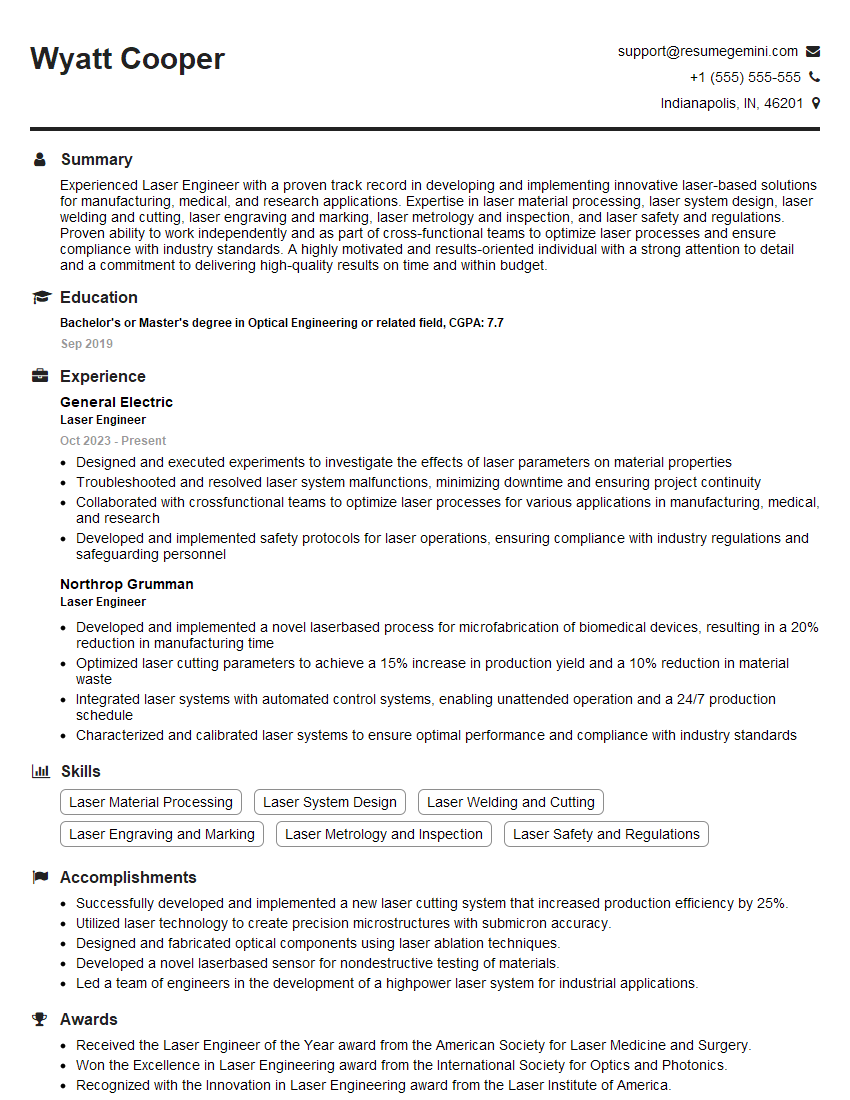
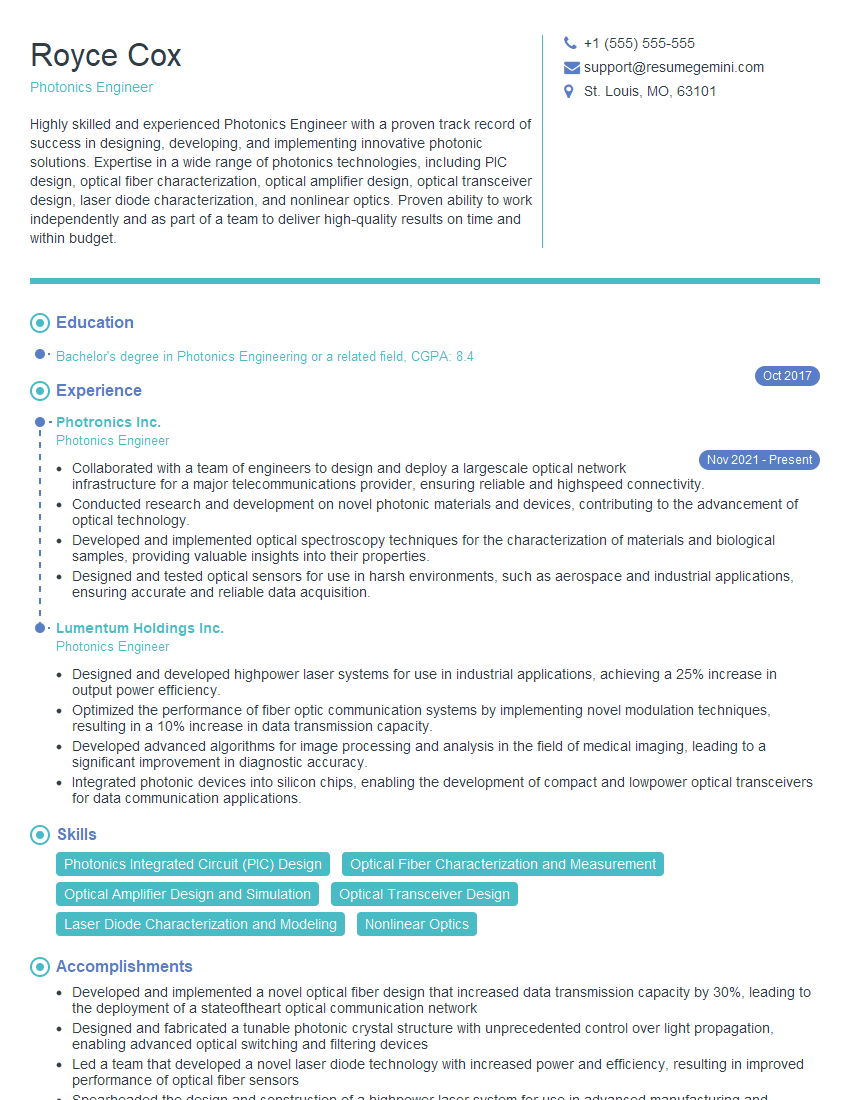
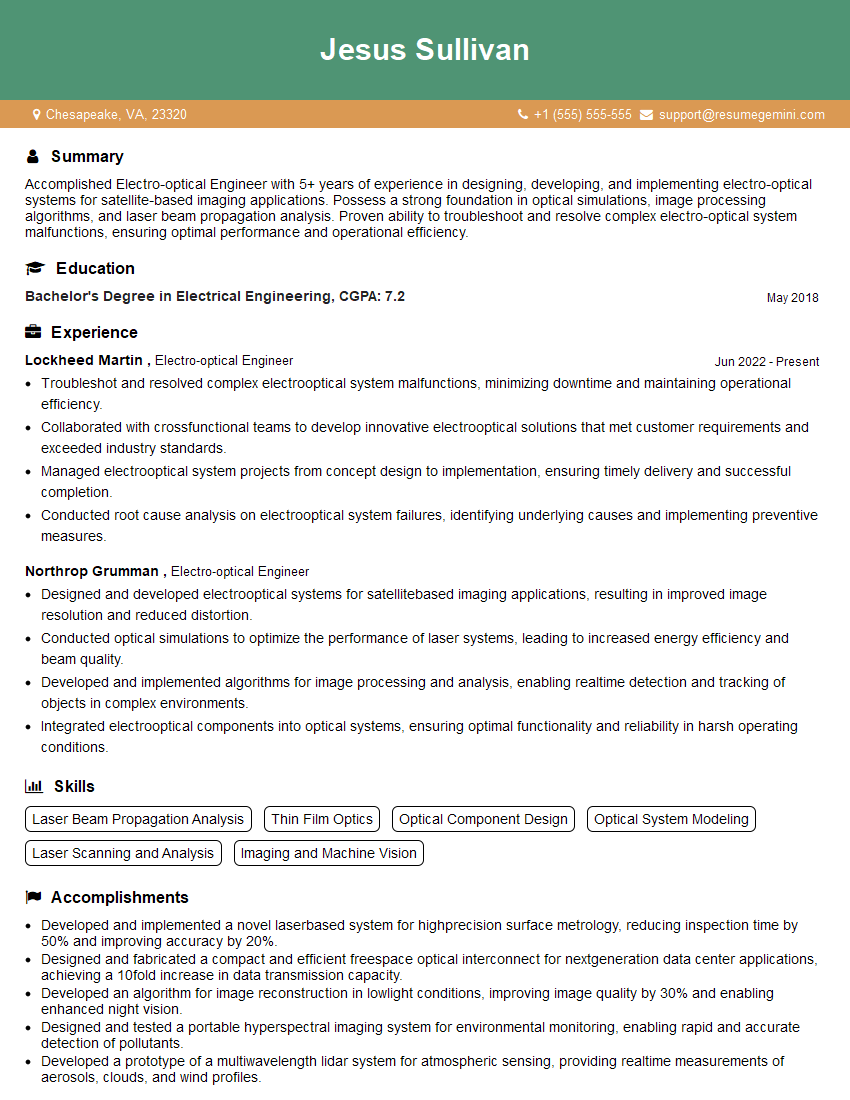
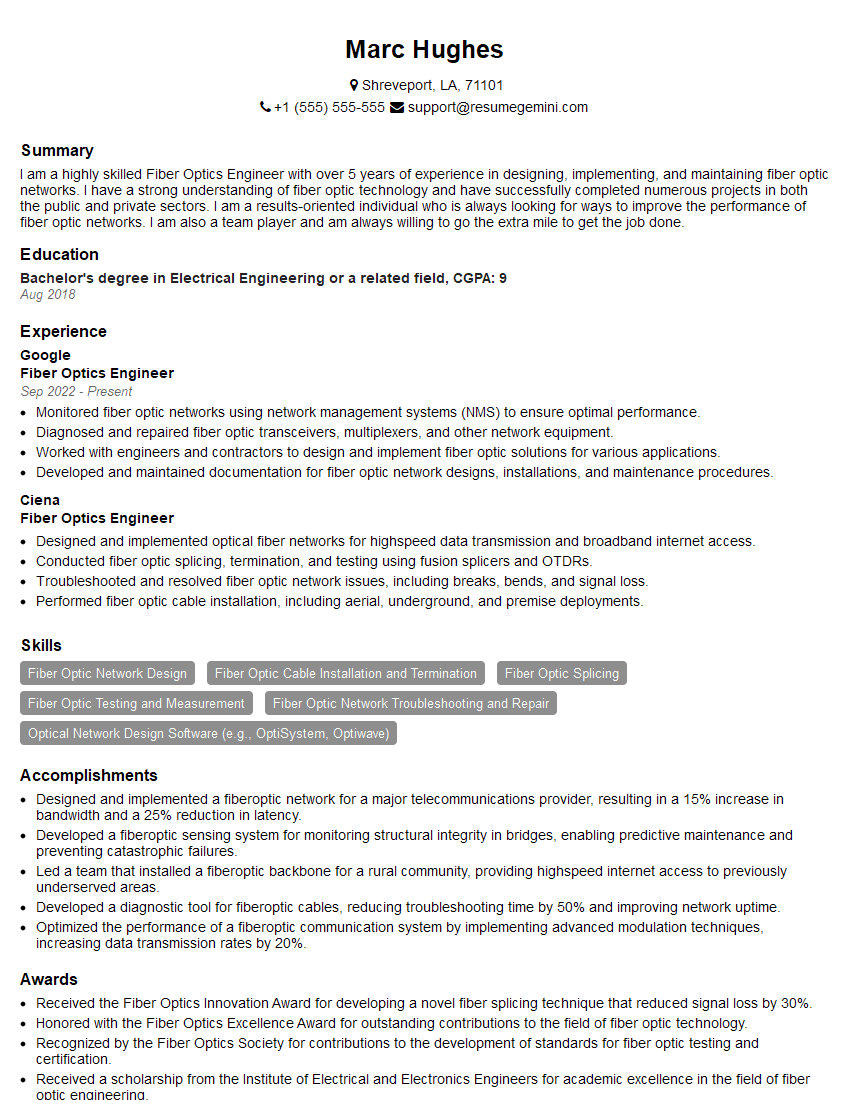
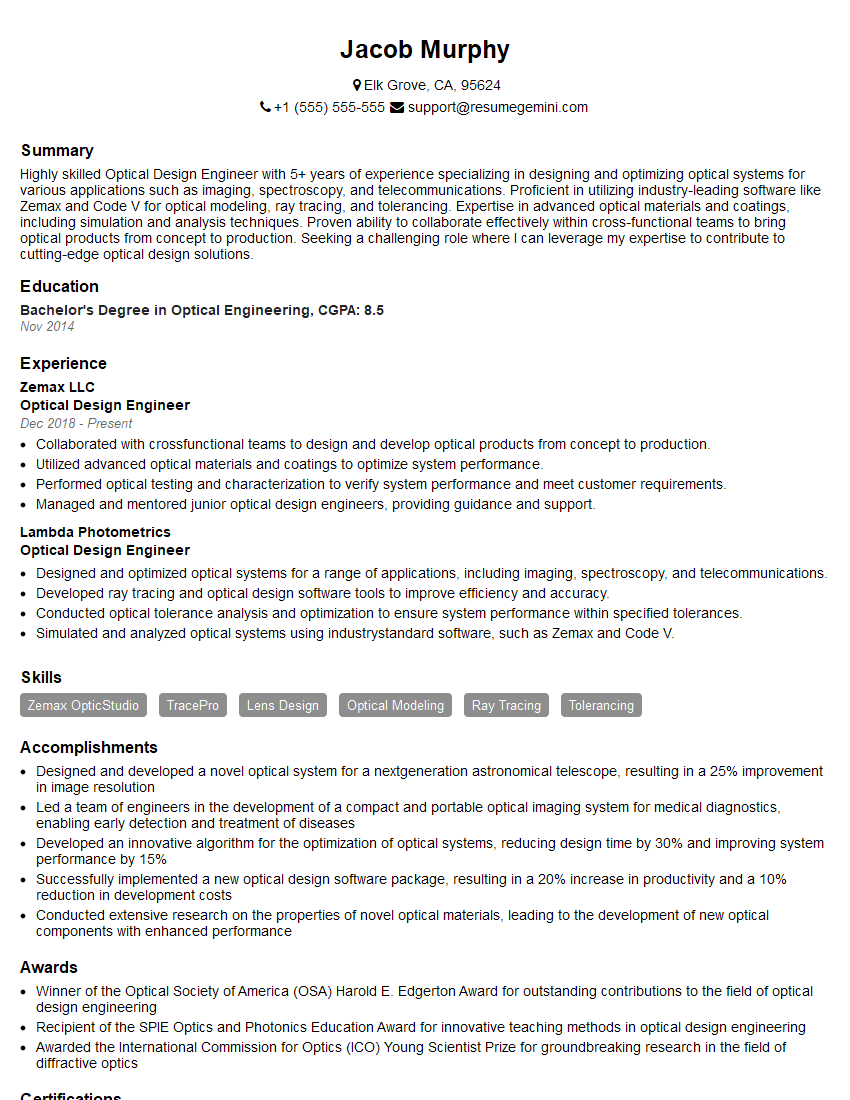
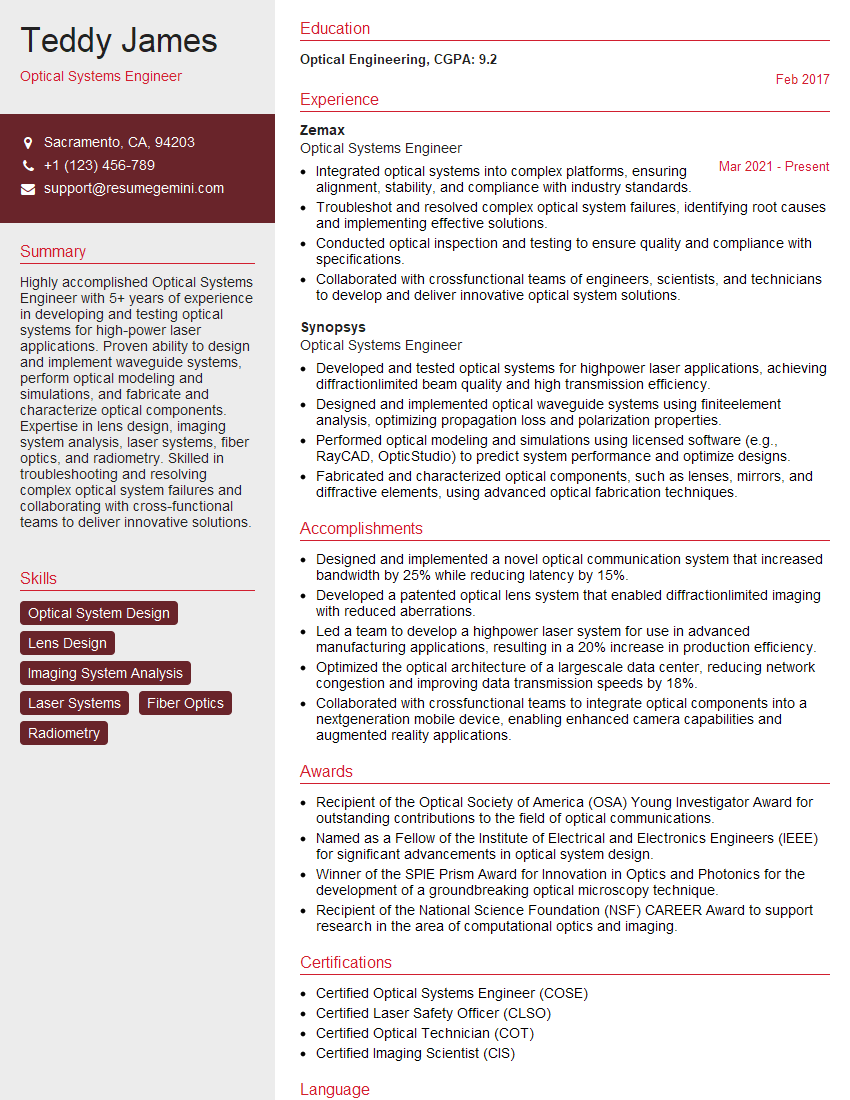
Mastering Optical Component Design opens doors to exciting and rewarding careers in fields like telecommunications, biomedical imaging, and advanced manufacturing. A strong understanding of these principles is highly sought after, significantly enhancing your job prospects. To maximize your chances, creating an ATS-friendly resume is crucial. ResumeGemini is a trusted resource that can help you build a professional and impactful resume tailored to highlight your skills and experience effectively. Examples of resumes tailored specifically to Optical Component Design are available to guide you. Take the next step towards your dream career today!
Explore more articles
Users Rating of Our Blogs
Share Your Experience
We value your feedback! Please rate our content and share your thoughts (optional).
What Readers Say About Our Blog
Very informative content, great job.
good