Interviews are more than just a Q&A session—they’re a chance to prove your worth. This blog dives into essential Optical Fiber Characterization and Measurement interview questions and expert tips to help you align your answers with what hiring managers are looking for. Start preparing to shine!
Questions Asked in Optical Fiber Characterization and Measurement Interview
Q 1. Explain the principle of Optical Time Domain Reflectometry (OTDR).
Optical Time Domain Reflectometry (OTDR) is a powerful technique used to characterize optical fibers. Imagine it like sending a short pulse of light down a fiber and listening for echoes. The principle relies on the fact that a small percentage of light is reflected back at any point where there’s an impedance mismatch – like a connector, splice, or a bend in the fiber. These reflections are detected by the OTDR, and the time it takes for the light to travel down the fiber and back provides information about the location of these events. The strength of the reflection is directly related to the severity of the impedance change.
In essence, an OTDR sends a pulse of light down the fiber. Any imperfections or changes in the fiber cause some of the light to be reflected back toward the OTDR. By measuring the time delay and the intensity of these back-reflections, the OTDR can determine the location and severity of events such as breaks, splices, and connectors. The resulting plot shows a profile of the fiber, revealing its length, loss, and the locations of any faults or components.
Q 2. Describe different types of optical fiber attenuation and their causes.
Optical fiber attenuation, or loss, refers to the decrease in optical power as light travels through the fiber. Several factors contribute:
- Absorption Loss: This is caused by the absorption of light energy by the fiber material itself. Impurities in the silica glass, such as hydroxyl ions (OH-), absorb specific wavelengths of light. This loss is usually relatively constant across a given wavelength range.
- Scattering Loss: This happens when light is scattered in different directions due to microscopic variations in the fiber’s refractive index. Rayleigh scattering, caused by density fluctuations in the glass, is the dominant scattering mechanism and is inversely proportional to the fourth power of the wavelength (meaning shorter wavelengths are scattered more).
- Bending Loss: Excessive bending of the fiber can lead to increased loss. Sharp bends can cause light to leak out of the fiber’s core. Macrobends, large-scale bends, and microbends, small-scale irregularities, contribute to this.
- Connector and Splice Loss: Imperfect connections between fiber segments introduce loss due to misalignment and air gaps. This is a significant loss source in many applications.
Understanding these loss mechanisms is crucial for designing and maintaining optical communication systems, as they directly impact the range and quality of signal transmission.
Q 3. What are the key parameters measured in optical fiber characterization?
Key parameters measured in optical fiber characterization include:
- Attenuation (Loss): The reduction in optical power as light travels through the fiber, measured in dB/km.
- Return Loss: The ratio of reflected power to incident power at a connection point, indicating the quality of a connection (lower is better).
- Optical Return Loss (ORL): Quantifies the amount of light reflected back at various points along the fiber, particularly important for identifying faults.
- Chromatic Dispersion: The spreading of an optical pulse due to different wavelengths traveling at different speeds.
- Polarization Mode Dispersion (PMD): The spreading of an optical pulse due to different polarization states traveling at different speeds.
- Fiber Length: The total length of the optical fiber.
- Event Location: The distance of any points of reflection (connectors, splices, breaks) along the fiber.
Accurate measurement of these parameters is critical for ensuring the reliability and performance of optical fiber communication systems.
Q 4. How does chromatic dispersion affect optical signal transmission?
Chromatic dispersion is a phenomenon where different wavelengths of light travel at slightly different speeds within an optical fiber. Imagine a group of runners (different wavelengths) starting a race at the same time but running at slightly different paces. The faster runners will arrive first, and the slower runners later. This causes the initial sharp pulse of light to broaden and spread out over time, leading to pulse broadening and intersymbol interference (ISI).
ISI occurs when the broadened pulses overlap, making it difficult to distinguish individual data bits. This ultimately limits the data transmission rate and the distance over which data can be reliably transmitted. Different fiber types exhibit varying amounts of chromatic dispersion; some are designed to minimize this effect.
Q 5. Explain the concept of polarization mode dispersion (PMD).
Polarization Mode Dispersion (PMD) is another form of pulse broadening that affects optical signals. Unlike chromatic dispersion, which is caused by wavelength differences, PMD arises from the fact that light can travel down the fiber in two orthogonal polarization states. These states can experience slightly different refractive indices in the fiber, leading to different propagation speeds.
Imagine two cars (polarization states) traveling down a slightly uneven road. One car might encounter a smoother path and travel slightly faster than the other. This difference in travel time, even though both cars start and end at the same points, causes a temporal spread of the signal. This spreading can lead to ISI, degrading the signal quality and limiting the transmission bandwidth. PMD is particularly significant in long-haul optical communication systems.
Q 6. What are the different methods for measuring optical fiber loss?
Several methods are used to measure optical fiber loss:
- Cutback Method: This is a simple but destructive method. The optical power is measured at the output end of a known length of fiber. The fiber is then cut back, and the measurement is repeated. The difference in power is used to calculate the attenuation.
- OTDR: As discussed previously, an OTDR is a non-destructive method that provides a complete profile of the fiber’s attenuation along its entire length.
- Optical Power Meter and Light Source: This method involves injecting light into the fiber using a calibrated light source and measuring the output power using an optical power meter. The attenuation is calculated from the difference in input and output power, knowing the fiber length.
The choice of method depends on the specific application and requirements. For example, the cutback method is suitable for simple loss measurements, whereas OTDR provides comprehensive information on fiber quality and fault location.
Q 7. How do you interpret an OTDR trace?
Interpreting an OTDR trace involves analyzing the graph generated by the OTDR. The horizontal axis represents the distance along the fiber, and the vertical axis represents the back-reflected power (often in dB). Key features to look for include:
- Fiber Loss Slope: A downward sloping line indicates the overall attenuation of the fiber. A steeper slope means higher loss.
- Fresnel Reflections: These are sharp peaks at the beginning and end of the fiber, representing reflections at the fiber ends. Their amplitude indicates the quality of the fiber end-faces.
- Splice and Connector Events: These are sharp dips or peaks in the trace, indicating connections between fiber segments or the presence of connectors. Their magnitude indicates the amount of loss introduced at these points.
- Faults and Breaks: These are significant reflections (high peaks) indicative of damage to the fiber, possibly breaks or severe macrobends.
By carefully analyzing these features, one can assess the overall quality of the fiber, identify the locations of faults or components, and determine the total length of the fiber. Software accompanying OTDRs often aids in automated analysis and reporting.
Q 8. Describe the process of optical fiber testing and troubleshooting.
Optical fiber testing and troubleshooting is a crucial process to ensure the reliable transmission of data through fiber optic networks. It involves a systematic approach to identify, locate, and rectify faults affecting signal quality and transmission performance. The process typically begins with a visual inspection of the fiber optic cable and its components, checking for any physical damage or incorrect terminations.
Following the visual inspection, specialized testing equipment such as an Optical Time-Domain Reflectometer (OTDR) and Optical Power Meter (OPM) are used. The OTDR is used to locate faults along the fiber length by measuring backscattered light, allowing for the identification of breaks, bends, and other impairments. The OPM measures the optical power levels at various points within the system, helping to determine the signal strength and identify areas of significant loss.
Troubleshooting involves interpreting the data obtained from the testing equipment to pinpoint the exact location and nature of the fault. For example, a significant loss in power at a specific point indicated by the OPM might be investigated further by using an OTDR to pinpoint a potential splice loss or connector contamination in that area. Once the fault is located, it’s then addressed through appropriate actions which can range from simple connector cleaning to fiber splicing or cable replacement depending on the severity and type of damage.
Throughout the process, meticulous record-keeping is crucial for future reference and to aid in preventative maintenance. Regular testing is recommended to proactively identify potential issues before they cause service disruptions.
Q 9. What are the limitations of OTDR?
While the OTDR is an invaluable tool in optical fiber testing, it does have limitations. One key limitation is its dead zone, which refers to the area immediately following a high-reflection event (like a connector or fault) where the OTDR cannot accurately detect events. This is because the strong reflection masks any weaker reflections from events within that short distance. The size of the dead zone is dependent on the OTDR’s specifications and the characteristics of the fiber.
Another limitation is the dynamic range, which represents the difference between the strongest and weakest signal that the OTDR can accurately measure. If a fault causes a very small reflection or attenuation, it might fall below the OTDR’s dynamic range, making it undetectable. This is particularly relevant for long haul applications.
Furthermore, OTDRs are sensitive to environmental factors such as temperature fluctuations which can affect accuracy. Also, the OTDR’s performance can be affected by the type of fiber being tested. Multi-mode fiber presents more challenges than single-mode fiber due to modal noise and other effects. Finally, OTDR testing requires specialized knowledge and experience to correctly interpret the results, and misinterpretation can lead to unnecessary repairs or failure to identify actual problems.
Q 10. Explain the difference between single-mode and multi-mode optical fibers.
The core difference between single-mode and multi-mode optical fibers lies in the number of light paths they can support. Imagine sending light through a pipe: a single-mode fiber is like a narrow pipe that allows only one path for light to travel, while a multi-mode fiber is like a wider pipe that allows multiple light paths to propagate simultaneously.
- Single-mode fiber: This type uses a very small core diameter (typically around 9 micrometers) allowing only one mode (or path) of light to propagate. This results in lower attenuation (signal loss) over longer distances and higher bandwidth. Single-mode fibers are generally used in long-haul telecommunications and high-speed data transmission.
- Multi-mode fiber: This type uses a larger core diameter (typically 50 or 62.5 micrometers), allowing multiple modes of light to propagate. This leads to higher attenuation and lower bandwidth compared to single-mode fibers, limiting their use to shorter distances. Multi-mode fibers are commonly used in local area networks (LANs) and shorter-range applications.
In simple terms, single-mode fibers are better suited for long-distance, high-bandwidth applications, while multi-mode fibers are more suitable for shorter distances and lower bandwidth applications. The choice between the two depends entirely on the specific requirements of the network.
Q 11. What are the various connectors used in optical fiber systems?
Various connectors are employed in optical fiber systems, each designed to meet specific requirements of different applications. The choice of connector depends on factors such as fiber type, environment, cost, and ease of use. Some of the most commonly used connectors include:
- SC (Subscriber Connector): A robust and widely used connector, known for its simplicity and reliability.
- FC (Ferrule Connector): Features a threaded coupling mechanism offering excellent repeatability and environmental sealing.
- LC (Lucent Connector): A smaller, more compact connector, gaining popularity due to its space-saving design and high density.
- ST (Straight Tip Connector): A bayonet-style connector which is easy to connect and disconnect, but less robust than SC or FC.
- MT-RJ (Mechanical Transfer-Registered Jack): A multi-fiber connector offering higher density and space-saving characteristics in comparison to individual connectors.
Each connector type has its own specific advantages and disadvantages relating to cost, size, reliability and ease of use. Selecting the right connector is crucial for the proper functioning of the optical fiber system and the longevity of the link. Incorrect connector usage can lead to significant signal loss and system failure.
Q 12. How do you measure optical return loss?
Optical Return Loss (ORL) measures the amount of optical power reflected back towards the source compared to the amount of optical power launched into the fiber. It’s expressed in decibels (dB) and indicates the quality of connections and the overall health of the optical link. A higher ORL value implies more light is reflected back, indicating potential problems such as poorly cleaved fiber ends, connector contamination or mismatched components.
ORL is measured using an Optical Return Loss Tester, which is frequently integrated into OTDRs. The tester sends a light pulse down the fiber, and measures the amount of light reflected back. The ORL measurement is then calculated using the ratio of the reflected power to the launched power.
For example, an ORL of -50 dB indicates very little light is reflected, signifying a good connection, while an ORL of -20 dB might indicate a significant problem that needs to be addressed. Low ORL can lead to signal degradation, affecting the performance and reliability of the optical link.
Q 13. What are the different types of optical fiber splicing techniques?
Optical fiber splicing techniques are essential for seamlessly connecting two individual fiber optic strands. Accurate splicing is crucial for maintaining minimal signal loss and preserving the integrity of the optical transmission. The most common splicing techniques are:
- Fusion Splicing: This is a widely used technique that uses an electric arc to melt and fuse the ends of the two fibers together, creating a strong and permanent connection with low signal loss. It offers excellent performance but requires specialized equipment and skill.
- Mechanical Splicing: This method employs a precisely engineered sleeve or connector to hold the two fiber ends together. It’s a faster and less expensive option than fusion splicing, but typically offers slightly higher insertion loss and potentially reduced mechanical robustness compared to fusion splicing.
The choice between fusion and mechanical splicing depends on several factors, including the budget, the required level of performance, and the availability of skilled personnel. For high-performance applications where minimal insertion loss is critical, fusion splicing is preferred. In situations where speed and cost are more important factors, mechanical splicing might be the more appropriate choice. Proper training and adherence to best practices are essential for successful implementation of either technique.
Q 14. Describe the different types of optical sources used in fiber optic communication.
Optical sources are essential components in fiber optic communication systems, responsible for generating the light signals that carry data through the optical fibers. The choice of the optical source is determined by factors such as the wavelength required, the transmission distance, and the data rate. Different types of optical sources include:
- Light Emitting Diodes (LEDs): LEDs are relatively inexpensive, easy to operate, and offer good performance for shorter distances and lower data rates. They are commonly used in multi-mode fiber networks. Their output is incoherent, meaning the light waves are not synchronized, leading to wider spectral width and lower bandwidth capacity than lasers.
- Laser Diodes (LDs): Laser diodes offer higher power output, narrower spectral width, and better performance over long distances and at higher data rates. This makes them suitable for both single-mode and multi-mode applications, particularly for long-haul networks and higher bandwidth systems. Their coherent light output provides much better performance in single mode fibers.
- Vertical Cavity Surface Emitting Lasers (VCSELs): VCSELs are a type of laser diode that emits light perpendicular to the chip surface. They are gaining popularity for their efficient manufacturing processes and suitability for high-speed short-reach applications.
Each optical source type has its own characteristics in terms of cost, power consumption, spectral width, and coherence. The appropriate selection of an optical source is crucial for optimizing the overall performance and reliability of the fiber optic communication system.
Q 15. Explain the working principle of an optical power meter.
An optical power meter measures the optical power level of a light source, typically a laser diode used in fiber optic communication. It works by using a photodetector, which converts the optical signal (light) into an electrical signal. This electrical signal is then amplified and processed to display the power level on a digital readout, usually in decibels (dB) or milliwatts (mW).
Imagine it like a light meter for photographers, but instead of visible light, it measures infrared light used in optical fibers. The photodetector is incredibly sensitive and can measure very low light levels. Different wavelengths require different photodetectors for optimal performance, so a high-quality optical power meter will have interchangeable heads or internal filters for this purpose.
In practice, optical power meters are crucial for verifying the output power of lasers, characterizing fiber optic components (attenuation, splitters), and troubleshooting network issues. A low power reading might indicate a faulty laser, a damaged fiber, or a poorly connected component.
Career Expert Tips:
- Ace those interviews! Prepare effectively by reviewing the Top 50 Most Common Interview Questions on ResumeGemini.
- Navigate your job search with confidence! Explore a wide range of Career Tips on ResumeGemini. Learn about common challenges and recommendations to overcome them.
- Craft the perfect resume! Master the Art of Resume Writing with ResumeGemini’s guide. Showcase your unique qualifications and achievements effectively.
- Don’t miss out on holiday savings! Build your dream resume with ResumeGemini’s ATS optimized templates.
Q 16. How do you test the continuity of an optical fiber?
Testing the continuity of an optical fiber involves verifying that there is a clear, unobstructed path for light to travel through the entire fiber length. This is usually accomplished using an optical time-domain reflectometer (OTDR). The OTDR sends a short pulse of light into the fiber; a portion of the light is reflected back at any discontinuities such as breaks, bends, or connectors. The time taken for the light to return is then used to determine the distance to the discontinuity.
Think of it like sonar for fiber optics. An OTDR creates a visual representation of the fiber showing its length and any imperfections. A complete lack of a return signal might indicate a significant break or a severe attenuation in the fiber. Visual inspection of fiber ends using a microscope can also help detect damage at connectors. This is often a first step before using the OTDR.
In professional settings, OTDR testing is mandatory during fiber optic cable installations and maintenance to ensure signal quality and identify potential problems before network deployment.
Q 17. What is the significance of numerical aperture (NA) in optical fibers?
The numerical aperture (NA) of an optical fiber describes its ability to accept light. A higher NA means the fiber can accept light from a wider range of angles. It’s essentially a measure of the light-gathering capacity of the fiber. NA is determined by the refractive indices of the fiber core and the cladding.
Imagine a water hose. A wider hose (higher NA) can accept more water (light) from different directions. A narrower hose is more restrictive. The NA is crucial because it determines the maximum angle at which light can enter the fiber core and still propagate along the fiber without leaking into the cladding. This directly impacts the fiber’s coupling efficiency and the amount of power launched into the fiber from a light source.
In practice, selecting the correct NA is important for efficient coupling between light sources, connectors, and fiber optic components. A mismatch in NA can lead to significant signal loss.
Q 18. Explain modal dispersion in optical fibers.
Modal dispersion occurs in multimode optical fibers, where multiple light paths (modes) can travel simultaneously through the fiber core. Because different modes have different path lengths and travel times, the signal at the end of the fiber arrives spread out in time, causing pulse broadening and limiting the transmission bandwidth.
Imagine throwing a handful of pebbles into a pond. Each pebble creates a ripple that travels at a slightly different speed and path, resulting in a diffused pattern rather than distinct, well-defined ripples. Similarly, different light modes in a multimode fiber arrive at different times, leading to signal distortion.
Modal dispersion is a significant limitation for high-speed data transmission over long distances using multimode fibers. Single-mode fibers mitigate this problem by supporting only one mode, minimizing dispersion. Reducing modal dispersion is crucial for ensuring high-bandwidth applications like Gigabit Ethernet or high-definition video transmission.
Q 19. What are the effects of bending loss on optical fiber transmission?
Bending loss refers to the power loss that occurs when an optical fiber is bent beyond its specified minimum bending radius. Excessive bending causes light to leak out of the fiber core into the cladding or surrounding material due to changes in the refractive index profile of the bent fiber. This light loss reduces the signal strength received at the far end of the fiber.
Think of a garden hose. Sharply bending the hose can cause the water to leak out. Similarly, extreme bending in fiber optics can lead to signal degradation. The severity of bending loss depends on the fiber’s characteristics (e.g., core diameter, NA) and the radius of curvature of the bend.
In practice, careful handling and installation procedures are crucial to minimize bending losses. Using proper cable management techniques, avoiding sharp bends, and employing appropriate cable trays and supports are essential practices to ensure reliable fiber optic communication.
Q 20. Describe the concept of optical fiber connectors and their importance.
Optical fiber connectors are crucial components that provide a physical interface for joining two optical fibers to establish a continuous optical path. They ensure minimal signal loss and consistent connection during transmission. Common types include SC, FC, LC, and ST connectors. These connectors employ precision-engineered ferrules to ensure accurate alignment of the fiber cores.
Imagine plumbing. You need connectors to join pipes smoothly. Similarly, optical fiber connectors enable seamless signal transmission without significant power loss. The quality of the connector and the proper termination technique play a major role in achieving a low-loss connection.
The importance of optical fiber connectors stems from their critical role in network connectivity. Poor connectorization can result in signal attenuation, power budget issues, and overall system performance degradation. Regularly inspecting and cleaning connectors are vital for ensuring network reliability and efficiency. A dirty connector can cause high losses.
Q 21. How does temperature affect optical fiber performance?
Temperature variations can significantly affect the performance of optical fibers. Changes in temperature can alter the refractive index of the fiber material, leading to changes in transmission characteristics such as attenuation and dispersion. Extreme temperatures can also induce stress in the fiber, potentially causing micro-bending and further attenuation.
Imagine a metal rod that expands and contracts with temperature changes. Similarly, optical fibers are susceptible to temperature-induced changes in their physical properties. These changes affect the propagation of light and impact the signal quality.
In real-world scenarios, temperature considerations are important for designing and deploying optical fiber networks, especially in outdoor environments or harsh climatic conditions. Designing systems with temperature stability in mind is crucial. Appropriate cable ratings and considerations for thermal expansion during installation must be addressed for reliable network operation.
Q 22. What are the different types of optical fiber cables?
Optical fiber cables are categorized primarily by their core material, cladding material, and mode of operation. The core, the central part of the fiber, and the cladding, the outer layer surrounding the core, dictate how light propagates.
- Single-Mode Fiber (SMF): This type has a small core diameter (around 8-10 microns), allowing only one mode of light to propagate. This results in low signal dispersion (spreading) over long distances, making it ideal for high-bandwidth applications like long-haul telecommunications and high-speed data centers. Think of it like a single lane highway – only one car (light signal) can travel at a time, but that car can travel very fast and far.
- Multi-Mode Fiber (MMF): These fibers have a larger core diameter (50 or 62.5 microns), allowing multiple modes of light to propagate simultaneously. This leads to higher signal dispersion over longer distances, limiting their use to shorter distances and lower bandwidth applications like local area networks (LANs) or building connections. Imagine a multi-lane highway – many cars (light signals) can travel at once, but traffic can become congested leading to slower speeds over long distances. MMF is further divided into types like OM1, OM2, OM3, and OM4, each with different specifications related to bandwidth and dispersion.
- Specialty Fibers: This broad category includes fibers designed for specific applications, such as dispersion-shifted fiber (DSF), which minimizes signal dispersion at specific wavelengths; non-zero dispersion-shifted fiber (NZDSF), offering even better performance than DSF; and photonic crystal fiber (PCF), with unique properties allowing for manipulation of light in ways not possible with conventional fibers.
Q 23. Explain the concept of optical signal-to-noise ratio (OSNR).
Optical Signal-to-Noise Ratio (OSNR) is a crucial metric in optical communication systems that measures the strength of the optical signal relative to the noise present in the signal. A higher OSNR indicates a cleaner signal with less interference, resulting in better system performance. It’s expressed in decibels (dB) and represents the ratio of the optical signal power to the total noise power.
Imagine you’re trying to hear someone speak in a crowded room. The speaker’s voice is the signal, and the background chatter is the noise. A high OSNR is like having a very loud speaker in a quiet room – the signal is strong and easily understood. A low OSNR would be like trying to hear someone whisper in a noisy stadium – the signal is weak and easily lost in the noise.
OSNR is measured using an optical spectrum analyzer (OSA). A low OSNR can lead to bit errors and data loss in the communication system, impacting performance significantly.
Q 24. What are the common faults encountered in optical fiber systems?
Faults in optical fiber systems can be broadly categorized into two types: connection related and fiber related.
- Connection Faults: These are often the most common and include poor connector terminations (leading to high loss and back reflections), misaligned connectors, loose connectors, and broken connectors. Contamination within the connector can also cause significant signal attenuation.
- Fiber Faults: These faults can occur within the fiber itself and can be more challenging to troubleshoot. They include fiber breakage, macrobends (sharp bends in the fiber), microbends (small bends occurring due to pressure or stress), and attenuation caused by environmental factors (such as excessive temperature changes or moisture ingress).
In addition, the presence of optical power loss caused by many factors may indicate a problem.
Q 25. How do you troubleshoot an optical fiber link?
Troubleshooting an optical fiber link requires a systematic approach. First, visually inspect the entire link for any physical damage or loose connections. Then, use specialized equipment such as an optical power meter and an optical time-domain reflectometer (OTDR) to identify the location and nature of the problem.
- Visual Inspection: Examine connectors, splices, and the fiber cable itself for any signs of damage, bending, or improper termination.
- Optical Power Meter (OPM): Measure the optical power levels at various points along the link to identify areas of significant power loss. Compare the measurements to the expected power levels based on the link’s specifications.
- Optical Time-Domain Reflectometer (OTDR): This instrument sends pulses of light down the fiber and analyzes the reflections to pinpoint the location and nature of any faults. An OTDR can detect fiber breaks, splices, connector losses, and even microbends, providing a detailed view of the fiber’s condition.
- Testing Connectors: If connector faults are suspected, consider testing connector insertion loss using appropriate testing equipment.
By carefully analyzing the data from the OPM and OTDR, you can pinpoint the location of the fault and determine the appropriate repair strategy.
Q 26. Describe the role of optical amplifiers in long-haul communication systems.
Optical amplifiers play a critical role in long-haul communication systems by compensating for signal loss due to attenuation in the fiber. As light travels over long distances, its power diminishes, requiring amplification to maintain signal strength and quality.
There are two main types: erbium-doped fiber amplifiers (EDFAs) and Raman amplifiers. EDFAs are the most common, operating in the 1550 nm wavelength range. They use erbium-doped fiber and pump lasers to amplify the signal light. Raman amplifiers are less common and have the capability of amplifying signals across a wider range of wavelengths.
Without optical amplifiers, long-haul communication would be impractical due to the exponential decrease in optical signal power with distance. Amplifiers allow for the transmission of signals over thousands of kilometers without requiring intermediate regeneration, making high-capacity, long-distance communication possible.
Q 27. What are the different standards used for optical fiber characterization?
Several international and industry standards govern optical fiber characterization. These standards define the specifications and testing methodologies for optical fibers, components, and systems. Some key standards include:
- International Telecommunication Union (ITU): The ITU publishes numerous recommendations covering various aspects of optical fiber technology, including fiber characteristics (e.g., ITU-T G.652 for single-mode fiber), testing methods, and network parameters.
- International Organization for Standardization (ISO): ISO standards address many aspects of fiber optic systems, including cabling, connectors, and testing procedures.
- TIA (Telecommunications Industry Association): TIA standards, particularly those related to fiber optic cabling systems within buildings (e.g., TIA-568), are widely used in local area networks and building infrastructure.
- IEC (International Electrotechnical Commission): IEC standards also play an important role, particularly in defining safety requirements and testing procedures for optical fiber systems.
Adherence to these standards ensures interoperability and reliability across different manufacturers and networks.
Q 28. Explain the concept of wavelength division multiplexing (WDM).
Wavelength Division Multiplexing (WDM) is a technology that allows multiple optical signals, each carrying different data streams at different wavelengths, to be transmitted simultaneously over a single optical fiber. It’s like having multiple lanes on a highway, each carrying different traffic (data) concurrently.
This significantly increases the capacity of a single fiber, improving bandwidth efficiency and reducing the need for multiple fibers. In a WDM system, different wavelengths are combined using multiplexers and separated using demultiplexers at the receiving end. Dense Wavelength Division Multiplexing (DWDM) systems pack many more wavelengths close together, further increasing capacity.
WDM is essential for modern high-capacity long-haul communication networks, enabling the transmission of enormous amounts of data over long distances. It has dramatically increased the efficiency of fiber optic communication systems.
Key Topics to Learn for Optical Fiber Characterization and Measurement Interview
- Fiber Optic Properties: Understanding refractive index, numerical aperture, attenuation, dispersion (chromatic and modal), and polarization mode dispersion. Prepare to discuss the impact of these properties on signal transmission.
- Measurement Techniques: Mastering techniques like Optical Time-Domain Reflectometry (OTDR), Optical Frequency-Domain Reflectometry (OFDR), and Optical Spectrum Analysis (OSA). Be ready to explain their principles, applications, and limitations.
- Loss and Attenuation Measurements: Familiarize yourself with different types of fiber loss (absorption, scattering), methods for measuring attenuation, and the impact of connectors and splices on overall system loss. Be prepared to troubleshoot scenarios involving high attenuation.
- Dispersion Measurement and Compensation: Understand the different types of dispersion and their effects on signal quality. Be able to discuss techniques for measuring and compensating for dispersion in optical communication systems.
- Fiber Testing and Standards: Become familiar with relevant industry standards (e.g., IEC, TIA) and best practices for testing and characterizing optical fibers. This includes understanding certification procedures and documentation.
- Practical Applications: Be ready to discuss real-world applications of fiber characterization, such as network troubleshooting, fiber optic sensor development, and quality control in manufacturing.
- Problem-Solving: Practice analyzing scenarios involving faulty fiber optic links. Develop your ability to identify potential issues based on measurement data and propose solutions.
- Advanced Topics (depending on the role): Consider exploring areas like nonlinear effects in optical fibers, coherent optical communication, or specific types of specialized fibers (e.g., photonic crystal fibers).
Next Steps
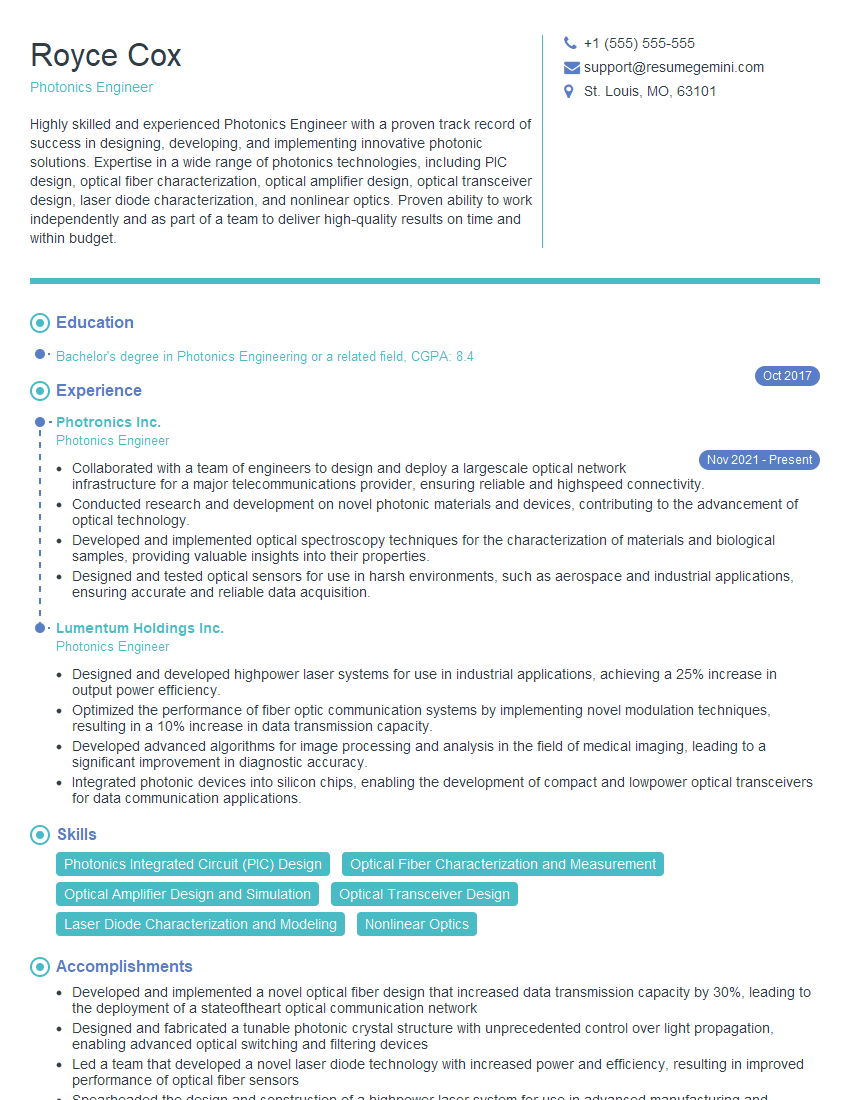
Mastering Optical Fiber Characterization and Measurement opens doors to exciting career opportunities in telecommunications, research, and manufacturing. A strong understanding of these concepts is highly valued and will significantly enhance your job prospects. To stand out, create an ATS-friendly resume that effectively highlights your skills and experience. ResumeGemini is a trusted resource to help you build a professional and impactful resume, ensuring your qualifications are clearly presented to potential employers. Examples of resumes tailored to Optical Fiber Characterization and Measurement are available to guide you.


Explore more articles
Users Rating of Our Blogs
Share Your Experience
We value your feedback! Please rate our content and share your thoughts (optional).
What Readers Say About Our Blog
Very informative content, great job.
good