The thought of an interview can be nerve-wracking, but the right preparation can make all the difference. Explore this comprehensive guide to Optical System Integration interview questions and gain the confidence you need to showcase your abilities and secure the role.
Questions Asked in Optical System Integration Interview
Q 1. Explain the process of aligning an optical system.
Aligning an optical system is a meticulous process of precisely positioning optical components to achieve the desired optical performance. Think of it like assembling a complex puzzle where each piece (lens, mirror, etc.) needs to be in the exact right spot to create a clear, focused image. The process generally involves iterative adjustments, using various tools and techniques to minimize errors and maximize performance.
It typically starts with a coarse alignment, using visual inspection and simple tools. For instance, we might use a laser to trace the beam path and adjust component positions to ensure the beam passes through the center of each element. Once this coarse alignment is complete, we move on to fine alignment, using more precise techniques such as autocollimation or interferometry. This ensures that the components are precisely aligned to within fractions of a wavelength of light. Finally, we conduct rigorous testing and measurement to verify the system’s performance parameters, such as spot size, wavefront error, and throughput. This often involves iterative refinement to minimize any discrepancies and optimize performance.
- Coarse Alignment: Using visual aids and simple adjustment mechanisms to get components roughly in place.
- Fine Alignment: Using precise instruments like autocollimators or interferometers for micron-level adjustments.
- Testing and Measurement: Verifying performance using tools such as beam profilers, wavefront sensors, and power meters.
Q 2. Describe your experience with different types of optical mounts and their applications.
My experience encompasses a wide range of optical mounts, each with specific applications. I’ve worked extensively with kinematic mounts, offering high stability and repeatability due to their three-point contact design, ideal for critical applications demanding minimal drift, such as high-precision metrology setups. I’ve also used flexure mounts, which provide excellent stability against vibration, making them suitable for sensitive instruments in challenging environments. Furthermore, I am proficient with magnetic mounts, offering quick and easy adjustments, frequently employed during prototyping or experimental setups where rapid adjustments are needed. In addition, I have experience with adhesive mounts for permanent or semi-permanent mounting of certain components. The selection always depends on the specific application, considering factors like environmental conditions, required precision, and ease of adjustment.
For instance, in a recent project involving a high-resolution microscopy system, kinematic mounts were crucial for maintaining long-term stability and achieving the required level of precision in the imaging system. In another project where the system was subjected to significant vibration, flexure mounts proved essential for mitigating the effects of environmental disturbances.
Q 3. How do you troubleshoot issues in optical system integration?
Troubleshooting in optical system integration is a systematic process requiring a methodical approach. It often resembles detective work, where you need to carefully eliminate possible causes one by one. I typically start by reviewing the system’s design specifications and the alignment procedure to identify potential sources of error. Then, I’d proceed with a thorough visual inspection, checking for obvious issues like loose connections, misaligned components, or damaged optics. I’d then use various diagnostic tools, depending on the suspected problem. For example, a beam profiler can identify beam distortions, while an interferometer can measure wavefront aberrations. I might also use a power meter to verify the light intensity at different points in the system. The process often involves iteratively refining the alignment, retesting, and verifying performance until the issue is resolved. I always maintain detailed records of my troubleshooting steps, including measurements, adjustments, and observations, which proves invaluable for future reference and debugging.
For instance, in one instance, a system showed unexpectedly low throughput. By systematically checking each component, I discovered a small misalignment in one of the lenses, which was causing significant light loss. Correcting the alignment immediately improved system performance.
Q 4. What are the common sources of error in optical system alignment?
Common sources of error in optical system alignment are numerous and often interconnected. They can stem from inaccuracies in component manufacturing, imperfect mounting, environmental factors, or inadequate alignment procedures. Manufacturing imperfections, such as lens decentering or surface irregularities, can significantly impact alignment and performance. Similarly, improper mounting, leading to stress or misalignment of components, introduces errors. Environmental effects, such as temperature fluctuations or vibrations, can cause shifts in component positions and compromise system stability. Finally, inaccurate alignment procedures or lack of precision during adjustment can also contribute significantly to overall errors. A key element in mitigating these errors is the careful selection of appropriate tolerances and the use of high-quality components and precise alignment techniques.
Q 5. Explain the concept of optical tolerances and their importance.
Optical tolerances define the acceptable limits of variation in the physical characteristics of optical components and their relative positions within a system. These tolerances, typically expressed as dimensions or angles, directly impact the system’s performance. For example, a tight tolerance on the surface flatness of a mirror ensures minimal wavefront aberration, crucial for high-resolution imaging. Similarly, tight tolerances on component spacing ensure accurate focal length and image quality. The importance of optical tolerances stems from their direct impact on the system’s overall performance. Too loose tolerances can lead to unacceptable levels of performance degradation, while overly stringent tolerances may increase manufacturing costs and complexity without a corresponding improvement in system performance. Therefore, careful consideration of these tolerances is vital in the initial design phase to balance performance requirements with practical manufacturing limitations.
Q 6. Describe your experience with optical metrology techniques.
My experience includes a broad range of optical metrology techniques, including interferometry (for wavefront analysis and surface characterization), autocollimation (for angle measurement and alignment verification), and beam profiling (for measuring beam diameter and shape). I’m proficient in using interferometers like Fizeau and Twyman-Green interferometers for precise surface measurement and wavefront analysis. Autocollimators are frequently used for alignment of mirrors and other optical components, ensuring accurate angular orientation. Beam profilers are invaluable for analyzing beam quality, including spot size and shape, providing vital information for optimizing the system performance. Furthermore, I’m experienced in using specialized software to analyze metrology data, extracting meaningful information for optimization and troubleshooting. For example, in a recent project, we used interferometry to detect subtle wavefront distortions in a high-power laser system, allowing us to optimize the system’s performance through corrective adjustments.
Q 7. How do you ensure the stability and repeatability of an optical system?
Ensuring stability and repeatability of an optical system is crucial for consistent performance. This involves careful consideration of several factors starting with the selection of high-quality, stable components, and robust mounting solutions that minimize vibrations and environmental influences. Kinematic mounts are excellent for reducing degrees of freedom and enhancing stability. Moreover, thermal management is crucial; isolating the system from temperature fluctuations using temperature-controlled enclosures or active thermal stabilization can substantially improve stability and reduce drift. The alignment process itself should be well-documented and standardized to ensure repeatability. This involves using precise alignment techniques and documented procedures for making adjustments. Finally, periodic calibration and verification of the system’s performance using metrology techniques helps to maintain consistent performance over time. This proactive approach ensures long-term stability and reliability, preventing unexpected performance degradation.
Q 8. What are the key considerations for integrating optical components with mechanical systems?
Integrating optical components with mechanical systems requires careful consideration of several crucial factors. The primary goal is to ensure the optical performance isn’t compromised by the mechanical design. This involves managing factors like:
- Vibration and Shock: Optical systems are sensitive to vibrations. The mechanical design must effectively isolate the optical components from external vibrations, preventing misalignment or damage. This often involves using vibration damping materials and robust mounting structures. For example, in a satellite-based optical communication system, vibrations during launch require specialized shock mounts for the optical components.
- Thermal Expansion Mismatch: Different materials expand and contract at different rates with temperature changes. This can lead to stress on optical components and misalignment. Careful selection of materials with similar thermal expansion coefficients and the use of compliant mounts are essential. Imagine a laser system operating in a wide temperature range; thermal expansion differences could easily affect beam pointing accuracy.
- Alignment and Stability: Maintaining precise alignment of optical components is paramount. The mechanical design should provide robust and stable mounts to prevent drift or movement. This often involves using kinematic mounts, which provide six degrees of freedom of constraint.
- Accessibility and Maintainability: The mechanical design should allow for easy access to optical components for maintenance, alignment adjustments, and replacement. This might involve using modular designs and easily removable components.
- Weight and Size: In many applications, particularly aerospace and portable devices, minimizing the overall size and weight of the system is critical. This influences the choice of materials and design approaches for the mechanical system.
Q 9. Explain the principles of optical path length and its impact on system performance.
Optical path length (OPL) refers to the distance light travels through an optical system, taking into account the refractive index of each medium. It’s not simply the geometrical distance but rather the product of the geometrical distance and the refractive index of the medium. OPL = n * d, where ‘n’ is the refractive index and ‘d’ is the geometrical distance.
OPL significantly impacts system performance because it determines the phase of the light wave. Variations in OPL, whether due to temperature changes, manufacturing tolerances, or environmental factors, can lead to:
- Interference effects: In interferometers, even small OPL changes can drastically alter the interference pattern, affecting measurement accuracy.
- Aberrations: Uneven OPL across the wavefront can introduce aberrations, degrading the image quality in imaging systems.
- Phase shifts: In coherent optical communication systems, OPL variations can affect signal integrity.
Therefore, precise control and stability of OPL are crucial for achieving optimal performance in various optical systems. For instance, in a high-precision optical sensor, temperature-induced OPL changes are minimized through the use of temperature-compensated components and environmental control.
Q 10. Describe your experience with different types of optical sensors and their applications.
My experience encompasses a wide range of optical sensors, including:
- Photodiodes: Used extensively in various applications from light detection in optical communication to light intensity measurements in industrial processes. I’ve worked with silicon photodiodes in projects involving optical power monitoring and spectroscopy.
- CCD/CMOS image sensors: These are the backbone of digital imaging systems. I’ve been involved in projects utilizing these sensors in machine vision, microscopy, and astronomical imaging, focusing on optimizing sensor performance through proper lens selection and signal processing techniques.
- Fiber optic sensors: I have experience integrating fiber Bragg gratings (FBGs) and other fiber optic sensors for strain, temperature, and pressure measurements in structural health monitoring applications. These sensors are ideal for remote sensing and harsh environments.
- Laser range finders: These sensors use laser pulses to measure distances. I’ve used time-of-flight (TOF) and triangulation-based range finders in robotics and 3D scanning applications.
The choice of sensor depends on the specific application requirements, including sensitivity, dynamic range, response time, and cost. For example, while CCD sensors offer high resolution, CMOS sensors are often preferred in applications demanding high speed and low power consumption.
Q 11. How do you select appropriate optical components for a specific application?
Selecting appropriate optical components requires a thorough understanding of the application requirements and a systematic approach. The process involves:
- Defining System Specifications: This step clarifies the key performance indicators (KPIs), such as wavelength range, power levels, resolution, field of view, and tolerances.
- Component Selection: Based on the specifications, suitable components are identified, considering factors like performance, cost, availability, and reliability. This often involves researching datasheets and consulting with manufacturers.
- Simulation and Modeling: Optical design software (e.g., Zemax, Code V) is used to simulate the system’s performance with selected components. This helps to verify the design and identify potential issues early in the process.
- Prototyping and Testing: A prototype is built and tested to validate the design and ensure that the system meets the specifications. This usually involves evaluating parameters like power throughput, image quality, and alignment stability.
- Iteration and Optimization: The process is iterative; based on testing results, components might be adjusted or replaced to optimize the system’s performance.
For instance, in designing a high-power laser system, selecting components with appropriate damage thresholds is crucial. Choosing an optical fiber for long-distance communication involves considering parameters such as attenuation and dispersion.
Q 12. Explain the importance of thermal management in optical system integration.
Thermal management is critical in optical system integration because temperature variations can significantly affect the performance of optical components. Temperature fluctuations can cause:
- Changes in refractive index: This leads to variations in optical path length and can degrade image quality or affect the wavelength of light.
- Thermal lensing: Uneven heating of optical components can create a refractive index gradient, acting like a lens and distorting the beam.
- Mechanical stress: Differential thermal expansion between components can create stress, potentially leading to damage or misalignment.
- Changes in component properties: Certain optical components have temperature-sensitive properties, affecting their performance.
Effective thermal management strategies include:
- Heat sinks: These are passive cooling devices used to dissipate heat from components.
- Temperature controllers: Active temperature control systems maintain a stable temperature environment for the optical components.
- Thermal insulation: Isolating the optical system from external temperature variations reduces thermal stress.
- Material selection: Choosing components with low thermal expansion coefficients reduces the impact of temperature changes.
In a high-power laser system, for example, robust cooling solutions are crucial to prevent thermal lensing and damage to optical components.
Q 13. What are the different types of optical fibers and their applications?
Optical fibers are classified into several types, primarily based on their core material and mode of operation:
- Single-mode fiber: Has a small core diameter (typically around 9 μm) that allows only one mode of light propagation. This minimizes modal dispersion, enabling long-distance transmission with high bandwidth. Commonly used in long-haul telecommunications and high-speed data networks.
- Multi-mode fiber: Has a larger core diameter (typically 50 μm or 62.5 μm), allowing multiple modes to propagate. This results in higher modal dispersion, limiting the transmission distance and bandwidth. Often used in shorter-distance applications like local area networks (LANs) and building cabling.
- Step-index fiber: Has a sharp change in refractive index at the core-cladding boundary. This type of fiber is simpler to manufacture but suffers from higher modal dispersion compared to graded-index fibers.
- Graded-index fiber: Has a gradual change in refractive index from the center of the core to the cladding. This reduces modal dispersion, allowing for longer transmission distances compared to step-index multi-mode fibers. Often used in intermediate-distance applications.
The choice of fiber depends heavily on the application requirements. For high-bandwidth, long-distance communication, single-mode fiber is the preferred choice, while multi-mode fiber is suitable for shorter distances where cost is a major consideration.
Q 14. Describe your experience with fiber optic splicing and termination techniques.
My experience with fiber optic splicing and termination techniques includes:
- Fusion splicing: This technique uses an electric arc to melt and fuse the ends of two fibers together, creating a strong and low-loss connection. I’ve used fusion splicers extensively, ensuring proper fiber alignment and minimizing splice loss. Precise fiber cleaving is critical for optimal results.
- Mechanical splicing: This method uses precision alignment and clamping mechanisms to connect two fibers. While simpler and less expensive than fusion splicing, it typically results in higher losses. It’s often chosen when high precision isn’t a strict requirement.
- Fiber termination: This involves preparing the fiber end and connecting it to a connector (e.g., SC, FC, ST). I’ve worked with various connector types, ensuring proper cleaning and polishing of the fiber end to minimize losses and maintain good optical performance. Precise alignment and proper epoxy application are vital for reliable connections.
Proper splicing and termination are critical for maintaining signal integrity in optical communication systems. I follow strict procedures and use specialized tools and equipment to minimize losses and ensure the reliability of the connections. The choice of technique depends on the application’s requirements and cost constraints.
Q 15. How do you design and implement an optical system test plan?
Designing and implementing an optical system test plan requires a systematic approach, ensuring all critical aspects are covered. It starts with clearly defining the system’s specifications and requirements. We then identify the key performance indicators (KPIs) to be tested, such as resolution, throughput, and wavefront error.
Next, we develop a test matrix outlining specific tests, the required equipment, measurement procedures, acceptance criteria, and responsible personnel. For example, a test might involve measuring the Modulation Transfer Function (MTF) using a specialized instrument to assess image sharpness. Another test could focus on evaluating the system’s tolerance to environmental factors like temperature and vibration using environmental chambers.
The plan must also account for data acquisition, analysis, and reporting. We use statistical methods to ensure the reliability and validity of results. Finally, a robust test plan includes contingency planning to handle unexpected issues and iterative testing to validate adjustments or modifications.
For instance, in a recent project involving a high-precision astronomical telescope, we designed a plan that incorporated rigorous wavefront error measurements using interferometry, detailed environmental testing simulating launch conditions, and a comprehensive alignment procedure. This ensured the telescope performed to its stringent requirements.
Career Expert Tips:
- Ace those interviews! Prepare effectively by reviewing the Top 50 Most Common Interview Questions on ResumeGemini.
- Navigate your job search with confidence! Explore a wide range of Career Tips on ResumeGemini. Learn about common challenges and recommendations to overcome them.
- Craft the perfect resume! Master the Art of Resume Writing with ResumeGemini’s guide. Showcase your unique qualifications and achievements effectively.
- Don’t miss out on holiday savings! Build your dream resume with ResumeGemini’s ATS optimized templates.
Q 16. Explain the concept of optical scattering and its impact on image quality.
Optical scattering is the phenomenon where light deviates from its original path when it interacts with imperfections in an optical system’s components. These imperfections can be surface roughness, bulk inhomogeneities within the material, or dust particles. The scattered light reduces the amount of light reaching the intended location, resulting in a decrease in image contrast and the appearance of ‘noise’ or ‘haze’.
Think of it like shining a flashlight through a slightly frosted glass – some light passes through directly, while some gets scattered, blurring the beam. In an optical system, this scattering degrades image quality by reducing sharpness, creating stray light artifacts, and decreasing overall signal-to-noise ratio (SNR). This impact is particularly significant in high-resolution imaging systems, such as microscopes or telescopes, where even small amounts of scattering can significantly affect performance.
Minimizing scattering involves using high-quality optical components with smooth surfaces and low bulk scattering materials, as well as careful cleaning and handling to avoid dust contamination.
Q 17. What are the different types of optical coatings and their applications?
Optical coatings are thin layers deposited onto optical components to modify their properties, such as reflectivity, transmissivity, or anti-reflectivity. Different types cater to various applications.
- Anti-reflection (AR) coatings: Minimize reflections at the surface, maximizing transmission. These are crucial in lenses and windows to reduce ghosting and improve image clarity. Common examples include single-layer magnesium fluoride (MgF2) or multilayer coatings.
- High-reflection (HR) coatings: Maximize reflectivity at specific wavelengths. These are used in mirrors, laser resonators, and optical filters. Dielectric multilayer coatings are commonly employed.
- Dichroic coatings: Reflect certain wavelengths and transmit others, enabling color separation in instruments like spectrometers. These are often multilayer interference coatings.
- Metal coatings: Provide high reflectivity across broad spectral ranges. Aluminum and silver are common choices, often used in mirrors needing high reflectivity in the visible to near-infrared regions.
The choice of coating depends on the specific needs of the optical system. For example, a high-power laser system might require damage-resistant coatings, while a microscope objective may benefit from broadband AR coatings to improve image quality across multiple wavelengths.
Q 18. Describe your experience with optical modeling and simulation software.
I have extensive experience with various optical modeling and simulation software packages, including Zemax OpticStudio, Code V, and LightTools. These tools are indispensable for designing and analyzing optical systems.
Zemax OpticStudio, for instance, allows for comprehensive lens design, tolerancing, and analysis. I use it regularly to optimize lens designs for specific applications, predicting system performance based on component specifications and environmental factors. Code V is particularly useful for complex systems requiring high precision. LightTools helps visualize the propagation of light through the system, making it invaluable for identifying stray light sources and assessing illumination uniformity.
In a recent project designing a compact spectrometer, I used Zemax OpticStudio to design and optimize the optical configuration, including the diffraction grating and imaging lenses. The software allowed me to iterate the design quickly, exploring different solutions and identifying the optimal design parameters based on resolution and throughput requirements. This significantly reduced the time and cost of prototyping.
Q 19. How do you ensure the environmental robustness of an optical system?
Ensuring environmental robustness of an optical system involves considering several factors and implementing suitable mitigation strategies. Temperature fluctuations can alter component dimensions and refractive indices, affecting system performance. Vibration and shock during transportation or operation can misalign components and degrade image quality. Humidity and pressure changes can also induce stress and damage.
To address these, we use techniques like hermetic sealing to protect sensitive components from moisture and dust. We incorporate thermal management solutions, such as heat sinks or thermoelectric coolers, to maintain stable operating temperatures. Vibration isolation mounts are crucial to reduce the impact of external vibrations. And finally, robust mechanical designs and material selections ensure the system can withstand shock loads.
In one project involving an airborne imaging system, we designed a ruggedized enclosure that protected the optics from shocks and vibrations during flight. Temperature-compensated components were selected to minimize performance drift due to temperature variations. Extensive environmental testing was conducted to validate the system’s ability to withstand extreme conditions.
Q 20. What are the key performance indicators (KPIs) for an optical system?
Key Performance Indicators (KPIs) for an optical system vary depending on the application, but some common metrics include:
- Resolution/MFT: Measures the ability to distinguish fine details in an image (e.g., line pairs per millimeter or Modulation Transfer Function).
- Transmission/Throughput: The fraction of incident light that successfully passes through the system.
- Wavefront error: Measures the deviation of the wavefront from an ideal spherical or plane wave, impacting image quality.
- Field of View (FOV): The angular extent of the scene captured by the system.
- Distortion: Non-linear mapping of object points to image points.
- Stray light: Unwanted light reaching the image sensor, reducing contrast.
- Point Spread Function (PSF): Describes the system’s response to a point source of light.
For example, in a telecommunications application, the key KPIs might be transmission efficiency and signal-to-noise ratio. In an astronomical telescope, resolution and wavefront error are paramount. Selecting and tracking these KPIs is vital for quality control and performance evaluation during design, manufacturing, and operation.
Q 21. Describe your experience with different types of lasers and their applications.
My experience encompasses several laser types and their applications:
- HeNe lasers: Commonly used for alignment purposes due to their relatively low cost and good beam quality. I’ve used them extensively in interferometry setups and optical alignment procedures.
- Diode lasers: Versatile and compact, widely used in barcode scanners, optical storage, and laser pointers. Their low cost and efficiency make them attractive for many applications. I’ve incorporated them into compact spectroscopic systems.
- Fiber lasers: Offer high power and excellent beam quality in a flexible format. Their applications range from material processing to telecommunications. I’ve integrated them into high-power laser systems requiring precise beam delivery.
- Solid-state lasers: Provide high power and tunability, often used in scientific research, medical applications, and laser rangefinding. I have worked on systems integrating Nd:YAG lasers for material processing and research applications.
The selection of a specific laser type depends heavily on the application’s requirements. Factors to consider include wavelength, power, beam quality, coherence, and cost. Understanding these characteristics is essential for successful system integration.
Q 22. Explain the concept of optical aberrations and how they are corrected.
Optical aberrations are imperfections in an optical system that cause light rays to not converge perfectly at a single point, leading to blurred or distorted images. Think of it like throwing a handful of pebbles at a target – if they don’t all hit the bullseye, you have an aberration. These imperfections arise from various factors, including the shape of the optical elements (e.g., lenses, mirrors), manufacturing imperfections, and the wavelength of light.
Common types of aberrations include:
- Spherical aberration: Rays passing through the outer parts of a lens focus at a different point than those passing through the center.
- Chromatic aberration: Different wavelengths of light are refracted differently, leading to color fringing.
- Astigmatism: The lens focuses light differently in different planes, resulting in blurred or distorted images.
- Coma: Off-axis points appear as comet-shaped streaks.
Aberrations are corrected using several techniques:
- Aspheric lenses: Lenses with non-spherical surfaces, precisely designed to minimize aberrations.
- Multiple lens elements: Combining multiple lenses with different shapes and refractive indices can cancel out aberrations.
- Diffractive optical elements (DOEs): These elements use diffraction to control the wavefront of light, correcting aberrations.
- Computer-aided design (CAD) optimization: Sophisticated software like Zemax or Code V can simulate and optimize lens designs to minimize aberrations.
For example, in designing a high-resolution camera lens, careful selection and arrangement of lens elements are crucial to minimize chromatic aberration and achieve sharp, color-accurate images. Correcting these aberrations is critical for the performance of many optical instruments, from telescopes to microscopes.
Q 23. How do you manage risks associated with optical system integration?
Managing risks in optical system integration requires a proactive and multi-faceted approach. It begins with thorough planning and risk identification. This involves creating a detailed work breakdown structure, identifying potential failure points (e.g., component failures, misalignments, environmental factors), and assessing the likelihood and impact of each risk.
Mitigation strategies include:
- Redundancy: Incorporating backup components or systems to ensure functionality even if one component fails. For instance, using dual laser sources in a laser scanning system.
- Tolerance analysis: Analyzing the impact of manufacturing tolerances and environmental variations on system performance. This involves sophisticated simulations to determine acceptable ranges for component parameters.
- Robust design: Designing the system to be less sensitive to variations in component parameters or environmental conditions.
- Thorough testing and verification: Conducting rigorous testing at different stages of integration to identify and address potential problems early. This includes environmental testing to ensure robustness.
- Proper documentation and traceability: Maintaining detailed records of components, assembly procedures, and test results to facilitate troubleshooting and future maintenance.
During a recent project involving a complex laser interferometer, we identified the risk of misalignment due to thermal expansion. We mitigated this by using temperature-stabilized components and incorporating a sophisticated active alignment system. This proactive approach ensured the successful completion of the project and avoided costly delays.
Q 24. Describe your experience with different types of optical detectors and their applications.
My experience encompasses a wide range of optical detectors, each with its own strengths and weaknesses. I’ve worked with:
- Photomultiplier Tubes (PMTs): Extremely sensitive detectors ideal for low-light applications, such as astronomy or fluorescence microscopy. Their high gain allows the detection of single photons.
- Charge-Coupled Devices (CCDs): Widely used in digital cameras and scientific imaging. They offer high spatial resolution and excellent linearity but can have lower sensitivity than PMTs.
- Complementary Metal-Oxide-Semiconductor (CMOS) sensors: A cost-effective alternative to CCDs, finding increasing use in high-speed imaging and consumer electronics. They offer faster readout speeds and are becoming increasingly sensitive.
- Photodiodes: Simple and relatively inexpensive detectors often used in optical power meters and fiber optic communications. They are less sensitive than PMTs or CCDs but offer good linearity and speed.
- Infrared detectors: Used in thermal imaging, spectroscopy, and remote sensing. These detectors, such as InSb or HgCdTe, are sensitive to infrared radiation, invisible to the human eye.
The choice of detector depends critically on the specific application. For example, in a biomedical imaging system requiring high sensitivity at low light levels, a PMT might be the best choice. In a high-speed machine vision system, a CMOS sensor with fast readout might be preferred. My experience allows me to select the optimal detector based on the performance requirements and budget constraints of the project.
Q 25. Explain the principles of free-space optical communication.
Free-space optical communication (FSO) uses light beams to transmit data wirelessly through the atmosphere. Imagine using a highly directional laser beam as a ‘wire’ through the air. It’s a rapidly developing technology offering high bandwidth and security advantages compared to radio frequency (RF) communication.
The basic principles are simple: A transmitter modulates a laser beam with information (e.g., using intensity modulation or polarization modulation), and a receiver detects the modulated light and demodulates it to recover the data.
Key aspects of FSO include:
- Beam divergence: The spreading of the laser beam as it travels, limiting the range of communication.
- Atmospheric effects: Turbulence, scattering, and absorption by atmospheric components (water vapor, aerosols) attenuate the signal and can cause pointing errors.
- Pointing and tracking: Precise alignment of the transmitter and receiver is crucial, especially over longer distances.
- Modulation techniques: Various techniques are used to efficiently encode information onto the laser beam.
Challenges in FSO include overcoming atmospheric attenuation and maintaining accurate pointing, especially in turbulent conditions. Advanced techniques, such as adaptive optics and beam shaping, are employed to improve performance in adverse conditions. FSO is particularly useful in situations where fiber optic cables are impractical or impossible to install, such as connecting buildings across a city or providing communication links in disaster relief situations.
Q 26. How do you perform a tolerance analysis of an optical system?
Tolerance analysis is crucial for assessing the sensitivity of an optical system’s performance to variations in component parameters. These variations arise from manufacturing tolerances, environmental factors (temperature, pressure), and material properties. The goal is to determine if the system will still meet its performance specifications despite these variations.
The process typically involves:
- Defining tolerances: Establishing acceptable ranges for component parameters (e.g., lens radius, surface roughness, refractive index).
- Monte Carlo simulations: Randomly varying component parameters within their tolerances and simulating the system’s performance using optical design software (like Zemax or Code V). This is repeated many times to obtain a statistical distribution of performance metrics.
- Sensitivity analysis: Identifying which component parameters have the greatest impact on system performance. This helps in focusing efforts on improving the accuracy and stability of critical components.
- Worst-case analysis: Determining the system’s performance under the most extreme combinations of component parameter variations.
For example, in a satellite-based imaging system, a tolerance analysis would help determine the acceptable tolerances on mirror curvature and surface figure to ensure the system’s resolution remains within specifications despite variations in temperature and launch conditions. The results of the analysis guide manufacturing tolerances and inform the design of robust mechanisms to compensate for environmental effects.
Q 27. Describe your experience with optical design software (e.g., Zemax, Code V).
I have extensive experience using both Zemax and Code V, two leading optical design software packages. My expertise encompasses the full design cycle, from initial concept and layout to tolerance analysis and optimization. I am proficient in using these tools to:
- Design lenses and optical systems: Modeling various optical elements and systems, including refractive, reflective, and diffractive elements.
- Analyze optical performance: Evaluating key metrics such as spot diagrams, modulation transfer functions (MTFs), and wavefront aberrations.
- Optimize designs: Employing optimization algorithms to improve system performance and minimize aberrations.
- Conduct tolerance analysis: Assessing the impact of manufacturing tolerances and environmental factors on system performance.
- Generate manufacturing drawings: Creating detailed drawings for lens manufacturing and assembly.
For instance, in a recent project designing a high-power laser delivery system, I used Zemax to optimize the design of a beam shaping system to minimize power loss and ensure uniform beam intensity. Code V was employed for the detailed tolerance analysis to identify critical design parameters.
Q 28. How do you ensure the safety of personnel working with optical systems?
Ensuring the safety of personnel working with optical systems is paramount. This requires a multi-pronged approach encompassing training, engineering controls, and administrative procedures.
Key aspects of optical safety include:
- Laser safety training: All personnel working with lasers must receive appropriate training on laser hazards, safe operating procedures, and emergency protocols. This training covers laser classifications, eye and skin protection, and emergency response plans.
- Engineering controls: Implementing engineering controls to minimize exposure to hazardous radiation. This includes using laser safety eyewear appropriate to the laser’s wavelength and power, enclosing lasers in protective housings, and using interlocks to prevent accidental activation.
- Administrative controls: Establishing administrative controls such as standard operating procedures (SOPs), safety audits, and emergency response plans. These procedures define safe operating procedures and outline actions to take in case of accidents or emergencies.
- Proper signage and warnings: Clearly marked laser areas and warning signs are essential to alert personnel to potential hazards.
- Regular maintenance and inspections: Conducting regular maintenance and inspections of laser systems to ensure safety features are functioning correctly.
In my experience, implementing these measures proactively is crucial in creating a safe working environment. We routinely conduct safety audits and refresher training to ensure compliance with safety standards and prevent accidents. A robust safety culture is not only essential but also vital for the efficient and reliable operation of any optical system.
Key Topics to Learn for Optical System Integration Interview
- Optical Fiber Communication: Understanding fiber types, signal propagation, attenuation, dispersion, and different modulation techniques. Practical application: Designing efficient long-haul communication networks.
- Optical Component Characterization: Familiarize yourself with techniques for measuring optical power, loss, polarization, and wavelength. Practical application: Troubleshooting issues in optical systems and optimizing performance.
- Optical Alignment and Assembly: Mastering techniques for precise alignment of optical components, including lasers, fibers, and detectors. Practical application: Building and testing complex optical systems.
- Optical System Design and Modeling: Understanding simulation tools and methodologies for designing and optimizing optical systems. Practical application: Predicting system performance and identifying potential design flaws.
- Optical Testing and Measurement: Familiarize yourself with various optical testing equipment and methodologies. Practical application: Ensuring the quality and reliability of optical systems.
- Troubleshooting and Problem-Solving: Develop a systematic approach to identify and resolve issues in optical systems. Practical application: Efficiently diagnosing and fixing malfunctions in complex setups.
- Optical System Integration Software and Tools: Familiarity with relevant software packages for system design, simulation, and data analysis. Practical application: Streamlining the design and testing process.
Next Steps
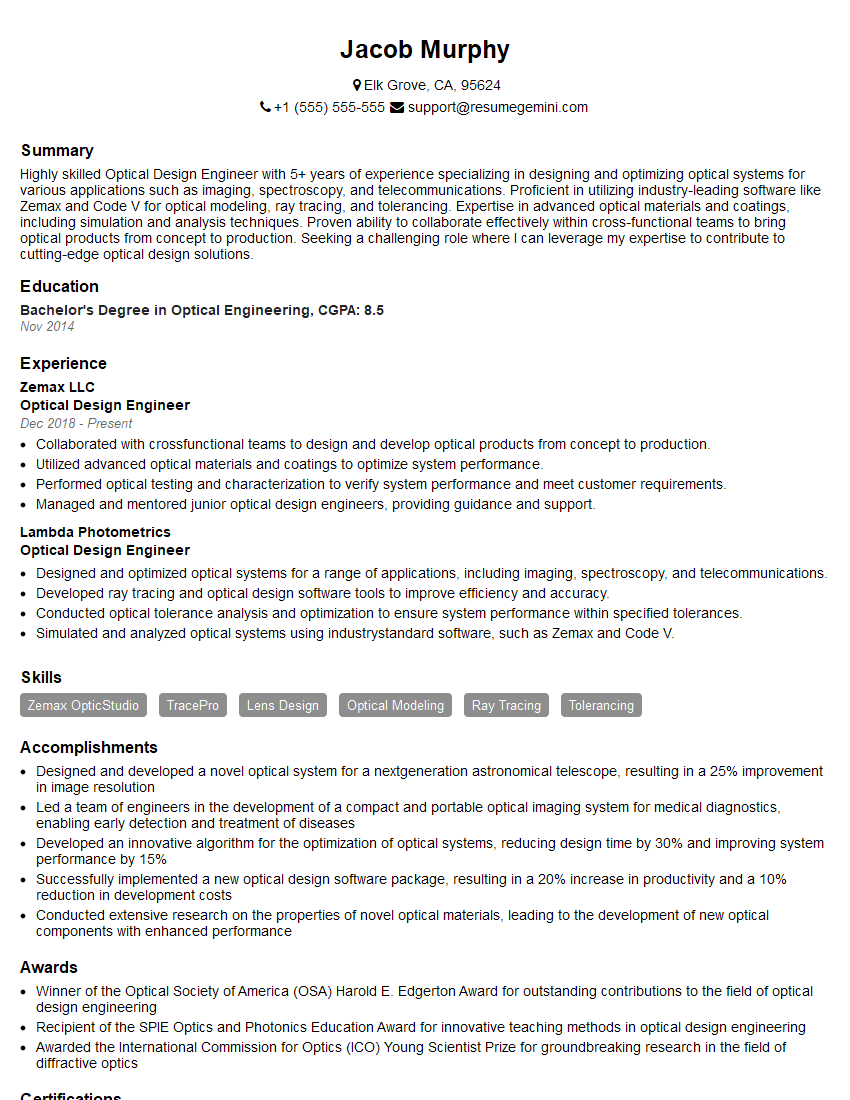
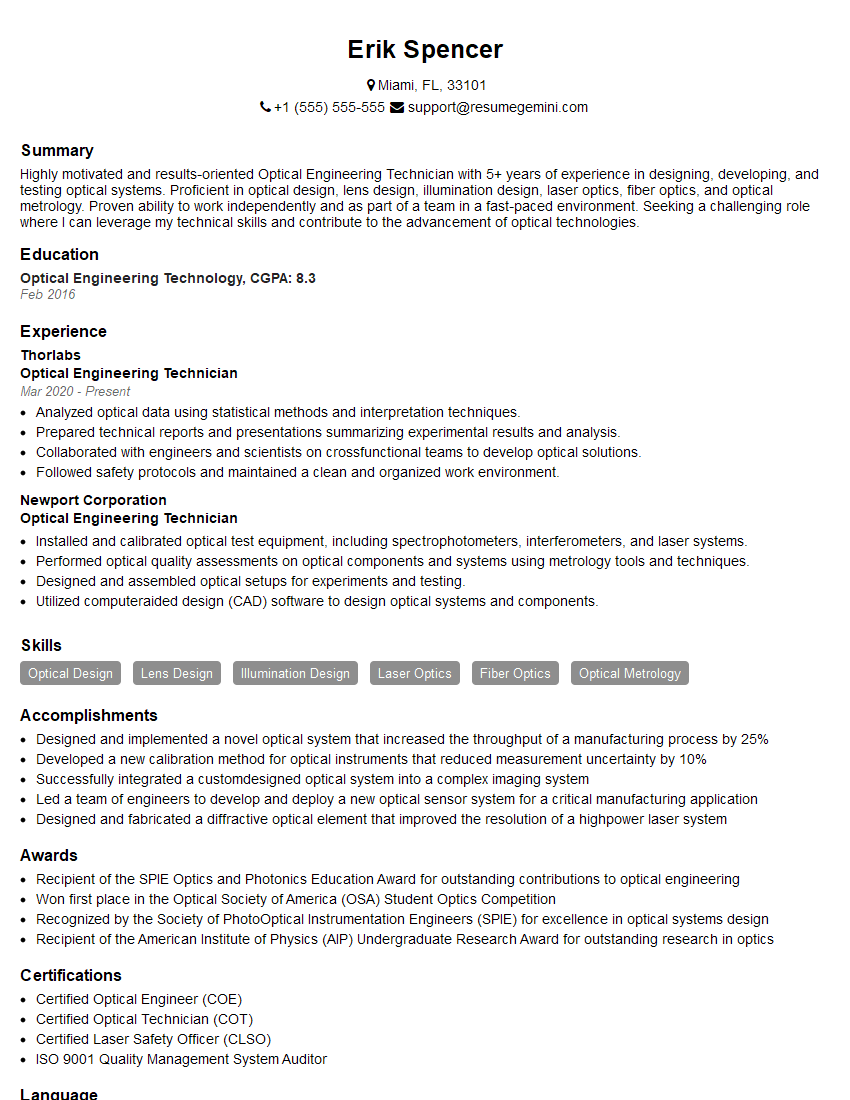
Mastering Optical System Integration opens doors to exciting and rewarding career opportunities in a rapidly growing field. A strong understanding of these concepts is crucial for securing your ideal role. To significantly boost your job prospects, crafting a compelling and ATS-friendly resume is paramount. ResumeGemini is a trusted resource that can help you build a professional resume that highlights your skills and experience effectively. We provide examples of resumes tailored specifically to Optical System Integration to help you get started. Take the next step towards your dream career – build a powerful resume today!
Explore more articles
Users Rating of Our Blogs
Share Your Experience
We value your feedback! Please rate our content and share your thoughts (optional).
What Readers Say About Our Blog
Very informative content, great job.
good