Interviews are opportunities to demonstrate your expertise, and this guide is here to help you shine. Explore the essential Optical System Modeling interview questions that employers frequently ask, paired with strategies for crafting responses that set you apart from the competition.
Questions Asked in Optical System Modeling Interview
Q 1. Explain the principles of ray tracing in optical system modeling.
Ray tracing is a fundamental technique in optical system modeling. It involves tracking the path of individual rays of light as they propagate through an optical system. We assume light travels in straight lines until it encounters an interface between two media with different refractive indices, at which point it bends according to Snell’s Law. This law dictates the relationship between the angles of incidence and refraction: n1sinθ1 = n2sinθ2, where n1 and n2 are the refractive indices of the two media, and θ1 and θ2 are the angles of incidence and refraction, respectively.
The process typically involves defining the starting position and direction of a ray, then iteratively applying Snell’s Law and the laws of reflection at each surface. This allows us to predict where the ray will end up, and thus determine the image formed by the optical system. Software packages utilize sophisticated algorithms to trace many rays, effectively simulating the behavior of light in complex systems.
For example, consider a simple lens. By tracing numerous rays originating from a single point on an object, we can determine the location and size of the corresponding point on the image. Tracing rays parallel to the optical axis helps determine the focal point of the lens. The culmination of all these traced rays creates a complete picture of the image formed, including any aberrations present.
Q 2. Describe different types of optical aberrations and how to correct them.
Optical aberrations are imperfections in the image formed by an optical system, causing deviations from perfect geometrical optics. They arise from the limitations of real optical elements and the approximations inherent in simple lens design. Common aberrations include:
- Spherical Aberration: Rays far from the optical axis focus at different points than those near the axis, resulting in a blurred image.
- Chromatic Aberration: Different wavelengths of light are refracted differently, leading to a color fringe around the image.
- Coma: Off-axis points appear as comet-shaped blur.
- Astigmatism: Different curvatures of the wavefront in the sagittal and tangential planes, leading to two focal lines instead of one point.
- Distortion: Non-linear magnification leading to a barrel or pincushion shaped image.
- Field Curvature: The image plane is curved rather than flat.
Aberration correction involves careful lens design. This might involve using multiple lenses of different shapes and materials to counteract the individual aberrations. Aspheric lenses, which have non-spherical surfaces, can also significantly reduce spherical aberration. Achromats, combinations of lenses made from different types of glass with different dispersive properties, effectively minimize chromatic aberration. Modern lens design software uses sophisticated optimization algorithms to achieve the best possible aberration correction.
Q 3. What are the advantages and disadvantages of using paraxial approximation?
The paraxial approximation simplifies optical system modeling by considering only rays that are very close to the optical axis. This allows for the use of simpler mathematical formulas based on small-angle approximations, like sin θ ≈ θ and tan θ ≈ θ. This significantly reduces computational complexity.
Advantages:
- Simplified calculations: Paraxial approximation allows for easier and faster calculations, especially for complex systems.
- Analytical solutions: Many optical systems can be analyzed analytically using paraxial approximation, providing insights into the system’s behavior without resorting to numerical simulations.
Disadvantages:
- Limited accuracy: The approximation breaks down for rays far from the optical axis, making it unsuitable for systems with large apertures or significant off-axis fields of view.
- Neglects aberrations: The paraxial approximation inherently neglects many types of optical aberrations, which become significant in real-world systems.
In practice, the paraxial approximation is a valuable tool for initial design and analysis, but its limitations should be carefully considered. For accurate modeling of real-world systems, it’s often necessary to use more sophisticated techniques that account for non-paraxial rays and aberrations.
Q 4. How do you model diffraction effects in an optical system?
Diffraction effects, arising from the wave nature of light, are crucial in high-resolution optical systems. They limit the achievable image resolution and introduce blurring. Modeling diffraction involves considering the wave propagation of light, typically using the Huygens-Fresnel principle or Fourier optics.
One common approach is to use the angular spectrum method, which decomposes the light field into its spatial frequency components using a Fourier transform. The propagation of each frequency component is then calculated, accounting for the effects of diffraction. Finally, the propagated components are combined using an inverse Fourier transform to obtain the diffracted field.
Another common method uses the Fresnel or Fraunhofer diffraction integrals, which provide analytical solutions for the diffracted field in specific regimes (near-field and far-field). These methods are particularly useful for analyzing the point spread function (PSF) of an optical system, which describes how a point source of light is imaged. The PSF directly relates to the image resolution. Software packages typically implement these or similar techniques to simulate diffraction in complex optical systems. The simulation results can then be used to assess the image quality and resolution limits.
Q 5. Explain the concept of Optical Transfer Function (OTF) and its significance.
The Optical Transfer Function (OTF) is a powerful tool for characterizing the image quality of an optical system. It describes the system’s response to spatial frequencies in the object plane. The OTF is a complex function, with magnitude representing the Modulation Transfer Function (MTF) and phase representing the Phase Transfer Function (PTF).
The MTF indicates the ability of the system to transfer contrast at various spatial frequencies. A high MTF at a given frequency means that the system preserves contrast well at that frequency; a low MTF indicates loss of contrast. The PTF describes the phase shift introduced by the system at different spatial frequencies. Phase shifts can lead to image blurring.
The OTF’s significance lies in its ability to quantify image quality in a comprehensive way. It is especially useful for comparing the performance of different optical systems. By analyzing the MTF, we can determine the resolution capabilities of a system, while the PTF provides insights into potential phase-related image degradations. For example, a system with a high MTF at high spatial frequencies will produce sharper images, while a system with significant phase distortion in the PTF will likely produce blurry images.
Q 6. Describe different methods for tolerancing optical systems.
Tolerancing optical systems involves determining acceptable variations in the manufacturing parameters of optical components. This is essential to ensure that the final system meets its performance specifications within a reasonable cost.
Several methods are used for tolerancing:
- Worst-case analysis: This method considers the extreme values of all tolerances and determines the resulting performance. While simple, it often leads to overly conservative designs.
- Statistical tolerancing: This approach uses statistical distributions to model the variations in manufacturing parameters. It allows for a more realistic assessment of the system’s performance and can lead to more cost-effective designs. Monte Carlo simulations are frequently employed in this method.
- Root-sum-square (RSS) tolerancing: A simplified statistical approach that assumes independent and normally distributed tolerances. This provides a quick estimate of the total tolerance but lacks the accuracy of full Monte Carlo simulations.
- Sensitivity analysis: This involves determining how sensitive the system’s performance is to changes in individual manufacturing parameters. This helps prioritize which tolerances need to be more tightly controlled.
The choice of tolerancing method depends on factors like the complexity of the optical system, the required accuracy, and the cost constraints. Software tools are often employed to automate the tolerancing process and provide a comprehensive analysis.
Q 7. How do you model polarization effects in optical systems?
Modeling polarization effects is crucial for systems involving polarized light, such as those utilizing polarizers, waveplates, or birefringent materials. Polarization is described by the state of the electric field vector of light. The Jones calculus is a common matrix-based method for modeling the effect of optical elements on polarization. Each optical element is represented by a Jones matrix, and the effect of a sequence of elements is modeled by multiplying their corresponding matrices.
For example, a linear polarizer oriented at an angle θ with respect to the x-axis would have a Jones matrix:
[[cos²θ, sinθcosθ], [sinθcosθ, sin²θ]]
Similarly, waveplates and other birefringent elements can be represented by their respective Jones matrices. The resulting Jones vector, obtained by multiplying the input Jones vector by the system’s overall Jones matrix, represents the output polarization state. More sophisticated methods, such as Mueller calculus, are needed to account for partially polarized light and depolarization effects. These methods use 4×4 matrices to represent the polarization state and the effect of optical elements, allowing for a more complete description of polarization behavior in complex systems.
Q 8. What software packages are you proficient in for optical system modeling? (e.g., Zemax, Code V, LightTools)
I’m proficient in several leading optical design software packages. My primary expertise lies in Zemax OpticStudio, which I’ve used extensively for over eight years across a wide range of projects, from simple lens design to complex free-space optical communication systems. I’m also familiar with Code V, particularly its strengths in tolerancing and manufacturing analysis. While I haven’t used LightTools as frequently, I have experience leveraging its capabilities for non-sequential ray tracing simulations, particularly useful when modeling complex scattering effects or illumination systems.
My proficiency extends beyond just using the software; I understand the underlying optical principles and algorithms that drive these tools, allowing me to interpret results effectively and troubleshoot complex design challenges.
Q 9. Explain the differences between sequential and non-sequential ray tracing.
Sequential and non-sequential ray tracing are two fundamentally different approaches to modeling light propagation in optical systems. Think of sequential ray tracing as tracing a single ray through an optical system in a predetermined order, like a single marble rolling down a defined path. Each optical element encountered along the way influences the ray’s direction and intensity. This method is efficient and works well for systems where light only interacts with one element at a time, such as a standard camera lens.
Non-sequential ray tracing, however, simulates the interaction of many rays simultaneously and allows for multiple reflections and scatterings. Imagine this as throwing a handful of marbles into a pinball machine; each marble (ray) can bounce off multiple elements unpredictably. This approach is computationally more intensive but crucial for modeling complex systems with scattering, diffraction gratings, or interactions between many optical components.
In essence: Sequential ray tracing is faster and suitable for simpler systems, while non-sequential is slower but necessary for accurate simulation of more complex interactions.
Q 10. How do you model scattering in optical systems?
Modeling scattering in optical systems depends heavily on the nature of the scattering itself. There are several models available depending on the type of scattering mechanism and desired level of detail.
- Rayleigh Scattering: Used for scattering from particles much smaller than the wavelength of light (e.g., air molecules). This model predicts scattering intensity inversely proportional to the fourth power of the wavelength, explaining the blue sky.
- Mie Scattering: Suitable for scattering from particles comparable in size to the wavelength of light (e.g., dust, fog). This model considers both the size and refractive index of the scattering particles.
- BRDF (Bidirectional Reflectance Distribution Function): Used for modeling surface scattering from rough surfaces. This involves specifying a function that defines the relationship between incident and reflected light. This can be a measured or theoretical function.
In software like Zemax or LightTools, these models are often implemented as built-in features or through user-defined scattering models. The choice of model directly impacts the accuracy and computational cost of the simulation. Often, a simplified model is used initially, and its accuracy is assessed before moving to more computationally expensive and precise models.
Q 11. Describe your experience with different types of optical elements (lenses, mirrors, prisms).
My experience with optical elements encompasses a broad spectrum. I’ve extensively modeled various lenses, including singlet lenses, achromatic doublets, and aspheric lenses, understanding the trade-offs between their aberration correction capabilities and manufacturing complexities. I’ve worked with various mirror types: spherical, parabolic, and off-axis parabolic, knowing their applications in telescopes, laser resonators, and beam shaping systems. I also have significant experience in modeling the use of prisms, including dispersion prisms (used in spectrometers), roof prisms (used for image inversion), and polarizing prisms (used for polarization control).
Beyond this, I’m also familiar with diffractive optical elements (DOEs), graded index (GRIN) lenses, and fiber optics. My understanding includes not only their optical properties but also their manufacturing limitations and tolerances, a crucial aspect in real-world applications.
Q 12. How do you optimize an optical system for performance and cost?
Optimizing an optical system is a multi-faceted process that balances performance and cost. It’s iterative and requires a clear understanding of the design goals and constraints.
I typically begin by defining key performance metrics (e.g., spot size, modulation transfer function (MTF), chromatic aberration). Then I use optimization algorithms (e.g., damped least squares, simulated annealing) within the optical design software to improve these metrics. These algorithms adjust design parameters (e.g., lens curvatures, thicknesses, element separations) to find an optimal solution.
Cost optimization involves considering the manufacturability of the system. This includes choosing commercially available optical elements, simplifying the design to reduce the number of components, and selecting materials and manufacturing processes that balance performance with cost effectiveness. A thorough tolerance analysis is crucial to ensure the design remains within specifications despite manufacturing variations.
Q 13. Explain your approach to solving an optical design problem.
My approach to solving an optical design problem follows a structured methodology:
- Problem Definition: Clearly define the system requirements, including performance specifications, constraints, and desired cost.
- Initial Design: Create an initial design using either analytical methods or rule-of-thumb estimations. This is often based on similar existing designs or using paraxial ray tracing for a preliminary assessment.
- Optimization: Utilize optimization algorithms to refine the design and improve performance metrics while keeping an eye on the manufacturing constraints.
- Tolerance Analysis: Assess the sensitivity of the design to manufacturing errors. This helps understand the impact of realistic variations in component dimensions and surface quality.
- Validation: Verify the design’s performance using detailed ray tracing simulations, including non-sequential ray tracing if needed.
- Iteration and Refinement: Iterate through steps 3-5, refining the design based on the results of the analyses. This is an iterative process, continually improving the design.
This iterative process is key to achieving a design that meets the specifications within realistic manufacturing limitations.
Q 14. How do you validate the accuracy of your optical models?
Validating the accuracy of optical models is crucial. I use several methods to ensure confidence in my simulations:
- Comparison with Existing Designs: For well-established designs (e.g., a simple doublet lens), I’ll compare my model’s predicted performance against published data or experimental measurements.
- Experimental Verification: When feasible, I build and test prototypes of the designed system. Measured performance is then compared to the model’s predictions to identify discrepancies.
- Sensitivity Analysis: Assessing the model’s sensitivity to input parameters (e.g., refractive indices, surface curvatures) helps determine the model’s robustness and identify potential sources of error.
- Independent Verification: Occasionally, a second independent model is developed to verify results. Comparing the results from two independent models provides additional confidence.
The level of validation effort depends on the complexity of the system and its criticality. For high-stakes applications, rigorous experimental verification is vital. For less demanding situations, comparisons with existing designs and sensitivity analyses might suffice.
Q 15. Describe your experience with different types of optical sensors.
My experience with optical sensors encompasses a wide range, from simple photodiodes to sophisticated multispectral imagers. I’ve worked extensively with:
- Photodiodes and phototransistors: These are fundamental sensors, ideal for simple light detection tasks. I’ve used them in applications ranging from basic light intensity measurements to proximity sensing. Understanding their spectral response and noise characteristics is crucial for accurate modeling.
- Charge-Coupled Devices (CCDs) and Complementary Metal-Oxide-Semiconductor (CMOS) image sensors: These are the workhorses of digital imaging. My experience includes modeling their quantum efficiency, dark current, and read noise to predict image quality. I’ve modeled the effects of pixel crosstalk and blooming as well.
- Spectrometers: I have significant experience modeling the performance of various spectrometer types, from grating-based spectrometers to Fourier Transform Infrared (FTIR) spectrometers. This involves understanding diffraction efficiency, resolving power, and stray light.
- Laser rangefinders and Lidar systems: These utilize time-of-flight measurements or other techniques to determine distance. My experience includes modeling the effects of laser beam divergence, atmospheric attenuation, and target reflectivity on measurement accuracy.
In each case, accurate modeling requires a deep understanding of the sensor’s physics and the limitations imposed by noise and other factors. For example, modeling a CCD camera for low-light applications requires careful consideration of shot noise, which can significantly degrade image quality.
Career Expert Tips:
- Ace those interviews! Prepare effectively by reviewing the Top 50 Most Common Interview Questions on ResumeGemini.
- Navigate your job search with confidence! Explore a wide range of Career Tips on ResumeGemini. Learn about common challenges and recommendations to overcome them.
- Craft the perfect resume! Master the Art of Resume Writing with ResumeGemini’s guide. Showcase your unique qualifications and achievements effectively.
- Don’t miss out on holiday savings! Build your dream resume with ResumeGemini’s ATS optimized templates.
Q 16. How do you handle thermal effects in optical system modeling?
Thermal effects are a significant concern in optical system modeling, especially for precision applications. Temperature changes can lead to material expansion, altering optical path lengths and causing aberrations. I address thermal effects using several techniques:
- Finite Element Analysis (FEA): I use FEA software to model the temperature distribution within the optical system under various operating conditions. This helps determine the resulting thermal stresses and deformations.
- Material property databases: Accurate material properties, including their temperature dependence (e.g., refractive index, thermal expansion coefficient), are essential. I rely on established databases to obtain reliable data.
- Ray tracing with thermal effects: Once the thermal deformations are determined through FEA, I incorporate these deformations into the optical ray tracing model to assess the impact on image quality and performance. This might involve using a deformed surface description in the ray tracing software.
- Compensation strategies: The model helps evaluate potential compensation strategies, such as temperature control systems or thermally stable designs. For instance, a model might reveal the need for a specific material with a low thermal expansion coefficient in a critical component.
Imagine a telescope operating in extreme temperature variations – accurate thermal modeling is crucial to ensure the telescope maintains its focusing capability and image sharpness. My experience ensures these aspects are addressed effectively.
Q 17. Explain your experience with tolerance analysis and its importance.
Tolerance analysis is critical for ensuring that an optical system performs as designed, even considering the inevitable imperfections in manufacturing and assembly. It helps identify the most sensitive parameters and guide design optimization.
My experience includes conducting tolerance analysis using both Monte Carlo methods and deterministic approaches. Monte Carlo simulations involve randomly sampling manufacturing tolerances to statistically evaluate the system’s performance variation. Deterministic methods, such as worst-case analysis, provide a more conservative but computationally less intensive approach. The choice of method depends on the complexity of the system and the desired level of accuracy.
The importance of tolerance analysis cannot be overstated. A system that looks perfect on paper may perform poorly if tolerances are not properly managed. A well-conducted tolerance analysis identifies critical tolerances, enabling cost-effective manufacturing while still meeting performance specifications. For example, in designing a high-precision laser system, tolerance analysis can highlight which component’s manufacturing precision directly impacts beam quality and needs more stringent control.
Q 18. Describe your experience with different types of optical coatings.
Optical coatings are essential for controlling the transmission, reflection, and polarization of light within an optical system. I’ve worked with various coating types:
- Anti-reflection (AR) coatings: These minimize reflections at surfaces, maximizing transmission and reducing stray light. The design of AR coatings often involves multiple layers of dielectric materials optimized for a specific wavelength range.
- High-reflection (HR) coatings: These maximize reflection at specific wavelengths, used in mirrors and resonators. They can be designed for high reflectivity over a broad or narrow spectral range.
- Dichroic coatings: These selectively transmit or reflect different wavelengths, commonly used in optical filters and beam splitters. Designing dichroic coatings requires precise control over layer thicknesses and refractive indices.
- Polarizing coatings: These control the polarization state of light, used in applications such as polarimetry and optical isolators. They often utilize birefringent materials or metallic layers.
Modeling the performance of these coatings involves using specialized software that calculates the reflectance and transmittance of multilayer thin films based on the refractive indices and thicknesses of each layer. This ensures that the desired optical properties are achieved.
Q 19. How do you model the effects of manufacturing tolerances on optical performance?
Modeling the effects of manufacturing tolerances on optical performance is done using tolerance analysis, as mentioned earlier. I typically employ Monte Carlo methods. This involves creating a model of the optical system where the parameters (e.g., surface curvature, thickness, position) are allowed to vary within their specified manufacturing tolerances. The software then performs many simulations with randomly selected values within these tolerances, generating a statistical distribution of the system’s performance metrics.
For example, let’s say we are modeling a lens system. The model will include tolerances for parameters like the radius of curvature of each lens surface, the lens spacing, and the center thickness. A Monte Carlo simulation will run numerous ray traces with randomly perturbed values for these parameters. The results will reveal the range of possible performance variation, such as changes in the spot size, image position, and wavefront error, providing valuable insights into the robustness of the design to manufacturing imperfections.
This analysis allows us to identify the most critical tolerances, those that have the greatest impact on performance. This information then helps optimize the design or tighten tolerances where necessary, leading to a more robust and cost-effective design. The output is often presented as histograms or probability density functions showing the distribution of key performance indicators.
Q 20. Explain your understanding of different types of optical materials and their properties.
Understanding optical materials is crucial for optical system design. I’m familiar with the properties of a wide range of materials, including:
- Glasses: Different glass types (e.g., BK7, fused silica, Schott glasses) offer varying refractive indices, Abbe numbers (a measure of chromatic dispersion), and thermal properties. Choosing the right glass is critical for minimizing chromatic aberration and ensuring thermal stability.
- Crystals: Crystals like calcium fluoride (CaF2) and zinc selenide (ZnSe) are often used in infrared optics due to their excellent transmission in that spectral region. Their properties, like refractive index and birefringence, must be considered carefully.
- Polymers: Polymers, such as polycarbonate and PMMA (acrylic), are lightweight and cost-effective but often have lower refractive indices and greater susceptibility to environmental factors. They are suitable for applications where high precision or performance is less critical.
- Metals: Metals like aluminum and silver are used for mirrors due to their high reflectivity, but their properties such as thermal expansion need to be considered.
For each material, I consider factors like refractive index, dispersion, transmission, absorption, thermal expansion coefficient, and mechanical strength when selecting the most appropriate material for a specific application. For instance, in high-power laser systems, material selection is paramount to avoid thermal lensing and damage.
Q 21. How do you model the effects of environmental factors (temperature, humidity) on optical performance?
Environmental factors like temperature and humidity significantly impact optical system performance. I incorporate these effects into the modeling process in several ways:
- Temperature-dependent material properties: As mentioned earlier, I use temperature-dependent refractive indices and thermal expansion coefficients for all materials in the model. This allows me to simulate the changes in optical path length and aberrations due to temperature fluctuations.
- Humidity effects: Humidity can affect the performance of certain optical components, especially those with uncoated surfaces or those sensitive to moisture. The models may incorporate the effects of humidity on refractive index and absorption, if applicable. For example, a humidity-sensitive coating might cause changes in its refractive index and thus impact its optical performance.
- Environmental chambers: I’ve used environmental chambers to test and validate the model predictions under controlled temperature and humidity conditions. The experimental data provides valuable validation data for the model.
- Compensation strategies: The model helps develop strategies for mitigating environmental effects, such as temperature stabilization systems or hermetically sealed enclosures.
Consider an outdoor laser rangefinder – modeling the effects of temperature and humidity on the laser beam propagation and on the optical components is vital for ensuring accurate distance measurements. I ensure that all relevant environmental parameters are included to create a reliable and accurate optical system model.
Q 22. Describe your experience with free-space optical communication system modeling.
Modeling free-space optical communication (FSO) systems involves simulating the propagation of light beams through the atmosphere. It’s crucial for designing efficient and reliable FSO links, which are increasingly important for high-bandwidth applications. My experience includes using software like MATLAB and specialized optical propagation codes to model atmospheric turbulence, beam wander, scintillation, and pointing errors. I’ve worked on projects simulating various FSO system architectures, including those employing different modulation formats, beam shaping techniques, and adaptive optics to mitigate atmospheric effects. For example, I once modeled a system using a Gaussian beam and compared its performance to a Bessel beam under varying atmospheric conditions to determine optimal beam choice for a specific range and data rate.
A key aspect is accurately representing the atmospheric channel. This involves employing models such as the Kolmogorov turbulence model and considering parameters like the refractive index structure parameter (Cn²) and wind speed. I’ve used these models to predict bit error rates (BER) and system availability under realistic atmospheric scenarios. The results from these simulations have directly informed the design of robust and high-performance FSO systems.
Q 23. How do you perform Monte Carlo simulations for optical systems?
Monte Carlo simulations are indispensable for analyzing optical systems with inherent randomness or uncertainty. In optical system modeling, this often involves simulating the behavior of photons or rays interacting with optical components. The process involves:
- Defining the system: This includes specifying the optical components (lenses, mirrors, detectors), their properties (e.g., refractive index, reflectivity), and the light source characteristics (e.g., wavelength, power).
- Generating random numbers: This is the core of Monte Carlo. Random numbers are used to simulate random processes such as scattering, diffraction, and thermal noise.
- Simulating photon/ray propagation: The simulation tracks the path of individual photons or rays through the optical system, applying the laws of optics and considering the random effects. For example, if modeling scattering, we use random numbers to determine the scattering angle and intensity.
- Collecting and analyzing results: The simulation gathers data on parameters like the number of photons detected, signal-to-noise ratio (SNR), and spot size. These data are then statistically analyzed to characterize the system’s performance.
Imagine trying to predict the illumination pattern of a light bulb with multiple reflections in a complex room. A Monte Carlo simulation would model thousands of photons bouncing off surfaces, eventually providing a statistically accurate representation of the illumination pattern. This is significantly more efficient than solving the full wave equation, particularly in complex scenarios.
Q 24. What are the limitations of optical system modeling software?
Optical system modeling software, while powerful, has inherent limitations. These include:
- Computational complexity: Simulating complex systems with high accuracy can be computationally expensive, especially for large-scale systems or those requiring wave optics simulations. For instance, modeling the detailed diffraction patterns of a complex freeform lens can consume significant resources.
- Model accuracy: The accuracy of the simulation depends heavily on the accuracy of the input parameters and the chosen models. Imperfect knowledge of material properties or simplifying assumptions can introduce errors.
- Approximations and assumptions: Many software packages rely on approximations and simplifications of physical phenomena (e.g., paraxial approximation for ray tracing). These simplifications might not be valid for all applications, particularly with high-numerical-aperture systems or those involving strong non-linear effects.
- Software limitations: The software itself might have limitations in terms of the types of optical components it can model, the range of wavelengths it can handle, or the sophistication of the physical models it employs.
For example, a simple ray tracing software might struggle to accurately model diffraction effects, which can be crucial in certain applications like microscopy. It’s vital to choose the right software and to carefully consider the limitations when interpreting the simulation results.
Q 25. How do you model nonlinear optical effects?
Modeling nonlinear optical effects requires more sophisticated techniques than those used for linear optics. These effects arise when the response of a material to light is not proportional to the incident intensity. Common nonlinear effects include:
- Second-harmonic generation (SHG): Conversion of light at one frequency to light at double the frequency.
- Third-harmonic generation (THG): Conversion to triple the frequency.
- Self-phase modulation (SPM): Intensity-dependent change in the refractive index.
- Stimulated Raman scattering (SRS): Transfer of energy from light at one frequency to light at a lower frequency.
Modeling these effects often involves solving the nonlinear wave equation, which is computationally intensive. Numerical methods like the split-step Fourier method or finite-difference time-domain (FDTD) methods are frequently used. The specific approach depends on the nonlinear effect and the desired level of accuracy. For example, simulating SHG in a nonlinear crystal would require a detailed model of the crystal’s nonlinear susceptibility and its interaction with the incident light wave using a suitable numerical method. The resulting simulations provide predictions of the efficiency of frequency conversion or other relevant parameters.
Q 26. Describe your experience with optimizing optical systems for specific applications (e.g., imaging, illumination, laser systems).
My experience encompasses optimizing optical systems for diverse applications. For imaging systems, I’ve used optimization algorithms to design lens systems with improved resolution, field of view, and aberration correction. This often involves using optimization software that iteratively adjusts design parameters to minimize merit functions that represent desired performance characteristics. For example, I optimized a microscope objective to minimize spherical and chromatic aberrations, resulting in a significant enhancement in image quality.
In illumination design, I’ve worked on optimizing light guides and freeform lenses to achieve uniform illumination patterns. This often requires balancing various factors such as brightness, uniformity, and energy efficiency. A project involved designing a LED-based illumination system for a medical device, requiring optimization for even illumination over a specific area while minimizing glare.
Regarding laser systems, my work has involved optimizing resonator designs for improved beam quality and power output. This often necessitates analyzing mode structures and mitigating thermal effects. For example, I optimized a high-power laser resonator to maximize its efficiency and minimize beam distortion caused by thermal lensing.
Q 27. Explain your familiarity with different types of optical measurements and testing techniques.
I’m familiar with a wide range of optical measurement and testing techniques, both experimental and simulated. These include:
- Interferometry: Techniques like Michelson and Mach-Zehnder interferometry for measuring wavefront aberrations and surface profiles.
- Diffraction measurements: Measuring the diffraction patterns of optical components to assess their quality and performance.
- Optical power meters: Measuring the power of light sources and beams.
- Spectroscopy: Analyzing the spectral content of light sources.
- Beam profiling: Measuring the spatial distribution of light intensity in a beam.
- MTF (Modulation Transfer Function) and PSF (Point Spread Function) measurements: Characterizing the image quality of imaging systems.
I understand the principles behind these techniques and have hands-on experience using various instruments. The choice of measurement technique depends on the specific application and the parameters to be measured. For example, interferometry would be a suitable choice to assess the quality of precision optics, whereas beam profiling would be used to characterize a laser beam.
Q 28. How do you handle uncertainties and errors in optical system modeling?
Uncertainty and errors are inevitable in optical system modeling. Handling them requires a multi-faceted approach:
- Uncertainty quantification: Identifying and quantifying the sources of uncertainty, such as uncertainties in material properties, component tolerances, and environmental factors. This often involves using statistical methods and propagation of errors.
- Sensitivity analysis: Determining how sensitive the simulation results are to variations in the input parameters. This helps to identify critical parameters that require more precise measurement or modeling.
- Monte Carlo simulations (again!): Employing Monte Carlo techniques to propagate uncertainties through the model, generating a probability distribution of the output parameters instead of a single deterministic result. This provides a more realistic representation of the system’s behavior.
- Model validation and verification: Comparing simulation results with experimental measurements to validate the accuracy of the model. This often involves iteratively refining the model until the agreement between simulation and experiment is satisfactory.
- Error analysis: Systematically analyzing the sources and magnitudes of errors in the simulation. This can help identify areas where model improvement or further experimental data is needed.
For instance, if modeling a telescope, I would incorporate uncertainties in the mirror surface figure, atmospheric turbulence, and detector noise to provide a realistic estimate of the telescope’s imaging performance.
Key Topics to Learn for Optical System Modeling Interview
- Ray Tracing Techniques: Understanding various ray tracing methods (e.g., paraxial, ray-transfer matrices, non-sequential) and their applications in different optical systems. Consider the strengths and limitations of each approach.
- Optical Design Software Proficiency: Demonstrate familiarity with industry-standard software packages like Zemax, Code V, or LightTools. Be prepared to discuss your experience with specific features and workflows.
- Aberration Theory: A solid grasp of different aberration types (spherical, chromatic, coma, astigmatism, etc.), their causes, and correction methods is crucial. Be ready to discuss how these affect system performance.
- Diffraction and Interference: Understand the principles of diffraction and interference and their impact on image quality and resolution. Be able to discuss applications like diffraction gratings and interferometry.
- Optical Materials and Coatings: Familiarity with the properties of various optical materials (e.g., glass types, plastics) and anti-reflection/high-reflection coatings is essential for realistic system modeling.
- Tolerancing and Optimization: Demonstrate understanding of optical tolerancing and optimization techniques used to ensure system performance within manufacturing constraints. Discuss strategies for minimizing sensitivity to component variations.
- Polarization and its effects: Understanding how polarization affects optical systems and how to model its impact is important for many applications.
- Practical Applications and Case Studies: Prepare to discuss practical applications of optical system modeling in areas such as imaging systems, fiber optics, laser systems, or illumination design. Highlighting specific projects or case studies will strengthen your application.
- Problem-Solving and Analytical Skills: Showcase your ability to approach complex optical problems systematically, using both theoretical knowledge and practical skills. Be ready to discuss your problem-solving methodologies.
Next Steps
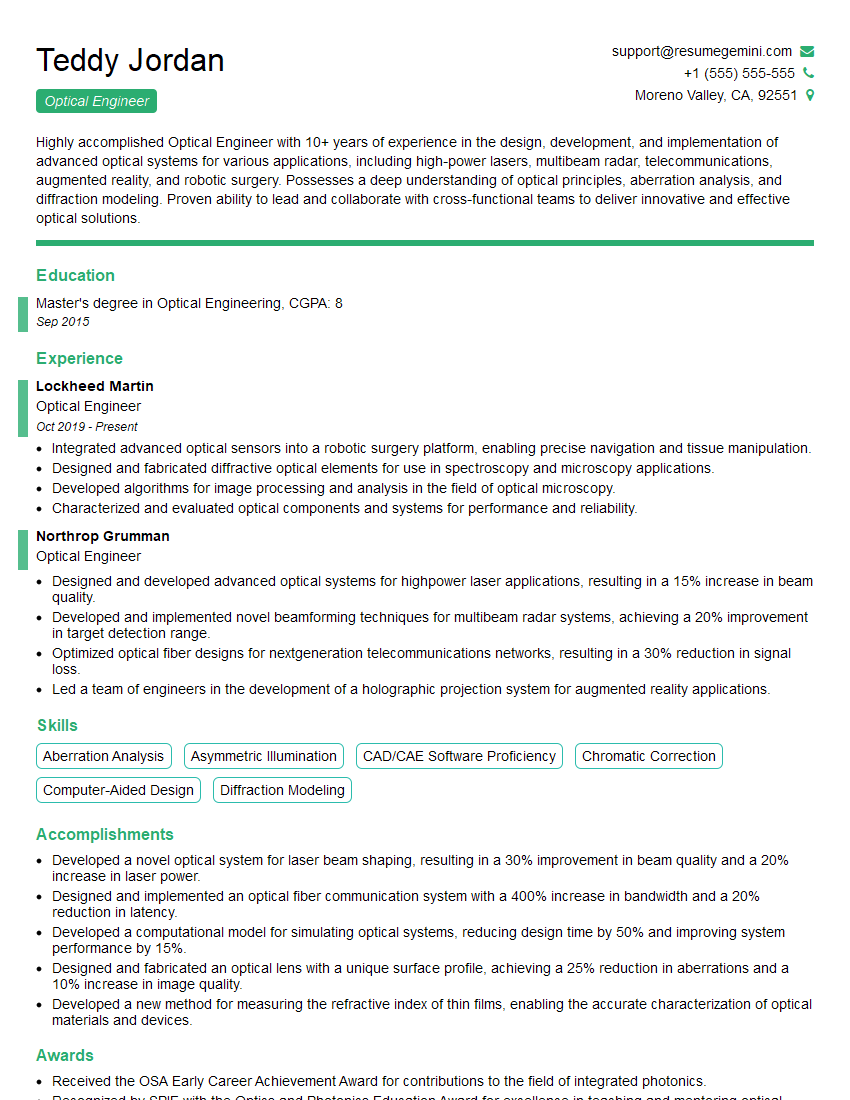
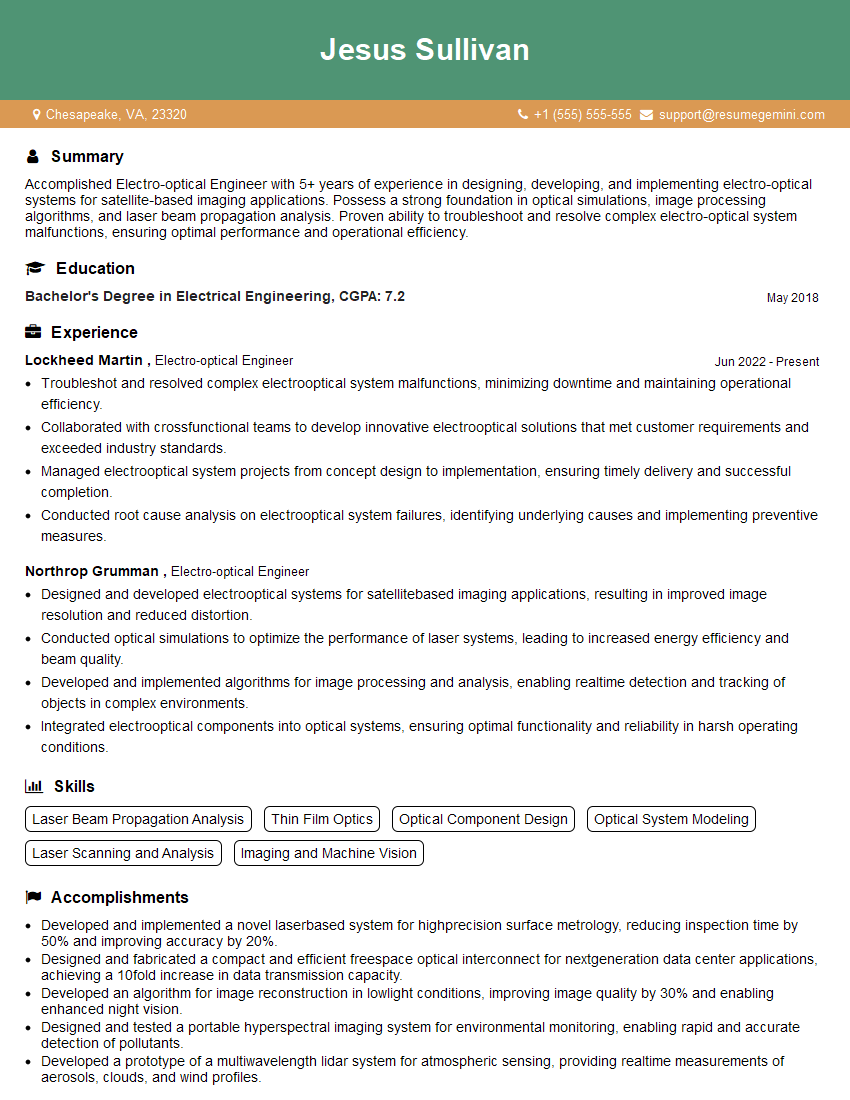
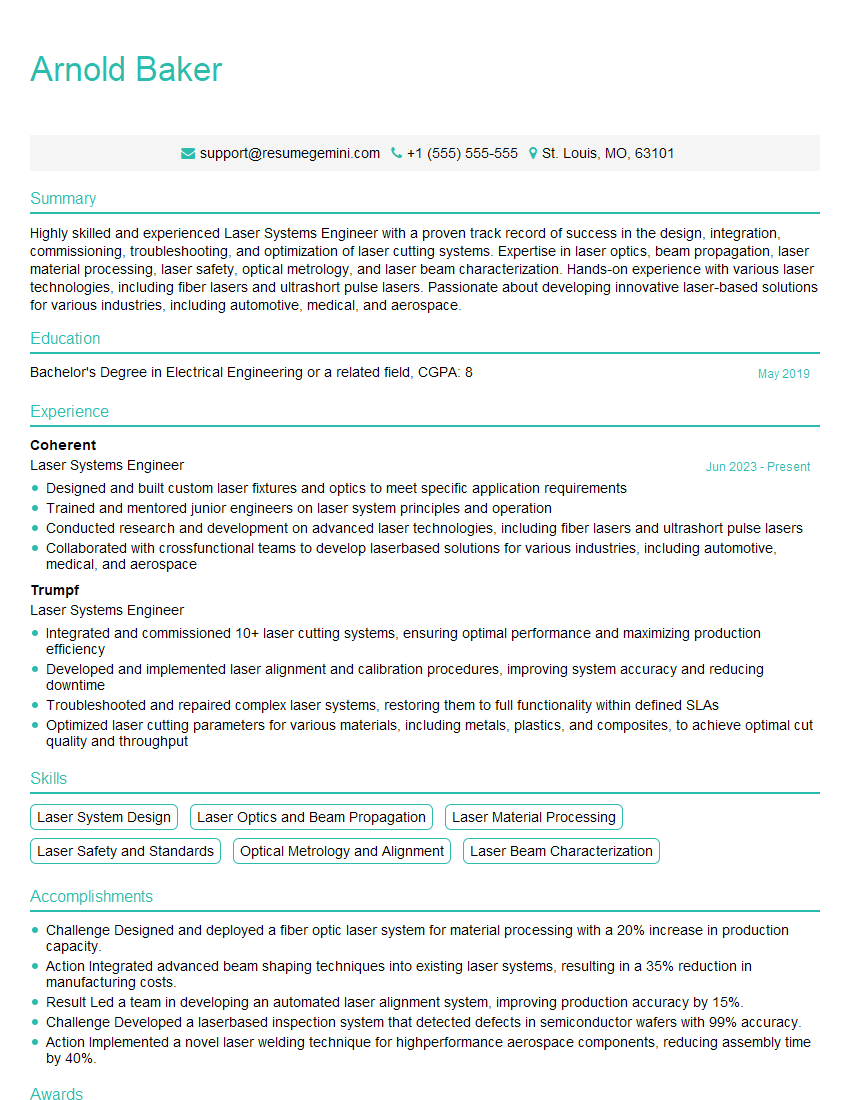
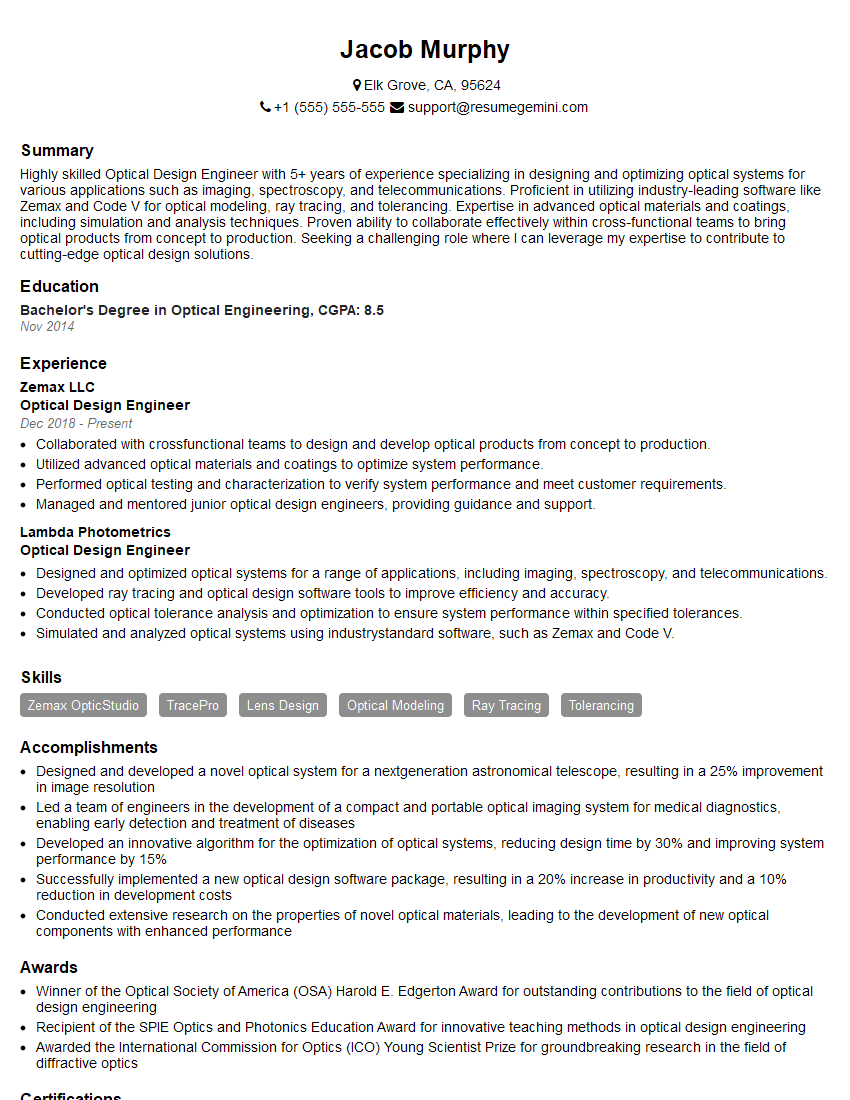
Mastering Optical System Modeling opens doors to exciting and rewarding careers in cutting-edge technology. To maximize your job prospects, focus on building an ATS-friendly resume that highlights your skills and experience effectively. ResumeGemini is a trusted resource that can help you craft a professional and compelling resume that stands out to recruiters. Take advantage of their expertise and explore the examples of resumes tailored to Optical System Modeling to further enhance your application materials. Your future in this field awaits!
Explore more articles
Users Rating of Our Blogs
Share Your Experience
We value your feedback! Please rate our content and share your thoughts (optional).
What Readers Say About Our Blog
Very informative content, great job.
good