Interviews are more than just a Q&A session—they’re a chance to prove your worth. This blog dives into essential Orchestral Repertoire Knowledge interview questions and expert tips to help you align your answers with what hiring managers are looking for. Start preparing to shine!
Questions Asked in Orchestral Repertoire Knowledge Interview
Q 1. Name three symphonies by Beethoven and briefly discuss their stylistic differences.
Beethoven’s symphonies represent a pivotal moment in musical history, marking a transition from Classical to Romantic styles. Three significant examples showcasing stylistic evolution are:
Symphony No. 3, ‘Eroica’: This symphony, initially dedicated to Napoleon, is monumental in scope and emotional intensity. It breaks away from the Classical structure with its expanded length and dramatic contrasts. The sheer power and heroic sweep represent a departure from the elegance and balance of earlier symphonies. Think of the dramatic power of the opening movement, a far cry from the refined elegance of a Haydn symphony.
Symphony No. 5: Famous for its iconic opening motif –
da-da-da-DUH– this symphony epitomizes struggle and triumph. While maintaining a Classical four-movement structure, it uses thematic development with greater intensity and complexity than its predecessors. The relentless drive of the first movement and the triumphant finale showcase Beethoven’s growing mastery of dramatic expression.Symphony No. 9: This symphony represents the pinnacle of Beethoven’s achievement and a bold leap into the Romantic era. It introduces a chorus and vocal soloists in the final movement, an unprecedented innovation for the symphony form. The sheer emotional depth, the integration of vocal and instrumental forces, and the philosophical weight of the ‘Ode to Joy’ finale solidifies its position as a landmark work.
In essence, we see a progression from the structured elegance of Classical forms towards the more emotionally expressive and expansive style of Romanticism. The shift is evident in the increasing length, the heightened emotional intensity, and the exploration of new musical territories.
Q 2. Compare and contrast the compositional styles of Mahler and Strauss.
Gustav Mahler and Richard Strauss, both giants of the late Romantic era, shared some common ground but also displayed significant stylistic differences. Both pushed the boundaries of orchestral writing, creating works of immense scale and complexity.
Similarities: Both composers wrote large-scale orchestral works, often incorporating elements of Wagnerian romanticism (though Strauss would later move away from this). Both were masters of orchestration, employing vast orchestral forces to create rich, colorful soundscapes. They both dealt with profound emotional themes in their compositions, and their music often reflects a sense of introspection and psychological depth.
Differences: Mahler’s symphonies are often characterized by their integration of vocal elements, programmatic narratives (even if not explicitly stated), and a blend of folk music elements with high art. His symphonies are often intensely personal and deeply psychological. Think of the introspective nature of his 5th Symphony or the darkly evocative world of his 6th. Strauss, on the other hand, is known for his virtuosic orchestral writing and his tone poems, which often depict specific scenes or narratives in vivid detail. His works, while emotionally rich, often prioritize formal structure and instrumental brilliance. Compare the dramatic sweep of Also Sprach Zarathustra with the introspective lyricism of Mahler’s Kindertotenlieder. The difference in approach is stark.
In short, while both composers were masters of the late Romantic orchestra, Mahler’s style leans towards the introspective and psychologically complex, while Strauss’s focus lies on virtuosity and vivid narrative depiction through orchestral means.
Q 3. Discuss the evolution of the orchestral concerto from the Baroque to the Romantic period.
The orchestral concerto underwent a significant transformation from the Baroque to the Romantic period.
Baroque Concerto (e.g., Vivaldi’s Four Seasons): Characterized by a relatively small orchestra (ripieno) contrasted with a smaller group of soloists (concertino). The focus was on virtuosity and clear melodic lines. The structure often followed a three-movement pattern (fast-slow-fast) with a clear interplay between the soloist(s) and the orchestra. The soloist often took a more prominent role but still remained within the overall structural framework dictated by the orchestra.
Classical Concerto (e.g., Mozart’s Piano Concertos): The concerto became more integrated. While still showcasing the soloist’s virtuosity, the relationship between soloist and orchestra became more balanced and interactive. The orchestra played a more significant role in thematic development, with the soloist engaging in a true dialogue rather than simply presenting solo passages. Formal structures became more sophisticated.
Romantic Concerto (e.g., Brahms’ Piano Concerto No. 1): This period witnessed an expansion of the concerto’s scope and emotional depth. The works became longer and more dramatic, with extended solo passages showcasing the technical and expressive capabilities of the soloist and the expressive power of the orchestra. The orchestra’s role became more equal with the soloist; the interplay between them became more complex and dramatic. Themes often explored larger, more emotional themes. The formal structure, while still present, is subservient to the narrative arc and expression of emotion.
The evolution traces a path from a clear separation of soloist and orchestra to a more integrated and dramatically charged partnership, reflecting the wider shift in musical aesthetics from the Baroque’s formality to the Romantic’s emotional intensity.
Q 4. Identify the key characteristics of the Classical symphony.
The Classical symphony, typically associated with the Viennese school of Haydn, Mozart, and early Beethoven, exhibits key characteristics:
Four-movement structure: Generally consisting of a fast movement (often in sonata form), a slow movement, a minuet and trio (sometimes replaced by a scherzo), and a final fast movement.
Sonata form: A prevalent compositional structure in the first and sometimes fourth movements, characterized by exposition (presentation of themes), development (manipulation and transformation of themes), and recapitulation (return of themes).
Homophonic texture: Primarily characterized by a single melodic line accompanied by chords, creating a clear and balanced musical texture.
Clarity and balance: Emphasizing formal structure, elegance, and melodic clarity.
Limited use of dynamics: Though dynamics were used, the dramatic contrasts found in later periods were less pronounced. Think of the relatively restrained dynamics of a Mozart symphony in contrast to the powerful crescendos of a Romantic symphony.
Orchestration: Utilizing a relatively standard Classical orchestra, typically featuring strings, woodwinds (two oboes, two bassoons), horns, and trumpets, but without the wide range of instruments seen in later periods.
These characteristics contributed to the creation of works that were both intellectually stimulating and aesthetically pleasing, establishing a framework that would influence composers for generations.
Q 5. Describe the instrumentation of a standard Romantic orchestra.
The standard Romantic orchestra significantly expanded upon its Classical predecessor, adding instruments and enhancing the overall sonic palette. A typical Romantic orchestra included:
Strings: A larger string section than in the Classical period, with first and second violins, violas, cellos, and double basses. The larger section allowed for a richer and more powerful sound.
Woodwinds: Expanded to include a full complement of flutes (often two or more), oboes (two), clarinets (two or more, often including the bass clarinet), and bassoons (two or more).
Brass: The brass section grew significantly. It usually included at least two horns, two trumpets (often with higher pitched trumpets added), and three trombones (with a tuba sometimes included). This expansion provided a broader range of timbres and a greater capacity for dramatic effects.
Percussion: Beyond timpani (kettledrums), the Romantic orchestra incorporated a wider array of percussion instruments, including bass drum, snare drum, cymbals, triangle, and sometimes more exotic instruments to create specific effects. This increased the orchestra’s sonic vocabulary and ability to depict a wider range of emotions and scenes.
This expanded instrumentation allowed for a much richer, more colorful, and emotionally expressive sound world, perfectly suited to the heightened emotionalism and dramatic scope of Romantic music.
Q 6. What are the defining features of Stravinsky’s neoclassical style?
Igor Stravinsky’s neoclassical style, emerging in the early 20th century, represented a reaction against the expressive excesses of late Romanticism and early 20th-century musical modernism. Key features include:
Formal clarity and structure: A return to the clarity of form and structure found in Classical music. Stravinsky’s neoclassical works often employ traditional forms like sonata form, fugue, and concerto grosso.
Objectivity and detachment: A rejection of emotionally charged Romanticism in favor of a more objective, detached style. The music often avoids overt emotional expression, focusing instead on formal perfection and instrumental technique.
Use of older musical styles: Borrowing elements from Baroque and Classical music, including contrapuntal textures and clear melodic lines. Think of the use of Baroque-like counterpoint in his ballet, Pulcinella.
Simple melodies and harmonies: Often employing simpler melodies and harmonies compared to the more complex and chromatic styles of Romanticism and early modernism. His music maintains a balance and clarity that isn’t present in other more dissonant styles.
Emphasis on texture and rhythm: While melodies were often simple, Stravinsky masterfully manipulated texture and rhythm to create complex and engaging musical experiences. The rhythmic complexities of The Rite of Spring, even in its neoclassical phase, show this influence.
Stravinsky’s neoclassicism was not a mere stylistic revival but rather a sophisticated reworking of past styles in a new context, forging a distinctive and influential voice in 20th-century music.
Q 7. Analyze the use of leitmotifs in Wagner’s operas.
Richard Wagner’s use of leitmotifs, or leading motives, is a cornerstone of his dramatic style. Leitmotifs are short, recurring musical themes associated with specific characters, objects, ideas, or emotions within his operas.
Character portrayal: Certain leitmotifs represent individual characters, often reflecting their personality or fate. For example, the ‘fate’ motif in Die Walküre foreshadows doom.
Emotional expression: Leitmotifs convey emotions and states of mind, enhancing the dramatic impact of the scenes. The ‘love’ theme might sound different in moments of passionate love versus moments of heartbroken despair.
Development and transformation: Leitmotifs are not static; they can be transformed or developed throughout the opera, reflecting changes in the character, situation, or the narrative’s progression. The same theme might appear in different keys or orchestrations, subtly reflecting the changing emotional landscape.
Wagner’s masterful use of leitmotifs creates a complex web of musical associations that deepen the audience’s understanding of the drama, adding an extra layer of meaning and emotional impact. It links seemingly disparate moments in the opera through recurring musical ideas, reinforcing the overall narrative.
By weaving these musical threads together, Wagner creates a rich tapestry of sound that enhances and intensifies the dramatic power of his operas, making them profoundly moving and unforgettable experiences.
Q 8. Discuss the impact of Debussy’s impressionism on orchestral music.
Debussy’s impressionism revolutionized orchestral music by shifting the focus from traditional structures and clear melodies towards atmosphere and color. Instead of striving for dramatic climaxes, he prioritized evoking moods and sensory experiences. This involved a significant departure from the Romantic era’s emphasis on powerful emotional expression.
Key features of Debussy’s impressionistic style include:
- Whole-tone scales and pentatonic scales: These scales create a hazy, less defined tonal center, contributing to the dreamlike quality of his music. Think of the shimmering atmosphere in La Mer.
- Parallel chords and suspended chords: These create a sense of ambiguity and floating harmony, avoiding traditional cadences and resolutions. This is evident in the ethereal textures of Clair de Lune.
- Orchestral color: Debussy masterfully utilized the unique timbres of individual instruments and explored new ways to blend and layer them, creating a rich sonic tapestry. His innovative use of the harp and the flute, for example, added a unique shimmer and delicacy to his orchestral works.
- Fluid melodic lines and fragmented motifs: Instead of strong, memorable themes, Debussy often used shorter, fragmented melodic ideas that intertwine and evolve organically, mirroring the fluidity of nature and impressions.
The impact of Debussy’s impressionism is undeniable. It paved the way for 20th-century composers like Ravel, and influenced subsequent movements in music, including modernism and minimalism. Composers started to experiment more freely with harmony, timbre, and form, opening up new avenues for musical expression.
Q 9. Compare the compositional techniques of Brahms and Tchaikovsky.
Brahms and Tchaikovsky, while both giants of the Romantic era, employed distinct compositional techniques. Brahms, rooted in the Classical tradition, emphasized rigorous structure and counterpoint, while Tchaikovsky leaned towards a more overtly emotional and melodic style, often employing lush orchestration and dramatic contrasts.
Brahms:
- Formal Structure: His symphonies and chamber works are characterized by meticulously crafted structures, often adhering closely to traditional forms like sonata form. His mastery of counterpoint creates complex, interwoven textures.
- Harmony: Brahms’s harmony is often complex and chromatic, pushing the boundaries of tonality while maintaining a strong sense of resolution. He uses intricate modulations and unexpected harmonic shifts, adding depth and sophistication.
- Melody: His melodies are often strong and memorable but sophisticated, avoiding overly sentimental or simplistic phrasing.
- Orchestration: His orchestration is generally balanced and clear, serving the structure and highlighting the interplay of voices.
Tchaikovsky:
- Formal Structure: While Tchaikovsky understood traditional forms, he sometimes allowed emotional expression to subtly modify formal structures. His melodies often drive the overall structure.
- Harmony: Tchaikovsky’s harmonic language is more straightforward than Brahms’s, though still rich and expressive. He uses lush harmonies to amplify the emotional impact of his music.
- Melody: His melodies are often intensely lyrical and memorable, easily capturing the listener’s emotions. They’re characterized by a captivating melodic line.
- Orchestration: Tchaikovsky is renowned for his brilliant and colorful orchestration, using the full range of the orchestra to create dramatic effects and vivid sonic landscapes. The famous Romeo and Juliet overture exemplifies his use of contrasting instrumental colors to create a powerful emotional narrative.
In essence, Brahms’s music is characterized by intellectual rigor and structural precision, while Tchaikovsky’s emphasizes emotional power and expressive beauty. Both composers, however, achieved unparalleled mastery within their distinct styles.
Q 10. Explain the role of the timpani in a Romantic orchestra.
The timpani played a crucial and evolving role in the Romantic orchestra. Prior to the Romantic era, its use was largely limited to providing punctuating rhythmic effects. However, during the Romantic period, composers explored its potential for expressive depth, making it a far more versatile and important instrument.
In the Romantic orchestra, the timpani:
- Provided rhythmic drive and emphasis: Similar to its earlier function, but now more subtly integrated into the musical fabric.
- Contributed to harmonic color: The ability to quickly change tuning allowed composers to create harmonic implications and transitions, enriching the overall sonic landscape. For example, Wagner often uses the timpani to create dramatic harmonic shifts.
- Added emotional depth: The deep, resonant tone of the timpani proved remarkably effective in conveying feelings of power, sorrow, or mystery. Think of the somber timpani rolls in the opening of Mahler’s 5th Symphony.
- Created dramatic effects: Composers often used timpani rolls and sustained notes to heighten tension, build excitement, or underscore specific moments of drama.
The increased range of timpani tuning and the growing number of timpanists in the orchestra during the Romantic era allowed composers to explore these new expressive possibilities, resulting in a significant increase in the instrument’s presence and importance in orchestral works.
Q 11. Discuss the development of the orchestral suite from its origins to the 20th century.
The orchestral suite evolved from its origins in Baroque dance suites to become a significant form in the Romantic era and beyond. Initially, suites comprised a series of dances, often with contrasting characters, linked together to form a cohesive whole. These dances typically followed a set order, such as allemande, courante, sarabande, and gigue.
Baroque Period: The Baroque suite provided a framework for showcasing instrumental virtuosity and compositional skill. Bach’s orchestral suites are prime examples of this period.
Classical Period: The Classical period saw a shift towards more integrated and unified structures within the suite, although the dance forms remained central. Haydn and Mozart used the suite form more sparingly, integrating it into their larger works or operas.
Romantic Period: During the Romantic period, the suite form underwent a significant transformation. Composers began to move beyond purely dance-based movements, incorporating other forms like marches, nocturnes, intermezzos, and character pieces. The focus shifted to unified thematic material and narrative coherence, which was strengthened by the use of leitmotifs, as seen in the symphonic poems.
20th Century: In the 20th century, the orchestral suite continued to evolve, with composers exploring a wider range of styles and forms. Some retained the traditional dance-suite structure, while others used the title ‘suite’ to simply denote a collection of related orchestral pieces.
The development of the orchestral suite reflects the ongoing evolution of musical forms, constantly adapting and responding to changing tastes and compositional techniques. The flexibility of the suite form, allowing composers to incorporate various styles and movements, ensured its enduring relevance throughout different periods.
Q 12. Identify three significant works for orchestra written by female composers.
While female composers have historically faced significant barriers to recognition, several created important and enduring orchestral works. Here are three significant examples:
- Lili Boulanger’s Psalm 24: This powerful and moving work showcases Boulanger’s mastery of orchestration and her profound spiritual depth. The piece demonstrates a sophisticated command of orchestral colors and textures.
- Clara Schumann’s Piano Concerto in A minor: Though primarily known as a pianist, Clara Schumann composed a highly regarded piano concerto that demonstrates remarkable lyrical beauty and technical skill, with a captivating interplay between the solo piano and the orchestra.
- Florence Price’s Symphony in E minor: This groundbreaking work was the first symphony by an African-American woman to be performed by a major American orchestra. The symphony exhibits a compelling blend of Romantic and African-American musical traditions, exhibiting both dramatic power and lyrical expression.
These works represent just a fraction of the substantial contributions made by female composers to the orchestral repertoire. Their talent and skill are becoming increasingly recognized and celebrated, as we continue to recover and promote previously overlooked musical voices.
Q 13. Explain the differences between a symphony and a concerto.
While both symphonies and concertos are large-scale orchestral works, they differ significantly in their structure and purpose:
Symphony:
- Structure: Typically consists of four movements, each with its own character and form (though variations exist). The movements often exhibit contrasting tempos and moods.
- Focus: Primarily explores the expressive potential of the orchestra itself, using a variety of instrumental combinations and textures to create a unified whole.
- Soloist: Does not feature a soloist; it’s purely an orchestral composition.
Concerto:
- Structure: Usually comprises three movements, a fast-slow-fast structure is common, although variations exist. The concerto frequently features a dramatic contrast between the soloist and the orchestra.
- Focus: Showcases a solo instrument (or sometimes a small ensemble) in dialogue with the orchestra. It highlights both the soloist’s virtuosity and the orchestral accompaniment’s support.
- Soloist: Features one or more soloists who engage in a virtuosic interplay with the orchestra. The concerto provides a platform for highlighting the solo instrument’s capabilities.
In essence, a symphony is an orchestral statement in itself, while a concerto is a collaborative effort between a soloist and the orchestra, creating a dynamic and interactive musical experience. The concerto form provides a framework for contrasting timbres and dynamics which creates an engaging musical dialogue.
Q 14. Describe the structure of a typical sonata-form movement.
Sonata form, a cornerstone of Western classical music, typically consists of three sections: exposition, development, and recapitulation. While variations exist, a typical structure might look like this:
Exposition:
- Theme 1 (Tonic Key): Usually presented by the primary instrument or section of the orchestra, establishing the main thematic idea and the tonal center (tonic).
- Transition: Modulates to a contrasting key (usually dominant).
- Theme 2 (Dominant Key or closely related key): Introduces a second theme that complements or contrasts with Theme 1. This theme often has a different character than Theme 1.
- Closing Theme (optional): Often a shorter, more conclusive theme in the dominant key.
Development:
- Fragmentation and Modulation: Themes from the exposition are developed and transformed. They are broken down, rearranged, and shifted through various keys, creating a sense of harmonic instability and tension.
- Exploration: The development section provides an opportunity to explore the harmonic and melodic potential of the thematic material in new and exciting ways. Often this section is more improvisational in nature.
Recapitulation:
- Theme 1 (Tonic Key): Theme 1 is restated in the tonic key.
- Theme 2 (Tonic Key): Theme 2 is also restated, but this time also in the tonic key.
- Coda (optional): The movement concludes with a coda, often a brief, conclusive passage that reinforces the tonic key and brings the movement to a satisfying close.
While this outlines a typical structure, composers frequently deviate from it, using the sonata form as a flexible framework for exploring musical ideas. Understanding sonata form provides crucial insight into the architecture of a vast body of classical music, from symphonies to sonatas and concertos.
Q 15. What are some common challenges in programming an orchestral concert?
Programming an orchestral concert presents numerous challenges, all interlinked and demanding meticulous planning. One major hurdle is balancing the artistic vision with practical constraints. This involves selecting repertoire that’s both musically rewarding and feasible given the orchestra’s skill level, available rehearsal time, and budget. For example, a complex Romantic symphony might be breathtaking but require significantly more rehearsal than a shorter, more accessible piece.
Another challenge is coordinating the various elements – musicians, conductors, stagehands, lighting, sound – to create a cohesive and seamless performance. Managing individual musician schedules, securing necessary instruments and parts, and ensuring effective communication are all critical. Imagine the logistical nightmare of coordinating soloists who may have their own agents and travel arrangements!
Finally, the potential for unforeseen issues, from musician illness to equipment malfunctions, necessitates robust contingency planning. This includes having backup musicians ready, ensuring instrument backups are available, and developing alternative solutions for potential technical problems. A successful concert is as much about anticipating and mitigating risk as it is about realizing the musical vision.
Career Expert Tips:
- Ace those interviews! Prepare effectively by reviewing the Top 50 Most Common Interview Questions on ResumeGemini.
- Navigate your job search with confidence! Explore a wide range of Career Tips on ResumeGemini. Learn about common challenges and recommendations to overcome them.
- Craft the perfect resume! Master the Art of Resume Writing with ResumeGemini’s guide. Showcase your unique qualifications and achievements effectively.
- Don’t miss out on holiday savings! Build your dream resume with ResumeGemini’s ATS optimized templates.
Q 16. How would you approach selecting repertoire for a youth orchestra?
Selecting repertoire for a youth orchestra requires a careful balance between educational value, musical interest, and performance feasibility. The pieces should challenge the young musicians without overwhelming them, fostering their development while ensuring an enjoyable experience.
I would start by assessing the orchestra’s current skill level and identify areas needing improvement. For example, if their intonation is weak, pieces emphasizing melodic lines and clear articulation would be beneficial. If their rhythmic precision needs work, incorporating pieces with complex rhythmic patterns would be a good choice.
Then I’d consider their musical maturity. Exposure to different styles and eras is vital; therefore, a program might include a Baroque suite, a Classical divertimento, and a Romantic piece, ensuring diversity while maintaining a manageable level of difficulty.
Finally, I’d choose works that are engaging and enjoyable for both the players and the audience. Pieces with memorable melodies, exciting rhythms, and clear orchestral textures are far more likely to captivate a young audience and inspire enthusiasm among the players. Think of the vibrant colors of a piece like Holst’s ‘Second Suite in F’ or the dramatic contrasts in Rimsky-Korsakov’s ‘Scheherazade’ (perhaps in a simplified arrangement).
Q 17. Discuss the importance of considering audience engagement when selecting repertoire.
Audience engagement is paramount when selecting orchestral repertoire. A concert should be an enjoyable and enriching experience, leaving the audience feeling satisfied and wanting more. This demands careful consideration of the audience’s musical background, preferences, and expectations.
A purely academic or overly obscure program, while perhaps fascinating to specialists, might leave a general audience feeling alienated or bored. Conversely, a program entirely composed of crowd-pleasing ‘easy listening’ pieces may fail to stimulate or challenge the audience’s musical appreciation.
The ideal approach involves a thoughtful balance. Including at least one well-known and beloved piece (perhaps a popular concerto or a movement from a famous symphony) can attract a broader audience and create a sense of familiarity. Then, introduce less familiar, yet accessible, works that showcase the orchestra’s capabilities and expand the audience’s musical horizons. Perhaps a lesser-known but beautifully crafted piece by a well-regarded composer, or a carefully selected piece from a less frequently performed era. Program notes offering insightful context and anecdotes can greatly enhance audience appreciation.
Q 18. How do you ensure the accuracy of orchestral scores and parts?
Ensuring the accuracy of orchestral scores and parts is crucial for a successful performance. Errors, however small, can disrupt the flow of the music and undermine the overall artistic quality.
My approach relies on multiple layers of verification. First, I meticulously examine the scores and parts procured from publishers or other reputable sources, comparing them against available digital editions if possible. Then, I involve several skilled musicians in the process – often including section principals – for independent review. They check for any inconsistencies, errors in notation, or potential ambiguities in the parts.
Following individual reviews, the scores and parts undergo a collaborative cross-checking process to ensure uniformity and accuracy across all instruments. This collective review often reveals errors that individual proofreaders may have missed. Finally, I use a variety of digital tools – music notation software such as Sibelius or Finale can be used to generate parts, correct errors and cross-check for accuracy.
This multi-layered approach combines human expertise with technological capabilities, creating a comprehensive quality control process that minimizes the risk of errors reaching the musicians.
Q 19. Describe your experience with music library cataloging systems.
My experience with music library cataloging systems is extensive. I’m proficient in using various systems, from large-scale integrated library systems (like Koha or Aleph) to specialized music library management software. I understand the importance of metadata in facilitating efficient retrieval and organization of musical scores and related materials.
I’m familiar with standardized cataloging practices like AACR2 (Anglo-American Cataloguing Rules) and Library of Congress Subject Headings, ensuring consistency and searchability within the library’s collection. This includes creating and maintaining accurate records that accurately reflect the composer, title, instrumentation, publisher, and other relevant information.
Furthermore, I’m experienced in creating customized metadata fields to cater to specific needs, such as adding performance notes, details about available arrangements, or links to relevant online resources. This detailed cataloging greatly improves the usability of the library and allows for accurate searching and retrieval based on various criteria. Effective cataloging is essential for efficient library management and research.
Q 20. Explain your process for researching and selecting appropriate orchestral works.
My process for researching and selecting orchestral works begins with clearly defining the parameters of the project – the orchestra’s capabilities, the concert’s theme (if any), the desired duration, and the target audience. This forms the framework for my search.
I then consult a variety of sources, including online databases (like WorldCat or IMSLP), specialized music catalogs, and published bibliographies. I explore different compositional periods and styles, considering a broad spectrum of works to ensure both familiar and less frequently performed pieces are considered.
As I identify potential pieces, I carefully evaluate their suitability based on the defined parameters. This includes reviewing scores, listening to recordings, and considering the technical demands on the orchestra. I also consider the overall flow and coherence of the program, aiming to create a balanced and engaging musical narrative. Finally, I take into account practical factors like the availability of scores, performance rights, and potential costs. The final selection is a careful balancing act between musical excellence, practical constraints, and audience appeal.
Q 21. How do you handle requests for unusual or obscure orchestral works?
Requests for unusual or obscure orchestral works require a more in-depth research approach. It begins with precise identification of the work, including the composer, title, and any known alternative titles or variations.
Then, I utilize a variety of resources, including specialized libraries, online archives, and contacting musicologists or experts in the relevant compositional period or style. I’ll also explore possibilities for obtaining copies of scores through interlibrary loan or direct contact with publishers or private collectors.
In cases where the original score is unavailable or incomplete, I assess the feasibility of preparing a modern edition or arrangement. This might involve commissioning a reputable music editor to create a practical performing edition from existing fragments or other sources. Ultimately, securing and preparing obscure works can be a time-consuming process, requiring patience, resourcefulness, and meticulous attention to detail, but the rewards are considerable, especially when bringing rarely heard musical treasures to life.
Q 22. What strategies do you use to maintain a comprehensive orchestral repertoire database?
Maintaining a comprehensive orchestral repertoire database requires a multi-faceted approach. It’s not just about listing titles; it’s about creating a resource that’s easily searchable, adaptable, and constantly updated. My strategy involves a combination of digital and analog methods.
Digital Database: I utilize a robust database system, likely a relational database like MySQL or PostgreSQL, allowing for complex queries and data relationships. Fields include composer, title, instrumentation, duration, publisher, copyright information, recording availability, and even links to score images or digital scores. Regular backups and data validation are critical.
Organized Physical Files: While digital is key, I also maintain well-organized physical files for scores, parts, and program notes. A robust filing system—perhaps by composer, era, or instrumentation—is crucial for quick access. This offers a redundancy, allowing access even without digital resources.
Regular Updates: The database is continuously updated. This involves not just adding new works, but also correcting errors, adding new recordings, and updating copyright information. This can be achieved through subscriptions to music libraries, industry publications, and active participation in the classical music community.
Cross-referencing: I ensure data consistency across different parts of the database. For instance, a composer’s name should be consistent across all entries. This reduces ambiguity and facilitates efficient searching.
Think of it like a well-stocked library, but with detailed metadata for every book (score).
Q 23. Describe your knowledge of copyright laws pertaining to orchestral music.
Copyright law in orchestral music is complex and varies across jurisdictions. Generally, it protects the musical composition itself, the arrangement (for example, an orchestration of a piano piece), and any published arrangements. Copyright protection typically lasts for the life of the composer plus 70 years (in many countries). This means that performing a work publicly requires obtaining performance rights licenses, unless the work is in the public domain.
Understanding the intricacies is crucial. For instance, performing a work in a concert hall necessitates acquiring licenses through organizations such as performing rights societies (like ASCAP, BMI, or SESAC in the US, or equivalent organizations in other countries). Failure to do so can lead to legal action and significant penalties.
My knowledge extends to understanding fair use provisions, which permit limited use of copyrighted material without permission in certain circumstances (e.g., education, criticism, commentary). However, the boundaries of fair use are often blurry and should be carefully considered on a case-by-case basis. When in doubt, seeking legal counsel is always recommended. I make sure to always consult the relevant performing rights organizations before programming any work. It is my professional and ethical responsibility to uphold these laws.
Q 24. How would you prepare an orchestra for a challenging contemporary piece?
Preparing an orchestra for a challenging contemporary piece requires a multifaceted approach that combines technical expertise, detailed score analysis, and careful communication.
Score Analysis: I begin by thoroughly analyzing the score, identifying technical challenges, unusual playing techniques, and interpretative nuances. This involves understanding the composer’s style and intent. I’d look for unusual rhythmic patterns, extended techniques, unusual instrumental combinations, or complex harmonic language.
Section Rehearsals: I would conduct section rehearsals to address specific challenges within individual sections. For instance, the string section might need focused work on extended techniques like col legno (playing with the wood of the bow) or sul ponticello (playing near the bridge). The wind players might face demanding breath control and precise intonation in rapid passages.
Full Orchestra Rehearsals: These rehearsals bring together all sections, focusing on balance, blend, and ensemble. I would use recording to aid analysis and feedback to address issues in real-time. The goal is to achieve a unified and cohesive interpretation.
Composer Interaction (if possible): If the composer is available, their input on interpretation, technique, and even specific passages is invaluable. They offer unique insight into their intentions.
Gradual Progression: I would work up to the full piece gradually. We might start with short, manageable sections, building complexity over time. This avoids overwhelming the orchestra.
Preparing a contemporary piece is like solving a complex puzzle, requiring careful planning and communication to achieve a coherent musical picture.
Q 25. Discuss your approach to working with composers to prepare new works for orchestra.
Collaborating with composers on new orchestral works requires a collaborative approach based on mutual respect and clear communication. It’s about translating their vision into a tangible performance.
Early Discussions: Early dialogue is crucial. Understanding the composer’s intentions, their compositional process, and their desired sonic palette is paramount. This involves discussing the overall concept, stylistic influences, and any specific technical challenges they foresee.
Score Review and Feedback: As the composer develops the score, I provide feedback based on my experience with orchestral performance. This might involve suggesting slight modifications to make the work more practical or effective for the orchestra. This feedback should always be constructive and respectful.
Rehearsal Process: During rehearsals, my role is to work closely with the composer to ensure their intentions are accurately realized. This may involve clarifying details in the score, exploring different interpretations, or adjusting dynamics and tempos to achieve the desired sonic outcome.
Open Communication: Maintaining open communication throughout the entire process is essential. Regular feedback sessions ensure that any issues are addressed promptly and that the composer’s vision remains central.
Think of this as a true partnership—the composer provides the blueprint, and I help build the house.
Q 26. Explain your familiarity with different orchestral conducting styles.
Orchestral conducting styles vary considerably, reflecting diverse historical periods, musical aesthetics, and personal interpretations. My familiarity spans a range of styles.
Historical Styles: I understand the conducting techniques of earlier periods, such as the more restrained and less expressive styles of the Baroque era, in contrast to the more expansive and emotionally charged gestures of the Romantic period. The use of a baton also evolved over time.
Modern Styles: I’m adept at interpreting contemporary conducting styles, which often incorporate a more nuanced and precise approach to phrasing, dynamics, and articulation. This might involve employing subtle cues or focusing on precise articulation rather than large, sweeping gestures.
Individual Styles: I also appreciate the diverse styles of individual conductors, such as the highly visual and emotionally charged style of Leonard Bernstein, compared to the more precise and technically focused approach of Carlos Kleiber. Each conductor brings a unique perspective.
My understanding of these styles informs my own approach, allowing me to adapt my technique to best suit the music at hand.
Q 27. How do you manage different sections of the orchestra to achieve a unified sound?
Achieving a unified sound from the diverse sections of an orchestra requires careful attention to detail, effective communication, and a deep understanding of instrumental balance. My approach involves several key strategies.
Balanced Section Rehearsals: Dedicated section rehearsals allow me to address individual section issues – intonation, balance, articulation within each section. This allows for a solid foundation before integrating the sections.
Careful Listening: I actively listen to the blend between sections, identifying where imbalances occur and adjusting accordingly. This involves understanding the acoustic properties of each instrument and how they interact with others.
Clear Communication: Clear instructions and precise cues are essential. I communicate my expectations clearly and directly to each section, ensuring everyone understands their role in achieving the desired balance.
Dynamic Control: Effective use of dynamics is crucial for achieving a unified sound. Subtle adjustments in volume can significantly impact the overall texture and balance. I carefully shape the dynamics to create a cohesive and expressive performance.
Imagine the orchestra as a finely tuned machine – each section plays a vital role, and it’s my job to ensure they work together seamlessly.
Q 28. What are your strategies for rehearsal techniques and addressing technical challenges in orchestral performance?
Effective rehearsal techniques and strategies for addressing technical challenges are crucial for achieving a high-quality orchestral performance. My approach is tailored to the specific demands of the music and the orchestra’s abilities.
Targeted Rehearsal Plans: I create detailed rehearsal plans that address specific technical challenges. This might involve focusing on a particularly difficult passage, refining intonation, or working on ensemble accuracy.
Incremental Approach: I build towards the complete performance gradually. We start with isolated sections, gradually integrating them to create a cohesive whole. This allows the musicians to master challenging sections without being overwhelmed.
Problem-Solving: When encountering technical issues, I work collaboratively with musicians to identify the source of the problem and develop effective solutions. This may involve adjusting bowing techniques, fingerings, or articulations.
Recording and Playback: I use recording technology to pinpoint specific issues such as intonation problems, rhythmic discrepancies, or balance concerns. Listening back objectively allows for more effective problem-solving.
Positive Reinforcement: Maintaining a positive and supportive rehearsal environment is crucial. I emphasize the musicians’ successes and provide constructive feedback to foster confidence and improve performance.
Think of it like building a house—you need a strong foundation, careful attention to detail, and teamwork to create a beautiful and functional structure. This same care is needed in orchestral rehearsals.
Key Topics to Learn for Orchestral Repertoire Knowledge Interview
Ace your Orchestral Repertoire Knowledge interview by mastering these key areas. Remember, deep understanding, not rote memorization, is key to showcasing your expertise.
- Historical Periods & Styles: Develop a strong grasp of the stylistic evolution of orchestral music, from Baroque to contemporary. Understand the key composers and their characteristic compositional techniques within each period.
- Instrumentation & Scoring: Analyze orchestral scores effectively. Identify the instruments and their roles within a given composition. Understand how composers use instrumentation to create specific sonic effects and moods.
- Form & Structure: Analyze the formal structures of orchestral works (e.g., sonata form, rondo, theme and variations). Be able to identify these structures in different pieces and discuss their impact on the overall musical narrative.
- Key Composers & Masterpieces: Develop a comprehensive understanding of major orchestral works by prominent composers. Go beyond simple familiarity—analyze their compositional approaches, and be prepared to discuss their significance within the broader context of musical history.
- Conducting Techniques & Interpretation: While not always explicitly tested, a nuanced understanding of conducting techniques and interpretive choices will demonstrate a deeper appreciation for the performance aspect of orchestral repertoire.
- Analytical Skills: Practice analyzing excerpts of scores. Be able to identify melodic, harmonic, and rhythmic structures, and discuss their function within the larger context of the piece.
Next Steps
Mastering Orchestral Repertoire Knowledge is crucial for career advancement in the orchestral world. It demonstrates a profound understanding of musical history and compositional techniques, vital for roles requiring deep musical insight. To significantly boost your job prospects, create a strong, ATS-friendly resume that highlights your expertise. ResumeGemini is a trusted resource to help you build a professional and effective resume that showcases your skills and experience.
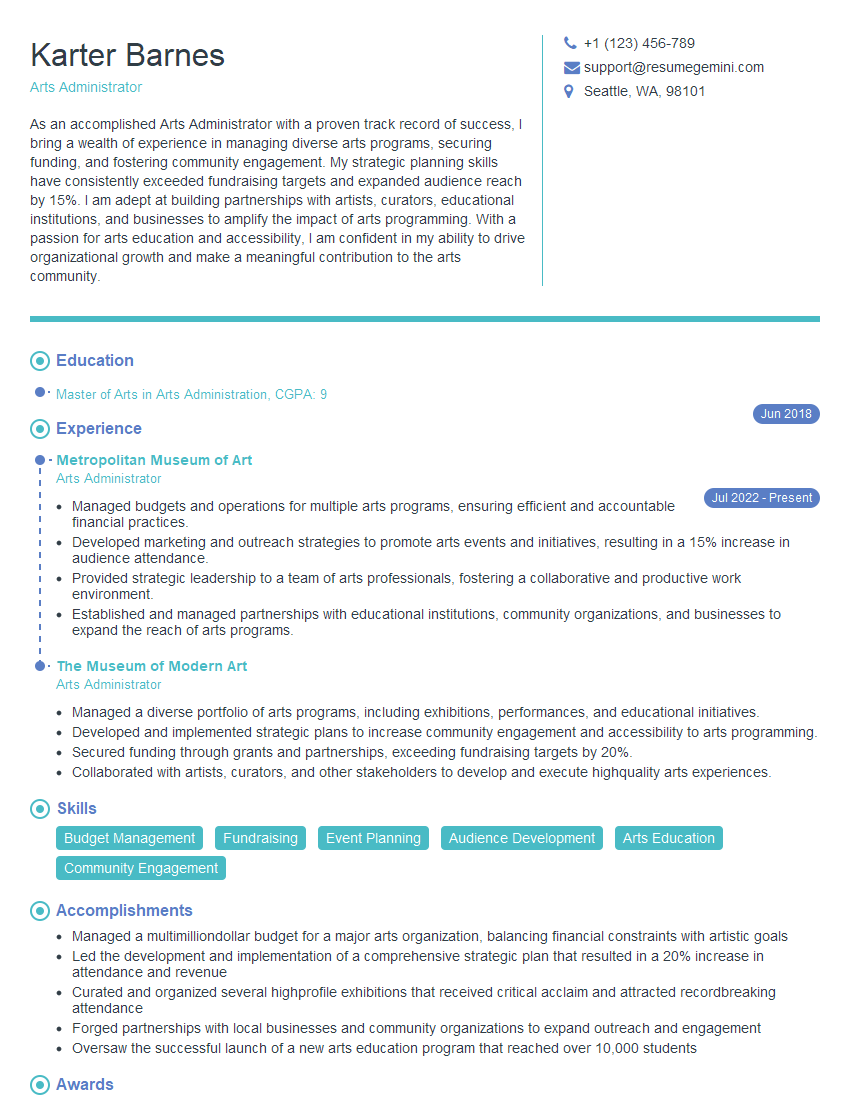
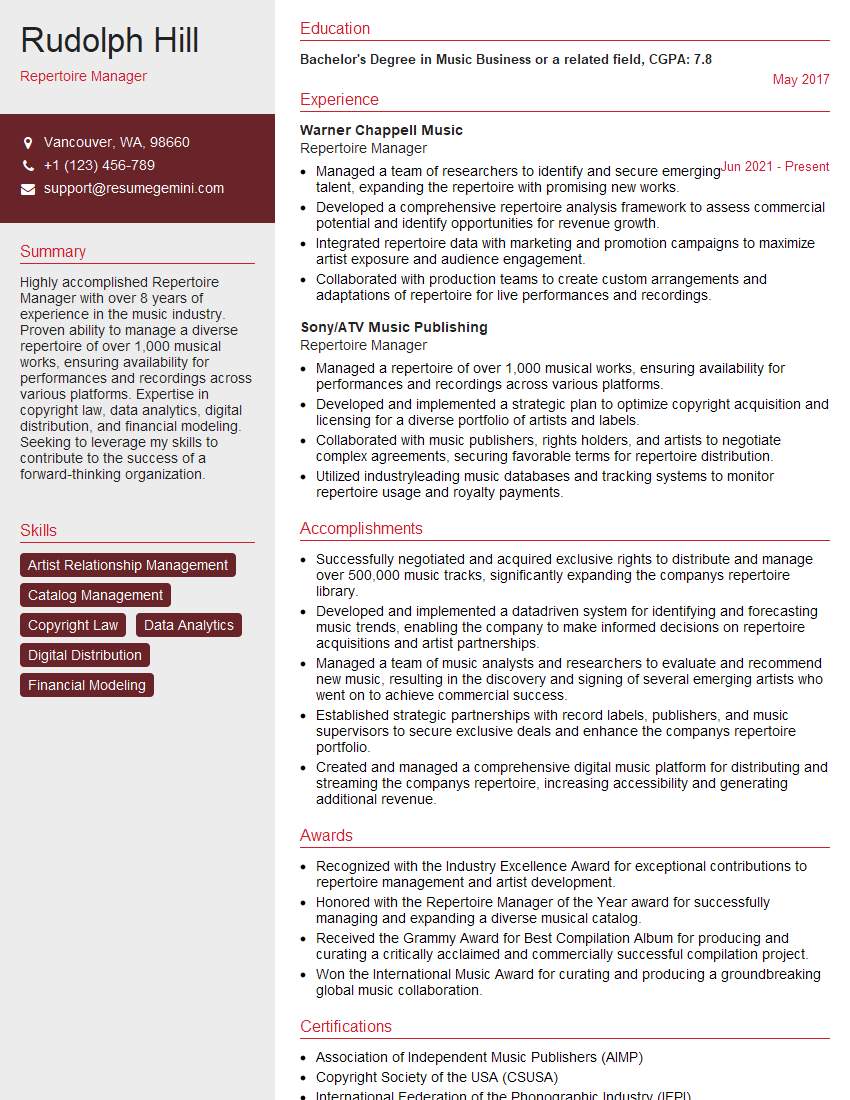
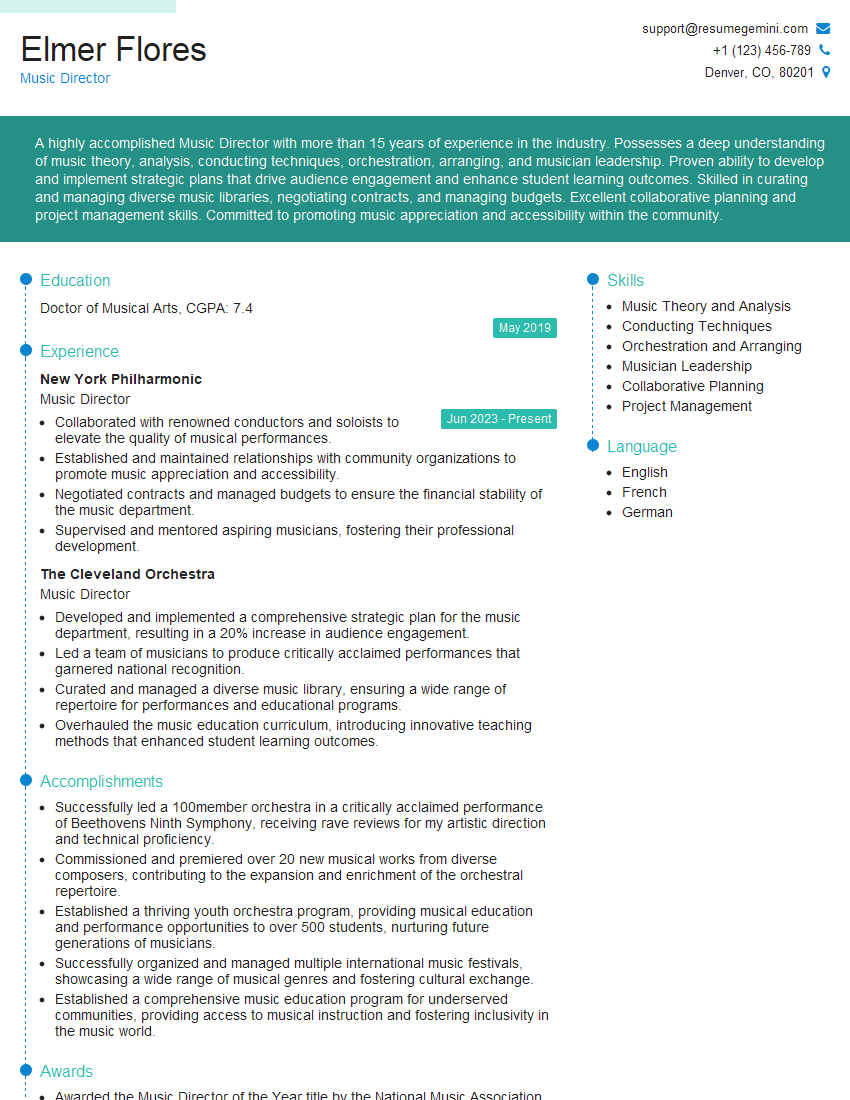
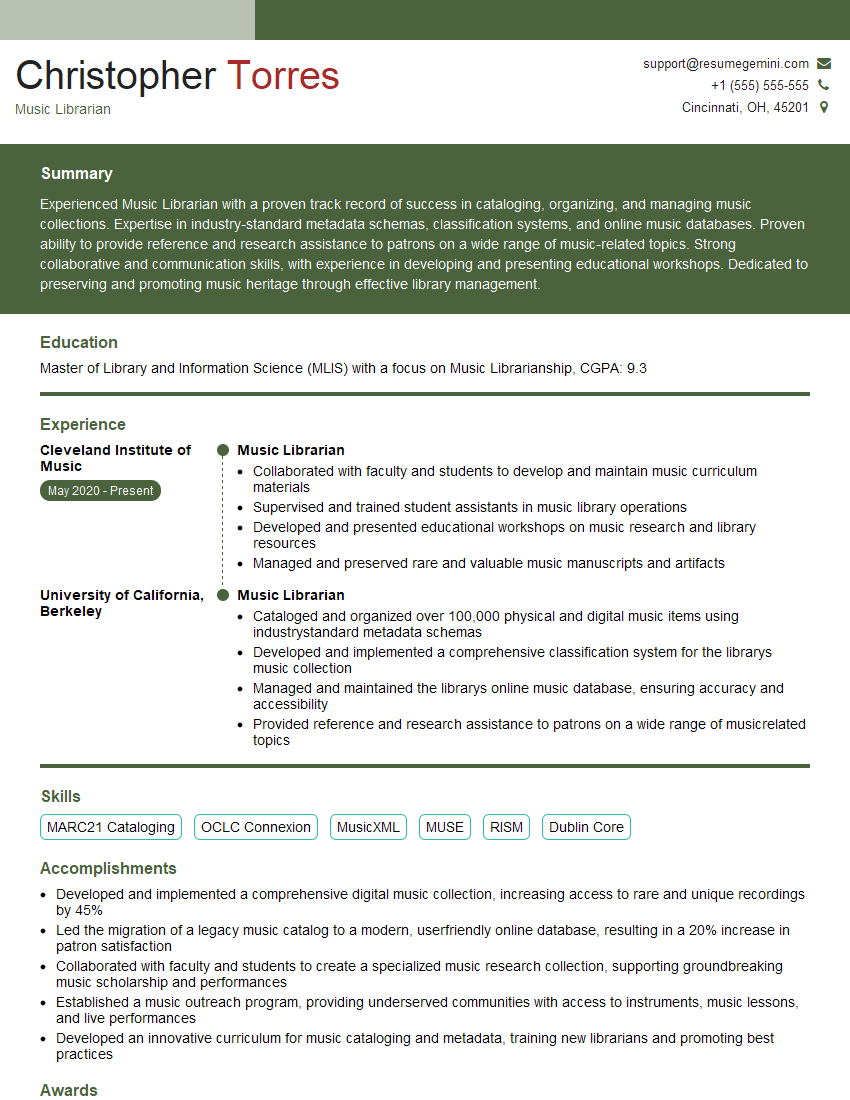
Take advantage of ResumeGemini’s tools and resources – examples of resumes tailored to showcasing Orchestral Repertoire Knowledge are available to guide you. Crafting a compelling resume is a significant step in securing your dream position.
Explore more articles
Users Rating of Our Blogs
Share Your Experience
We value your feedback! Please rate our content and share your thoughts (optional).
What Readers Say About Our Blog
Very informative content, great job.
good