Preparation is the key to success in any interview. In this post, we’ll explore crucial Visualization and Rendering interview questions and equip you with strategies to craft impactful answers. Whether you’re a beginner or a pro, these tips will elevate your preparation.
Questions Asked in Visualization and Rendering Interview
Q 1. Explain the difference between rasterization and ray tracing.
Rasterization and ray tracing are two fundamentally different approaches to rendering 3D scenes. Think of it like painting a picture: rasterization is like filling in pixels on a canvas, while ray tracing is like tracing light rays from the viewer’s eye back to the scene.
Rasterization is a process where the scene is projected onto a 2D screen, and the polygons that make up the 3D models are broken down into individual pixels. The color and shading of each pixel are determined by the polygon it belongs to, using algorithms like Gouraud or Phong shading. It’s efficient for real-time rendering, as seen in games and interactive applications, because it can leverage hardware acceleration extensively. However, it has limitations in handling complex light interactions like reflections and refractions.
Ray tracing, on the other hand, simulates the path of light rays from the viewer’s eye into the scene. For each pixel, a ray is cast, and the ray’s intersections with objects are calculated. The color of the pixel is determined by the objects that the ray intersects and the lighting conditions. This method is computationally expensive, but it produces photorealistic images with accurate reflections, refractions, and shadows, making it ideal for offline rendering in movies and high-quality image generation. Recent advancements have brought real-time ray tracing capabilities to high-end gaming hardware, but it still requires significant processing power.
In essence, rasterization prioritizes speed and is suitable for dynamic scenes, while ray tracing prioritizes accuracy and is better for static or less dynamic scenes where image quality is paramount.
Q 2. Describe your experience with different shading models (e.g., Phong, Blinn-Phong, Cook-Torrance).
I have extensive experience implementing and comparing various shading models. My work has involved Phong, Blinn-Phong, and Cook-Torrance, each offering different levels of realism and computational cost.
Phong shading is a simple and efficient model that approximates the specular highlight using a cosine term based on the angle between the light source, the surface normal, and the viewer. It’s fast but can appear somewhat unrealistic.
Blinn-Phong shading is an improvement over Phong, replacing the angle calculation with a half-vector, which results in a smoother and more accurate specular highlight. It’s a good balance between speed and quality.
Cook-Torrance is a physically based model that takes into account the microfacets on a surface. It provides highly realistic results, including accurate specular highlights and more nuanced reflections, but it’s computationally more expensive than the previous two. I’ve used it in projects demanding photorealism, often incorporating it with normal and roughness maps for finer control. I’ve also worked with variations and optimizations of these models, tailoring their implementation based on the specific performance requirements of each project. For example, I’ve optimized Blinn-Phong for mobile rendering by simplifying some calculations while maintaining a good visual quality.
Q 3. How do you optimize a scene for real-time rendering?
Optimizing a scene for real-time rendering involves a multi-pronged approach focusing on reducing the workload on the GPU. Here’s a strategy I often employ:
- Level of Detail (LOD): Use different levels of detail for models depending on their distance from the camera. Faraway objects can use simplified meshes with fewer polygons, while close-up objects maintain high detail. This significantly reduces the polygon count.
- Occlusion Culling: Identify and remove objects that are hidden behind other objects from rendering. This prevents the GPU from wasting time rendering unseen geometry. Techniques like hierarchical Z-buffering or frustum culling are very effective.
- Draw Call Optimization: Minimize the number of draw calls by batching objects with the same material and shader. This reduces the overhead of switching between rendering states.
- Shader Optimization: Write efficient shaders, avoiding unnecessary calculations. Consider using simpler shaders where visual quality is not critically affected.
- Texture Optimization: Use appropriately sized textures, compress textures (e.g., using DXT compression), and utilize texture atlases to reduce the number of texture binds.
- Mesh Optimization: Optimize mesh geometry to reduce the number of vertices and triangles. Tools like mesh simplification algorithms are invaluable.
For instance, in a game with many trees, instead of rendering each leaf individually, I might use a billboard technique for distant trees and only render detailed models for trees close to the player.
Q 4. Explain the concept of Z-buffering and its limitations.
Z-buffering, also known as depth buffering, is a technique used to solve the hidden surface problem in 3D graphics. It works by storing the depth (distance from the camera) of each pixel in a separate buffer called the Z-buffer. When rendering a new pixel, the algorithm compares its depth to the depth already stored in the Z-buffer for that pixel. If the new pixel is closer, its color is written to the framebuffer, and its depth is updated in the Z-buffer. Otherwise, the existing pixel remains. Think of it like painting layers, where the closest layer always covers the ones behind.
However, Z-buffering has limitations. One is Z-fighting, which occurs when two surfaces are very close together and their depths are so similar that the Z-buffer cannot accurately distinguish between them. This results in flickering or incorrect rendering. Another limitation is its precision; the Z-buffer has a finite number of bits to represent depth, which can lead to inaccuracies, especially in scenes with a large depth range. Furthermore, Z-buffering doesn’t handle complex transparency effects as accurately as some other methods (e.g., ray tracing).
Q 5. What are normal maps and how are they used in rendering?
Normal maps are texture maps that store surface normal vectors for each pixel in a texture. Instead of representing color information, they store a vector indicating the direction of the surface normal at each point, which is critical for calculating lighting and shading. Imagine it as a tiny map of how the surface slopes at each pixel.
They are used to add fine-grained surface details without increasing the polygon count. A low-poly model can appear much more detailed by using a normal map that simulates bumps, dents, and other irregularities. The rendering engine uses the normal map data to calculate the lighting based on these simulated surface variations. This technique dramatically improves visual fidelity without the performance cost of highly detailed geometry.
For example, a simple sphere with a brick normal map would appear to have the detailed texture of a brick wall without requiring the creation of a high-polygon brick model. This is crucial for optimizing real-time rendering, as it allows for high visual fidelity with minimal performance impact.
Q 6. Describe your experience with different texture mapping techniques.
My experience with texture mapping techniques is extensive, encompassing various methods used to apply 2D images (textures) onto 3D surfaces. These techniques define how the texture coordinates are mapped to the surface.
I’m proficient in planar mapping (simplest, directly projecting the texture), cylindrical mapping (wrapping the texture around a cylinder), spherical mapping (mapping onto a sphere), and cubic mapping (mapping onto a cube). I’ve also worked with more advanced techniques like projective texture mapping, which allows for perspective-correct texturing, and environment mapping, used to create reflections and refractions. In addition, I understand and have used various methods for seamless texture tiling to avoid obvious repetition artifacts. The choice of technique often depends on the object’s geometry and desired visual effect.
I also have experience optimizing texture mapping pipelines. For instance, I’ve worked on mipmapping implementations to improve performance and reduce aliasing artifacts, and used techniques like atlasing to minimize texture switching. Furthermore, I understand different texture formats and their trade-offs in terms of compression, memory usage, and quality.
Q 7. Explain the process of creating physically based materials.
Creating physically based materials (PBR) involves defining material properties based on real-world physics. Rather than relying on arbitrary parameters, PBR aims to simulate how light interacts with a surface based on its inherent characteristics. This leads to more realistic and predictable rendering results across different lighting conditions.
The key parameters typically include:
- Albedo: The base color of the material.
- Roughness: Determines the level of surface smoothness; a rough surface scatters light more diffusely than a smooth surface.
- Metallic: Indicates how metallic the material is, affecting its reflectivity and how light interacts with it. Metals reflect light specularly, while non-metals have a more diffuse reflection.
- Normal Map: Defines surface details and affects lighting calculations.
- Ambient Occlusion (AO): Simulates the darkening of areas where light cannot easily reach due to surrounding geometry.
The process often involves measuring or estimating these parameters based on real-world materials or using existing material databases. I’ve used various tools and techniques for material creation, including physically based renderers like Arnold, V-Ray, and Cycles, as well as tools for measuring material properties from real-world samples. The goal is to create materials that look believable and consistent across different lighting scenarios and viewpoints, offering predictable and accurate rendering regardless of the lighting setup.
Q 8. How do you handle shadows in a real-time rendering environment?
Shadow rendering in real-time is crucial for visual fidelity. We can’t afford the computationally expensive methods used in offline rendering, so we employ approximations. The most common techniques include shadow maps, shadow volumes, and screen-space ambient occlusion (SSAO).
Shadow Maps are the most widely used. They render the scene from the light’s perspective, storing the depth information into a texture. During the main rendering pass, we compare the depth of each pixel to the corresponding depth in the shadow map to determine if it’s in shadow. This is efficient but can suffer from aliasing (jagged shadows) and self-shadowing issues. To mitigate aliasing, techniques like Percentage-Closer Filtering (PCF) are employed, which average the depths of nearby texels in the shadow map.
Shadow Volumes create shadow volumes around objects, calculating the parts of the scene occluded by these volumes. While more accurate than shadow maps for certain scenarios, they’re more computationally expensive, especially for complex geometry.
SSAO doesn’t actually render shadows directly from light sources. Instead, it approximates ambient occlusion effects in screen space, simulating the darkening effect caused by objects blocking ambient light. It’s very efficient, but the quality is often lower and may not accurately represent light source directionality.
In my experience, I’ve often used a combination of shadow maps (for directional and point lights) and SSAO (to enhance the shadowing effect and fill in subtle shadow details). The choice of technique depends heavily on the target platform’s performance capabilities and the desired level of visual quality.
Q 9. What are the advantages and disadvantages of using different rendering pipelines (e.g., deferred, forward)?
Forward and deferred rendering are two major pipelines in real-time rendering, each with its own set of trade-offs.
- Forward Rendering: In this pipeline, lighting calculations are performed for each object once per light source. This is relatively simple to implement but can become very inefficient with many light sources, as the lighting calculations are repeated for every object.
- Deferred Rendering: This pipeline first renders the scene’s geometry and stores relevant data (position, normal, albedo, etc.) into G-buffers. Then, a lighting pass iterates over the pixels in the G-buffers, performing lighting calculations only once per pixel, regardless of the number of lights affecting that pixel. This is very efficient for scenes with many lights, but it requires more memory and can be more complex to implement.
Advantages of Forward Rendering: Simpler implementation, easier to debug, typically less memory consumption.
Disadvantages of Forward Rendering: Performance degrades significantly with many light sources.
Advantages of Deferred Rendering: Highly efficient with many light sources, advanced lighting techniques are easier to implement.
Disadvantages of Deferred Rendering: More complex to implement and debug, higher memory consumption, can suffer from performance issues in scenes with very high polygon counts (due to the G-buffer cost).
In practice, the best choice depends on the specific project. For mobile games or projects with low light counts, forward rendering might be sufficient. For high-fidelity games or projects with dynamic lighting, deferred rendering often provides better performance.
Q 10. Describe your experience with different lighting techniques (e.g., ambient occlusion, global illumination).
I have extensive experience with various lighting techniques. Let’s discuss a few:
- Ambient Occlusion (AO): AO simulates the darkening effect caused by the proximity of surfaces. It makes scenes look more realistic by adding subtle shadows in crevices and corners. Screen-space ambient occlusion (SSAO) is a common real-time technique, while more accurate but computationally expensive methods like ray-traced AO exist for offline rendering. I’ve used SSAO extensively in projects to enhance visual realism without significant performance overhead.
- Global Illumination (GI): GI simulates the indirect lighting effects caused by light bouncing around the scene. This includes effects like diffuse interreflection and caustics. Real-time GI is challenging, with techniques like light probes, photon mapping (mostly offline), and irradiance caching providing varying degrees of accuracy and performance trade-offs. I’ve worked with pre-baked GI solutions using lightmaps and light probes, providing a good balance of visual quality and real-time performance in many projects.
- Image-Based Lighting (IBL): IBL uses pre-computed environment maps to simulate the illumination from a complex environment. This is a very efficient way to include realistic indirect lighting effects in real-time. I’ve incorporated IBL into several projects to quickly and effectively add realistic reflections and ambient lighting.
The choice of lighting technique is often a careful balance between visual quality and performance. For example, in a mobile game, we might use only simple diffuse lighting and SSAO, while a high-end PC game could utilize a combination of IBL, GI approximations, and more sophisticated shadow techniques.
Q 11. Explain the concept of frustum culling.
Frustum culling is a crucial optimization technique in 3D graphics. The ‘frustum’ refers to the viewable region of the 3D scene, defined by the camera’s perspective projection. Frustum culling involves determining which objects are visible within this frustum and discarding those that are outside of it. This prevents the rendering system from processing objects that the user won’t even see.
The process typically involves checking if an object’s bounding volume (e.g., bounding box, bounding sphere) intersects with the frustum. If the bounding volume is entirely outside the frustum, the object is culled. Efficient algorithms exist to perform these intersection tests rapidly.
Think of it like this: imagine you’re filming a scene with a camera. You wouldn’t bother filming objects that are miles away and completely outside the camera’s view. Frustum culling does the same thing in the computer, greatly improving performance by skipping unnecessary calculations.
Implementing frustum culling can significantly reduce the number of polygons that need to be processed, leading to a substantial performance increase, particularly in scenes with a large number of objects.
Q 12. How do you optimize texture memory usage?
Optimizing texture memory is critical for real-time rendering, as texture memory is often a limited resource. Several strategies can be employed:
- Texture Compression: Using compressed texture formats (like DXT, ETC, ASTC) significantly reduces memory footprint. The choice of format depends on the target platform and its capabilities.
- Mipmapping: Creating mipmaps—a series of progressively lower-resolution versions of the texture—allows the rendering system to select the appropriate level of detail based on the distance to the object. This reduces aliasing and memory bandwidth usage.
- Texture Atlasing: Combining multiple smaller textures into a single larger texture (atlas) reduces the number of texture binding calls, which are expensive operations. Efficient packing algorithms are crucial for minimizing wasted space in the atlas.
- Procedural Textures: Generating textures procedurally (using algorithms) instead of storing them as bitmap images can save significant memory and reduce loading times. Perlin noise and other procedural techniques are commonly used.
- Level of Detail (LOD) for Textures: Switching to lower-resolution textures for distant objects is another effective way to reduce memory usage and bandwidth consumption.
In practice, a combination of these techniques is often employed to achieve optimal texture memory usage. For instance, in a project I worked on, we used ASTC compression, mipmapping, and texture atlasing to efficiently manage textures on mobile devices with limited resources.
Q 13. What are some common performance bottlenecks in real-time rendering?
Real-time rendering performance can be bottlenecked in many areas. Here are some of the most common:
- Fillrate: The speed at which the graphics card can write pixels to the screen. This can be a bottleneck in scenes with high polygon counts or complex effects.
- Vertex Processing: The time taken to process vertices of 3D models. Complex models or excessive vertex shader calculations can lead to slowdowns.
- Pixel Processing: The time taken to process pixels during the fragment shader stage. Complex shaders or many post-processing effects can severely impact performance.
- Memory Bandwidth: The speed at which data can be transferred between the CPU, GPU, and memory. High-resolution textures or large amounts of geometry data can saturate the memory bandwidth.
- CPU Overhead: The CPU is responsible for scene management, physics calculations, AI, and more. High CPU load can limit the GPU’s ability to render the scene efficiently.
- Draw Calls: The number of times the GPU is asked to draw something. Too many draw calls (e.g., from many small objects) can significantly reduce performance.
Profiling tools are essential for identifying performance bottlenecks. Once a bottleneck is identified, various optimization techniques can be applied, depending on the specific problem. For example, reducing polygon count, optimizing shaders, using level of detail (LOD) systems, and implementing techniques like frustum culling can significantly improve performance.
Q 14. Describe your experience with shader programming (e.g., HLSL, GLSL).
I’m proficient in both HLSL (High-Level Shading Language) and GLSL (OpenGL Shading Language). I’ve used them extensively for a wide range of tasks, from simple lighting shaders to complex effects like subsurface scattering and physically based rendering (PBR).
HLSL is primarily used with DirectX, whereas GLSL is used with OpenGL. While their syntax differs slightly, the underlying concepts are similar. Both allow programmers to create custom shaders that define how the GPU processes vertices and pixels. I’ve found HLSL generally to be slightly more user-friendly for beginners, while GLSL offers a wider range of built-in functions and features in some areas.
// Example GLSL fragment shader for simple diffuse lighting #version 330 core in vec3 FragPos; in vec3 Normal; out vec4 FragColor; uniform vec3 LightPos; uniform vec3 LightColor; uniform vec3 ObjectColor; void main() { vec3 lightDir = normalize(LightPos - FragPos); float diff = max(dot(Normal, lightDir), 0.0); vec3 diffuse = diff * LightColor; FragColor = vec4(diffuse * ObjectColor, 1.0); }
My experience includes creating shaders for various effects such as:
- Lighting: Diffuse, specular, ambient, and more sophisticated lighting models like PBR.
- Texturing: Using various texture types, blending modes, and sampling techniques.
- Post-Processing: Implementing effects like bloom, depth of field, anti-aliasing, and screen-space reflections.
- Particle Effects: Creating realistic particle systems through shader techniques.
Shader programming is a crucial skill for any real-time renderer, allowing for incredible flexibility and control over visual effects. I’m confident in my ability to write performant and visually appealing shaders for a wide range of applications.
Q 15. Explain your understanding of different GPU architectures.
GPU architectures are fundamentally about how processing units are organized and interconnected to handle massive parallel computations, crucial for visualization and rendering. Think of it like a highly organized factory, where each worker (core) specializes in a specific task, all working simultaneously to achieve a common goal—producing stunning visuals.
Broadly, we have several architectural approaches:
CUDA (Nvidia): Nvidia’s proprietary architecture offering a parallel computing platform and programming model. It allows developers to harness the power of many cores simultaneously for tasks like ray tracing and physics simulations. Imagine it as a factory with highly specialized assembly lines, each dedicated to a specific part of the rendering pipeline.
AMD ROCm: AMD’s open-source equivalent to CUDA, providing a similar parallel computing environment for their GPUs. It offers flexibility and the potential for customization tailored to specific rendering needs. This is like a more flexible factory where you can rearrange the assembly lines as needed.
Vulkan/DirectX 12: These are low-level APIs offering greater control over GPU resources, allowing for more efficient management and optimization. These are like having direct control over the factory floor, scheduling tasks optimally without intermediaries.
Unified Shader Architecture: A common design where all processing units (cores) are able to execute various shader programs. This flexibility is great for handling diverse tasks within a single rendering pipeline. It’s a factory where workers can be easily reassigned to different tasks as needed.
Understanding these architectures helps in choosing the right tools and techniques for optimization and efficiency in rendering. For instance, optimizing a ray tracing algorithm for a CUDA-based GPU requires a different approach than optimizing for a Vulkan-based system.
Career Expert Tips:
- Ace those interviews! Prepare effectively by reviewing the Top 50 Most Common Interview Questions on ResumeGemini.
- Navigate your job search with confidence! Explore a wide range of Career Tips on ResumeGemini. Learn about common challenges and recommendations to overcome them.
- Craft the perfect resume! Master the Art of Resume Writing with ResumeGemini’s guide. Showcase your unique qualifications and achievements effectively.
- Don’t miss out on holiday savings! Build your dream resume with ResumeGemini’s ATS optimized templates.
Q 16. How do you debug rendering issues?
Debugging rendering issues can be a detective’s work, requiring careful observation, systematic analysis, and a little bit of intuition. My approach usually involves a multi-step process:
Visual Inspection: Carefully examining the rendered output for inconsistencies—incorrect textures, lighting artifacts, geometric errors, etc. This is often the first and most straightforward step.
Frame Debugger: Using a frame debugger (built into many engines or available as standalone tools) to step through the rendering pipeline frame-by-frame. This allows identifying the exact stage where the error occurs.
Shader Debugging: Examining and debugging shaders (code that runs on the GPU) using debugging tools that allow setting breakpoints and inspecting variable values. This is crucial for identifying issues related to shaders calculations and lighting effects.
Profiling: Using profiling tools to identify performance bottlenecks within the rendering pipeline. A slow rendering process might not directly point to an error but could indicate an inefficient algorithm or data structure.
Simplification: Reducing the complexity of the scene or the rendering process to isolate the source of the error. Removing assets, temporarily disabling effects, or simplifying geometry can help narrow down the problem area.
Logging: Incorporating logging statements in the code to track variables and events during rendering. This provides invaluable information when analyzing unexpected behavior.
For instance, I once spent days debugging a flickering texture issue. By using a frame debugger, I discovered the problem was caused by a race condition in how the texture data was being updated, a problem easily solved with proper synchronization.
Q 17. What are your experiences with different game engines (e.g., Unity, Unreal Engine)?
I have extensive experience with both Unity and Unreal Engine, each offering distinct strengths and weaknesses. Unity excels in its ease of use, rapid prototyping capabilities, and a vast asset store. Its scripting system, using C#, is relatively straightforward, making it a good choice for rapid iteration and simpler projects. I’ve used Unity extensively for developing AR/VR applications and interactive visualizations focusing on ease of deployment and cross-platform compatibility.
Unreal Engine, on the other hand, is known for its high-fidelity rendering capabilities, especially in real-time ray tracing and its powerful Blueprint visual scripting system alongside C++. This makes it ideal for high-end game development, architectural visualization, and simulations requiring photorealistic results. I’ve used Unreal Engine to create complex simulations with detailed physical models and sophisticated lighting setups.
My experience extends to choosing the appropriate engine based on project requirements. For a quick prototype showcasing a simple concept, Unity would be preferable due to its rapid development cycle. But for creating a visually stunning game or simulation demanding cutting-edge rendering capabilities, Unreal Engine’s power and flexibility are unmatched.
Q 18. Explain your experience with different 3D modeling software (e.g., Maya, 3ds Max, Blender).
My 3D modeling experience spans across Maya, 3ds Max, and Blender. Each software package offers its own unique workflow and strengths.
Maya: Known for its robust animation capabilities and industry-standard pipeline integration, Maya is often the go-to choice for high-end animation and visual effects studios. Its strong character rigging and animation tools are unparalleled. My projects using Maya have involved creating intricate character models and animating complex scenes for film and game production.
3ds Max: This software shines in architectural visualization, particularly for its powerful modeling and rendering tools, and efficient workflows for large-scale projects. Its polygon modeling capabilities have been used for creating architectural designs and highly detailed environments.
Blender: A highly versatile and open-source option, Blender is gaining popularity due to its comprehensive feature set and strong community support. It’s a great choice for a quick prototype or experimentation. My experience with Blender is focused on its scripting capabilities and procedural generation techniques, for rapid prototyping and experimental rendering techniques.
Selecting the appropriate software depends heavily on the project needs and personal preferences. While Maya might be preferred for complex character animation, 3ds Max might be a better choice for architectural visualization projects.
Q 19. How do you handle large datasets in visualization?
Handling large datasets in visualization requires a strategic approach combining efficient data structures, optimized algorithms, and appropriate rendering techniques. The sheer volume of data can overwhelm even the most powerful hardware if not managed carefully.
Data Reduction Techniques: Employing techniques like level of detail (LOD) rendering, where simpler representations of the data are used at greater distances; octrees or kd-trees for spatial partitioning, allowing faster rendering of only visible data; and simplification algorithms, reducing the number of polygons or points while preserving essential features.
Streaming and Caching: Instead of loading the entire dataset at once, implementing techniques to stream data into the memory as needed, and caching frequently accessed parts. This reduces memory usage and minimizes loading times.
Out-of-core Rendering: For exceptionally large datasets that can’t fit entirely into system memory, using techniques where data is loaded and processed from the hard drive in parts. This requires careful optimization to minimize disk I/O operations.
GPU-Accelerated Computation: Leveraging the power of GPUs for data processing and rendering steps. Many algorithms, such as volume rendering, benefit greatly from GPU acceleration.
Data Visualization Techniques: Choosing appropriate visualization techniques that handle large datasets efficiently—for example, using point clouds instead of polygon meshes, or employing techniques like volume rendering or isosurface extraction.
For example, I worked on a project visualizing a massive point cloud representing a geological survey. By using an octree to spatially index the points and employing LOD rendering, we were able to interactively explore and visualize the data smoothly despite its enormous size.
Q 20. Describe your experience with data visualization techniques.
My experience with data visualization spans a wide range of techniques, each chosen based on the specific nature of the data and the insights to be conveyed.
Scatter Plots: Useful for showing the relationship between two or more variables. I’ve used these to visualize correlations in financial data and relationships between environmental variables.
Bar Charts and Histograms: Excellent for displaying the distribution of categorical or numerical data. I’ve used these to visualize demographic data and survey results.
Line Charts: Effective in representing trends over time, often used in visualizing stock prices, temperature readings, or other time-series data.
Heatmaps: Great for displaying data density or intensity across a 2D space, often used in visualizing geographic data, sensor readings, or correlation matrices.
3D Visualization: Techniques like volume rendering, isosurface extraction, and point cloud rendering have been applied to visualize large, complex datasets in three dimensions. I’ve used these to represent geological models, medical scans, and simulations.
Choosing the right visualization technique is critical for effective communication. A poorly chosen visualization can obscure insights rather than clarify them. I always carefully consider the audience and the message I want to communicate before selecting a visualization method.
Q 21. Explain your understanding of color spaces and color management.
Color spaces and color management are crucial for ensuring consistent and accurate color reproduction across different devices and workflows. A color space defines a range of colors that can be represented, while color management is the process of ensuring that colors are interpreted and displayed correctly regardless of the device.
Some common color spaces include:
sRGB: The standard color space for the internet and most consumer displays. It’s a relatively small color gamut suitable for most web applications.
Adobe RGB: A wider color gamut than sRGB, offering a greater range of colors, primarily used in professional printing and photography.
Rec. 709: A standard color space for high-definition television, offering a balance between wide gamut and accuracy.
ACES (Academy Color Encoding System): A color space designed for high dynamic range (HDR) images, providing a wider range of colors and brightness than traditional color spaces.
Color management involves using color profiles (ICC profiles) to map colors between different color spaces. This is crucial in workflows involving multiple devices and software, ensuring that colors appear consistently throughout the process. Without color management, colors can shift unpredictably, leading to discrepancies between what is designed and what is displayed or printed. I frequently utilize color management in projects where accurate color representation is paramount, like post-production work or high-fidelity visualizations.
Q 22. What are some common techniques for optimizing polygon count?
Optimizing polygon count is crucial for real-time rendering, as it directly impacts performance. High polygon counts strain the GPU, leading to lower frame rates. Several techniques can drastically reduce polygon count without significantly impacting visual fidelity.
Level of Detail (LOD): This is a fundamental technique. It involves using different polygon meshes for the same object depending on its distance from the camera. Faraway objects use low-poly meshes, while closer objects use higher-poly meshes. Think of it like seeing a car in the distance – you see its overall shape, not the details of the headlights. As you get closer, the details become more apparent.
Mesh Simplification Algorithms: Algorithms like Quadric Error Metrics (QEM) and progressive meshes intelligently reduce the polygon count by merging or removing vertices while minimizing the visual distortion. These algorithms are often used to generate LODs automatically.
Normal Mapping and other Texture-based Techniques: Instead of modeling high-poly details directly, we can use normal maps, displacement maps, and other textures to simulate them. This creates the illusion of detail with a significantly lower polygon count. Imagine painting intricate details onto a smooth surface – you achieve a complex look without changing the underlying shape.
Instancing: If you have many identical or very similar objects (like trees in a forest), instancing renders them efficiently by sharing vertex data. Instead of rendering each tree individually, the GPU renders one instance and repositions it multiple times, saving substantial processing power.
Culling: Techniques like frustum culling remove objects outside the camera’s view frustum. This prevents the GPU from processing unseen geometry. Back-face culling removes polygons facing away from the camera, a simple yet effective optimization.
In practice, I’ve used a combination of these techniques on large-scale outdoor environments and complex character models, achieving significant performance improvements without compromising visual quality. For example, in a game project I worked on, implementing LODs and normal mapping resulted in a 30% increase in frame rate.
Q 23. Describe your experience with different image formats and compression techniques.
My experience encompasses a wide range of image formats and compression techniques. The choice of format and compression depends heavily on the specific application – whether it’s a game, a film, or a web application.
Lossless Formats (e.g., PNG, TIFF): These formats preserve all image data, resulting in high-quality images suitable for archiving and applications where even minor data loss is unacceptable. However, they typically have larger file sizes.
Lossy Formats (e.g., JPEG, JPG, WebP): These formats compress images by discarding some data deemed less important to the human eye. This leads to smaller file sizes, ideal for web applications and games where bandwidth is a constraint. The trade-off is a slight reduction in image quality. The degree of compression can be adjusted to balance file size and quality.
Compression Techniques: I’m familiar with various compression algorithms, including those used in JPEG (Discrete Cosine Transform), PNG (DEFLATE), and WebP (various techniques). Understanding these algorithms helps in choosing the right format and adjusting compression settings for optimal results. For example, I once optimized a game’s texture atlases by switching to WebP and tweaking compression settings, reducing the overall game size by 15% without a noticeable decrease in visual quality.
HDR Image Formats (e.g., OpenEXR, HDR): These are crucial for high-dynamic-range imaging, representing a wider range of light intensities. They’re vital for creating realistic lighting and rendering scenes with bright highlights and deep shadows. I often utilize these in my projects involving realistic simulations or physically-based rendering (PBR).
Selecting the appropriate image format and compression method often requires careful consideration of factors like image type, desired quality, and storage limitations. It is a balancing act between visual quality, file size, and performance.
Q 24. How do you approach creating realistic lighting in a scene?
Creating realistic lighting is paramount in achieving visual fidelity. My approach involves a combination of techniques, ranging from basic ambient lighting to advanced global illumination methods.
Ambient Lighting: Provides a uniform base level of illumination, simulating indirect light bouncing around the environment.
Directional Lighting: Simulates light from a distant source like the sun, creating shadows and highlights.
Point Lights: Simulate light sources emitting light in all directions, like lamps or fireflies. The falloff of light is crucial for realism.
Spot Lights: Simulate focused light sources, like spotlights or flashlights, with a defined cone of illumination.
Global Illumination Techniques (e.g., Ray Tracing, Path Tracing): These advanced techniques simulate the indirect bouncing of light, producing realistic soft shadows, ambient occlusion, and color bleeding. They’re computationally expensive but yield photorealistic results. I’ve used ray tracing in projects requiring high realism.
Physically Based Rendering (PBR): This modern approach to rendering uses physically accurate models for light interaction with materials, leading to more realistic reflections, refractions, and shadows. PBR workflows are now industry standard and essential for realistic lighting.
In a recent project, I combined PBR with ray-traced global illumination to achieve highly photorealistic results. Understanding the interplay between different light sources and their impact on materials is key to creating a convincing and believable scene.
Q 25. What is your experience with implementing post-processing effects?
Post-processing effects are essential for enhancing the visual quality and mood of a rendered scene. I have extensive experience implementing a variety of post-processing effects using shaders and rendering pipelines.
Bloom: Simulates the bright glow around intense light sources, adding realism and visual appeal.
Anti-aliasing (AA): Reduces jagged edges (aliasing) in rendered images, improving clarity. Techniques like FXAA and MSAA are commonly used.
Depth of Field (DOF): Simulates the natural blurring of out-of-focus areas, increasing the sense of depth and focus.
Screen Space Ambient Occlusion (SSAO): Approximates ambient occlusion in screen space, creating more realistic shadows in crevices and corners without the computational cost of ray tracing.
Tone Mapping: Maps high-dynamic-range (HDR) images to the lower dynamic range of displays, adjusting the brightness and contrast for optimal viewing.
Color Grading: Allows for adjusting the overall color and mood of the scene, enhancing the artistic vision.
I’ve utilized these effects in several projects, often tailoring them to specific artistic styles and requirements. For example, in a stylized game, I implemented a custom bloom effect that exaggerated the glow for a more vibrant look.
Q 26. Explain the differences between forward and deferred rendering.
Forward and deferred rendering are two fundamental approaches to rendering 3D scenes. They differ primarily in how they handle lighting calculations.
Forward Rendering: In forward rendering, lighting calculations are performed for each object during the object’s rendering pass. For each light source, the shader calculates the light’s contribution to each pixel. This is simple to implement but becomes computationally expensive with a large number of light sources.
Deferred Rendering: In deferred rendering, geometry data (position, normal, albedo, etc.) is rendered to G-buffers (textures) in the first pass. In the second pass, lighting calculations are performed using the data from these G-buffers. This allows for efficient handling of many light sources because lighting calculations are done only for visible pixels, not for every object.
The choice between forward and deferred rendering depends on the specific needs of the project. Forward rendering is generally simpler and more suitable for scenes with few light sources, while deferred rendering excels in handling many light sources and complex lighting effects. I’ve used both techniques extensively, selecting the most appropriate one based on project requirements and performance considerations.
Q 27. How do you handle occlusion culling in your projects?
Occlusion culling is a crucial optimization technique that improves performance by not rendering objects hidden behind other objects. Several methods exist for achieving occlusion culling:
Hierarchical Z-Buffering: Uses a hierarchical representation of the scene to quickly determine if objects are visible. This is efficient for static scenes.
Occlusion Queries: The GPU determines if a particular object is visible. It’s flexible but can be expensive if overused.
Hardware Occlusion Culling: Many modern GPUs include hardware support for occlusion culling, providing efficient automatic culling.
Portal Rendering: Divides the scene into smaller areas connected by portals. Only objects visible through a portal are rendered, significantly reducing rendering complexity.
In my projects, I’ve leveraged both hardware occlusion culling and more advanced techniques like portal rendering, depending on the project’s complexity and scale. In a large outdoor scene, combining hierarchical Z-buffering with hardware occlusion culling provides a substantial performance gain. In complex indoor environments, I’ve opted for portal rendering to further enhance performance.
Q 28. What is your preferred method for creating realistic water effects?
Creating realistic water effects is a challenging task, requiring a combination of techniques. My preferred method often combines several approaches to capture the nuances of water behavior.
Normal Mapping and Displacement Mapping: These texture-based techniques add subtle details to the water surface, simulating small waves and ripples.
Vertex Animation: Animating vertices based on wave patterns and wind direction provides dynamic and realistic water movement.
Wave Simulation: More sophisticated techniques like Gerstner waves or spectral methods provide accurate and visually compelling water simulations, considering factors like wind speed and direction, and water depth.
Refraction and Reflection: Accurate rendering of refractions (light bending as it passes through water) and reflections (environment reflected on the water surface) is crucial for realism. This often involves using environment maps and screen-space reflections.
Caustics: Simulating the light patterns created by water refracting and reflecting light can add a significant level of detail and realism, although this can be computationally expensive.
For simpler applications, I might use normal and displacement maps combined with vertex animation. For more demanding projects requiring highly realistic water, I’d employ advanced wave simulation techniques along with accurate refraction and reflection rendering. In one project, I implemented a Gerstner wave simulation to model ocean waves, and the results were significantly more realistic compared to simpler methods.
Key Topics to Learn for Visualization and Rendering Interview
- Fundamentals of 3D Graphics: Understand transformations (translation, rotation, scaling), projection matrices (perspective, orthographic), and viewing frustums. Consider exploring different coordinate systems and their interrelation.
- Shading and Lighting Models: Master the principles of diffuse, specular, and ambient lighting. Familiarize yourself with different shading techniques like Phong, Blinn-Phong, and Cook-Torrance. Be prepared to discuss real-time vs. offline rendering considerations.
- Texture Mapping and Image Processing: Understand different texture types (diffuse, normal, specular), filtering techniques (mipmap, anisotropic), and common image formats. Discuss the practical applications of UV mapping and texture atlases.
- Ray Tracing and Path Tracing: Grasp the core concepts of ray tracing, including ray-object intersection and recursive ray generation. Understand the advantages and disadvantages of path tracing and its role in achieving photorealistic rendering.
- Rendering Pipelines and Optimization: Familiarize yourself with the stages of a typical rendering pipeline (vertex processing, geometry processing, rasterization, fragment processing). Discuss strategies for optimizing rendering performance, such as level of detail (LOD) techniques and culling.
- Real-time Rendering Techniques: Explore techniques crucial for interactive applications such as deferred shading, forward shading, shadow mapping, and screen-space ambient occlusion (SSAO).
- Shader Programming (GLSL, HLSL): Understand the basics of shader programming and be prepared to discuss your experience with writing shaders for different rendering effects. Be ready to discuss efficiency and optimization within shaders.
- Data Structures and Algorithms: Many rendering problems benefit from efficient data structures and algorithms. Be prepared to discuss your understanding of spatial partitioning techniques (octrees, kd-trees) and their application in rendering.
Next Steps
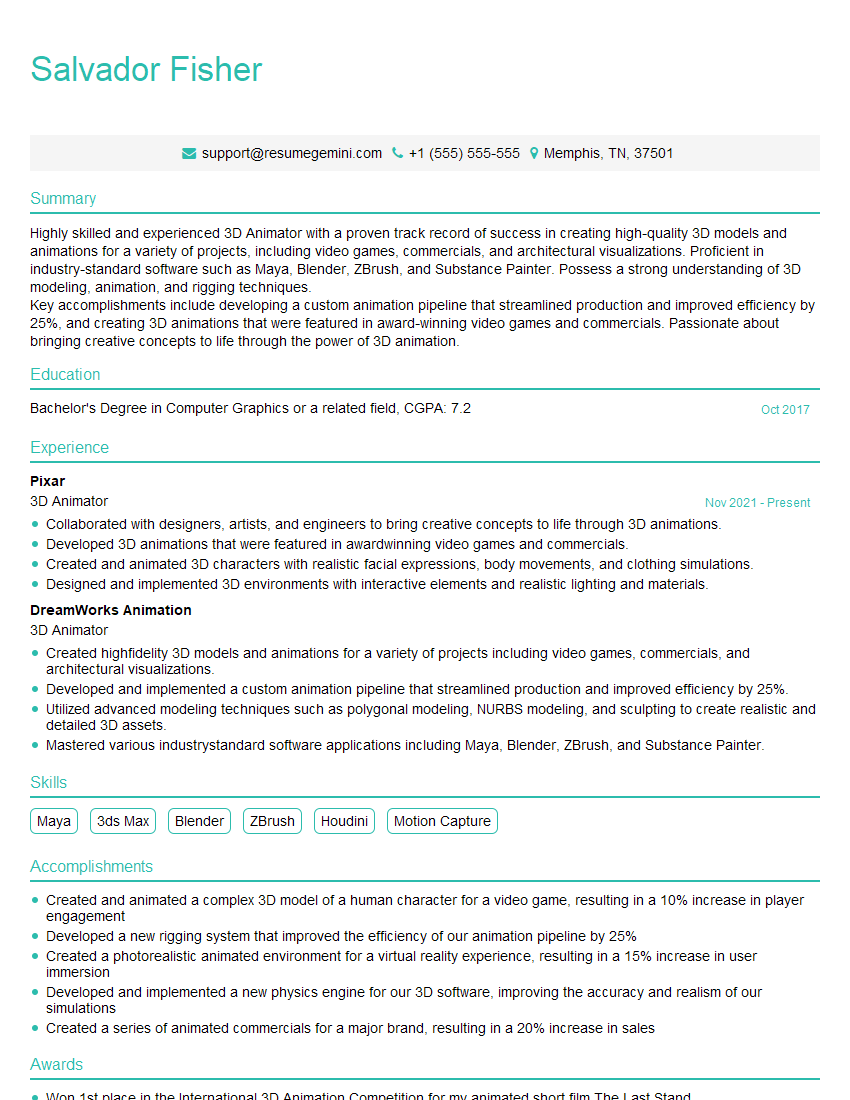
Mastering visualization and rendering opens doors to exciting and rewarding careers in game development, film, architecture, and more. A strong foundation in these skills is highly sought after, leading to increased job opportunities and higher earning potential. To maximize your chances of landing your dream role, it’s crucial to create an ATS-friendly resume that highlights your skills and experience effectively. ResumeGemini is a trusted resource to help you build a professional and impactful resume that catches the eye of recruiters. Examples of resumes tailored to Visualization and Rendering are available to guide you.





Explore more articles
Users Rating of Our Blogs
Share Your Experience
We value your feedback! Please rate our content and share your thoughts (optional).
What Readers Say About Our Blog
Very informative content, great job.
good