Interviews are opportunities to demonstrate your expertise, and this guide is here to help you shine. Explore the essential Ornamental Lettering interview questions that employers frequently ask, paired with strategies for crafting responses that set you apart from the competition.
Questions Asked in Ornamental Lettering Interview
Q 1. Explain the difference between calligraphy and ornamental lettering.
While both calligraphy and ornamental lettering involve creating beautiful lettering, they differ significantly in their approach and purpose. Calligraphy focuses primarily on the expressive and fluid movement of the writing tool, prioritizing the aesthetic quality of the stroke itself. Think of the elegant flourishes of Spencerian script or the bold strokes of a broad-edged italic nib. The content, while important, is secondary to the beauty of the writing process. Ornamental lettering, on the other hand, takes a more decorative approach. It’s about creating visually stunning letterforms, often incorporating intricate details, flourishes, and embellishments. The emphasis is on the overall design and visual impact of the final product, rather than the execution of individual strokes. Think of the elaborate capitals found in illuminated manuscripts or the intricate designs of Art Nouveau lettering. Essentially, calligraphy is about the *process* while ornamental lettering is about the *design*.
Q 2. Describe your experience with various lettering styles (e.g., Gothic, Roman, Uncial).
My experience spans a wide range of historical and contemporary lettering styles. I’m proficient in Gothic lettering, renowned for its angularity and often intricate tracery. I’ve worked extensively with its various sub-styles, including Blackletter and Textura, each demanding precision and a deep understanding of their structural nuances. Roman lettering, with its classical elegance and balance, is another area of expertise. I can execute both uppercase and lowercase forms with accuracy, appreciating the subtle differences between styles like Capitalis Monumentalis and Rustic Capitals. My experience extends to Uncial, a beautiful and flowing script characterized by its rounded forms and often used in early medieval manuscripts. I’ve explored the variations within Uncial, understanding how the pen angle and pressure can drastically alter the character’s feel. I also have practical skills in more modern styles like Art Nouveau, Art Deco, and contemporary interpretations of traditional forms, allowing me to adapt my style to any project requirement.
Q 3. What tools and materials are essential for creating high-quality ornamental lettering?
Creating high-quality ornamental lettering requires a thoughtful selection of tools and materials. For traditional methods, I primarily rely on high-quality nibs and pens, carefully choosing them based on the desired style and effect. For example, a broad-edged nib is perfect for creating bold strokes in Roman capitals, while a fine-point nib is more suitable for detailed Gothic lettering. I utilize a variety of inks, from archival-quality pigmented inks to water-soluble inks, depending on the surface and desired longevity. The paper or other substrate is equally crucial; its texture and weight affect the ink flow and the overall appearance of the lettering. For digital lettering, I use a graphics tablet and specialized software like Adobe Illustrator, ensuring high resolution and precise control. Other essential tools might include rulers, compasses, French curves, and a variety of pencils for sketching and layout.
Q 4. How do you approach the design and layout of ornamental lettering for a specific project?
Designing and laying out ornamental lettering for a project begins with a thorough understanding of the client’s needs and the project’s context. This involves carefully considering the message, target audience, and the physical space where the lettering will be displayed. For example, lettering for a formal invitation will differ significantly from lettering on a storefront sign. I start by sketching several design options, experimenting with different styles, scales, and layouts. I pay close attention to the overall balance and harmony of the composition, ensuring the lettering is both aesthetically pleasing and legible. Digital tools are invaluable for refining and experimenting with different arrangements before committing to the final design. I often present several mock-ups to the client, facilitating collaborative feedback and refining the design until it perfectly meets their vision.
Q 5. Explain your process for creating a custom ornamental lettering design from concept to completion.
My process begins with the initial consultation, clarifying the project requirements and gathering inspiration. Next, I meticulously research relevant historical styles or develop a unique design concept. This phase involves extensive sketching, experimenting with different letterforms and embellishments. I then refine my chosen design digitally, ensuring precise proportions and spacing. This digital phase allows for easy iteration and refinement. After client approval, I execute the final lettering, employing traditional or digital techniques depending on the project’s specifications. The final stage is quality control, ensuring the lettering is accurately rendered and meets the highest standards of precision and consistency. For instance, recently I created a custom logo for a bakery, incorporating flourishes inspired by Art Nouveau to create a refined yet playful feel that reflected their brand.
Q 6. How do you ensure accuracy and consistency in your lettering work?
Accuracy and consistency are paramount. I utilize various methods to maintain them. For traditional lettering, precise tools and consistent hand pressure are essential. I frequently use guidelines and templates to maintain even spacing and consistent letterforms. For digital lettering, software tools allow for precise control and the easy replication of elements, maintaining consistency across large projects. Regular self-assessment through comparison to reference material and peer review is crucial. I also maintain a detailed record of my work, including sketches and digital files, creating a valuable resource for future projects and ensuring continuity in my style and approach. This documented process allows me to maintain a high level of quality and consistency across all my projects.
Q 7. Describe your experience with different lettering techniques (e.g., brush lettering, pen lettering, digital lettering).
My experience encompasses a range of lettering techniques. Brush lettering offers expressive freedom, allowing me to create dynamic and fluid letterforms. I’ve utilized this in many projects, particularly where a more organic and less formal feel is required. Pen lettering, using various nibs, provides unparalleled precision and control, ideal for projects needing intricate detail and sharp lines, particularly when working with traditional styles. Digital lettering offers unparalleled flexibility and allows for efficient creation and manipulation of designs. This is frequently used for large-scale projects or complex layouts. Each technique has its strengths, and I seamlessly integrate them to achieve the best result for each individual project, often combining digital rendering with hand-lettered refinements for a unique aesthetic.
Q 8. How do you handle revisions and client feedback on your lettering designs?
Revisions are a crucial part of the design process, and I embrace them as opportunities to refine the lettering and ensure client satisfaction. My process typically involves presenting initial sketches or digital mockups, followed by a detailed discussion with the client to understand their vision. I then incorporate their feedback iteratively, providing revised designs at each stage. I use version control – often naming files sequentially (e.g., ‘Design_v1.ai’, ‘Design_v2.ai’) – to keep track of changes and easily revert if needed. For major changes, I might create entirely new concepts based on feedback, ensuring the final product accurately reflects the client’s requirements. Clear communication throughout is key; I always explain the rationale behind design choices and openly discuss any limitations or challenges.
For instance, a client may initially request a very ornate script style but later decide they prefer something more minimalist. I’d provide options reflecting this shift, explaining how each choice affects readability and the overall aesthetic. This collaborative approach ensures a positive outcome.
Q 9. What are some common challenges you face in creating ornamental lettering and how do you overcome them?
Creating ornamental lettering presents unique challenges. One common hurdle is achieving balance between intricate detail and legibility. Too much ornamentation can make the lettering difficult to read, while too little can lack visual interest. I overcome this by carefully considering the intended audience and context. For instance, a wedding invitation might allow for more elaborate flourishes than a street sign. Another challenge lies in maintaining consistency throughout a piece, especially in large-scale projects. This requires meticulous planning, often involving the creation of a detailed style guide before starting the actual lettering.
Technical challenges include mastering the nuances of various lettering styles and tools. For example, achieving smooth curves in hand-drawn lettering or precisely controlling kerning (the space between letters) in digital fonts takes practice and precision. To overcome this, I continually refine my skills through practice, workshops, and studying historical examples. I also experiment with different tools and techniques, choosing the best approach for each project.
Q 10. How do you maintain the historical accuracy and authenticity when working with traditional lettering styles?
Maintaining historical accuracy is paramount when working with traditional lettering styles. My approach involves extensive research. I study period-specific examples from books, museums, and archives to understand the characteristic forms, proportions, and decorative elements of the chosen style. For instance, if working with a 17th-century typeface, I’d delve into the historical context, examining similar works from that era to grasp its nuances. This includes understanding the tools and materials used at the time, which often influence the letterforms’ appearance.
I utilize high-resolution scans of historical examples as references during the design process. I meticulously recreate the key features, ensuring the letterforms’ weight, serifs, and overall structure faithfully reflect the original style. I avoid anachronistic elements or interpretations that would compromise authenticity. The goal is not merely to imitate, but to understand and respectfully reinterpret the spirit of the original style.
Q 11. Explain your knowledge of different typefaces and their historical context.
My knowledge of typefaces spans various historical periods and styles. For example, I’m familiar with the elegant curves and refined details of 18th-century Roman typefaces, like Caslon, and the geometric precision of early 20th-century Art Deco styles. I understand how these styles evolved – influenced by technology, social trends, and artistic movements – and how these influences shaped their aesthetic qualities. Knowing the history helps me choose the right typeface for a project. For instance, using a Gothic Blackletter typeface for a contemporary logo might feel jarring, while it would be entirely appropriate for a medieval-themed project.
I’m also proficient with modern typefaces, understanding the distinctions between serif, sans-serif, and script fonts, and their respective uses. This range of knowledge ensures I can cater to diverse client requirements, whether they seek a classic look or a contemporary feel.
- Old Style: Characterized by their relatively low contrast between thick and thin strokes and their diagonal stress.
- Transitional: A bridge between Old Style and Modern, featuring a higher contrast and more vertical stress.
- Modern: Known for their high contrast and vertical stress, exemplified by Didot and Bodoni.
- Slab Serif: Distinctive for their thick, blocky serifs.
- Sans Serif: Clean and simple, lacking serifs.
Q 12. How do you incorporate lettering into larger design projects?
Incorporating lettering into larger design projects involves careful consideration of the overall composition and the lettering’s role within that composition. I often start by establishing a visual hierarchy – determining which elements should be emphasized and how the lettering will contribute to that hierarchy. The lettering style, size, and placement all influence the overall aesthetic and readability. For instance, in a poster design, I might use a bold, sans-serif typeface for the main headline and a more delicate script for smaller details.
I frequently use mockups to visualize how the lettering will integrate with the project’s other elements. This allows me to adjust the lettering’s scale, color, and placement until it harmonizes with the design’s overall feel. Software like Adobe Illustrator and Photoshop allows me to experiment with various arrangements and quickly see the effect of different choices. Collaboration with other designers on the project ensures a cohesive final product.
Q 13. Describe your experience working with various substrates (e.g., paper, wood, metal).
My experience encompasses a wide range of substrates. Working with paper allows for intricate details and delicate techniques, such as watercolor lettering or calligraphy. Wood requires a different approach, often involving carving, burning, or painting; the grain and texture of the wood influence the lettering’s style and execution. Metalwork, whether engraving on copper or etching on steel, necessitates specialized tools and techniques, demanding precision and control.
Each substrate presents unique challenges and opportunities. For instance, the porous nature of wood might require multiple coats of paint or sealant, while engraving on metal necessitates a firm hand and precise tool control. I adapt my techniques to each material, always considering its properties and limitations to ensure a high-quality and lasting result. I’ve had the pleasure of working on various projects ranging from hand-painted wooden signs to engraved metal plaques, each requiring unique skill sets and problem-solving abilities.
Q 14. How do you adapt your lettering style to suit different client needs and project requirements?
Adaptability is crucial in this field. Client needs vary widely, from needing a traditional typeface for a historical marker to a modern, minimalist style for a tech company logo. I approach each project by carefully listening to the client’s vision, understanding their target audience, and analyzing the project’s context. I ask clarifying questions to understand the project’s purpose, the desired tone, and any stylistic preferences they have.
I then propose several design concepts, each tailored to different aspects of their brief. I might offer options ranging from elegant scripts to bold sans-serifs, explaining the strengths and weaknesses of each style in terms of readability, aesthetic impact, and suitability for the project’s purpose. This iterative process ensures the final design not only meets the client’s specifications but also effectively communicates the intended message. I find that a collaborative approach leads to the most successful outcomes, fostering strong client relationships.
Q 15. Describe your understanding of color theory and how it applies to ornamental lettering.
Color theory is the foundational understanding of how colors mix, interact, and create visual effects. In ornamental lettering, it’s crucial for establishing mood, hierarchy, and visual harmony. We consider the color wheel, understanding complementary colors (opposite each other, creating contrast), analogous colors (adjacent, creating harmony), and triadic colors (equidistant, offering vibrant combinations). For example, a logo might use complementary colors like blue and orange to create a bold statement, while a wedding invitation might use analogous colors like soft pinks and purples for a romantic feel. Beyond basic relationships, I also consider color temperature (warm vs. cool), saturation (intensity), and value (lightness/darkness) to achieve the desired aesthetic. A rich, dark teal might convey luxury, while a pastel yellow might suggest playfulness. Careful color selection significantly impacts the overall impression and effectiveness of the lettering.
Career Expert Tips:
- Ace those interviews! Prepare effectively by reviewing the Top 50 Most Common Interview Questions on ResumeGemini.
- Navigate your job search with confidence! Explore a wide range of Career Tips on ResumeGemini. Learn about common challenges and recommendations to overcome them.
- Craft the perfect resume! Master the Art of Resume Writing with ResumeGemini’s guide. Showcase your unique qualifications and achievements effectively.
- Don’t miss out on holiday savings! Build your dream resume with ResumeGemini’s ATS optimized templates.
Q 16. How do you use scale and proportion to create visually appealing lettering?
Scale and proportion are essential for creating balanced and visually pleasing lettering. Scale refers to the overall size of the lettering in relation to its surroundings. Proportion refers to the harmonious relationship between individual elements within the lettering design, such as the thickness of strokes, the size of serifs (the small decorative flourishes at the ends of strokes), and the spacing between letters and words. Imagine designing lettering for a billboard versus a wedding invitation: the scale would drastically differ. Within the design itself, inconsistent proportions can lead to a chaotic and unprofessional look. I often use a grid system or mathematical ratios (like the Golden Ratio) to ensure consistent and visually appealing proportions across all elements. This ensures that the lettering isn’t just legible but also aesthetically satisfying. I might, for instance, use a modular grid to maintain consistent spacing and letter heights, ensuring a balanced and harmonious design, regardless of the overall size of the piece.
Q 17. Explain your understanding of kerning and tracking.
Kerning and tracking are crucial for fine-tuning the spacing in lettering. Kerning refers to adjusting the space between individual letter pairs. For example, the pair ‘A’ and ‘V’ might need more space than ‘T’ and ‘A’. Tracking, on the other hand, refers to adjusting the overall spacing between all letters within a word or line of text. Tight tracking might be used for a compact, modern feel, while loose tracking creates a more airy, open feel. I use both techniques to optimize readability and visual appeal. Poor kerning can make words appear cramped or uneven, while poor tracking can make a piece appear unprofessional. In practice, I use my software’s kerning and tracking tools iteratively, constantly refining the spacing until I achieve visual harmony and optimal legibility. Think of it like adjusting the notes in a musical piece – each small adjustment contributes to a well-balanced, pleasing whole.
Q 18. How do you manage your time effectively when working on multiple lettering projects?
Managing multiple projects effectively requires a structured approach. I utilize project management software to track deadlines, tasks, and progress for each project. This allows me to prioritize tasks based on urgency and deadline, ensuring that even the smallest details are not overlooked. Breaking down large projects into smaller, manageable tasks helps me maintain focus and prevent feeling overwhelmed. Timeboxing is another helpful technique; I allocate specific time blocks for working on particular aspects of each project. This enforced structure helps me avoid getting bogged down in one project while neglecting others. Regular review and adjustment of my schedule is also crucial to ensure I remain on track and address any unexpected delays or changes in client requests. Maintaining a consistent workflow, combined with these strategies, allows for efficient and effective juggling of multiple projects.
Q 19. What software or digital tools are you proficient in for creating or enhancing ornamental lettering?
My skillset encompasses both traditional and digital tools. I’m proficient in Adobe Illustrator, Photoshop, and InDesign. Illustrator is my primary tool for vector-based lettering creation, allowing precise control over shapes and curves. Photoshop is invaluable for adding texture, color effects, and refining details. InDesign is crucial when integrating the lettering into larger layouts, such as book covers or brochures. Beyond software, I utilize a range of digital styluses and tablets for a natural and responsive drawing experience, mirroring the feel of traditional pen and ink, but with the added versatility and precision of digital tools. Knowing which tool is best suited to each task is essential for efficient and high-quality work.
Q 20. Describe your experience with creating lettering for different applications (e.g., logos, signage, book covers).
My experience spans a variety of applications. I’ve designed logos that needed to be instantly recognizable and memorable, often employing simple, bold lettering with a clear visual identity. For signage, legibility at a distance is paramount, so I focus on clean lines and easily decipherable forms, choosing fonts and sizes appropriate for the viewing distance. In book cover design, I collaborate closely with the author and publisher to create lettering that reflects the book’s genre and tone, often incorporating decorative elements to enhance the visual appeal. Each application presents unique challenges and requires a nuanced approach to ensure the lettering is not only visually appealing but also serves its intended purpose. For instance, a whimsical font might be perfect for a children’s book cover but unsuitable for a serious legal document.
Q 21. How do you balance artistic expression with the functional aspects of lettering?
Balancing artistic expression and functionality is a constant consideration. While artistic freedom is important, the lettering must also be legible and appropriate for its intended purpose. For instance, highly stylized lettering might look stunning but be difficult to read from a distance on a sign. I find the key lies in thoughtful planning and iteration. I begin by understanding the specific requirements and constraints of the project. Then, I explore various design options, allowing for creativity while remaining mindful of functionality. I continuously test and refine my designs through feedback and iterations, striving for a harmonious balance between aesthetic appeal and practical application. This iterative approach ensures that the final product is both beautiful and effective.
Q 22. How do you price your lettering services?
Pricing ornamental lettering services requires a nuanced approach, balancing artistic value with project specifics. I typically consider several factors:
- Project Scope: The complexity of the design, the number of letters, the level of detail, and the size all significantly impact pricing. A simple, single-word logo will cost less than an elaborate, multi-panel mural.
- Materials: The cost of materials varies widely. Hand-painted lettering on a large canvas will be more expensive than digitally created lettering for a website. High-end paints, gold leaf, or other specialty materials will increase the final price.
- Time Investment: This is a crucial factor. Intricate designs require more time for sketching, refinement, and execution. I estimate the time commitment accurately and factor in my hourly rate.
- Client’s Budget: While I aim for fair compensation, I also work with clients to find mutually agreeable solutions, sometimes offering tiered options or payment plans.
- My Experience & Reputation: My established reputation allows me to charge a premium for my expertise and unique style. However, I maintain transparency in explaining the pricing structure.
For example, a small, simple logo design might start at $200, while a large-scale mural could be priced in the thousands. I always provide a detailed quote outlining all aspects of the project and pricing before commencing work.
Q 23. Describe your experience working with different clients and personalities.
Working with diverse clients has been a rewarding experience, shaping my approach to collaboration. I’ve worked with individuals with varying levels of design knowledge, from those with very clear visions to those seeking guidance. Each interaction requires adapting my communication style to ensure mutual understanding.
For example, I had one client who was incredibly detail-oriented and provided extensive mood boards and reference materials. This was ideal, as it facilitated precise execution of their vision. Another client had a general idea but needed considerable guidance. In this case, I initiated a collaborative design process involving multiple sketches, revisions, and feedback sessions, which ultimately led to a satisfying outcome. The key is active listening and clear communication to bridge any knowledge gaps and build trust.
Q 24. Explain your process for evaluating the quality of your own lettering work.
Evaluating my own work involves a multi-step process that goes beyond simply liking the visual outcome. I consider:
- Technical Accuracy: I assess the consistency of letterforms, spacing, stroke weight, and overall balance. Are the curves smooth? Are the proportions harmonious? Even subtle inconsistencies can detract from the overall quality.
- Aesthetic Appeal: This involves evaluating the composition, flow, and overall visual impact. Does the lettering work within its intended context? Does it evoke the desired emotion or feeling?
- Client Feedback: Crucial input. A client’s satisfaction is paramount. I actively seek feedback during the design process and after completion to address any concerns or suggestions.
- Self-Reflection: Stepping back and viewing the work with a fresh perspective is critical. I often use photographs or digital copies to analyze the overall effect from a distance. I also analyze the lettering from the perspective of a user, considering if it is easily read and understood.
- Comparison to Past Work: Comparing my work to past projects helps to identify areas of improvement and growth. I keep a portfolio to track my evolution.
This rigorous self-assessment helps maintain high standards and continuously improve my lettering skills.
Q 25. How do you stay updated on new trends and developments in the field of ornamental lettering?
Staying current in the ever-evolving field of ornamental lettering is crucial. My approach involves a multi-pronged strategy:
- Industry Publications: I regularly read design magazines, blogs, and online articles dedicated to lettering, typography, and related design fields. This exposes me to new styles, techniques, and trends.
- Online Communities: Participation in online forums, social media groups (e.g., Instagram, Behance), and design communities provides a platform for exchanging ideas, sharing inspiration, and learning from fellow artists and designers.
- Workshops and Conferences: Attending workshops and conferences allows for direct interaction with leading figures in the industry, learning new skills, and gaining valuable insights.
- Museum Visits: Studying historical lettering and calligraphy in museums and galleries provides inspiration and a deeper understanding of traditional techniques.
- Experimentation: I regularly experiment with different styles, tools, and materials to expand my creative horizons and develop my unique voice.
By actively seeking new knowledge and experiences, I can ensure that my skills remain fresh and relevant within the industry.
Q 26. Describe your experience with collaborating with other designers or artists.
Collaboration with other designers and artists enriches my creative process. I’ve had positive experiences working with graphic designers, illustrators, and architects. Successful collaboration depends on clear communication, shared vision, and mutual respect for each other’s expertise.
For example, I collaborated with a graphic designer on a logo project. They handled the overall branding aspects while I focused on the lettering design. This division of labor allowed for efficient workflow and a high-quality final product. In another instance, I worked with an architect on a building signage project. My expertise in lettering design complemented their architectural vision, resulting in a cohesive design solution. Collaborative projects broaden perspectives and often produce unexpected and innovative results.
Q 27. What are your career goals regarding ornamental lettering?
My career goals revolve around continuously improving my artistic skills and expanding my reach. I aim to:
- Expand my client base: I seek to work on a wider range of projects, engaging with both large corporations and individual clients. This would broaden my portfolio and allow me to explore varied applications of my lettering skills.
- Develop a signature style: Although versatility is important, I also aim to refine a unique style that distinguishes my work and creates a recognizable brand identity for myself.
- Mentor aspiring letterers: Sharing my knowledge and passion with others is important. I plan to offer workshops and mentorship opportunities to aspiring letterers.
- Explore different mediums: I’d like to explore more unconventional mediums and applications for ornamental lettering, pushing the boundaries of the art form.
- Create a legacy: Ultimately, I want to create work that endures and contributes meaningfully to the world of ornamental lettering.
Q 28. What is your approach to problem-solving in a creative field like lettering?
Problem-solving in lettering involves a creative and methodical approach. My strategy involves:
- Clearly Define the Problem: First, I thoroughly understand the challenge. Is it a stylistic issue, a technical hurdle, or a client-related concern? Precise problem definition is crucial.
- Brainstorm Solutions: I generate multiple potential solutions, exploring various design approaches, techniques, and materials. Mind mapping or sketching can facilitate this process.
- Test and Refine: I create prototypes or sketches to test the viability of different solutions. This allows for iterative refinement based on feedback and self-evaluation.
- Seek External Input: When needed, I seek feedback from colleagues, mentors, or online communities to gain fresh perspectives and identify potential blind spots.
- Embrace Failure as a Learning Opportunity: Not every attempt will be successful. I treat setbacks as learning opportunities, analyzing what went wrong and adjusting my approach accordingly.
This systematic approach ensures that challenges are met efficiently and creatively, leading to satisfying results.
Key Topics to Learn for Your Ornamental Lettering Interview
- Historical Context & Styles: Understanding the evolution of ornamental lettering, from classical Roman inscriptions to Art Nouveau and beyond. This includes recognizing key stylistic features and identifying different lettering schools.
- Letterforms & Construction: Mastering the construction of individual letters, including understanding proportions, serifs, terminals, and the relationship between ascenders and descenders. Practice drawing various letterforms from memory.
- Tools & Techniques: Familiarity with various tools used in ornamental lettering, such as brushes, nibs, pencils, and digital software. Demonstrate understanding of different techniques like brush lettering, pointed pen calligraphy, and digital lettering.
- Composition & Layout: Understanding principles of composition, including kerning, tracking, leading, and alignment. Be prepared to discuss how to create visually appealing and legible lettering arrangements.
- Practical Application & Projects: Be ready to discuss past projects, highlighting your problem-solving skills in creating lettering for diverse applications (signage, logos, book covers, etc.). Showcase your ability to adapt your style to different contexts and briefs.
- Typography & Design Principles: Show understanding of fundamental typography principles such as readability, hierarchy, and visual weight. Relate these principles to your ornamental lettering work.
- Troubleshooting & Refinement: Discuss your approach to correcting errors and refining your lettering. This includes techniques for improving consistency, achieving balance, and resolving compositional challenges.
Next Steps
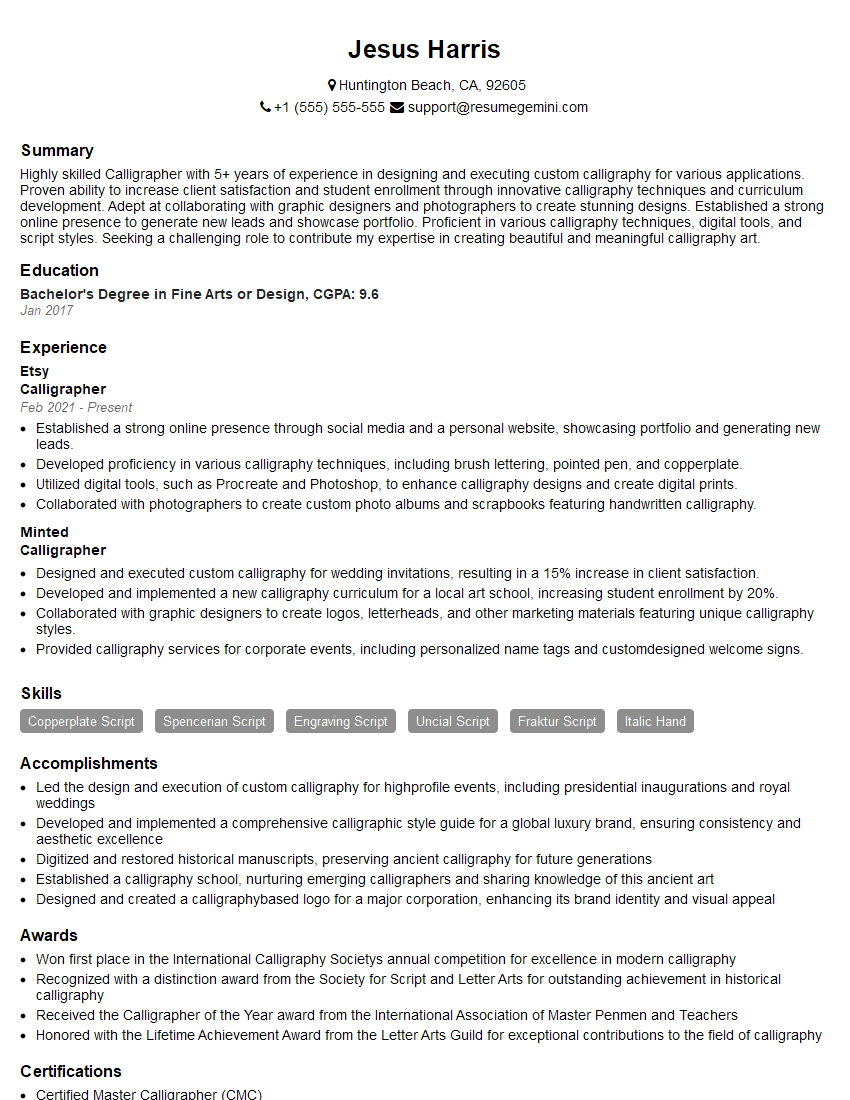
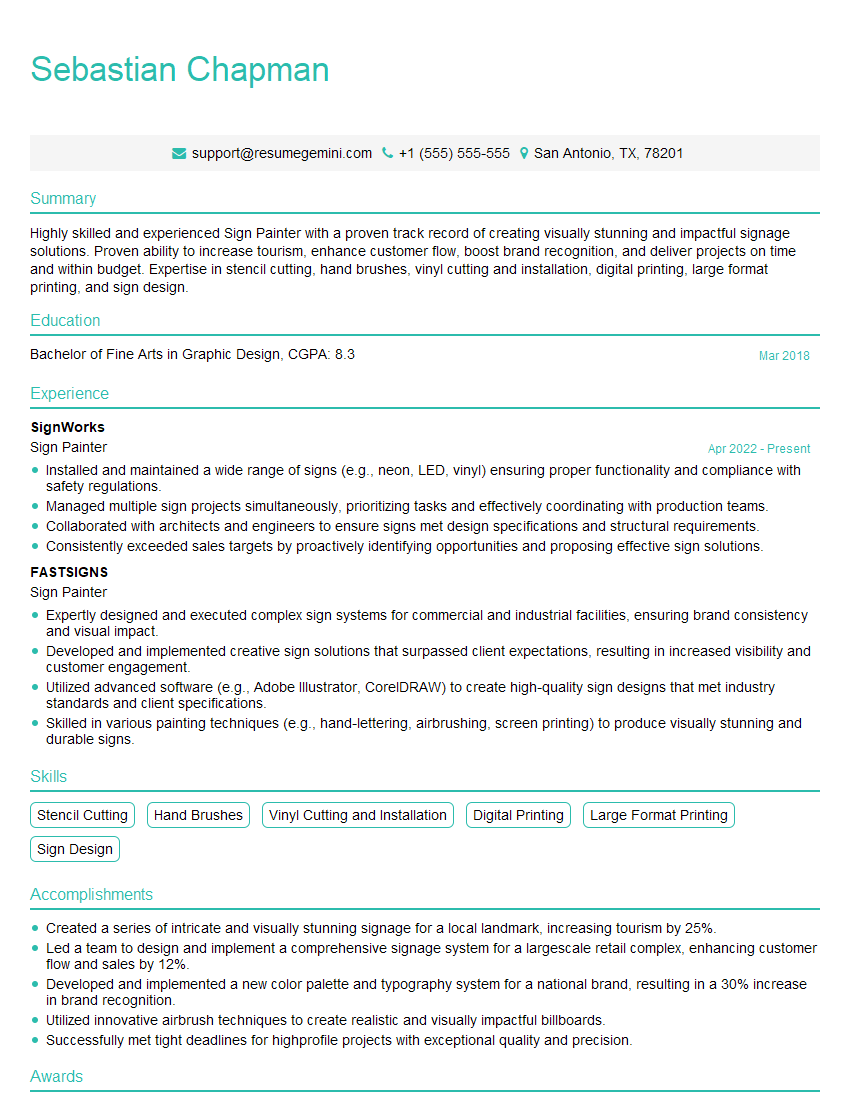
Mastering ornamental lettering opens doors to exciting careers in graphic design, calligraphy, signage, and more! To maximize your job prospects, crafting a strong, ATS-friendly resume is crucial. ResumeGemini is a trusted resource to help you build a professional resume that highlights your skills and experience effectively. We offer examples of resumes tailored to the Ornamental Lettering field to guide you. Take the next step towards your dream career – create a compelling resume that showcases your unique talents and expertise.
Explore more articles
Users Rating of Our Blogs
Share Your Experience
We value your feedback! Please rate our content and share your thoughts (optional).
What Readers Say About Our Blog
Very informative content, great job.
good