Interviews are opportunities to demonstrate your expertise, and this guide is here to help you shine. Explore the essential Packaging Line Optimization interview questions that employers frequently ask, paired with strategies for crafting responses that set you apart from the competition.
Questions Asked in Packaging Line Optimization Interview
Q 1. Describe your experience with Lean manufacturing principles in a packaging line context.
Lean manufacturing focuses on eliminating waste and maximizing value in a production process. In a packaging line context, this means identifying and removing anything that doesn’t directly contribute to producing a high-quality packaged product efficiently. My experience involves implementing various Lean tools like Value Stream Mapping to visualize the entire packaging process, identify bottlenecks, and streamline workflows. I’ve also utilized 5S methodology (Sort, Set in Order, Shine, Standardize, Sustain) to create a more organized and efficient work environment, reducing waste from searching for materials or tools. For example, in one project, by implementing a kanban system for packaging materials, we reduced inventory holding costs by 15% and improved order fulfillment times by 10%. Another successful application was the use of Kaizen events – focused improvement workshops – to systematically address recurring problems in the sealing process, leading to a significant decrease in defective packages.
Q 2. Explain your understanding of Six Sigma methodologies and their application to packaging line optimization.
Six Sigma is a data-driven methodology aimed at minimizing defects and variations in a process. In packaging line optimization, this translates to achieving near-perfect quality and consistency. I’ve used Six Sigma’s DMAIC (Define, Measure, Analyze, Improve, Control) cycle extensively. The Define phase involves clearly specifying the project goals, such as reducing the number of damaged packages or improving line speed. The Measure phase involves collecting data on key metrics. The Analyze phase uses statistical tools like control charts and regression analysis to identify root causes of variation. The Improve phase involves implementing solutions, and the Control phase focuses on monitoring the improved process to ensure sustained results. For instance, in a project focused on reducing package rejects due to incorrect labeling, we used Six Sigma tools to pinpoint the cause as inconsistent label application pressure. By adjusting the machine settings and implementing a new quality control check, we reduced the defect rate by over 80%.
Q 3. How would you identify and quantify bottlenecks in a packaging line?
Identifying bottlenecks requires a combination of observation, data analysis, and process understanding. I typically start by conducting a time study of each stage of the packaging line, measuring cycle times and identifying any significant delays. This could involve using a stopwatch or more sophisticated methods like video recording and analyzing footage. I would then analyze the collected data to identify areas where the throughput is significantly lower than the rest of the line. Visual management tools like Andon boards can also highlight areas experiencing problems in real-time. Finally, statistical process control (SPC) charts provide insights into the variability and stability of different stages of the process. For quantification, I’d use metrics such as cycle time, production rate, and utilization rates of individual machines or operators. For example, a bottleneck could be a slow-filling machine that significantly reduces the overall packaging line speed; it’s easily quantified by comparing its output to the rest of the line.
Q 4. What are the key performance indicators (KPIs) you would use to measure packaging line efficiency?
Key Performance Indicators (KPIs) for packaging line efficiency encompass various aspects of the process. These include:
- Overall Equipment Effectiveness (OEE): Measures the percentage of time a machine is producing good quality output.
- Throughput Rate: Number of units packaged per unit of time.
- Line Efficiency: Ratio of actual production to planned production.
- Defect Rate: Percentage of defective packages.
- Downtime: Percentage of time the line is not producing.
- Mean Time Between Failures (MTBF): Average time between equipment failures.
- Mean Time To Repair (MTTR): Average time taken to repair equipment.
Q 5. How do you balance speed and quality in a high-speed packaging line?
Balancing speed and quality in a high-speed packaging line is crucial. It requires a holistic approach that integrates both preventative and reactive strategies. Preventative measures focus on proactive quality control such as implementing robust quality checks at various stages of the packaging process, using high-quality materials and components, maintaining equipment meticulously, and providing comprehensive operator training. Reactive measures focus on promptly identifying and resolving issues. This involves using advanced sensors and monitoring systems to immediately detect quality deviations, coupled with sophisticated data analysis tools to help determine the root causes of these deviations. This allows for quick adjustments to parameters to prevent defects and minimize downtime. For example, a vision system can detect poorly sealed packages in real-time, triggering an automatic rejection mechanism before they leave the line, maintaining quality without stopping the entire line.
Q 6. Describe your experience with different types of packaging equipment and their maintenance.
My experience encompasses a wide range of packaging equipment, including:
- Fillers: Liquid, powder, and granular fillers.
- Sealers: Heat sealers, induction sealers, and ultrasonic sealers.
- Labelers: Pressure-sensitive labelers, wrap-around labelers.
- Cartoners and Case packers: Automatic systems for packaging products into cartons and cases.
Q 7. How would you troubleshoot a recurring issue on a packaging line?
Troubleshooting a recurring issue starts with a systematic approach. First, I would gather data on the problem, documenting the frequency, severity, and any patterns. This might involve reviewing historical maintenance logs, production records, and operator feedback. Next, I would use a structured problem-solving methodology like the 5 Whys to delve deeper into the root cause of the issue. For example, if the problem is frequent jams in the packaging machine, we might ask: Why is the machine jamming? (Lack of lubrication). Why is there a lack of lubrication? (Lubrication schedule not followed). Why isn’t the lubrication schedule being followed? (Lack of training). Then, I’d implement corrective actions, which could range from minor adjustments to major repairs or equipment upgrades. Finally, it’s crucial to monitor the effectiveness of the solution and implement preventive measures to avoid future recurrence. This could involve updating maintenance procedures, improving operator training, or implementing process controls.
Q 8. Explain your experience with root cause analysis techniques.
Root cause analysis is crucial for effective problem-solving in packaging line optimization. It’s not enough to just address symptoms; we need to identify the underlying issues driving inefficiencies. I’m proficient in several techniques, including the 5 Whys, Fishbone diagrams (Ishikawa diagrams), and Pareto analysis.
For example, if a packaging line is experiencing frequent jams, simply clearing the jams repeatedly won’t solve the problem. Using the 5 Whys, we might ask: Why are there jams? (Answer: Incorrectly sized packaging material). Why is the packaging material incorrectly sized? (Answer: Supplier sent the wrong batch). Why was the wrong batch sent? (Answer: Lack of clear communication on specifications). Why was communication lacking? (Answer: Inadequate quality control procedures). This iterative questioning helps uncover the root cause – flawed quality control – allowing for a targeted solution rather than a series of band-aid fixes.
Fishbone diagrams help visualize potential causes, categorized by factors like machinery, materials, methods, manpower, and environment. Pareto analysis identifies the ‘vital few’ problems contributing to the majority of the issues, focusing our efforts on the most impactful areas for improvement.
Q 9. How do you implement and track changes to improve packaging line performance?
Implementing and tracking changes requires a structured approach. I typically use a Plan-Do-Check-Act (PDCA) cycle. We begin by planning the changes, specifying measurable goals, and predicting potential impacts. This might include implementing new software for quality control, upgrading machinery, or retraining personnel on best practices. Detailed documentation is crucial at this stage.
The ‘Do’ phase involves the actual implementation. We carefully monitor the changes, collecting data continuously. The ‘Check’ phase focuses on analyzing the collected data against the goals established in the planning phase. This includes examining OEE (Overall Equipment Effectiveness) metrics, production output, defect rates, and downtime. Key Performance Indicators (KPIs) are vital here.
Finally, the ‘Act’ phase involves either standardizing the successful changes, refining the process based on learnings, or discarding unsuccessful changes. This cycle is iterative; changes are continuously monitored and adapted. Using tools like dashboards and reports, we visualize progress and identify areas requiring attention. This ensures data-driven improvements and accountability.
Q 10. What software or tools are you proficient in for analyzing packaging line data?
My proficiency spans several software and tools for analyzing packaging line data. I’m highly skilled in using Manufacturing Execution Systems (MES) such as Rockwell Automation’s FactoryTalk ProductionCenter, Siemens’ SIMATIC IT, and Wonderware InTouch. These systems collect real-time data on production parameters, allowing for detailed analysis of performance bottlenecks.
In addition, I’m experienced with statistical process control (SPC) software like Minitab, which helps identify trends and patterns in the data. This allows us to predict potential issues and implement proactive solutions before they impact the line’s performance. Spreadsheet software like Microsoft Excel is also extensively used for data management, analysis, and reporting. Finally, specialized data visualization tools like Tableau are helpful in communicating insights to stakeholders and providing actionable reports.
Q 11. How do you manage change and resistance to change when optimizing a packaging line?
Change management is critical to the success of any optimization project. Resistance to change is natural; people are creatures of habit. My approach starts with clear communication and transparency. I involve the team from the outset, explaining the rationale behind changes and how they will benefit the team and the company. This fosters a sense of ownership and reduces resistance.
I use training and continuous feedback to equip the team with the skills and confidence to adapt to the new processes. I address concerns openly and honestly, providing opportunities for input and feedback. I also celebrate small wins along the way, reinforcing positive behavior and encouraging further cooperation. For instance, recognizing the team’s success in mastering a new piece of software can significantly boost morale and encourage adoption of other changes.
If resistance persists, I use a collaborative approach, working with individuals to understand their concerns and address them effectively. Sometimes, minor adjustments to the implementation plan can resolve issues and demonstrate a willingness to listen. A champion within the team can be very influential in promoting change.
Q 12. Describe your experience with OEE (Overall Equipment Effectiveness) calculations and improvement strategies.
OEE (Overall Equipment Effectiveness) is a key metric in packaging line optimization. It measures the effectiveness of equipment utilization and is calculated as the product of Availability, Performance, and Quality.
- Availability: The percentage of time the equipment is available to run (uptime).
- Performance: The speed at which the equipment runs relative to its design speed.
- Quality: The percentage of good parts produced relative to the total parts produced.
Improving OEE involves targeted actions in each of these areas. For example, improving availability might require implementing predictive maintenance to reduce downtime. Performance can be improved by optimizing machine settings, reducing changeover times, and improving material handling. Improving quality may require stricter quality control procedures, operator training, and reducing material defects. I use data analysis to pinpoint areas for improvement within the OEE calculation and apply solutions accordingly.
For instance, if a low OEE score is due to poor availability, I might investigate the root causes of downtime through root cause analysis, implement a preventative maintenance schedule and upgrade aging equipment.
Q 13. How would you approach optimizing a packaging line with limited budget and resources?
Optimizing a packaging line with limited budget and resources requires a prioritized and strategic approach. I start by identifying low-hanging fruit – quick wins that require minimal investment but can yield significant improvements. This might include improving existing processes, better operator training, and improved material handling.
We can focus on areas with the highest impact. Pareto analysis will help identify the few key areas responsible for most inefficiencies. We then prioritize those and develop cost-effective solutions. This could involve repurposing existing equipment, collaborating with suppliers for better pricing on materials, or implementing simple process changes.
Lean manufacturing principles, such as eliminating waste and improving workflow, are particularly valuable in low-resource settings. This could involve simple process mapping and identifying areas where processes can be streamlined. Finally, we should focus on clear measurement and data tracking to ensure our limited resources are used effectively.
Q 14. How do you ensure safety protocols are maintained during packaging line optimization projects?
Safety is paramount during any packaging line optimization project. I begin by conducting a thorough risk assessment, identifying potential hazards and implementing appropriate control measures. This involves adhering to all relevant safety regulations and industry best practices. All team members receive comprehensive safety training before commencing any work.
Throughout the project, safety is continually monitored. We establish clear communication channels for reporting any safety concerns or incidents. Regular safety meetings are held to review progress, identify potential issues, and ensure adherence to safety protocols. Lockout/Tagout procedures are strictly followed during equipment maintenance and repairs. I work closely with safety officers and maintain detailed safety records, ensuring compliance and continuous improvement in safety practices.
Furthermore, I make sure to select and use equipment and tools designed with safety features, promoting a culture of safety awareness, and encouraging proactive reporting of near misses to prevent future accidents.
Q 15. Describe your experience with different types of packaging materials and their impact on the line.
My experience spans a wide range of packaging materials, from flexible films like polyethylene and polypropylene to rigid materials such as cardboard, corrugated board, and various plastics. Each material presents unique challenges and opportunities for line optimization.
- Flexible Films: These are often used for flow wraps, pouches, and bags. Their flexibility requires precise tension control to avoid wrinkles or tears, impacting speed and efficiency. For example, I once optimized a line using a new film with improved tear resistance, resulting in a 15% reduction in rejects.
- Rigid Materials: Cardboard and corrugated board require robust handling systems to prevent damage. Precise placement and consistent sealing are crucial. I’ve worked on projects where implementing a new robotic palletizer significantly improved throughput and reduced labor costs associated with manual handling.
- Plastics: The properties of plastics, such as PET and HDPE, vary widely, influencing the choice of filling and sealing equipment. I’ve addressed issues like inconsistent sealing on plastic containers by fine-tuning temperature and pressure settings on the sealing machine.
Understanding the properties of each material is paramount. This knowledge guides the selection of appropriate equipment, speeds, and adjustments to maximize efficiency and minimize waste.
Career Expert Tips:
- Ace those interviews! Prepare effectively by reviewing the Top 50 Most Common Interview Questions on ResumeGemini.
- Navigate your job search with confidence! Explore a wide range of Career Tips on ResumeGemini. Learn about common challenges and recommendations to overcome them.
- Craft the perfect resume! Master the Art of Resume Writing with ResumeGemini’s guide. Showcase your unique qualifications and achievements effectively.
- Don’t miss out on holiday savings! Build your dream resume with ResumeGemini’s ATS optimized templates.
Q 16. How do you incorporate sustainability principles into packaging line optimization?
Sustainability is a core consideration in all my optimization projects. It’s not just about reducing waste; it’s about designing a more environmentally responsible packaging line.
- Material Selection: We prioritize using recycled or recyclable materials, and explore options like lightweighting packaging without compromising product protection. For instance, I helped a client switch to a lighter-weight cardboard box, reducing material consumption by 20% without affecting product integrity.
- Waste Reduction: Optimizing line efficiency inherently reduces waste. By minimizing rejects, improving fill accuracy, and streamlining processes, we lessen the environmental impact. Implementing automated quality control systems helps identify and eliminate defects early, thereby reducing waste.
- Energy Efficiency: We analyze energy consumption of equipment and identify areas for improvement. This could involve upgrading to more energy-efficient machinery, optimizing machine settings, or implementing energy-saving practices within the facility.
- Water Usage: In cleaning and sanitation processes, we look for opportunities to reduce water consumption through efficient cleaning systems and recycled water solutions.
Sustainability isn’t an add-on; it’s integral to a holistic optimization strategy. It often leads to cost savings and a positive brand image, too.
Q 17. What is your experience with automated guided vehicles (AGVs) or other automated systems in packaging?
I have extensive experience with AGVs and other automated systems in packaging. These technologies are transforming the industry by enhancing efficiency and flexibility.
- AGVs for Material Handling: AGVs can automate the movement of materials between different stages of the packaging line, eliminating manual handling and reducing the risk of errors. In one project, we integrated AGVs to transport palletized goods from the packaging line to the warehouse, freeing up valuable floor space and boosting overall throughput.
- Robotics for Packaging Tasks: Robotic arms can perform tasks like picking, placing, and palletizing, increasing speed and accuracy. For example, I’ve worked on projects where robots replaced manual palletizing, significantly improving both efficiency and worker safety.
- Automated Guided Carts (AGCs): These smaller, more nimble systems can enhance smaller material movement within the line, improving the flow of materials between machines.
- Integration Challenges: Implementing automated systems requires careful planning and integration with existing equipment and software. This requires expertise in control systems, data communication protocols, and safety standards. Successfully handling the integration is crucial for avoiding costly downtime and inefficiencies.
The key is to carefully assess the specific needs of the packaging line and select the most appropriate automation technology to achieve the desired results.
Q 18. How do you handle unexpected downtime or equipment failures on a packaging line?
Unexpected downtime is a major concern in packaging lines. My approach involves a structured, multi-pronged strategy:
- Immediate Response: The first step is to quickly assess the situation and take immediate actions to mitigate the impact. This includes isolating the problem, ensuring safety, and contacting relevant maintenance personnel.
- Root Cause Analysis: Once the immediate issue is resolved, a thorough investigation is conducted to determine the root cause of the downtime. This may involve reviewing logs, inspecting equipment, and interviewing operators.
- Corrective Actions: Based on the root cause analysis, corrective actions are implemented to prevent future occurrences. This may involve repairing or replacing faulty components, improving maintenance procedures, or redesigning processes.
- Preventive Maintenance: A robust preventive maintenance program is crucial to minimize unexpected downtime. This includes regular inspections, lubrication, and scheduled maintenance activities.
- Data-Driven Insights: Tracking downtime data, analyzing patterns, and leveraging predictive maintenance technologies can help identify potential problems before they occur.
By combining immediate response with a thorough analysis and preventive measures, we can significantly reduce downtime and improve overall line efficiency.
Q 19. Describe your experience with project management methodologies in a packaging line optimization setting.
I’ve extensively used various project management methodologies in packaging line optimization, primarily Agile and Lean methodologies.
- Agile: The iterative nature of Agile allows us to adapt to changing requirements and incorporate feedback throughout the project lifecycle. This is particularly important in complex projects where unforeseen challenges may arise. We use Scrum frameworks, regularly updating stakeholders on progress and incorporating their feedback into sprints.
- Lean: Lean methodologies focus on eliminating waste and maximizing efficiency. We apply Lean principles to identify bottlenecks, streamline processes, and reduce unnecessary steps within the packaging line. Value stream mapping is a crucial tool for this.
- Gantt Charts & Critical Path Method (CPM): For scheduling and tracking progress, we use Gantt charts to visualize project timelines and CPM to identify critical tasks that require close monitoring.
- Risk Management: A crucial component of any project is proactive risk management. We identify potential risks early on and develop mitigation strategies to minimize their impact on the project timeline and budget.
The choice of methodology depends on the project’s complexity and specific requirements. Often, a hybrid approach combining elements from different methodologies proves most effective.
Q 20. How would you communicate complex technical information to non-technical stakeholders?
Communicating complex technical information to non-technical stakeholders requires a clear, concise, and relatable approach.
- Visual Aids: Charts, graphs, and diagrams are invaluable tools for simplifying complex data. Instead of focusing on technical jargon, we illustrate key findings with simple visuals that are easily understandable.
- Analogies and Metaphors: Using relatable analogies helps non-technical stakeholders grasp complex concepts more effectively. For instance, explaining throughput in terms of cars per hour on a highway is more intuitive than using technical metrics.
- Storytelling: Weaving a narrative around the technical information can make it more engaging and memorable. This helps maintain their interest and ensure they retain the key information.
- Focus on the Business Impact: Frame the technical information within the context of its business implications. Focus on the key benefits, such as cost savings, improved efficiency, or increased profitability. This helps justify the technical decisions and ensures alignment with business goals.
- Interactive Sessions: Interactive presentations and Q&A sessions provide opportunities for clarification and feedback, ensuring everyone understands the information.
The key is to translate complex technical language into plain language, focusing on the ‘why’ and ‘so what’ of the technical details.
Q 21. How do you ensure data accuracy and integrity when analyzing packaging line performance?
Data accuracy and integrity are crucial for accurate analysis of packaging line performance. I use a multi-layered approach to ensure this:
- Data Validation: We implement data validation rules and checks throughout the data collection and processing stages. This includes validating data types, ranges, and consistency.
- Data Source Verification: We carefully verify the accuracy and reliability of data sources. This might involve checking sensor calibrations, reviewing manual data entry procedures, and comparing data from multiple sources.
- Data Cleaning and Transformation: Before analysis, data is cleaned to handle missing values, outliers, and inconsistencies. Data transformation techniques are used to ensure data is in the appropriate format for analysis.
- Statistical Process Control (SPC): SPC charts and techniques help monitor process variation and identify potential issues early on. This enables prompt corrective actions before significant errors accumulate.
- Regular Audits: Regular audits of data collection and analysis processes ensure continued accuracy and adherence to quality standards.
By combining these methods, we build confidence in the data used for decision-making. Inaccurate data can lead to ineffective optimization efforts, highlighting the critical importance of data integrity.
Q 22. What are the common causes of packaging line inefficiencies, and how would you address them?
Packaging line inefficiencies stem from various sources, often interconnected. Think of it like a chain – if one link is weak, the whole chain is compromised. Common culprits include:
- Equipment malfunctions: This could range from minor jams in a labeling machine to major breakdowns in the filling system. For example, a worn conveyor belt can cause frequent stoppages and product damage.
- Bottlenecks: One slow stage can hold up the entire line. Imagine a traffic jam – one slow car causes a ripple effect. This could be due to insufficient capacity at a particular stage, like a slower filler than the rest of the line.
- Material handling issues: Inefficient movement of materials (empty containers, finished goods) leads to delays and wasted time. Poorly designed storage locations or inadequate transport systems are common examples.
- Operator errors: Human error is inevitable, but can be minimized through proper training, clear procedures, and efficient user interfaces. For instance, incorrect parameter settings or failure to detect a problem promptly can cause significant downtime.
- Poor quality control: Defective products require re-work or disposal, disrupting the flow. Implementing robust quality checks at different points along the line minimizes this issue.
Addressing these requires a multi-pronged approach: preventative maintenance programs, optimized line balancing (adjusting speeds of different machines to match the slowest), streamlined material flow using lean methodologies, comprehensive operator training programs with standardized operating procedures (SOPs), and advanced process control systems (APCS) for real-time monitoring and adjustment.
Q 23. Explain your experience with different packaging line layouts and their impact on efficiency.
My experience encompasses various packaging line layouts, from simple linear configurations to complex U-shaped and S-shaped designs. The choice of layout significantly impacts efficiency.
- Linear layouts are straightforward but can be prone to bottlenecks if one machine fails. They’re suitable for simpler processes with lower volumes.
- U-shaped layouts allow for better operator movement and workflow optimization, reducing transportation time and improving overall efficiency. The flow of materials is generally more compact and efficient. I’ve seen significant improvements in throughput using this design in a project for a food packaging client.
- S-shaped layouts are even more complex and usually implemented in high-volume, high-speed lines where efficient material flow is critical. They often incorporate multiple stages of inspection and quality control.
Selecting the right layout involves considering factors like product characteristics, production volume, available space, and budget. Simulation software is often used to model different scenarios and optimize throughput before implementing the layout. Analyzing the current layout using value stream mapping helps to pinpoint areas of waste and bottlenecks, forming the basis for a more effective design.
Q 24. How do you identify and mitigate risks associated with packaging line optimization projects?
Risk mitigation in packaging line optimization projects is paramount. I employ a systematic approach incorporating:
- Risk assessment: A thorough assessment identifies potential risks, such as equipment downtime, delays in project completion, and cost overruns. I use a structured methodology like Failure Mode and Effects Analysis (FMEA) to analyze potential failure modes, their effects, and the severity.
- Contingency planning: For each identified risk, I develop contingency plans. For example, having backup equipment available in case of a machine failure, or alternative solutions ready if a supplier experiences delays.
- Phased implementation: Instead of a complete overhaul, implementing changes in phases minimizes disruption and allows for iterative adjustments based on performance data. This approach reduces overall risk and allows for easier identification of any issues during each phase.
- Communication and stakeholder management: Keeping all stakeholders (operators, management, suppliers) informed and involved throughout the project is crucial. Clear communication mitigates misunderstandings and ensures buy-in.
- Monitoring and evaluation: Continuous monitoring of Key Performance Indicators (KPIs) like Overall Equipment Effectiveness (OEE) and throughput allows for early detection of problems and adjustment of the optimization strategies.
For example, in a recent project, we identified the risk of supplier delays for a critical piece of equipment. The contingency plan was to source the equipment from a secondary supplier, thus mitigating the project delay risk. This proactive approach ensured a smooth project execution.
Q 25. Describe your approach to continuous improvement in a packaging line environment.
My approach to continuous improvement is based on the principles of Lean manufacturing and Six Sigma. It’s an ongoing process, not a one-time event.
- Data-driven decision making: Regularly collecting and analyzing data from the packaging line, such as OEE, downtime reasons, and production metrics, provides insights into areas for improvement. This data forms the base for informed choices.
- Kaizen events: These focused workshops involve operators and other stakeholders to brainstorm and implement quick, small improvements. These events foster a culture of continuous improvement and empower employees to identify and resolve issues.
- Value stream mapping: This helps visualize the entire process, identify bottlenecks, and eliminate waste. This provides a clear overview of the current process and highlights areas for streamlining.
- 5S methodology: Implementing 5S (Sort, Set in Order, Shine, Standardize, Sustain) in the packaging line improves workplace organization and efficiency. This reduces waste and improves the safety of the workplace.
- Regular performance reviews: Analyzing the data collected and tracking the KPIs helps track progress and make adjustments to the continuous improvement plan as needed.
For example, in one project, a Kaizen event led to the redesign of a packaging station resulting in a 15% increase in output and a significant reduction in operator fatigue.
Q 26. How do you prioritize different optimization projects based on their potential impact?
Prioritizing optimization projects requires a structured approach. I typically use a combination of methods:
- Financial impact: Projects with the highest potential return on investment (ROI) are prioritized. This includes calculating the potential cost savings from increased efficiency and reduced waste.
- Operational impact: Projects that address major bottlenecks or significantly improve OEE are prioritized. This focuses on the improvement of the most critical aspects of the packaging line.
- Risk assessment: Projects with lower implementation risks are often preferred, especially in early stages of optimization. Reducing the risk of project failure is a key consideration.
- Urgency: Some projects might need urgent attention due to safety concerns, impending regulatory changes, or significant production delays. Addressing these urgent issues is often given precedence.
I often use a matrix to visualize the relative importance of different projects based on these factors. This helps make objective decisions and clearly communicate the rationale to stakeholders.
Q 27. What are your salary expectations for this role?
My salary expectations are in line with the market rate for a Packaging Line Optimization expert with my experience and skillset. I am open to discussing a competitive compensation package that reflects the value I bring to the organization. I would be happy to provide further details during our salary negotiation phase.
Q 28. Do you have any questions for me?
Yes, I have a few questions. I’d like to learn more about:
- The specific challenges the company is facing in its packaging line operations.
- The company’s current technology infrastructure and its openness to adopting new technologies.
- The team structure and the level of support I can expect for the role.
- The company’s long-term vision for packaging line optimization and its commitment to continuous improvement.
Key Topics to Learn for Packaging Line Optimization Interview
- Line Efficiency & Output: Understanding key performance indicators (KPIs) like Overall Equipment Effectiveness (OEE), production rate, and downtime analysis. Practical application: Analyzing historical data to identify bottlenecks and propose improvements.
- Packaging Process Flow: Mastering the sequence of operations, material handling, and the interaction between different machines within the packaging line. Practical application: Designing and optimizing the layout of a packaging line to minimize movement and maximize throughput.
- Statistical Process Control (SPC): Applying SPC techniques to monitor and control the packaging process, identifying and addressing variations to maintain quality and consistency. Practical application: Implementing control charts to track key parameters and detect anomalies.
- Lean Manufacturing Principles: Applying principles like Kaizen, 5S, and Value Stream Mapping to eliminate waste and improve efficiency throughout the packaging process. Practical application: Identifying and eliminating non-value-added activities in the packaging process.
- Automation & Robotics: Understanding the role of automated systems and robotics in optimizing packaging lines, including their integration, maintenance, and troubleshooting. Practical application: Evaluating the feasibility and benefits of incorporating automated systems to improve speed and accuracy.
- Preventive Maintenance & Downtime Reduction: Developing strategies for preventive maintenance to minimize downtime and maximize equipment lifespan. Practical application: Creating a PM schedule based on equipment criticality and historical data analysis.
- Packaging Material Optimization: Exploring strategies to minimize material waste and optimize packaging design for efficient production and distribution. Practical application: Evaluating different packaging materials and designs to identify cost-effective and environmentally friendly solutions.
Next Steps
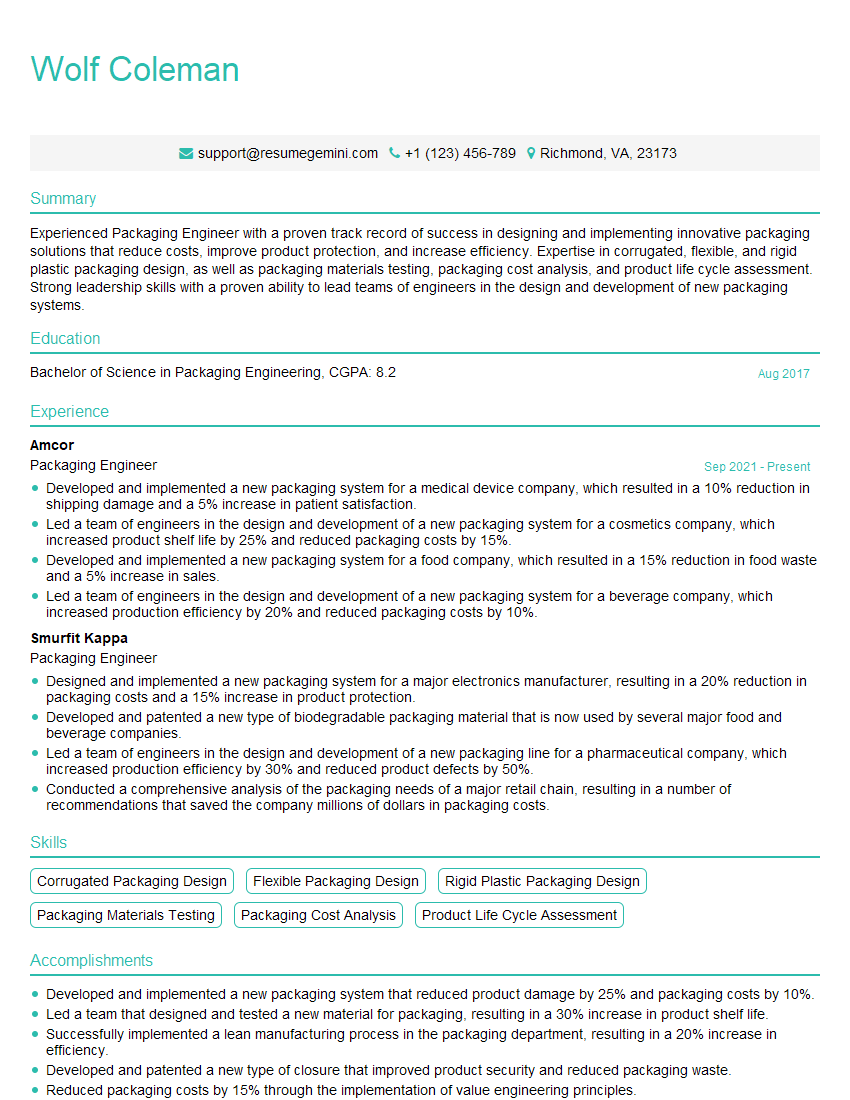
Mastering Packaging Line Optimization is crucial for career advancement in the manufacturing and logistics sectors, opening doors to higher-paying roles and increased responsibilities. An ATS-friendly resume is your key to unlocking these opportunities. To ensure your skills and experience shine, consider using ResumeGemini to craft a compelling and effective resume. ResumeGemini provides a streamlined process and even offers examples of resumes tailored to Packaging Line Optimization to help you stand out from the competition.
Explore more articles
Users Rating of Our Blogs
Share Your Experience
We value your feedback! Please rate our content and share your thoughts (optional).
What Readers Say About Our Blog
Very informative content, great job.
good