Interviews are opportunities to demonstrate your expertise, and this guide is here to help you shine. Explore the essential Paper interview questions that employers frequently ask, paired with strategies for crafting responses that set you apart from the competition.
Questions Asked in Paper Interview
Q 1. Explain the process of papermaking from pulp to finished product.
Papermaking is a fascinating journey from a fibrous slurry to the finished product we use daily. It begins with pulping, where raw materials like wood or recycled paper are broken down into individual fibers. This pulp then undergoes several crucial steps:
- Cleaning and Screening: The pulp is cleaned to remove impurities like bark and knots, then screened to separate out fiber bundles, ensuring consistent fiber length.
- Refining: This mechanical process further breaks down the fibers, creating a more workable consistency and influencing the final paper’s properties – strength, smoothness, and absorbency.
- Stock Preparation: Additives like fillers (clay, calcium carbonate), sizing agents (starch, synthetic polymers), and retention aids are added to enhance the paper’s quality. This is where the ‘recipe’ for a specific type of paper is defined.
- Paper Machine Formation: The pulp mixture is diluted and spread thinly onto a moving wire mesh on a paper machine. Water drains, leaving behind a continuous sheet of fibers.
- Pressing: The wet sheet is pressed to remove excess water and improve its strength.
- Drying: The sheet is passed over heated rollers to dry completely.
- Calendering: This process smooths and compresses the sheet, giving the paper its final surface finish, from glossy to rough.
- Coating (optional): Certain papers receive additional coatings to enhance their print quality, smoothness, or other specialized properties, like water resistance.
- Finishing: The finished paper is cut, rolled, or packaged based on its intended use.
Think of it like baking a cake; you need the right ingredients (pulp and additives) and careful steps (refining, forming, drying) to achieve the desired texture and quality (the final paper).
Q 2. Describe different types of paper and their applications.
The world of paper is incredibly diverse! Here are some common types and their applications:
- Newsprint: Made from recycled and mechanical pulp, it’s inexpensive and absorbent, ideal for newspapers.
- Printing and Writing Papers: These range widely in quality and surface finish. Examples include bond paper (smooth, for printing and writing), coated paper (for high-quality printing), and book paper (durable, for books).
- Packaging Papers: Used for boxes, bags, and wrapping. These emphasize strength and durability, often using recycled content.
- Tissue Paper: Soft and absorbent, made from bleached pulp, commonly used in hygiene and cleaning products.
- Specialty Papers: This category encompasses a vast array of papers with specialized properties, including security paper (with embedded features to prevent counterfeiting), filter paper (for laboratory use), and photographic paper (for image development).
The choice of paper depends on the intended use. For instance, a high-quality glossy coated paper is necessary for magazine printing to reproduce vibrant colors, while a strong, water-resistant paper is essential for food packaging.
Q 3. What are the key quality parameters for evaluating paper?
Evaluating paper quality requires a comprehensive assessment of several key parameters:
- Basis Weight: The mass per unit area (grams per square meter or gsm), which indicates the paper’s thickness and weight.
- Brightness: A measure of how much white light the paper reflects, important for print quality and visual appeal.
- Opacity: The ability of the paper to prevent light from showing through, important for documents printed on both sides.
- Tensile Strength: The paper’s resistance to tearing, affecting its durability and handling properties.
- Burst Strength: The paper’s resistance to bursting under pressure, crucial for packaging applications.
- Smoothness: The surface texture, affecting print quality and the feel of the paper.
- Absorbency: How much ink or liquid the paper can absorb, important for various applications.
These parameters are measured using standardized testing methods and instruments. For example, a caliper gauge measures thickness, and a brightness meter measures whiteness. The specific parameters most critical will vary depending on the intended application of the paper.
Q 4. How do you ensure consistent paper quality during production?
Consistent paper quality is paramount. It relies on a combination of careful process control and continuous monitoring:
- Precise Pulp Preparation: Maintaining consistent fiber length, freeness (drainage rate), and additive levels is essential.
- Automated Paper Machine Control: Sophisticated sensors and automated systems constantly monitor and adjust key parameters such as moisture content, speed, and temperature on the paper machine.
- Regular Quality Checks: Samples are taken throughout the production process and tested for key quality parameters. Statistical Process Control (SPC) techniques are often used to identify and address deviations early.
- Calibration and Maintenance: Regular calibration of measuring instruments and preventative maintenance of the paper machine are vital for preventing issues and ensuring consistent performance.
- Operator Training: Skilled operators are key. Their experience and attention to detail contribute significantly to consistency.
Think of it like a finely tuned orchestra; each instrument (process step) must play its part precisely to create a harmonious outcome (consistent paper quality).
Q 5. Explain the role of different additives in paper manufacturing.
Additives play a critical role in tailoring paper properties to meet specific needs. Key examples include:
- Fillers (e.g., clay, calcium carbonate): Increase opacity, brightness, and smoothness, and reduce the cost of the paper.
- Sizing Agents (e.g., starch, synthetic polymers): Reduce ink feathering and improve printability.
- Retention Aids: Improve fiber retention on the wire mesh during paper formation, reducing fiber loss and improving paper strength.
- Wet-Strength Agents: Increase the strength of the paper when wet, important for packaging and tissue products.
- Colorants and Pigments: Add color to the paper.
- Coatings: Applied to enhance surface properties, like smoothness and printability.
The type and amount of additive used depend on the intended use of the paper. A high-quality printing paper will likely have more fillers and sizing agents compared to a simple newsprint.
Q 6. Describe different pulping processes and their advantages/disadvantages.
Pulping, the process of breaking down raw materials into fibers, uses various methods:
- Mechanical Pulping: Grinds wood into fibers using mechanical force (e.g., groundwood, thermomechanical pulp). Advantages: High yield, low cost. Disadvantages: Lower strength, less brightness, and lower quality than chemical pulps.
- Chemical Pulping: Uses chemicals to dissolve lignin, the binder in wood, leaving behind cellulose fibers (e.g., kraft, sulfite). Advantages: Higher strength, brightness, and quality. Disadvantages: Lower yield, higher cost, and potential environmental concerns related to chemical usage and waste disposal.
- Semi-Chemical Pulping: Combines mechanical and chemical treatments. Advantages: Balances yield and quality. Disadvantages: Can be less consistent in quality compared to fully chemical pulping.
The choice of pulping process depends on factors like the desired paper properties, cost considerations, and environmental impact. For example, newsprint often uses mechanical pulping for its high yield and low cost, while high-quality printing papers typically use chemical pulping for superior strength and brightness.
Q 7. What are the common defects found in paper and how are they addressed?
Paper defects can occur at various stages of the production process. Common ones include:
- Holes and Breaks: Caused by fiber clumps, uneven pulp distribution, or machine malfunctions. Solution: Improved screening and refining, careful control of paper machine parameters.
- Shives: Undigested wood fibers that create rough spots on the paper’s surface. Solution: Improved pulping process and screening.
- Pick-up: Fibers adhering to rollers or other parts of the machine, resulting in surface irregularities. Solution: Proper cleaning and maintenance of the paper machine, adjusting machine settings.
- Watermarks: Variations in the thickness of the paper sheet, sometimes intentional, but can also indicate inconsistent pulp distribution. Solution: Better control of stock preparation and paper machine operation.
- Stains: Impurities introduced during pulping or manufacturing. Solution: Better cleaning and quality control.
Identifying and addressing these defects requires thorough knowledge of the papermaking process and rigorous quality control measures. A systematic approach, involving continuous monitoring, root cause analysis, and process adjustments, is critical to minimizing defects and ensuring high-quality paper production.
Q 8. Explain the importance of paper recycling and its environmental impact.
Paper recycling is crucial for environmental sustainability. It significantly reduces the demand for virgin wood pulp, thus conserving forests and mitigating deforestation. The process involves collecting used paper, sorting it by type, and then pulping it to create new paper. This drastically reduces the energy consumption and greenhouse gas emissions associated with paper production compared to starting from scratch. For example, producing recycled paper uses about 60% less energy than making paper from virgin wood fibers. Furthermore, recycling paper reduces water pollution, as the process requires less water than traditional papermaking. Finally, it minimizes the amount of paper ending up in landfills, reducing landfill space and mitigating environmental damage associated with paper decomposition.
- Reduced Deforestation: Less reliance on virgin wood pulp means fewer trees are cut down.
- Lower Energy Consumption: Recycling uses significantly less energy than making paper from scratch.
- Water Conservation: The recycling process needs less water compared to traditional methods.
- Reduced Landfill Waste: Less paper in landfills minimizes environmental impact.
Q 9. How do you optimize paper production for cost-effectiveness and efficiency?
Optimizing paper production for cost-effectiveness and efficiency involves a multi-pronged approach focusing on raw material selection, process optimization, and waste reduction. Firstly, sourcing sustainable and cost-effective pulp sources is paramount. This could include utilizing recycled fibers strategically, negotiating favorable contracts with pulp suppliers, and exploring alternative fiber sources. Secondly, optimizing the paper machine’s operation is critical. This involves fine-tuning parameters like speed, moisture content, and pressure to minimize defects and maximize output. Implementing real-time monitoring and control systems allows for continuous adjustments and prevents costly downtime. Thirdly, efficient energy management is key. This includes utilizing energy-efficient machinery, optimizing steam and power usage, and implementing waste heat recovery systems. Finally, minimizing waste generation throughout the process is crucial, involving optimizing the pulping process, improving trim and broke handling, and implementing effective recycling programs within the mill.
For example, implementing a closed-loop water system can significantly reduce water consumption and associated costs. Another example involves using advanced process control systems to monitor and control paper quality, preventing defects and reducing waste.
Q 10. Describe your experience with paper machine operation and maintenance.
My experience encompasses all aspects of paper machine operation and maintenance. This includes hands-on experience with various types of paper machines, from smaller-scale machines to large, high-speed production lines. I’m proficient in troubleshooting mechanical, electrical, and process-related issues. This involves understanding the complex interplay between different machine components, such as the headbox, press section, dryer section, and calender stacks. My maintenance experience includes preventive maintenance schedules, predictive maintenance using vibration analysis and other diagnostic techniques, and corrective maintenance involving repairs and component replacements. I have worked extensively with paper machine control systems, including programmable logic controllers (PLCs) and distributed control systems (DCS). In one instance, I successfully identified and resolved a recurring issue with paper breaks on a high-speed paper machine by systematically analyzing the process parameters and making adjustments to the headbox and press section. This significantly improved production efficiency and reduced downtime.
Q 11. Explain the concept of paper coating and its effects on paper properties.
Paper coating is a process where a layer of material is applied to the surface of paper to enhance its properties. This coating can significantly alter the paper’s properties, making it suitable for specific applications. Different types of coatings exist, including clay coatings for improved smoothness and brightness, polymeric coatings for enhanced water resistance and printability, and various specialty coatings for specific functionalities such as gloss or heat resistance. The effects of coating include:
- Improved Printability: Coatings provide a smoother surface for ink absorption, enhancing the quality of printed images.
- Enhanced Opacity: Coatings reduce show-through of text or images on the opposite side of the paper.
- Increased Brightness: Clay coatings, for instance, significantly increase the paper’s brightness.
- Improved Water Resistance: Polymer coatings increase resistance to water and moisture.
- Specialized Properties: Specialty coatings provide properties like gloss, heat resistance, or specific chemical resistance.
For example, glossy magazine paper is coated with a polymeric coating for high-quality print reproduction and gloss, while packaging paper may be coated for water resistance and barrier properties.
Q 12. How do you troubleshoot problems in a paper mill environment?
Troubleshooting in a paper mill environment requires a systematic and analytical approach. My strategy involves a combination of hands-on investigation, data analysis, and collaboration. I typically start with a thorough assessment of the problem, gathering information from operators, reviewing process data, and visually inspecting the relevant equipment. Then, I systematically check the various process variables, looking for deviations from normal operating parameters. This often includes analyzing data from sensors, such as pressure, temperature, and moisture content. I utilize diagnostic tools like vibration analysis and infrared thermography to identify potential mechanical or electrical problems. I then develop hypotheses about the root cause of the problem and test them through controlled experiments or adjustments to process parameters. Finally, once the root cause is identified and verified, I implement a solution and monitor the system’s performance to ensure the problem is resolved.
For example, if a paper machine is experiencing frequent breaks, I would systematically investigate factors like fiber consistency, headbox pressure, moisture content, and dryer temperature, and use a structured approach (e.g., a decision tree) to isolate the problem.
Q 13. Describe your experience with paper testing and quality control procedures.
My experience with paper testing and quality control encompasses a wide range of procedures. This includes routine testing to ensure consistency and adherence to customer specifications and troubleshooting tests to identify and rectify quality issues. I’m proficient in using various testing instruments and methodologies to evaluate key paper properties such as weight, thickness, brightness, opacity, tensile strength, burst strength, tear strength, and smoothness. I understand the importance of statistical process control (SPC) in maintaining consistent quality and identifying potential process variations. I have experience with implementing and interpreting control charts to monitor key quality parameters and proactively address emerging issues. In my previous role, I developed and implemented a new testing procedure for assessing the printability of a new type of coated paper, ensuring it met the requirements of our customers.
Q 14. What are the different types of paper testing equipment?
Various types of paper testing equipment are used to evaluate different properties of paper. These include:
- Thickness Gauge: Measures the thickness of the paper.
- Brightness Meter: Measures the brightness of the paper.
- Opacity Meter: Measures the paper’s opacity.
- Tensile Strength Tester: Measures the paper’s tensile strength (resistance to pulling).
- Burst Strength Tester: Measures the paper’s resistance to bursting pressure.
- Tear Strength Tester: Measures the paper’s resistance to tearing.
- Smoothness Tester: Measures the smoothness of the paper surface.
- Caliper Gauge: Measures the thickness of the paper.
- Basis Weight Scale: Measures the weight of a standard sheet of paper.
- Air Permeability Tester: Measures the air permeability of paper.
The specific equipment used depends on the type of paper and the properties being evaluated. Advanced equipment might include sophisticated image analysis systems for evaluating surface defects.
Q 15. Explain the principles of paper strength and its measurement.
Paper strength is a complex property encompassing several key characteristics that determine its ability to withstand various stresses. These include tensile strength (resistance to pulling forces), burst strength (resistance to sudden pressure), tear strength (resistance to ripping), and folding endurance (number of folds before failure). These properties are interconnected; for example, high tensile strength usually correlates with high burst strength.
Measuring paper strength involves standardized testing methods using specialized instruments. For instance, tensile strength is measured using a tensile tester, which grips a strip of paper and applies a controlled force until it breaks. The force at breakage and the elongation are recorded. Burst strength is determined using a Mullen tester, which measures the pressure required to burst a circular sample. Tear strength is assessed using a Elmendorf tear tester. The results are expressed in units like Newtons (N), Kilograms-force (kgf), or pounds-force (lbf), and they are crucial for selecting the right type of paper for specific applications, such as packaging, printing, or writing.
For example, a paper intended for packaging heavy items requires significantly higher tensile and burst strength compared to paper used for printing brochures.
Career Expert Tips:
- Ace those interviews! Prepare effectively by reviewing the Top 50 Most Common Interview Questions on ResumeGemini.
- Navigate your job search with confidence! Explore a wide range of Career Tips on ResumeGemini. Learn about common challenges and recommendations to overcome them.
- Craft the perfect resume! Master the Art of Resume Writing with ResumeGemini’s guide. Showcase your unique qualifications and achievements effectively.
- Don’t miss out on holiday savings! Build your dream resume with ResumeGemini’s ATS optimized templates.
Q 16. How do you manage inventory and supply chain for paper production?
Effective paper inventory and supply chain management is crucial for minimizing costs and ensuring continuous production. It involves a multi-faceted approach incorporating forecasting, procurement, storage, and transportation.
- Forecasting: Accurate demand forecasting is paramount. This involves analyzing historical sales data, market trends, and seasonality to predict future demand. Advanced techniques like time series analysis and machine learning can enhance forecasting accuracy.
- Procurement: Strategic sourcing of raw materials (pulp, additives) is key. This includes negotiating favorable prices with suppliers, managing supplier relationships, and ensuring consistent quality. Diversification of suppliers minimizes risks associated with supply disruptions.
- Storage: Proper warehousing is essential to prevent damage to paper rolls due to moisture, temperature fluctuations, or pest infestation. Effective warehouse layout and inventory management systems (like FIFO – First In, First Out) are crucial.
- Transportation: Efficient transportation is necessary for timely delivery of raw materials and finished products. This involves selecting appropriate modes of transportation (trucks, rail, ships) and optimizing logistics to minimize transit time and transportation costs.
Real-time inventory tracking systems using barcodes or RFID tags enable precise monitoring of stock levels, facilitating timely replenishment and avoiding stockouts or overstocking. A robust supply chain management system integrates all these aspects to optimize the entire process.
Q 17. Describe your experience with paper industry safety regulations.
Safety in the paper industry is paramount, encompassing various regulations concerning machinery, handling of chemicals, and personal protective equipment (PPE). My experience includes rigorous adherence to OSHA (Occupational Safety and Health Administration) standards in the US, or equivalent regulations in other countries.
This involves regular safety inspections of machinery, ensuring proper guarding and lockout/tagout procedures to prevent accidents during maintenance. Proper handling and storage of hazardous chemicals, including pulp bleaching agents and adhesives, are strictly enforced, involving specific training for personnel on safe handling protocols. Furthermore, ensuring employees use appropriate PPE such as safety glasses, gloves, and hearing protection is a non-negotiable aspect of daily operations. Regular safety training programs, emergency response drills, and incident reporting procedures are crucial for maintaining a safe work environment. I have extensive experience in developing and implementing safety programs, leading safety audits, and investigating workplace incidents to identify root causes and implement corrective actions.
Q 18. What are the environmental regulations relevant to paper manufacturing?
Environmental regulations governing paper manufacturing are increasingly stringent worldwide. They primarily focus on reducing water and air pollution, minimizing waste generation, and promoting sustainable forestry practices.
- Water Pollution: Regulations limit the discharge of wastewater containing pollutants such as suspended solids, organic matter, and chemicals used in bleaching. Treatment plants are mandatory to reduce these pollutants before discharge.
- Air Pollution: Emission limits are placed on pollutants such as particulate matter and volatile organic compounds (VOCs) from processes like pulping, bleaching, and drying. Efficient air pollution control technologies are essential.
- Waste Management: Regulations address the management of solid waste, including sludge from wastewater treatment and paper scraps. Recycling and waste minimization strategies are encouraged.
- Sustainable Forestry: Regulations often mandate the use of sustainably sourced wood pulp, promoting responsible forest management practices to avoid deforestation.
Compliance with these regulations is crucial to obtain operational permits and avoid penalties. This often involves continuous monitoring of emissions and effluent quality, detailed record-keeping, and regular audits by environmental agencies.
Q 19. How do you contribute to a sustainable paper production process?
Contributing to sustainable paper production is a core principle in my approach. This involves a holistic strategy incorporating several key elements.
- Increased Recycling: Maximizing the use of recycled fiber in paper production significantly reduces the need for virgin wood pulp, conserving forests and reducing waste. This requires efficient collection and processing of recyclable paper.
- Process Optimization: Implementing efficient pulping and bleaching processes minimizes energy and water consumption, and reduces the generation of pollutants. This may involve adopting advanced technologies and optimizing process parameters.
- Closed-Loop Water Systems: Utilizing closed-loop water systems minimizes water consumption and wastewater discharge. This involves recycling and reusing water within the production process.
- Bioenergy: Utilizing biomass from the papermaking process for energy generation reduces reliance on fossil fuels and minimizes greenhouse gas emissions.
- Sustainable Sourcing: Ensuring that wood pulp originates from sustainably managed forests that comply with certifications like the Forest Stewardship Council (FSC) is vital for environmental protection.
Implementing these measures not only reduces environmental impact but also enhances the company’s reputation and strengthens its competitive advantage in the increasingly environmentally conscious market.
Q 20. Explain your understanding of different types of paper fibers and their properties.
Paper fibers are the fundamental building blocks of paper, dictating its properties. The most common fiber sources are wood and various non-wood plants.
- Wood Fibers: These are primarily sourced from softwoods (e.g., pine, spruce) and hardwoods (e.g., eucalyptus, birch). Softwood fibers are typically longer and stronger, lending greater tensile strength to the paper. Hardwood fibers are shorter and provide greater smoothness and opacity. The type of wood used greatly impacts the final paper properties.
- Non-Wood Fibers: These include fibers from plants like bagasse (sugarcane residue), bamboo, hemp, and kenaf. These offer sustainable alternatives to wood pulp, depending on the geographical location and availability. They can vary considerably in fiber length and strength.
- Fiber Properties: Key properties influencing paper characteristics include fiber length (affecting strength and tear resistance), fiber diameter (affecting smoothness and opacity), and fiber wall thickness (affecting strength and stiffness).
Understanding fiber properties allows for designing paper blends to achieve specific characteristics. For instance, a blend of long softwood and short hardwood fibers can create a strong and smooth paper suitable for printing. The selection of fiber type directly impacts the paper’s final quality, cost, and sustainability.
Q 21. Describe your experience with statistical process control (SPC) in paper manufacturing.
Statistical Process Control (SPC) is essential for maintaining consistent quality and efficiency in paper manufacturing. It involves using statistical methods to monitor and control manufacturing processes, identify sources of variation, and prevent defects.
My experience with SPC in paper production includes implementing control charts (e.g., X-bar and R charts, C charts for defects) to monitor key quality parameters like paper weight, thickness, moisture content, and tensile strength. Data is collected regularly from the production line and analyzed to identify trends and patterns. Control limits are established to determine whether the process is operating within acceptable limits or exhibiting statistically significant variations. When variations exceed control limits, it signals a need for corrective action. This could involve adjusting machine settings, investigating potential causes of variation, or implementing process improvements.
For example, a significant increase in the variation of paper weight might indicate a problem with the pulp consistency, requiring adjustments to the pulping process. SPC is instrumental in reducing waste, improving product quality, and enhancing overall efficiency by preventing deviations from the desired specifications.
Example: An X-bar chart shows the average paper weight over time. If the data points consistently fall outside the upper control limit, it suggests that the paper is becoming too heavy, possibly due to excess moisture.
Q 22. How do you analyze and interpret paper testing data?
Analyzing paper testing data involves a systematic approach to understand the properties and quality of the paper. This begins with understanding the specific tests conducted – such as tensile strength, burst strength, tear resistance, opacity, brightness, and smoothness. Each test provides a different piece of the puzzle. For example, tensile strength measures the paper’s resistance to pulling forces, while burst strength indicates its ability to withstand pressure.
Interpretation involves comparing the test results against established standards (e.g., ISO standards) or internal specifications for the particular paper grade. Deviations from the expected values indicate potential issues in the manufacturing process or raw material quality. Statistical analysis, including mean, standard deviation, and control charts, is crucial for determining if variations are random or systematic. For instance, consistently low tensile strength could indicate problems with the pulp refining process or the type of fiber used.
We then use this data to identify areas for improvement in the manufacturing process or to troubleshoot issues with a particular batch of paper. Visual inspection of the paper is also vital, looking for flaws like holes, wrinkles, or discoloration that might not be captured by the testing alone. Ultimately, the goal is to ensure that the final product meets the required specifications and customer expectations.
Q 23. Explain your experience with different paper finishing techniques.
My experience encompasses a wide range of paper finishing techniques, crucial for enhancing the paper’s properties and aesthetics. This includes:
- Coating: I’ve worked with various coating methods, including blade coating, roll coating, and air knife coating, to improve printability, smoothness, and opacity. For example, I’ve been involved in optimizing the coating weight to achieve the desired balance between printability and cost.
- Calendering: This process uses rollers to increase paper smoothness and gloss. I’ve worked with different calendering techniques to achieve specific surface finishes, catering to diverse customer requirements, from high-gloss magazine paper to matte-finish brochures.
- Embossing: This technique adds texture to the paper’s surface, improving its visual appeal and tactile quality. I’ve managed projects that involved selecting and setting up embossing rollers to achieve the desired effect on various paper grades.
- Cutting and Trimming: Precise cutting and trimming are essential for producing paper in the required sizes and shapes. I have experience with different cutting machines and techniques, ensuring consistent accuracy and minimal waste.
- Folding and Perforating: I’ve been involved in setting up and overseeing folding and perforating processes, crucial for creating leaflets, brochures, and other printed products.
My expertise also extends to troubleshooting common finishing issues, such as coating defects, uneven gloss, and inaccurate cuts. A recent project involved identifying and resolving a recurring issue with uneven coating by adjusting the blade pressure and coating speed on the coating machine.
Q 24. Describe your problem-solving skills in a paper mill setting.
Problem-solving in a paper mill environment often involves a multi-faceted approach. A situation I recall involved a significant drop in paper strength. The initial reaction was to blame the pulp, but I used a systematic approach:
- Data Collection: I started by gathering data from all relevant sources – the pulping process, the paper machine readings, the quality control lab results, and even the weather data (humidity can affect paper strength).
- Root Cause Analysis: Analyzing the data revealed that a recent change in the drying section temperature was correlated with the reduced strength. This wasn’t immediately apparent, as the focus was initially on pulp properties.
- Hypothesis Testing: I hypothesized that the faster drying rate was causing internal stresses within the paper, leading to reduced strength. We conducted several small-scale experiments to test this.
- Solution Implementation: After confirming the hypothesis, we adjusted the drying temperature and monitored the results. The paper strength returned to the expected levels.
- Preventative Measures: We implemented improved monitoring of drying temperatures and established a protocol for handling similar situations in the future.
This exemplifies my ability to move beyond superficial observations and systematically investigate the root cause of a problem, utilizing data analysis and experimentation.
Q 25. How do you handle conflicting priorities in a fast-paced paper production environment?
Handling conflicting priorities in a fast-paced paper production environment requires effective prioritization and communication. I use a framework based on urgency and importance:
- Prioritization Matrix: I categorize tasks using a matrix based on urgency and importance (e.g., urgent and important, important but not urgent, etc.). This helps me focus my efforts on the most critical tasks first.
- Communication and Collaboration: Open communication with team members, supervisors, and other stakeholders is crucial. I proactively discuss competing priorities, explaining trade-offs and seeking input to ensure that everyone is aligned.
- Flexibility and Adaptability: Unexpected issues frequently arise. I am adaptable and prepared to shift priorities when necessary, ensuring that critical production deadlines are met.
- Time Management: Effective time management techniques such as time blocking and task delegation are essential to effectively handle multiple tasks.
For example, I recently faced conflicting demands: a rush order needed immediate attention, while another long-term project was also crucial. Through clear communication, I secured additional resources for the rush order while maintaining progress on the long-term project, ensuring both were successfully completed.
Q 26. Explain your experience with paper industry trends and innovations.
The paper industry is constantly evolving. I’m keenly aware of several key trends and innovations:
- Sustainability: The increased focus on environmentally friendly practices is driving the adoption of recycled fibers, reduced water and energy consumption, and biodegradable coatings.
- Digitalization and Automation: Smart sensors, machine learning, and predictive maintenance are improving efficiency and reducing waste in paper mills.
- New Fiber Sources: Research into alternative fiber sources like agricultural residues and bamboo is gaining momentum, offering sustainable alternatives to traditional wood pulp.
- Specialty Papers: There is increasing demand for specialized papers with unique properties, such as high-performance packaging materials and functional papers for electronics.
- Circular Economy: The move towards a circular economy is prompting innovative approaches to paper recycling and waste management, creating closed-loop systems that minimize environmental impact.
I actively participate in industry conferences and read trade publications to stay updated on these developments. I believe that embracing these innovations is crucial for the continued growth and sustainability of the paper industry.
Q 27. What are your future career goals in the paper industry?
My future career goals involve taking on increased responsibility within the paper industry, leveraging my expertise and experience to contribute to its sustainability and innovation. I aspire to become a senior process engineer or a production manager, leading teams and optimizing production processes. This would allow me to further apply my knowledge in process improvement, quality control, and sustainability initiatives. I also want to mentor and train the next generation of paper industry professionals, sharing my knowledge and experience to ensure the industry’s continued success.
Q 28. Describe your experience working in a team environment in the paper industry.
Throughout my career, I have consistently worked in collaborative team environments. In the paper industry, teamwork is essential given the complexity of the manufacturing process. My experience involves working with cross-functional teams comprising engineers, technicians, operators, and quality control personnel. I’ve found that effective communication, mutual respect, and shared goals are fundamental to success.
A notable example is our team’s effort to reduce energy consumption in the paper drying process. We brought together engineers from different disciplines, operators with valuable on-the-ground experience, and members of the environmental team. By leveraging everyone’s expertise and creating a collaborative atmosphere, we developed and implemented energy-saving measures, leading to a substantial reduction in our environmental footprint. My role involved coordinating the efforts of the team, facilitating communication, and ensuring that everyone felt valued and heard.
Key Topics to Learn for Your Paper Interview
- Paper’s Core Functionality: Understand the fundamental principles and architecture of Paper. Explore its design philosophy and key features.
- Data Structures & Algorithms within Paper: Familiarize yourself with the data structures and algorithms employed by Paper. Be prepared to discuss their efficiency and trade-offs.
- Practical Application & Use Cases: Research real-world examples of how Paper is used in various industries or applications. This will demonstrate your understanding of its practical relevance.
- Problem Solving with Paper: Practice solving problems using Paper. Consider scenarios that require optimization, efficiency, or creative solutions within Paper’s constraints.
- API Integration & Interaction: If applicable, learn about Paper’s API and how it interacts with other systems. Understanding this will showcase your ability to integrate Paper into larger projects.
- Security Considerations in Paper: Explore any security features or vulnerabilities related to Paper and how to address them. This highlights a crucial aspect of professional development.
- Troubleshooting & Debugging within Paper: Develop your skills in identifying and resolving common issues encountered when working with Paper.
Next Steps
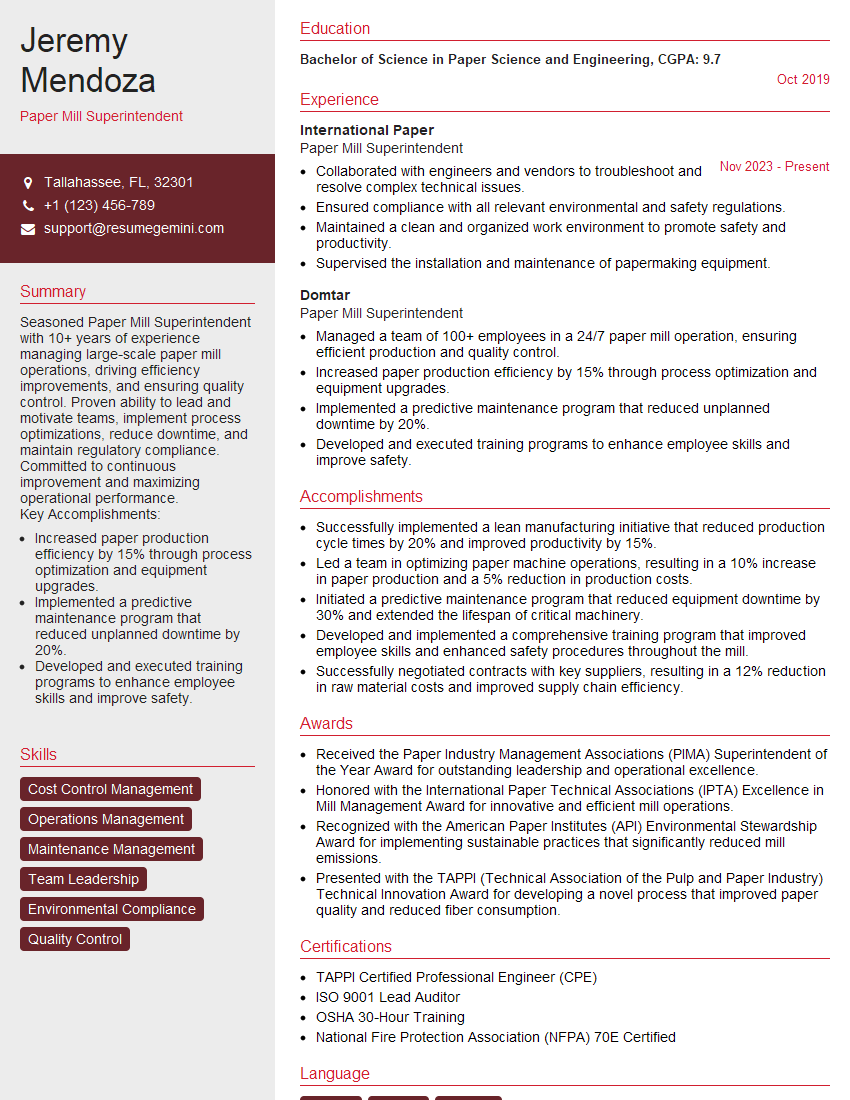
Mastering Paper opens doors to exciting opportunities in a rapidly evolving technological landscape. Demonstrating proficiency in Paper significantly enhances your career prospects across various roles. To maximize your chances, invest time in creating a compelling and ATS-friendly resume that showcases your skills effectively. ResumeGemini is a trusted resource that can help you build a professional resume tailored to highlight your Paper expertise. Examples of resumes optimized for Paper applications are available to guide you.
Explore more articles
Users Rating of Our Blogs
Share Your Experience
We value your feedback! Please rate our content and share your thoughts (optional).
What Readers Say About Our Blog
Very informative content, great job.
good