Cracking a skill-specific interview, like one for Parachute Packing and Rigging, requires understanding the nuances of the role. In this blog, we present the questions you’re most likely to encounter, along with insights into how to answer them effectively. Let’s ensure you’re ready to make a strong impression.
Questions Asked in Parachute Packing and Rigging Interview
Q 1. Explain the different types of parachute canopies and their applications.
Parachute canopies come in various shapes and sizes, each designed for specific applications. The most common types are round, square (ram-air), and parafoil.
- Round parachutes: These are the simplest and most reliable type. Their large surface area creates a high drag, resulting in a slow descent rate. They’re primarily used for emergency situations, cargo drops, and training purposes. Think of them as the classic ‘mushroom’ shape you see in movies.
- Square or Ram-air parachutes: These canopies are more aerodynamic and offer greater maneuverability compared to round parachutes. Air enters vents at the front and inflates the canopy, creating a more stable and controlled descent. They’re frequently used in skydiving, BASE jumping, and precision cargo delivery, allowing for more controlled landings.
- Parafoil parachutes: These are highly maneuverable, wing-shaped canopies. Their design allows for precise steering and control during descent. These are commonly seen in paragliding, aerial photography, and some military applications.
The choice of canopy depends on factors like intended use, required descent rate, and desired maneuverability. For example, an emergency parachute needs to be reliable above all else, prioritizing a slow, safe descent, while a skydiving parachute needs to be maneuverable to enable accurate landings.
Q 2. Describe the proper procedure for packing a round parachute.
Packing a round parachute is a meticulous process that demands precision and attention to detail. A poorly packed round parachute can result in a malfunction during deployment, potentially leading to serious injury or fatality. Here’s a simplified overview; always refer to the manufacturer’s instructions:
- Laying out the canopy: Spread the canopy evenly on a clean, flat surface, ensuring no lines are twisted or tangled.
- Bridle and risers: Neatly fold the bridle and risers, ensuring they are centered and aligned.
- Folding the canopy: Begin by folding the canopy in a specific, consistent pattern (this varies based on the parachute’s design; refer to the manufacturer’s instructions). The goal is to create a compact, tightly-packed bundle. This usually involves a series of accordion-style folds.
- Placing into the container: Carefully place the folded canopy into the parachute container, ensuring it is snug and evenly distributed.
- Securing the pack: Secure the packed parachute using the container’s closing mechanism; this is often a series of straps and buckles. Ensure it’s firmly closed and sealed.
- Final inspection: Before sealing the container, conduct a thorough visual inspection for any signs of loose lines, wrinkles, or other irregularities.
Remember, proper training is crucial for packing round parachutes. Improper packing can have fatal consequences.
Q 3. Detail the steps involved in packing a square parachute.
Packing a square parachute is significantly more complex than packing a round parachute due to its more intricate design and the need to maintain the airflow dynamics. It requires specialized training and a thorough understanding of the canopy’s construction. The process, while varying slightly based on the specific canopy design, generally includes these steps:
- Pre-flight inspection: Thoroughly check the canopy for any damage or wear and tear.
- Laying out the canopy: Carefully lay out the canopy ensuring it’s free of wrinkles or twists.
- Line organization: Organize the suspension lines and carefully gather them together according to the manufacturer’s guidelines. This needs to be done systematically to avoid tangles.
- Folding the canopy: Square canopies involve a more systematic and often complex folding technique designed to ensure the canopy deploys correctly. Often involves specific folding patterns to create a compact pack while avoiding line twists.
- Bridle and riser attachment: Secure the bridle and risers to the folded canopy as specified by the manufacturer.
- Packing into the container: Carefully place the folded canopy into the container, ensuring the pack is even and dense.
- Securing the pack: Seal the container, verifying the straps and buckles are secure.
- Final inspection: A final visual inspection is essential before the parachute is considered ready for use. Ensure proper placement, no twists or damage, and no loose lines.
Incorrect packing of a square parachute can lead to malfunctions during deployment, including collapses, twists, or asymmetric inflation, resulting in dangerous and uncontrolled descents. Never attempt to pack a square parachute without proper training.
Q 4. What are the critical safety checks performed before and after parachute packing?
Safety checks are paramount in parachute packing and rigging. Before packing, a thorough inspection of the canopy, lines, risers, and container is mandatory. This includes checking for:
- Canopy damage: Holes, tears, cuts, or abrasion.
- Line wear and tear: Fraying, chafing, or broken strands.
- Risers: Damage or wear.
- Hardware: Corrosion, damage, or improper function of carabiners, buckles, and other hardware.
- Container integrity: Damage to the container itself, ensuring straps and closures are functional.
After packing, a final visual inspection is performed to ensure the parachute is correctly packed and the container is securely sealed. This includes verifying the pack is free of wrinkles or irregularities.
Documentation of all inspections is crucial, as it provides traceability in case of an incident. Any damage identified should be thoroughly documented and appropriately addressed before further use. Think of these inspections as a pre-flight checklist for an airplane, critical for ensuring safety.
Q 5. How do you identify and address damaged parachute components?
Identifying and addressing damaged parachute components requires a trained eye and adherence to strict protocols. Any suspected damage should be treated with utmost seriousness. Damage can range from minor wear to significant tears or breaks.
- Visual inspection: This is the first and most important step. Closely examine the canopy for holes, tears, cuts, or abrasion. Inspect lines for fraying, chafing, or broken strands. Check risers and all hardware for any signs of wear or damage.
- Testing: Some damage may require specialized testing to evaluate the structural integrity.
- Repair or Replacement: Minor damage can sometimes be repaired by a qualified rigger, however, extensive damage generally necessitates replacement of the affected component, often the entire canopy.
- Documentation: Every instance of damage, repair, or replacement must be meticulously documented, including the nature of the damage, the repair method (if any), and any component replacements.
Example: If a small tear is discovered in the canopy, a qualified rigger will assess if it can be repaired using appropriate materials and techniques. However, a significant tear, especially near the seams, would almost certainly necessitate canopy replacement to ensure safety.
Q 6. Explain the importance of maintaining accurate parachute packing records.
Maintaining accurate parachute packing records is crucial for ensuring safety and liability. These records provide a complete history of the parachute, including its packing, inspections, and any repairs or replacements. This information is invaluable for several reasons:
- Traceability: In case of an incident, detailed records enable investigators to trace the parachute’s history, identify potential causes, and improve safety procedures.
- Maintenance tracking: Records help track the parachute’s lifespan and identify any patterns in wear and tear. This allows for proactive maintenance and replacement, avoiding potential failures.
- Liability: Accurate records can be critical in determining liability in case of accidents.
- Compliance: Many regulatory bodies mandate detailed parachute packing and maintenance records for safety compliance.
These records typically include the date of packing, the packer’s identification, the parachute’s serial number, inspection results, and any repairs or replacements. Imagine a medical chart; parachute records are just as critical in tracking the equipment’s health and history.
Q 7. Describe the process of inspecting suspension lines for wear and tear.
Inspecting suspension lines for wear and tear is a critical safety check. Suspension lines are crucial components that connect the parachute canopy to the harness. Damage to these lines can compromise the parachute’s performance and lead to accidents.
The inspection involves:
- Visual inspection: Carefully examine each line for any signs of fraying, chafing, cuts, or broken strands. Pay close attention to areas where the lines are subject to high stress or friction, such as near the canopy, the bridle, and attachment points.
- Tactile inspection: Run your fingers along each line to detect any areas of unusual softness or stiffness, which could indicate internal damage.
- Stress testing (if applicable): In some cases, specialized stress tests may be performed to assess the line’s strength and integrity.
- Documentation: Any damage or wear should be meticulously documented, including the line’s identification and the nature of the damage.
Any damaged line should be immediately replaced. Never compromise on the integrity of suspension lines; their condition is directly related to the safety of the parachute system.
Q 8. What are the common causes of parachute malfunctions, and how can they be prevented?
Parachute malfunctions, thankfully rare with proper care, stem from several sources. The most common are packing errors, such as incorrect bridle placement or line twists, which can lead to canopy collapse or partial openings. Damaged or worn components, including the canopy itself, suspension lines, or risers, also pose significant risks. Environmental factors like strong winds or extreme temperatures can exacerbate existing weaknesses. Finally, improper deployment techniques can result in a difficult or incomplete opening.
Prevention hinges on meticulous attention to detail. Rigorous training in proper packing techniques, emphasizing visual inspections and consistent procedures, is crucial. Regular equipment maintenance, including canopy inspections for tears, wear, and fraying, and line checks for damage or weakness, is paramount. A thorough pre-jump check, verifying the integrity of the entire system, from harness to main and reserve parachutes, is absolutely essential before every jump. Proper understanding and application of emergency procedures is also a vital preventative measure.
- Example: A poorly packed main parachute might result in a twisted canopy, leading to a partial opening and a potentially dangerous situation. Regular inspections and proper packing techniques prevent this.
- Example: A worn suspension line, weakened by UV exposure and repeated use, may snap during deployment, resulting in canopy failure. Regular line inspections and replacement according to manufacturer recommendations are essential.
Q 9. How do you handle a situation where a packed parachute shows signs of damage?
Discovering damage on a packed parachute is a serious matter requiring immediate action. Never attempt to use a damaged parachute. The parachute must be immediately removed from service and carefully examined by a qualified parachute rigger.
The rigger will assess the extent of the damage, determining whether repair is feasible or if the parachute needs to be replaced. Depending on the nature of the damage, this might involve microscopic inspection of fabric or a thorough assessment of the entire suspension line system. Documentation of the damage and the rigger’s assessment is essential. Any parachute deemed unusable should be marked accordingly and appropriately disposed of to avoid accidental reuse.
Think of it like this: you wouldn’t fly in a plane with a known engine problem. Similarly, you wouldn’t jump with a parachute exhibiting any signs of damage. Safety is paramount, and immediate action is critical.
Q 10. Explain the significance of proper harness fitting and adjustment.
Proper harness fitting and adjustment are fundamental to safety and comfort during a jump. An ill-fitting harness can restrict movement, cause discomfort, or even lead to serious injury in an emergency.
A correctly fitted harness provides secure attachment of the parachute to the jumper while allowing for freedom of movement. Adjustments are crucial to ensure the harness snugly fits the individual’s body without excessive tightness or looseness. The leg straps, chest strap, and shoulder straps should be adjusted to ensure a secure and comfortable fit. This prevents the harness from shifting during freefall or landing, which could result in significant injury or even equipment malfunction.
Imagine a seatbelt in a car – too loose, and it’s ineffective; too tight, and it’s uncomfortable and potentially dangerous. The same principle applies to a parachute harness. A proper fit is essential for both safety and comfort.
Q 11. What are the different types of parachute reserve systems?
Reserve parachute systems are designed to provide backup in case of main parachute malfunction. Several types exist, each with its own features and deployment mechanisms. The most common are:
- Pilot chute reserve systems: These utilize a small pilot chute to help deploy the reserve. They are common and relatively simple.
- Automatic activation devices (AADs): These electronic devices automatically deploy the reserve parachute if certain parameters, such as altitude and rate of descent, indicate a malfunction. AADs are becoming increasingly common, offering an added layer of safety.
- Manual reserve systems: These require manual deployment by the jumper using a handle or a similar release mechanism. They require training and quick reaction time in emergency situations.
The choice of reserve system depends on factors such as the jumper’s experience level, the type of jumping being performed, and personal preference. However, regular maintenance and inspections are critical for all reserve parachute systems.
Q 12. Describe the procedure for deploying and recovering a parachute after a jump.
Parachute deployment and recovery procedures vary depending on the type of parachute and the situation. However, the general steps are as follows:
- Deployment: For a main parachute, this involves pulling the ripcord, allowing the parachute to fully inflate. For a reserve parachute, the deployment method depends on the system – manual or automatic.
- Freefall: During freefall, the jumper must maintain stability and control.
- Canopy flight: Once the parachute is deployed, the jumper must steer and control the canopy towards a safe landing area.
- Landing: The jumper must perform a controlled landing, minimizing impact.
- Recovery: After landing, the parachute should be carefully packed and inspected. Damaged components should be noted and the parachute should not be reused until it has been inspected and repaired by a qualified rigger.
Every jump should involve pre-flight checks and post-flight inspections to ensure safe operation and maintenance of equipment. This is non-negotiable for safety and liability reasons.
Q 13. What are the legal and regulatory requirements for parachute packing and rigging?
Legal and regulatory requirements for parachute packing and rigging vary by country and region. However, common themes include:
- Licensing and certification: Riggers must hold valid licenses or certifications demonstrating their proficiency and competency in parachute packing and maintenance. These certifications are issued by regulating bodies after rigorous testing and proving experience and knowledge.
- Regular inspections: Parachutes and related equipment are subject to regular inspections to ensure they meet safety standards. These inspections usually follow a strict schedule based on usage or time.
- Record keeping: Detailed records must be kept of all parachute packing and maintenance activities, including the date of packing, the rigger’s identification, and any noted repairs or damages. This helps maintain a clear audit trail of equipment history.
- Compliance with standards: Packing and rigging must adhere to established standards and guidelines set by relevant aviation or sporting authorities. These standards cover packing procedures, equipment maintenance and material specifications.
Failing to comply with these regulations can result in serious penalties, including suspension of licenses, fines, or even criminal charges in cases of negligence leading to injury or death.
Q 14. Explain the role of the reserve parachute in emergency situations.
The reserve parachute serves as a critical safety backup in case the main parachute malfunctions or fails to deploy correctly. In emergency situations, the reserve parachute provides a crucial means of safe descent.
Imagine the reserve parachute as the ultimate safety net. If the main parachute fails, the reserve offers a second chance at a safe landing. The successful deployment and operation of the reserve parachute are essential for the jumper’s survival. For this reason, reserve parachutes are subject to stringent maintenance requirements and regular inspections. Regular checks and proper packing are essential to ensuring the reserve is ready for deployment in case of emergency.
Q 15. How do you identify and rectify malfunctions in the parachute deployment system?
Identifying malfunctions in a parachute deployment system requires a systematic approach. It begins with a thorough pre-flight inspection, visually checking all components for damage, wear, and proper assembly. This includes examining the main parachute canopy for tears, holes, or fraying; the reserve parachute for similar defects; the deployment system (including bridle, pilot chute, and container) for any signs of wear or damage to the stitching, hardware, or deployment mechanisms; and the harness for any chafing, cuts, or loose stitching.
If a malfunction is suspected, a more detailed examination is necessary. This may involve using specialized tools to test the strength of stitching, inspect the integrity of the deployment bag, and check the functioning of the release mechanisms. For example, I might use a tensiometer to measure the strength of the suspension lines. If a problem is found, the affected component needs to be replaced or repaired according to the manufacturer’s specifications and using only certified materials. Documentation of all inspections and repairs is crucial for maintaining a safety record.
Imagine finding a small snag in the main canopy. Instead of ignoring it, I’d carefully assess its severity. If it’s minor, a qualified rigger might be able to repair it; however, if the tear is significant, the canopy must be replaced. Any doubt about the integrity of the system leads to immediate replacement of the problematic part, guaranteeing safety.
Career Expert Tips:
- Ace those interviews! Prepare effectively by reviewing the Top 50 Most Common Interview Questions on ResumeGemini.
- Navigate your job search with confidence! Explore a wide range of Career Tips on ResumeGemini. Learn about common challenges and recommendations to overcome them.
- Craft the perfect resume! Master the Art of Resume Writing with ResumeGemini’s guide. Showcase your unique qualifications and achievements effectively.
- Don’t miss out on holiday savings! Build your dream resume with ResumeGemini’s ATS optimized templates.
Q 16. What are the potential risks associated with improperly packed parachutes?
Improperly packed parachutes pose significant risks, potentially leading to catastrophic consequences. The most serious risk is a malfunction during deployment. This could involve a complete failure to deploy, a partial deployment (such as a line-over), or a delayed deployment, all resulting in a potentially fatal fall. A poorly packed parachute is also more susceptible to entanglement, which can further impede deployment or lead to a difficult landing.
For example, a main parachute packed with twists or improperly stowed lines could result in the canopy not fully inflating, leading to a low-altitude deployment and a potentially fatal impact. Similarly, a reserve parachute improperly packed could fail to deploy even after a main parachute malfunction. A seemingly minor error during packing—like not properly seating the canopy in the pack—can have devastating effects. Therefore, rigorous adherence to established packing procedures is paramount to ensure parachute safety.
Q 17. Describe your experience working with different types of parachute materials.
My experience encompasses a wide range of parachute materials, from traditional nylon and ripstop nylon to more advanced materials like high-tenacity nylon and specialized coatings. Each material has its own unique properties—strength, weight, porosity, resistance to abrasion, and susceptibility to UV degradation—which influence its suitability for various parachute applications. Nylon is a common material due to its strength-to-weight ratio and durability, but higher-tenacity nylon provides improved strength for high-performance parachutes. Different coatings enhance the material’s water resistance, UV resistance, or other specific characteristics.
For example, I’ve worked extensively with ripstop nylon, a woven fabric with reinforced threads that prevent tears from spreading. This material is ideal for many general-purpose parachutes. However, for specialized applications like high-altitude parachutes or those subjected to extreme stresses, I’ve also used materials with specific treatments to enhance their lifespan and performance under harsh conditions. My experience includes evaluating and selecting the best material based on intended use, environmental conditions, and performance requirements. The selection process is carefully documented to maintain traceability and ensure quality.
Q 18. Explain the importance of maintaining a clean and organized work environment.
Maintaining a clean and organized work environment is absolutely critical for safe and efficient parachute packing and rigging. A cluttered workspace increases the risk of errors, as essential components can be easily overlooked or misplaced. This not only impacts the quality of the packing but also poses significant safety hazards. Foreign objects in the parachute can cause malfunctions during deployment. Moreover, a well-organized workspace promotes a more focused and meticulous approach, reducing the likelihood of mistakes.
For instance, I always ensure my work area is free of loose threads, debris, and other materials. Components are meticulously organized, and each step of the packing process is performed in a designated area. This attention to detail ensures that all parts are accounted for, contributing to a consistently high level of quality and safety. A clean and organized workspace contributes to a safer and more efficient working environment, ultimately enhancing the reliability and safety of the parachutes we pack.
Q 19. How do you stay current with the latest advancements in parachute technology?
Staying current with advancements in parachute technology is an ongoing commitment. I regularly attend industry conferences and workshops, participate in continuing education courses, and actively read industry publications and technical journals. I also maintain close relationships with manufacturers and other experts in the field, exchanging knowledge and discussing the latest innovations.
Specifically, I focus on updates related to new materials, canopy designs, deployment systems, and safety regulations. For example, I’ve recently been studying advancements in para-commando parachutes and the use of new high-strength lightweight materials. Staying informed about these advancements is essential for maintaining a high level of proficiency and ensuring that I’m using the best and safest techniques and materials in my work.
Q 20. Describe your experience troubleshooting parachute equipment malfunctions.
Troubleshooting parachute equipment malfunctions requires a methodical approach. It starts with a careful examination of the system to identify the source of the problem. This often involves a visual inspection followed by more detailed checks, including strength testing of components and functionality tests of the deployment mechanisms. I systematically eliminate possibilities until I pinpoint the root cause. Detailed records are essential for tracking the troubleshooting process and ensuring a proper resolution.
For example, I once encountered a reserve parachute that wouldn’t deploy correctly due to a jammed release mechanism. After a thorough inspection, I determined that a small piece of debris was obstructing the mechanism. Carefully removing the obstruction solved the issue. Other problems might involve replacing damaged lines, repairing tears in the canopy, or addressing problems with the deployment bag. Each situation calls for a careful analysis and the application of appropriate repair techniques.
Q 21. What are the signs of wear and tear on parachute components?
Recognizing signs of wear and tear on parachute components is critical for ensuring safety. This involves regular inspections looking for several key indicators. On the canopy, look for tears, abrasion, holes, UV degradation (indicated by discoloration or stiffening), and signs of chemical damage. Suspension lines should be checked for fraying, breakage, or weakening. The bridle and pilot chute should be examined for similar signs of damage. Hardware, such as rings and buckles, should be inspected for cracking or deformation. Stitching should be carefully examined for looseness or broken threads.
For example, noticing a small tear or a weakened section of stitching might seem insignificant, but ignoring it could lead to catastrophic failure. A small abrasion might grow into a larger tear over time. Any sign of wear exceeding acceptable limits—as defined by manufacturers or regulatory bodies—should lead to immediate replacement of the affected component. Regular and careful inspections are essential to detect problems before they lead to accidents.
Q 22. How do you ensure the proper functioning of the pilot chute system?
Ensuring a pilot chute system functions correctly is paramount to a safe parachute deployment. The pilot chute is the small parachute that initially deploys, pulling out the main parachute. Its proper functioning hinges on several key factors:
- Regular Inspection: Before every jump, I meticulously inspect the pilot chute for any signs of wear and tear, including fraying lines, damaged fabric, or improper bridle attachment. I look for anything that might compromise its deployment.
- Deployment Sequence: The pilot chute’s deployment relies on a smooth and efficient sequence. I ensure the pilot chute container is correctly packed and properly secured within the main container, preventing snags or premature deployment. I also check the deployment bag’s integrity to make sure it’s not compromised.
- Line Tension: The pilot chute lines must be correctly tensioned to ensure proper inflation. Over-tensioning can lead to line breakage, while under-tensioning can result in a failed deployment. I use established techniques to properly tension the lines during packing.
- Container Integrity: The pilot chute container itself needs to be in perfect working order. I look for any signs of damage or stress points that could compromise its ability to deploy the chute smoothly and reliably.
For example, during a recent inspection, I discovered a small tear in the pilot chute’s fabric. This seemingly minor defect could have led to a catastrophic failure, so I replaced the pilot chute immediately. This highlights the importance of proactive and thorough inspections.
Q 23. What are the different types of parachute malfunctions and their consequences?
Parachute malfunctions can range from minor inconveniences to life-threatening situations. Understanding these malfunctions and their consequences is crucial for safety. Here are some examples:
- Main Canopy Malfunctions: These include line twists, which can cause uncontrolled spinning; partial or complete collapses, potentially leading to a hard landing; and malfunctions of the steerable controls, which impact landing precision. The consequences can range from a difficult landing to severe injury.
- Reserve Malfunctions: Though less frequent than main canopy malfunctions, reserve malfunctions are exceptionally serious. These include delayed or failed deployment, canopy malfunctions, or bridle entanglement. The consequences can be devastating.
- Pilot Chute Malfunctions: As previously discussed, pilot chute malfunctions can prevent the main parachute from deploying. This leads to a rapid descent and a high-impact landing with potentially fatal results.
- Equipment Malfunctions: These are problems with the container, including faulty zippers, broken seams, or a malfunctioning deployment system. Any of these could prevent the parachute from deploying properly.
Imagine a scenario where a line twist occurs during a jump. The jumper might experience rapid uncontrolled spinning, making a safe landing challenging. Understanding these potential problems and having emergency procedures in place is vital for safe skydiving.
Q 24. Describe your experience with different types of parachute containers.
My experience encompasses a wide variety of parachute containers, each designed for specific parachute types and operational needs. I’ve worked with:
- Round parachutes: These older designs are simpler in construction, usually housed in straightforward rectangular or cylindrical containers. Packing is relatively straightforward but requires precision to avoid line twists.
- Ram-air parachutes: These high-performance canopies demand more sophisticated containers designed to protect the delicate fabric and maintain its aerodynamics. They often utilize specialized packing techniques to prevent damage.
- Reserve parachutes: Reserve containers are built to be exceptionally rugged and reliable, often employing redundant safety features. Their packing involves meticulous attention to detail to guarantee deployment in any emergency situation. I’m proficient in packing both round and square reserve canopies.
- Different Materials: I have experience working with various container materials, including nylon, ripstop nylon, and other high-tenacity fabrics, understanding how each material ages and requires maintenance.
One memorable experience involved working with a rare, antique round parachute. Its container was made of heavy canvas, and the packing technique differed significantly from modern methods. This experience expanded my knowledge base and solidified my understanding of the evolution of parachute containers.
Q 25. How do you handle emergencies during parachute packing or maintenance?
Handling emergencies during parachute packing or maintenance requires a calm, methodical approach and strict adherence to safety protocols. My response depends on the nature of the emergency:
- Packing Errors: If I discover a packing error, I immediately stop work and rectify the problem. This might involve completely repacking the parachute, or if the problem cannot be solved, the parachute is removed from service.
- Damaged Equipment: Any damage to the parachute or container is documented, and the parachute is immediately removed from service. The extent of the damage determines whether repair is possible or if a replacement is necessary.
- Personal Injury: In the event of a personal injury, first aid is administered, emergency services are contacted, and a thorough investigation into the cause is undertaken. This involves complete documentation of the incident, along with any necessary equipment inspections.
I have personally dealt with an instance where I found a critical flaw in a reserve parachute container during a routine inspection. My immediate action ensured that this potentially life-threatening issue was resolved before the parachute was used. This underscores my commitment to proactive safety management.
Q 26. Describe your experience with parachute packing quality control procedures.
Quality control in parachute packing is non-negotiable. My experience includes implementing and adhering to rigorous procedures ensuring the highest safety standards. These procedures typically include:
- Visual Inspection: A thorough visual inspection of the parachute canopy, lines, and container for any defects is the first step. This is meticulously performed before, during, and after packing.
- Line Count and Bridle Check: Each line is carefully counted and its attachment points verified to ensure no lines are missing or improperly attached. The bridle is also examined for proper alignment and tension.
- Deployment System Check: The functionality of the pilot chute and main deployment system is rigorously tested to ensure seamless and reliable deployment.
- Documentation: Each packing is meticulously documented, including the date, time, packer’s signature, and any observed discrepancies. This allows for traceability and accountability.
- Random Inspections: Regular random inspections of packed parachutes by experienced personnel further reinforce quality control measures.
I adhere to a strict ‘zero tolerance’ policy for defects and errors. If I find a single error, no matter how minor, it results in the rejection and repacking of the parachute. This rigorous approach reflects my commitment to safety and risk mitigation.
Q 27. What is your experience with different parachute deployment methods?
My experience encompasses various parachute deployment methods, each suited to different types of parachutes and operational contexts:
- Manual Deployment: This classic method involves deploying the parachute manually using a rip cord. It requires proper training and skill to ensure a consistent deployment.
- Automatic Activation Devices (AADs): AADs are sophisticated electronic devices that automatically deploy the reserve parachute if certain altitude and rate-of-descent thresholds are exceeded. This technology offers an additional safety layer, particularly in emergencies.
- Static Line Deployment: Used primarily in training, static line deployment involves a line connecting the parachute to the aircraft, deploying the parachute upon exit.
- Freefall Deployment: This method involves deploying the parachute after a period of freefall. This demands precise timing and judgment from the skydiver.
For instance, during a training session, I demonstrated the proper use and maintenance of an AAD, explaining its critical role in preventing accidents in cases of malfunction. I believe in a multi-layered approach to parachute deployment, combining both manual skill and automatic safety measures.
Q 28. How would you handle a situation where you disagree with a superior regarding safety protocols?
Safety is paramount in my profession, and I would never compromise on established protocols. If I disagree with a superior regarding safety protocols, I would follow a structured approach:
- Private Discussion: I would first address my concerns directly with my superior in a private setting, clearly explaining my rationale using factual evidence and established safety standards. I’d aim for a collaborative discussion to find a mutually acceptable solution.
- Documentation: I would document my concerns, including the date, time, individuals involved, and the specific details of the disagreement. This serves as a record and protects both myself and the organization.
- Escalation: If my concerns remain unaddressed, I would escalate the issue to the next level of management, adhering to the organization’s chain of command. I would be prepared to present a detailed case explaining the potential safety risks and propose alternative solutions.
- Whistleblowing (if necessary): As a last resort, and only if serious safety concerns remain unresolved despite my efforts, I would consider reporting the issue through appropriate channels (possibly an external safety authority) to ensure the safety of those involved.
My primary concern would always be the safety of the individuals involved. I believe in proactive risk management and would not hesitate to take the necessary steps to ensure appropriate safety protocols are followed.
Key Topics to Learn for Parachute Packing and Rigging Interview
- Parachute Types and Components: Understanding the different types of parachutes (round, square, ram-air), their components (canopy, lines, harness, reserve), and their specific functions is crucial. This includes knowing the limitations and capabilities of each type.
- Packing Procedures: Mastering the precise and methodical steps involved in packing various parachute types. This includes understanding the importance of proper tension, wrinkle-free deployment, and consistent techniques to ensure reliable performance.
- Rigging Techniques and Procedures: Gain a comprehensive understanding of the process of assembling, inspecting, and maintaining parachute systems. This involves knowledge of different rigging methods, line lengths, and safety checks.
- Safety Regulations and Procedures: Familiarity with industry safety standards, regulations, and best practices is paramount. This includes understanding pre-flight inspections, post-flight procedures, and emergency protocols.
- Troubleshooting and Problem Solving: The ability to identify and resolve potential issues with parachutes and rigging is vital. This includes understanding common problems, their causes, and effective solutions.
- Materials Science and Aerodynamics: A foundational understanding of the materials used in parachute construction and the aerodynamic principles governing their function will demonstrate a deeper level of expertise.
- Maintenance and Repair: Knowing how to perform routine maintenance, identify damage, and execute necessary repairs will showcase your practical skills and commitment to safety.
Next Steps
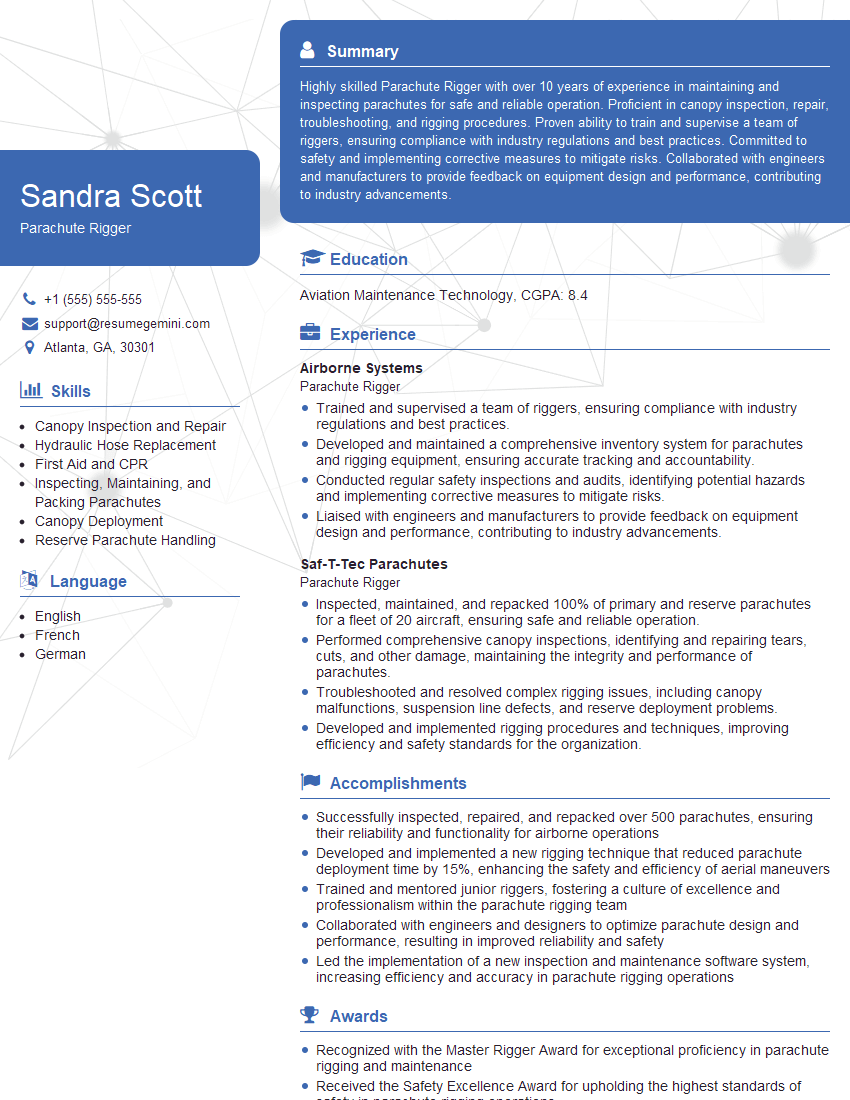
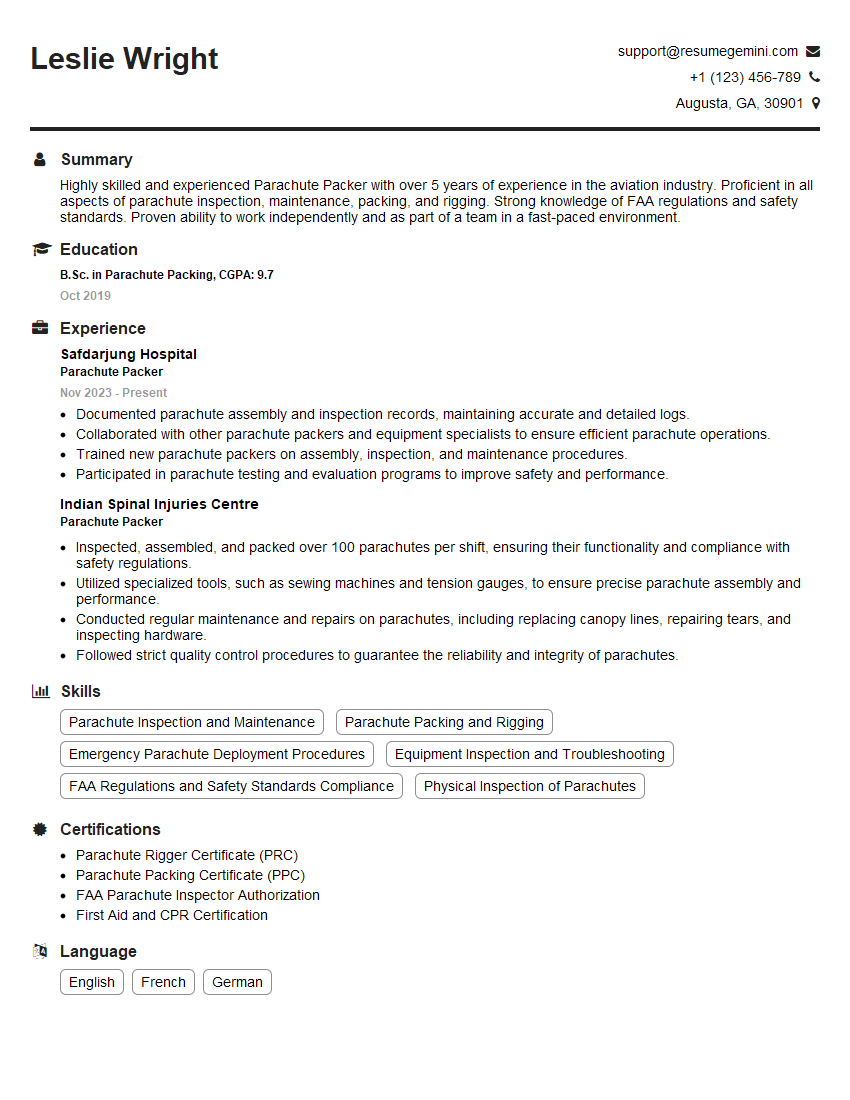
Mastering Parachute Packing and Rigging opens doors to rewarding careers in aviation, military operations, and specialized industries. A strong foundation in these skills demonstrates commitment to safety and precision, essential qualities highly valued by employers. To significantly boost your job prospects, creating a professional and ATS-friendly resume is vital. ResumeGemini is a trusted resource to help you build a compelling resume that showcases your skills and experience effectively. We provide examples of resumes tailored to the Parachute Packing and Rigging field to help you get started.
Explore more articles
Users Rating of Our Blogs
Share Your Experience
We value your feedback! Please rate our content and share your thoughts (optional).
What Readers Say About Our Blog
Very informative content, great job.
good