Unlock your full potential by mastering the most common Parking Citation Management interview questions. This blog offers a deep dive into the critical topics, ensuring you’re not only prepared to answer but to excel. With these insights, you’ll approach your interview with clarity and confidence.
Questions Asked in Parking Citation Management Interview
Q 1. Explain the process of issuing a parking citation.
Issuing a parking citation involves a systematic process designed to ensure fairness and accuracy. It typically begins with a parking enforcement officer observing a vehicle violating a parking regulation. This could be anything from exceeding the time limit in a designated parking spot to parking in a no-parking zone. The officer then verifies the violation, noting the specific infraction, location, time, date, and license plate number. They’ll often use a handheld device or mobile app to record this information, which automatically generates a citation.
Next, the citation is printed, usually containing a unique citation number, a description of the violation, the location, date, time, applicable fine amount, and instructions on how to pay or appeal. Finally, the citation is affixed to the vehicle’s windshield in a clearly visible location. The entire process is documented, including photographic evidence in some cases, ensuring accountability and minimizing disputes.
For example, imagine a car parked in a loading zone for over 15 minutes. The officer would note the violation, record the details, and generate a citation showing the specific infraction (parking in loading zone), the time and duration of the violation, the location, and the relevant fine. This detailed record ensures the process is transparent and easily auditable.
Q 2. Describe your experience with different types of parking violations.
Throughout my career, I’ve encountered a wide range of parking violations. Some of the most common include exceeding time limits in metered or permit-only spaces, parking in handicapped spaces without proper permits, blocking fire hydrants or crosswalks, and parking in no-parking or tow-away zones.
More complex violations involve vehicles obstructing traffic flow, particularly in congested areas. I’ve also dealt with situations involving abandoned vehicles, requiring different procedures including notification and potential towing. Each violation demands a specific approach depending on the severity and local ordinances. For instance, parking in a handicapped spot without a permit carries a significantly higher fine than a simple meter violation because of its impact on accessibility. Understanding these nuances is critical for fair and consistent enforcement.
Q 3. How do you handle citizen disputes regarding parking citations?
Handling citizen disputes requires a calm, professional, and empathetic approach. The first step is carefully reviewing the citation and any supporting evidence, including photographs or officer’s notes. I listen attentively to the citizen’s concerns, focusing on understanding their perspective. Often, simple misunderstandings about parking regulations are the root cause of disputes. In these cases, clearly explaining the regulation and how it was violated usually resolves the issue.
However, some disputes may involve legitimate concerns, such as incorrect license plate information or evidence that the vehicle was not illegally parked. In such cases, I investigate thoroughly, potentially reviewing surveillance footage if available. If the dispute is substantiated, the citation can be dismissed or amended. If the citizen is still dissatisfied, they may be directed towards the official appeals process.
For example, I once dealt with a case where a driver claimed they had a valid parking permit but it was not visible on their dashboard. After confirming the permit’s validity through our system and checking the timing, we were able to resolve the matter favorably.
Q 4. What software or systems have you used for parking citation management?
My experience encompasses a variety of software and systems used for parking citation management. I’ve worked extensively with both proprietary and open-source solutions. These systems typically include features for citation generation, payment processing, data storage and retrieval, reporting and analytics, and integration with license plate recognition (LPR) technology.
Examples include systems that allow officers to input citation details on handheld devices, automatically generating a unique citation number and recording the violation details, geo-location, and timestamp. These systems often integrate with a central database for efficient data management and reporting. Other systems I have worked with include specialized software for managing appeals, generating reports on citation trends, and handling payments. Example System Name: ParkSmart Pro, CityZen Parking Enforcement
Q 5. How do you ensure the accuracy and integrity of parking citation data?
Maintaining the accuracy and integrity of parking citation data is paramount. This involves multiple layers of quality control. Firstly, the use of technology like LPR systems and handheld devices with GPS reduces human error in recording details like license plate numbers and locations. Secondly, regular system audits are performed to identify and correct any inconsistencies.
Thirdly, rigorous data validation procedures are in place to ensure data accuracy before entering it into the system. For example, the system may flag incorrect license plate formats or geographic inconsistencies. Data backups are crucial to prevent data loss. Furthermore, regular training for enforcement officers on data entry and procedures is essential to minimize errors. Finally, adhering to strict data privacy regulations is essential to protect citizen information.
Q 6. Describe your experience with parking citation appeals processes.
My experience with parking citation appeals processes involves a structured approach that ensures fairness and due process. Generally, a citizen can submit an appeal within a specified timeframe, typically providing evidence supporting their claim. This might include photographs, witness statements, or supporting documentation.
The appeal is then reviewed by a designated authority, who assesses the evidence provided against the original citation. Decisions are based on established guidelines and regulations. The citizen is informed of the decision in writing, and if the appeal is unsuccessful, they may have further options, such as escalating the matter to a higher authority or pursuing legal action. Transparency and a clear appeals procedure are crucial to maintain public trust and ensure the process is equitable.
Q 7. How do you maintain up-to-date knowledge of parking regulations?
Staying updated on parking regulations requires a multifaceted approach. I regularly review updated municipal codes and ordinances related to parking, paying particular attention to changes or amendments. I also attend relevant professional development workshops and conferences to stay abreast of industry best practices and legal updates.
Furthermore, I maintain subscriptions to relevant publications and online resources that provide insights into new technologies, legal precedents, and changes in parking enforcement practices. Networking with colleagues in the field allows for the exchange of information and experiences. This continuous learning ensures I can apply the most current and accurate information in my daily work.
Q 8. How do you prioritize and manage a high volume of parking citations?
Managing a high volume of parking citations requires a systematic approach. Think of it like a well-oiled machine; each part plays a crucial role. We prioritize citations based on several factors: urgency (e.g., citations associated with blocked emergency lanes are top priority), time-sensitivity (citations nearing appeal deadlines), and citation type (e.g., violations with higher fines processed first).
- Automated Workflow: We utilize a citation management system (CMS) that automatically sorts and categorizes citations based on predefined rules. This system flags overdue payments and nearing appeal deadlines.
- Team Specialization: Our team is divided into specialized units – processing, appeals, collections – allowing for efficient task allocation and expertise focus. This improves turnaround times and reduces errors.
- Performance Monitoring: Regular performance dashboards track key metrics like processing times, appeal rates, and collection rates. This data-driven approach enables us to identify bottlenecks and adjust workflows as needed. For example, if we see a spike in appeals related to a specific parking zone, we can investigate the signage or enforcement procedures.
Essentially, it’s about combining technology with a well-structured team and a continuous improvement mindset to ensure that even a large volume of citations gets processed efficiently and fairly.
Q 9. What strategies do you use to improve parking citation compliance?
Improving parking citation compliance is about making it easy to comply and difficult to avoid. It’s not about just issuing tickets; it’s about creating a culture of responsible parking.
- Clear Signage and Communication: This is fundamental. Ambiguous signage is a common source of disputes. We ensure clear, consistent signage at all locations. We also utilize multiple communication channels – website, mobile app, social media – to inform drivers about parking regulations.
- Fair and Consistent Enforcement: Consistent enforcement fosters trust and reduces the perception of arbitrary ticketing. We provide regular training to enforcement officers on procedures and best practices.
- Incentives and Education: We might offer discounted parking rates for permit holders, or run campaigns promoting responsible parking behavior through public service announcements. Education is key; many violations happen due to a lack of awareness.
- Technology Integration: Using apps that guide drivers to available parking spots, or a system that sends parking violation notifications via text message, can be very effective.
The goal is to create a system where compliance is the easiest, most convenient option for drivers.
Q 10. How do you ensure timely processing and payment of parking citations?
Timely processing and payment is critical for maintaining the integrity of the parking citation system. Delays can lead to disputes and revenue loss. We achieve this through a combination of automated processes and diligent monitoring.
- Automated Payment Systems: We offer multiple convenient payment options, including online portals, mobile apps, and payment kiosks, to minimize processing time and enhance user experience. Automated reminders are sent via email and text.
- Workflow Optimization: Our CMS automatically routes payments to the appropriate accounts and updates citation statuses. This minimizes manual intervention and reduces the likelihood of errors. The entire process, from issuing the citation to updating the system to show payment completion, is meticulously documented.
- Proactive Monitoring: We actively monitor payment processing times and identify potential bottlenecks or delays using system reports and dashboards. This allows for quick intervention and resolution of any issues.
- Escalation Procedures: For non-payments, we have a clearly defined escalation procedure, beginning with reminder notices and culminating in more stringent collection efforts if necessary. Each step is clearly documented to maintain accountability and transparency.
Ultimately, the goal is to streamline the entire payment process from beginning to end, making it as efficient as possible for both the driver and the municipality.
Q 11. Explain your experience with data analysis related to parking citations.
Data analysis plays a vital role in improving the efficiency and effectiveness of our parking citation management. We leverage data to understand trends, identify issues, and make data-driven decisions.
- Identifying High-Violation Areas: We analyze citation data geographically to identify areas with consistently high violation rates. This helps us assess whether additional signage, enforcement, or alternative parking solutions are needed.
- Analyzing Violation Types: We track the frequency of different violation types to understand the most common parking issues. This helps to prioritize enforcement efforts and public awareness campaigns.
- Assessing Collection Rates: We analyze payment data to identify trends in payment behavior and identify potential issues with the payment processing system or billing procedures. A low collection rate in a particular area might indicate a problem with payment options or lack of awareness among drivers.
- Measuring Enforcement Officer Performance: We use data to objectively evaluate the performance of our enforcement officers, not just in terms of the number of citations issued, but also in terms of accuracy and consistency.
By using sophisticated data analysis techniques, we can uncover patterns and insights that would be difficult, if not impossible, to detect manually. This evidence-based approach helps us to optimize our strategies and achieve better outcomes.
Q 12. How do you identify and address inefficiencies in the parking citation process?
Identifying and addressing inefficiencies is an ongoing process. We use a combination of data analysis, process mapping, and feedback mechanisms.
- Process Mapping: We regularly map out our citation processes to visually identify bottlenecks and areas for improvement. This includes reviewing the steps from issuing the citation to final payment. We use this to pinpoint areas where automation or streamlining might be beneficial.
- Data Analysis: We analyze key performance indicators (KPIs) like citation processing times, appeal rates, and payment processing times to pinpoint areas of slowdowns or high error rates.
- Feedback Mechanisms: We actively solicit feedback from our enforcement officers, administrative staff, and the public to identify pain points and areas for improvement. This could involve surveys, focus groups, or simply reviewing online comments and reviews.
- Technology Upgrades: We regularly evaluate new technologies and software to identify solutions that can automate tasks, reduce manual data entry, and improve overall efficiency. For example, upgrading to a new CMS with better reporting and analytics capabilities.
Continuous improvement is key; we treat efficiency improvements as an iterative process, constantly refining our processes and technology based on data and feedback.
Q 13. Describe your experience with parking citation reporting and analysis.
Parking citation reporting and analysis are crucial for transparency and accountability. We generate a variety of reports to track performance, identify trends, and inform decision-making.
- Regular Performance Reports: We generate daily, weekly, and monthly reports on key metrics like the number of citations issued, payment rates, and appeal rates. These reports are used to monitor performance and identify any areas of concern.
- Trend Analysis Reports: We use data analysis tools to identify trends and patterns in citation data, such as peak violation times and locations. This helps in allocating resources effectively.
- Financial Reports: We generate financial reports summarizing parking citation revenue, collection rates, and outstanding balances. This is vital for budgeting and resource allocation.
- Ad-hoc Reporting: We can generate custom reports to respond to specific inquiries or investigate specific issues. For example, a report might be created to examine the causes of a sudden increase in citations in a particular area.
Our reporting system is designed to be flexible and adaptable, allowing us to provide the information needed to make informed decisions and maintain transparency.
Q 14. How do you handle situations where a parking citation is issued in error?
Handling erroneously issued citations is crucial for maintaining fairness and public trust. Our process emphasizes a thorough review and transparent resolution.
- Appeal Process: We have a clear and accessible appeal process for drivers who believe a citation was issued in error. This process involves submitting an appeal form with supporting evidence.
- Internal Review: The appeal is reviewed internally by a designated team. This involves reviewing the evidence provided, including photos, officer notes, and any relevant parking regulations.
- Evidence-Based Decision: Decisions are based solely on the evidence presented and relevant regulations. If the evidence demonstrates the citation was issued in error, the citation is voided and the driver is notified.
- Communication: Drivers are notified of the decision in writing, regardless of the outcome. If the citation is voided, a clear explanation of the reasons is provided. If the appeal is denied, the reasoning is also explained clearly and options for further appeal are outlined (if applicable).
Our goal is to ensure a fair and transparent process, correcting errors swiftly and maintaining public confidence in our citation system. This fosters trust and encourages responsible parking habits.
Q 15. What metrics do you use to evaluate the effectiveness of parking citation management?
Evaluating the effectiveness of parking citation management involves analyzing several key metrics. We need to understand not just the volume of citations issued, but also their impact on parking availability, revenue generation, and overall compliance.
- Citation Issuance Rate: This metric tracks the number of citations issued per period (daily, weekly, monthly). A high rate might indicate a need for improved signage or enforcement strategies, while a low rate could suggest insufficient enforcement.
- Appeal Rate: A high appeal rate suggests potential issues with clarity of signage, fairness of enforcement, or accuracy of citation issuance. Analyzing the reasons for appeals helps identify areas for improvement.
- Collection Rate: This metric measures the percentage of citations for which payment has been received. A low collection rate indicates potential problems with payment processing, communication with violators, or the enforcement process itself.
- Parking Turnover Rate: Improved parking turnover, meaning more frequent changes in parked vehicles, suggests successful enforcement and increased parking availability for others. We can measure this through observation or using technology like license plate recognition systems.
- Revenue Generated: This is a crucial metric indicating the financial effectiveness of the parking citation system. This should be analyzed alongside operating costs to determine overall profitability.
For example, if our collection rate is consistently low (below 80%), we might investigate whether our payment options are convenient enough or if communication regarding outstanding citations could be improved. We might also examine whether there’s consistency in applying the ticketing rules amongst enforcement officers.
Career Expert Tips:
- Ace those interviews! Prepare effectively by reviewing the Top 50 Most Common Interview Questions on ResumeGemini.
- Navigate your job search with confidence! Explore a wide range of Career Tips on ResumeGemini. Learn about common challenges and recommendations to overcome them.
- Craft the perfect resume! Master the Art of Resume Writing with ResumeGemini’s guide. Showcase your unique qualifications and achievements effectively.
- Don’t miss out on holiday savings! Build your dream resume with ResumeGemini’s ATS optimized templates.
Q 16. Describe your experience with parking enforcement technology.
My experience with parking enforcement technology spans several years, encompassing both handheld devices and integrated systems. I’ve worked extensively with:
- Handheld Citation Writing Devices: These devices streamline the citation process, ensuring accurate data capture and reducing paperwork. They also allow for digital photo capture of violations, adding evidence to the citation.
- License Plate Recognition (LPR) Systems: LPR technology significantly enhances enforcement efficiency by automatically identifying vehicles violating parking regulations. This is especially useful for identifying repeat offenders and managing parking permits.
- Parking Management Software: I have expertise in using software that manages the entire citation lifecycle, from issuance to payment processing and data analysis. This includes features for managing parking permits, generating reports, and tracking key metrics.
- Mobile Payment Systems: Integrating mobile payment options improves convenience for citizens and enhances collection rates. We can track payment trends and address any issues promptly.
In one particular project, we implemented LPR cameras in a high-traffic downtown area. The result was a 25% increase in parking turnover and a significant reduction in long-term illegal parking, directly impacting the availability of parking spots for legitimate users. This technology allowed us to move from a largely reactive enforcement strategy to a more proactive, data-driven approach.
Q 17. How familiar are you with relevant state and local parking laws and regulations?
I possess a thorough understanding of state and local parking laws and regulations. My knowledge is continuously updated through professional development courses, legal updates, and regular review of relevant codes.
This understanding is critical to ensure that all citations are issued legally and fairly. I am particularly familiar with:
- Disabled parking regulations: These are strictly enforced, requiring a comprehensive understanding of permit types, accessibility standards, and appropriate enforcement procedures.
- Time limits and restrictions: This encompasses the various types of time limits (e.g., 15-minute, 2-hour), their specific locations, and exemptions.
- Permit requirements and regulations: A deep understanding of resident permits, business permits, and other types is necessary for accurate enforcement.
- Appeals processes: I am well-versed in the procedures for handling appeals, including reviewing evidence, applying relevant laws, and making fair decisions.
I understand that legal compliance is paramount in parking enforcement and ensure all actions adhere to the letter and spirit of the law.
Q 18. What is your experience with parking citation databases and record keeping?
My experience with parking citation databases and record-keeping is extensive. I’m proficient in using various database management systems (DBMS) to effectively manage and track citation information.
This includes:
- Data Entry and Management: Accurate and timely data entry is vital. This includes details of the violation, vehicle information, location, date, time, and the citation number itself.
- Data Integrity: Maintaining data integrity is crucial to ensure accuracy and prevent errors that could lead to legal challenges. Regular data cleansing and validation are part of this process.
- Reporting and Analytics: I can generate reports on citation issuance, collection rates, revenue, and other key metrics. These reports are vital for identifying trends and areas for improvement.
- Data Security and Compliance: Protecting sensitive personal data is of paramount importance. I understand and comply with data privacy regulations.
- Archiving and Retrieval: Efficiently archiving and retrieving citation records is important for legal purposes and for responding to inquiries.
I’ve used various systems including SQL and cloud-based databases for managing parking citation data, ensuring that the data is secure, accurate, and readily accessible when needed.
Q 19. Explain your experience with customer service related to parking citations.
Excellent customer service is crucial in parking citation management. It helps de-escalate potentially tense situations and fosters a more positive relationship between the enforcement agency and the public.
My experience includes:
- Handling Inquiries: I’m skilled at responding to inquiries about citations, providing clear and concise explanations of violations, appeal processes, and payment options.
- Addressing Complaints: I approach complaints with empathy and professionalism, investigating issues thoroughly and providing fair resolutions. This involves carefully reviewing evidence and applying relevant regulations.
- Explaining Regulations: I can clearly and patiently explain parking regulations to the public, helping to promote compliance and prevent future violations.
- Providing Payment Options: Offering various convenient payment options (online, mail, in-person) enhances customer satisfaction and improves collection rates.
- Managing Appeals: Handling appeals fairly and efficiently is essential. This includes reviewing all evidence and following established procedures.
I believe in treating every interaction as an opportunity to build trust and understanding, even when dealing with frustrated citizens. A calm and respectful approach often leads to more positive outcomes.
Q 20. How do you contribute to a positive work environment within a parking enforcement team?
Contributing to a positive work environment in a parking enforcement team requires a collaborative and supportive approach.
My contributions include:
- Teamwork and Collaboration: I actively participate in team meetings, sharing ideas and information to help improve overall efficiency and effectiveness. This includes sharing best practices, problem-solving, and mutual support.
- Open Communication: I encourage open and honest communication among team members, ensuring that everyone feels heard and valued. I actively listen to colleagues and provide constructive feedback.
- Mentorship and Support: I am always willing to mentor and support newer team members, helping them to develop their skills and knowledge. This contributes to a cohesive and supportive team environment.
- Positive Attitude: Maintaining a positive and professional attitude, even in challenging situations, helps create a more pleasant and productive work environment for everyone.
- Respectful Interactions: I treat all colleagues with respect and courtesy, fostering a culture of mutual appreciation and understanding.
I believe that a strong team is crucial for success in parking enforcement, and I strive to be a positive and contributing member.
Q 21. Describe your experience with training new employees on parking citation procedures.
Training new employees on parking citation procedures is a vital aspect of effective parking enforcement. My approach involves a structured program that combines theoretical knowledge with practical experience.
The training typically covers:
- Legal Framework: A thorough understanding of relevant state and local laws and regulations is paramount.
- Citation Issuance Procedures: This includes step-by-step guidance on accurately completing citations and capturing necessary evidence.
- Technology Use: Training on handheld devices, LPR systems, and parking management software is essential.
- Customer Service Skills: Effective communication and conflict resolution techniques are crucial when interacting with the public.
- Safety Procedures: Ensuring the safety of enforcement officers is critical. This covers situational awareness, de-escalation techniques, and reporting procedures.
- Practical Field Training: Shadowing experienced officers in the field allows new employees to apply their knowledge in real-world scenarios.
- Ongoing Mentorship: Providing continued support and guidance after the initial training ensures ongoing improvement.
I use a combination of classroom instruction, hands-on training, and role-playing exercises to make the training engaging and effective. This ensures that new employees are well-equipped to perform their duties professionally and competently.
Q 22. How do you balance enforcement with fairness and customer service?
Balancing enforcement with fairness and customer service in parking citation management is crucial for maintaining public trust and ensuring a smooth operation. It’s about creating a system that is both effective in deterring illegal parking and understanding and addressing the needs of drivers. This involves several key strategies:
- Clear and Consistent Communication: Using clear signage, readily available information on parking regulations, and easily understandable citation language minimizes confusion and potential disputes. For example, providing multiple language options on signs and citation notices improves accessibility for a diverse community.
- Fair and Consistent Enforcement: All parking officers should adhere to the same standards to prevent biased or arbitrary enforcement. This includes regular training on regulations and procedures and impartial review of any disputed citations. This ensures that citations are issued fairly and equally, regardless of the driver’s background or the location of the violation.
- Robust Appeals Process: A transparent and efficient appeals process allows drivers to challenge citations they believe are unfair or inaccurate. This process should be easily accessible and clearly outlined. For instance, an online portal for appeals, coupled with a clear timeline for processing, can increase efficiency and satisfaction.
- Empathy and Understanding: Parking officers should be trained to handle drivers with empathy and professionalism, even in situations where a citation is unavoidable. Explaining the reason for the citation calmly and clearly can mitigate frustration.
- Proactive Communication: Consider adding information about parking options and restrictions to city websites and mobile apps. This preventative measure can reduce citations issued due to driver misinformation.
Q 23. How do you maintain confidentiality when handling sensitive parking citation data?
Confidentiality of parking citation data is paramount, adhering to relevant privacy laws (like GDPR or CCPA, depending on location). Protecting this sensitive information requires a multi-layered approach:
- Data Encryption: All parking citation data, both in transit and at rest, should be encrypted using strong encryption algorithms. This prevents unauthorized access even if the data is intercepted.
- Access Control: Strict access control measures should be in place, limiting access to the data based on the need-to-know principle. Employees should only have access to the data necessary for their job functions. Role-based access control (RBAC) is an effective way to manage this.
- Secure Data Storage: Parking citation data should be stored on secure servers with robust security measures, such as firewalls and intrusion detection systems. Regular security audits and penetration testing should be conducted to identify and address vulnerabilities.
- Data Minimization: Only collect and retain necessary data. Unnecessary data should be purged regularly in accordance with data retention policies.
- Employee Training: Regular training should be provided to all employees handling parking citation data on the importance of confidentiality and the consequences of data breaches. This includes secure data handling practices and awareness of privacy regulations.
- Incident Response Plan: A comprehensive incident response plan should be in place to address data breaches or security incidents quickly and effectively. This plan should outline steps to contain the breach, notify affected individuals, and mitigate further damage.
Q 24. Describe your experience with budget management related to parking citation operations.
My experience with budget management in parking citation operations involves a deep understanding of both revenue projections and expenditure control. This includes:
- Revenue Forecasting: Developing accurate revenue forecasts based on historical data, anticipated growth, and seasonal variations. This involves analyzing trends in citation issuance and payment rates.
- Expense Budgeting: Creating detailed budgets for personnel costs (parking officers, administrative staff), technology (citation systems, software), and operational expenses (vehicle maintenance, supplies).
- Budget Monitoring and Control: Regularly monitoring actual expenses against the budgeted amounts, identifying variances, and taking corrective actions as needed. This may involve adjusting staffing levels, negotiating with vendors, or finding cost-saving measures.
- Performance Reporting: Preparing regular reports on budget performance, highlighting key metrics like citation issuance rates, collection rates, and cost per citation. This information informs strategic decision-making.
- Resource Allocation: Allocating resources effectively to maximize efficiency and achieve budget objectives. This may involve prioritizing investments in technology or training based on their impact on revenue generation or cost savings.
For example, in a previous role, I successfully implemented a new citation system that reduced operational costs by 15% while improving citation issuance and collection rates. This was achieved by carefully analyzing the existing system’s inefficiencies and selecting a cost-effective, yet efficient alternative.
Q 25. What is your experience with parking citation revenue tracking and reconciliation?
Accurate revenue tracking and reconciliation are fundamental to the financial health of any parking citation operation. My experience includes:
- Automated Systems: Implementing and managing automated systems for tracking citations issued, payments received, and outstanding balances. This minimizes manual errors and ensures data accuracy.
- Regular Reconciliation: Performing regular reconciliation of citation revenue against bank deposits and accounting records to identify any discrepancies or irregularities. This includes investigating and resolving any variances.
- Data Analysis: Analyzing revenue data to identify trends, seasonality, and potential revenue leakage. This helps in optimizing revenue collection strategies and improving forecasting accuracy.
- Reporting and Auditing: Generating accurate and timely reports on revenue performance for management and auditing purposes. This involves complying with all relevant financial reporting regulations.
- Payment Processing: Managing the various payment processing methods, including online payments, mail-in payments, and in-person payments. This includes ensuring security and efficient processing of payments.
For instance, I once identified a significant discrepancy in revenue due to a coding error in the automated system. By promptly correcting the error and implementing additional data validation checks, we recovered lost revenue and prevented future occurrences.
Q 26. How do you stay current with changes in parking technology and best practices?
Staying current with parking technology and best practices is essential for maintaining a modern and efficient parking citation management system. My strategies include:
- Professional Development: Attending conferences, workshops, and webinars related to parking management and technology. This keeps me updated on industry trends and innovations.
- Industry Publications: Reading industry publications, journals, and online resources to stay informed about new technologies, best practices, and emerging challenges.
- Networking: Networking with colleagues and experts in the field to share knowledge and learn from their experiences. This includes participating in professional organizations.
- Technology Research: Researching and evaluating new technologies that can improve efficiency, accuracy, and customer service in parking citation management. This includes exploring options like license plate recognition systems, mobile payment apps, and advanced analytics platforms.
- Benchmarking: Benchmarking our performance against other organizations to identify areas for improvement and adopt best practices.
Q 27. Describe a time you had to resolve a difficult situation related to parking citations.
One challenging situation involved a business owner repeatedly contesting parking citations issued for their employees’ vehicles parked illegally in loading zones. The business argued that they needed the spaces for deliveries. While I understood their need for access, the loading zones were clearly marked, and the repeated violations warranted enforcement.
My approach involved a multi-step solution:
- Understanding the Issue: I met with the business owner to understand their perspective and the challenges they faced regarding delivery access.
- Exploring Alternatives: We jointly explored alternative solutions, such as applying for loading zone permits or designating specific parking areas for their deliveries.
- Compromise and Collaboration: We reached a compromise: the business would apply for permits while temporarily reducing the number of citations through a warning period.
- Follow-up and Monitoring: Following this, I monitored their compliance, providing further support and guidance as needed.
This approach successfully resolved the issue while adhering to regulations. It highlighted the importance of understanding the context behind violations and prioritizing collaborative solutions where possible.
Q 28. How do you use technology to improve efficiency in parking citation management?
Technology plays a pivotal role in improving efficiency in parking citation management. I leverage various technologies to optimize various aspects of the process:
- License Plate Recognition (LPR): LPR systems automate the process of identifying and recording parking violations, reducing the need for manual observation and increasing accuracy. The data can be integrated with citation issuing systems for immediate processing.
- Mobile Citation Systems: Mobile devices equipped with citation software streamline the process of issuing citations, reducing paperwork and improving efficiency for parking officers in the field. This allows for real-time data capture and transmission.
- Automated Payment Systems: Online payment portals and mobile payment apps provide convenient options for drivers to pay citations, reducing processing time and improving collection rates. This also reduces the administrative overhead associated with manual processing.
- Data Analytics: Advanced analytics tools provide insights into parking patterns, citation trends, and revenue performance. This allows for data-driven decision-making regarding enforcement strategies and resource allocation. For example, heatmaps of parking violations can guide targeted enforcement efforts.
- Citizen Portals: User-friendly online portals where drivers can view their citation history, pay citations, and submit appeals, improving transparency and customer satisfaction.
Key Topics to Learn for Parking Citation Management Interview
- Understanding Citation Processes: Learn the lifecycle of a parking citation, from issuance to appeal and enforcement. This includes understanding relevant legislation and regulations.
- Data Management and Analysis: Explore how parking citation data is collected, stored, and analyzed. Consider the role of technology in optimizing these processes and identifying trends.
- Compliance and Auditing: Understand the importance of compliance with local, state, and federal regulations regarding parking citations. Familiarize yourself with audit procedures and best practices for ensuring accuracy and fairness.
- Customer Service and Communication: Explore effective communication strategies for interacting with citizens regarding parking citations, including handling complaints and appeals.
- Technology and Systems: Investigate the various software and systems used in parking citation management, such as citation issuance devices, databases, and payment processing systems. Understanding the integration of these systems is crucial.
- Revenue Management and Budgetary Considerations: Analyze how parking citation revenue contributes to the overall budget and explore strategies for maximizing revenue collection while maintaining fairness.
- Problem-Solving and Decision-Making: Prepare to discuss scenarios requiring critical thinking and problem-solving skills within the context of parking citation management, such as handling complex appeals or resolving system errors.
- Legal Aspects of Parking Enforcement: Gain a solid understanding of the legal framework surrounding parking citations, including due process and potential legal challenges.
Next Steps
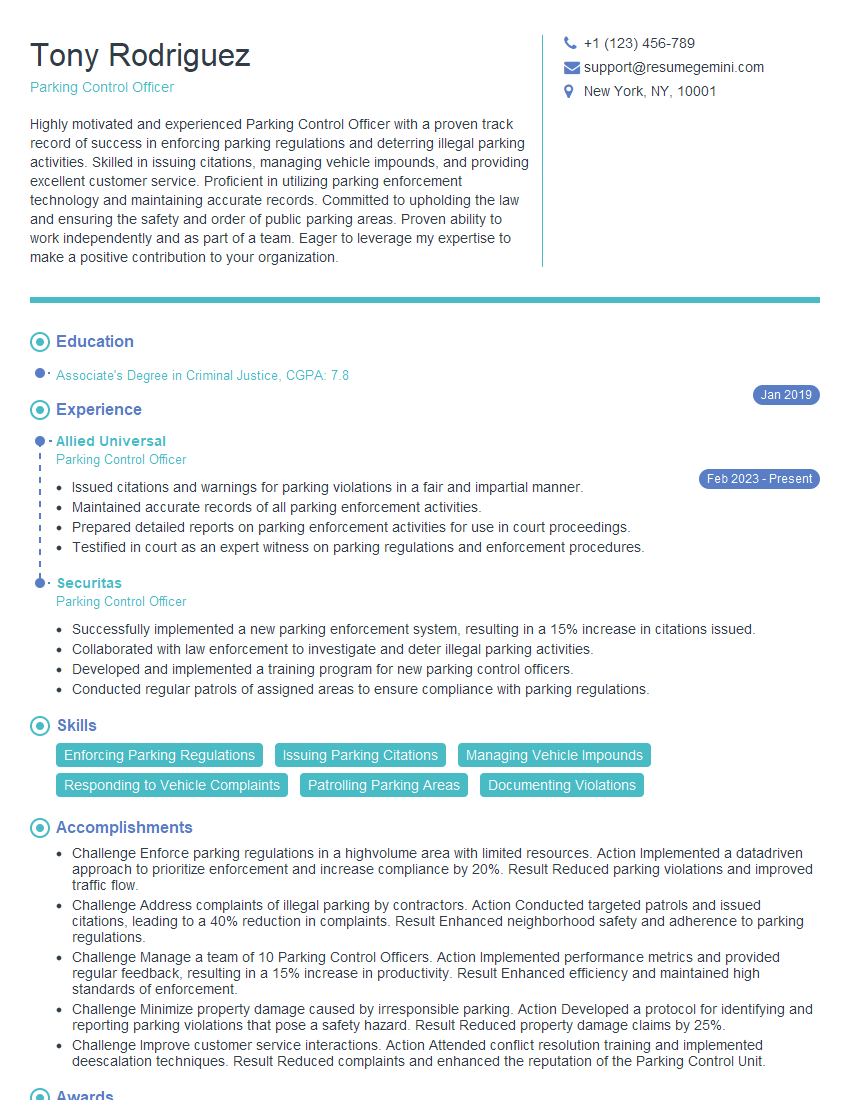
Mastering Parking Citation Management opens doors to rewarding careers in public administration, transportation management, and technology. A strong understanding of this field demonstrates valuable skills in data analysis, compliance, and customer service – highly sought-after attributes in today’s job market. To maximize your job prospects, create an ATS-friendly resume that highlights your relevant skills and experience. ResumeGemini is a trusted resource for building professional resumes that get noticed. They offer examples of resumes tailored to Parking Citation Management to help you present yourself effectively. Take advantage of these resources to craft a compelling resume that showcases your readiness for a successful career in this field.
Explore more articles
Users Rating of Our Blogs
Share Your Experience
We value your feedback! Please rate our content and share your thoughts (optional).
What Readers Say About Our Blog
Very informative content, great job.
good