Every successful interview starts with knowing what to expect. In this blog, we’ll take you through the top Part Design for Moldability interview questions, breaking them down with expert tips to help you deliver impactful answers. Step into your next interview fully prepared and ready to succeed.
Questions Asked in Part Design for Moldability Interview
Q 1. Explain the principles of Design for Manufacturing (DFM) in the context of injection molding.
Design for Manufacturing (DFM) in injection molding focuses on creating parts that are easily and cost-effectively produced. It’s about thinking like a manufacturer from the very beginning of the design process, anticipating potential challenges and incorporating solutions into the part’s design. This minimizes production time, reduces material waste, and improves overall product quality.
- Material Selection: Choosing a resin appropriate for the application and the molding process. For example, using a high-impact polystyrene for a durable toy versus a flexible TPU for a phone case.
- Geometry Optimization: Designing parts with features that are easily molded, such as consistent wall thicknesses, adequate draft angles, and simplified geometries to avoid sink marks or warping.
- Parting Line Considerations: Strategically placing the parting line to simplify mold construction and reduce the risk of flash or parting line defects. A good parting line strategy often minimizes the number of mold cavities required.
- Undercut Management: Addressing undercuts through design modifications or the use of specialized mold components (slides, lifters). This may involve slightly modifying the design to eliminate undercuts altogether or incorporating a design change to allow for molding them.
- Tolerance Analysis: Defining acceptable tolerances to ensure dimensional accuracy and proper part functionality. This is critical for parts that require close tolerances, such as those in electronic assemblies.
Ignoring DFM principles can lead to costly mold revisions, longer lead times, increased material costs, and ultimately a flawed final product.
Q 2. Describe your experience with different types of plastic resins and their suitability for molding.
My experience encompasses a wide range of plastic resins, including: ABS, polycarbonate, polypropylene, polyethylene, nylon, PETG, and various engineered plastics. Each resin has unique properties that dictate its suitability for different applications. For instance:
- ABS (Acrylonitrile Butadiene Styrene): A versatile and cost-effective material with good impact resistance, suitable for many consumer products.
- Polycarbonate: A high-strength, high-temperature resin ideal for demanding applications requiring exceptional impact strength and clarity.
- Polypropylene: A lightweight, chemically resistant material commonly used for containers and automotive parts.
- Polyethylene: Often used for flexible packaging, bottles, and films due to its flexibility and low cost. High-density polyethylene (HDPE) is more rigid than low-density polyethylene (LDPE).
- Nylon: Known for its strength, toughness, and high temperature resistance. Used frequently in automotive and industrial components.
- PETG (Polyethylene Terephthalate Glycol-modified): Offers good clarity, strength, and chemical resistance. Suitable for food packaging and other applications.
Selecting the correct resin involves considering factors such as the part’s required mechanical properties (strength, stiffness, flexibility), chemical resistance, temperature resistance, and cost. I always carefully evaluate the application requirements before making a material selection.
Q 3. How do you determine the appropriate wall thickness for an injection molded part?
Determining appropriate wall thickness is crucial for both part functionality and moldability. Too thin, and the part will be weak and prone to warping; too thick, and it will increase material costs and potentially lead to sink marks (indentations on the surface). The ideal wall thickness depends on several factors:
- Part Size and Shape: Larger and more complex parts generally require thicker walls.
- Resin Type: Different resins have different melt flow rates and shrinkage characteristics, affecting the minimum acceptable wall thickness.
- Part Functionality: Parts under stress need thicker walls.
- Molding Process Parameters: Injection pressure, melt temperature, and mold temperature influence the final wall thickness.
A good starting point is to aim for a consistent wall thickness throughout the part. However, variations are often unavoidable. Gradual transitions are preferred over sharp changes in wall thickness. I typically use mold flow analysis software to simulate the filling process and optimize wall thickness to minimize warping and sink marks. A good rule of thumb is to use a minimum wall thickness of 0.020 inches (0.5 mm), but this can vary greatly depending on the part and material.
Q 4. Explain the importance of draft angles in mold design.
Draft angles are the slight tapers incorporated into the vertical walls of a molded part, allowing it to be easily removed from the mold cavity. Without sufficient draft, the part may stick, causing damage to the part or mold. This is especially crucial in complex geometries.
A typical draft angle ranges from 0.5 to 3 degrees, depending on the part’s size, geometry, and material. Steeper draft angles are necessary for parts with deep cavities or undercuts. I always ensure that all vertical walls have adequate draft. Failure to do so leads to broken parts, damaged molds, and inefficient production.
Think of it like removing a candle from a candle mold – a slight taper makes it much easier.
Q 5. What are common parting line considerations during part design?
Parting line considerations are critical in mold design because they dictate how the two mold halves separate to release the molded part. A poorly placed parting line can result in defects, such as flash (excess material squeezed out at the parting line) or uneven surfaces. Factors to consider include:
- Part Geometry: The parting line should be placed in a location that minimizes the complexity of the mold and reduces the risk of defects. Simple, straight parting lines are generally preferred.
- Part Features: Undercuts or complex shapes often necessitate the use of specialized mold components, such as slides or lifters, to compensate for the complex parting line.
- Cosmetic Considerations: If the parting line is visible on the finished product, it should be strategically placed to minimize its visual impact.
Properly planning the parting line significantly influences the cost and manufacturability of the mold and greatly improves product aesthetics.
Q 6. How do you design for undercuts in injection molding?
Undercuts, features that prevent direct ejection from the mold, pose a significant challenge in injection molding. They require specialized mold components or design modifications. There are several strategies to handle undercuts:
- Design Changes: The most straightforward approach is to redesign the part to eliminate the undercut altogether. Often, minor adjustments can resolve the issue.
- Slides and Lifters: These are moving parts within the mold that allow the undercut to be released. They add complexity and cost but are necessary for many undercuts.
- Two-part Molds: Sometimes, using a two-part mold or multiple molds is necessary, especially for parts with intricate undercuts. This typically increases overall molding costs.
- Unscrewing Mechanisms: For complex undercut geometries, unscrewing mechanisms may be used.
Careful consideration of the cost versus complexity must be given. The selection process involves weighing the cost of incorporating more complex mechanisms against possible design changes to avoid undercuts altogether.
Q 7. Discuss your experience with mold flow analysis software.
I have extensive experience using mold flow analysis software, such as Moldex3D and Autodesk Moldflow. These tools are invaluable for predicting potential molding problems and optimizing part and mold designs. They allow me to simulate the entire injection molding process, including melt flow, pressure distribution, temperature gradients, and warpage. This helps in:
- Optimizing Gate Location and Design: Ensuring complete filling of the cavity without defects such as air traps or short shots.
- Predicting Warpage and Shrinkage: Identifying potential areas of distortion and optimizing part design to minimize these issues.
- Evaluating Wall Thickness: Verifying that wall thicknesses are sufficient to prevent warping and other problems.
- Assessing Stress and Strain: Analyzing the stresses and strains within the part to verify its structural integrity.
- Reducing Molding Cycle Time: Optimizing the molding process parameters to reduce cycle time and improve overall efficiency.
Using these tools before mold manufacturing helps to prevent costly mistakes and ensure the part is moldable. I would consider these simulations a crucial part of any product development cycle.
Q 8. Explain how to minimize sink marks and warpage in molded parts.
Sink marks and warpage are common molding defects stemming from uneven cooling and shrinkage of the plastic. Minimizing them requires a multifaceted approach focusing on design and processing.
- Uniform Wall Thickness: Maintaining consistent wall thickness throughout the part is crucial. Thick sections cool slower than thin sections, leading to shrinkage differences and sink marks. Imagine a thick wall as a sponge holding more water (heat) – it will take longer to dry (cool). Aim for variations of no more than ±10%, depending on the material and part complexity.
- Optimized Rib Design: Ribs provide stiffness but can also trap heat, causing sink marks. Design ribs with sufficient draft (taper) and avoid abrupt changes in thickness where ribs meet the main part body. Think of ribs as channels guiding the heat away.
- Strategic Placement of Gates and Runners: Proper gate placement ensures uniform filling and minimizes pressure variations that cause sink marks. The gate should be placed in the thickest section, allowing for controlled filling.
- Material Selection: Some polymers are more prone to warping than others. Choosing the right material with appropriate shrinkage properties is essential. A material’s data sheet will specify shrinkage rates.
- Mold Design Considerations: Proper mold venting prevents air entrapment, which can cause irregularities. Sufficient cooling channels help to even out the cooling rate.
- Molding Parameters: Adjusting molding parameters such as injection pressure, melt temperature, and holding time can influence the final part quality. This requires iterative experimentation and process optimization.
For example, in a design for a plastic housing with thick walls, incorporating strategically placed ribs and utilizing a material with low shrinkage would greatly mitigate sink marks and warpage.
Q 9. What are the key considerations for designing robust and manufacturable plastic parts?
Designing robust and manufacturable plastic parts involves considering several key aspects throughout the design process. The goal is to create a part that is both functional and cost-effective to produce.
- Design for Manufacturing (DFM): This principle emphasizes creating a design that is easily manufactured without compromising functionality. This includes simplifying geometry, minimizing sharp corners, and selecting appropriate manufacturing processes.
- Material Selection: Choosing a suitable material based on mechanical properties (strength, stiffness, flexibility), thermal properties (heat resistance, thermal expansion), and chemical resistance (exposure to chemicals, solvents). This often involves trade-offs. For example, a high-strength material might be more expensive or difficult to mold.
- Tolerance Analysis: Defining acceptable tolerances for dimensions and features ensures that the part functions correctly within the given manufacturing capabilities. Too tight tolerances can increase costs and lead to scrap.
- Draft Angles: Incorporating draft angles (taper) on walls and features makes it easier to remove the part from the mold. Sufficient draft angle is crucial to prevent damage or excessive force during demolding.
- Undercuts and Side Actions: Undercuts (features that prevent easy removal from the mold) necessitate more complex mold designs. Consideration needs to be given to feasibility. Sometimes the design can be modified to avoid undercuts or slide mechanisms, lifters, or other specialized mold features are required.
- Wall Thickness Optimization: As mentioned before, uniform wall thickness minimizes stress concentration, warpage, and sink marks.
- Cost Optimization: Considering the cost of materials, mold fabrication, and molding processes to make sure the design stays within the budget.
For example, I once redesigned a complex part with many undercuts, significantly simplifying the geometry to avoid side actions and thereby reducing production cost by 30%.
Q 10. How do you incorporate tolerances and GD&T into part designs for moldability?
Tolerances and Geometric Dimensioning and Tolerancing (GD&T) are essential for defining acceptable variations in part dimensions and ensuring proper assembly and functionality. They are integrated into part designs from the beginning to ensure moldability.
- Dimensioning and Tolerancing: Using clear dimensioning and tolerances based on the manufacturing process capabilities. This involves understanding the precision achievable with injection molding and selecting appropriate tolerances.
- GD&T Symbols: Applying appropriate GD&T symbols (e.g., position, perpendicularity, runout) to define feature control frames (FCFs) and specify the allowable deviations for critical features. These help ensure the part is functional, even if it has manufacturing variations within the tolerance zones.
- Feature Control Frames (FCFs): Using FCFs to clearly communicate the required tolerances and their relationships to each other. These are crucial for mold designers and manufacturers to understand the design intent.
- Moldability Analysis: Employing tools and techniques to analyze how the specified tolerances affect the mold design and manufacturing process. This might involve Finite Element Analysis (FEA) to simulate the molding process and predict potential issues related to tolerances.
- Material Shrinkage Compensation: Accounting for material shrinkage during the design phase by using adjusted dimensions. This involves considering the molding material’s shrinkage rates provided in the material datasheet.
For instance, specifying a position tolerance using a GD&T symbol ensures that crucial features like mating surfaces are within the acceptable range, even with inherent variation during the molding process. This prevents assembly problems and ensures functionality.
Q 11. Describe your experience with different mold types (e.g., single cavity, multi-cavity).
My experience encompasses a wide range of mold types, each offering distinct advantages and challenges.
- Single Cavity Molds: These molds produce one part per cycle and are ideal for prototypes, low-volume production, or parts with complex geometries requiring specialized mold features. The design process focuses on the individual part and mold details without repetition. This often makes initial production costs higher but permits a focus on quality.
- Multi-cavity Molds: These molds produce multiple parts per cycle, significantly increasing production efficiency for high-volume applications. Design becomes more complex with attention to ensuring consistent filling and cooling across all cavities and minimizing the potential for mismatched parts. The trade-off is that correcting a mold defect could require a more substantial and costly investment.
- Family Molds: These produce multiple different but related parts within a single mold. This streamlines manufacturing and reduces setup time, but the design complexity increases due to the need to accommodate different part features and gating systems within the same mold.
- Hot Runner Molds: These reduce material waste by preventing the creation of runners and sprues. This is an advantage when manufacturing high-value parts or those using expensive materials. The design must consider the complex hot runner system and the need for precision temperature control.
In my previous role, we transitioned from single-cavity molds to a 16-cavity mold for a high-volume plastic container, resulting in a substantial reduction in unit production cost.
Q 12. Explain the process of creating and interpreting a mold flow analysis report.
Mold flow analysis (MFA) is a crucial step in the part design process, helping to predict potential molding issues before the mold is manufactured.
- Creating the Analysis: MFA software requires a 3D CAD model of the part and mold, material properties, and processing parameters (injection pressure, melt temperature, etc.). The software simulates the filling, packing, and cooling stages of the injection molding process.
- Interpreting the Report: The report typically includes visualizations such as fill time, pressure distribution, temperature profiles, weld lines, and potential sink marks. Analyzing these helps identify potential problems and determine necessary design modifications.
- Key Parameters to Examine: Analyzing fill time variations can highlight potential short shots or areas where the melt might not reach uniformly. Pressure distribution helps identify high-pressure zones that could lead to warpage or stress cracks. Temperature profiles show how the part cools down; uneven cooling can cause warping. Weld lines indicate areas where multiple melt flows meet, which can be points of weakness. Air traps can cause voids or surface blemishes.
- Iterative Process: MFA is an iterative process. Based on the initial results, design changes are made, and the analysis is repeated until a satisfactory outcome is achieved.
In one project, MFA revealed a potential air trap in a complex geometry that would lead to surface blemishes. By modifying the gating system and adding vents, we eliminated the problem in the simulation and, consequently, in the manufactured parts.
Q 13. How do you handle complex geometries during the design process for molding?
Handling complex geometries in mold design requires a strategic approach that balances design intent with manufacturability. A simplified approach is often best.
- Simplification Strategies: The first step is to evaluate the design’s complexity and explore opportunities for simplification. This may involve removing unnecessary features or redesigning features to reduce undercut requirements.
- Feature Splitting: Breaking down complex geometries into simpler, moldable sub-components that can be assembled later is a common approach.
- Molding Techniques: Exploring appropriate molding techniques to handle challenging geometries, such as using inserts, slides, or other specialized molding mechanisms.
- Parting Line Considerations: The location of the parting line—the plane where the mold halves separate—is critical for complex geometries. Careful planning ensures features are easily removed without damage or excessive force. A poorly located parting line is a common source of failure.
- Draft Angles: Consistent application of draft angles reduces the force required to eject the part from the mold.
- Undercut Management: If undercuts are unavoidable, design needs to address how they will be molded, for example, utilizing inserts, slides, or lifters.
For instance, a complex part with many undercuts may be split into multiple parts to simplify molding; the sub-parts are then assembled later. This would reduce the cost of the mold and increase production efficiency.
Q 14. Discuss your understanding of different gating systems.
Gating systems are crucial for delivering the molten plastic into the mold cavity efficiently and consistently.
- Direct Gating: The simplest method, where the runner directly feeds the melt into the part. Suitable for simple parts but can lead to weld lines and jetting.
- Indirect Gating: The melt flows through a runner system before entering the cavity. This approach allows for better flow control and reduces the risk of jetting. Examples include tab gating and edge gating.
- Submarine Gating: The gate is located at the bottom of the cavity. This helps to minimize visible marks but requires careful design to prevent air entrapment.
- Hot Runner Systems: These systems keep the plastic molten in the runner system, eliminating the need for runners and sprues, thus minimizing waste. Hot runner systems are more complex and expensive, making them suitable for high-value parts and high-volume production. They come in various types (e.g., valve gates, hot runner nozzles).
- Multiple Gate Systems: These systems use multiple gates to feed the mold cavity, improving fill balance and reducing the risk of defects. This can be useful in parts with thick sections or complex geometries.
The choice of gating system depends on part geometry, material, production volume, and cost considerations. I often use a combination of modeling and simulation to select the best approach.
Q 15. What are some common material defects encountered in injection molding, and how can they be prevented during design?
Material defects in injection molding are a common source of frustration and cost overruns. They often stem from improper design choices or insufficient understanding of the material’s behavior under high pressure and temperature. Some frequent defects include:
- Sink Marks: These are depressions on the surface of the part, typically caused by insufficient material flow to fill the mold cavity completely. They are often found in thick sections. Prevention: Reduce wall thickness, add ribs for reinforcement, or incorporate venting features in the mold design.
- Warping/Distortion: Uneven cooling or internal stresses within the part can lead to warping. Prevention: Design parts with symmetrical geometry whenever possible, optimize wall thicknesses for uniform cooling, and incorporate features to reduce residual stresses.
- Short Shots: Insufficient molten plastic reaches the furthest areas of the mold, resulting in incomplete parts. Prevention: Ensure adequate gate size and location, optimize runner and sprue systems for efficient material flow, and review mold temperature.
- Flashing: Excess material squeezed out between mold halves. Prevention: Ensure tight mold closure, check for appropriate mold tolerances, and review clamping force.
- Burn Marks: Discoloration or degradation of the plastic due to excessive heat. Prevention: Optimize injection molding parameters (injection speed, melt temperature), check for adequate mold venting and ensure consistent mold temperature.
Careful material selection, coupled with thoughtful consideration of the part’s geometry and processing parameters, is crucial for minimizing these defects. Finite Element Analysis (FEA) simulations can also predict potential problems before mold production.
Career Expert Tips:
- Ace those interviews! Prepare effectively by reviewing the Top 50 Most Common Interview Questions on ResumeGemini.
- Navigate your job search with confidence! Explore a wide range of Career Tips on ResumeGemini. Learn about common challenges and recommendations to overcome them.
- Craft the perfect resume! Master the Art of Resume Writing with ResumeGemini’s guide. Showcase your unique qualifications and achievements effectively.
- Don’t miss out on holiday savings! Build your dream resume with ResumeGemini’s ATS optimized templates.
Q 16. How do you ensure the manufacturability of a part during the design phase?
Ensuring manufacturability during the design phase is paramount. It involves a proactive approach considering several factors:
- Draft Angles: Parts need sufficient draft angles (the slight taper on vertical walls) to allow for easy ejection from the mold. A minimum of 0.5-1 degree is typically needed, though steeper angles may be required depending on the geometry and material.
- Wall Thickness Consistency: Uniform wall thickness promotes consistent cooling and minimizes warping. Avoid abrupt changes in thickness.
- Undercuts and Complex Geometries: These increase mold complexity and cost. It’s often more economical to simplify geometry or explore alternative molding techniques such as multi-cavity molds or insert molding.
- Ribs and Bosses for Reinforcement: Ribs and bosses can improve part strength and rigidity without significantly impacting moldability. Proper design ensures they don’t interfere with part ejection or cause stress concentrations.
- Gate and Ejector Pin Locations: Careful placement of gates ensures complete filling of the mold, while strategically placed ejector pins facilitate easy removal of parts from the mold. These require careful consideration to avoid weak points or interference with part features.
- Design for Assembly: If the part is part of a larger assembly, design it with features that enable easy assembly while maintaining moldability.
DFM (Design for Manufacturing) software tools can be invaluable in this phase, helping to identify potential manufacturing challenges early in the design process.
Q 17. What software are you proficient in for 3D modeling and CAD for molding applications?
My proficiency extends across several leading 3D modeling and CAD software packages, including SolidWorks, Autodesk Inventor, and Creo Parametric. I’m also experienced with Moldflow analysis software, which allows for detailed simulation of the injection molding process to predict potential issues and optimize designs before manufacturing.
Q 18. Describe a time you had to redesign a part to improve its moldability.
I once worked on a project involving a complex, aesthetically designed housing for a consumer electronics device. The initial design featured numerous intricate curves and thin walls, resulting in significant warping and sink marks during initial mold trials. The solution involved a multi-step redesign process:
- FEA Analysis: We conducted a thorough Finite Element Analysis to pinpoint the areas of greatest stress and potential for warping.
- Geometric Simplification: We streamlined certain curves and slightly increased wall thickness in critical areas identified by the FEA. While it impacted the aesthetics slightly, it greatly improved moldability.
- Rib Reinforcement: We incorporated strategic ribs in areas susceptible to sink marks. These ribs provided additional support without significantly altering the overall design.
The revised design significantly improved the part’s moldability, resulting in a successful manufacturing process and a high-quality final product. The slight aesthetic compromise was a worthwhile trade-off for improved manufacturability and reduced costs.
Q 19. How do you balance aesthetic design considerations with moldability requirements?
Balancing aesthetics and moldability requires careful consideration and iterative design. It’s often a matter of finding creative compromises. For instance:
- Early Collaboration: Involving manufacturing engineers early in the design process is critical. This enables early identification and mitigation of potential moldability challenges.
- Exploring Alternative Designs: If a highly intricate design proves difficult to mold, explore alternative designs that achieve a similar aesthetic effect with simpler geometry.
- Surface Treatments: After molding, surface treatments like texturing or painting can be applied to enhance the aesthetics of the part, mitigating the need for overly complex mold designs.
The key is iterative design and communication between the design and manufacturing teams to achieve a product that meets both aesthetic and manufacturing requirements. Sometimes, using simulations can help visualize the effect of design changes on both.
Q 20. What are your preferred methods for communicating design specifications to mold makers?
Clear and concise communication is essential. My preferred methods include:
- Detailed 3D CAD Models: Providing high-quality 3D CAD models with clear annotations and dimensions. This serves as the primary communication tool.
- 2D Drawings: Supplemented by detailed 2D drawings that highlight critical dimensions, tolerances, and surface finishes.
- Moldflow Analysis Reports: If applicable, sharing Moldflow simulation reports provides valuable insights into the molding process and helps anticipate potential problems.
- Clear Communication Protocol: Establishing a clear and regular communication channel with the mold makers to address any questions or concerns during the manufacturing process.
Using a consistent set of standards and terminology ensures that everyone involved understands the design intent and specifications.
Q 21. Explain your understanding of different types of runners and sprue systems.
Runner and sprue systems are crucial for delivering molten plastic to the mold cavity efficiently. Several types exist, each with its advantages and disadvantages:
- Cold Runner Systems: Molten plastic is not fully used, and the remaining material in the runners is ejected and recycled after cooling. This reduces material waste but adds to the tooling cost.
- Hot Runner Systems: Molten plastic is kept at a high temperature in the runner system preventing solidification, leading to reduced material waste and potentially faster cycle times. However, they are more expensive.
- Single-Gate Systems: The simplest system where a single gate injects the material into the mold cavity. Suitable for smaller parts and simpler geometries.
- Multi-Gate Systems: Multiple gates inject the material into different sections of the mold cavity, improving filling for complex shapes and reducing weld lines.
- Submarine Sprue System: The sprue is submerged below the parting line to minimize flashing.
- Edge Gate System: The gate is located on the edge of the part, facilitating ease of part removal and reduced marking
The choice of runner and sprue system depends on factors like part design, material properties, production volume, and cost considerations. Proper design minimizes material waste, ensures complete filling, and reduces cycle time.
Q 22. Describe your experience with different types of ejection systems.
Ejection systems are crucial for removing molded parts from the mold cavity after the injection molding process. The choice of system depends heavily on the part geometry, material, and production volume. I have extensive experience with several types, including:
- Standard Ejector Pins: These are the most common, suitable for parts with simple geometries and sufficient draft. They’re cost-effective but might not be sufficient for complex parts or those with undercuts.
- Sleeves and Hydraulic Ejectors: Used for parts with deep draws or intricate features. Sleeves provide a more controlled ejection force, preventing damage, while hydraulic ejectors offer greater force for challenging parts.
- Air Ejection: Air pressure is used to blow the part out of the mold. This is particularly useful for fragile parts or those with delicate features. It’s also beneficial for high-speed molding.
- Combination Systems: Many designs use a combination of these methods to ensure reliable and damage-free part ejection. For instance, ejector pins might handle the majority of the part, while a sleeve or air ejection handles a specific undercut.
For example, I once worked on a project involving a complex medical device with several delicate internal features. A combination of air ejection and strategically placed ejector pins was employed to ensure clean ejection without damaging the final product. Selecting the right ejection system is essential to avoid part damage, ensure efficient production, and maintain high quality.
Q 23. How do you select appropriate materials for specific applications considering moldability?
Material selection is critical for moldability and overall part performance. Factors to consider include:
- Part Functionality: What are the mechanical, thermal, and chemical requirements of the part?
- Moldability: Material’s viscosity, shrinkage, and tendency to warp influence the molding process and part quality. Some materials flow better than others, impacting the ability to fill complex cavities.
- Cost: Material costs vary significantly, impacting overall part price.
- Sustainability: The environmental impact of the material throughout its lifecycle (production, use, disposal) is increasingly important.
I often use material property databases and consult with material suppliers to find the best balance between properties and moldability. For example, if a part needs high strength and chemical resistance, a high-performance engineering plastic like PEEK might be suitable, even though it can be more challenging to mold than simpler materials like PP. However, if the part is less demanding, a more readily moldable material with a lower environmental impact might be chosen.
Q 24. What are your experiences with using Design of Experiments (DOE) in part design optimization?
Design of Experiments (DOE) is a powerful statistical method for optimizing part designs. It allows for efficient exploration of the design space by systematically varying key parameters and analyzing the resulting effects on critical responses such as warping, shrinkage, and ejection forces. My experience with DOE includes:
- Full Factorial Designs: Testing all combinations of factors to identify significant interactions.
- Fractional Factorial Designs: A cost-effective approach when a full factorial design is impractical, sacrificing some detail for speed.
- Response Surface Methodology (RSM): Using statistical models to optimize the process and predict responses based on factor settings.
In a recent project involving a complex housing, we used a fractional factorial design to optimize the gate location and melt temperature. This allowed us to significantly reduce part warping and improve dimensional accuracy, ultimately minimizing scrap and improving efficiency. Software like Minitab or JMP is commonly used for DOE analysis and interpretation.
Q 25. How do you incorporate sustainability considerations into the design process for molding?
Sustainability is becoming increasingly important in design and manufacturing. Incorporating sustainability into the injection molding process involves several aspects:
- Material Selection: Choosing materials with recycled content, bio-based origins, or readily recyclable properties. This minimizes environmental impact and contributes to a circular economy.
- Design for Disassembly: Designing parts for easy disassembly and component reuse or recycling at the end of their life cycle.
- Energy Efficiency: Optimizing the molding process to reduce energy consumption. This includes choosing efficient molding machines and optimizing processing parameters.
- Waste Reduction: Minimizing material waste during the design and manufacturing phases through optimized designs and efficient processes.
For example, I worked on a project where we replaced a traditional polypropylene material with a bio-based alternative, reducing the carbon footprint of the part without compromising its functionality. This involved careful consideration of the new material’s moldability characteristics.
Q 26. Describe your understanding of the importance of surface finish in injection molding.
Surface finish is crucial for both aesthetic and functional aspects of injection molded parts. A smooth surface improves appearance, reduces friction (in moving parts), and can enhance the part’s resistance to corrosion or wear. Factors influencing surface finish include:
- Mold Surface Finish: The quality of the mold’s surface directly impacts the molded part’s surface. Polished molds produce smoother parts.
- Mold Material: Different mold materials yield different surface finishes.
- Processing Parameters: Melt temperature, injection pressure, and cooling rate affect surface quality.
- Material Properties: The material’s inherent flow characteristics and tendency to stick to the mold can impact the surface.
For instance, in applications where surface appearance is critical (e.g., consumer electronics), highly polished molds and specific processing parameters are needed. In applications requiring high-strength or corrosion resistance, the surface finish might not be as critical.
Q 27. Explain your approach to troubleshooting issues during the production phase of injection molded parts.
Troubleshooting during production requires a systematic approach. My approach typically involves:
- Identify the Problem: Clearly define the issue—Is it a dimensional problem, a surface defect, an ejection problem, or something else?
- Gather Data: Collect data on the molding process parameters (temperature, pressure, cycle time), material properties, and visual inspection results of the defective parts.
- Analyze the Data: Look for patterns and correlations to identify the root cause. Control charts, histograms, and other statistical tools can be helpful here.
- Develop and Implement Solutions: Based on the analysis, implement changes to the process parameters, mold design, or material selection. These changes could involve adjusting mold temperatures, injection pressures, or even redesigning the part or mold.
- Verify the Solution: Monitor the process closely after implementing changes to ensure the problem is resolved and the solution is sustainable.
For example, if parts are consistently warping, we might investigate factors like gate location, cooling rate, or material shrinkage. The solution could be as simple as adjusting cooling lines or as complex as redesigning the part for better flow or modifying the mold temperature profile. A methodical approach is crucial for efficient troubleshooting.
Q 28. How do you stay up-to-date with the latest advancements in injection molding technology?
Staying current in injection molding requires continuous learning. My strategies include:
- Industry Publications and Journals: I regularly read publications like Plastics Engineering and other industry-specific journals.
- Conferences and Trade Shows: Attending conferences like NPE allows me to learn about new technologies and best practices.
- Online Resources and Webinars: Many online resources offer valuable insights into the latest advancements and technical developments in the field.
- Networking with Professionals: Connecting with other engineers and industry experts through professional organizations and online forums provides valuable knowledge exchange.
- Continuing Education Courses: I actively seek out workshops and training courses focusing on new technologies and techniques within injection molding.
Staying informed about advancements in materials, molding equipment, and simulation techniques is crucial for remaining competitive and delivering innovative solutions.
Key Topics to Learn for Part Design for Moldability Interview
- Draft Angles and Undercuts: Understanding the importance of incorporating appropriate draft angles to facilitate part ejection and avoid undercuts that hinder moldability. Practical application: Analyzing existing part designs to identify and rectify potential moldability issues related to draft.
- Wall Thickness and Ribs: Designing for consistent wall thickness to prevent warping and sink marks. Understanding the proper use of ribs for structural support while minimizing molding challenges. Practical application: Calculating optimal wall thickness based on material properties and part geometry.
- Gate and Runner Design: Knowing the different types of gating systems and their impact on part quality and cycle time. Practical application: Selecting appropriate gate locations and runner designs to ensure efficient filling and minimize defects.
- Material Selection and its Influence on Moldability: Understanding the properties of various plastics and their suitability for different molding processes. Practical application: Justifying material choices based on part requirements and manufacturability.
- Ejection System Design: Familiarity with different ejection methods and their design considerations. Practical application: Identifying potential ejection problems in existing designs and proposing solutions.
- Parting Line Considerations: Understanding the impact of parting line location on part aesthetics, functionality, and mold complexity. Practical application: Optimizing parting line placement to simplify mold construction and improve part quality.
- Mold Flow Analysis (MFA): Understanding the principles of MFA and its application in predicting potential molding problems. Practical application: Interpreting MFA results and proposing design modifications to improve moldability.
- Tolerance Stack-up Analysis: Understanding how tolerances accumulate and their impact on assembly. Practical application: Designing for manufacturability by considering realistic tolerances.
Next Steps
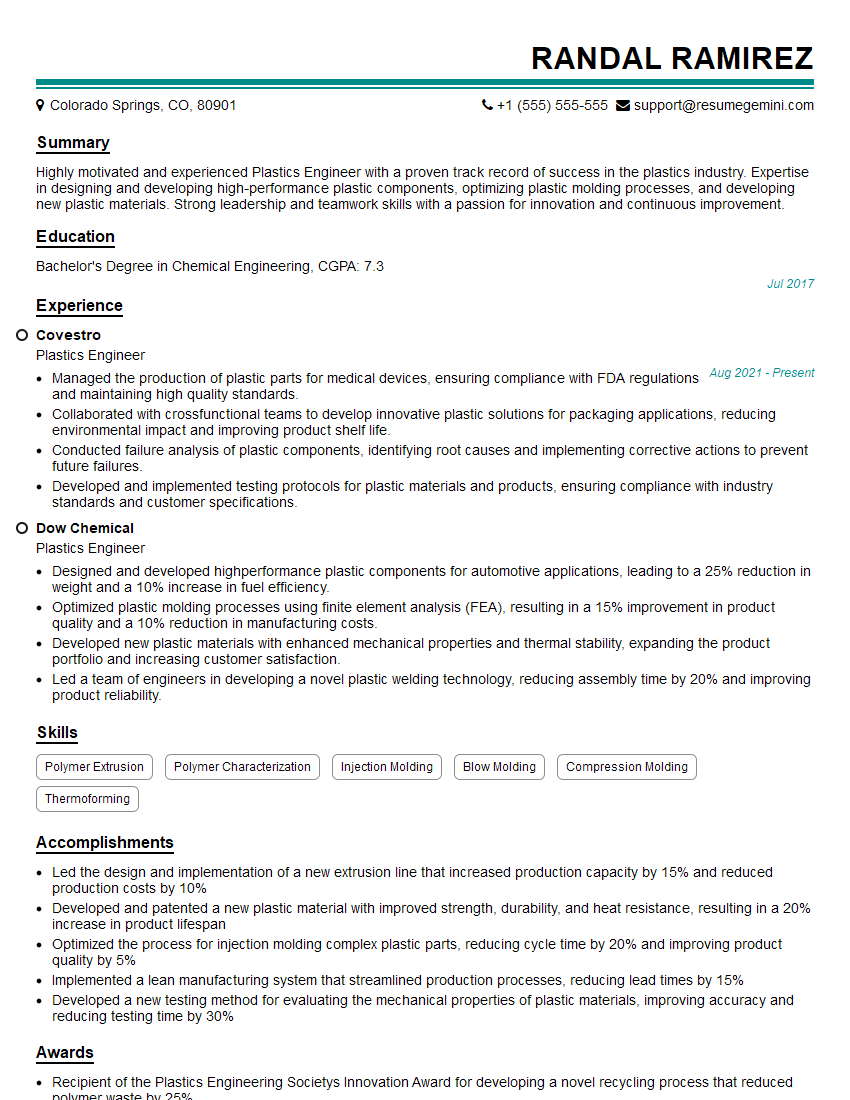
Mastering Part Design for Moldability is crucial for a successful career in manufacturing engineering, opening doors to exciting opportunities and higher earning potential. A strong, ATS-friendly resume is your key to unlocking these possibilities. To ensure your qualifications shine, we strongly encourage you to leverage ResumeGemini, a trusted resource for creating professional and impactful resumes. ResumeGemini provides examples of resumes tailored specifically to Part Design for Moldability, giving you a head start in crafting a document that effectively showcases your expertise.
Explore more articles
Users Rating of Our Blogs
Share Your Experience
We value your feedback! Please rate our content and share your thoughts (optional).
What Readers Say About Our Blog
Very informative content, great job.
good