Preparation is the key to success in any interview. In this post, we’ll explore crucial Patent Cooperation Treaty (PCT) Filing interview questions and equip you with strategies to craft impactful answers. Whether you’re a beginner or a pro, these tips will elevate your preparation.
Questions Asked in Patent Cooperation Treaty (PCT) Filing Interview
Q 1. Explain the purpose and benefits of filing a PCT application.
The Patent Cooperation Treaty (PCT) is a global patent system that allows applicants to seek patent protection in multiple countries through a single application. Its primary purpose is to streamline the international patent application process, reducing costs and administrative burdens. The key benefit is that it provides a single application window to protect an invention in many countries simultaneously. This allows inventors to delay national-phase decisions (filing in individual countries) until after an international search and potentially an international preliminary examination.
Imagine you’ve invented a revolutionary widget and want patent protection in the US, Europe, and Japan. Instead of filing three separate patent applications, each with its own fees and complexities, you can file one PCT application. This significantly reduces your upfront costs and simplifies management, letting you assess the viability of your invention in different markets before committing to full national-phase filings in each jurisdiction.
- Reduced Costs: Fewer application fees and legal costs upfront.
- Simplified Process: One application for multiple countries.
- Delayed Decision Making: More time to assess market potential before committing to national-phase filings.
- Earlier Market Research: The international search report provides insights into prior art globally.
Q 2. Describe the different phases of a PCT application.
A PCT application progresses through several distinct phases:
- National Phase Application: Filing of the PCT application with the World Intellectual Property Organization (WIPO). This includes a detailed description of the invention, claims defining the scope of the invention, drawings (if applicable), and an abstract.
- International Search: The International Searching Authority (ISA) conducts a search of relevant prior art worldwide to determine the novelty and inventive step of the invention.
- International Preliminary Examination (Optional): This involves a preliminary examination by the International Preliminary Examining Authority (IPEA) to assess the patentability of the invention. This stage is not mandatory, but many applicants elect to proceed with this option.
- National Phase Entry: Once the international phase is complete, applicants must enter the national phase in each country where they seek patent protection. This involves filing a separate national application and paying fees in each designated country.
Think of it as a funnel: starting broad with one application, then narrowing down the focus to individual countries as the process progresses.
Q 3. What is the priority date and its significance in a PCT application?
The priority date in a PCT application is the filing date of the earliest application from which the PCT application claims priority. Its significance lies in establishing the date from which novelty and inventive step are assessed. Essentially, it’s your claim to having invented something first, preventing others from claiming priority and potentially invalidating your patent later.
For example, if you filed a provisional patent application in the US on January 1st, 2023, and then filed a PCT application on July 1st, 2023, claiming priority from the January 1st application, your priority date would be January 1st, 2023. This means that any prior art published after January 1st, 2023, will not be considered when examining the novelty and inventive step of your invention.
Q 4. Explain the role of the International Searching Authority (ISA).
The International Searching Authority (ISA) is responsible for conducting a thorough search of worldwide prior art relevant to the invention described in the PCT application. The ISA’s search aims to identify documents that are similar or identical to the claimed invention. This search generates a written report called the International Search Report (ISR), which includes a list of cited documents and an assessment of the novelty and inventive step (non-obviousness) of the invention.
This is crucial because the ISR provides valuable feedback to the applicant. It helps the applicant understand the state of the art and assess the patentability of their invention. The ISR is also essential for deciding which countries to pursue in the national phase.
Q 5. What is the International Preliminary Examining Authority (IPEA)?
The International Preliminary Examining Authority (IPEA) conducts a preliminary examination of the patentability of an invention claimed in a PCT application. Unlike the ISA, which only searches for prior art, the IPEA assesses the claims for patentability based on various criteria including novelty, inventive step, and industrial applicability. The IPEA issues an International Preliminary Examination Report (IPER), which provides an opinion on the patentability of the invention.
While not mandatory, an IPER can provide a significant advantage. It gives the applicant valuable feedback before entering the national phase. It can also expedite the national phase examination in some countries, resulting in faster patent grant.
Q 6. What are the requirements for a PCT application?
A PCT application must meet several requirements, which can be broadly categorized into:
- Formalities: Correctly completed forms, appropriate fees, and adherence to WIPO’s formatting guidelines.
- Content: A clear and concise description of the invention, claims that define the invention’s scope, drawings (if applicable), and an abstract. The description must enable a person skilled in the art to make and use the invention.
- Disclosure: The application must adequately disclose the invention, enabling a person skilled in the art to make and use it. This means providing sufficient detail and information about the invention.
Failure to meet these requirements can lead to rejection of the application or significant delays. Proper legal guidance during the drafting stage is essential to ensuring compliance.
Q 7. Explain the concept of ‘national phase’ entry.
National phase entry is the final step in the PCT process where the applicant files a separate national application in each country where they want patent protection. The PCT application acts as a foundation, but each country has its own specific requirements and examination procedures.
It’s like having a blueprint (PCT application) which you then adapt to the building codes (national laws) of each country you want to build in. You need to translate the application into the local language and potentially adapt the claims based on national practices and prior art available in that specific jurisdiction. Fees, timelines, and specific requirements will vary greatly from country to country.
Q 8. Describe the process of claiming priority under the PCT.
Claiming priority under the PCT allows you to leverage the filing date of an earlier national application (your ‘priority application’) to establish an earlier filing date for your PCT application. This is crucial because it can significantly impact your patent’s lifespan, especially in jurisdictions where the first-to-file system applies. Think of it like this: you’re staking your claim early, securing your place in line.
The process involves explicitly claiming priority in your PCT application, stating the details of your prior application: application number, filing date, and country. This information is usually included in Section IV (Claims) and the Request form itself. Crucially, the invention disclosed in your PCT application must be disclosed in your priority application, even if described differently or not as prominently. The relationship between the inventions needs to be demonstrably clear.
Example: You file a national application in the US on January 1st, 2023. You then file a PCT application on July 1st, 2023, claiming priority from your US application. Your PCT application will then effectively be considered as filed on January 1st, 2023, in countries that recognize this priority claim.
Q 9. What is a PCT request and what information does it contain?
The PCT request is the formal document initiating the international phase of your patent application. It’s your gateway to seeking protection in multiple countries simultaneously. Think of it as the ‘entry ticket’ to the PCT system. It must be submitted to the receiving Office (usually the patent office in the country where you initially file).
The PCT request contains essential information about the applicant, the invention, and your intentions. Key information included are:
- Applicant details
- Inventor details
- Title of the invention
- Request for international publication
- List of designated states (countries where you seek patent protection)
- List of elected states (countries where you continue prosecution after the international phase)
- Designation and Election fees (based on the chosen states)
Failing to provide complete and accurate information in the PCT request can lead to delays or even rejection of your application. Accuracy and completeness are paramount.
Q 10. How does the PCT system facilitate international patent protection?
The PCT system streamlines the process of seeking patent protection in multiple countries. It achieves this by providing a single, unified application that can be used to seek protection in numerous countries simultaneously, instead of filing separate national applications in each country. This saves significant time, resources, and effort. This centralized system also establishes a common procedure for international applications, making it easier for applicants to understand the requirements and timelines.
The PCT gives you a period of time (about 18 months from priority date) to decide which countries you want to pursue national phase patent applications in. This ‘grace period’ allows you to assess the commercial viability of your invention in different markets, improving strategic decision-making. Therefore, the PCT offers a cost-effective and efficient way to protect your intellectual property internationally.
Q 11. What are the deadlines associated with a PCT application?
The PCT application has several critical deadlines: the most important is the deadline for filing the PCT application itself. The next critical deadline is the deadline for filing the international application with the International Bureau. You typically have 30 months from the priority date to file the national phase applications in each designated state. There are also deadlines related to payment of fees, such as request fees, search fees, and publication fees. Missing these deadlines can lead to the abandonment of your application in certain countries.
Example: If your priority date is January 1st, 2023, you generally have until July 1st, 2025 to file national phase applications in each country you have designated.
It’s crucial to keep a detailed timeline of all deadlines and to actively manage them to prevent losing your international protection.
Q 12. Explain the concept of ‘amendments’ in a PCT application.
Amendments in a PCT application involve modifying the initial application’s content, typically to improve clarity, correct errors, or strengthen the claims. This is a vital stage in refining your patent application before entering the national phase in various countries. You can amend the claims, description, and drawings, but there are significant limitations on what amendments are allowed after certain stages in the process. The rules governing permissible amendments are complex and vary depending on the stage of prosecution.
Example: You might amend your claims to narrow their scope to address issues raised by the International Searching Authority (ISA) or the International Preliminary Examining Authority (IPEA). You could also amend the description to clarify a previously ambiguous point.
Amendments must always be made within the scope of the original disclosure to avoid introducing new matter.
Q 13. What are the different types of PCT fees?
The PCT system involves several fees that are due at various stages of the process. These fees vary based on factors like the number of pages, designated states, and the type of fee. It is important to note that these fees are separate from national phase fees you will pay in each country where you pursue patent protection after the international phase.
Types of PCT fees include:
- Request fees: Paid when filing the PCT application.
- Search fees: Paid to cover the cost of the international search conducted by the ISA.
- Examination fees: Paid to cover the cost of the international preliminary examination conducted by the IPEA (optional but recommended).
- Publication fees: Paid to cover the cost of publishing your PCT application.
- Designation fees: Paid for each country where you want to seek protection.
- Election fees: Paid for each country you want to pursue in the national phase after the international stage.
Failure to pay these fees on time can result in the abandonment of your application.
Q 14. How does the PCT handle translations of applications?
The PCT doesn’t require immediate translation of the application into all languages. The application is initially filed in one language (typically English, French, or German). However, translation is required for national phase applications. The PCT application is published in the language of filing. Then, depending on the language requirements of each designated state, translations must be filed before a given deadline in the national phase. This is a critical aspect to keep in mind because delays in translation can impact your application in a given country.
Example: If you file your PCT application in English and seek protection in Spain, a Spanish translation will be required before the deadline set by the Spanish Patent and Trademark Office for the national phase entry. Therefore, careful planning and timely translation are essential to secure patent protection in all desired countries.
Q 15. What are the potential problems that can arise during PCT prosecution?
PCT prosecution, while offering a pathway to global patent protection, isn’t without its challenges. Problems can arise at various stages. One common issue is objections related to patentability, such as lack of novelty, inventive step (non-obviousness), or insufficient disclosure. The International Searching Authority (ISA) and the International Preliminary Examining Authority (IPEA) meticulously examine the application for these deficiencies. Another potential hurdle is formal requirements. Failing to adhere to strict deadlines, formatting rules, or required documentation can lead to rejection or delays. Unity of invention issues can arise if the application claims multiple unrelated inventions. This requires amendments or divisional applications, adding complexity and cost. Finally, challenges with translation can occur, particularly for applications filed in languages other than the language of the ISA/IPEA. Inaccurate or poor-quality translations can lead to misinterpretations and rejection. Successfully navigating these challenges requires meticulous planning, a deep understanding of PCT rules, and the expert guidance of a patent attorney.
Career Expert Tips:
- Ace those interviews! Prepare effectively by reviewing the Top 50 Most Common Interview Questions on ResumeGemini.
- Navigate your job search with confidence! Explore a wide range of Career Tips on ResumeGemini. Learn about common challenges and recommendations to overcome them.
- Craft the perfect resume! Master the Art of Resume Writing with ResumeGemini’s guide. Showcase your unique qualifications and achievements effectively.
- Don’t miss out on holiday savings! Build your dream resume with ResumeGemini’s ATS optimized templates.
Q 16. Explain the differences between a PCT and a national patent application.
A PCT application is an international application that allows you to seek patent protection in multiple countries by filing a single application. Think of it as a ‘gateway’ application. It’s not a patent itself; rather, it’s a stepping stone to obtaining national patents. A national patent application, on the other hand, is filed directly with the patent office of a specific country. This means you file separate applications for each country you want protection in. Key differences include:
- Filing Process: PCT involves a single filing, while national applications require separate filings in each jurisdiction.
- Language: PCT applications are typically filed in English, French, or German; national applications follow the language requirements of each country.
- Examination: PCT involves international search and preliminary examination, while national applications undergo examination by each country’s patent office.
- Costs: PCT applications have an initial filing fee and subsequent fees for entry into national phases; national applications have fees specific to each country.
- Timelines: PCT provides an 18-month window before national phase entry, giving you time to evaluate market potential before investing in individual countries.
Q 17. How does one choose the appropriate International Searching Authority (ISA)?
The choice of International Searching Authority (ISA) depends primarily on the technology field of your invention. Each ISA, typically a national patent office (like the USPTO, EPO, or JPO), has expertise in specific technological areas. For example, if your invention relates to semiconductors, choosing an ISA known for its expertise in this field might be advantageous. You can also consider the language of the ISA, the expected turnaround time for the international search report, and the associated costs. The PCT Applicant’s Guide usually lists ISAs and their areas of competence, allowing you to make an informed decision. Although you can’t directly choose the ISA if filing through a receiving office, some receiving offices can process the application and automatically route it to a particular ISA that you may have preferenced based on the invention’s technology.
Q 18. How can you ensure your PCT application meets all formal requirements?
Ensuring your PCT application meets formal requirements is crucial for avoiding delays and rejection. This involves careful preparation and attention to detail. Here’s a checklist:
- Strict adherence to deadlines: PCT has strict deadlines for various actions. Missing them can be fatal.
- Proper formatting: Follow the formatting guidelines precisely. This includes font size, margins, and page numbering.
- Complete documentation: Ensure all required forms, drawings (if applicable), and power of attorney are included.
- Accurate claims: Clearly and concisely define the scope of your invention in the claims.
- Sufficient disclosure: The description must clearly and completely describe your invention, enabling a person skilled in the art to practice it.
- Correct language: Use the designated language of the ISA; ensure accurate translation if necessary.
- Correct filing fees: Pay all required fees on time.
Q 19. What strategies can be employed to overcome an objection raised by the ISA/IPEA?
Overcoming objections raised by the ISA or IPEA requires a strategic approach. The first step is a thorough understanding of the objection.
- Amend the application: Address the objection directly by amending the claims, description, or drawings. This may involve narrowing the claims to overcome novelty or inventive step issues or clarifying the description to address sufficiency of disclosure issues.
- Submit arguments: If amendment isn’t sufficient, provide reasoned arguments explaining why the objection is unfounded. This may involve citing relevant prior art or explaining the inventive concept.
- Provide evidence: Supporting evidence, such as expert opinions or additional experimental data, can strengthen your arguments.
- File a divisional application: For unity of invention objections, consider filing a divisional application to separate distinct inventions.
- Appeal: If the objection persists, an appeal to a higher authority might be necessary, though this comes with added costs and time.
Q 20. Explain the concept of ‘unity of invention’ in a PCT application.
Unity of invention means that a single PCT application must relate to a single general inventive concept. Essentially, all claimed inventions should be so linked as to form a single general inventive concept. This prevents applicants from combining unrelated inventions into a single application to reduce costs. An application lacks unity of invention if the claims cover multiple inventions that are not linked by a single inventive concept. For instance, an application claiming a novel engine design and a novel fuel injection system for that engine would likely have unity, while an application claiming a novel engine design and a new type of bicycle would lack it. If a unity objection is raised, you might need to restrict the application to a single invention, or file divisional applications to cover the additional inventions separately. Ignoring unity of invention can lead to rejection of parts or all of your application.
Q 21. What is the role of a patent attorney in PCT filing?
A patent attorney plays a crucial role in PCT filing, acting as your expert guide through the complex process. Their expertise ensures compliance with formal requirements, and their strategic thinking helps to maximize the chances of success.
- Drafting the application: Patent attorneys prepare the application documents, ensuring they are comprehensive, accurate, and comply with PCT requirements.
- International search and examination: They monitor the international search and preliminary examination, providing strategic advice on responding to objections.
- National phase entry: They advise on which countries to enter the national phase in, based on your market strategy and the results of the international examination.
- Strategic decision-making: They help in making critical decisions, like amending claims or filing divisional applications.
- Communication with patent offices: They act as intermediaries between you and the ISA/IPEA, ensuring clear and effective communication.
Q 22. Discuss the implications of electing only certain designated states in a PCT application.
Choosing only certain designated states in a PCT application means you’re seeking patent protection only in those specific countries, rather than pursuing protection worldwide. This decision significantly impacts costs and strategic planning. Filing for every country is expensive, so selecting only relevant markets aligns your budget with your business goals.
For example, a small biotech company developing a drug primarily for the US and European markets might only designate those regions, saving the substantial fees associated with pursuing protection in numerous other countries. Conversely, a large multinational corporation with global ambitions would likely designate many countries to secure a wider scope of protection.
The implication is a narrower geographical protection umbrella; your patent won’t be enforceable outside the designated states. This choice should be made carefully, considering market analysis, potential competitor activity, and long-term business strategy. It’s not a decision to be taken lightly; incorrect designation can result in costly and time-consuming national-phase entry later if you later wish to expand your protection.
Q 23. How does one address discrepancies between the priority application and the PCT application?
Discrepancies between a priority application and a PCT application can be a significant hurdle. The PCT application must generally be consistent with the priority application. Significant differences can lead to rejection. Addressing these requires careful comparison of both applications. Minor discrepancies, such as typographical errors or minor wording changes, usually aren’t problematic. However, substantial changes in the claims, drawings, or descriptions can be.
The best approach involves meticulous review. Identify discrepancies, document them, and consider amending the PCT application to align it with the priority application wherever necessary. If the changes are substantive, justification needs to be provided to the receiving office. A common example might be adding a claim based on new experimental data obtained after the priority filing date. In this case, it might be necessary to argue that the added claim is implicit in the priority application or doesn’t constitute a new matter. Remember that the rules about allowable amendments vary between different national patent offices you will eventually enter into.
Failing to address discrepancies properly can lead to the PCT application being rejected, resulting in lost time and resources.
Q 24. How does the PCT handle multiple inventors or applicants?
The PCT handles multiple inventors or applicants by requiring clear identification of each. This information is crucial for proper record-keeping and to avoid confusion. Each inventor’s name, address, and nationality needs to be accurately provided. Similarly, applicants (whether individuals or entities) need to be properly identified, with all relevant details.
Think of it like this: Imagine a co-authored scientific paper. Every author must be correctly listed to give proper credit and avoid disputes. The PCT is similar; the correct identification of all inventors and applicants is necessary for the validity of the application. Complex situations involving multiple assignees or contractual arrangements will require careful consideration and potentially specific legal advice.
Incorrect information on inventorship or applicants can cause serious problems, potentially leading to delays, rejection, or even invalidity of the patent. Careful attention should be given to these details during the filing process.
Q 25. Describe the process for requesting early publication of a PCT application.
Early publication of a PCT application is possible by requesting it. This request should be submitted to the receiving office. Early publication, however, does not guarantee faster processing. It usually occurs approximately 18 months from the priority date, even if the request is submitted earlier. This is a strategic decision. Early publication provides a global announcement of the invention, allowing the applicant to deter others from developing similar technologies and potentially licensing the invention.
The benefits of early publication include establishing a prior art position and potentially increasing the value of the invention. However, there’s also a risk – the invention will be publicly known earlier, potentially allowing competitors to develop workaround solutions or other innovations. So there is a trade-off.
The procedure is simple, usually involving a written request during the PCT application filing. The applicant needs to check the specific requirements and deadlines specified by the Receiving Office, as they may vary.
Q 26. What are some common mistakes to avoid during PCT filing?
Several common mistakes can jeopardize a PCT application. One common mistake is insufficiently describing the invention. The application must clearly and completely describe the invention, its technical features, and how it works. Vague or incomplete descriptions can lead to rejection. Another common mistake is failing to meet deadlines. The PCT process involves strict deadlines for various actions, such as filing the application, paying fees, and responding to office actions. Missing deadlines can be fatal.
Incorrect claims are another frequent problem. Claims define the scope of protection; poorly drafted claims can be too broad, too narrow, or not clearly supported by the description. Failure to identify the correct inventors or applicants is a serious mistake, as discussed earlier. Finally, not properly addressing discrepancies between the priority application and the PCT application can also cause issues.
Avoiding these pitfalls necessitates meticulous preparation, careful attention to detail, and adherence to the rules and deadlines.
Q 27. Explain the procedure for correcting errors in a PCT application.
Correcting errors in a PCT application is possible through formal amendment procedures. The type of correction and timing determine the process. Minor errors might be correctable by a simple request, while more significant changes require formal amendments. The rules for correction vary depending on the stage of the application.
For example, a typographical error in the applicant’s address might be easily rectified with a simple correction request. However, a substantial change to the claims usually involves a formal amendment, potentially subject to fees and deadlines. The ability to amend will depend on the stage of the application in relation to the international search and examination processes. Late amendments might not be allowed.
It’s best to consult with a patent professional early on to determine the best approach. Attempting to correct errors without proper guidance could complicate the process and lead to further problems.
Q 28. How do you ensure compliance with PCT regulations throughout the application process?
Ensuring compliance with PCT regulations requires a proactive and multi-faceted approach. First, thorough understanding of the PCT rules is essential. This requires careful study of the PCT regulations and any relevant guidelines. Second, meticulous preparation of the application is key to avoiding problems later on. This involves carefully drafting the specification, claims, and drawings.
Third, timely actions are critical. Meet all deadlines associated with filing, paying fees, and responding to office actions. Fourth, regular consultation with a patent professional is highly recommended. A patent attorney or agent experienced with PCT filings can provide valuable guidance, preventing mistakes and ensuring compliance. They’ll know the specific requirements for your situation and guide you through the process.
Finally, thorough record-keeping is essential to keep track of all actions, correspondence, and deadlines. Failing to do so could cause you to miss important deadlines or miss important correspondence.
Key Topics to Learn for Patent Cooperation Treaty (PCT) Filing Interview
Landing your dream job in PCT filing requires a solid understanding of its intricacies. Focus your preparation on these key areas:
- PCT Application Process: Understand the phases of the PCT process, from the international application to entry into the national phase. Consider the timelines and requirements at each stage.
- PCT Requirements for Claims and Specifications: Delve into the specific drafting requirements for claims and specifications within a PCT application. Practice analyzing claims for clarity, support, and patentability.
- International Searching Authority (ISA) and International Preliminary Examining Authority (IPEA) Reports: Learn how to interpret and respond to ISA and IPEA reports, including understanding objections and amendments.
- PCT National Phase Entry: Master the process of entering the national phase in different jurisdictions. This includes understanding the deadlines, fees, and specific requirements of various countries.
- PCT Treaty Provisions and their Practical Applications: Gain a comprehensive understanding of the key articles of the PCT treaty and how they practically impact filing strategies.
- Strategies for overcoming common challenges: Explore potential problems during the PCT process (e.g., overcoming objections, managing deadlines, dealing with conflicting national laws) and how to address them effectively.
- Ethical Considerations in PCT Filing: Understand professional conduct and ethical responsibilities associated with PCT filings. This includes considerations of honesty and accuracy in application documents.
Next Steps
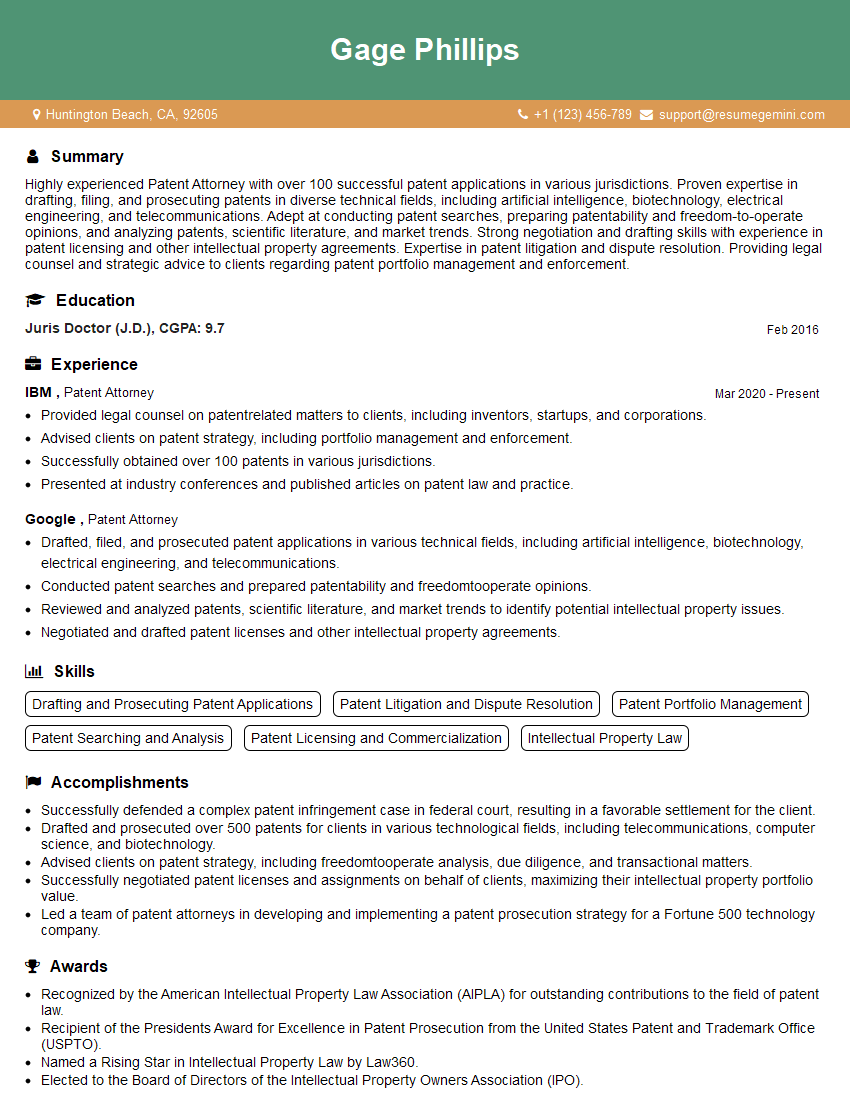
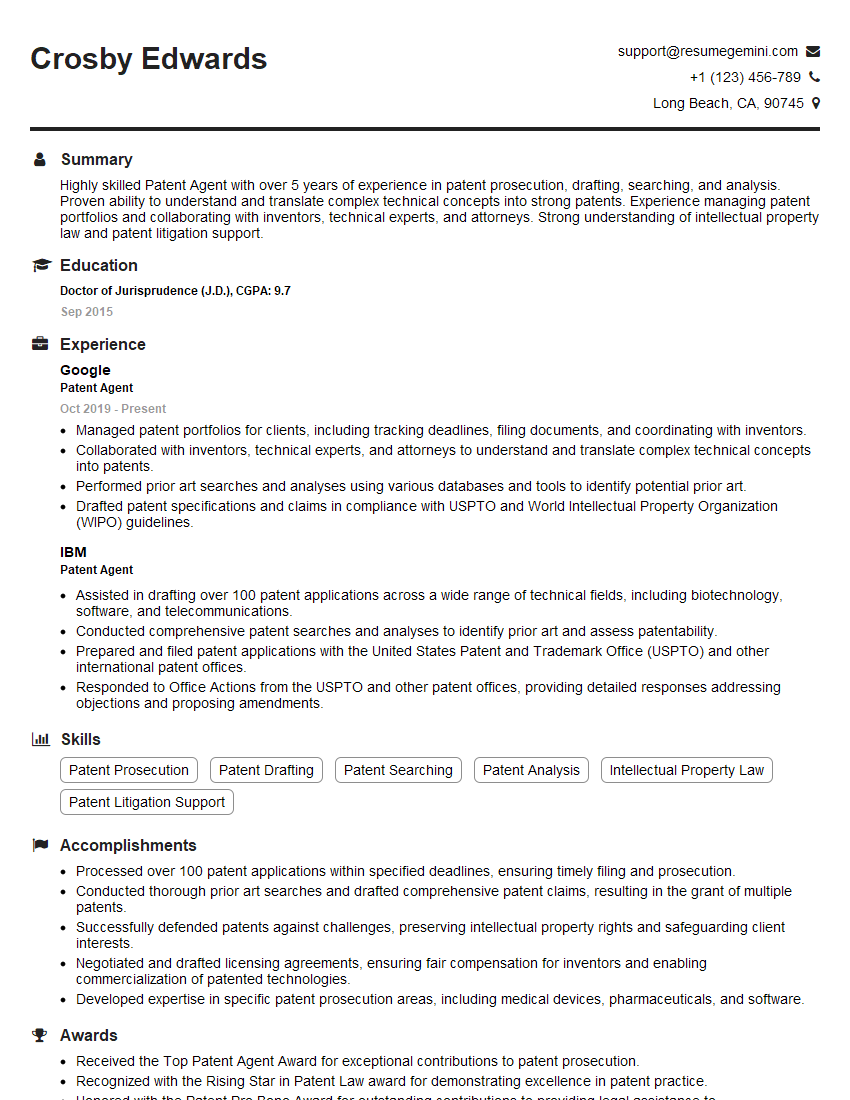
Mastering Patent Cooperation Treaty (PCT) filing opens doors to exciting career opportunities in intellectual property law and management. A strong understanding of these concepts will significantly enhance your interview performance and job prospects. To further strengthen your application, focus on building an ATS-friendly resume that highlights your skills and experience. ResumeGemini is a trusted resource to help you craft a professional and impactful resume that catches the eye of recruiters. They even provide examples of resumes tailored to Patent Cooperation Treaty (PCT) Filing, giving you a head start in your job search.
Explore more articles
Users Rating of Our Blogs
Share Your Experience
We value your feedback! Please rate our content and share your thoughts (optional).
What Readers Say About Our Blog
Very informative content, great job.
good