The right preparation can turn an interview into an opportunity to showcase your expertise. This guide to Patent Infringement Analysis interview questions is your ultimate resource, providing key insights and tips to help you ace your responses and stand out as a top candidate.
Questions Asked in Patent Infringement Analysis Interview
Q 1. Explain the process of claim construction in patent infringement analysis.
Claim construction is the process of determining the meaning and scope of the claims in a patent. It’s essentially defining the boundaries of what the patent protects. This is crucial because infringement is determined by comparing the accused product or process to these defined boundaries. Think of it like drawing a fence around your property – the fence defines what’s yours and what’s not. The claims are the legal “fence” of a patent.
The process often involves analyzing the claim language itself, considering the patent specification (the detailed description of the invention), the prosecution history (the record of interactions with the patent office), and any relevant expert testimony. Judges or juries rely heavily on this construction to determine if infringement has occurred.
For example, a claim might read: “A method for brewing coffee comprising the steps of: (a) heating water; (b) adding ground coffee beans; (c) filtering the mixture.” Claim construction would clarify what “heating water” means (e.g., does it include using a microwave, stovetop, or specific temperature ranges?), what constitutes “ground coffee beans” (e.g., does it exclude instant coffee?), and what defines “filtering” (e.g., what types of filters are acceptable?). Ambiguities are resolved through a careful examination of the patent’s documentation and context.
Q 2. Describe the difference between literal infringement and doctrine of equivalents.
Literal infringement occurs when the accused product or process falls squarely within the literal language of the patent claims. It’s a direct, word-for-word match. Think of it like a perfect overlap between the claimed invention and the accused product. If every element of a claim is found in the accused product, it’s literal infringement.
The doctrine of equivalents, on the other hand, broadens the scope of patent protection beyond the literal language of the claims. It addresses situations where the accused product or process doesn’t literally infringe but performs substantially the same function in substantially the same way to achieve substantially the same result. This doctrine prevents someone from avoiding infringement by making insignificant changes to a patented invention. It’s like making minor tweaks to a recipe while still producing the same outcome – you could still be held liable for infringement under the doctrine of equivalents.
For instance, if a patent claims a “red ball” and an infringer uses an “orange ball,” literal infringement might not exist, but the doctrine of equivalents could apply if the color difference is immaterial to the ball’s function.
Q 3. How do you determine the scope and validity of a patent claim?
Determining the scope and validity of a patent claim is a complex process that involves multiple factors. The scope defines what the patent protects, while validity determines if the patent is legally sound. Both are critical in infringement analysis.
- Scope: As mentioned earlier, claim construction directly determines the scope. The broader the claims, the more they potentially cover, but the risk of invalidity increases. Narrower claims offer less protection but are generally safer from invalidation.
- Validity: Validity is assessed by determining if the invention is novel (new), non-obvious (not an obvious variation of existing technology), and useful (has practical application). Prior art, which includes all publicly known inventions before the patent application’s filing date, plays a critical role in assessing novelty and non-obviousness. If prior art anticipates the invention or renders it obvious, the patent may be invalid.
A patent examiner at the patent office initially assesses validity, but courts may revisit this during infringement litigation. An invalid patent cannot be enforced, regardless of whether infringement has occurred.
Q 4. Explain the role of prior art in patent infringement analysis.
Prior art is crucial in patent infringement analysis, primarily for assessing the validity of a patent and, to a lesser extent, interpreting the claims. Prior art encompasses any information publicly available before the patent’s filing date, including patents, publications, products, and processes.
If prior art shows that the claimed invention was already known or obvious before the patent application, the patent may be deemed invalid. This is because a patent must represent a novel and non-obvious contribution to the field. The more prior art that anticipates the patented invention, the weaker the patent becomes. Prior art can also be used to help understand the meaning of the claims, particularly when the claim language is ambiguous.
Imagine prior art as a historical record of inventions. If your invention is already recorded in this history before your patent application, then your patent wouldn’t be valid because it’s not truly new.
Q 5. What are the key elements of a patent infringement lawsuit?
A patent infringement lawsuit typically involves several key elements:
- The Patent: The plaintiff (patent holder) must establish ownership of a valid patent.
- Infringement: The plaintiff must prove that the defendant (accused infringer) has infringed the patent claims, either literally or under the doctrine of equivalents.
- Damages: If infringement is found, the plaintiff can seek monetary damages to compensate for the harm caused by the infringement. This could include lost profits, royalties, or other economic losses.
- Injunctive Relief: The plaintiff may request an injunction to stop the defendant from continuing the infringing activity. This is particularly important to protect the market share of the patent holder.
- Defendant’s Defenses: The defendant can raise defenses, such as invalidity of the patent, non-infringement (literal or under the doctrine of equivalents), or unenforceability (due to misconduct by the patent holder).
The entire process involves extensive discovery, expert testimony, and legal arguments, often leading to a lengthy and costly legal battle.
Q 6. How do you assess the infringement of a software patent?
Assessing the infringement of a software patent presents unique challenges because software is often implemented in many different ways. Literal infringement is difficult to prove, as even minor code changes can avoid direct matches with the claims. The doctrine of equivalents is often more relevant. The focus is on comparing the functionality, not the code itself.
The analysis requires a deep understanding of both the patented software and the accused software’s functionalities. This often involves reverse engineering to understand the inner workings of the accused software. Experts in software engineering and computer science are essential in identifying whether the accused software performs the same function as the patented software in substantially the same way to achieve substantially the same result. Even if the code is different, similar algorithms or data structures could still lead to a finding of infringement.
A key aspect is identifying the “means-plus-function” claims, which specify functions without precisely defining the specific structures used to perform those functions. These claims offer a broader protection but require demonstrating equivalence in the functionality.
Q 7. Describe your experience with different types of patent claims (e.g., method, composition, system).
Throughout my career, I’ve worked extensively with various types of patent claims, each requiring a nuanced approach to infringement analysis:
- Method Claims: These claims protect a particular process or series of steps. Analysis focuses on whether the accused process performs the same steps, in the same order, to achieve the same result. Minor variations might still constitute infringement under the doctrine of equivalents.
- Composition Claims: These claims protect a specific composition of matter, like a chemical compound or a pharmaceutical formulation. Analysis involves comparing the chemical composition and properties of the claimed invention to the accused product. Minor variations in concentration or the addition of insignificant components might not affect infringement.
- System Claims: These claims protect an apparatus or system that includes multiple components working together. Analysis involves comparing the structure and functionality of the claimed system to the accused system. The key is to establish whether the accused system incorporates all essential elements of the claimed system.
My experience extends to complex claims involving combinations of these types, along with claims that incorporate specific features or limitations. Each case requires a detailed understanding of the technology and the specific wording of the claims.
Q 8. How do you identify potential infringers?
Identifying potential infringers begins with a thorough understanding of the asserted patent claims. We meticulously examine the patent’s specifications and claims to define the protected invention precisely. Then, we utilize a multi-pronged approach. This involves comprehensive searches of relevant product databases, market analyses to identify competitors, and online searches to locate companies potentially using the patented technology. We also leverage specialized software tools for patent landscaping and infringement analysis. For example, if the patent protects a novel method for image compression, we would search for companies selling products or offering services that incorporate image compression. We’d analyze their marketing materials, technical specifications, and even conduct reverse engineering (if appropriate) to determine if their products or services infringe on the claimed invention. The process often incorporates keyword searches using specific technical terms from the patent claims, which helps narrow down the search and improve efficiency. This systematic approach allows us to identify potential infringers with a high degree of accuracy and minimize false positives.
Q 9. What are some common defenses against patent infringement?
Several common defenses exist against patent infringement accusations. One is invalidity, arguing that the patent itself is legally flawed because it doesn’t meet the requirements of patentability (e.g., novelty, non-obviousness, utility). Another common defense is non-infringement, where the accused party argues that their product or process doesn’t actually fall within the scope of the patent claims. This could involve arguing that the claims are interpreted narrowly, or that certain elements of the claim aren’t present in the accused product. A third defense is unenforceability, which argues that the patent shouldn’t be enforced due to misconduct during the prosecution of the patent application, such as inequitable conduct. Finally, prior art can be used as a defense to demonstrate that the invention was already known or used before the patent application’s filing date. Successfully employing these defenses requires deep technical knowledge, meticulous legal analysis, and a persuasive presentation in court.
Q 10. Explain the concept of willful infringement.
Willful infringement refers to patent infringement that occurs knowingly and intentionally. It’s a more serious form of infringement than unintentional infringement. Establishing willful infringement often requires demonstrating that the infringer had actual knowledge of the patent and consciously chose to infringe upon it, or that they acted with deliberate indifference or reckless disregard for the patent’s existence. This heightened standard of culpability usually necessitates presenting evidence like internal communications, expert testimony regarding the infringer’s awareness of the patent, or their attempts to design around the patent’s claims that ultimately failed. The consequences of a finding of willful infringement are severe. They can include enhanced damages, which often significantly increase the monetary award to the patent holder, and the possibility of injunctive relief, preventing the infringer from further production or sales of the infringing product.
Q 11. How do you analyze the commercial impact of patent infringement?
Analyzing the commercial impact of patent infringement requires a multi-faceted approach. We assess the infringer’s market share, revenue generated from the infringing products, and the potential lost profits the patent holder suffered. We examine factors such as the infringing product’s sales volume, pricing strategy, and overall market demand. We also consider the patent holder’s potential lost sales and the competitive landscape. This involves gathering market research data, conducting financial analyses, and creating economic models to quantify the monetary losses the patent holder has incurred due to the infringement. In some cases, we also assess the impact on brand reputation, business relationships, and potential future market opportunities. This comprehensive evaluation is crucial in determining the appropriate monetary compensation and crafting a strategic litigation plan.
Q 12. Describe your experience with patent litigation discovery.
Patent litigation discovery is a crucial phase where both sides exchange information. My experience includes extensive participation in discovery, ranging from formulating detailed interrogatories and requests for production of documents to conducting depositions of key witnesses. I’ve managed large volumes of electronically stored information (ESI), utilizing tools like Relativity to organize, review, and analyze relevant data. In one case, we successfully uncovered internal emails showing the defendant’s conscious decision to proceed despite awareness of the patent, which was vital in establishing willful infringement. The strategic planning and execution of the discovery process are paramount. It demands a deep understanding of the applicable rules of evidence and a keen ability to identify and secure critical information that supports our client’s case. Effective use of discovery can significantly influence the outcome of the litigation.
Q 13. How do you handle complex patent claim charts?
Complex patent claim charts can be daunting, but a systematic approach is key. We start by breaking down each claim element individually. Then, we create a visual representation—often using software tools—that maps each element to the accused product’s components or processes. This allows us to clearly identify any potential overlaps or discrepancies. Color-coding, annotations, and clear labeling enhance readability and facilitate quick identification of critical aspects. Furthermore, we develop a structured approach for evaluating claim limitations against the accused device or method. We may create tables comparing specific claim limitations with corresponding features of the accused technology, making it easy to assess the presence or absence of each element. This ensures that no element is overlooked. This meticulous approach allows us to efficiently assess infringement and build a strong case, even when faced with intricate claims.
Q 14. Explain the difference between a patent and a trademark.
Patents and trademarks protect different aspects of intellectual property. A patent protects a novel invention—a new and useful process, machine, manufacture, composition of matter, or any new and useful improvement thereof. Patents grant the inventor exclusive rights to use, sell, and manufacture the invention for a specified period. Think of it as protecting the functionality or underlying technology of a product or process. A trademark, conversely, protects brand identifiers like logos, slogans, and brand names. Trademarks prevent others from using confusingly similar marks that could cause consumer confusion regarding the source of goods or services. Trademarks protect branding and consumer recognition, unlike patents, which protect inventions. For example, a patent might protect the specific technology behind a new type of smartphone camera, whereas a trademark protects the brand name and logo associated with the smartphone itself. Both are valuable forms of intellectual property protection but serve distinct purposes.
Q 15. What is the role of expert witnesses in patent litigation?
Expert witnesses in patent litigation play a crucial role in bridging the gap between complex technical information and the legal understanding of the court. They are highly specialized individuals with extensive knowledge in the relevant field of technology, who can provide unbiased, credible opinions and analyses to assist the judge and jury in understanding the technical aspects of the case.
Their testimony often centers around the claims of the patent, the accused infringing product or process, and the prior art. They might be called upon to explain complex technical concepts in simple terms, compare and contrast the patent claims with the accused technology, and assess the validity of the patent based on prior art. Essentially, they translate technical jargon into understandable explanations, enabling the court to make an informed decision.
For example, in a software patent infringement case, an expert witness might explain the functionality of the patented software algorithm and how the defendant’s software utilizes similar or identical concepts. This clarifies the potentially complex technical issues for the legal team and the court.
Career Expert Tips:
- Ace those interviews! Prepare effectively by reviewing the Top 50 Most Common Interview Questions on ResumeGemini.
- Navigate your job search with confidence! Explore a wide range of Career Tips on ResumeGemini. Learn about common challenges and recommendations to overcome them.
- Craft the perfect resume! Master the Art of Resume Writing with ResumeGemini’s guide. Showcase your unique qualifications and achievements effectively.
- Don’t miss out on holiday savings! Build your dream resume with ResumeGemini’s ATS optimized templates.
Q 16. How do you evaluate the strength of a patent?
Evaluating the strength of a patent is a multifaceted process, relying on a comprehensive assessment of several key factors. It’s like judging the structural integrity of a building – you need to examine various aspects before you can confidently assess its overall strength.
- Claim Scope: Broader claims cover a wider range of technologies but are more vulnerable to challenges based on prior art. Narrower claims are more specific and easier to defend, but might limit the protection offered.
- Prior Art Search: A thorough search for prior art (existing inventions or publications) is crucial. If the invention is already publicly known, the patent may be deemed invalid due to anticipation or obviousness.
- Claim Construction: The way the patent claims are interpreted is critical. Ambiguous claims can be open to various interpretations, weakening the patent’s protective power. Precisely worded claims are much stronger.
- Novelty and Non-obviousness: The invention must be novel (new and unique) and non-obvious (not an obvious extension of existing technology) to a person skilled in the art. This is often the most challenging aspect to prove or disprove.
- Enablement: The patent’s specification must adequately describe how to make and use the invention. If it fails to do so, it can be challenged for lack of enablement.
Each factor contributes to the overall strength assessment. A patent with broad claims but weak novelty may be considered weak, while a patent with narrower claims, strong novelty, and clear enablement may be considered strong. The evaluation is always relative and case-specific.
Q 17. Describe your experience using patent databases (e.g., USPTO, Google Patents).
I have extensive experience using various patent databases, including the USPTO (United States Patent and Trademark Office) database and Google Patents. These databases are indispensable tools for patent infringement analysis and patent portfolio management.
The USPTO database is the primary source for US patents, providing detailed information on granted patents, pending applications, and related documents. I routinely use its advanced search features to locate relevant patents based on keywords, classification codes (CPC or USPC), and applicant names. Google Patents provides a user-friendly interface for searching across multiple patent offices worldwide, facilitating broader prior art searches.
My experience involves not just searching, but critically evaluating the results. This includes understanding the different patent types, parsing the complex language of patent claims and specifications, and identifying relevant prior art that could be used to challenge or support a patent’s validity. I am also skilled in using Boolean operators and other advanced search techniques to refine search results and effectively manage large datasets of patent documents.
Q 18. How do you assess the validity of a patent based on prior art?
Assessing the validity of a patent based on prior art is a rigorous process requiring meticulous attention to detail and a deep understanding of patent law. It involves comparing the claimed invention with the prior art to determine whether the invention is novel and non-obvious.
The process typically involves:
- Identifying relevant prior art: This requires thorough searches using various databases and strategies, focusing on publications, patents, and other evidence predating the patent’s filing date.
- Claim construction: Clearly defining the meaning of the patent claims is essential for determining whether the prior art anticipates or renders the claimed invention obvious.
- Comparing the prior art to the claims: This involves a detailed comparison to see if the prior art discloses all the elements of the claim (anticipation) or if the claimed invention would have been obvious to a person of ordinary skill in the art in view of the prior art (obviousness).
- Assessing the level of skill in the art: This understanding is crucial to determine what a person of ordinary skill in that particular field would have considered obvious at the time.
For example, if prior art discloses all the elements of a claim, the patent may be invalidated for anticipation. If the combination of two prior art references would render the claimed invention obvious, the patent may be invalidated for obviousness. These assessments are often complex and require expert judgment. A strong understanding of the specific technology area is also essential.
Q 19. What are some common pitfalls in patent infringement analysis?
Patent infringement analysis, while a systematic process, has several common pitfalls that can lead to inaccurate conclusions or missed opportunities. Avoiding these requires careful planning and execution.
- Incomplete Prior Art Search: Failing to conduct a thorough prior art search can lead to overlooking relevant prior art that could invalidate a patent or weaken the infringement claim.
- Improper Claim Construction: Misinterpreting the scope of the patent claims can lead to both false positives (erroneously identifying infringement) and false negatives (missing actual infringement).
- Ignoring Equivalents: Failing to consider the doctrine of equivalents, which allows for infringement even if the accused product doesn’t literally match the claim, can significantly limit the effectiveness of the analysis.
- Overlooking Design Arounds: The accused product might have implemented the essential function of the patented invention in a slightly different way, avoiding literal infringement but potentially still infringing under the doctrine of equivalents.
- Lack of Technical Expertise: Attempting analysis without sufficient expertise in the relevant technology can lead to flawed interpretation of technical specifications and functionality.
By employing a structured approach that addresses these pitfalls, including thorough prior art searching, careful claim construction, and a deep understanding of the relevant technology, the accuracy and robustness of patent infringement analysis can be significantly enhanced.
Q 20. Explain the concept of patent licensing.
Patent licensing is a legal agreement that grants a licensee the right to use a patented invention under specific terms and conditions. Think of it as renting the rights to use a patented technology, rather than owning it outright.
The patent holder (licensor) grants the license, while the licensee pays fees or royalties in exchange for the right to manufacture, use, or sell the patented technology. There are various types of licenses, including:
- Exclusive License: Grants the licensee the sole right to use the patented invention within a defined scope.
- Non-exclusive License: Allows the licensor to grant licenses to other parties.
- Sole License: Similar to exclusive but the licensor may retain some use rights.
Licensing can be a mutually beneficial arrangement. The licensor receives royalties and avoids the costs associated with manufacturing and distribution, while the licensee gains access to valuable technology without the need for extensive research and development. Negotiating the terms of a license, such as the royalty rate and the scope of the licensed rights, requires careful consideration of both parties’ interests.
Q 21. Describe your experience with patent portfolio management.
Patent portfolio management involves strategically managing a company’s collection of patents to maximize their value and minimize their risk. This includes actively monitoring, analyzing, and utilizing the patents to protect the company’s innovation and gain a competitive advantage.
My experience in patent portfolio management includes:
- Portfolio Analysis: Assessing the strength, scope, and value of existing patents.
- Patent Prosecution: Guiding the preparation and filing of patent applications to secure optimal patent protection.
- Freedom to Operate (FTO) Analysis: Identifying potential risks related to infringement of third-party patents.
- Licensing and Enforcement: Managing the licensing of patents and enforcing patent rights against infringers.
- Portfolio Optimization: Identifying and eliminating underperforming patents, while actively pursuing new patent applications related to the company’s key technologies.
Effective patent portfolio management requires a proactive approach, using data-driven analysis to identify opportunities and mitigate risks. It’s about creating a balanced portfolio of strong, well-protected patents that align with the company’s business strategy.
Q 22. How do you conduct a freedom-to-operate (FTO) analysis?
A Freedom-to-Operate (FTO) analysis is a crucial step before launching a new product or technology. It’s essentially a risk assessment determining whether your invention can be commercially used without infringing existing patents. Think of it as a pre-flight check for your product.
The process typically involves these steps:
- Identifying relevant technologies: This requires a deep understanding of your invention’s components and functions. What technologies are used? Are there any similar technologies on the market?
- Patent searching: We use specialized databases like Google Patents, Espacenet, and others to search for patents that might cover aspects of your invention. This involves using keywords related to your technology’s functionality and components.
- Claim analysis: This is the most critical step. We meticulously examine the claims of each potentially relevant patent. Patent claims define the boundaries of the patent’s protection – they precisely describe what the invention is. We determine if your invention falls within the scope of any of these claims.
- Prior art analysis: We review prior art, which are inventions publicly known before the claimed invention. This helps determine the novelty and non-obviousness of your invention and the validity of the patents found.
- Risk assessment and mitigation: Based on the search results and claim analysis, we assess the likelihood of infringement. If a risk is identified, we explore mitigation strategies such as redesigning the product, licensing the patent, or seeking an opinion from a patent attorney.
For example, let’s say you are developing a new type of smartphone camera. An FTO analysis would involve searching for patents related to image stabilization, autofocus, lens design, and image processing. If we find a patent claiming a specific image stabilization technique that is integral to your camera’s functionality, we need to carefully assess the risk of infringement and consider options to avoid potential legal issues.
Q 23. Explain the difference between a utility patent and a design patent.
Utility patents and design patents protect different aspects of an invention. A utility patent protects the functional aspects of an invention – how it works. A design patent protects the ornamental design of an invention – how it looks.
Think of a smartphone. A utility patent might cover a new method of energy-efficient screen display, while a design patent might protect the unique shape and aesthetic features of the phone’s casing.
- Utility Patent: Protects the functionality, processes, machines, manufactures, compositions of matter, or improvements thereof. It requires demonstrating novelty, non-obviousness, and utility.
- Design Patent: Protects the novel and ornamental design of a product. The design must be non-obvious to someone familiar with the art. It focuses on the visual appearance rather than the functionality.
The duration of protection is also different. Utility patents generally have a term of 20 years from the date of application, while design patents have a term of 15 years from the date of grant.
Q 24. How do you handle amendments to patent claims during litigation?
Handling amendments to patent claims during litigation is a complex process requiring a deep understanding of patent law and the specific facts of the case. Amendments can be proposed by either the patent holder (patentee) or the accused infringer. They aim to clarify the scope of the patent claims or address specific issues raised during the litigation.
Amendments are carefully scrutinized by the courts to ensure they don’t broaden the scope of the patent beyond what was originally claimed. The process often involves:
- Identifying the need for amendment: This may arise due to challenges to claim validity or issues with infringement analysis.
- Drafting the amendment: The amendment must be carefully worded to address the identified problem without broadening the scope of the claims.
- Submitting the amendment to the court: The amendment is presented to the court, often with supporting arguments justifying the changes.
- Opponent’s response: The opposing party will typically review and respond to the proposed amendments, potentially raising objections.
- Court’s decision: The court will review the proposed amendments and determine whether they are allowable based on patent law principles.
A successful amendment clarifies the scope of the patent claims, enhancing the clarity for the court and potentially strengthening the patentee’s position. However, poorly drafted amendments might weaken the patent or be deemed inadmissible by the court. Strategic considerations, including maintaining the validity and enforceability of the patent, are paramount throughout this process. It often requires a highly collaborative approach with experienced patent litigators.
Q 25. Describe your experience working with international patent laws.
My experience with international patent laws encompasses a significant portion of my career. I’ve worked on numerous cases involving patents filed in multiple jurisdictions, including the US, Europe, Japan, and China. Understanding international patent law requires recognizing that each country has its own unique system, procedures, and legal precedents.
Key aspects of my experience include:
- Navigating different patent offices: I’m familiar with the processes and requirements of various patent offices worldwide, such as the European Patent Office (EPO), the Japanese Patent Office (JPO), and the Chinese National Intellectual Property Administration (CNIPA).
- Understanding different claim interpretation approaches: Patent claim construction – how claims are interpreted – can vary across jurisdictions. This requires a nuanced understanding of the legal frameworks in each country.
- Managing cross-border litigation: I’ve been involved in coordinating international litigation efforts, including managing multiple law firms, experts, and witnesses.
- Addressing jurisdictional issues: I have experience in analyzing where to file lawsuits strategically, considering factors such as venue, available remedies, and the specific legal landscape of a particular jurisdiction.
For instance, a recent case involved a client with a US patent seeking to enforce their rights against an infringer operating primarily in China. We needed to carefully analyze the relevant Chinese patent laws, consider the challenges of enforcing a foreign patent in China, and develop a comprehensive strategy for navigating the complex legal landscape of that jurisdiction.
Q 26. How do you prepare for a deposition in a patent infringement case?
Preparing for a deposition in a patent infringement case is critical, as it can significantly impact the outcome of the litigation. A deposition is a sworn testimony given under oath outside of court. Preparation is key to effectively presenting your case and protecting your client.
My preparation typically involves:
- Thorough review of the case documents: This includes the patent, the accused product, prior art, expert reports, and all other relevant documentation. The goal is to have a deep understanding of the technical details, the legal arguments, and the facts of the case.
- Identifying potential questions: I anticipate the questions the opposing counsel might ask, based on the case documents and the adversary’s strategy. This helps in formulating clear and concise answers.
- Practice answering questions: Mock depositions with colleagues or superiors are invaluable for practicing different scenarios and improving the delivery of responses. This allows for refining answers and building confidence.
- Highlighting key evidence: Identifying and preparing specific documents or exhibits that support my client’s position is essential for effective communication during the deposition.
- Collaborating with legal counsel: Close collaboration with the legal team ensures that answers are legally sound and strategically aligned with the case objectives.
Remember, a deposition is not just about answering questions accurately, but also about presenting information in a clear, concise, and compelling manner. The goal is to leave a positive and credible impression on the opposing counsel and the court.
Q 27. What are some ethical considerations in patent infringement analysis?
Ethical considerations are paramount in patent infringement analysis. Maintaining integrity and objectivity is crucial to ensure fairness and the proper administration of justice.
Key ethical considerations include:
- Complete and accurate disclosure: It’s essential to disclose all relevant information, even if it’s unfavorable to the client’s case. Withholding information constitutes a serious ethical breach.
- Avoiding conflicts of interest: It’s critical to avoid situations that might compromise impartiality, such as having a financial interest in the outcome of the case.
- Maintaining confidentiality: Client information is confidential and must be protected at all times.
- Respect for intellectual property rights: Analyzing patents requires respect for the rights of patent holders. Our work should not encourage or facilitate infringement.
- Competence and diligence: We must possess the necessary expertise and skills to handle the work effectively and with diligence. Taking on cases beyond our capabilities is unethical.
For example, if I uncover evidence that contradicts my client’s position, I have a responsibility to disclose this to my client and legal team. It is unethical to selectively present only the information that supports the client’s narrative. Ethical conduct ensures trust and maintains the integrity of the legal system.
Q 28. Explain your experience with different types of damages calculations in patent infringement cases.
My experience encompasses various methods of damages calculations in patent infringement cases, focusing on accurately quantifying the financial losses suffered by the patent holder due to the infringement.
Common approaches include:
- Reasonable royalty: This approach determines the royalty the patent holder would have received had they licensed the patented technology to the infringer. It considers factors such as the patent’s value, the infringer’s profits, and industry licensing practices.
- Lost profits: This method calculates the profits the patent holder lost due to the infringement. This requires demonstrating a causal link between the infringement and the loss of profits.
- Enhanced damages: In some cases, the court may award enhanced damages to punish the infringer for willful infringement. This usually requires proving the infringer knew about the patent and intentionally infringed it.
The choice of methodology depends on the specifics of the case. For instance, a reasonable royalty approach is often preferred when lost profits are difficult to prove. I have experience developing detailed economic models, conducting market research, and working with expert witnesses to support our chosen methodology and ensure accurate and defensible damages calculations. Each case presents unique challenges, and thorough research and analysis are crucial for producing credible and persuasive evidence.
Key Topics to Learn for Patent Infringement Analysis Interview
- Claim Construction: Understanding the nuances of claim language and interpreting the scope of patent claims. This involves analyzing claim limitations, dependent claims, and the role of claim language in determining infringement.
- Infringement Theories: Mastering literal infringement, doctrine of equivalents, and the various legal tests used to determine whether an accused product or process infringes a patent. Practical application involves analyzing the accused product’s features against the claim limitations.
- Prior Art Analysis: Understanding how prior art impacts infringement analysis, particularly in the context of invalidity arguments. This includes identifying relevant prior art and assessing its impact on claim construction and infringement.
- Patent Prosecution History: Analyzing the file history of a patent to understand the intent behind claim language and potential limitations on the scope of the claims. This impacts how claims are interpreted during infringement analysis.
- Expert Witness Testimony: Understanding the role of expert witnesses in patent litigation, including the preparation and presentation of technical evidence related to infringement. This involves applying technical knowledge to support legal arguments.
- Types of Patents: Demonstrating a comprehensive understanding of different patent types (e.g., utility, design, plant) and how infringement analysis varies depending on the type of patent involved. This includes understanding the unique characteristics of each patent type.
- Case Law & Statutory Interpretation: Familiarity with key case law and statutory provisions relevant to patent infringement analysis. This requires understanding how courts have interpreted relevant laws and precedents.
Next Steps
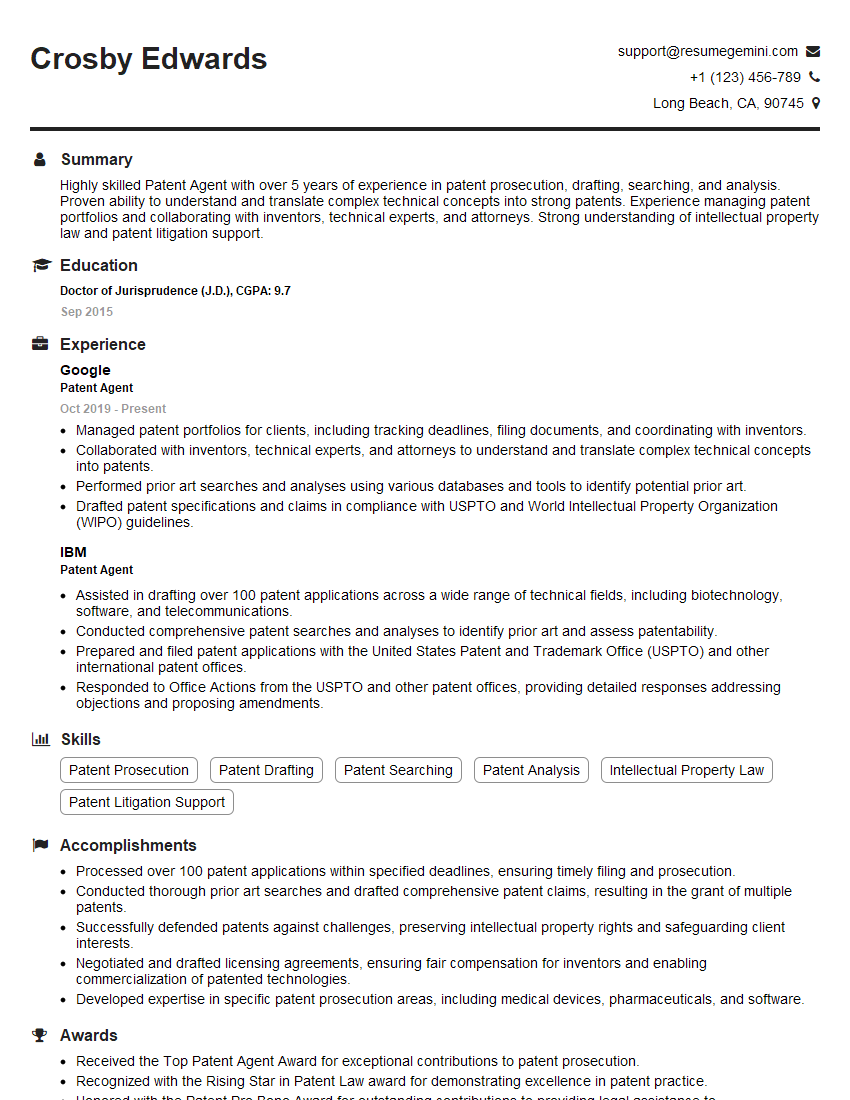
Mastering Patent Infringement Analysis is crucial for a successful and rewarding career in intellectual property law and related fields. A strong understanding of these concepts opens doors to exciting opportunities and positions you as a valuable asset to any organization dealing with patents. To maximize your job prospects, create a compelling and ATS-friendly resume that highlights your skills and experience effectively. ResumeGemini is a trusted resource to help you build a professional and impactful resume. We provide examples of resumes tailored to Patent Infringement Analysis to give you a head start. Invest time in crafting a strong resume – it’s your first impression with potential employers.
Explore more articles
Users Rating of Our Blogs
Share Your Experience
We value your feedback! Please rate our content and share your thoughts (optional).
What Readers Say About Our Blog
Very informative content, great job.
good