Cracking a skill-specific interview, like one for Knowledge of Sewing Machine Components, requires understanding the nuances of the role. In this blog, we present the questions you’re most likely to encounter, along with insights into how to answer them effectively. Let’s ensure you’re ready to make a strong impression.
Questions Asked in Knowledge of Sewing Machine Components Interview
Q 1. Explain the function of the feed dogs in a sewing machine.
The feed dogs are a crucial part of your sewing machine; think of them as the tiny teeth that move your fabric. They’re located under the needle plate and consist of two small, metal claws that grip and move the fabric forward with each stitch. Without properly functioning feed dogs, your fabric won’t advance smoothly, leading to inconsistent stitching and potential frustration.
They work in tandem with the presser foot, which holds the fabric firmly in place. The feed dogs pull the fabric, while the presser foot ensures it remains flat and aligned for even feeding. Imagine trying to sew without them – it would be like trying to draw a straight line with a shaky hand! The feed dogs provide that essential stability and control over fabric movement.
Different sewing machines offer variations in feed dog design. Some have drop-down feed dogs, allowing you to lower them for tasks like free-motion quilting or embroidering, while others have fixed feed dogs that are always engaged.
Q 2. Describe the different types of sewing machine needles and their applications.
Sewing machine needles come in a wide variety of types, each designed for specific fabrics and sewing projects. Choosing the right needle is vital for achieving a clean, professional finish and preventing needle breakage. Here are some common types:
- Universal Needles: These are your all-purpose workhorses, suitable for most woven fabrics like cotton, linen, and silk.
- Ballpoint Needles: Designed for knit fabrics, their rounded tip prevents snagging or damaging the delicate knit structure.
- Jeans Needles: Reinforced to withstand the heavy-duty stitching required for denim and canvas.
- Leather Needles: Feature a sharp point to easily pierce leather and other thick materials.
- Embroidery Needles: These have a larger eye to accommodate thicker embroidery threads.
- Stretch Needles: Similar to ballpoint needles, but specifically designed for stretch fabrics like spandex and lycra.
Selecting the incorrect needle can result in skipped stitches, broken needles, or damage to your fabric. Always check your needle type before starting a new project and match it to your fabric for optimal results. For instance, using a universal needle on a knit fabric will almost certainly lead to skipped stitches and puckered seams.
Q 3. How do you troubleshoot a sewing machine that is skipping stitches?
A sewing machine skipping stitches is a common problem, but usually easily solved. Here’s a systematic troubleshooting approach:
- Check the Needle: A bent, dull, or incorrectly inserted needle is the most frequent culprit. Replace it with a new needle of the correct type and size for your fabric and project.
- Inspect the Thread: Ensure the thread is correctly threaded through the machine, free from knots or tangles, and appropriate for your fabric and project. Different thread types and weights work better with different needles and materials. A thin thread on thick fabric can lead to skipped stitches.
- Examine the Tension: Improper tension settings can cause skipped stitches. Adjust the upper and bobbin tension until the stitches are even and balanced on both sides of the fabric.
- Check the Feed Dogs: Make sure the feed dogs are raised and functioning correctly. If the feed dogs are clogged with lint or debris, clean them thoroughly.
- Inspect the Bobbin Case: Make sure the bobbin is properly seated and the bobbin case is clean and free from lint.
- Check for Fabric Obstructions: If anything is interfering with the movement of the fabric, this may also cause skipped stitches. For example, a pin or piece of thread left behind.
By methodically checking each of these points, you’ll likely pinpoint the cause of the skipping stitches. If the problem persists after trying all these steps, it’s time to consult a sewing machine repair technician.
Q 4. What are the common causes of a broken needle?
Broken needles are a common sewing frustration, often caused by several factors:
- Using the wrong needle for the fabric: Attempting to sew heavy denim with a fine needle will inevitably break the needle.
- Bent needles: A bent needle will not sew properly and likely break under stress.
- Dull needles: A dull needle will have difficulty piercing thick fabrics and may snap.
- Incorrect needle insertion: Improperly inserted needles can easily bend or break.
- Hitting pins or other obstructions: Fabric pins or other materials left in the fabric will cause needle breakage.
- Incorrect thread tension: Excessive tension puts undue stress on the needle.
- Sewing too fast: High speeds strain the needle.
Preventing broken needles involves careful attention to needle selection, proper insertion, and avoiding high speed sewing when working with heavier fabrics.
Q 5. How do you adjust the tension on a sewing machine?
Sewing machine tension refers to the balance between the upper thread (from the spool) and the bobbin thread (from the bobbin case). Proper tension creates even stitches that look the same on both the top and bottom of the fabric. Too much tension on one side leads to puckering or broken threads; too little tension results in loose stitches.
Adjusting tension varies by machine model, but generally involves:
- Upper Thread Tension: This is usually controlled by a dial or knob located near the spool pin. Turning the dial clockwise increases tension, while counter-clockwise decreases it.
- Bobbin Tension: Bobbin tension is often more challenging to adjust, as it usually involves adjusting tiny screws inside the bobbin case. Consult your sewing machine’s manual for specific instructions, as this can vary greatly between machine types.
When adjusting tension, make several test stitches on a scrap of fabric to see the effect of your changes. Aim for stitches where the top and bottom threads are interwoven evenly and neatly, without puckering or looseness. Remember, small adjustments are often more effective than large ones.
Q 6. Explain the difference between a straight stitch and a zigzag stitch.
The straight stitch and the zigzag stitch are fundamental sewing stitches, each serving distinct purposes:
- Straight Stitch: This is the most basic stitch, creating a simple, straight line of stitching. It’s ideal for seams, hemming, and general sewing applications. It’s known for its strength and is the foundation of most sewing projects. Think of it as the building block of garment construction.
- Zigzag Stitch: This stitch creates a pattern of alternating straight lines, resembling a ‘Z’ shape. Its primary function is to prevent seams from unraveling (overlocking) and to secure raw edges. It’s also used for decorative purposes and applying elastic. It’s more versatile than the straight stitch, providing added flexibility and durability to seams.
The difference lies in their stitch formation and application. The straight stitch is purely functional, while the zigzag stitch offers both functionality and decorative capabilities. Both are essential in a sewer’s toolkit, with the choice between them depending entirely on the task at hand.
Q 7. Describe the function of the bobbin and how to properly wind it.
The bobbin is a small, cylindrical spool that holds the lower thread in your sewing machine. It works in conjunction with the upper thread to create the stitch. A properly wound and correctly placed bobbin is essential for smooth sewing.
To wind a bobbin:
- Place an empty bobbin on its spindle (usually found on the side or top of your machine): Make sure it’s correctly seated and aligned.
- Thread the bobbin winder: This usually involves guiding the thread onto a small pin or groove on the bobbin winder, which is a separate mechanism on the machine.
- Turn on the bobbin winder: This mechanism will spin the bobbin, winding the thread onto it. Stop winding when the bobbin is full—avoid overfilling.
- Remove the full bobbin: Carefully remove the wound bobbin from the spindle.
- Insert the bobbin into the bobbin case: This is a small compartment within the machine’s body. Consult your machine’s manual for precise instructions as placement varies by model. Ensure the bobbin is inserted correctly; an improperly placed bobbin can lead to tangled threads and improper stitching.
Proper bobbin winding ensures consistent tension and prevents thread jams or breakage. Always wind bobbins carefully and refer to your sewing machine’s manual for specific instructions.
Q 8. How do you clean and lubricate a sewing machine?
Cleaning and lubricating your sewing machine regularly is crucial for its longevity and smooth operation. Think of it like servicing your car – preventative maintenance prevents bigger problems down the line. The process involves several steps:
Unplug the machine: Safety first! Always disconnect the power before beginning any cleaning or maintenance.
Dust removal: Use a soft brush or compressed air to remove dust and lint from all accessible areas, paying close attention to the bobbin case area, feed dogs, and shuttle race. A small vacuum with a brush attachment can be very helpful.
Oil application: Use high-quality sewing machine oil (not household oil!). Apply a single drop of oil to designated lubrication points. Your machine’s manual will specify these points; typically, they include the hook assembly, moving parts under the needle plate, and the various shafts and gears. Avoid over-oiling; too much oil can attract more dust and lint.
Clean the bobbin case: Remove the bobbin case and clean it thoroughly with a soft brush. Lint buildup here is a common cause of sewing problems. You can also use a lint-free cloth dampened with sewing machine cleaner (available at sewing stores) for a more thorough clean.
Clean the needle plate: Remove the needle plate (if possible on your machine model) and clean away any accumulated lint and debris from underneath.
Test run: After cleaning and oiling, run a test stitch to ensure everything is running smoothly. Listen for any unusual noises – this could indicate a problem that requires further attention.
Remember, consistency is key. Regular cleaning and lubrication, even just a quick wipe down after each project, will significantly extend the life of your sewing machine.
Q 9. What are the safety precautions when working with a sewing machine?
Sewing machine safety is paramount. Treat your machine with respect and always follow these precautions:
Unplug before cleaning or maintenance: This prevents accidental shocks.
Keep fingers clear of the needle: Never reach under the needle while the machine is running. Use the finger guards provided on many machines.
Keep the area clear: Remove any loose fabric, cords, or obstructions that could get caught in the machine.
Use the correct needle and thread: Using the wrong type can cause breakage or damage to the machine.
Avoid loose clothing: Keep long hair tied back and avoid wearing loose clothing that could get caught in the moving parts.
Supervise children: Never allow children to operate a sewing machine without adult supervision.
Regular maintenance: Keep your machine clean and lubricated to prevent malfunctions and potential injuries.
Following these simple safety measures will greatly reduce the risk of accidents and injuries. Remember, a moment of carelessness can lead to serious consequences.
Q 10. How do you identify and repair a broken timing belt?
A broken timing belt can significantly impact your sewing machine’s functionality, causing the needle and hook timing to be off. This results in skipped stitches or a complete inability to sew. Identifying a broken belt is usually straightforward – you’ll see a visibly broken or stretched component. Repairing it requires:
Accessing the timing belt: This often involves opening the sewing machine’s casing. Consult your machine’s manual for specific instructions as it varies across models.
Inspecting the belt: Examine the belt for any cracks, fraying, or obvious breaks. Even minor damage may warrant replacement.
Replacing the belt: This requires careful alignment. The machine manual provides diagrams showing the correct routing of the belt. Improper alignment can lead to further damage. Ensure the new belt has the correct specifications for your machine model.
Reassembly: Carefully reassemble the machine, following your manual’s instructions. Pay close attention to the proper alignment of all parts.
Testing: Run a test stitch to ensure the needle and hook are properly timed and the machine is functioning correctly.
Replacing a timing belt can seem daunting, but with careful attention to detail and your machine’s manual, it’s a manageable repair. If you’re uncomfortable working inside the machine’s mechanisms, a qualified repair technician should handle the repair.
Q 11. Explain the purpose of the presser foot and its various types.
The presser foot is a crucial component that holds the fabric firmly in place against the feed dogs, ensuring even feeding and stitch quality. Think of it as an anchor for your fabric during the sewing process. Different types of presser feet cater to various sewing techniques:
General-purpose foot: This is the standard foot used for most sewing tasks.
Zipper foot: Its narrow design allows sewing close to the zipper teeth.
Buttonhole foot: Guides the fabric for consistent buttonholes.
Overcasting foot: Creates neat overcasting stitches on raw edges.
Walking foot: Prevents fabric layers from shifting while sewing, ideal for thick fabrics or multiple layers.
Quilting foot: Offers enhanced control and visibility for quilting projects.
Each presser foot is designed for specific applications. Choosing the right foot ensures professional results and minimizes frustration. Always check your machine’s manual to understand compatibility and proper usage of the various presser feet.
Q 12. How do you troubleshoot a sewing machine that is making loud noises?
Loud noises from a sewing machine often signal a problem needing attention. Troubleshooting requires a systematic approach:
Identify the type of noise: Is it a grinding sound, a clicking, a squeaking, or something else? This helps narrow down the potential causes.
Check the needle: Bent or dull needles are common culprits. Replace the needle with a new one of the correct type for your fabric.
Inspect the timing: Incorrect timing between the needle and hook can cause loud noises. This is more complex and might require professional assistance.
Lubricate moving parts: Apply a drop of sewing machine oil to the appropriate areas. Over-lubrication can be just as problematic as under-lubrication.
Check the bobbin case: A damaged or improperly installed bobbin case can produce loud noises. Make sure it’s correctly inserted and not damaged.
Examine the feed dogs: Make sure the feed dogs are moving freely and not obstructed by lint or debris.
Check the belt: A loose or damaged belt can cause unusual noises. Assess its condition.
If the problem persists after these checks, it’s best to consult a sewing machine repair technician. Attempting complex repairs without proper knowledge can potentially cause more damage.
Q 13. What is the function of the stitch regulator?
A stitch regulator, often found on advanced sewing machines, maintains consistent stitch length regardless of sewing speed. Think of it as a cruise control for your stitches. It ensures even stitching, especially useful when sewing curves or working with different fabric thicknesses. Without a stitch regulator, stitch length can vary depending on how quickly you’re sewing, potentially affecting the quality of your project. This is particularly helpful for quilting and other precision sewing tasks.
Q 14. Explain the different types of sewing machine motors.
Sewing machine motors vary in power source and mechanism. The main types include:
Direct-drive motors: These motors are directly connected to the internal workings of the machine, offering enhanced precision and efficiency. They are quieter and often found in high-end sewing machines.
Belt-drive motors: The motor is connected to the machine via a belt, transferring power to the internal mechanisms. They are a more common and generally less expensive option. The belt can wear out over time and require replacement.
Rotary hook motors: These work in conjunction with a rotary hook system. This type of hook provides smooth operation and is generally associated with lighter-duty machines.
AC motors: Older machines typically utilize alternating current (AC) motors. These usually require a higher voltage.
DC motors: Modern machines increasingly use direct current (DC) motors. They provide more speed and power control.
The choice of motor type often influences the sewing machine’s features, performance, and price point. Understanding the differences helps make informed purchase decisions.
Q 15. How do you maintain a walking foot sewing machine?
Maintaining a walking foot sewing machine involves more than just basic cleaning. Because the walking foot mechanism adds complexity, regular attention is crucial for optimal performance and stitch quality. Think of it like maintaining a car – regular checks prevent major breakdowns.
Cleaning: Regularly brush away lint and dust from the feed dogs, walking foot, and surrounding areas. Use a soft brush and compressed air to reach hard-to-access spots. A build-up of lint can interfere with the even feed of fabric.
Lubrication: Apply a high-quality sewing machine lubricant (not oil!) to the moving parts of the walking foot and the feed mechanism. This reduces friction and prevents wear. Follow your machine’s manual for specific lubrication points.
Inspection: Visually inspect the walking foot for any damage, such as bent or broken parts. Check the feed dogs to ensure they move freely and smoothly. A problem with the teeth might cause skipped stitches or uneven fabric feed.
Needle and Bobbin: Always use the correct needle for the fabric type, and ensure the bobbin is properly wound and inserted. Incorrect tension settings or a faulty bobbin can impact stitch quality and the evenness of fabric feed. Even the walking foot will struggle if the needle isn’t doing its job.
Career Expert Tips:
- Ace those interviews! Prepare effectively by reviewing the Top 50 Most Common Interview Questions on ResumeGemini.
- Navigate your job search with confidence! Explore a wide range of Career Tips on ResumeGemini. Learn about common challenges and recommendations to overcome them.
- Craft the perfect resume! Master the Art of Resume Writing with ResumeGemini’s guide. Showcase your unique qualifications and achievements effectively.
- Don’t miss out on holiday savings! Build your dream resume with ResumeGemini’s ATS optimized templates.
Q 16. Describe the process for changing the needle on an industrial sewing machine.
Changing the needle on an industrial sewing machine is a crucial yet straightforward task, essential for maintaining smooth operation and preventing damage. Improper needle insertion is a common cause of skipped stitches or needle breakage.
Raise the needle to its highest point. This ensures you have adequate clearance to safely remove and insert the needle.
Loosen the needle clamp screw. This screw holds the needle in place; usually, a small screwdriver is needed. Turn it counterclockwise.
Remove the old needle. Gently pull the old needle straight upwards. Do not twist it, as this could damage the needle clamp.
Insert the new needle. Ensure the flat side of the needle (the shaft) faces toward the back of the machine, aligning with the needle clamp. Push the needle firmly into the clamp until it is secure.
Tighten the needle clamp screw. Tighten the screw firmly, ensuring the needle is held securely but not over-tightened. Over-tightening can damage the needle.
Lower the needle. Check to ensure the needle moves freely and smoothly through its entire range of motion.
Q 17. What are the common problems associated with a malfunctioning hook assembly?
The hook assembly is the heart of the sewing machine, responsible for catching the upper thread loop to create the stitch. Malfunctions here can be disruptive. Think of it like a crucial cog in a clock – one small problem can stop the entire mechanism.
Broken Hook: A cracked or damaged hook will result in missed stitches and thread breakage. This requires professional repair or replacement.
Incorrect Timing: The hook’s timing must be precise. If it’s off, the hook won’t catch the loop correctly, leading to skipped stitches or loops on the underside of the fabric.
Bent Hook: Even slight bending can cause similar problems as a broken hook. A damaged hook must be replaced.
Worn Hook: Over time, the hook can wear down, especially on high-usage industrial machines. This can lead to inconsistent stitches and ultimately failure.
Lubrication Problems: Insufficient or incorrect lubrication can lead to increased friction and wear on the hook assembly, eventually causing it to malfunction.
Q 18. How do you troubleshoot a sewing machine that is not feeding fabric properly?
Troubleshooting fabric feeding problems requires a systematic approach. It’s a bit like detective work, systematically eliminating possibilities.
Check the feed dogs: Ensure they are clean and free from obstructions. Lint or thread build-up can prevent the fabric from moving properly. Sometimes a simple cleaning solves the issue.
Inspect the presser foot: Make sure the presser foot is correctly engaged and providing even pressure on the fabric. A loose presser foot is a common culprit.
Verify needle and tension: A bent needle or incorrect tension settings can cause feeding problems. Always use the correct needle for the fabric type and check your tension.
Examine the bobbin case and bobbin: A full or improperly wound bobbin, or issues within the bobbin case, can affect the feed.
Check the timing: Improper timing of the hook and feed dogs can be a more complex problem requiring a professional inspection.
Test with a different fabric: Sometimes the problem is with the fabric itself; using a different type can help isolate if the issue is with the machine or the material.
Q 19. Explain the importance of regular maintenance for sewing machines.
Regular maintenance for sewing machines is crucial for ensuring their longevity, efficiency, and safety. It’s like preventative car maintenance; it saves money and headaches in the long run.
Increased lifespan: Regular cleaning and lubrication prevent wear and tear, extending the machine’s life.
Improved stitch quality: A well-maintained machine produces consistent, high-quality stitches, preventing time-consuming rework and frustration.
Reduced downtime: Preventative maintenance prevents unexpected breakdowns, reducing costly downtime and production delays, particularly crucial in a professional setting.
Safety: A properly maintained machine is a safer machine. Loose parts or worn components can pose safety risks.
Cost-effectiveness: Regular maintenance is far more cost-effective than emergency repairs.
Q 20. How do you identify the different types of stitch patterns?
Sewing machine stitch patterns are identified primarily through their stitch length, width, and the configuration of the upper and lower threads. Understanding these basics opens up a world of creative possibilities.
Straight Stitch: A simple straight stitch is the most basic type. It’s defined by its consistent length and the straight path of the needle.
Zigzag Stitch: This is characterised by its side-to-side movement of the needle creating a zig-zag pattern. The stitch width and length are adjustable.
Overlock Stitch: Creates a secure and finished edge for fabrics; this stitch often involves multiple threads for durability. It’s identified by its distinct looped edges.
Satin Stitch: Produces a dense, decorative filling stitch. It is characterized by its closely spaced, usually straight, stitches that often form a solid pattern.
Blind Stitch: A hidden stitch used for hemming, typically featuring stitches that are barely visible on the right side of the garment.
Many machines have stitch selection dials or digital displays that show stitch type and number. The machine’s manual will usually provide a visual reference guide for identifying the stitches available on that specific model.
Q 21. What tools are necessary for basic sewing machine repair?
Basic sewing machine repair requires a small, well-organized toolkit. Think of it as your sewing machine’s first aid kit.
Screwdrivers: A set of small screwdrivers (Phillips and flathead) in various sizes is essential for opening the machine and adjusting parts.
Needle-nose pliers: Useful for manipulating small parts and removing broken needles.
Tweezers: For handling tiny parts like screws or springs.
Small brush: For cleaning lint and dust from the machine’s interior.
Sewing machine oil: A high-quality sewing machine oil is needed for lubrication. Never use general purpose oils.
Cloth or lint-free rags: For cleaning and wiping down parts.
Magnifying glass: Helpful for inspecting tiny components and identifying problems.
Beyond these, a detailed sewing machine manual is invaluable for understanding the specific components and repair procedures for your particular machine model.
Q 22. How do you troubleshoot a sewing machine that is producing inconsistent stitch length?
Inconsistent stitch length on a sewing machine is a common problem, often stemming from several interconnected factors. Think of it like trying to write with a pen that sometimes releases more ink than others – the result is uneven strokes. To troubleshoot, systematically check these areas:
Tension: Incorrect upper or lower tension can cause this. Upper tension is controlled by a dial, and lower tension is adjusted via the bobbin case tension. Adjust them slightly, testing after each small adjustment. Too tight upper tension pulls the top thread down creating small stitches, and vice versa.
Stitch Length Dial: Ensure the stitch length dial is set to the desired length and is functioning correctly. Sometimes, the dial can be slightly jammed or misaligned.
Needle: A bent, dull, or incorrectly sized needle can create uneven stitches. Replace it with a new needle of the correct size and type for your fabric.
Feed Dogs: The feed dogs move the fabric under the needle. If they’re dirty or obstructed, they can cause inconsistent feeding. Clean them carefully with a brush and ensure nothing is obstructing their movement.
Timing: In more advanced machines, there’s a timing mechanism coordinating needle and hook movement. This usually requires professional attention if it’s misaligned.
Troubleshooting is a process of elimination. Start with the simplest solutions (needle, tension) and work your way to more complex issues. Always consult your machine’s manual for specific instructions and diagrams.
Q 23. Explain the different types of sewing machine presser feet and their uses.
Presser feet are specialized attachments that hold the fabric in place while sewing. Just like different tools are used for different carpentry tasks, each presser foot is designed for a specific sewing technique. Here are a few examples:
General-Purpose Foot: This is the workhorse, suitable for most straight stitching and basic sewing tasks. Think of it as your everyday screwdriver.
Zipper Foot: Its narrow design allows it to sew close to the zipper teeth without sewing over them. Like a specialized tool for precise work.
Buttonhole Foot: This foot creates consistent buttonholes, often with multiple steps. It’s like a jig for perfect holes.
Blind Hem Foot: This foot creates an almost invisible hem by catching only a few threads of the fabric edge. It’s a tool for the meticulous.
Walking Foot: Designed for multiple layers of fabric or difficult-to-feed materials (like leather or vinyl), it has its own feed dogs that help move all layers evenly.
Quilting Foot: Similar to a walking foot but often features an open toe for better visibility.
Selecting the correct presser foot is crucial for achieving professional-looking results. Always refer to your sewing machine’s manual to ensure you’re using the foot correctly.
Q 24. How do you adjust the stitch width on a sewing machine?
Adjusting stitch width changes the horizontal distance between stitches. It’s like controlling the spacing between words in a sentence; closer spacing gives a denser look, further spacing creates a looser look. Most machines have a dial or lever clearly marked ‘stitch width’ usually ranging from 0 (straight stitch) to a maximum width.
The process is usually straightforward: locate the stitch width control (often a dial or lever near the stitch length control), and turn or adjust it to your desired setting. Test on a scrap of fabric to ensure the width is correct. Some machines might require you to select a specific stitch type (like a zig-zag) to adjust the stitch width; the straight stitch often has a fixed width.
Q 25. Describe the process for replacing the bobbin case.
Replacing a bobbin case is essential for maintaining smooth sewing. It’s like changing a car’s oil – a preventative measure to avoid larger problems. The process varies slightly depending on the machine model, but generally:
Raise the Needle: Always ensure the needle is in its highest position to prevent damage.
Open the Bobbin Case Cover: Locate the cover (usually a small door or latch) that gives access to the bobbin area.
Remove the Old Bobbin Case: Carefully remove the old bobbin case, often by gently pulling it out or using a release mechanism. Note how it’s oriented to replace it correctly.
Insert the New Bobbin Case: Carefully insert the new (or refilled) bobbin case, ensuring it’s properly seated and oriented. Consult your machine’s manual for specific positioning.
Close the Bobbin Case Cover: Ensure the cover is securely closed.
Always consult your sewing machine’s manual for specific instructions. Incorrectly installed bobbin cases can lead to poor stitching, skipped stitches, or even damage to the machine.
Q 26. Explain the different types of sewing machine drives (direct drive, belt drive etc).
Sewing machine drives determine how the motor’s power is transferred to the needle and rotating hook. The two main types are:
Belt Drive: This is the classic system. The motor spins a belt that rotates a series of gears, ultimately moving the needle and hook. It’s like a chain transferring power in a bicycle. Belt drives are generally quieter but can lose power over time, or if the belt slips or breaks.
Direct Drive: In this system, the motor is directly connected to the needle shaft, eliminating the belt and reducing power loss. It’s like a direct connection from engine to wheels, providing more efficient power transfer. Direct drive machines tend to be quieter and more powerful.
Other less common drive types exist, but belt and direct drive represent the prevalent options in modern sewing machines. Each has its own advantages and disadvantages in terms of noise, power, and maintenance.
Q 27. How do you troubleshoot a sewing machine that is producing birdnesting?
Birdnesting – the tangled mess of upper and lower threads at the back of the sewing machine – is frustrating but usually fixable. Imagine two threads fighting over territory, leading to a knotty mess. The causes are typically:
Tension Problems: This is the most common culprit. Too much upper or lower tension pulls the threads tighter than they should be, leading to tangles. Adjust both the upper tension (dial on the machine) and the lower tension (bobbin case tension). Start with slight adjustments and test frequently.
Bobbin Winding Issues: An unevenly wound bobbin can cause feeding problems, resulting in birdnesting. Ensure the bobbin is properly and evenly wound.
Needle Issues: A bent, dull, or incorrectly sized needle can disrupt the timing of the stitch formation, causing thread build-up.
Incorrect Needle/Thread Combination: Using the wrong needle or thread type for your fabric can cause problems. Consult charts showing the proper pairings.
Dirty Machine: Lint or dust can build up in the bobbin area, interfering with the smooth movement of threads. Clean the machine regularly.
Systematic troubleshooting is key. Start with the simplest solutions (tension) and progress to more complex issues (cleaning).
Q 28. Describe the process for removing and installing a sewing machine needle.
Replacing a sewing machine needle is a basic maintenance task, but crucial for optimal sewing performance. A dull or bent needle is like writing with a dull pencil – it won’t perform as well. Here’s how:
Raise the Needle: Always raise the needle to its highest position.
Loosen the Needle Clamp Screw: Most machines have a screw on the needle clamp that needs to be loosened (usually by turning it counter-clockwise).
Remove the Old Needle: Gently pull the old needle straight out. Never force it.
Insert the New Needle: Insert the new needle, making sure the flat side of the needle shaft faces the back of the machine (towards the needle clamp). This is important for correct needle alignment.
Tighten the Needle Clamp Screw: Tighten the needle clamp screw securely.
Always use the correct needle size and type for your fabric and thread. Consult charts to ensure proper combinations. Incorrect needles lead to skipped stitches, broken needles and damage to the machine.
Key Topics to Learn for Knowledge of Sewing Machine Components Interview
- Basic Machine Anatomy: Understanding the function and interaction of key components like the needle, feed dogs, presser foot, bobbin, and stitch plate. Learn how to identify and troubleshoot issues related to each part.
- Stitch Formation: Explore the mechanics of stitch creation, including the role of the needle, hook, and bobbin in producing different stitch types. Be prepared to discuss the impact of tension and timing on stitch quality.
- Different Sewing Machine Types: Familiarize yourself with various sewing machine types (e.g., industrial, domestic, serger) and their unique components and functionalities. Discuss the advantages and disadvantages of each type for different applications.
- Maintenance and Troubleshooting: Develop a comprehensive understanding of routine maintenance procedures, including cleaning, lubrication, and needle changes. Practice identifying and resolving common sewing machine problems, focusing on diagnosing issues based on component malfunctions.
- Motor and Drive Systems: Understand the different types of motor systems used in sewing machines (e.g., direct drive, belt drive) and their impact on machine performance. Be ready to explain how these systems influence speed, power, and noise levels.
- Safety Procedures: Demonstrate knowledge of safe operating practices, including proper needle handling, guarding against moving parts, and maintaining a clean and organized workspace.
- Advanced Components (if applicable): Depending on the role, you may need to understand more specialized components like automatic thread cutters, programmable stitch controls, or specific features related to industrial sewing machines.
Next Steps
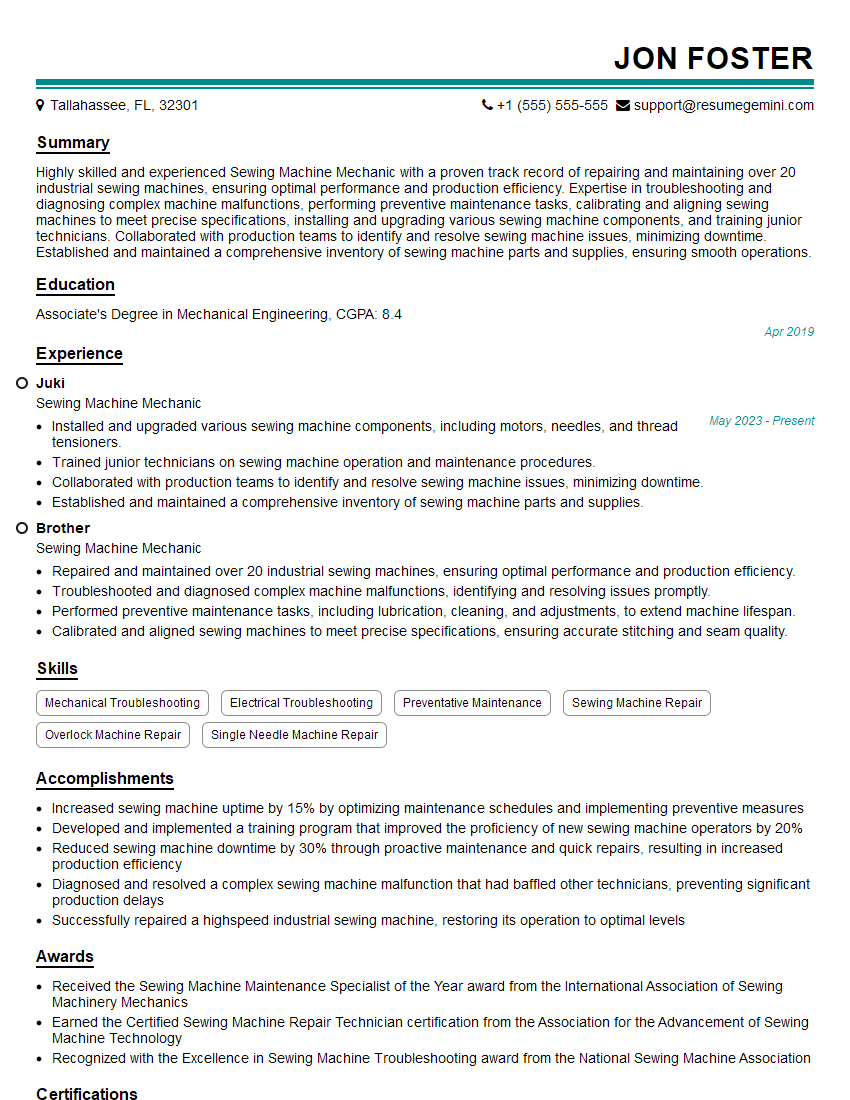
Mastering your knowledge of sewing machine components is crucial for career advancement in the sewing and textile industry, opening doors to more specialized roles and higher earning potential. A well-crafted resume is essential to highlight your expertise to potential employers. Creating an ATS-friendly resume, optimized for applicant tracking systems, significantly increases your chances of landing an interview. ResumeGemini is a trusted resource to help you build a professional and effective resume that showcases your skills and experience. Examples of resumes tailored to highlight expertise in sewing machine components are available to help you get started.
Explore more articles
Users Rating of Our Blogs
Share Your Experience
We value your feedback! Please rate our content and share your thoughts (optional).
What Readers Say About Our Blog
Very informative content, great job.
good