Unlock your full potential by mastering the most common Patent Licensing interview questions. This blog offers a deep dive into the critical topics, ensuring you’re not only prepared to answer but to excel. With these insights, you’ll approach your interview with clarity and confidence.
Questions Asked in Patent Licensing Interview
Q 1. Explain the difference between exclusive, non-exclusive, and sole licensing.
The key difference between exclusive, non-exclusive, and sole licensing lies in the extent of rights granted to the licensee.
- Non-exclusive licensing: This grants the licensee the right to use the patented technology, but the licensor retains the right to license the same technology to others. Think of it like a permission slip – you’re allowed to use it, but so are many others. For example, a software company might grant non-exclusive licenses for its patented compression algorithm to multiple app developers.
- Exclusive licensing: This grants the licensee the *exclusive* right to use the patented technology within a defined scope (geographical area, specific application, etc.). The licensor cannot use the technology themselves within that scope, nor can they license it to anyone else. This is like getting a lease on an apartment – only *you* can live there. An example would be a pharmaceutical company exclusively licensing a patented drug formulation to another company for marketing and sale in a specific region.
- Sole licensing: This is a less common type, essentially a more restrictive form of exclusive licensing. It’s similar to exclusive, but often includes stricter restrictions and/or a commitment from the licensee to actively exploit the patent. The licensor retains the right to use the technology, but cannot license it to anyone else. It’s exclusive to one licensee, but the licensor can still use it. A rare scenario might involve a small startup needing substantial funding, agreeing to a sole license to get that funding while maintaining the right to develop alternative solutions.
Q 2. Describe the key elements of a typical patent licensing agreement.
A typical patent licensing agreement covers several crucial elements:
- Parties involved: Clearly identifying the licensor (patent owner) and licensee.
- Patents licensed: Precisely defining the specific patents or patent applications being licensed, including their numbers and jurisdictions.
- License grant: Specifying the type of license (exclusive, non-exclusive, sole), the licensed rights (manufacturing, selling, using, etc.), and any geographical limitations.
- Territory: Defining the geographic area where the licensee is permitted to use the patented technology.
- Term of the agreement: Stating the duration of the license, which could be a fixed period or ongoing.
- Royalty payments or fees: Detailing the compensation structure, including upfront fees, running royalties (often a percentage of sales), or milestone payments (paid upon achieving certain goals).
- Reporting requirements: Outlining the licensee’s obligation to provide regular reports on sales or usage to the licensor.
- Warranties and indemnities: Addressing the licensor’s warranties regarding the validity and enforceability of the patents, and specifying indemnification clauses to protect both parties from potential liabilities.
- Termination clause: Establishing grounds for termination of the agreement by either party.
- Dispute resolution: Specifying a mechanism for resolving any disputes that may arise, such as arbitration or litigation.
A well-drafted agreement is vital for protecting the interests of both parties and preventing future conflicts.
Q 3. How do you assess the value of a patent portfolio for licensing purposes?
Assessing the value of a patent portfolio for licensing requires a multi-faceted approach.
- Patent quality: Determining the strength and validity of each patent, considering factors like claim scope, prior art, and potential challenges.
- Market analysis: Identifying potential licensees and evaluating the size and growth potential of the relevant markets. Understanding demand for the patented technology is critical.
- Competitive landscape: Assessing the presence of competing technologies and their market share to gauge the potential for licensing revenue.
- Freedom to operate (FTO): Analyzing the potential infringement risks of the patents being licensed. This minimizes potential future legal issues for the licensee.
- Financial modeling: Projecting potential licensing revenue based on various scenarios, considering royalty rates, license fees, and market forecasts.
A combination of qualitative and quantitative assessments, often leveraging expert opinion, is essential for a reliable valuation. It’s like appraising a house – you need to consider not only its size and features (patent quality) but also its location and market conditions (market analysis).
Q 4. What are the different types of patent licensing models (e.g., upfront fees, royalties, milestones)?
Patent licensing models offer flexibility to suit different circumstances.
- Upfront fees: A one-time payment made by the licensee to the licensor upon signing the agreement. This provides immediate revenue for the licensor.
- Royalties: Ongoing payments made by the licensee to the licensor based on a percentage of sales or other metrics (e.g., units produced). This aligns the interests of both parties, as the licensor’s income increases with the licensee’s success.
- Milestones: Payments made by the licensee to the licensor upon achieving specific milestones, such as product launch, regulatory approval, or sales targets. This incentivizes the licensee to achieve certain goals.
- Hybrid models: Often, licensing agreements utilize a combination of these models, such as an upfront fee plus ongoing royalties.
The choice of model depends on factors like the strength of the patent, market conditions, and the negotiation power of both parties.
Q 5. Explain the concept of cross-licensing.
Cross-licensing is an agreement where two or more parties grant each other licenses to their respective patents. It’s like a trade of patent rights.
This is common in industries with complex technologies where companies own multiple patents that may overlap. It can avoid costly and time-consuming litigation by allowing companies to utilize each other’s technologies without fear of infringement. It’s a strategic way to avoid legal battles and access needed technology. Imagine two car manufacturers; one has a patent on a superior engine cooling system, and the other has a patent on an advanced braking system. They might cross-license, allowing each to incorporate the other’s technology into their vehicles.
Q 6. How do you identify potential licensees for a given patent?
Identifying potential licensees requires a systematic approach.
- Competitive analysis: Identifying companies operating in the relevant market that may benefit from the patented technology.
- Patent searches: Examining patent databases to identify companies that have filed patents in related technological areas, indicating potential interest in the technology being licensed.
- Industry events and conferences: Networking to meet with potential licensees and present the licensing opportunity.
- Online research: Using online resources to identify companies with relevant products or services.
- Market research reports: Utilizing market research to better understand industry trends and identify key players.
A targeted approach, focusing on companies with a demonstrated need for the patented technology, is more likely to yield success. Imagine you have a patent for a noise-cancelling headphone technology; your target audience would be companies in the audio and consumer electronics market.
Q 7. Discuss the role of due diligence in patent licensing transactions.
Due diligence in patent licensing transactions is crucial for mitigating risks and ensuring a successful outcome.
- Patent validity assessment: Reviewing the patent’s claims, prosecution history, and prior art to evaluate its strength and enforceability.
- Freedom to operate (FTO) analysis: Assessing potential infringement risks related to the licensed technology.
- Financial due diligence: Evaluating the licensee’s financial stability and ability to meet its obligations under the license agreement.
- Legal review of the license agreement: Ensuring the agreement is clear, comprehensive, and protects the interests of both parties.
- Background checks on the licensee: Investigating the licensee’s reputation, history, and potential litigation risks.
Thorough due diligence helps prevent costly mistakes and ensures that both parties enter into the agreement with a clear understanding of the risks and rewards involved. Think of it as a home inspection before purchasing a house; it prevents costly surprises down the line.
Q 8. What are some common challenges in negotiating patent licensing agreements?
Negotiating patent licensing agreements can be complex, often involving significant challenges. These challenges stem from the inherent ambiguity around the value of a patent, the differing priorities of licensors and licensees, and the intricate legal framework governing such agreements.
- Valuation Disputes: Determining a fair royalty rate or upfront payment is often a major sticking point. The value of a patent can be subjective and depend on factors like market potential, competitive landscape, and the strength of the patent itself. One party might overestimate their patent’s worth, while the other undervalues it, creating a negotiation impasse.
- Scope of License: Defining the precise scope of the license (e.g., exclusive, non-exclusive, geographical limitations, field of use) is crucial and can be a source of contention. Ambiguity in these terms can lead to future disputes.
- Confidentiality Concerns: Both parties need to protect their confidential information. Negotiating appropriate confidentiality clauses is essential to ensure that sensitive business information remains protected throughout the licensing process.
- Enforcement and Termination: Establishing clear mechanisms for dispute resolution and outlining the conditions for termination are vital. Without these provisions, resolving disagreements or terminating a problematic agreement becomes difficult and potentially costly.
- Intellectual Property Rights Assurance: The licensor needs to ensure the validity and enforceability of their patent. Patent litigation can dramatically impact the license’s value, making due diligence on patent strength paramount.
For example, I once negotiated a license for a novel medical device technology. The challenge was in balancing the licensee’s desire for a low royalty rate with the licensor’s need to secure a fair return on its investment in research and development. We addressed this by creating a tiered royalty structure, with the rate increasing as the licensee’s sales grew, incentivizing both parties.
Q 9. How do you handle disputes related to patent licensing agreements?
Disputes related to patent licensing agreements can arise from various sources, including royalty payment disagreements, infringement claims, or breaches of contract. Effective dispute resolution typically involves a multi-step approach.
- Negotiation and Mediation: This is often the first step, aiming to find a mutually agreeable solution through open communication and compromise. A skilled mediator can help facilitate these discussions.
- Arbitration: If negotiation fails, arbitration offers a more formal, private alternative to litigation. A neutral arbitrator hears both sides and issues a binding decision.
- Litigation: As a last resort, litigation in a court of law might be necessary. This can be expensive and time-consuming, but it’s sometimes unavoidable for resolving complex or high-stakes disputes. Litigation often involves expert witnesses to testify on technical aspects of the patent and the license agreement.
In one case, a licensee disputed the royalty rate stipulated in the agreement, claiming the calculation methodology was flawed. We successfully resolved the dispute through arbitration, utilizing an independent expert to review the calculations and provide a binding opinion. This avoided costly and time-consuming litigation.
Q 10. Explain the importance of intellectual property rights management in licensing.
Intellectual property rights (IPR) management is paramount in patent licensing. It ensures the licensor’s rights are protected, and the licensee understands the scope of their permitted use. Effective IPR management encompasses several key aspects:
- Due Diligence: Thoroughly investigating the validity and enforceability of the patent before entering into a licensing agreement. This includes examining prior art and assessing the patent’s claims.
- Clear Licensing Terms: Defining the specific rights granted under the license, including geographic limitations, field of use, and permitted modifications. Ambiguous terms can lead to disputes and enforcement challenges.
- Record Keeping: Maintaining accurate records of the license agreement, payments, and compliance activities. This is crucial for both parties in managing their rights and obligations.
- Enforcement: Taking appropriate action against infringement. This might involve sending cease-and-desist letters or initiating legal action.
- Patent Portfolio Management: A holistic approach, considering the entire patent portfolio and licensing strategy to maximize value and minimize risk.
Without proper IPR management, a licensor might unknowingly grant rights beyond the scope of their patent, or a licensee might inadvertently infringe on another party’s IPR.
Q 11. Describe your experience with patent valuation methodologies.
Patent valuation is a crucial aspect of patent licensing, determining the fair market value of a patent for licensing purposes. Various methodologies exist, each with its strengths and weaknesses:
- Income Approach: Estimates the value based on the future income or royalties the patent is expected to generate. This method is suitable for patents with a clear track record of commercial success.
- Cost Approach: Focuses on the costs associated with developing the patented invention, including research, development, and legal expenses. This method is useful for relatively new or unproven patents.
- Market Approach: Compares the subject patent to similar patents that have been licensed or sold in the past. This method relies on the availability of comparable transactions.
I have extensive experience employing a hybrid approach, combining elements of the income and market approaches. For instance, when valuing a pharmaceutical patent, we might analyze the projected sales of the drug (income approach) while simultaneously comparing the patent’s license terms to similar drugs already on the market (market approach). This approach provides a more robust and reliable valuation.
Q 12. How do you ensure compliance with relevant laws and regulations in patent licensing?
Ensuring compliance with relevant laws and regulations is essential in patent licensing. This involves understanding and adhering to both national and international laws.
- Antitrust Laws: Patent licensing agreements must comply with antitrust laws to prevent anti-competitive practices, such as tying arrangements or exclusive dealing. For instance, it’s crucial to ensure that a licensing agreement does not unduly restrict competition within a relevant market.
- International Treaties: If the license involves international aspects, compliance with relevant international treaties, like the TRIPS agreement, is crucial. This includes understanding the intellectual property laws of all relevant jurisdictions.
- Export Control Regulations: The transfer of technology under a patent license may be subject to export control regulations. This is especially relevant for patents relating to sensitive technologies.
- Data Privacy Laws: If the licensing agreement involves data handling, compliance with data privacy laws like GDPR is essential.
For example, I’ve assisted clients in structuring patent licensing agreements in a way that complies with antitrust laws, taking into account the market share of both the licensor and licensee. This involves careful attention to the terms of the license to avoid the appearance of collusion or market restriction.
Q 13. What are the ethical considerations in patent licensing?
Ethical considerations are paramount in patent licensing. Maintaining integrity and transparency throughout the process is crucial.
- Truthful Disclosure: Both licensors and licensees must be transparent about the patent’s strength, limitations, and any potential challenges. Withholding material information is unethical and can have legal consequences.
- Fair Negotiation: Negotiations must be conducted fairly and in good faith, avoiding coercive or deceptive practices. Both parties should have an equal opportunity to present their arguments and interests.
- Confidentiality: Confidential information exchanged during negotiations must be treated with utmost respect and not disclosed to third parties without consent.
- Patent Misuse: Using patents to stifle innovation or competition rather than to promote it is considered unethical and can be legally actionable.
For instance, I’ve had instances where a client attempted to inflate the value of their patent or withhold information about its limitations. I insisted on truthful disclosure and advised them to change their approach. Transparency is not only ethically responsible but also fosters long-term trust and successful collaborations.
Q 14. How do you manage the licensing process from initiation to agreement execution?
Managing the patent licensing process requires a structured approach, from initiation to agreement execution.
- Initiation: This stage involves identifying potential licensees, conducting market research, and assessing the commercial viability of licensing the patent.
- Due Diligence: Both parties conduct due diligence to understand the patent’s strength, the licensee’s capabilities, and the market potential.
- Negotiation: Negotiating the key terms of the license agreement, including royalty rates, license scope, and payment terms.
- Drafting: The license agreement is drafted by legal counsel, incorporating all agreed-upon terms.
- Review and Approval: The agreement is reviewed and approved by both parties’ legal and business teams.
- Execution: The license agreement is signed and executed, formalizing the licensing relationship.
- Post-Execution: This involves ongoing monitoring of the licensee’s compliance and managing any disputes that may arise.
I use a project management approach, creating timelines, assigning responsibilities, and regularly tracking progress to ensure efficiency and adherence to deadlines. This systematic approach minimizes potential delays and ensures all necessary steps are taken to secure a well-structured and legally sound license agreement.
Q 15. Discuss your experience with different licensing strategies (e.g., offensive, defensive).
Patent licensing strategies can be broadly categorized as offensive or defensive. An offensive licensing strategy focuses on maximizing revenue by actively licensing your patents to others. This might involve seeking out potential licensees, negotiating favorable terms, and actively enforcing your patent rights against infringers. Think of it like a proactive sales approach. For example, a pharmaceutical company with a breakthrough drug patent might aggressively license it to generic manufacturers in various countries to generate substantial royalties.
A defensive licensing strategy, conversely, aims to protect your business from patent infringement lawsuits by obtaining licenses to patents held by others that are relevant to your operations. This can prevent costly litigation and ensure freedom to operate in your chosen market. Imagine a technology startup developing a new software application; a defensive strategy might involve licensing patents owned by competitors that cover similar functionalities, protecting them from potential lawsuits.
Beyond these two, there are hybrid strategies. For instance, a company might pursue an offensive strategy for its core, most valuable patents while employing a defensive strategy for patents covering less critical technologies.
Career Expert Tips:
- Ace those interviews! Prepare effectively by reviewing the Top 50 Most Common Interview Questions on ResumeGemini.
- Navigate your job search with confidence! Explore a wide range of Career Tips on ResumeGemini. Learn about common challenges and recommendations to overcome them.
- Craft the perfect resume! Master the Art of Resume Writing with ResumeGemini’s guide. Showcase your unique qualifications and achievements effectively.
- Don’t miss out on holiday savings! Build your dream resume with ResumeGemini’s ATS optimized templates.
Q 16. How do you track and monitor the performance of licensing agreements?
Tracking and monitoring licensing agreements involves a multi-faceted approach. First, a robust system for tracking royalty payments is crucial. This typically involves regular reporting from licensees, often through dedicated software or platforms. We need to ensure accurate reporting of sales figures, manufacturing quantities, or other metrics specified in the agreement, ensuring payments align with these metrics.
Secondly, we need to actively monitor compliance with the terms of the agreement. This includes monitoring the licensee’s use of the patented technology to ensure it aligns with the scope of the license. Regular audits may be necessary, both financial and technical, to verify compliance. Non-compliance can lead to contract termination or legal action.
Finally, continuous performance evaluation is necessary. We analyze the royalty income generated, compare it against projected revenues, and identify any areas for improvement in licensing strategy. Data analysis helps to inform future negotiations and optimize overall licensing performance. This might involve tracking the number of licensees, the average royalty rate, and the overall revenue generated from the patent portfolio.
Q 17. Explain the role of freedom-to-operate analysis in licensing.
Freedom-to-operate (FTO) analysis is a crucial step before launching any product or service, especially one that uses patented technology. It’s a comprehensive investigation to determine whether your activities infringe on any existing patents. It’s like a ‘patent search’ on steroids – not just searching for patents, but deeply analyzing them to understand their scope and potential overlap with your own technology.
In licensing, FTO analysis plays a key role in several ways. Firstly, for a licensee, an FTO analysis helps them ensure that utilizing the licensed technology doesn’t expose them to further infringement lawsuits. Secondly, for a licensor, providing an FTO analysis – or at least the assurance of having undertaken one – reassures potential licensees about the safety of using their technology. Think of it as due diligence; both parties are mitigating their risk. A comprehensive FTO analysis typically involves identifying relevant patents, interpreting claims, assessing the likelihood of infringement, and developing strategies to mitigate any identified risks. This might include suggesting design changes to avoid infringing claims, negotiating cross-licenses, or seeking legal opinions.
Q 18. Describe your experience with international patent licensing.
International patent licensing introduces significant complexities compared to domestic licensing. The biggest difference lies in the varying legal frameworks governing patents across different jurisdictions. Each country has its own patent laws, enforcement mechanisms, and legal systems. This means that licensing agreements must be carefully drafted to reflect these differences and to ensure compliance with applicable laws.
Another critical consideration is the enforcement of intellectual property rights. The level of enforcement varies substantially across nations. Certain countries offer stronger protection than others, making it crucial to consider this factor when selecting potential licensees. Furthermore, language barriers, cultural differences, and the complexities of international contract law necessitate meticulous attention to detail and often require legal counsel specialized in international intellectual property.
I have extensive experience navigating these challenges. For example, I’ve worked on several projects involving the licensing of patents in Asia, where understanding regional nuances and navigating different legal systems was paramount to ensuring successful agreements. These included considering regional variations in patent term, licensing procedures, and enforcement capabilities.
Q 19. How do you handle confidentiality issues in patent licensing transactions?
Confidentiality is paramount in patent licensing transactions. Sensitive information – including the details of the invention, the terms of the agreement, and business strategies – is often exchanged during the negotiation process. We safeguard this information through several mechanisms.
Firstly, we employ comprehensive non-disclosure agreements (NDAs) that explicitly outline the confidential nature of the exchanged information and specify the obligations of both parties to protect it. Secondly, we manage information securely through controlled access to documents and databases. Access is limited to only authorized personnel on a need-to-know basis. Thirdly, we maintain a detailed audit trail of all accessed and distributed information to maintain accountability and prevent unauthorized disclosures. Breaches of confidentiality can have serious legal ramifications and damage the trust between the parties involved, therefore maintaining a meticulous approach is always prioritized.
Q 20. How do you measure the success of a patent licensing program?
Measuring the success of a patent licensing program involves a combination of qualitative and quantitative metrics. Quantitatively, we look at key performance indicators (KPIs) such as total royalty revenue generated, the number of successful licensing agreements, and the average royalty rate achieved. These provide a clear indication of the financial performance of the program.
Qualitatively, we consider factors like the strategic value of the licensees obtained – are they key players in the industry? Have we successfully defended our patents against infringement? Have we managed to establish a strong reputation for our patent portfolio? These provide a broader perspective on the impact and long-term success of the program. A successful program not only generates revenue but also protects and strengthens the company’s overall IP position. Regular review and adaptation of the strategy based on the data collected is crucial to ensuring long-term success.
Q 21. Explain the impact of patent litigation on licensing strategies.
Patent litigation significantly impacts licensing strategies. The outcome of a patent lawsuit can substantially alter the value and enforceability of a patent. A win strengthens the patent’s position, enabling more favorable licensing terms and potentially increasing demand for licenses. Conversely, a loss can weaken or even invalidate the patent, reducing its licensing potential.
Litigation can also impact licensing negotiations. The threat of litigation, or ongoing litigation, might incentivize potential licensees to negotiate more favorable terms to avoid potential legal battles. It’s important to consider the litigation landscape when developing a licensing strategy. For example, if a competitor is known to be aggressive in asserting its patents, a defensive licensing strategy might become more critical, while a successful patent defense might strengthen one’s offensive strategy.
In essence, patent litigation often affects not only the value of the patent itself but also the entire dynamics and risk profile surrounding its licensing. Therefore it necessitates a holistic approach and dynamic adaptations in the licensing strategy.
Q 22. What are the key differences between licensing patents and trademarks?
The core difference between licensing patents and trademarks lies in what they protect. Patents protect inventions – novel and useful processes, machines, manufactures, compositions of matter, or improvements thereof. Trademarks, on the other hand, protect brand identifiers – names, logos, slogans, and other symbols that distinguish goods and services of one party from those of others. A patent license grants permission to use a patented invention, often involving manufacturing or selling a product incorporating the invention. A trademark license allows the licensee to use the trademark in connection with their goods or services, ensuring consistent brand identity and preventing confusion in the marketplace. For instance, imagine a company that invents a new type of battery (patent). They might license the patent to another company to manufacture and sell the batteries. Separately, that same company might license its logo (trademark) to a retailer to use on promotional materials for the batteries. The key distinction is the nature of the intellectual property: patents protect functional inventions, while trademarks protect brand identity.
Q 23. Describe your experience with open-source licensing models.
My experience with open-source licensing models is extensive. I’ve worked with various licenses, including GPL (GNU General Public License), MIT License, Apache License, and BSD licenses. I understand the nuances of each license’s copyleft and permissive nature, the implications for derivative works, and how they impact a company’s strategy regarding software development and commercialization. For example, I advised a client integrating a GPL-licensed library into their commercial software. We carefully navigated the requirements of the GPL, ensuring compliance and mitigating potential legal risks. Understanding the reciprocal obligations within copyleft licenses and the freedoms offered by permissive licenses is crucial for successful open-source integration and avoiding costly legal disputes.
Q 24. How do you balance the interests of different stakeholders in a licensing agreement?
Balancing the interests of different stakeholders in a licensing agreement requires a nuanced understanding of each party’s goals and a collaborative approach. Typically, the stakeholders include the licensor (patent or trademark owner), the licensee (the entity seeking permission to use the IP), and potentially investors or other interested parties. I use a structured process that begins with clearly defining each party’s objectives and expectations. This often involves negotiating royalty rates, territorial restrictions, exclusivity, and warranties. I then craft the agreement to reflect a fair balance, incorporating provisions that protect each party’s interests while fostering a mutually beneficial relationship. For example, I might structure a royalty payment schedule that is performance-based, rewarding the licensee’s success while ensuring fair compensation for the licensor. Successful negotiation relies on clear communication, empathy, and a willingness to find creative solutions that address everyone’s concerns. It’s frequently about finding the optimal point on a spectrum between maximum profit for the licensor and minimum cost for the licensee.
Q 25. Describe your experience with technology transfer agreements.
Technology transfer agreements (TTAs) are a significant part of my practice. These agreements govern the transfer of intellectual property, typically from a research institution or university to a commercial entity. My experience encompasses various aspects of TTAs, from negotiating licensing terms for patented technologies to managing the transfer of know-how, software, and data. I’ve worked on projects involving the licensing of university-developed medical devices, where the complexities of regulatory approvals and commercialization were paramount. Successful TTAs require careful consideration of ownership rights, confidentiality provisions, milestone payments, and dispute resolution mechanisms. I often utilize a phased approach to TTAs, allowing for incremental technology transfer and risk mitigation for both parties. This approach is especially valuable in situations where the commercial viability of the technology is still uncertain.
Q 26. How do you stay up-to-date with changes in patent law and licensing practices?
Keeping abreast of changes in patent law and licensing practices requires a multi-faceted approach. I subscribe to leading legal journals and online resources specializing in intellectual property law. I regularly attend industry conferences and seminars, networking with other professionals in the field. Active participation in professional organizations, such as AIPLA (American Intellectual Property Law Association), provides access to cutting-edge information and fosters collaboration with peers. Moreover, I utilize sophisticated legal research databases to track legislative changes and case law developments. Staying informed isn’t just about reading legal documents; it’s about understanding the implications of those changes for my clients and proactively adapting my strategies accordingly.
Q 27. How do you build and maintain relationships with licensees?
Building and maintaining strong relationships with licensees is crucial for long-term success. Open and transparent communication is paramount. I believe in fostering a collaborative environment where licensees feel comfortable raising concerns and seeking assistance. Regular check-ins, both formal and informal, allow me to monitor progress, address challenges, and build trust. Proactive problem-solving and a willingness to adapt the licensing agreement as needed demonstrate commitment and strengthen the relationship. This relationship-building approach helps minimize disputes and maximizes the value derived from the licensing agreement for both parties. For example, I’ve helped negotiate amendments to licensing agreements to reflect changes in market conditions or the licensee’s operational needs, fostering a spirit of partnership.
Q 28. Explain your experience with software patent licensing.
Software patent licensing is a specialized area I’ve gained considerable experience in. The unique nature of software patents, often involving complex algorithms and processes, demands a deep technical understanding. I’ve handled licensing agreements covering a wide range of software technologies, from mobile applications to enterprise software systems. One challenging case involved licensing a patented compression algorithm. The agreement needed to carefully define the scope of the licensed rights, accounting for various implementations and potential future adaptations of the algorithm. Navigating the intricacies of open-source components within the software was also crucial. Successful software patent licensing requires a clear definition of the patented technology, precise licensing terms, and attention to the ever-evolving landscape of software development and open-source contributions.
Key Topics to Learn for Patent Licensing Interview
- Types of Patent Licenses: Understand the differences between exclusive, non-exclusive, sole, and cross-licenses. Consider the implications of each for both licensors and licensees.
- Licensing Negotiations: Practice negotiating key terms such as royalty rates, upfront fees, field of use restrictions, and territorial limitations. Develop strategies for addressing potential conflicts and reaching mutually beneficial agreements.
- Intellectual Property Valuation: Learn methods for assessing the market value of patents, considering factors like market size, competitive landscape, and technological advancements. Be prepared to discuss different valuation approaches.
- Patent Portfolio Management: Explore strategies for building, maintaining, and monetizing a patent portfolio. This includes identifying valuable patents, managing licensing agreements, and enforcing IP rights.
- Legal Aspects of Patent Licensing: Familiarize yourself with relevant laws and regulations, including contract law, antitrust law, and international IP treaties. Understand the importance of clear and enforceable licensing agreements.
- Market Analysis and Competitive Landscape: Develop skills in analyzing market trends, identifying competitors, and understanding the competitive dynamics of the relevant technology space. This is crucial for effective licensing strategies.
- Financial Modeling and Forecasting: Practice building financial models to project revenue streams, expenses, and profitability associated with licensing agreements. Understand key financial metrics relevant to licensing deals.
- Dispute Resolution: Understand mechanisms for resolving disputes related to patent licensing, including negotiation, mediation, and arbitration.
Next Steps
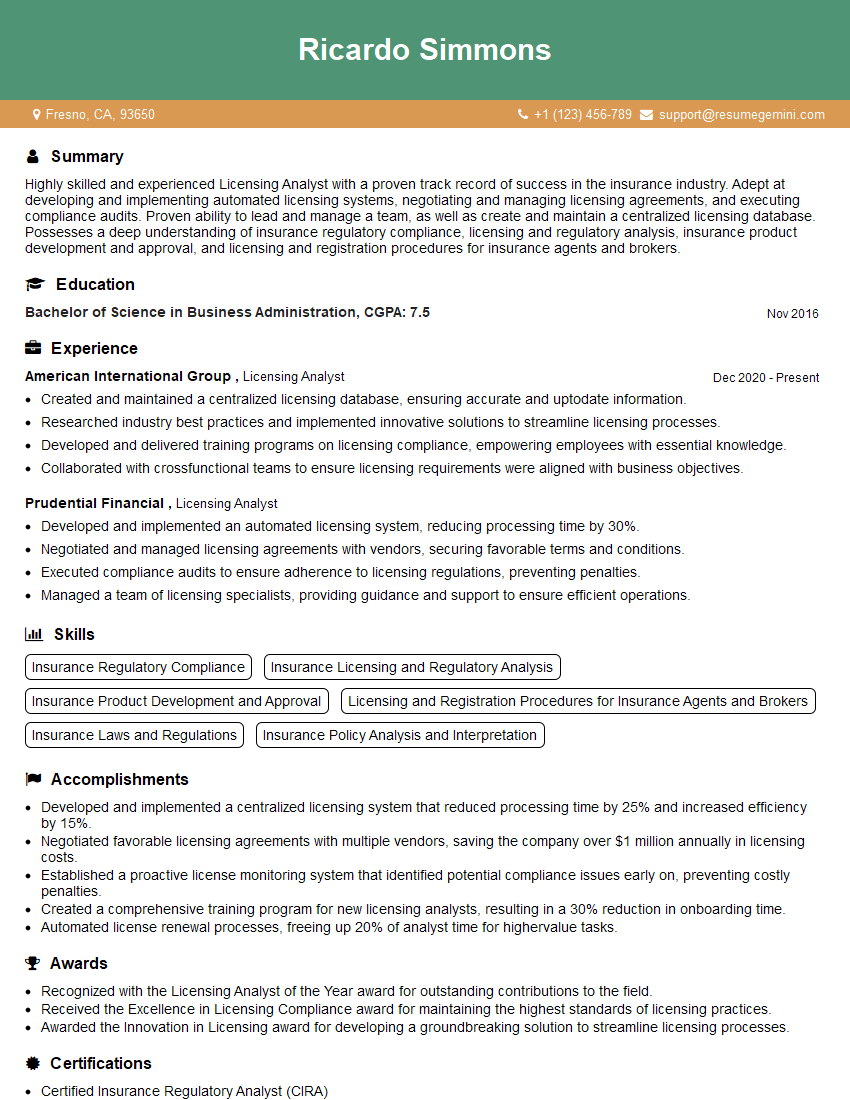
Mastering patent licensing opens doors to exciting and lucrative career opportunities in a rapidly evolving field. A strong understanding of these concepts will significantly enhance your interview performance and future success. To maximize your job prospects, creating a compelling and ATS-friendly resume is crucial. We strongly recommend leveraging ResumeGemini, a trusted resource for building professional resumes. ResumeGemini provides examples of resumes tailored specifically to Patent Licensing, helping you present your skills and experience in the best possible light. Take the next step and build a resume that truly showcases your potential.
Explore more articles
Users Rating of Our Blogs
Share Your Experience
We value your feedback! Please rate our content and share your thoughts (optional).
What Readers Say About Our Blog
Very informative content, great job.
good