Interviews are more than just a Q&A session—they’re a chance to prove your worth. This blog dives into essential Path Planning and Motion Control interview questions and expert tips to help you align your answers with what hiring managers are looking for. Start preparing to shine!
Questions Asked in Path Planning and Motion Control Interview
Q 1. Explain the difference between global and local path planning.
Global and local path planning are two distinct stages in the process of finding a route from a starting point to a goal. Think of it like planning a road trip: global planning is like choosing the overall route across the country, while local planning is navigating around individual obstacles and adjusting your course on the fly.
Global path planning uses a map of the entire environment to find an optimal path from start to finish. Algorithms like A*, Dijkstra’s, or rapidly-exploring random trees (RRT) are employed. This stage prioritizes finding the most efficient route considering the global environment, ignoring smaller details.
Local path planning, on the other hand, focuses on immediate surroundings and reacts to dynamic changes in the environment (like moving obstacles). It refines the global path, ensuring safe navigation. Techniques like potential fields or dynamic window approaches are typical here. This stage is crucial for reacting to unexpected events.
Example: Imagine a robot navigating a warehouse. Global planning determines the optimal route from one shelf to another, while local planning adjusts the route to avoid forklifts or workers encountered along the path.
Q 2. Describe A* search algorithm and its applications in path planning.
The A* (A-star) search algorithm is a graph traversal and path search algorithm that is often used in many fields of computer science due to its completeness, optimality, and efficiency. In path planning, it excels at finding the shortest path between a starting point and a goal within a given environment, considering the cost of traversing each path segment.
A* uses a heuristic function, h(n), to estimate the cost from a node n to the goal. This estimate, combined with the actual cost g(n) from the start to node n, forms the total cost f(n) = g(n) + h(n). The algorithm prioritizes nodes with the lowest f(n), effectively exploring promising paths first.
Applications:
- Video Game AI: Pathfinding for characters in games.
- Robotics: Planning robot movements in various environments, from warehouses to self-driving cars.
- GPS Navigation: Calculating the shortest driving routes, avoiding traffic congestion.
- Network Routing: Finding optimal paths for data packets in computer networks.
Example (conceptual): Imagine a grid-based map. A* would evaluate each cell, considering its distance from the start (g(n)), its estimated distance to the goal (h(n), often using Manhattan distance or Euclidean distance), and prioritize expanding cells with lower total cost (f(n)).
Q 3. What are the advantages and disadvantages of using Dijkstra’s algorithm for path planning?
Dijkstra’s algorithm is another graph search algorithm, often used for finding the shortest paths in a graph with non-negative edge weights. While effective, it has limitations when compared to A* for path planning.
Advantages:
- Simplicity: Dijkstra’s is conceptually easier to understand and implement than A*.
- Guaranteed Optimality: It always finds the shortest path (given non-negative weights).
Disadvantages:
- No Heuristic: Unlike A*, Dijkstra’s doesn’t use a heuristic function. This means it explores all possible paths systematically, which can be computationally expensive in large environments.
- Inefficient in Large Maps: Its exhaustive search makes it very inefficient for finding paths in large or complex environments where A*’s heuristic guidance can greatly reduce search space.
Example: Consider a large city map. Dijkstra’s would examine every possible road, regardless of distance to the destination, whereas A* would intelligently prioritize routes that appear closer to the goal.
Q 4. Explain the concept of potential fields in path planning.
Potential field methods represent the environment as a landscape of forces. The robot is attracted to the goal by a ‘goal force’ and repelled by obstacles by ‘obstacle forces’. The robot’s path is determined by the resultant of these forces.
Think of it as a ball rolling down a hill towards the goal, but with bumps (obstacles) pushing it away. The resultant force directs the ball along a path that avoids obstacles while heading towards the goal.
Attractive Potential: This force pulls the robot towards the goal. The closer the robot gets to the goal, the stronger the attractive force.
Repulsive Potential: This force pushes the robot away from obstacles. The closer the robot gets to an obstacle, the stronger the repulsive force. The strength is typically inversely proportional to the distance.
Challenges: Local minima (places where the robot gets stuck) and computational complexity are significant hurdles with this approach.
Q 5. How do you handle dynamic obstacles in path planning?
Handling dynamic obstacles requires algorithms that can adapt to changing environments. Several approaches are common:
- Dynamic Window Approach (DWA): This method evaluates a set of possible control actions (e.g., speed and steering angle) within a short time horizon and selects the best action based on criteria such as safety and proximity to the goal. It’s suitable for mobile robots that need immediate reactive control.
- Velocity Obstacles: This approach models the obstacles’ motion and determines the ‘velocity obstacle’—the set of velocities that will lead to a collision. The robot’s velocity is chosen from outside the velocity obstacles.
- Re-planning: Global planning is performed periodically, updating the path based on the current positions of dynamic obstacles. This approach may be less reactive but suitable for slower moving obstacles.
- Artificial Potential Fields with Time-Varying Potentials: The repulsive potential is adjusted continuously to reflect the changing positions of the obstacles.
Example: A self-driving car uses a combination of these methods to navigate around pedestrians and other vehicles. The car constantly updates its path to avoid collisions.
Q 6. Describe different path smoothing techniques.
Path smoothing techniques refine a raw path, making it more efficient and safer for the robot to follow. Raw paths generated by algorithms like A* are often jagged or contain unnecessary sharp turns.
Common techniques include:
- Cubic Splines: These smooth curves pass through a set of waypoints, creating a continuous and smooth path.
- Bézier Curves: Similar to splines, but provide more control over the curve’s shape using control points.
- B-splines: Offer a more flexible approach than cubic splines, particularly useful for complex shapes.
- Moving Average Filter: A simple technique that smooths the path by averaging points within a certain window size.
Choosing the right technique depends on the requirements (e.g., computational cost, smoothness, accuracy). For example, a moving average filter is fast but might not result in a highly accurate smooth path, whereas cubic splines may be computationally more expensive but produce a smoother path.
Q 7. What are the common challenges in real-world path planning?
Real-world path planning presents several significant challenges beyond the idealized scenarios in simulations:
- Environmental Uncertainty: Imperfect maps, unknown obstacles (e.g., unexpected debris), and sensor noise make path planning more complex.
- Computational Constraints: Real-time path planning requires algorithms to be computationally efficient enough to operate within the available processing power and time constraints of the robot or system.
- Dynamic Environments: Moving obstacles (e.g., people, vehicles) require the path planning system to adapt and replan frequently.
- Safety and Robustness: The path must ensure the safety of the robot and its environment, including collision avoidance and handling unexpected events.
- Actuator Limitations: The robot’s physical capabilities (e.g., limited turning radius, maximum speed) need to be considered in path planning.
- Path Following Errors: The robot’s motion control system might not perfectly follow the planned path; errors need to be addressed.
Overcoming these challenges often involves using a combination of algorithms, sensor fusion, robust control techniques, and adaptive planning strategies.
Q 8. Explain the role of PID controllers in motion control.
PID controllers are the workhorses of motion control, ensuring a system accurately follows a desired trajectory. They’re named for their three components: Proportional, Integral, and Derivative. Think of it like steering a car:
Proportional (P): This term reacts to the current error – the difference between where you are and where you want to be. A larger error leads to a stronger corrective action. Imagine turning the steering wheel more sharply the further you are from your lane.
Integral (I): This addresses persistent errors. If you’re consistently drifting to one side, the integral term gradually increases the correction until the error is eliminated. It’s like gently adjusting your steering over time to compensate for a persistent road slope.
Derivative (D): This anticipates future error based on the rate of change of the current error. It prevents overshooting by slowing down the correction as you approach the target. Think of easing off the steering wheel as you approach the center of the lane to avoid overcorrection.
The PID controller continuously adjusts the system’s actuator (e.g., motor) based on these three terms, creating a smooth and accurate response. Tuning the P, I, and D gains is crucial to achieving optimal performance; too much P can lead to oscillations, while too much I might cause slow response, and too much D might make the system overly damped.
Q 9. Describe different types of motion control systems (e.g., open-loop, closed-loop).
Motion control systems can be broadly categorized into open-loop and closed-loop systems:
Open-loop control: In this system, the controller sends a command to the actuator without any feedback about the actual output. Imagine telling a robot arm to move 10 degrees – it does so without checking if it actually moved 10 degrees. This approach is simple but susceptible to errors caused by external disturbances or imperfections in the system. An example would be a simple conveyor belt moving at a fixed speed; it doesn’t monitor its actual speed.
Closed-loop control (or feedback control): Here, sensors measure the actual output and this feedback is used to compare with the desired output (setpoint), creating an error signal that drives the controller. The controller adjusts the actuator until the error is minimized. This is akin to using a GPS while driving; you constantly receive feedback on your location and adjust your steering to reach your destination. This approach is more precise and robust to external disturbances.
Hybrid systems also exist, combining elements of both open-loop and closed-loop control for optimal performance.
Q 10. What is the significance of feedback in closed-loop motion control?
Feedback is the cornerstone of accurate and robust closed-loop motion control. It enables the system to self-correct for errors that arise from various sources such as:
- External disturbances: Unforeseen forces, like wind or impacts, can affect the system’s trajectory. Feedback helps compensate for these.
- Internal uncertainties: Imperfections in the system’s mechanical components or actuator characteristics can cause deviations from the desired behavior. Feedback allows for correction based on the actual behavior.
- Model inaccuracies: Mathematical models used to design the controller might not perfectly capture the system’s dynamics. Feedback bridges the gap between the model and reality.
Without feedback, even minor errors can accumulate and lead to significant deviations from the intended path, rendering the system unreliable. Think of a self-driving car without GPS or sensors; it wouldn’t know its position and would likely crash.
Q 11. Explain the concept of trajectory planning.
Trajectory planning is the process of generating a sequence of desired positions, velocities, and accelerations for a robot or other controlled system over time. It’s like creating a detailed roadmap for the system to follow. This roadmap must consider several factors including:
Path planning: Determining the geometric path the system should take to reach its destination. This might involve avoiding obstacles or following specific constraints.
Timing: Defining the speed and acceleration profile along the path. This is crucial for ensuring smooth motion and avoiding jerky movements or exceeding physical limits.
Constraints: Incorporating limitations such as joint limits (for robots), maximum velocities and accelerations, and obstacles to ensure that the generated trajectory is feasible and safe.
Common trajectory planning techniques include polynomial interpolation, spline interpolation, and B-spline curves. The choice depends on the complexity of the task and the desired smoothness of motion.
Q 12. How do you ensure smooth and accurate trajectory tracking?
Ensuring smooth and accurate trajectory tracking involves a combination of effective trajectory planning and precise control. Here are key strategies:
Smooth Trajectory Generation: Use techniques like cubic splines or quintic polynomials to generate trajectories with continuous velocity and acceleration profiles, minimizing jerky movements. Avoiding abrupt changes in velocity and acceleration is crucial for smooth operation and reduced wear and tear.
Appropriate Controller Design: Implement a robust controller like a PID controller, carefully tuning the gains to achieve optimal performance. The controller should be capable of handling disturbances and tracking errors.
Feedback Control: Utilize sensor feedback to constantly monitor the system’s actual position, velocity, and acceleration. Compare this with the desired trajectory and use the error signal to drive the controller.
Feedforward Control: Incorporate a feedforward component in addition to the feedback controller to anticipate the desired trajectory. This helps to reduce the error signal and improve tracking accuracy.
Robustness Considerations: Account for uncertainties in the system model and external disturbances. Employ techniques like adaptive control or robust control to enhance the system’s resilience to unexpected situations.
Regular testing and calibration are crucial to ensure the system performs accurately and smoothly under various operating conditions.
Q 13. Describe different types of robot manipulators and their kinematic properties.
Robot manipulators come in various configurations, each with unique kinematic properties that affect their workspace, dexterity, and control complexity. Some examples include:
Articulated Robots: These have revolute joints (rotary joints) connected in a series, mimicking a human arm. They offer high dexterity but can be complex to control due to their multiple degrees of freedom.
Cartesian Robots: These move along three orthogonal axes (X, Y, Z), using prismatic joints (linear joints). They are simple to control but have limited dexterity and workspace.
SCARA Robots: Selective Compliance Assembly Robot Arm. These have two parallel revolute joints, offering good dexterity in a planar workspace. They are commonly used in assembly applications.
Cylindrical Robots: These combine a revolute joint with two prismatic joints, providing a cylindrical workspace.
Spherical Robots: Also known as polar robots, these have a revolute joint and two prismatic joints, creating a spherical workspace.
The kinematic properties – such as the Denavit-Hartenberg (DH) parameters – define the relationship between the robot’s joint angles and its end-effector position and orientation. These parameters are crucial for both forward and inverse kinematic calculations.
Q 14. Explain the concept of forward and inverse kinematics.
Forward and inverse kinematics are fundamental concepts in robotics that relate the robot’s joint angles to its end-effector pose (position and orientation):
Forward Kinematics: This involves calculating the end-effector’s pose given the robot’s joint angles. It’s a straightforward calculation using the robot’s kinematic model (e.g., DH parameters). You know the angles, you find the position.
Inverse Kinematics: This is the inverse problem; you know the desired end-effector pose and want to find the corresponding joint angles. This is generally a more challenging problem, often involving iterative numerical solutions. You know where you want to go, you find the angles needed.
Forward kinematics is used to simulate the robot’s motion, while inverse kinematics is essential for robot control. In applications such as pick-and-place operations, inverse kinematics is used to determine the required joint angles to move the end-effector to a specific location. The complexity of inverse kinematics increases significantly with the number of degrees of freedom in the robot.
Q 15. How do you deal with singularities in robot kinematics?
Singularities in robot kinematics represent configurations where the robot’s Jacobian matrix becomes singular, meaning it loses its full rank and becomes non-invertible. This typically occurs at specific joint angles where the robot’s end-effector loses one or more degrees of freedom, effectively ‘locking up’ in a certain direction. Imagine trying to extend your arm straight out to the side – you have limited ability to move it further in certain directions due to your shoulder’s limited range of motion. This is analogous to a kinematic singularity.
Dealing with singularities requires a multi-pronged approach. Firstly, avoiding them is paramount. Careful path planning algorithms can be designed to steer clear of these problematic configurations. This involves analyzing the robot’s workspace and identifying singular regions to exclude them from the robot’s operational space.
Secondly, if a singularity is unavoidable (perhaps due to constraints in the task), resolution techniques must be implemented. These could involve:
- Redundant joint control: Utilizing extra degrees of freedom in a redundant manipulator to navigate around the singularity.
- Pseudo-inverse methods: Employing the Moore-Penrose pseudo-inverse of the Jacobian, which allows for a solution even when the matrix is singular, though it might not be the optimal solution.
- Singularity robust control: Designing control strategies that are less sensitive to the singularity, using techniques such as damped least squares or adding artificial damping to the Jacobian.
Finally, reconfiguration might be an option. This might involve redesigning the robot’s mechanical structure or the task itself to eliminate or mitigate the singularity problem.
Career Expert Tips:
- Ace those interviews! Prepare effectively by reviewing the Top 50 Most Common Interview Questions on ResumeGemini.
- Navigate your job search with confidence! Explore a wide range of Career Tips on ResumeGemini. Learn about common challenges and recommendations to overcome them.
- Craft the perfect resume! Master the Art of Resume Writing with ResumeGemini’s guide. Showcase your unique qualifications and achievements effectively.
- Don’t miss out on holiday savings! Build your dream resume with ResumeGemini’s ATS optimized templates.
Q 16. What are the different methods for robot calibration?
Robot calibration is the process of precisely determining the robot’s physical parameters, like link lengths, joint angles, and offsets, to match its actual configuration to its theoretical model. Accurate calibration is crucial for achieving high precision and repeatability in robotic tasks.
Several methods exist for robot calibration, broadly classified as:
- Geometric calibration: This method focuses on determining the geometric parameters of the robot, such as link lengths and joint angles. Techniques include using external measurement systems like laser trackers or theodolites to precisely measure the robot’s pose at various configurations.
- Kinematic calibration: This goes beyond geometric calibration and accounts for kinematic errors like joint flexibilities, gear backlash, and transmission inaccuracies. It uses various mathematical models and optimization techniques to estimate these parameters.
- Self-calibration: This method leverages the robot’s own sensors (like encoders) and internal measurements to estimate its kinematic parameters. It often requires the robot to move through a series of carefully planned configurations.
The choice of method often depends on the robot’s complexity, the accuracy requirements, and the available equipment. For example, a simple robot arm might only require geometric calibration using a theodolite, while a complex, high-precision industrial robot might necessitate a combined approach utilizing both geometric and kinematic calibration techniques.
Q 17. Explain the concept of Jacobian matrix in robotics.
The Jacobian matrix in robotics is a fundamental tool that relates the joint velocities of a robot to the velocity of its end-effector. Think of it as a translator: it converts changes in joint angles to changes in the end-effector’s position and orientation. This is crucial for motion control and path planning.
Mathematically, it’s a matrix where each element represents the partial derivative of the end-effector’s velocity components (position and orientation) with respect to each joint velocity. For a six-degree-of-freedom robot, it’s a 6×6 matrix.
For example, a simple two-link planar manipulator would have a 2×2 Jacobian relating the angular velocities of the two joints to the Cartesian velocities (x and y) of the end-effector. [[∂x/∂θ1, ∂x/∂θ2], [∂y/∂θ1, ∂y/∂θ2]]
The Jacobian is essential for various tasks:
- Inverse kinematics: Determining the joint angles required to achieve a desired end-effector pose.
- Velocity control: Converting desired end-effector velocities to joint velocities.
- Singularity analysis: Identifying configurations where the Jacobian becomes singular, leading to loss of controllability.
- Force control: Transforming forces/torques at the end-effector to joint torques.
Q 18. Describe different methods for obstacle avoidance in mobile robots.
Obstacle avoidance is a critical aspect of mobile robot navigation. Several methods exist, each with strengths and weaknesses:
- Potential Field Methods: These methods create an artificial potential field, with repulsive forces from obstacles and an attractive force towards the goal. The robot’s path is determined by the resultant force vector. Simple to implement but can get stuck in local minima (e.g., getting trapped in a narrow passage).
- Artificial Potential Fields with Local Minima Avoidance: Employ techniques like random walks or adding artificial noise to escape local minima.
- Bug Algorithms (Bug 1, Bug 2): These algorithms are based on following the obstacle’s boundary until the robot can reach the goal. Relatively simple and guaranteed to reach the goal but may lead to long paths.
- Voronoi Diagrams: Constructs a diagram that represents the closest distance to any obstacle. The path planning follows the skeleton of this diagram.
- Rapidly-exploring Random Trees (RRTs): These are probabilistic algorithms that randomly sample the robot’s configuration space to create a tree that eventually connects the start and goal configurations. Effective for high-dimensional spaces and complex environments.
- A* Search Algorithm: Finds the shortest path from a starting point to a goal using heuristics. It is computationally expensive for complex spaces, but it works well for grid-based environments.
The choice of method depends on the complexity of the environment, computational resources, and desired path properties. For example, a simple warehouse environment might use potential fields, while a complex outdoor environment might require RRTs.
Q 19. What are the challenges in path planning for multi-robot systems?
Path planning for multi-robot systems presents significant challenges beyond those encountered in single-robot scenarios. The key challenges include:
- Collision Avoidance: Ensuring that multiple robots avoid colliding with each other and with static obstacles becomes exponentially more complex as the number of robots increases. Simple methods used for single robots are computationally infeasible for many robots.
- Coordination and Communication: Robots need to coordinate their movements to achieve a common goal. Effective communication strategies are essential, particularly in dynamic environments where robot positions and plans change rapidly.
- Scalability: Algorithms need to scale well with the number of robots. Methods that work well for a few robots might become computationally intractable with many robots.
- Inter-robot Interference: Robots might interfere with each other’s plans, for example, by blocking each other’s access to crucial points or resources.
- Centralized vs. Decentralized Control: Choosing between centralized (one controller manages all robots) and decentralized (robots make local decisions) control architectures significantly impacts the complexity and robustness of the system.
Consider a scenario with delivery drones in a city: efficient path planning needs to prevent collisions while optimizing delivery times, requiring advanced algorithms and communication protocols.
Q 20. Explain the concept of cooperative path planning.
Cooperative path planning involves coordinating the movements of multiple robots to achieve a shared objective. It’s not just about avoiding collisions; it’s about strategically planning paths so robots can work together efficiently. This is crucial in scenarios such as collaborative construction, search and rescue, or multi-robot exploration.
Key aspects of cooperative path planning include:
- Task Allocation: Distributing tasks among robots based on their capabilities and current locations.
- Conflict Resolution: Developing strategies for resolving conflicts that might arise due to competing robot paths.
- Communication Protocols: Designing efficient communication mechanisms for exchanging information and coordinating robot movements.
- Formation Control: Maintaining desired spatial relationships among robots while they move.
Consider a team of robots cleaning a large warehouse: cooperative path planning ensures that the robots divide the area efficiently, minimizing overlap and maximizing cleaning speed. Centralized methods might be used for pre-planning or coordination, while decentralized algorithms could be employed for dynamic obstacle avoidance and local adjustments.
Q 21. Describe different sensor technologies used in path planning and motion control.
Various sensor technologies play a crucial role in path planning and motion control, providing crucial information about the robot’s environment and its own state.
- LiDAR (Light Detection and Ranging): Provides accurate 3D point cloud data of the environment, ideal for creating detailed maps and detecting obstacles. Often used in autonomous vehicles and mobile robots.
- Cameras (Vision Systems): Offer rich visual information about the surroundings. Advanced computer vision techniques are used to extract relevant features, such as obstacles, lane markings (for autonomous vehicles), or object recognition. Mono, stereo, and RGB-D cameras are common choices.
- Ultrasonic Sensors: Relatively inexpensive and simple sensors that measure distance by emitting ultrasonic waves. They are commonly used for short-range obstacle detection and proximity sensing.
- Radar: Useful for detecting objects at longer ranges, even in adverse weather conditions. Often employed in autonomous driving for environmental perception.
- Inertial Measurement Units (IMUs): Measure linear acceleration and angular velocity, providing information about the robot’s own movement. Combined with GPS, they offer a robust way to estimate the robot’s pose.
- GPS (Global Positioning System): Provides global positioning information, essential for outdoor navigation. Accuracy can be affected by obstructions and multipath effects.
- Encoders: Provide information about the position and velocity of the robot’s joints, crucial for closed-loop control.
The selection of sensors depends on the specific application and the required level of precision and robustness. Autonomous vehicles often use a sensor fusion approach, combining data from multiple sensors to enhance reliability and accuracy.
Q 22. How do you handle sensor noise and uncertainty in path planning?
Sensor noise and uncertainty are unavoidable realities in path planning. Imagine a robot navigating a room using only noisy lidar data – the walls might appear slightly shifted or objects might be momentarily ‘seen’ where they aren’t. To handle this, we employ several strategies. Probabilistic methods, like those used in Kalman filtering or particle filters, are crucial. These algorithms maintain a probability distribution over the robot’s pose (location and orientation) and map, incorporating sensor measurements and motion commands to continually refine their estimates. This allows the planner to create paths that account for this uncertainty. For example, instead of planning a path that directly grazes a wall, a probabilistic approach might add a safety margin, ensuring the robot stays a safe distance away even with potential positional error. Furthermore, robust path planning algorithms, such as those based on rapidly-exploring random trees (RRTs) or artificial potential fields, can be modified to incorporate uncertainty directly into the cost function, penalizing paths that traverse regions of higher uncertainty.
Another key approach is sensor fusion, combining data from multiple sensors (e.g., lidar, cameras, IMU) to provide a more comprehensive and reliable understanding of the environment. Each sensor’s inherent noise characteristics can be modeled and used to weight its contribution in the fusion process, improving overall accuracy. This allows the system to better handle outliers or temporary sensor malfunctions. Finally, replanning is often necessary – a path computed initially might become infeasible due to unexpected obstacles or significant drift. A robust system continuously monitors its progress, and if deviations exceed acceptable thresholds, it replan to adapt to changing conditions.
Q 23. What are the considerations for real-time path planning in embedded systems?
Real-time path planning in embedded systems presents unique challenges due to limited computational resources and strict timing constraints. Think of a self-driving car – it needs to plan its path almost instantaneously to avoid collisions. Key considerations include:
- Computational Complexity: Algorithms like A* or Dijkstra’s, while optimal, can be computationally expensive for large environments. We often choose less computationally intensive algorithms such as D* Lite or variants of RRT, which can provide near-optimal solutions more quickly. Often, we need to pre-process the environment to create a simplified representation, for example, using a graph structure instead of raw point cloud data.
- Memory Constraints: Embedded systems often have limited RAM. Therefore, efficient data structures and algorithms that minimize memory footprint are critical. This might involve techniques like spatial partitioning (e.g., octrees) to organize map data effectively.
- Real-time Requirements: The planning algorithm must meet strict deadlines. Real-time operating systems (RTOS) and careful code optimization are essential to ensure that paths are calculated within the required timeframe. Techniques like pre-computation of parts of the search space can also improve real-time performance.
- Power Consumption: Power efficiency is often paramount. Algorithms and hardware need to be selected to minimize energy consumption, especially in battery-powered devices.
For example, in a drone navigation system, we might use a simplified map representation (e.g., a grid) and a fast path planning algorithm like D* Lite to ensure that the path is computed quickly enough to react to changing wind conditions or obstacles.
Q 24. How do you ensure the safety and reliability of motion control systems?
Ensuring safety and reliability in motion control systems is paramount, especially in applications like robotics and autonomous vehicles. Imagine the consequences of a malfunctioning robot arm in a factory or an autonomous car failing to brake. Safety mechanisms are layered, ranging from hardware redundancy to sophisticated software checks.
- Hardware Redundancy: Critical components, such as actuators and sensors, might have backups. If one fails, the backup takes over seamlessly, preventing system failure. This could be achieved using dual motors or duplicate sensor systems.
- Software Safety Mechanisms: This includes things like watchdog timers which monitor the program’s execution. If the program freezes or crashes, the watchdog timer triggers a safety shutdown. Emergency stops and limits on actuator speeds and torques also prevent unintended movements or damage. Fault detection and diagnosis algorithms continuously monitor the system for anomalies, such as sensor drift or actuator malfunctions.
- Formal Verification: Formal methods can rigorously prove the correctness of critical software components, providing strong assurance of safety and reliability. This approach is especially valuable in high-integrity applications where failures can have catastrophic consequences.
- Safety Standards Compliance: Motion control systems often need to comply with industry standards like ISO 13849 (for machinery safety) or IEC 61508 (for functional safety). These standards define requirements for risk assessment, design, and verification to ensure safety.
A layered safety approach, combining hardware and software redundancy with robust algorithms and safety standards compliance, greatly enhances system safety and reliability, minimizing risks associated with potential failures.
Q 25. What is the role of simulation in the design and testing of path planning algorithms?
Simulation plays a crucial role in the development and testing of path planning algorithms. It allows us to evaluate algorithms in a controlled environment before deploying them in the real world. Think of it as a virtual test track for autonomous vehicles – much safer and cheaper than using real cars. Simulation allows for:
- Algorithm Evaluation: We can compare different path planning algorithms under various conditions (e.g., different obstacle densities, different environments, different sensor noise levels). Metrics such as path length, computation time, and success rate can be easily measured and compared.
- Parameter Tuning: Many path planning algorithms have parameters that need to be carefully tuned for optimal performance. Simulation provides a convenient environment to experiment with different parameter settings without risking damage to real-world hardware.
- Scenario Testing: We can test the algorithm’s robustness against a wide variety of challenging scenarios, such as unexpected obstacles, narrow passages, or complex terrain. This helps identify potential weaknesses and improve the algorithm’s reliability.
- Hardware-in-the-Loop (HIL) Simulation: This integrates the control system software with a simulated environment, allowing for more realistic testing of the entire system, including the interaction between software and hardware.
For example, before deploying a path planning algorithm on a robot navigating a warehouse, we might simulate hundreds of different warehouse layouts and obstacle configurations to test its performance and identify potential issues before deployment in a real setting, greatly reducing risk and saving resources.
Q 26. Describe your experience with different path planning libraries or tools.
I have extensive experience with several path planning libraries and tools. My work has involved using ROS (Robot Operating System) extensively, leveraging its navigation stack, which provides a suite of tools and algorithms for path planning, localization, and control. I’ve worked with various planners within the ROS navigation stack, including A*, D*, and dynamic window approach. Beyond ROS, I’ve also used OMPL (Open Motion Planning Library), a powerful and flexible library that provides a wide range of path planning algorithms. OMPL is particularly useful for complex robots with many degrees of freedom, where finding feasible paths can be challenging. I’m also familiar with various visualization tools, such as RViz (for ROS) and MATLAB, which are vital for debugging and evaluating path planning results. In addition, I have experience using custom-built planning libraries tailored to the needs of specific projects, which often provide performance benefits for specialized applications.
Q 27. Explain a challenging path planning problem you’ve solved and how you approached it.
One particularly challenging problem I encountered involved path planning for a multi-robot system tasked with cooperative object manipulation. The robots needed to coordinate their movements to grasp and transport a large, irregularly shaped object through a cluttered environment. The complexity arose from the need to consider both individual robot path planning and the coordination between robots. Simply finding collision-free paths for each robot independently wasn’t sufficient – the robots needed to synchronize their movements to maintain a stable grasp on the object while avoiding collisions with each other and obstacles.
My approach involved a combination of techniques. First, I used a centralized approach, where a central planner determined the overall strategy for object manipulation. This planner used a mixed-integer linear programming (MILP) formulation to find collision-free trajectories that minimized the overall transport time and maintained a robust grasp. Secondly, to improve the efficiency of the search space exploration, I employed a hierarchical approach. A high-level planner determined a coarse global path for the object, and local planners then refined this path for each individual robot, handling local obstacles and coordinating robot movements near the object. This hierarchical approach reduced the computational complexity significantly compared to a fully centralized planner, allowing for real-time planning. Through extensive simulation and real-world testing, we achieved a successful implementation with highly reliable object manipulation using a distributed control system.
Q 28. Discuss your experience with different motion control hardware and software.
My experience with motion control hardware and software spans a wide range of platforms. I’ve worked with various types of actuators, including servo motors, stepper motors, and pneumatic cylinders. On the software side, I’m proficient in using real-time operating systems (RTOS) such as VxWorks and FreeRTOS for controlling motion systems. I’ve worked with motion control libraries and APIs provided by various manufacturers of industrial controllers, such as those of Beckhoff or National Instruments. In addition, I’ve used various programming languages like C/C++ for developing low-level control algorithms and Python for higher-level planning and simulation tasks. I’m also familiar with various communication protocols such as CAN bus, Ethernet/IP, and Modbus for coordinating multiple devices in a motion control system. One specific project involved the development of a custom motion controller for a robotic arm, where I programmed the low-level control algorithms in C++ using an RTOS and implemented high-level path planning using ROS. This project encompassed everything from designing the control algorithm to integrating it with the hardware.
Key Topics to Learn for Path Planning and Motion Control Interviews
Landing your dream job in Path Planning and Motion Control requires a solid understanding of core concepts and their practical applications. This section outlines key areas to focus your preparation.
- Path Planning Algorithms: Explore various algorithms like A*, Dijkstra’s, RRT, and their strengths and weaknesses in different scenarios. Consider the computational complexity and applicability to various robot types and environments.
- Motion Control Techniques: Master PID control, trajectory planning (e.g., polynomial, spline interpolation), and feedback control systems. Understand how to handle disturbances and ensure smooth, accurate movements.
- Kinematic and Dynamic Modeling: Develop a strong understanding of robot kinematics (forward and inverse) and dynamics. Be prepared to discuss modeling techniques and their application in path planning and control design.
- Sensor Integration: Explore how sensors (e.g., LiDAR, cameras, IMUs) are used for localization, mapping, and feedback in path planning and motion control systems. Understand sensor fusion techniques.
- Obstacle Avoidance and Collision Detection: Learn different strategies for obstacle avoidance, including potential field methods, and various collision detection algorithms. Be prepared to discuss their computational efficiency.
- Practical Applications: Think about real-world applications like autonomous vehicles, robotics in manufacturing, drones, and warehouse automation. Understanding these use cases will strengthen your understanding of the field.
- Problem-Solving and Design Thinking: Practice approaching problems systematically. Be ready to discuss your approach to designing and implementing a motion control system, including considerations for safety, efficiency, and robustness.
Next Steps: Elevate Your Career and Your Resume
Mastering Path Planning and Motion Control opens doors to exciting and rewarding careers in cutting-edge technology. To maximize your job prospects, a strong, ATS-friendly resume is crucial. A well-crafted resume highlights your skills and experience effectively, helping you stand out from the competition.
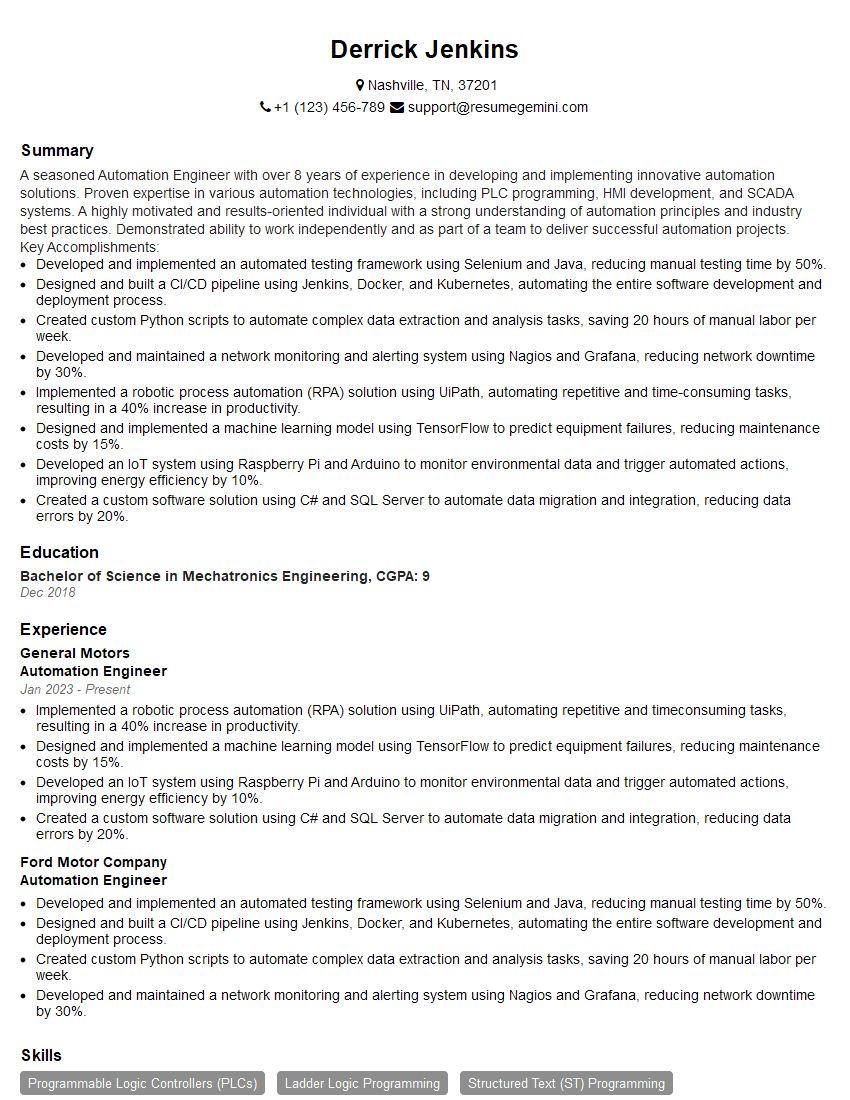
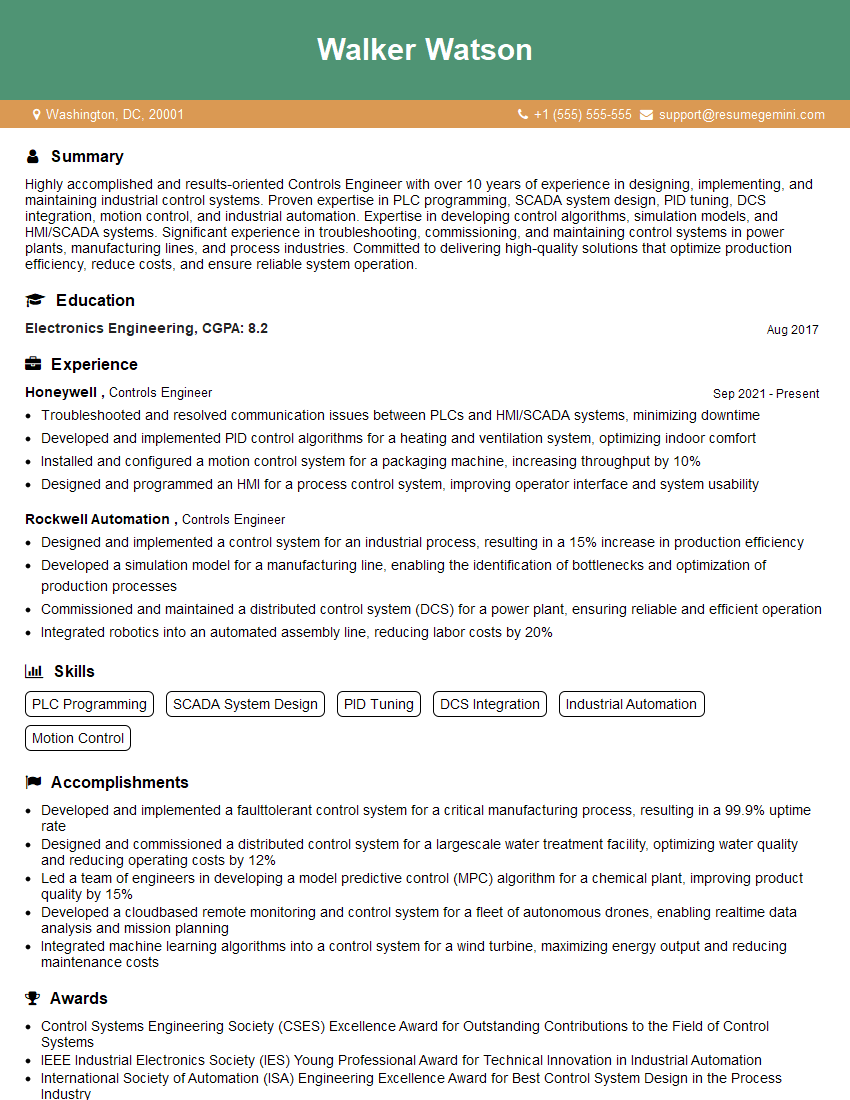
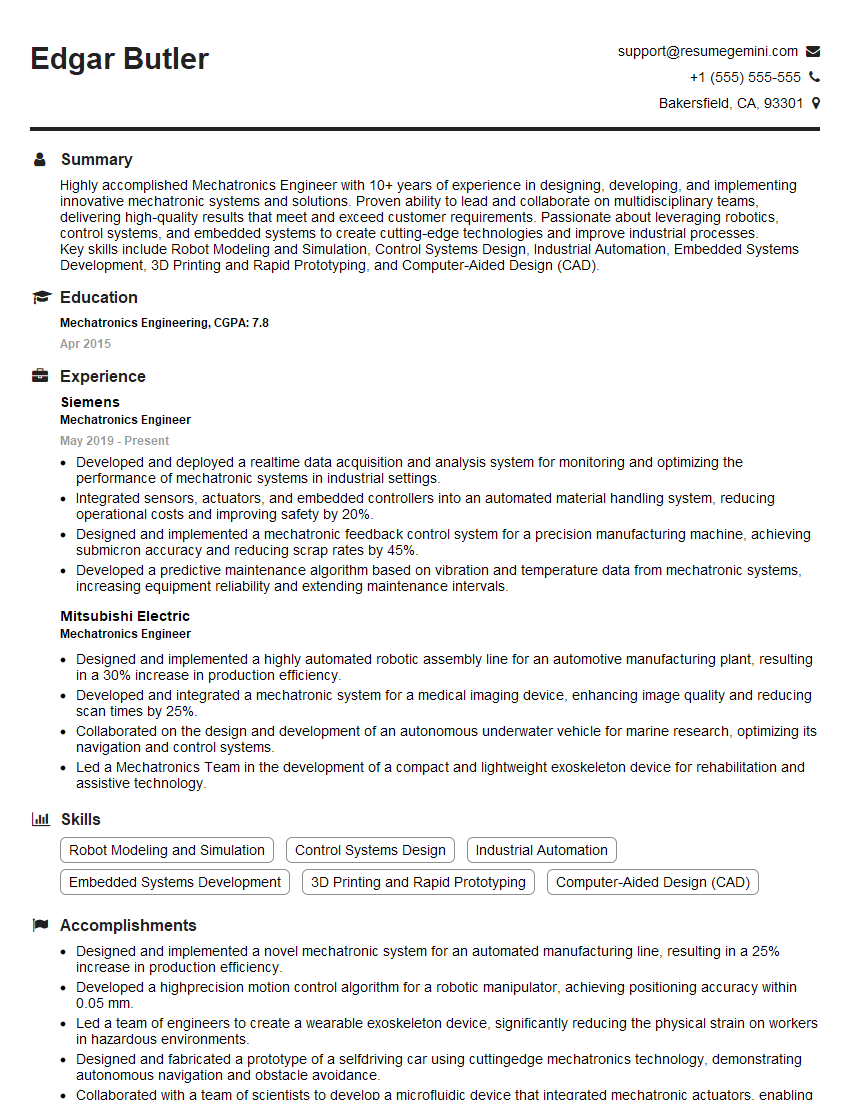
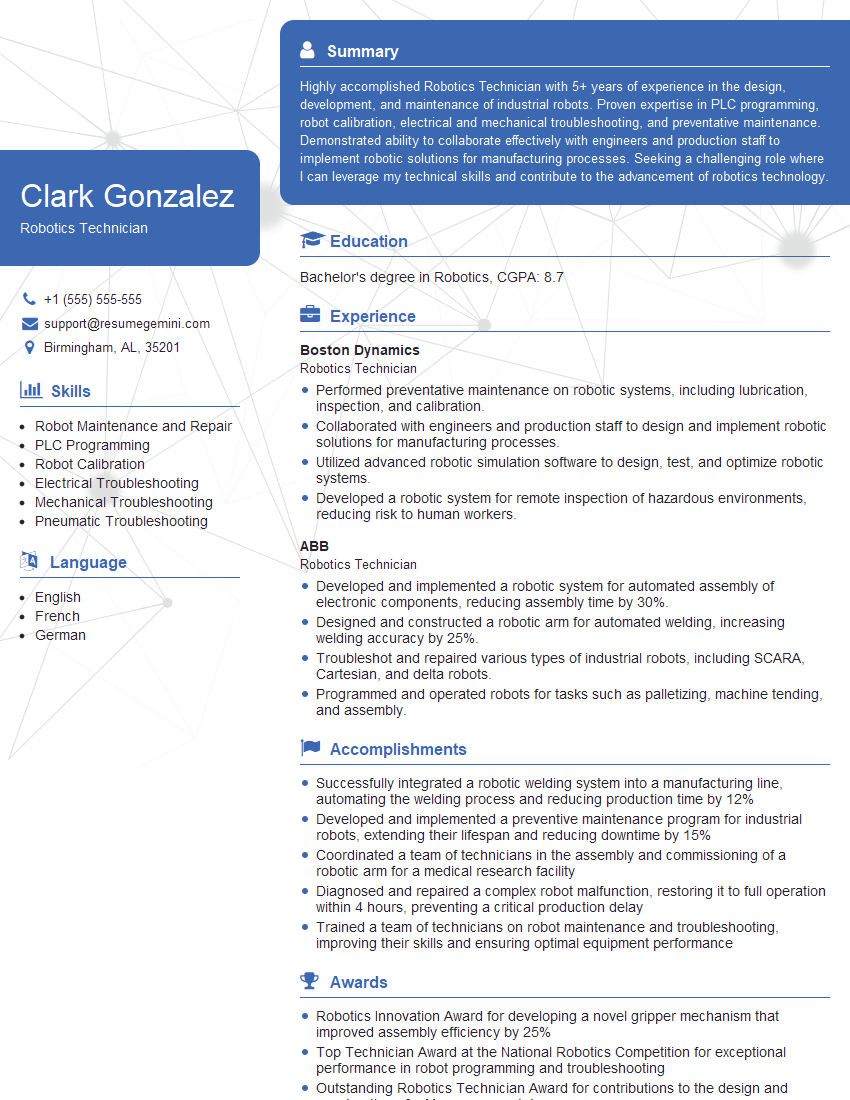
We strongly recommend leveraging ResumeGemini to build a professional and impactful resume. ResumeGemini provides the tools and resources to craft a compelling narrative that showcases your expertise in Path Planning and Motion Control. Examples of resumes tailored to this field are available to guide you.
Invest the time to refine your resume – it’s your first impression with potential employers. With the right preparation and a well-structured resume, you’ll be well-positioned for success in your job search.

Explore more articles
Users Rating of Our Blogs
Share Your Experience
We value your feedback! Please rate our content and share your thoughts (optional).
What Readers Say About Our Blog
Very informative content, great job.
good