Are you ready to stand out in your next interview? Understanding and preparing for Pattern Grading and Alteration interview questions is a game-changer. In this blog, we’ve compiled key questions and expert advice to help you showcase your skills with confidence and precision. Let’s get started on your journey to acing the interview.
Questions Asked in Pattern Grading and Alteration Interview
Q 1. Explain the process of grading a pattern from one size to another.
Grading a pattern involves systematically increasing or decreasing its dimensions to create different sizes. Think of it like stretching or shrinking a photograph while maintaining its overall shape. It’s not simply enlarging everything uniformly; different body parts require different grading rates. For instance, the waistline will typically increase at a higher rate than the sleeve length. The process involves meticulously adjusting measurements along key points on the pattern pieces—like bust, waist, hip, and sleeve lengths—based on established size charts.
The process typically begins with a base size, often a size medium. We then apply a series of incremental increases or decreases, defined by a grading chart specific to the garment type. For example, the grading chart might dictate that to go from a size medium to a large, the bust measurement increases by 2 inches, the waistline by 1.5 inches, and the hip by 2.5 inches. These adjustments are then applied proportionally across the entire pattern piece. This isn’t a simple addition; curve adjustments and slope alterations must be made to maintain garment fit and style.
Q 2. Describe different grading methods (e.g., manual, automated).
There are two primary grading methods: manual and automated.
- Manual Grading: This traditional method uses tools like rulers, curves, and French curves to make adjustments directly onto the paper pattern. It’s precise but time-consuming, especially for multiple sizes. It requires a deep understanding of pattern construction and body proportions to ensure accurate adjustments and maintain the garment’s design integrity. I often utilize this method for intricate details or when a highly customized fit is required.
- Automated Grading: This utilizes specialized software, like those found in CAD systems, to input the base pattern and automatically generate the graded sizes. The software calculates the necessary adjustments based on pre-programmed grading rules. This is significantly faster and more efficient than manual grading, especially for large-scale production. However, it requires careful setup of the grading rules and meticulous review to catch any discrepancies.
Hybrid approaches are also common, combining manual adjustments for complex areas with automated grading for simpler sections to leverage the advantages of both methods.
Q 3. How do you handle grading complex design details (e.g., darts, princess seams)?
Grading complex design details like darts and princess seams requires a nuanced approach. These features are not simply lengthened or shortened; their shape and positioning need careful consideration to maintain the garment’s drape and aesthetic appeal.
For darts, we need to maintain the dart’s point and its overall length while adjusting its width. Consider a dart on a bodice – you may need to increase the length of the dart and the width at the bust, but you will likely only increase the dart’s length and not its width at the waist. This precise adjustment ensures the dart doesn’t distort the fit or create unwanted wrinkles.
Similarly, princess seams require attention to the shaping and curve. Grading these requires careful understanding of how the seam interacts with the body’s curves. You’ll adjust the spacing and length of the princess seams whilst maintaining a smooth, flowing silhouette. Often, the curve itself needs to be adjusted depending on the size change – adding more curve to larger sizes and reducing it for smaller sizes. Manual grading is especially useful here as the software can struggle to manage these complex curves.
Q 4. What software or tools are you proficient in for pattern grading?
My expertise encompasses both manual techniques and several industry-standard software packages. I am proficient in using CAD software like Gerber Accumark and Optitex, which are widely employed in apparel manufacturing. These systems provide automated grading capabilities, allowing for efficient and consistent scaling of patterns across multiple sizes. They also offer features like grading rules management and visual verification tools. While I am confident with software, I believe the nuanced understanding of patternmaking and garment construction remains paramount, regardless of the tools used. Even with automated grading, manual review is always necessary to catch potential errors and ensure aesthetic quality.
Q 5. How do you ensure accuracy in grading patterns?
Accuracy in grading is paramount. It impacts both the garment’s fit and the efficiency of production. To ensure accuracy, I employ a multi-step approach.
- Using Accurate Grading Charts: Starting with a well-constructed, reliable grading chart is crucial. This chart dictates the precise measurements for each size, and the proportions should be meticulously researched to reflect realistic body measurements.
- Thorough Pattern Checking: Before and after grading, I meticulously check the pattern pieces against specifications and conduct test runs on muslins (prototype garments) to verify the fit in each graded size. This allows for early identification and correction of any errors.
- Consistent Measurement Techniques: I always follow consistent measurement techniques throughout the process. For instance, I measure from the same consistent points for every size and I take into account the fabric’s grainlines.
- Software Verification (when applicable): When using automated grading software, a detailed visual check is critical to catch any unexpected alterations. This includes checking the integrity of the seam lines, curves, and dart placement.
Q 6. Explain the importance of maintaining consistent proportions during grading.
Maintaining consistent proportions is vital for creating garments that fit well across different sizes. Imagine a graded dress where the sleeves were proportionately smaller than the body – it would look disproportionate and awkward! Maintaining these proportions ensures the garments look and fit correctly regardless of the size. It’s about more than just adding inches; it’s about maintaining the balance and style across sizes. If the proportions are off, the garment will not drape correctly and will look ill-fitting, even if the individual measurements are accurate.
This is achieved through precise grading rules based on body proportions and garment design. For example, the relationship between the bust, waist, and hip circumference needs to be maintained, and the sleeve length should be adjusted proportionately to the body length. The grading chart and software should incorporate these relationships to guarantee consistency.
Q 7. How do you identify and correct grading errors?
Identifying and correcting grading errors requires a keen eye and methodical approach. Visual inspection is the first step. I carefully examine the graded pattern pieces, looking for any distortions, asymmetry, or inconsistencies. If using software, comparing the graded patterns to the original pattern can highlight discrepancies.
Test runs using muslin prototypes are indispensable. Muslins allow for identifying fit issues before cutting expensive materials. Any discrepancies in fit point to grading errors. For example, excessive ease (extra fabric) in certain areas or pulling at seams are clues.
Correction strategies depend on the nature of the error. Minor adjustments might simply involve fine-tuning measurements on the pattern pieces. For significant errors, I might have to re-grade portions or even sections of the pattern. In extreme cases, a review of the grading chart may be needed. The iterative process of checking, adjusting, and testing is crucial to guarantee accuracy.
Q 8. How do you handle grading for different body types or fits?
Grading for different body types and fits involves adjusting a base pattern to accommodate variations in measurements. Think of it like tailoring a single shirt pattern to fit a range of body shapes and sizes. We don’t just add inches uniformly; we consider proportional changes across different body areas.
The process typically involves using a grading scale – a set of measurements representing different sizes. These scales account for factors like chest circumference, waist circumference, hip circumference, height, and other key measurements. For instance, a size small might require a 1-inch increase in the waist measurement for a medium, while the hip circumference might need a 1.5-inch increase. These increases aren’t linear; the grading rules are dependent upon the style of the garment and the designer’s specifications.
Advanced grading software can automate this, but manual techniques remain crucial for intricate designs. Manual grading allows for nuanced adjustments based on the pattern’s design and the desired fit – a more relaxed fit versus a tailored one will require different grading approaches. For example, a fuller skirt would require more significant grading across the hip and waist than a fitted pencil skirt.
- Body Type Considerations: Grading for different body types (e.g., pear-shaped, apple-shaped, athletic) demands a deeper understanding of how the pattern interacts with these shapes. We might adjust the dart placement or ease curves differently to ensure a flattering silhouette for each type.
- Fit Considerations: A close-fitting garment will require more precise grading and potentially additional adjustments to accommodate the natural body curves than a loose-fitting style. Close-fitting garments may also necessitate alterations to prevent pulling or bagginess.
Q 9. Describe your experience with making alterations to existing patterns.
My experience with pattern alteration is extensive. I’ve worked on countless projects involving adjustments to existing patterns, ranging from simple sleeve length modifications to complex adjustments for individual body shapes.
I’ve encountered various scenarios, including:
- Adjusting for different sleeve lengths: This is a common alteration, often involving adjusting the sleeve cap height and modifying the sleeve itself.
- Altering the neckline: Changing necklines involves adjustments to the neckline curve and often requires modifying the shoulder area for a proper fit.
- Modifying the waistline: This might include raising or lowering the waistline, often requiring adjustments to the side seams and darts.
- Adjusting for full-bust or full-hip adjustments: These involve increasing the pattern in specific areas to provide ample room for the body shape.
For more complex alterations, I use a combination of draping, modeling the pattern on a dress form, and technical sketching to map changes efficiently. I always prioritize a methodical and documented approach to avoid mistakes and ensure consistent results.
Q 10. How do you adjust a pattern for different fabric types?
Fabric type significantly impacts pattern adjustments. Different fabrics drape differently, influencing the final garment’s fit and appearance. A pattern that works perfectly in a crisp cotton might look entirely different in a flowing silk or a heavy wool.
Here’s how I adjust patterns based on fabric type:
- Drape and Weight: Lightweight, drapey fabrics (like silk or rayon) might need less ease (the extra fabric added for comfort and movement) than stiffer fabrics (like linen or denim). I might even reduce seam allowances for more fluid drape in lightweight materials.
- Stretch: Stretchy fabrics require adjustments to seam allowances and ease to account for their ability to expand. A reduction in seam allowances might be necessary.
- Texture: Fabrics with texture (like tweed or corduroy) might need minor adjustments to prevent puckering or distortion. I might grade slightly differently to prevent bunching or pulling.
- Shrinkage: Fabrics that are prone to shrinkage, like wool, need pre-shrinking before cutting out the pattern pieces. This ensures the finished garment fits accurately.
Experimentation is key. I often create small test samples in the chosen fabric before cutting into my primary fabric. This allows for evaluation and fine-tuning of the pattern.
Q 11. Explain the process of creating a first sample from a graded pattern.
Creating a first sample from a graded pattern is a crucial step in the process. This is where the theory translates into reality. It allows for a tangible assessment of the pattern’s fit and accuracy.
My process involves:
- Choosing the Fabric: I select a fabric that closely resembles the intended final fabric in weight and drape. Muslin is often used for its affordability and ease of alteration.
- Cutting the Pattern Pieces: I carefully cut the pattern pieces following the instructions, making sure to accurately mark all notches and grain lines. This attention to detail is critical.
- Constructing the Sample: I assemble the garment following standard construction techniques. This stage allows me to identify any unforeseen issues with the design’s assembly.
- Reviewing and documenting: Once completed, I carefully assess the fit and any inconsistencies.
Creating a well-constructed sample allows for the identification and correction of flaws. It is a significant step in the development process.
Q 12. How do you use a sample to assess the fit and make necessary adjustments?
Assessing the fit of a sample involves a thorough evaluation of its silhouette on a dress form or a live model. It’s not just about measurements; it’s about the overall aesthetic and comfort.
My assessment focuses on:
- Overall Silhouette: Does the garment hang properly? Are there any areas of pulling, bagginess, or distortion?
- Specific Areas: I examine the fit around the shoulders, bust, waist, hips, and other key areas. Are there any gaps, wrinkles, or areas that feel uncomfortable?
- Ease and Movement: Does the garment allow for sufficient ease of movement? Does it feel restrictive or overly loose?
- Balance: Are the proportions balanced, or does any area feel disproportionately large or small?
Based on this assessment, I make the necessary adjustments directly onto the sample, often using pins and chalk. These adjustments are then transferred back to the original pattern, ensuring that the adjustments are consistent and well-documented.
Q 13. What is your approach to documenting grading adjustments and changes?
Documentation is essential in pattern grading and alteration. It ensures accuracy, consistency, and traceability for future projects. I utilize a multi-faceted approach:
- Detailed notes: I meticulously record all grading adjustments, noting the specific measurements, areas modified, and rationale behind the changes. This includes sketches and diagrams.
- Digital tools: I use digital pattern-making software to store and manage my patterns. This allows for easy retrieval and modification in the future.
- Physical markings: I mark directly onto the pattern pieces, indicating the adjustments. This involves clear labeling and annotations that are understood by myself and anyone else who might work with these patterns.
- Sample garments: I keep samples of altered garments to serve as visual records. These samples act as evidence of the adjustments made and their effect.
Thorough documentation is crucial for efficient and error-free production in any sized operation. It also helps in identifying common issues across sizes to facilitate future grading.
Q 14. How do you handle time constraints when grading patterns for a deadline?
Time constraints are a reality in the garment industry. When facing deadlines, I prioritize efficiency and accuracy without compromising quality.
My strategies include:
- Prioritization: I identify the most critical adjustments first and focus on those, tackling less significant modifications afterward as time permits.
- Automation: I leverage digital grading software to automate repetitive tasks, saving significant time on large-scale grading projects.
- Streamlining processes: I simplify processes to minimize the number of steps required, without compromising accuracy or quality.
- Effective communication: I clearly communicate potential delays or difficulties to stakeholders to manage expectations.
Sometimes, compromises must be made. In these instances, I focus on achieving the most critical fit issues first, leaving minor adjustments for later iterations. Prioritization ensures the most important aspects are addressed within the given timeframe.
Q 15. What are some common challenges you face in pattern grading and how do you address them?
Pattern grading, while seemingly straightforward, presents several challenges. One common issue is maintaining design integrity across sizes. A beautiful detail on a size small might be distorted or lost on a size extra-large. Another challenge is accurately predicting how different fabrics will behave during grading. A drapey fabric might require more ease than a structured one. Finally, managing complex design details, such as princess seams or intricate darts, during grading requires meticulous attention to detail to ensure consistent fit across all sizes.
To address these, I employ several strategies. Firstly, I always begin with a well-drafted base pattern or sloper, ensuring its fit is impeccable. Then, I utilize precise grading rules, customized to the specific garment and fabric. These rules account for body measurements and fabric drape. For complex details, I often create separate grading rules for those elements, ensuring they scale proportionally and maintain their intended aesthetic. When dealing with unique fabrics, I create test garments in different sizes before committing to mass production to avoid costly mistakes.
For example, if a design features a fitted bodice with intricate darts, I might grade the dart size independently while maintaining the overall placement, ensuring that the darts are never too shallow or too deep on larger sizes. I also use digital grading software to allow for faster iterations and more precise adjustments.
Career Expert Tips:
- Ace those interviews! Prepare effectively by reviewing the Top 50 Most Common Interview Questions on ResumeGemini.
- Navigate your job search with confidence! Explore a wide range of Career Tips on ResumeGemini. Learn about common challenges and recommendations to overcome them.
- Craft the perfect resume! Master the Art of Resume Writing with ResumeGemini’s guide. Showcase your unique qualifications and achievements effectively.
- Don’t miss out on holiday savings! Build your dream resume with ResumeGemini’s ATS optimized templates.
Q 16. Describe your experience with using CAD software for pattern making and grading.
I have extensive experience using CAD software for pattern making and grading, primarily using industry-standard programs such as Lectra Modaris and Gerber Accumark. My experience spans from creating initial patterns and grading rules to generating production-ready files for manufacturing. I’m proficient in utilizing the advanced features of these software such as automated grading, pattern nesting for efficient fabric utilization, and marker making.
The use of CAD software offers significant advantages over manual grading. It allows for precise, repeatable grading, eliminates human error, and drastically speeds up the process. The software also allows for quick adjustments and revisions based on fit tests. For instance, if a fit test reveals the need to adjust the shoulder slope across sizes, I can easily make this change in the CAD system and apply it across the entire size range in a matter of seconds. This drastically reduces the time needed for re-grading.
Beyond simply grading, I utilize the software to create tech packs for manufacturers, containing all the necessary information such as pattern pieces, specifications, and measurements.
Q 17. How do you work with designers to achieve their design vision while ensuring a practical pattern?
Collaboration with designers is crucial. My role is to translate their creative vision into a practical, manufacturable pattern while preserving the design’s aesthetic. I begin by thoroughly understanding the designer’s intent, reviewing sketches, mood boards, and technical drawings. We discuss the garment’s intended fit, target market, and fabric choices. I then offer feedback based on my expertise in pattern making and grading, suggesting adjustments or modifications that will ensure feasibility and maintain design integrity across sizes.
For example, a designer might envision a highly fitted silhouette, which might prove impractical for larger sizes. In such cases, I would work with the designer to explore alternative design elements that achieve the same visual impact while providing a comfortable fit across the size range. This might involve subtle adjustments to seams, darts, or adding strategic ease allowances.
Throughout the process, I maintain open communication with the designer, presenting prototypes and revisions for their review and feedback. This iterative approach ensures that the final product accurately reflects both the designer’s vision and the requirements of practical pattern making.
Q 18. Explain your understanding of different ease allowances and their application in pattern grading.
Ease allowances are the extra fabric added to a pattern to compensate for the garment’s fit and the body’s natural movement. Different types of ease allowances serve different purposes. These include:
- Design Ease: This is extra fabric used to create a particular look or style, such as a loose or flowing fit.
- Fitting Ease: This is added to compensate for the difference between the body measurements and the garment’s finished measurements, allowing for comfortable movement and fit.
- Movement Ease: Added to specific areas of the garment, such as the underarms or across the shoulders, to provide extra space for motion.
Application during grading involves carefully adjusting ease allowances based on the intended fit and the body’s natural changes across sizes. Generally, more ease is added to larger sizes, accounting for the increase in body circumference. The amount of ease added depends on various factors, including the garment type, fabric, and target market. For instance, a dress intended for formal wear will have less ease than a relaxed casual top.
Q 19. How do you determine the appropriate amount of seam allowance during grading?
Seam allowance is the amount of fabric added beyond the pattern edge for stitching. It is typically determined by the manufacturer’s preferences and production requirements, rather than being graded. While the pattern itself is graded to accommodate different sizes, the seam allowance remains consistent across all sizes. For instance, a standard seam allowance might be 5/8 of an inch. This allows for consistent stitching and prevents discrepancies in the final garment across sizes.
Occasionally, adjustments might be made for very large sizes where extra seam allowance might be necessary to ensure ease of construction, but it is rare to change the seam allowance systematically during the grading process. The focus is entirely on grading the base pattern itself.
Q 20. How do you manage and organize patterns and grading files?
Organization is paramount in pattern grading. I maintain a digital database of patterns and grading rules, using a combination of CAD software and a digital asset management system. Patterns are named consistently using a clear naming convention (e.g., GarmentName_Size_Version), making them easily searchable and identifiable.
Grading rules are documented thoroughly, including details on grading factors, ease allowances and adjustments made for specific design features. Version control is crucial; each version of a pattern is saved with a timestamp, allowing easy tracking of changes and revisions. A thorough and organized system prevents mistakes, saves time, and simplifies collaboration. This is crucial for long-term projects and efficient teamwork.
Q 21. Explain your experience with different types of pattern grading (e.g., slopers, block patterns).
My experience encompasses various pattern grading methods using both slopers and block patterns. A sloper is a basic pattern based on precise body measurements, serving as the foundation for various garments. It’s highly personalized and a great base to start with. Block patterns, on the other hand, are more generic and often used as a starting point for a wider range of styles. They provide a simpler and faster starting point.
Grading a sloper involves precise adjustments based on the individual’s measurements. This results in a more customized fit and is ideal for bespoke or made-to-measure garments. Grading a block pattern usually involves applying standardized grading rules, offering a more streamlined process and is more suited for mass production. The choice depends on the project’s scale, the desired level of customization, and the client’s requirements. I have experience successfully grading both slopers and block patterns, adapting my approach based on the project’s specific needs.
Q 22. How do you ensure consistency in grading across different products?
Consistency in grading across different products is paramount for maintaining brand identity and ensuring a proper fit. It’s achieved through a combination of standardized procedures, meticulous attention to detail, and the use of consistent grading rules.
- Baseline Pattern: We start with a meticulously drafted base pattern, serving as the foundation for all sizes. Any adjustments made are recorded and applied consistently.
- Grading Rules: A detailed grading specification sheet is created, outlining the exact measurements and adjustments for each size, based on the target body measurements and brand specifications. This sheet acts as a blueprint, ensuring every grader follows the same process.
- Regular Audits and Checks: Regular quality control checks at various stages, including comparisons between graded patterns and finished garments, ensure adherence to the grading rules and identify any deviations. This might involve using sample garments and comparing them to the design specifications.
- Digital Grading Software: Utilizing digital grading software eliminates manual errors and ensures precision. These programs store the grading rules and automatically apply them to the base pattern, reducing human error and improving consistency.
For example, if a shirt’s sleeve needs to be widened by 1/2 inch per size, this would be explicitly stated in the grading rules, and the software or the grader would apply this consistently across all sizes.
Q 23. How do you stay updated on the latest trends and technology in pattern grading?
Staying updated in pattern grading requires a multi-pronged approach. The industry is constantly evolving with new technologies and design trends.
- Industry Publications and Conferences: I regularly read trade publications like Threads Magazine and attend industry conferences to learn about new techniques and software. These events offer opportunities to network with other professionals and learn firsthand about advancements in the field.
- Online Courses and Workshops: Many online platforms offer specialized courses and workshops on pattern making and grading software. This allows for continuous professional development and upskilling on the latest technologies.
- Software Updates and Training: I proactively participate in training sessions and workshops provided by the manufacturers of our digital grading software. This ensures proficiency in using the latest features and updates, leading to improved efficiency and accuracy.
- Networking with Professionals: Connecting with other pattern makers and graders through online forums and industry events keeps me abreast of current best practices and innovative solutions to challenges.
For instance, recently I learned about a new software feature that automates the grading of complex details like curved seams, improving both speed and accuracy of grading.
Q 24. Describe your experience with industrial pattern making and grading machinery.
My experience encompasses both traditional and automated pattern grading machinery. I’m proficient in using various cutting-edge technologies that enhance efficiency and accuracy.
- Manual Grading Tools: I have extensive experience with traditional tools like rulers, curves, French curves, and grading scales. This foundational understanding is crucial for understanding the underlying principles of pattern alteration and for troubleshooting digital grading issues.
- Digital Grading Software: I’m highly proficient in using industry-standard digital pattern grading software such as [Insert names of relevant software here, e.g., Optitex, Lectra]. These programs significantly improve the speed and accuracy of the grading process and facilitate complex adjustments.
- Automated Cutting Systems: I have worked with automated cutting systems which receive their instructions from the graded patterns generated by the digital software. Understanding the interface between digital grading and the actual cutting process is crucial for minimizing waste and ensuring quality.
For instance, I’ve used Optitex to grade a complex jacket pattern with many intricate details, significantly reducing the time it takes compared to manual grading, and ensuring consistent sizing across all sizes.
Q 25. How do you handle grading patterns for stretch fabrics?
Grading patterns for stretch fabrics requires a different approach than grading woven fabrics because of the fabric’s inherent ability to give. The process needs to account for the percentage of stretch and the resulting ease.
- Understanding Fabric Properties: The first step is to thoroughly understand the fabric’s properties, including its percentage of stretch in both warp and weft directions. This will inform the grading strategy.
- Adjusting Ease: Instead of solely focusing on measurements, ease must be adjusted to accommodate the fabric’s stretch. Too much ease in a highly elastic fabric will result in an ill-fitting garment, while too little ease will restrict movement and make it uncomfortable.
- Grading in Stages: Sometimes grading is done in stages. The initial grading may involve basic measurements, and then a fitting is conducted on a sample garment using the stretch fabric, with adjustments made before finalizing the pattern for mass production.
- Using Stretch-Specific Software: Some digital grading software allows you to input the fabric’s stretch properties and automatically adjust the grading calculations. This ensures accurate grading and minimizes fitting problems.
For example, when grading a bodycon dress for stretch fabric, the grading adjustments would be different than those made for a woven fabric, emphasizing less increase in ease across sizes, to maintain a flattering fit.
Q 26. What is your experience with different pattern grading techniques such as digital grading or manual grading?
I’m experienced in both manual and digital pattern grading techniques, recognizing the strengths and weaknesses of each approach. Both techniques are important, offering unique advantages depending on the project’s requirements.
- Manual Grading: My proficiency in manual grading provides a deep understanding of the fundamental principles of pattern alteration. This knowledge is essential for problem-solving and troubleshooting, especially when dealing with complex or unusual patterns.
- Digital Grading: I’m highly proficient in using various digital grading software, significantly improving speed and accuracy, particularly for large-scale production. Digital grading automates many tedious tasks, minimizing human error.
- Hybrid Approach: Frequently, I use a combination of both methods. Manual adjustments might be made to a digitally graded pattern for fine-tuning based on fit analysis from a sample garment. The digital process provides efficiency, while the manual process allows for adjustments based on specific fabric behavior and fit.
For example, a complex, couture garment may benefit from a primary manual grading approach, supplemented by digital tools for specific repetitive tasks, while mass production of a simple tee-shirt is efficiently handled with digital grading methods from start to finish.
Q 27. How familiar are you with different grading systems and their implications on the production process?
Understanding various grading systems is crucial for efficient production. Different systems offer different levels of complexity and are appropriate for different circumstances.
- Numerical Grading: This system uses precise numerical measurements to increase or decrease dimensions. It’s reliable and consistent for standard garments but can be time-consuming for complex designs.
- Proportional Grading: This involves adjusting the pattern by percentages. It is quick and often used for simpler garments, but it can lead to inconsistencies if not applied carefully.
- Metric Grading: Commonly used in Europe, this system employs the metric system (centimeters), requiring careful conversion if working with patterns based on another unit of measure.
- Imperial Grading: Common in the US and other countries, this uses inches.
- Grade Rules: A critical element in any system, these rules dictate how the base pattern is altered for different sizes, including changes in length, width, and other specific elements.
Choosing the right grading system depends on factors like the garment’s complexity, the desired level of precision, the type of software used, and the overall production process. For example, proportional grading may be ideal for basic t-shirts, whereas numerical grading is preferred for intricate structured garments requiring precise measurements.
Q 28. Describe a time you had to troubleshoot a complex grading issue. What was your solution?
I once encountered a complex grading issue with a tailored blazer pattern. The graded sleeves on larger sizes were consistently twisting and causing a poor fit, even though the grading rules appeared correct.
Troubleshooting Steps:
- Careful Pattern Review: I carefully reviewed the base pattern and the grading rules, checking for any potential inconsistencies or errors in calculations.
- Sample Garment Construction: I constructed a sample blazer in the problematic size range, paying close attention to the sleeve cap and its interaction with the armhole.
- Analysis of the Fit Problem: Through fitting the sample, I identified the specific area of the twisting – it was occurring at the elbow due to an inadequate amount of ease on the cap.
- Adjustment of the Grading Rules: Based on the analysis, I adjusted the grading rules for the sleeve cap, adding more ease to prevent the twisting, ensuring consistency was maintained across all sizes.
- New Sample and Testing: I created a new sample blazer using the revised grading rules, and the problem was resolved. Several additional sizes were tested to confirm the correction.
This situation highlighted the importance of not only mastering the digital or manual grading techniques but also possessing a strong understanding of garment construction and the ability to analyze fit issues effectively.
Key Topics to Learn for Pattern Grading and Alteration Interview
- Understanding Basic Pattern Anatomy: Grasping the fundamental components of a pattern (e.g., grainlines, notches, seam allowances) is crucial for successful grading and alteration.
- Grading Techniques: Mastering both manual and digital grading methods, including understanding the principles of scaling patterns up or down in size while maintaining garment proportions.
- Alteration Principles: Develop a strong understanding of different body types and how to adjust patterns to accommodate various shapes and sizes (e.g., full-bust adjustments, waist adjustments, sleeve adjustments).
- Fabric Considerations: Learn how different fabric types (drape, stretch, weight) influence the grading and alteration process and the necessary adjustments.
- Practical Application: Gain experience in applying your knowledge to real-world scenarios, such as creating a size chart, grading a base pattern, or altering a ready-to-wear garment.
- Problem-Solving: Develop the ability to troubleshoot common issues during grading and alteration, such as distortion, ill-fitting garments, and pattern inconsistencies.
- Software Proficiency (if applicable): Demonstrate familiarity with industry-standard pattern making software, and be prepared to discuss your experience using these tools for grading and alteration.
- Industry Standards and Best Practices: Familiarize yourself with industry standards and best practices related to pattern grading and alteration, including efficient workflows and quality control measures.
Next Steps
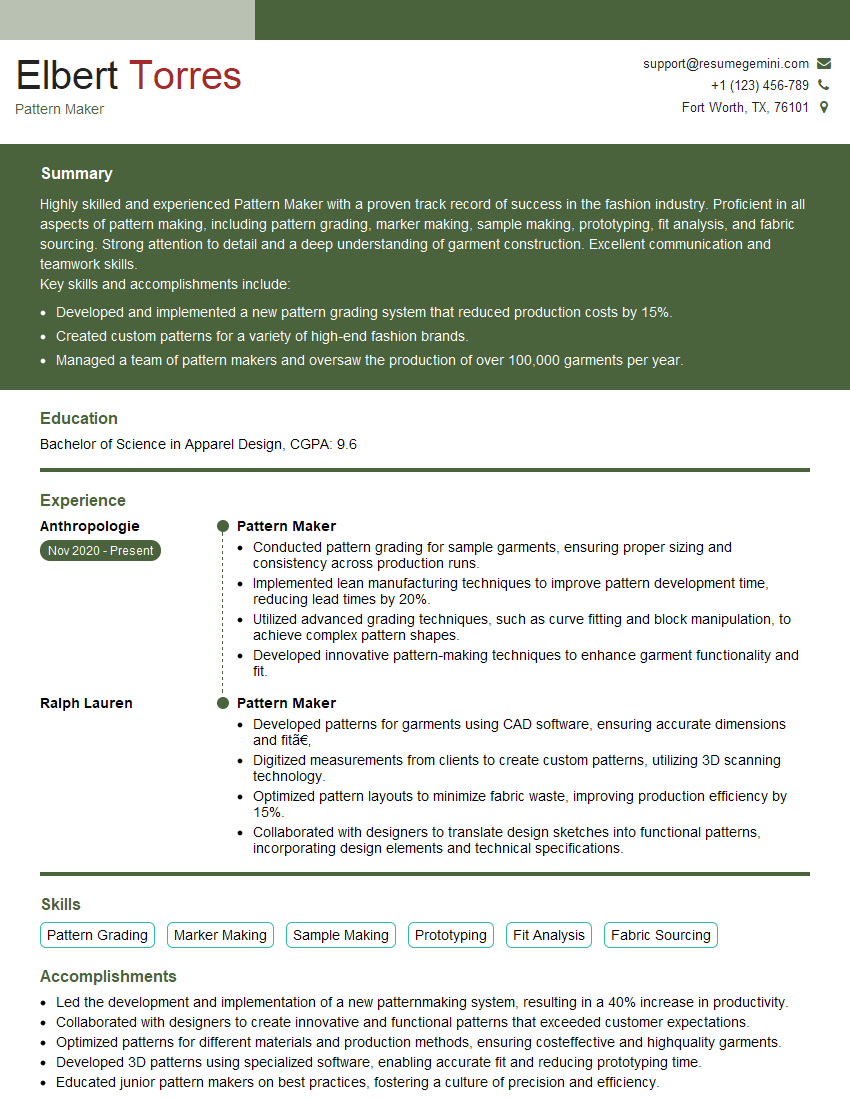
Mastering pattern grading and alteration opens doors to exciting career opportunities in the fashion and apparel industries. These skills are highly sought after, allowing you to advance in roles with increased responsibility and compensation. To maximize your job prospects, it’s crucial to present your skills effectively. Crafting an ATS-friendly resume is key to ensuring your application gets noticed by potential employers. We recommend using ResumeGemini, a trusted resource that helps you build a professional and impactful resume. ResumeGemini provides examples of resumes tailored to Pattern Grading and Alteration roles, assisting you in showcasing your expertise and experience in the best possible light.




Explore more articles
Users Rating of Our Blogs
Share Your Experience
We value your feedback! Please rate our content and share your thoughts (optional).
What Readers Say About Our Blog
Very informative content, great job.
good