The thought of an interview can be nerve-wracking, but the right preparation can make all the difference. Explore this comprehensive guide to PCB Fabrication and Assembly interview questions and gain the confidence you need to showcase your abilities and secure the role.
Questions Asked in PCB Fabrication and Assembly Interview
Q 1. Explain the difference between SMT and THT assembly.
SMT (Surface Mount Technology) and THT (Through-Hole Technology) are two fundamental methods for assembling components onto printed circuit boards (PCBs). The key difference lies in how the components are mounted.
SMT involves placing components directly onto the surface of the PCB, with their leads soldered to pads on the board’s surface. This allows for smaller, denser PCBs and automated high-speed assembly. Think of it like sticking tiny LEGO bricks onto a baseplate.
THT, on the other hand, uses components with leads that pass through holes in the PCB and are soldered on the opposite side. This method was prevalent in the past but is less common now due to its slower assembly process and larger component size restrictions. Imagine attaching larger LEGO pieces by poking their legs through the baseplate and securing them from below.
In practice, many modern PCBs use a combination of both SMT and THT components, leveraging the advantages of each technique. For example, large power components might use THT, while smaller, high-density integrated circuits use SMT.
Q 2. Describe the process of reflow soldering.
Reflow soldering is a crucial process in SMT assembly that melts solder paste to create electrical connections between surface-mount components and the PCB pads. It’s a carefully controlled thermal profile that ensures a strong and reliable joint.
- Paste Application: Solder paste, a mixture of tiny solder spheres and flux, is precisely applied to the PCB pads using a stencil or dispensing system. This step is critical for ensuring the right amount of solder at each connection.
- Component Placement: Surface-mount components are precisely placed onto the solder paste using a pick-and-place machine. Accuracy here is paramount to prevent shorts or open circuits.
- Reflow Oven: The PCB is then passed through a reflow oven, which subjects it to a precisely controlled temperature profile. This profile is crucial to achieve good solder joints, typically including preheating, soaking, reflow, and cooling phases. The temperature must rise slowly enough to avoid thermal shock to the components, and the reflow phase allows the solder to melt completely and form a solid, well-bonded joint. Temperature profiles are specific to the components and the solder used.
- Cooling: The PCB is finally cooled down to room temperature. A properly controlled cooling rate helps prevent stress on the components and board.
The entire process relies heavily on precise control of temperature and time. Improper reflow can lead to various defects like solder bridges, insufficient solder, or tombstoning (one component lead lifting). Sophisticated equipment like automated optical inspection (AOI) systems are used to verify the quality of the soldering.
Q 3. What are the common defects found in PCB fabrication?
Several defects can occur during PCB fabrication, impacting functionality and reliability. These can be broadly classified into:
- Etching Defects: Incomplete etching can leave unwanted copper traces, while over-etching can thin or remove traces, leading to open circuits.
- Drilling Defects: Broken or misaligned drill holes can prevent proper component insertion. Uneven hole sizes can also cause issues with component placement and soldering.
- Solder Mask Defects: This layer prevents solder from bridging unwanted traces. Defects like voids or short circuits due to incomplete masking can occur.
- Copper Plating Defects: Poor plating can result in weak traces that are prone to cracking or breaking. This can also affect the integrity of the solder joints.
- Layer Registration Issues: Misalignment between different layers of the PCB (e.g., inner layers versus surface copper) can create shorts or opens if the traces do not correctly align.
Proper quality control measures, including visual inspection and automated testing, are vital in identifying and minimizing these defects before the PCBs are populated with components.
Q 4. How do you ensure proper component placement during PCB assembly?
Ensuring proper component placement is critical for a functional PCB. It relies on a combination of accurate design, precise manufacturing processes, and robust quality control.
- Precise PCB Design: The PCB layout should clearly define the location and orientation of each component, including any specific placement requirements. Design software employs precise coordinate systems.
- Pick-and-Place Machines: Automated pick-and-place machines are used to precisely place components on the board. They use vision systems to locate components accurately and robotic arms to place them.
- Component Feeders: Components are usually supplied via tape-and-reel feeders, which ensures consistent feeding and accurate orientation of the components.
- AOI Inspection: Automated Optical Inspection (AOI) systems are frequently employed to verify component placement after the assembly process. This detects any misplaced, missing, or incorrectly oriented components.
- Human Inspection: Visual inspection by trained personnel is another key step to identify any defects that automated systems might miss.
Effective component placement relies on the close collaboration between design, manufacturing, and quality control teams. Any deviation from the designated placement can lead to circuit malfunctions, or even catastrophic failures. Thorough testing is paramount to ensure quality.
Q 5. What are the different types of PCB materials and their applications?
PCBs are manufactured from various substrate materials, each with specific properties that influence their performance and cost. Some common materials include:
- FR-4 (Flame Retardant 4): This is the most common material, a fiberglass-reinforced epoxy resin. It offers a good balance of cost, mechanical strength, and thermal stability. Widely used in general-purpose applications.
- Rogers 4003C: A high-frequency material with low dielectric loss, ideal for high-speed digital circuits and microwave applications. It provides better signal integrity at higher frequencies compared to FR-4.
- Polyimide (PI): Known for its high-temperature resistance and flexibility. Suitable for applications with extreme temperature variations or demanding flexibility requirements, like flexible PCBs.
- Aluminum-backed PCBs: Used in high-power applications where efficient heat dissipation is essential, utilizing the aluminum substrate for better thermal conductivity.
The choice of material depends significantly on the application requirements. For simple, low-cost electronics, FR-4 is often sufficient. However, for high-speed or high-power applications, specialized materials with better electrical and thermal properties are necessary.
Q 6. Explain the importance of solder paste inspection.
Solder paste inspection (SPI) is a crucial step in the surface mount technology (SMT) process that verifies the volume, shape, and position of the solder paste deposited on the PCB prior to component placement. It’s akin to checking the foundation before building a house.
SPI uses automated optical inspection systems or X-ray systems to analyze the solder paste. The inspection process compares the deposited solder paste with a predefined reference image to detect defects such as:
- Insufficient solder paste: This could lead to poor solder joints, open circuits, and unreliable connections.
- Excess solder paste: This may result in solder bridging between adjacent pads, short circuits, and component damage.
- Incorrect solder paste shape or location: Inconsistent or misaligned solder paste can also contribute to poor solder joints and assembly issues.
By identifying these defects early, before component placement, SPI significantly reduces the risk of rework, scrap, and costly production delays. A high-quality SPI ensures efficient, reliable, and cost-effective PCB assembly.
Q 7. Describe the AOI (Automated Optical Inspection) process.
Automated Optical Inspection (AOI) is a non-destructive quality control method used in PCB assembly to automatically inspect assembled boards for defects after the reflow soldering process. It essentially acts as a thorough visual inspection that’s far more efficient and precise than manual methods.
The process involves a high-resolution camera system that captures images of the PCB. Sophisticated image processing software compares these images to a reference model, identifying any deviations. These deviations could signal many defects, including:
- Missing components
- Misplaced components
- Incorrect component orientation
- Solder bridging
- Insufficient solder
- Cold solder joints
- Component tombstoning
The AOI system provides a detailed report highlighting the defects detected, enabling manufacturers to identify and address issues efficiently. While not foolproof, it drastically increases the reliability and quality of the final product by minimizing defects and enhancing overall yield.
Q 8. What are the safety precautions to be taken during PCB fabrication and assembly?
Safety in PCB fabrication and assembly is paramount. It involves a multifaceted approach addressing chemical hazards, electrical risks, and ergonomic concerns.
- Chemical Safety: Many PCB fabrication processes involve chemicals like etchants (e.g., ferric chloride), solvents (e.g., isopropyl alcohol), and fluxes. Always use appropriate personal protective equipment (PPE) like gloves, eye protection, and respirators as specified by the Safety Data Sheets (SDS). Work in well-ventilated areas and follow proper waste disposal procedures. Improper handling can lead to skin irritation, respiratory problems, or even fires.
- Electrical Safety: Working with electronic components and potentially live circuits necessitates caution. Ensure power is disconnected before handling PCBs. Use anti-static mats and wrist straps to prevent electrostatic discharge (ESD) damage to sensitive components. Never touch exposed circuitry while the power is on.
- Ergonomic Safety: Repetitive tasks like soldering or component placement can lead to strain injuries. Maintain good posture, take regular breaks, and utilize ergonomic tools and equipment to minimize repetitive strain injuries (RSI).
- Fire Safety: Many processes utilize flammable materials. Keep fire extinguishers readily available and understand their proper use. Adhere strictly to fire safety regulations and procedures.
Regular safety training and adherence to established safety protocols are essential for a safe working environment. A simple example is always ensuring the appropriate fume hood is used when working with etchants.
Q 9. How do you troubleshoot a PCB assembly failure?
Troubleshooting PCB assembly failures requires a systematic approach, combining visual inspection with testing methodologies. I often start with the simplest checks and progressively move towards more complex diagnostics.
- Visual Inspection: Begin with a thorough visual inspection of the assembled PCB. Look for obvious issues like: missing components, incorrect component orientation, solder bridges (excess solder connecting unintended traces), cold solder joints (poor solder connections), cracked components, or damaged traces.
- Continuity Testing: Use a multimeter to check the continuity of traces and connections. This helps verify that there are no breaks in the circuit paths.
- Component Testing: Test individual components using a multimeter or other appropriate testing equipment to ensure they are functioning correctly. A faulty component can cause the entire circuit to fail.
- Signal Tracing: Using an oscilloscope or logic analyzer, trace signals along the PCB to identify any signal integrity issues or unexpected voltage levels. This is crucial for identifying problems within complex circuits.
- Reflow Profile Analysis (for SMT): If surface mount technology (SMT) was used, examine the reflow soldering process. Incorrect reflow profiles can lead to poor solder joints.
- Software Debugging (if applicable): If the PCB is part of a larger system, software debugging might be necessary to rule out software errors.
Remember to document your findings at each step. This aids in identifying the root cause of the problem and helps prevent similar issues in the future. For instance, repeated cold solder joints might indicate a problem with the soldering station’s temperature control.
Q 10. Explain the concept of impedance matching in PCB design.
Impedance matching in PCB design is crucial for efficient signal transmission, especially at high frequencies. It involves ensuring that the impedance of the transmission line (the trace on the PCB) is matched to the impedance of the source and load impedances to minimize signal reflections and maximize power transfer.
Imagine sending waves down a rope. If the rope suddenly changes thickness, the wave will reflect back. Similarly, if the impedance changes abruptly on a PCB trace, the signal will reflect, causing signal distortion and loss of power. A common scenario is the transmission of signals between a high-speed microprocessor and a memory chip. Mismatched impedance can lead to signal degradation and data errors.
Impedance matching is achieved through careful control of trace width, trace length, and the dielectric constant of the PCB material. Specialized software tools are used for accurate impedance calculations and design. Common impedance values are 50 ohms for high-speed digital signals and 75 ohms for video signals.
Q 11. What are the different types of soldering techniques?
Soldering techniques vary depending on the type of components being used and the desired level of precision. Here are some common techniques:
- Through-Hole Soldering: Used for components with leads that pass through holes in the PCB. Techniques include hand soldering with an iron and wave soldering (explained later).
- Surface Mount Technology (SMT) Soldering: Used for surface mount components that are placed on the surface of the PCB. Common methods include reflow soldering (using a reflow oven), hand soldering with a fine-tipped iron, and selective soldering.
- Hand Soldering: Uses a soldering iron to manually apply solder to the joints. Requires skill and precision for consistent results.
- Wave Soldering: A mass soldering process for through-hole components (explained in more detail in the next answer).
- Reflow Soldering: Uses heat to melt solder paste that is pre-applied to the PCB and components. Typically done in a reflow oven.
- Selective Soldering: Applies solder only to specific areas of the PCB, often used to supplement reflow soldering.
Q 12. Describe the process of wave soldering.
Wave soldering is a mass production technique for soldering through-hole components to PCBs. It involves passing the assembled PCB across a wave of molten solder. The process generally involves these steps:
- Pre-treatment: The PCB is cleaned to remove any contaminants that could affect the soldering process. Flux is applied to improve the solder’s wetting ability.
- Wave Soldering: The PCB is conveyed across a wave of molten solder, typically generated by pumping the solder upwards to create a wave or by pumping the solder through a nozzle to create a laminar flow of molten solder. The leads of the components are submerged in the wave, allowing the solder to flow up and create a solder joint.
- Post-soldering Cleaning: Any excess solder or flux is removed from the PCB. This is often done using a cleaning agent. This step is crucial to avoid potential corrosion or short circuits caused by flux residues.
Wave soldering is efficient for high-volume production but less suitable for delicate surface-mount components which may be damaged by the force of the solder wave. The effectiveness of wave soldering is highly dependent on the wave’s height, temperature, and the PCB’s design (particularly the lead spacing and component placement).
Q 13. How do you handle static electricity during PCB assembly?
Static electricity is a significant threat to sensitive electronic components, causing latent damage or immediate failure. Handling static electricity effectively is crucial during PCB assembly. This is commonly addressed using several strategies:
- ESD Mats and Wrist Straps: The most common method is to work on an anti-static mat connected to earth ground. An anti-static wrist strap, also connected to ground, prevents charge buildup on the person handling the components. This creates a conductive path to earth, preventing the accumulation of static discharge.
- ESD Clothing: Wearing clothing made from dissipative materials can help minimize static buildup.
- Ionizing Air Blowers: These devices neutralize static charges in the air, preventing static buildup on components and work surfaces. This is particularly useful in dry environments where static electricity is more prevalent.
- Proper Packaging and Handling: Electronic components are often shipped in anti-static bags or containers, and it’s important to keep them in these protective packages until immediately before installation on the PCB. Using anti-static tweezers is also a best practice.
- Humidity Control: Maintaining appropriate humidity levels (typically 40-60%) helps reduce static electricity buildup in the air.
Ignoring ESD precautions can lead to costly repairs, replacements, or even entire board failure. A small spark can damage even the most robust components. A simple example is the instant failure of a microcontroller if a significant static discharge happens during insertion.
Q 14. What are the different types of PCB connectors?
PCB connectors come in a wide variety of types, each designed for specific applications and requirements. The choice of connector depends on factors like the number of connections, signal type (analog, digital, high-speed), environment, and cost.
- Through-Hole Connectors: These connectors have pins that pass through holes in the PCB. They are robust and relatively easy to solder but may be less suitable for high-density applications.
- Surface Mount Connectors: These connectors have surface mount pads instead of through-hole pins. They are smaller and enable higher component density. However they require more precise soldering techniques.
- Edge Connectors: These connectors connect to the edge of the PCB, often used for parallel interfaces or connection to backplanes.
- Card Edge Connectors: Specifically designed for connecting PCBs to other PCBs or backplanes. These feature a contact strip along the edge of the board, generally enabling a high number of connections.
- Right-Angle Connectors: These connectors are mounted at 90 degrees to the PCB, saving space and improving board layout.
- Board-to-Board Connectors: These connectors facilitate connections between two PCBs.
- IDC (Insulation Displacement Connectors): These connectors create connections by displacing the insulation of the wire, eliminating the need for soldering.
- RF Connectors: These connectors are designed to handle radio frequency signals and are frequently employed in wireless communication applications. Special design considerations exist to minimise signal loss.
Each connector type has its advantages and disadvantages. The selection process typically involves weighing factors such as cost, density, performance, and ease of assembly.
Q 15. Explain the importance of IPC standards in PCB manufacturing.
IPC standards are crucial in PCB manufacturing because they provide a universally recognized set of guidelines and specifications for materials, processes, and testing. Think of them as the recipe book for building reliable PCBs. Adherence to these standards ensures consistent quality, reliability, and interoperability across different manufacturers. This minimizes costly rework, failures, and ensures the final product meets performance expectations. For example, IPC-A-600 defines the acceptability criteria for assembled boards, providing clear visual standards to assess the quality of soldering, component placement, and overall workmanship. IPC-2221 outlines the requirements for printed boards, detailing critical aspects like trace width, spacing, and material selection for optimal performance and reliability.
Career Expert Tips:
- Ace those interviews! Prepare effectively by reviewing the Top 50 Most Common Interview Questions on ResumeGemini.
- Navigate your job search with confidence! Explore a wide range of Career Tips on ResumeGemini. Learn about common challenges and recommendations to overcome them.
- Craft the perfect resume! Master the Art of Resume Writing with ResumeGemini’s guide. Showcase your unique qualifications and achievements effectively.
- Don’t miss out on holiday savings! Build your dream resume with ResumeGemini’s ATS optimized templates.
Q 16. What are the common causes of solder bridges and how to prevent them?
Solder bridges, unwanted connections between adjacent pads, are a common issue in PCB assembly. They often occur due to excessive solder volume, insufficient spacing between pads, improper stencil design, or poor wave soldering parameters. Imagine trying to apply glue precisely – too much, and it spills over; too little, and you don’t get a good bond. Preventing solder bridges involves careful design considerations. This includes ensuring adequate pad spacing (following IPC guidelines), using the right stencil thickness and aperture size for the chosen solder paste, and optimizing the reflow oven profile to avoid excessive solder flow. Furthermore, visual inspection during the manufacturing process is critical, with automated optical inspection (AOI) systems playing a vital role in detecting these defects early.
Q 17. Describe the process of cleaning PCBs after assembly.
Cleaning PCBs after assembly is essential to remove flux residues which can lead to corrosion, insulation breakdown, and ultimately, equipment failure. Think of flux as a sticky residue that attracts dust and moisture. The cleaning process usually involves a combination of methods, depending on the type of flux used (water-soluble, no-clean, or rosin). For water-soluble fluxes, aqueous cleaning is performed using specialized cleaning agents followed by thorough rinsing and drying. No-clean fluxes require less rigorous cleaning, but might necessitate a solvent-based cleaning in high-reliability applications. The choice of cleaning method should always consider environmental regulations and the potential impact on the PCB’s components. Ultrasonic cleaning might also be used to improve cleaning effectiveness. Finally, thorough drying is paramount to avoid any residual moisture that may cause corrosion.
Q 18. How do you identify counterfeit components?
Identifying counterfeit components requires a multi-pronged approach encompassing visual inspection, component marking verification, and advanced testing. Visual inspection involves checking the markings, appearance, and packaging for discrepancies against genuine parts. Many counterfeit components have blurry or inconsistent markings, poorly replicated packaging, or show signs of tampering. Verification involves comparing the markings against the manufacturer’s database or authorized distributors’ records. Sophisticated tools like X-ray inspection or specialized component analyzers can be used to analyze the internal structure of the component and detect inconsistencies compared to authentic parts. Working only with authorized distributors is a significant step in reducing the risks of receiving counterfeit components.
Q 19. What are the different types of PCB testing methods?
PCB testing employs various methods to ensure functionality and reliability. These methods range from simple visual inspections to sophisticated automated tests.
- In-circuit testing (ICT): Verifies the connectivity between components and the PCB.
- Functional testing: Checks the overall functionality of the board according to its specifications.
- Automated optical inspection (AOI): Uses cameras and image processing to detect defects like solder bridges, shorts, and open circuits.
- Flying probe testing: A flexible testing approach, useful for high-mix, low-volume production.
- Boundary scan testing (JTAG): Allows testing of individual components and connections.
Q 20. Explain the concept of Design for Manufacturing (DFM).
Design for Manufacturing (DFM) is a crucial approach that integrates manufacturing considerations into the design process. It’s about thinking like a manufacturer from the very beginning. Instead of designing a theoretically perfect board that’s difficult to manufacture, DFM ensures the board is designed for efficient and cost-effective production. This might involve selecting components that are readily available, using standard PCB dimensions, choosing manufacturing processes that are easy to implement, and simplifying the assembly process to reduce the risk of errors. A simple example would be avoiding extremely fine pitch components that may be challenging to solder reliably, or choosing surface-mount technology (SMT) components that are generally easier to automate than through-hole components. DFM ultimately leads to reduced manufacturing costs, higher yields, and shorter lead times.
Q 21. How do you ensure the quality of PCB assembly?
Ensuring the quality of PCB assembly requires a comprehensive approach encompassing all stages of the process. This starts with selecting reputable component suppliers and implementing strict quality control measures at each step, from incoming component inspection to final testing. Utilizing appropriate assembly techniques, including proper solder paste application and reflow profiles, is critical for reliable connections. Regular calibration and maintenance of assembly equipment, coupled with the use of automated inspection systems like AOI and automated X-ray inspection (AXI), helps identify and eliminate defects early. Statistical process control (SPC) techniques monitor key parameters during production, allowing for proactive identification and correction of potential issues. Following IPC standards and regularly auditing the processes help to maintain consistent high quality.
Q 22. What are the different types of PCB board materials?
PCB board materials are chosen based on the application’s requirements for factors like thermal conductivity, dielectric strength, and cost. Common materials include:
- FR-4 (Flame Retardant 4): This is the most common material, offering a good balance of cost, mechanical strength, and thermal properties. It’s a fiberglass-reinforced epoxy resin, suitable for many applications.
- Rogers RO4000 series: These are high-frequency materials with low dielectric loss, ideal for microwave and high-speed digital applications. They provide excellent signal integrity.
- Polyimide (PI): Offers high temperature resistance and flexibility, often used in flexible circuits or applications with extreme thermal cycling.
- Ceramic: Provides excellent thermal conductivity, making it suitable for high-power applications. It’s more expensive and brittle than other materials.
- Aluminum: Used for high-power applications due to its superior thermal dissipation capabilities. Often found in power electronics.
The selection process involves careful consideration of the design’s thermal, mechanical, and electrical specifications. For instance, a high-speed server board might require Rogers RO4000 for signal integrity, while a simple consumer product might use the more economical FR-4.
Q 23. What is the difference between single-sided, double-sided and multilayer PCBs?
The difference lies in the number of conductive layers available for circuit routing:
- Single-sided PCBs: Have copper only on one side of the board. Simplest to manufacture, best for very simple circuits, but limited in complexity.
- Double-sided PCBs: Have copper on both sides, allowing for more complex circuitry and increased component density. Through-hole vias connect traces on opposite sides.
- Multilayer PCBs: Have multiple layers of copper separated by insulating layers (prepreg). This allows for significant increases in complexity and component density. Internal layers provide better signal integrity and reduce electromagnetic interference (EMI).
Think of it like building with LEGOs. Single-sided is like building a single flat layer, double-sided adds another layer with connections between them, and multilayer allows for numerous layers with intricate internal connections for far more complex structures.
Q 24. Explain the process of PCB etching.
PCB etching is a subtractive process used to create the desired copper patterns on the board. It involves the following steps:
- Photoresist Application: A photosensitive resin (photoresist) is applied evenly to the copper-clad board.
- Exposure: The board is exposed to ultraviolet (UV) light through a photomask, which has the circuit pattern. Exposed areas of the photoresist become soluble.
- Development: A developer solution removes the exposed photoresist, leaving the copper underneath unprotected in the areas where the circuit traces are to be etched.
- Etching: The board is immersed in an etchant solution (often ferric chloride or cupric chloride) that removes the unprotected copper, leaving behind the desired circuit pattern.
- Photoresist Removal: The remaining photoresist is removed, leaving the clean etched copper traces.
Think of it as creating a stencil (photomask) and using it to selectively remove copper (etching), leaving behind the desired circuit design. The quality of the etching process directly impacts the reliability and performance of the final PCB.
Q 25. What are the challenges of high-density PCB assembly?
High-density PCB assembly presents several challenges:
- Component Placement Accuracy: Precise placement of tiny components is crucial. Even minor misalignments can cause shorts or opens.
- Soldering Challenges: Small pads and fine pitch components make soldering more difficult. Issues like bridging, cold solder joints, and tombstoning are more common.
- Thermal Management: High component density leads to increased heat generation, requiring careful thermal design and potentially specialized cooling solutions.
- Signal Integrity Issues: Closely spaced traces can lead to crosstalk and signal degradation, demanding meticulous design and analysis.
- Inspection Difficulties: Inspecting densely packed PCBs for defects requires advanced techniques and equipment, such as automated optical inspection (AOI).
Imagine trying to assemble a complex clockwork mechanism; each part needs to be in exactly the right place, and any slight error can cause the entire system to fail. Similarly, high-density PCBs require extremely precise manufacturing and assembly processes to ensure proper functionality.
Q 26. Describe your experience with different types of automated assembly equipment.
My experience encompasses a range of automated assembly equipment, including:
- Pick-and-place machines: I’m proficient in operating and maintaining various models, from high-speed machines for high-volume production to smaller, more flexible systems for prototyping and small-batch production. I understand the importance of optimizing placement parameters for different components and board designs.
- Reflow ovens: I’m experienced in profile optimization and troubleshooting common reflow issues, such as bridging, tombstoning, and insufficient solder wetting. I understand the impact of different solder paste types and temperature profiles on joint quality.
- Automated optical inspection (AOI) systems: I’m proficient in using AOI systems to detect defects such as missing components, solder bridges, and opens. This ensures high-quality assembly and reduces rework.
- Wave soldering machines: I’m familiar with the operation and maintenance of wave soldering systems, including flux management and parameter optimization for through-hole components. This is less prevalent for high-density boards.
I have hands-on experience using equipment from leading manufacturers, and I am always eager to learn and adapt to new technologies in automated assembly.
Q 27. How do you manage inventory and procurement in PCB manufacturing?
Effective inventory and procurement management is crucial for efficient PCB manufacturing. My approach involves:
- Demand Forecasting: Accurate forecasting of material requirements based on production schedules and historical data helps prevent shortages and reduces excess inventory.
- Supplier Relationship Management: Strong relationships with reliable suppliers ensure timely delivery of high-quality materials at competitive prices.
- Inventory Tracking System: Utilizing an inventory management system (such as ERP or MRP software) for real-time tracking of stock levels, facilitating timely reordering.
- Quality Control: Implementing rigorous quality control checks on incoming materials to prevent the use of substandard materials.
- Lean Principles: Applying lean principles to optimize inventory levels, minimizing waste, and maximizing efficiency. This includes techniques like Kanban and Just-in-Time (JIT) inventory management.
For example, using a Kanban system to manage the flow of materials from suppliers directly to the production line ensures that we have the right amount of material at the right time, avoiding unnecessary storage costs and reducing the risk of stockouts.
Q 28. What are your skills in using PCB design software?
I’m proficient in several industry-standard PCB design software packages, including Altium Designer, Eagle, and KiCad. My skills encompass:
- Schematic Capture: Creating and managing electronic schematics, ensuring proper component placement and signal routing.
- PCB Layout: Designing efficient and manufacturable PCB layouts, considering factors such as trace width, spacing, and impedance control.
- Component Library Management: Maintaining and expanding component libraries to ensure accurate and efficient design processes.
- Design Rule Checking (DRC): Utilizing DRC to identify and resolve design errors before fabrication.
- Simulation and Analysis: Performing simulations to verify signal integrity, power integrity, and thermal performance.
I’ve used these tools in numerous projects, ranging from simple prototypes to complex multi-layer boards. My experience includes designing for high-speed digital signals, high-power applications, and EMI/EMC compliance, often adapting my approach based on specific project requirements and constraints.
Key Topics to Learn for PCB Fabrication and Assembly Interview
- PCB Design Fundamentals: Understanding Gerber files, layer stackups, and component placement strategies. Practical application: Analyzing a PCB design for manufacturability issues.
- Fabrication Processes: Detailed knowledge of etching, drilling, and surface finishing techniques. Practical application: Troubleshooting common fabrication defects like under-etching or misaligned vias.
- Soldering Techniques: Mastery of both through-hole and surface mount technology (SMT) soldering, including reflow and wave soldering processes. Practical application: Explaining the differences in soldering techniques and their suitability for various components.
- Component Placement and Handling: Understanding the importance of proper component orientation and handling to prevent damage. Practical application: Describing strategies for efficient and accurate component placement.
- Inspection and Testing: Familiarization with automated optical inspection (AOI), X-ray inspection, and functional testing methodologies. Practical application: Explaining the purpose and limitations of different inspection techniques.
- Quality Control and Process Improvement: Implementing techniques to minimize defects and improve overall yield. Practical application: Discussing strategies for root cause analysis and corrective actions.
- Material Selection and Properties: Understanding the characteristics of different PCB materials (e.g., FR4, Rogers) and their impact on performance. Practical application: Choosing appropriate materials for a specific application based on its requirements.
- Health and Safety Regulations: Adherence to safety protocols and regulations within the PCB fabrication and assembly environment. Practical application: Describing safe handling procedures for chemicals and equipment.
Next Steps
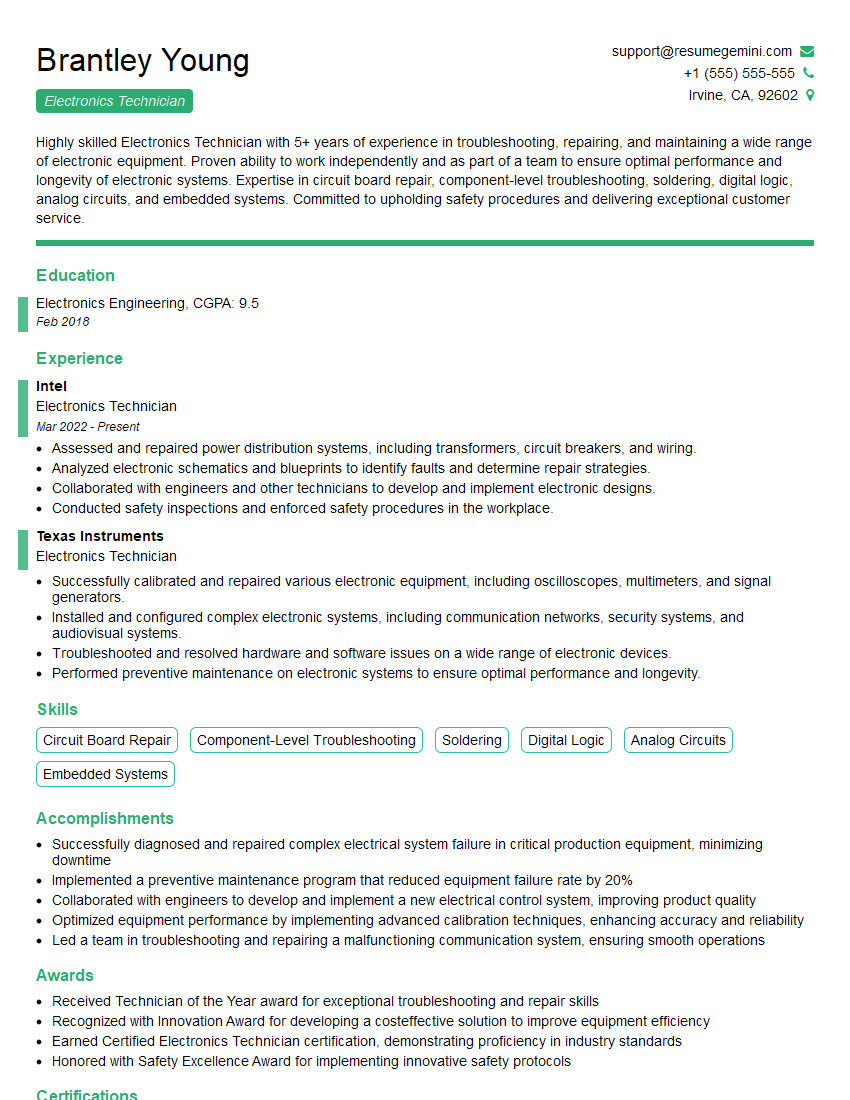
Mastering PCB Fabrication and Assembly opens doors to exciting career opportunities in electronics manufacturing, offering diverse roles and continuous learning potential. To maximize your job prospects, creating an ATS-friendly resume is crucial. An effectively crafted resume highlights your skills and experience, ensuring it gets noticed by potential employers. We strongly recommend using ResumeGemini to build a professional and impactful resume. ResumeGemini offers a streamlined process and provides examples of resumes tailored to the PCB Fabrication and Assembly field, helping you present your qualifications effectively. Take the next step towards your dream career – build your winning resume today!
Explore more articles
Users Rating of Our Blogs
Share Your Experience
We value your feedback! Please rate our content and share your thoughts (optional).
What Readers Say About Our Blog
Very informative content, great job.
good