The right preparation can turn an interview into an opportunity to showcase your expertise. This guide to Physical Comedy interview questions is your ultimate resource, providing key insights and tips to help you ace your responses and stand out as a top candidate.
Questions Asked in Physical Comedy Interview
Q 1. Explain the principles of timing in physical comedy.
Timing in physical comedy is everything; it’s the art of precisely controlling the rhythm and pace of your movements to maximize comedic effect. It’s not just about when you do something, but also how long you hold a pose, the speed of your actions, and the pauses between them. Think of it like a musical score – the notes (actions) are important, but the rests (pauses) are equally vital to create the melody (the comedic beat).
- The Pause: A well-placed pause before a physical action can build anticipation and heighten the comedic impact. Imagine a character reaching for a doorknob, pausing dramatically, and then flailing comically as they miss completely.
- The Slow Burn: Slowly building up to a physical gag, rather than rushing it, allows the audience to anticipate the payoff and appreciate the full comedic potential. Think of a character meticulously setting a trap, only to have it backfire spectacularly.
- The Surprise: Unexpected timing can create a comedic surprise. A character might stumble, but the unexpected element is the recovery—they might gracefully flip into a cartwheel before falling back down.
Mastering timing requires practice and a keen understanding of audience reaction. It’s an iterative process of refinement, continually adjusting based on the audience’s response.
Q 2. Describe three different techniques for creating comedic physicality.
Three distinct techniques for creating comedic physicality are slapstick, mime, and character-driven physicality.
- Slapstick: This involves exaggerated, often violent, physical actions like slipping on a banana peel, getting hit with a pie, or falling down a flight of stairs. The humor derives from the absurdity and unexpectedness of the situation. Think of the classic silent film comedians like Buster Keaton and Charlie Chaplin who mastered this style.
- Mime: Mime relies on precise, controlled movements to create illusions and tell stories without dialogue. It emphasizes creativity and precision, using the body to convey emotions and actions. Think of the iconic image of a mime struggling against an invisible wall – the humor comes from the clever manipulation of space and the contrast between effort and result.
- Character-Driven Physicality: This approach uses physicality to define and enhance a character’s personality. A nervous character might fidget constantly, while a pompous character might walk with an exaggerated swagger. The physicality becomes an extension of the character’s inner life, adding layers of depth and believability to the performance. Think of the quirky movements of a character like Mr. Bean.
Q 3. How do you incorporate exaggeration into your physical comedy?
Exaggeration is the cornerstone of effective physical comedy. It’s about amplifying natural movements and reactions to an almost cartoonish degree. It’s not about being more intense, but about being different – more unexpected and therefore funnier.
For example, a simple stumble can become a hilariously extended fall, complete with exaggerated flailing limbs and comical facial expressions. A slight frown can turn into a grotesque grimace, and a minor twitch becomes a full-blown seizure (within the boundaries of good taste, of course!).
I often utilize slow motion and repetition to further emphasize the exaggeration, allowing the audience to truly appreciate the absurdity of the action. This controlled approach makes the exaggeration more effective and less chaotic.
Q 4. What is your preferred method for developing a physical comedy character?
My preferred method for developing a physical comedy character involves a blend of observation, improvisation, and character building exercises.
I start by observing real people – their mannerisms, their quirks, their physical tics. I then take these observations and exaggerate them, pushing them beyond their natural limits to create something comical. I might combine elements from several people I’ve observed, creating a completely unique character. Improvisational games are helpful to discover the character’s spontaneous reactions and physicality. I might also use character sketches or questionnaires to solidify specific aspects of the character’s personality and backstory, ensuring a cohesive and believable presence.
Finally, I test the character in front of an audience, experimenting with different physical approaches and gauging the audience’s response. This iterative process allows me to refine the character until I find the most comedic and resonant approach.
Q 5. Explain the importance of audience engagement in physical comedy.
Audience engagement is paramount in physical comedy. The energy of the audience directly fuels the performance. A responsive audience provides a powerful feedback loop, allowing the performer to adjust their timing, intensity, and approach to maximize comedic effect.
I achieve this through direct eye contact, physical gestures directed towards the audience, and incorporating audience participation when appropriate. I actively try to create a sense of shared experience and build rapport with the audience, making them feel like active participants in the comedic process rather than just passive observers. This can involve improvisational elements responding to audience reactions or even incorporating audience suggestions directly into the routine.
Q 6. How do you manage physical risks and safety in your performances?
Safety is my top priority. While physical comedy often involves risk, I mitigate this through careful planning, rehearsal, and collaboration. Before performing any potentially dangerous stunt, I thoroughly rehearse it multiple times, often with a spotter, ensuring I understand the precise movements and potential hazards.
I prioritize safety equipment when needed, such as padding for falls or protective gear for stunts. I also ensure the performance space is safe and free of obstacles. Communication with my team and the venue staff is essential for identifying and addressing potential risks. I believe a successful physical comedy performance is one where the laughs come from the skill and precision of the performance, not from any genuine accidents.
Q 7. Describe your experience with improvisation in physical comedy.
Improvisation is integral to my physical comedy. It allows for spontaneity and adaptability, creating unique and unexpected moments of humor. Improvisational games and exercises help me develop quick thinking, refine my timing, and strengthen my physical instincts. I regularly incorporate improvisational elements into my performances, allowing for organic interaction with the audience and adapting the routine based on their reactions.
I find that improvisational exercises are extremely valuable for generating new ideas and overcoming creative blocks. I might work with other performers, improvising physical scenarios and developing characters together. The ability to react spontaneously to unexpected situations is critical, not only for maintaining the momentum of a performance but also for creating truly memorable and engaging comedic moments.
Q 8. How do you adapt your physical comedy style to different performance spaces?
Adapting physical comedy to different performance spaces is crucial for maximizing its impact. It’s not just about scaling the size of your movements; it’s about understanding the space’s nuances and adjusting your performance accordingly.
For example, a small, intimate space demands more subtle gestures and nuanced expressions. You want to connect with each audience member individually. In contrast, a large stage requires bigger, bolder movements to ensure visibility and engagement from the back rows. Consider the acoustics as well – a large, echoing space might require you to exaggerate your movements to match the sound.
Think of it like painting: a small canvas requires delicate brushstrokes, whereas a mural demands broader, more sweeping movements. I always start by observing the space: its size, its acoustics, its sightlines, and even the lighting. This informs my choices about movement, pacing, and even prop selection.
Q 9. Explain the use of props in physical comedy, providing specific examples.
Props are invaluable tools in physical comedy, adding another layer of visual and physical humor. They aren’t just objects; they become extensions of the comedic character and plot. The key is to choose props that can be manipulated in unexpected and hilarious ways.
For instance, a simple banana peel can be the source of numerous comedic slips, trips, and falls. A comically oversized hat can become a source of slapstick struggle and visually funny mishaps. A seemingly ordinary watering can can unexpectedly unleash a torrent of water, creating a chaotic and humorous scene.
The most effective props are often the most ordinary, highlighting the absurdity of everyday objects when used unconventionally. Consider a simple oversized rubber chicken, transforming it from an everyday object into a comedic weapon, a source of conflict or an unexpected participant in a chase scene.
Q 10. How do you incorporate sound effects into your physical comedy routine?
Sound effects enhance the physicality of a comedic routine by adding a layer of auditory humor and emphasis. They amplify the visual gag, making the joke even funnier. However, it’s about careful integration, not overkill.
For instance, a well-timed ‘boing’ sound effect when someone bounces off a wall adds a comedic punch that goes beyond the visual. Similarly, a loud ‘thwack’ accompanying a pie-in-the-face accentuates the impact, creating a far more humorous effect. The key is to use sound effects sparingly and strategically. Too many sound effects can be distracting and detract from the visual comedy.
In my routines, I often incorporate live sound effects, using my voice to mimic sounds or working with a sound technician to create a more complex soundscape. The perfect timing and effect selection can transform a simple physical gag into a memorable comedic moment.
Q 11. Discuss the role of facial expressions in physical comedy.
Facial expressions are absolutely crucial in physical comedy; they are the silent storyteller of the piece. They provide context, emotion, and often reveal the inner thoughts and reactions of the character, enriching the comedic narrative. A perfectly timed grimace, a surprised expression, or a mischievous smirk can transform a simple stumble into a hilarious moment.
Think of Buster Keaton’s deadpan expressions during his acrobatic stunts – they highlight the absurdity of the situation and heighten the comedic effect. Conversely, exaggerated expressions can be used to underscore the physical humor. The key lies in the perfect blend of timing and expression. A simple raised eyebrow can convey volumes, while a wide-eyed stare can enhance the feeling of shock and surprise.
I often practice facial expressions in front of a mirror, refining my ability to use subtle movements to convey complex emotions within the framework of a physical comedic scene. The audience connects with the emotion first and foremost, before even noticing the physicality.
Q 12. How do you use body language to tell a story in physical comedy?
Body language is the primary language of physical comedy; it’s how we tell the story without words. Through posture, gestures, and movement, we convey character, plot, and emotion. It’s about using the body to create a visual narrative that is both engaging and humorous.
For instance, a hunched posture could suggest a character is downtrodden, while exaggerated swagger might indicate arrogance. A wide, expansive stance could express confidence or defiance. Similarly, the way a character walks, their gestures, and their interactions with props all contribute to the storytelling. The subtle nuances in body language can communicate volumes, transforming a simple action into a multi-layered comedic moment.
I often choreograph my movements as carefully as I would write a script, designing specific actions to convey the emotional arc and plot progression of the routine. Every movement has meaning; it’s not just random flailing; every movement builds the story.
Q 13. Explain the significance of comedic timing in slapstick comedy.
Comedic timing in slapstick is paramount; it’s the difference between a funny pratfall and a painful accident. It’s about the precise synchronization of action, reaction, and sound to create a comedic effect. The pause before the fall, the perfectly timed sound effect, the exaggerated reaction – these are all elements of impeccable comedic timing.
Think of the classic pie-in-the-face routine: the anticipation, the build-up, the perfectly timed impact, and the subsequent reaction all determine its comedic value. Poor timing can lead to a lackluster effect. Mastering comedic timing requires practice, precision, and a keen understanding of audience reaction.
In my approach, I work tirelessly on refining comedic timing, often experimenting with variations in pacing to discover what resonates best with the audience. It’s a process that involves constant refinement and adaptation, paying close attention to the rhythm of the performance.
Q 14. What is your approach to creating a comedic routine from scratch?
Creating a comedic routine from scratch is a process of building upon a core idea, adding layers of physicality, and refining the comedic timing. It begins with a concept – perhaps a simple situation, a character quirk, or a common mishap. Then, you brainstorm ways to exaggerate and amplify the physical aspects of that concept.
I often start with character development; who is this person? What are their physical traits? What are their motivations? What’s the environment they’re in? Building a detailed character helps you understand their physical gestures and reactions. From there, I look for opportunities for physical mishaps, unexpected interactions, and escalating situations.
For example, starting with the simple idea of ‘someone trying to reach a high shelf’ can lead to a cascade of comedic events: they might use a wobbly chair, the chair might break, they might fall, and so on. The key is to build on the initial concept, escalating the physical comedy and refining the timing to create a coherent and hilarious narrative. It’s an iterative process of creation, revision, and refinement.
Q 15. Describe your experience with mime or pantomime techniques.
Mime and pantomime are foundational to physical comedy. They’re about communicating entirely through body language, facial expressions, and precise movements. My training involved years of studying classic mime techniques, focusing on the illusion of manipulating invisible objects, creating believable characters through posture and gait, and mastering the art of the ‘silent walk’. This involves not just moving, but embodying a specific emotion or narrative through every step. For example, a ‘heavy’ walk might suggest carrying a large burden, while a light, skipping gait could represent joy. I’ve also explored the more expressive side of pantomime, which allows for broader gestures and exaggerated character work, often used to highlight the absurdity of a situation.
I see mime as a form of visual storytelling, and my experience with it has profoundly influenced my comedic timing and ability to communicate complex emotions without a single word. It’s the basis for many of the comedic set pieces I create.
Career Expert Tips:
- Ace those interviews! Prepare effectively by reviewing the Top 50 Most Common Interview Questions on ResumeGemini.
- Navigate your job search with confidence! Explore a wide range of Career Tips on ResumeGemini. Learn about common challenges and recommendations to overcome them.
- Craft the perfect resume! Master the Art of Resume Writing with ResumeGemini’s guide. Showcase your unique qualifications and achievements effectively.
- Don’t miss out on holiday savings! Build your dream resume with ResumeGemini’s ATS optimized templates.
Q 16. How do you maintain energy and stamina during a physical comedy performance?
Maintaining energy in physical comedy is crucial. It’s a demanding art form that requires both physical and mental stamina. My approach is threefold: Firstly, physical preparation is essential. This means regular exercise, focusing on strength training, flexibility, and cardiovascular fitness. A strong core is particularly important for maintaining balance and executing dynamic movements. Secondly, hydration and nutrition play a critical role. I carefully manage my diet before a performance, avoiding heavy meals and ensuring I’m well-hydrated. Thirdly, mental preparation is equally vital. I use mindfulness techniques to center myself before a show, and I practice visualization to maintain focus and control my energy levels throughout the performance. I also break down my routines into smaller segments, allowing for brief moments of rest and recovery without disrupting the flow.
Essentially, it’s a holistic approach, blending physical fitness with mental discipline.
Q 17. Describe a time you had to overcome a challenge in a physical comedy performance.
During a performance of a slapstick routine involving a collapsing bookshelf, a crucial prop – a small, decorative shelf – unexpectedly broke during the setup. The audience was already seated, and panic momentarily flashed through me. Instead of abandoning the routine, I improvised. I played up the ‘accident’, portraying the broken shelf as part of the act, using exaggerated reactions and mime to imply the catastrophic failure of the bookshelf. I even incorporated the broken piece into the ensuing chaos. The audience erupted in laughter – they appreciated the spontaneity and my quick thinking. This taught me the invaluable lesson of embracing the unexpected and turning potential setbacks into comedic opportunities.
The key was to stay calm, think on my feet, and trust my comedic instincts. Improvisation is a vital skill for any physical comedian.
Q 18. What is your understanding of Commedia dell’Arte techniques?
Commedia dell’Arte is an Italian theatrical tradition that significantly impacts physical comedy. It’s characterized by its stock characters – like Harlequin, Columbine, and Pantalone – each with distinct physical traits and comedic styles. My understanding centers around its use of exaggerated movements, slapstick, improvisation, and the interplay between the actors. The fast-paced, energetic nature of Commedia dell’Arte, with its reliance on physical gags and comedic timing, directly informs my own comedic approach. For example, the use of precise body language to convey character traits, the physical interaction between characters to create humorous situations, and the use of masks to amplify facial expressions and create instantly recognizable characters, all contribute to the effectiveness of Commedia dell’Arte.
I often incorporate elements of Commedia dell’Arte, such as the use of specific character types and their associated physical attributes, into my own work. It’s a rich source of inspiration for physical comedic techniques.
Q 19. Explain the importance of repetition and variation in physical comedy.
Repetition and variation are fundamental to physical comedy’s effectiveness. Repetition allows the audience to understand and anticipate a gag, creating a sense of familiarity. This builds anticipation and ultimately allows the punchline to land more powerfully. However, if the repetition is exactly the same, it can become predictable and lose impact. This is where variation comes in. It involves subtle changes – a slightly different facial expression, a variation in timing, a change in the physical movement – which keeps the audience engaged and prevents the gag from becoming stale.
For example, a simple trip could be repeated three times, with each repetition having a slightly exaggerated fall. The first trip might be a clumsy stumble, the second a dramatic tumble, and the third a completely over-the-top, cartoonish collapse. This builds the comedic tension whilst providing enjoyable variations on the same theme.
Q 20. How do you incorporate audience participation into your physical comedy?
Audience participation can greatly enhance the energy and spontaneity of a physical comedy performance. I often incorporate it through carefully planned interactions. These can range from simple call-and-response gags, where the audience provides a predictable response to a set-up, to more interactive moments where I engage with specific audience members, such as choosing someone to participate in a mini-game or reacting to their spontaneous contributions. The key is to create moments of genuine interaction that feel natural and enhance the comedic flow without disrupting it.
In one of my shows, I invite an audience member to help me ‘build’ a tower out of imaginary blocks – a fantastically absurd scenario that leads to unexpected and hilarious results. It’s about establishing a rapport with the audience and turning them into active participants in the comedic narrative.
Q 21. Describe your understanding of stage combat techniques as they relate to comedy.
Stage combat in comedy isn’t about genuine violence; it’s about the carefully choreographed illusion of violence. My understanding involves a blend of theatrical techniques and comedic timing. The goal isn’t to inflict harm but to create funny, exaggerated reactions and memorable visual gags. This requires precise timing, practiced movements, and a deep understanding of comedic rhythm. A simple ‘punch’ becomes funnier when over-exaggerated, with a slow-motion wind-up and comically dramatic reaction from the recipient. The techniques used are adapted; for example, rather than a realistic sword fight, a comedic fight might involve oversized, rubbery weapons, slapstick collisions, and over-the-top expressions of pain.
Safety is paramount. Proper training in stage combat, focusing on safe techniques and the effective communication between actors is crucial to avoiding accidents while creating believable and hilarious fights.
Q 22. Explain your process for designing a physical comedy character’s movement.
Designing a physical comedy character’s movement begins with understanding the character’s personality and backstory. Is this character clumsy, graceful, manic, or stoic? Their movement should directly reflect these traits. I start by brainstorming key physical characteristics. For instance, a character with anxiety might fidget constantly, while a powerful character might have strong, deliberate movements.
Next, I consider the character’s physicality. Are they tall and lanky, short and stout? Their build influences how they move. A lanky character might be prone to tripping, while a stout character might struggle with agility. This phase involves experimentation – exploring different gaits, postures, gestures, and how they interact with objects and the environment.
Finally, I refine the movements through trial and error. I often film myself experimenting with different movements to identify what’s visually effective and comedic. The key is exaggeration – amplifying the natural movements to make them funnier. For example, a simple stumble can become a slapstick tumble, heightened by expressive facial reactions.
Q 23. What is your preferred method for practicing and refining physical comedy skills?
My preferred method for refining physical comedy skills involves a multi-pronged approach. Firstly, consistent practice is key. I dedicate time each day to practicing specific movements, routines, and improvisational exercises. This builds muscle memory and allows me to hone the precision and timing needed for effective physical comedy.
Secondly, I utilize video recording extensively. Filming my rehearsals allows me to objectively assess my performance. I look for areas where the timing is off, the movements aren’t clear, or the comedic impact is weak. This self-critique is crucial for refinement.
Thirdly, I seek feedback from trusted colleagues and mentors. A fresh perspective can reveal subtle flaws or areas for improvement that I might have missed. The collaborative aspect of critiquing and refining the performance is invaluable for growth.
Q 24. How do you incorporate character development into your physical comedic performances?
Incorporating character development into physical comedy is about making the movements an extension of the character’s personality. The movements shouldn’t be random; they should tell a story about who the character is. For example, a timid character might shrink away from physical interaction, using small, hesitant movements, while a boisterous character might use large, expansive gestures.
I often start by creating a detailed character sketch that outlines their personality traits, background, and motivations. Then, I develop a physical vocabulary – a set of distinct movements that uniquely express the character’s traits. These movements should be consistent throughout the performance, reinforcing the character’s identity.
Consider a character who is a perpetually frustrated chef. Their movements might include sharp, jerky movements when handling utensils, exaggerated sighs and exasperated head shakes, and a frustrated stomp of the foot when something goes wrong. These actions aren’t just funny; they reveal the character’s inner turmoil.
Q 25. Describe your understanding of the use of space and movement in physical comedy.
Space and movement are fundamental elements in physical comedy. The use of space defines the character’s relationship with their environment. A character confined to a small space might feel claustrophobic, expressing this through frantic, constrained movements, contrasting with a character in a vast space who moves with greater freedom and expansiveness.
Movement, on the other hand, creates rhythm and visual interest. The way a character moves across the stage or interacts with objects can communicate emotions, build anticipation, and establish comedic timing. For example, a slow, deliberate approach to a precarious situation can heighten tension before a sudden, chaotic resolution.
Effective use of space and movement creates visual storytelling. Consider the comedic effect of a character constantly bumping into objects or narrowly avoiding obstacles. This creates a rhythm of near misses and mishaps, engaging the audience and enhancing the comedic effect.
Q 26. How do you incorporate visual storytelling into physical comedy?
Visual storytelling in physical comedy is all about communicating a narrative through movement and visual gags rather than relying on dialogue. It’s about creating a series of visual moments that tell a story and evoke an emotional response from the audience.
For example, a character could use a series of exaggerated gestures to communicate their frustration at a broken appliance – slamming their fists on the table, throwing their hands up in the air, and stomping their feet. Each gesture is a visual beat in the story of their frustration. The audience understands the narrative through seeing their actions.
Clever use of props and staging also enhances visual storytelling. A character interacting with an oversized object, struggling with a poorly designed contraption, or accidentally triggering a chain reaction of events can create hilarious and memorable visual moments.
Q 27. Discuss your experience collaborating with other performers in physical comedy.
Collaborating with other performers in physical comedy is a dynamic and rewarding experience. It’s about creating a shared comedic language and trusting your partners to react spontaneously and creatively. Improvisation plays a large role in this collaboration, demanding quick thinking and a willingness to adapt to unexpected situations.
Successful collaboration hinges on clear communication and a shared understanding of the comedic goals. We often hold workshops or rehearsals to develop routines and establish a common vocabulary of physical movements and gestures that work well together. It is crucial to understand each other’s strengths and limitations. For example, I might excel at slapstick, while a partner may be gifted at mime. We build our performances by strategically combining strengths.
Trust is paramount. A well-executed physical comedy routine often depends on precise timing and physical coordination, requiring a significant degree of trust and shared understanding between performers.
Q 28. Explain your approach to creating a comedic persona.
Creating a comedic persona is about finding a unique combination of physicality, personality traits, and comedic style that sets the character apart. It’s about developing a character that is both believable and exaggerated – a delicate balance between reality and caricature.
I often begin by exploring different archetypes and exaggerating specific traits. For example, I might start with the archetype of the overly enthusiastic person, exaggerating their energy levels, gestures, and vocalizations. Then, I add layers of specific details, like a quirky habit or a recurring physical tic, to make the character more unique.
The persona should be consistent across all performances. This consistency helps the audience recognize and connect with the character. However, this doesn’t mean the character can’t evolve. A carefully crafted persona allows for subtle changes and growth that enriches the comedic experience.
Key Topics to Learn for Physical Comedy Interview
- Character Development: Understanding how to create believable and engaging characters through physicality, including posture, gait, and gestures. Practical application: Prepare a short character sketch demonstrating distinct physical traits and how they inform comedic choices.
- Timing and Pacing: Mastering the art of comedic timing, including pauses, build-ups, and releases. Practical application: Practice comedic routines focusing on varying the speed and rhythm of movements to maximize comedic effect.
- Gesture and Movement: Exploring the expressive power of the body, including facial expressions, body language, and mime techniques. Practical application: Analyze the physical comedy of established performers and identify key techniques they employ.
- Improvisation and Spontaneity: Developing skills in improvisation to react effectively to unexpected situations and collaborate creatively with others. Practical application: Participate in improv workshops or exercises to build spontaneity and adaptability.
- Physical Comedy Styles: Familiarizing yourself with different styles of physical comedy, such as slapstick, mime, clowning, and character-based physical humor. Practical application: Research and analyze examples of each style to understand their nuances and comedic impact.
- Stage Presence and Audience Engagement: Understanding how to command a stage and connect with an audience using physicality. Practical application: Practice performing routines in front of an audience and gather feedback on stage presence.
- Safety and Physical Awareness: Prioritizing safety and physical well-being while performing physically demanding routines. Practical application: Develop a solid understanding of proper warm-up and cool-down techniques to prevent injuries.
Next Steps
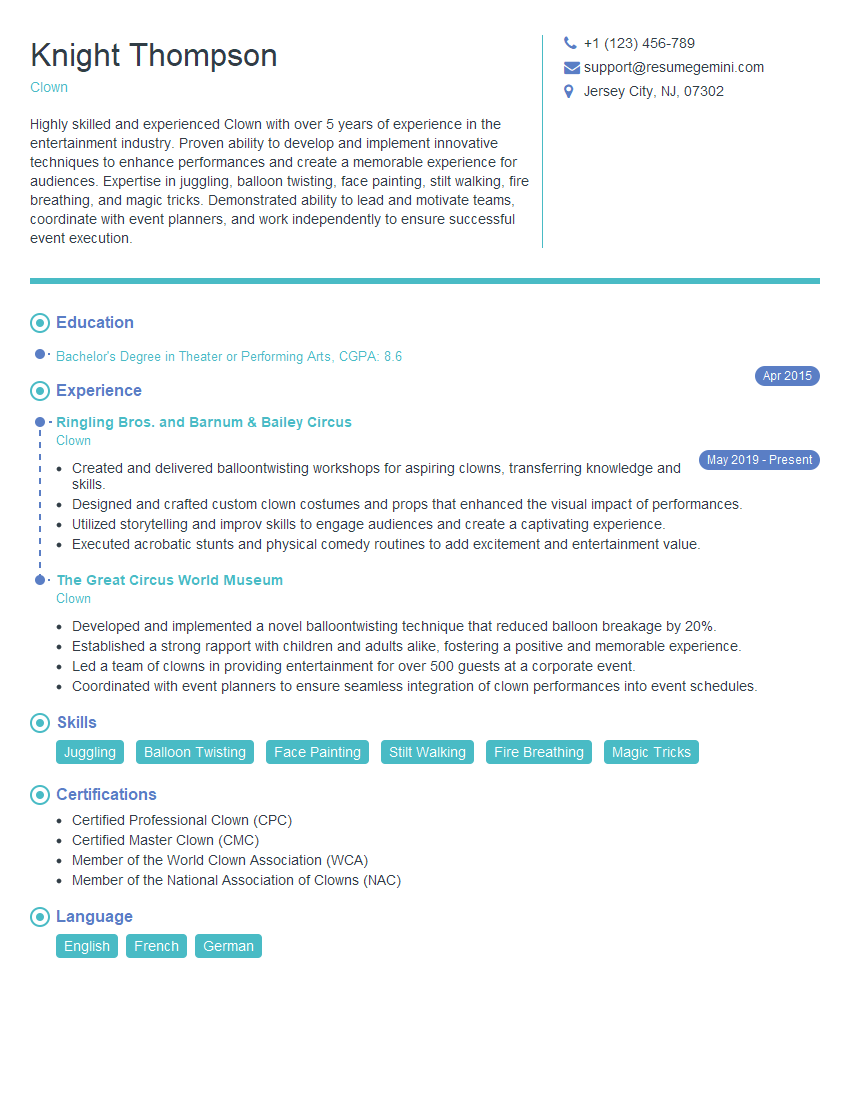
Mastering physical comedy can unlock exciting career opportunities in theater, film, television, and beyond. A strong resume is crucial for showcasing your skills and experience. To increase your chances of landing your dream role, create an ATS-friendly resume that highlights your unique abilities. We highly recommend using ResumeGemini to build a professional and impactful resume that stands out. ResumeGemini provides examples of resumes tailored specifically to the Physical Comedy field to help you craft a compelling narrative of your skills and experience.
Explore more articles
Users Rating of Our Blogs
Share Your Experience
We value your feedback! Please rate our content and share your thoughts (optional).
What Readers Say About Our Blog
Very informative content, great job.
good