The right preparation can turn an interview into an opportunity to showcase your expertise. This guide to Piano Proficiency interview questions is your ultimate resource, providing key insights and tips to help you ace your responses and stand out as a top candidate.
Questions Asked in Piano Proficiency Interview
Q 1. Explain the difference between major and minor scales.
The difference between major and minor scales lies primarily in their characteristic intervals, creating distinct emotional qualities. Major scales sound bright, happy, and uplifting, while minor scales generally evoke feelings of sadness, melancholy, or introspection.
A major scale is built using the formula: whole step, whole step, half step, whole step, whole step, whole step, half step. For example, the C major scale is C-D-E-F-G-A-B-C. Notice the intervals between each note.
A natural minor scale uses the formula: whole step, half step, whole step, whole step, half step, whole step, whole step. The A natural minor scale, for example, is A-B-C-D-E-F-G-A. The harmonic minor scale and melodic minor scale modify the intervals of the natural minor scale to create more complex harmonic possibilities.
This difference in intervallic structure significantly impacts the harmonic possibilities and the overall emotional character of a piece of music. A composer might choose a major key for a celebratory piece and a minor key for a more somber or reflective one.
Q 2. Describe your experience with different musical periods (e.g., Baroque, Classical, Romantic).
My experience spans several musical periods. In the Baroque era (roughly 1600-1750), I’ve focused on composers like Bach and Handel, exploring their intricate counterpoint, ornamentation, and the use of terraced dynamics. Playing their works requires a deep understanding of historical performance practice, including articulation, ornamentation, and the use of continuo.
Moving into the Classical period (roughly 1730-1820), I’ve delved into the works of Mozart, Haydn, and Beethoven, appreciating their clarity of form, balanced phrasing, and elegant melodies. This period emphasizes formal structure and balanced expression.
My study of the Romantic period (roughly 1820-1900) has included Chopin, Schumann, and Liszt, focusing on their expressive freedom, virtuosity, and dramatic use of harmony and dynamics. This era demands a much more expressive and passionate approach.
This broad range of experience allows me to approach different musical styles with the appropriate technical and interpretive skills, understanding the nuances of each period.
Q 3. How do you approach sight-reading unfamiliar music?
Sight-reading is a crucial skill. My approach involves a multi-step process. First, I quickly scan the piece to identify the key signature, time signature, and overall range. This gives me a fundamental framework for understanding the music.
Next, I look for rhythmic patterns and melodic contours. I try to grasp the overall shape and direction of the melody before diving into the details. This helps build a mental map of the piece.
Then, I start playing slowly and carefully, focusing on accuracy rather than speed. I’ll often break down challenging sections into smaller phrases, working on each individually until I can smoothly connect them.
Finally, I gradually increase the tempo as I gain confidence and fluency. Regular sight-reading practice is essential to improve this skill. It’s like learning a new language; consistent effort is vital for fluency.
Q 4. Discuss your approach to practicing complex piano pieces.
Practicing complex pieces requires a structured and methodical approach. I typically start by breaking the piece down into smaller, manageable sections. This allows me to focus on mastering individual technical challenges and musical details without being overwhelmed by the entire piece.
I utilize slow practice, focusing on accuracy and precision. This allows me to identify and correct any technical flaws early on. Gradually, I’ll increase the tempo as my accuracy improves.
I pay close attention to dynamics, articulation, and phrasing. These expressive elements are just as important as the technical aspects of the piece. Listening critically to recordings of renowned performers is invaluable.
Regular review is also crucial. I revisit previously practiced sections to maintain accuracy and ensure that the various parts work together cohesively.
Finally, I take breaks to avoid fatigue and maintain focus. It’s a marathon, not a sprint.
Q 5. Explain your understanding of music theory, including harmony and counterpoint.
My understanding of music theory is extensive, encompassing harmony, counterpoint, form, and analysis. Harmony involves the simultaneous sounding of notes, creating chords and progressions that underpin the emotional and structural framework of a piece.
I understand various chord types (major, minor, diminished, augmented), chord progressions (e.g., I-IV-V-I in C major), and the principles of voice leading (how individual melodic lines move smoothly and harmoniously).
Counterpoint, on the other hand, deals with the independent yet interwoven melodic lines in a piece. It involves understanding techniques like imitation, canon, and fugue. I can analyze complex contrapuntal textures, identifying the independent voices and their relationships.
This theoretical knowledge informs my interpretation and performance, allowing me to understand the composer’s intent and convey it effectively. For example, I can analyze a Bach prelude and fugue to understand the harmonic relationships and contrapuntal techniques used, leading to a more informed and nuanced performance.
Q 6. Describe your experience with improvisation.
Improvisation is a vital aspect of my musicianship. My approach is rooted in a strong understanding of music theory, particularly harmony and rhythm. I start by establishing a harmonic foundation, usually a chord progression or a rhythmic pattern.
From there, I use my knowledge of scales and modes to create melodic lines that fit within the established harmonic framework. I experiment with different rhythmic ideas and variations, keeping the overall structure engaging.
I often use stylistic references from different musical genres to shape my improvisations, adding elements of blues, jazz, or classical music depending on the context. For example, I might improvise a bluesy solo over a simple 12-bar blues progression.
Improvisation is a continuous process of exploration and experimentation, requiring both technical skills and creative imagination.
Q 7. How do you handle performance anxiety?
Performance anxiety is a common challenge for musicians. My approach to managing it is multifaceted. I start with thorough preparation – the more I know a piece, the more confident I feel. I practice in performance-like settings, simulating the actual concert environment.
I use relaxation techniques such as deep breathing exercises and visualization to calm my nerves before performances. I focus on the positive aspects of performing—sharing my passion for music with an audience.
It’s crucial to remember that some level of nervousness is natural and can even enhance performance. I try to channel this nervous energy into focused and energetic playing. Experiencing many performances has also helped build my confidence and resilience.
Q 8. What are your preferred methods for teaching piano?
My teaching philosophy centers around fostering a student’s individual passion for music. I believe in a multifaceted approach, blending technical drills with creative expression. I don’t believe in a ‘one-size-fits-all’ method. My approach is tailored to each student’s learning style, age, and goals.
- Method 1: Progressive Curriculum: I use a structured curriculum focusing on foundational skills like posture, hand position, and basic music theory, gradually progressing to more complex pieces and techniques. This builds a solid technical foundation.
- Method 2: Aural Training and Improvisation: I strongly emphasize ear training, encouraging students to listen critically and develop their musicality through improvisation exercises. This fosters creativity and musical fluency.
- Method 3: Personalized Practice Plans: I create personalized practice plans for each student, incorporating elements they find enjoyable and challenging, making practice engaging and productive. This addresses individual needs and keeps students motivated.
- Method 4: Performance Opportunities: I encourage students to perform, whether it’s at home for family or in small recitals. Performance provides invaluable experience and boosts confidence.
For example, a young beginner might benefit from playful games to learn notes, while an advanced student might benefit from tackling challenging etudes and analyzing complex scores.
Q 9. Explain your understanding of different piano techniques (e.g., legato, staccato).
Piano techniques are crucial for nuanced musical expression. Let’s examine legato and staccato:
- Legato: This means playing notes smoothly and connectedly, without any noticeable breaks between them. It’s achieved through smooth finger movements and proper pedaling. Think of it like singing a long, flowing melody – there’s a seamless transition between each note. In Chopin’s nocturnes, legato is essential for creating a beautiful, lyrical sound.
- Staccato: This involves playing notes in a short, detached manner, with a clear separation between each. This is achieved through short, controlled keystrokes, and minimal pedaling. Think of it like speaking distinct words – each note is articulated individually. A piece like a Scarlatti sonata often utilizes staccato for its bright, percussive character.
Beyond legato and staccato, other important techniques include non-legato (slightly detached), marcato (emphasized notes), and arpeggio (playing notes of a chord one after another). The mastery of these techniques is essential for conveying the composer’s intent and creating a compelling musical performance.
Q 10. Describe your experience with accompanying singers or other instrumentalists.
Accompanying singers and instrumentalists requires a high level of sensitivity, responsiveness, and technical skill. It’s less about showcasing my own virtuosity and more about supporting the other musicians and enhancing their performance.
- Active Listening: I must actively listen to the vocalist or instrumentalist, adapting my playing to match their phrasing, dynamics, and tempo. This involves anticipation and a deep understanding of musical phrasing.
- Dynamic Balance: It is crucial to maintain a good balance between the accompaniment and the soloist, ensuring that neither overpowers the other. I adjust my volume carefully to support the soloist without overshadowing them.
- Improvisation (where appropriate): In some instances, I might need to improvise, creating a sensitive and supportive harmonic background for the soloist. This demands creativity and strong harmonic knowledge.
For example, accompanying a vocalist in a romantic ballad requires a different approach compared to accompanying a string quartet playing a lively piece. In the first, a subtle and sensitive touch is necessary; in the second, a more dynamic and responsive style is needed.
Q 11. How do you adapt your playing style to different musical genres?
Adapting my playing style to different musical genres is fundamental. Each genre possesses unique characteristics in terms of rhythm, harmony, and phrasing.
- Classical: Demands technical precision, adherence to the score, and a focus on clarity and articulation.
- Jazz: Requires improvisation, swing feel, and a nuanced understanding of harmony and rhythm. Techniques like blues scales and chord substitutions are crucial.
- Pop/Rock: Emphasizes a strong rhythmic drive, a clear melodic line, and often involves simpler harmonies. The focus is often on conveying emotion directly and effectively.
- Blues: Relies heavily on blues scales, specific rhythmic patterns, and often features improvisation based on pentatonic scales. A sense of groove is vital.
This adaptability involves not just altering my technical approach but also understanding the emotional and stylistic nuances specific to each genre. For instance, a classical sonata demands a very different touch than a blues improvisation.
Q 12. Explain your knowledge of different piano compositions and composers.
My knowledge of piano compositions and composers is extensive, ranging across various periods and styles. I’m familiar with the works of:
- Baroque (e.g., Bach, Handel): Their music is characterized by counterpoint, ornamentation, and often a focus on clarity and structure. I can readily discuss the Well-Tempered Clavier or Handel’s Suites.
- Classical (e.g., Mozart, Haydn, Beethoven): This era saw the development of the sonata form and a shift towards more emotionally expressive music. I am well-versed in their sonatas, concertos, and variations.
- Romantic (e.g., Chopin, Schumann, Liszt): This period is known for its emotional intensity, virtuosity, and use of expressive harmonies. I can analyze and perform works from this era with a deep understanding of their musical language.
- 20th and 21st Century: My knowledge extends to modern and contemporary composers, including Debussy, Ravel, and many others. I can discuss the stylistic innovations and approaches used in their music.
My familiarity with composers and their works allows me to effectively convey their unique styles and musical ideas to students and audiences alike.
Q 13. Describe your approach to analyzing a musical score.
Analyzing a musical score is a critical skill. My approach involves a multi-layered process:
- Initial Overview: I begin by getting a general sense of the piece – its form, key, tempo, and overall character. This provides a context for deeper analysis.
- Harmonic Analysis: I carefully examine the harmony, identifying chord progressions, key changes, and any significant harmonic devices used. This helps understand the emotional arc of the piece.
- Melodic Analysis: I analyze the melodic lines, identifying their shape, range, and any significant motifs or themes. This helps identify musical ideas and development.
- Rhythmic Analysis: I examine the rhythmic patterns and meters, noting any syncopation or rhythmic complexities. Understanding rhythm is key to performance.
- Formal Structure: I identify the overall form of the piece (e.g., sonata form, rondo, theme and variations). This understanding is crucial for shaping a coherent interpretation.
- Dynamics and Articulation: I pay close attention to the composer’s markings for dynamics (loudness and softness) and articulation (how notes are played). These are crucial for shaping expression and conveying emotion.
Through this step-by-step process, I build a comprehensive understanding of the composer’s intentions and the musical architecture of the piece, which informs my performance and teaching.
Q 14. How do you maintain your piano playing skills?
Maintaining my piano playing skills requires consistent dedication and a structured approach:
- Regular Practice: I dedicate time each day to practicing scales, arpeggios, etudes, and repertoire. This keeps my technique sharp and prevents muscle memory from deteriorating.
- Varied Repertoire: I regularly work on pieces from different eras and styles to challenge myself and expand my musical vocabulary. This prevents stagnation and keeps my playing fresh.
- Masterclasses and Workshops: I participate in masterclasses and workshops to refine my technique and learn from other pianists. This helps to broaden my understanding and perspective.
- Performance Opportunities: Regular performance opportunities keep me engaged and provide valuable feedback. The experience of performing maintains a high level of readiness and confidence.
- Physical Well-being: I pay attention to my physical health, ensuring proper posture and hand care. Maintaining good health directly impacts the ability to play effectively and without injury.
Maintaining skills isn’t just about technical proficiency; it’s about nurturing a lifelong love of music and a commitment to continuous growth and improvement.
Q 15. What are your strengths and weaknesses as a pianist?
My greatest strength as a pianist lies in my ability to blend technical proficiency with musicality. I possess a strong foundation in classical technique, enabling me to execute complex passages with accuracy and control. However, I don’t see technique as an end in itself; I strive to infuse every performance with emotional depth and expressive nuance. This allows me to connect with the music on a deeper level and convey its meaning effectively to the audience. For instance, I recently performed a challenging Rachmaninoff prelude, and while the technical demands were significant, my focus was on shaping the phrases and conveying the underlying melancholic beauty of the piece.
A weakness I’m actively working on is my improvisation skills in certain styles, particularly bebop jazz. While I’m comfortable improvising in simpler styles, navigating the complex harmonic and rhythmic structures of bebop requires further dedicated practice and listening. I’m currently addressing this by regularly transcribing solos by legendary bebop pianists and incorporating those elements into my practice sessions.
Career Expert Tips:
- Ace those interviews! Prepare effectively by reviewing the Top 50 Most Common Interview Questions on ResumeGemini.
- Navigate your job search with confidence! Explore a wide range of Career Tips on ResumeGemini. Learn about common challenges and recommendations to overcome them.
- Craft the perfect resume! Master the Art of Resume Writing with ResumeGemini’s guide. Showcase your unique qualifications and achievements effectively.
- Don’t miss out on holiday savings! Build your dream resume with ResumeGemini’s ATS optimized templates.
Q 16. Describe your experience with recording music.
My recording experience spans several years and encompasses various settings. I’ve recorded in professional studios, using high-end microphones and recording interfaces, as well as in smaller home studios with more modest equipment. I’m proficient in the entire process, from initial setup and microphone placement to post-production editing and mastering. I understand the importance of achieving optimal sound quality, paying close attention to detail in every stage. For example, during a recent recording session, I meticulously adjusted the microphone distance to capture the subtle nuances of the piano’s tone without any unwanted noise. I also have experience editing and mixing tracks using software such as Logic Pro X and Ableton Live.
Q 17. How do you troubleshoot technical issues with a piano?
Troubleshooting technical issues on a piano requires a systematic approach. First, I identify the nature of the problem: Is it a sound-related issue (e.g., a sticking key, a muted note), a mechanical problem (e.g., a broken pedal), or an electronic issue (if it’s a digital piano)? Then, I proceed with a targeted solution. For a sticking key, I might try lubricating the mechanism. A muted note could point to a problem with the hammer or damper. If the issue involves a broken pedal, I might need to call for a professional technician. For digital pianos, troubleshooting usually involves checking power connections, cables, and software settings. I always prioritize safety and avoid any attempts at repairs that could worsen the problem. If the problem is beyond my expertise, I promptly seek assistance from a qualified piano technician.
Q 18. What software or technology are you proficient in for music production?
My proficiency in music production software includes Logic Pro X, Ableton Live, and GarageBand. I’m adept at recording, editing, mixing, and mastering audio using these programs. I understand the intricacies of MIDI sequencing, virtual instruments, and audio effects processing. For example, I often use Logic Pro X’s advanced MIDI editing capabilities to create complex and nuanced musical scores. I also have experience working with various plugins and virtual instruments to enhance the sound and texture of my recordings, ensuring a professional and polished final product.
Q 19. How do you create a practice plan for a student?
Creating a practice plan for a student involves a personalized approach tailored to their individual skill level, goals, and learning style. It begins with assessing their current abilities and identifying areas for improvement. The plan would then incorporate a balanced mix of technical exercises, musical pieces, and theoretical studies. For example, a beginner might focus on hand independence, basic scales, and simple songs, while a more advanced student might tackle complex etudes, sonatas, and advanced music theory concepts. The plan should include specific, measurable, achievable, relevant, and time-bound (SMART) goals, regular review sessions, and opportunities for performance or feedback. Regular communication and adjustments are key to ensuring the effectiveness of the plan and keeping the student engaged and motivated.
Q 20. Explain your understanding of music history.
My understanding of music history encompasses the major periods and stylistic developments, from the Baroque era through to contemporary music. I’m familiar with the key composers, their works, and their contributions to the evolution of musical styles. For example, I can discuss the influence of Bach’s counterpoint on later composers, or the development of the sonata form during the Classical period. I understand the socio-cultural contexts that shaped musical styles, and how those styles reflect the values and sensibilities of their respective eras. This historical awareness allows me to approach music with a deeper level of appreciation and understanding, enriching my performances and teaching.
Q 21. Describe your experience with different piano styles (e.g., jazz, classical, pop).
My experience with various piano styles is extensive. In classical music, my repertoire includes works by Bach, Mozart, Beethoven, Chopin, and Rachmaninoff. I have a strong understanding of classical performance techniques, including articulation, phrasing, dynamics, and pedaling. In jazz, I’m comfortable with different styles such as swing, bebop, and Latin jazz. I understand the principles of improvisation, harmony, and rhythm in jazz. My experience with pop music includes accompanying singers and playing in various ensembles. I can adapt my playing style to suit the specific demands of different genres, from the lyrical phrasing of a ballad to the energetic rhythms of a pop song. My adaptability is a key strength, allowing me to seamlessly transition between styles and offer diverse musical experiences.
Q 22. How do you handle a student who struggles with a particular technique?
When a student struggles with a technique, my approach is multifaceted and focuses on identifying the root cause. It’s rarely a simple matter of insufficient practice. I begin by carefully observing their posture, hand position, and finger movements. Is their hand tension too high? Are they using inefficient finger motion? Are they misinterpreting the musical phrasing?
- Detailed Breakdown: I might ask them to play the passage slowly, focusing on individual notes. We’ll analyze their fingering, perhaps trying alternative fingerings to find a more comfortable and efficient approach. I’ll often use visual aids, like videos demonstrating correct technique, or even have them mirror my hand movements.
- Targeted Exercises: We’ll incorporate specific exercises targeting the problematic technique. For instance, if it’s legato phrasing, we might work on scales and arpeggios emphasizing smooth transitions. If it’s staccato, we’ll focus on controlled finger detachment.
- Mental Approach: Often, a mental block can hinder technique. Encouragement, positive reinforcement, and breaking down the passage into smaller, manageable sections are crucial. We may even use visualization techniques to help the student internalize the correct movement.
- Example: One student struggled with rapid trills in a Scarlatti sonata. After observation, I discovered tension in their forearm. We worked on relaxation exercises, specifically targeting the forearm muscles, alongside trill exercises that prioritized speed only after achieving relaxed control. It took time and patience, but focusing on the underlying issue, rather than solely on the speed itself, brought success.
Q 23. Explain your understanding of music notation.
Music notation is the system of written symbols used to represent musical sounds and their characteristics. It’s a complex language that allows musicians to communicate musical ideas accurately and unambiguously across time and geographical boundaries. Understanding music notation is fundamental to piano proficiency.
- Staff Notation: The five-line staff is the foundation, with each line and space representing a specific pitch. Clefs (like treble and bass clef) indicate the pitch range.
- Notes and Rests: Notes represent the duration and pitch of sounds, while rests represent silence. Note values (whole, half, quarter, etc.) determine their duration.
- Time Signatures: Indicate the meter (organization of beats), specifying the number of beats per measure and the type of note receiving one beat. For example,
4/4time means four quarter notes per measure. - Key Signatures: Show the sharps or flats that apply to the entire piece, indicating the key.
- Dynamics: Symbols indicating the volume (e.g.,
pfor piano,ffor forte). - Articulation: Symbols defining how notes are played (e.g.,
legatofor smooth connection,staccatofor detached notes).
Understanding these elements is crucial for interpreting and performing a piece accurately. It’s a skill honed through consistent practice and careful study.
Q 24. Describe your experience working with students of varying skill levels.
My experience spans a wide range of skill levels, from absolute beginners to advanced students preparing for music conservatories. I adapt my teaching methodology to meet the individual needs of each student.
- Beginners: With beginners, the focus is on fundamental skills—posture, hand position, basic note reading, and simple rhythms. Building a solid foundation is paramount. I use engaging methods like games and simplified pieces to keep them motivated.
- Intermediate Students: Here, we delve into more complex musical concepts like harmony, counterpoint, and different musical styles. We work on repertoire appropriate to their skill level, focusing on technical proficiency and musical expression.
- Advanced Students: At the advanced level, the emphasis is on developing artistry and interpretation. We explore advanced techniques, tackle challenging repertoire, and work on refining musicality and performance skills. This often involves discussing the composer’s intentions and exploring various interpretative approaches.
My ability to adapt and cater my teaching style to various levels is a strength. It ensures that each student receives personalized attention and makes progress at their own pace.
Q 25. How do you assess a student’s progress?
Assessing a student’s progress is an ongoing process, involving both qualitative and quantitative measures.
- Technical Proficiency: I assess their accuracy, speed, fluency, and control in playing various technical exercises and musical pieces. This involves observation, listening, and using standardized scales to measure progress.
- Musicality: I evaluate their understanding of rhythm, dynamics, phrasing, articulation, and overall musical expression. This is more subjective and requires careful listening to their interpretations.
- Performance Skills: For older students, I assess their ability to perform confidently and expressively in front of an audience. This involves providing opportunities for recitals and performances to build confidence.
- Theory Knowledge: I regularly test their understanding of music theory concepts relevant to the material they’re learning.
- Regular Feedback: I provide consistent feedback throughout the learning process. This includes verbal comments during lessons, written comments on their performance, and regular assessments of their progress.
Ultimately, the goal is to see growth in all these areas. Progress isn’t always linear; there will be plateaus and challenges, but consistent work and appropriate feedback will lead to improvement.
Q 26. What are your goals as a pianist/teacher/musician?
My goals as a pianist, teacher, and musician are multifaceted. As a pianist, I strive for continuous improvement in my technical skills and musical expression. As a teacher, my primary goal is to nurture a love of music in my students and help them reach their full potential, regardless of their skill level or aspirations. As a musician, I aim to contribute to the wider musical community.
- Student Growth: Witnessing my students’ progress and their development as musicians is deeply rewarding. I want them to develop not just technical proficiency, but a deep understanding and appreciation of music.
- Artistic Expression: To foster in my students the ability to communicate emotions and ideas through music. Music is about more than just playing the notes correctly—it’s about expressing oneself authentically.
- Lifelong Learning: To instill in them the desire for continuous learning and growth, fostering a lifelong relationship with music.
These goals are intertwined. My own musical journey informs my teaching, and the joy and learning I experience through my students enriches my own musicianship.
Q 27. Describe a challenging musical piece you have mastered and your approach to it.
One challenging piece I’ve mastered is the Liszt Sonata in B minor. It’s technically demanding, requiring immense stamina, speed, and precision, and musically complex, requiring a deep understanding of form, harmony, and dramatic expression.
- Approach: My approach was methodical and systematic.
- Section-by-Section: I broke the piece down into smaller, manageable sections. I focused intensely on mastering each section’s technical challenges before moving on.
- Technical Drills: I developed targeted technical drills to improve specific areas, like rapid octave passages, arpeggios, and complex chord progressions.
- Musical Interpretation: I researched Liszt’s compositional style and biographical context to inform my interpretation. I spent significant time analyzing the structure and harmonic language of the piece.
- Performance Practice: Finally, I refined the piece through repeated performances, constantly adjusting phrasing, dynamics, and articulation to achieve the desired emotional impact. I also experimented with different approaches to pedaling and touch to create variety and nuance.
Conquering this piece was a significant achievement, demanding intense practice and dedication. It greatly enhanced my technical skills and broadened my musical understanding. The process was challenging but incredibly rewarding.
Q 28. Explain your familiarity with different piano manufacturers and models.
My familiarity with piano manufacturers and models extends to a broad range, encompassing both modern and vintage instruments. This knowledge is essential for advising students on instrument selection and understanding the nuances of different instruments’ sounds and playing characteristics.
- Steinway & Sons: Renowned for their exceptional tone quality, evenness across the keyboard, and durability. Different models within the Steinway line (e.g., Model D, Model B) offer varying sizes and tonal characteristics.
- Yamaha: A leading manufacturer known for their reliability, consistent quality, and wide range of models, offering instruments suitable for various budgets and playing levels.
- Bösendorfer: Famous for their Imperial model with its extended range, offering a unique tonal palette.
- Kawai: Another major manufacturer producing high-quality instruments, often praised for their responsiveness and clarity.
- Other Brands: There are many other reputable manufacturers, both large and small, each with its own distinctive sonic characteristics and design features.
Understanding the differences in action, sound, and feel between various models allows me to better support my students in selecting an instrument that best fits their needs and playing style. This also enables me to address specific issues related to a particular instrument’s features in my teaching.
Key Topics to Learn for Piano Proficiency Interview
- Music Theory Fundamentals: Understanding scales, chords, key signatures, and rhythm is crucial. Practice applying these concepts to various musical pieces.
- Sight-Reading Skills: Demonstrate your ability to accurately and expressively interpret unfamiliar sheet music. Practice with varied styles and complexities.
- Technical Proficiency: Showcase your dexterity, including scales, arpeggios, and other technical exercises. Be prepared to discuss your practice techniques and how you maintain your skills.
- Musical Interpretation and Expression: Discuss your approach to interpreting different musical styles and conveying emotion through your playing. Consider analyzing famous pieces and explaining your interpretation.
- Performance Skills: Prepare to discuss your experience performing in various settings, including solo and ensemble performances. Reflect on your stage presence and how you manage performance anxiety.
- Improvisation and Composition (if applicable): If relevant to the role, prepare to demonstrate your improvisational skills and/or discuss your compositional experience. Show examples of your work if possible.
- Pedagogical Approach (if applicable): If applying for teaching roles, be ready to discuss your teaching philosophy and methodology, including different teaching styles and approaches to student learning.
Next Steps
Mastering piano proficiency opens doors to diverse and rewarding career paths, from performing arts to music education and beyond. A strong resume is your key to unlocking these opportunities. Crafting an ATS-friendly resume that highlights your skills and experience is essential for getting noticed by potential employers. To create a compelling and effective resume, leverage the power of ResumeGemini. ResumeGemini provides a user-friendly platform and valuable tools to help you build a professional resume that showcases your piano proficiency. Examples of resumes tailored to various Piano Proficiency roles are available within the ResumeGemini platform.
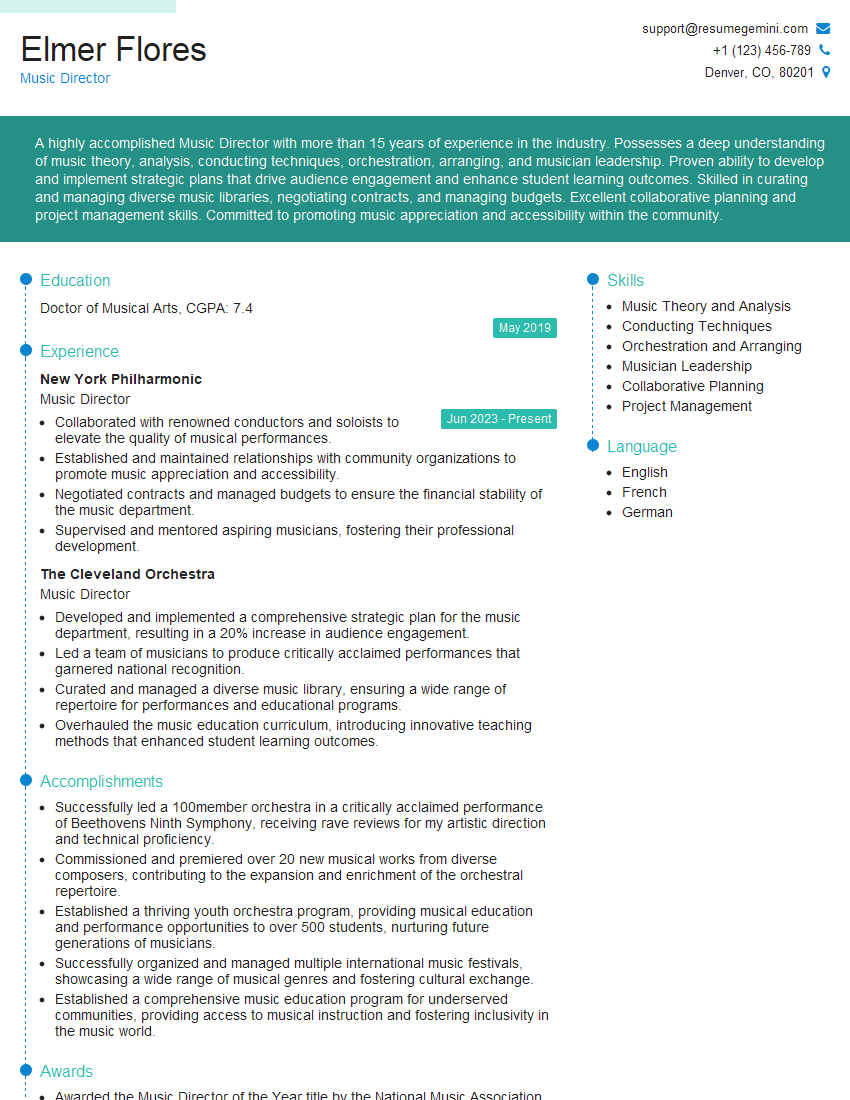
Music Director Resume Sample
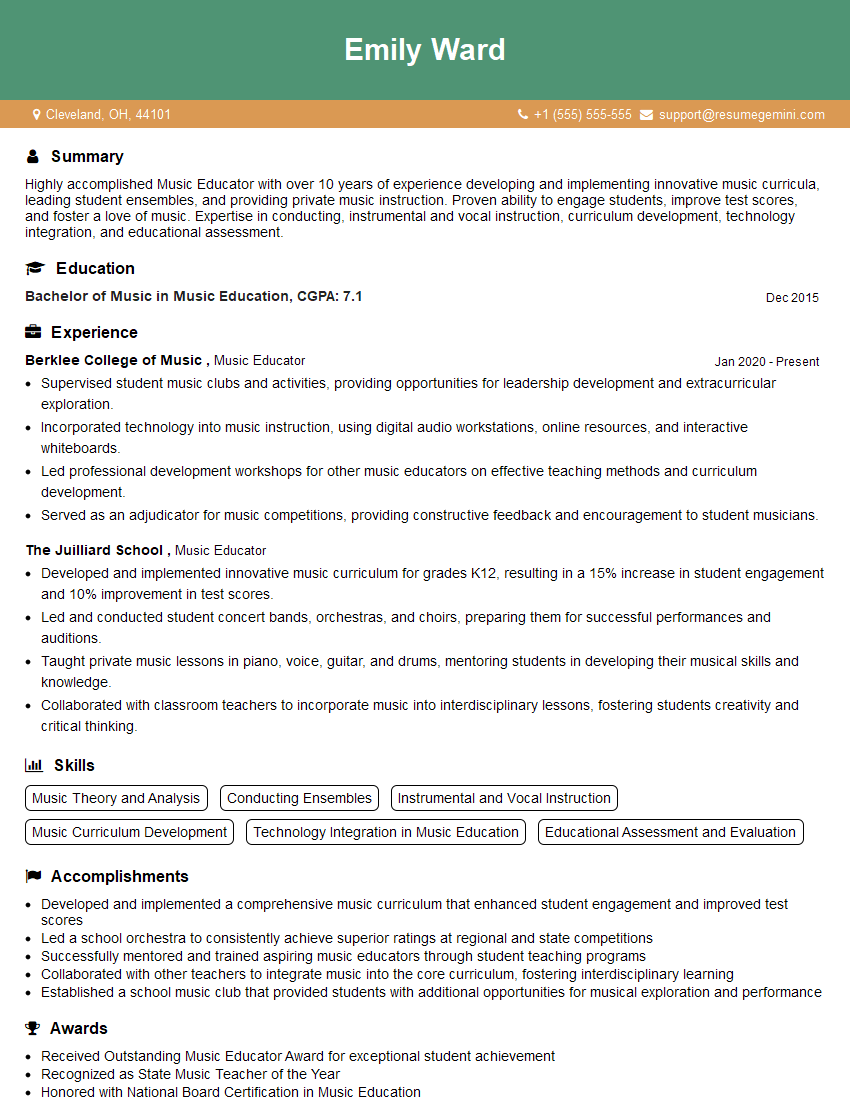
Music Educator Resume Sample
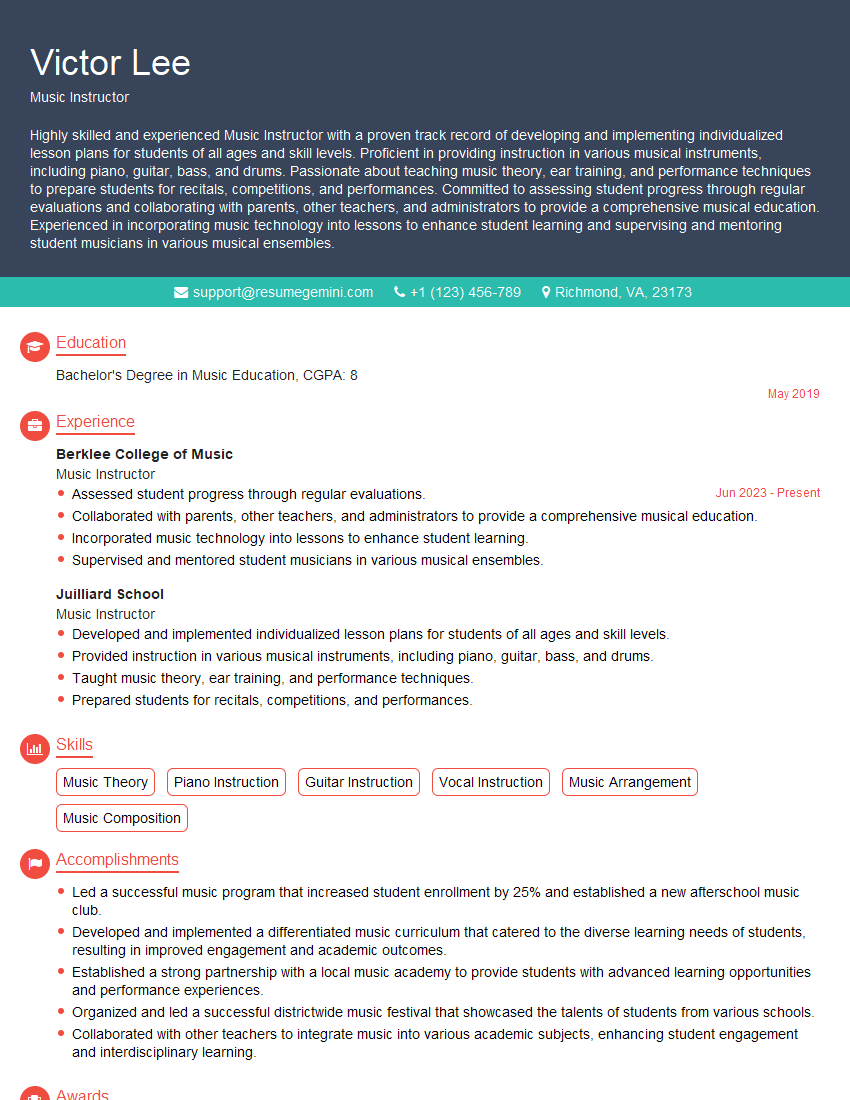
Music Instructor Resume Sample
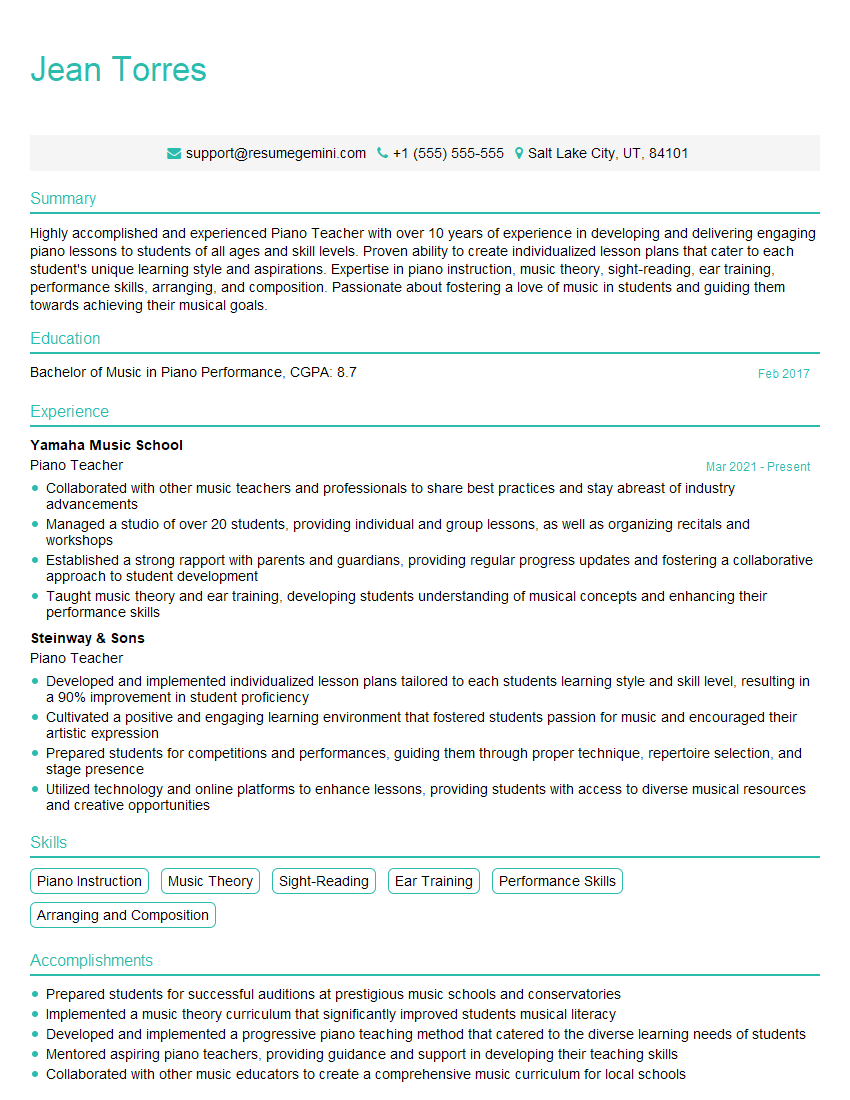
Piano Teacher Resume Sample
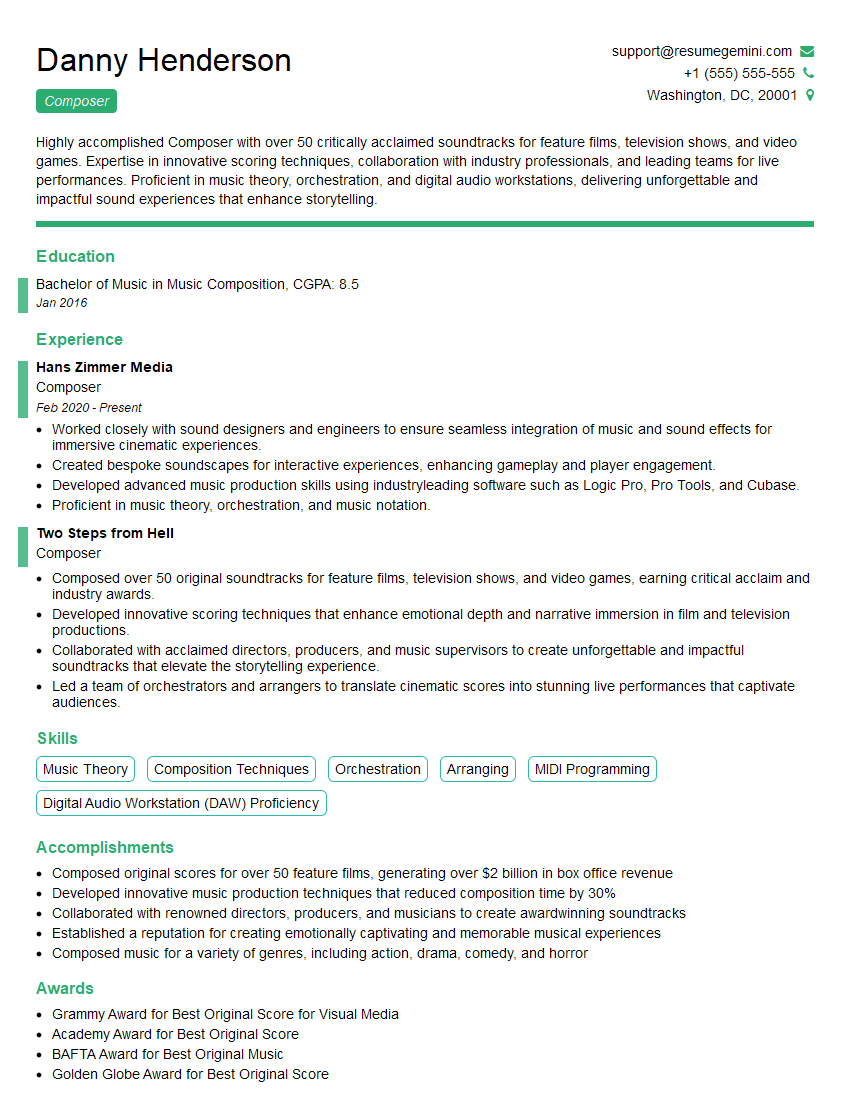
Composer Resume Sample
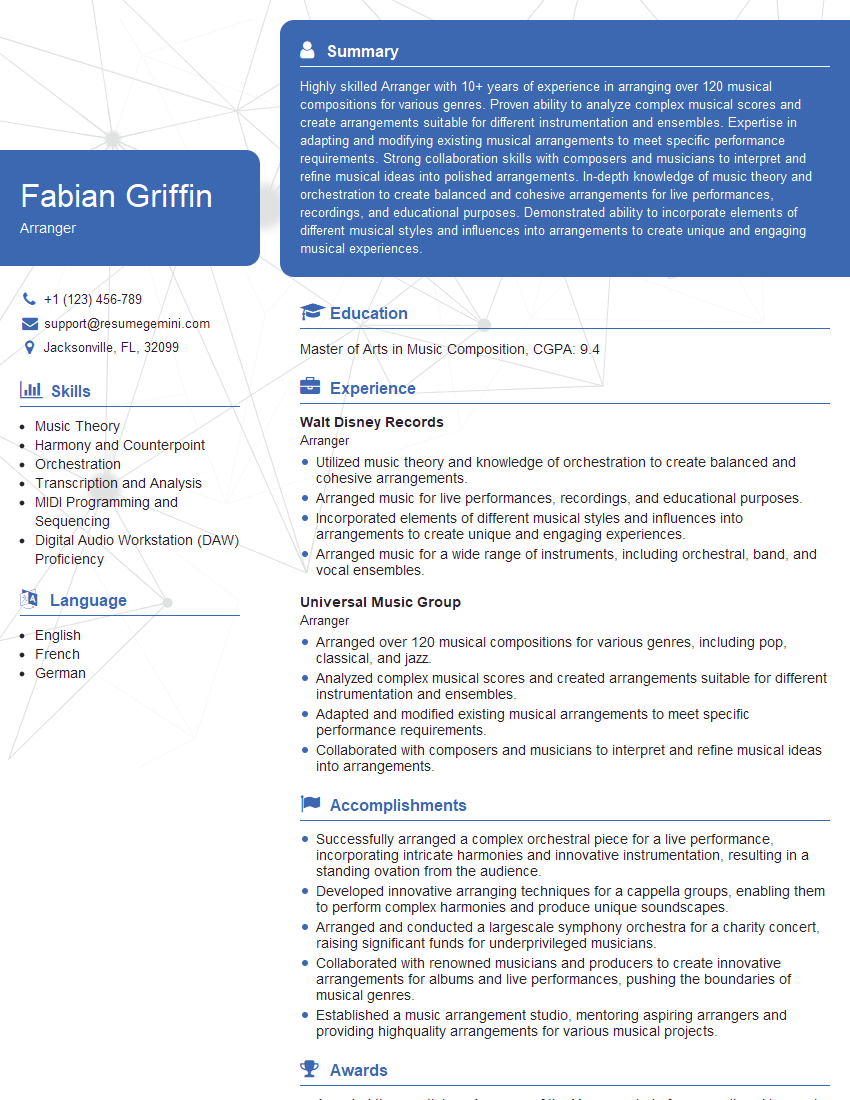
Arranger Resume Sample
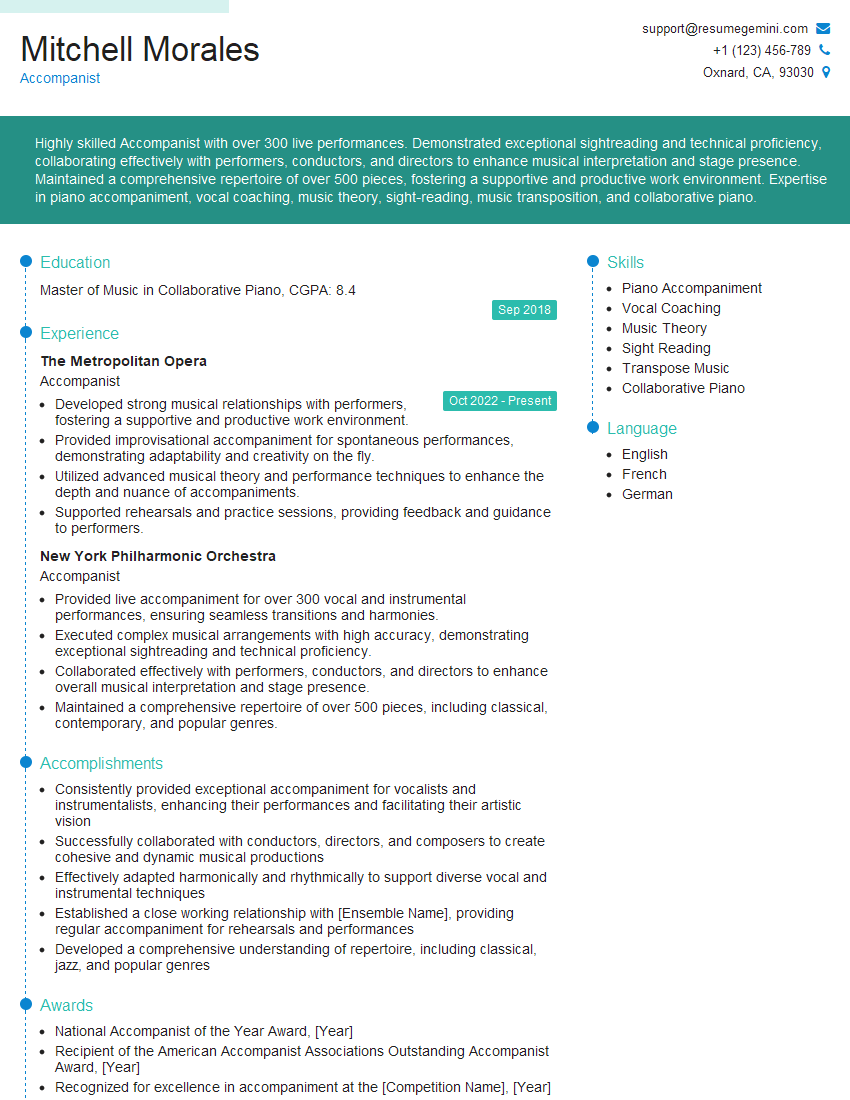
Accompanist Resume Sample
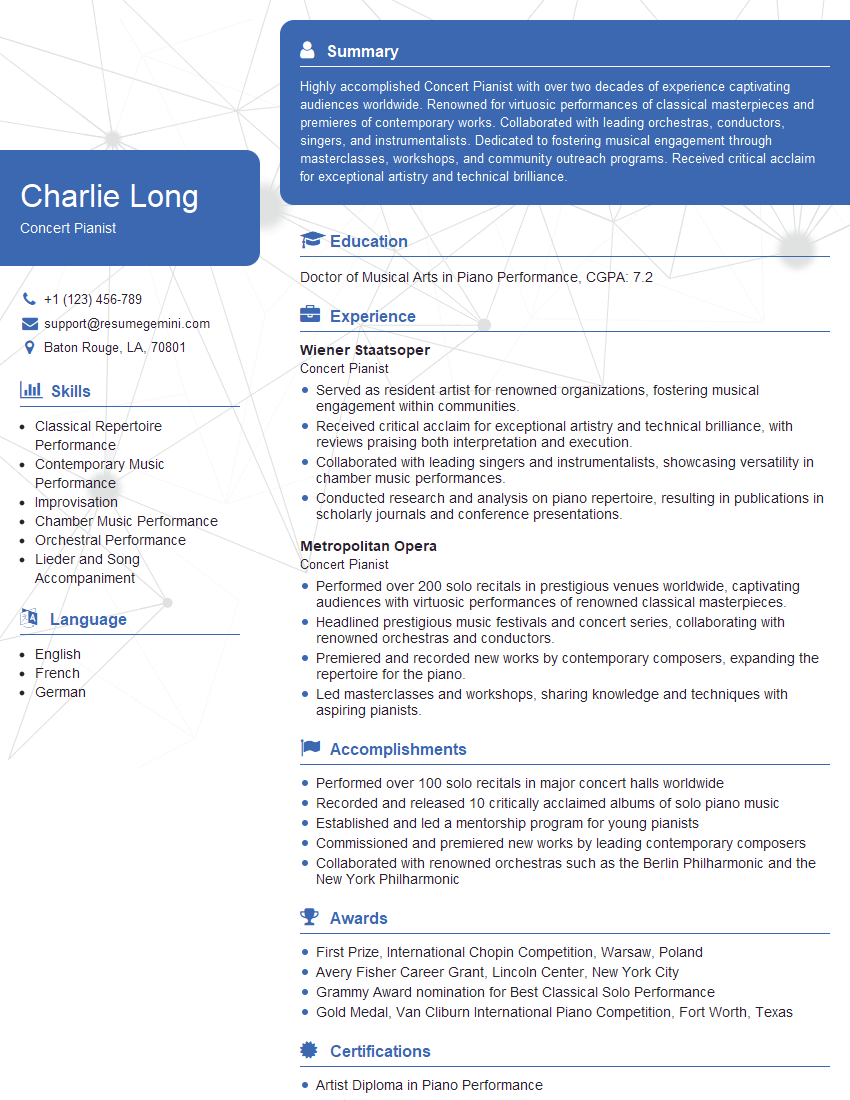
Concert Pianist Resume Sample
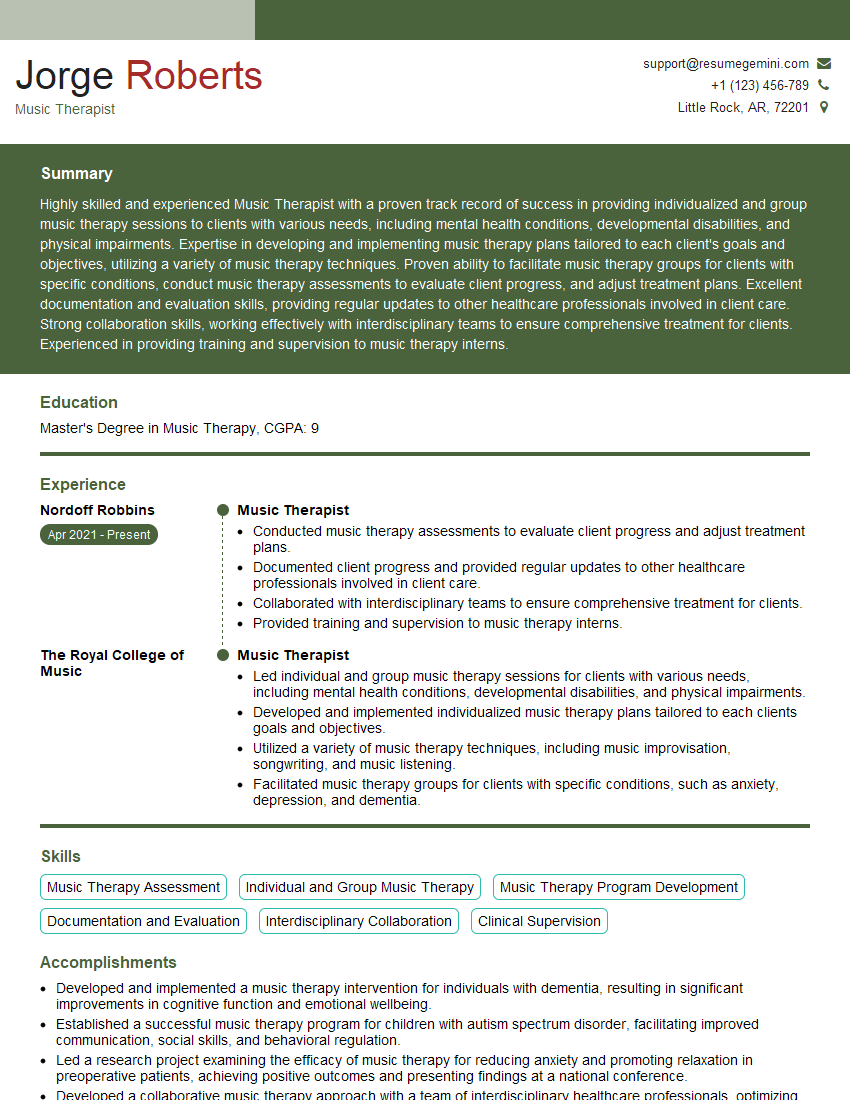
Music Therapist Resume Sample
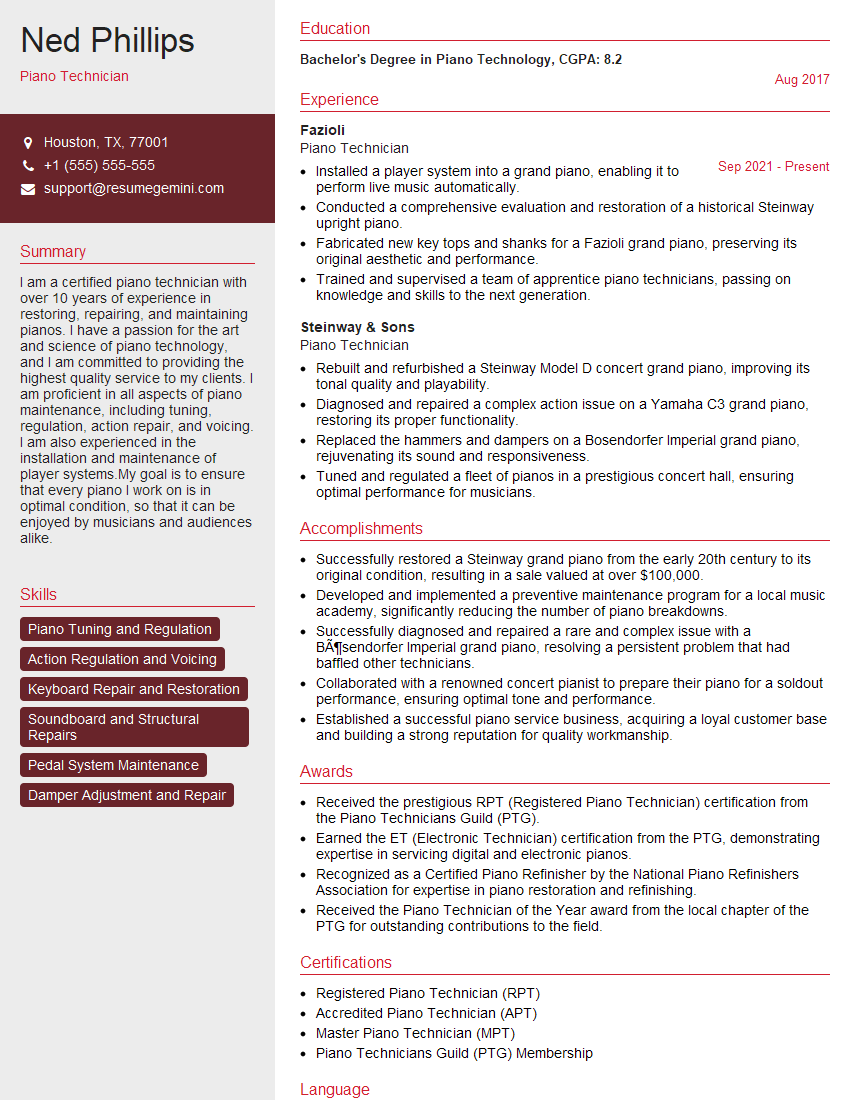
Piano Technician Resume Sample
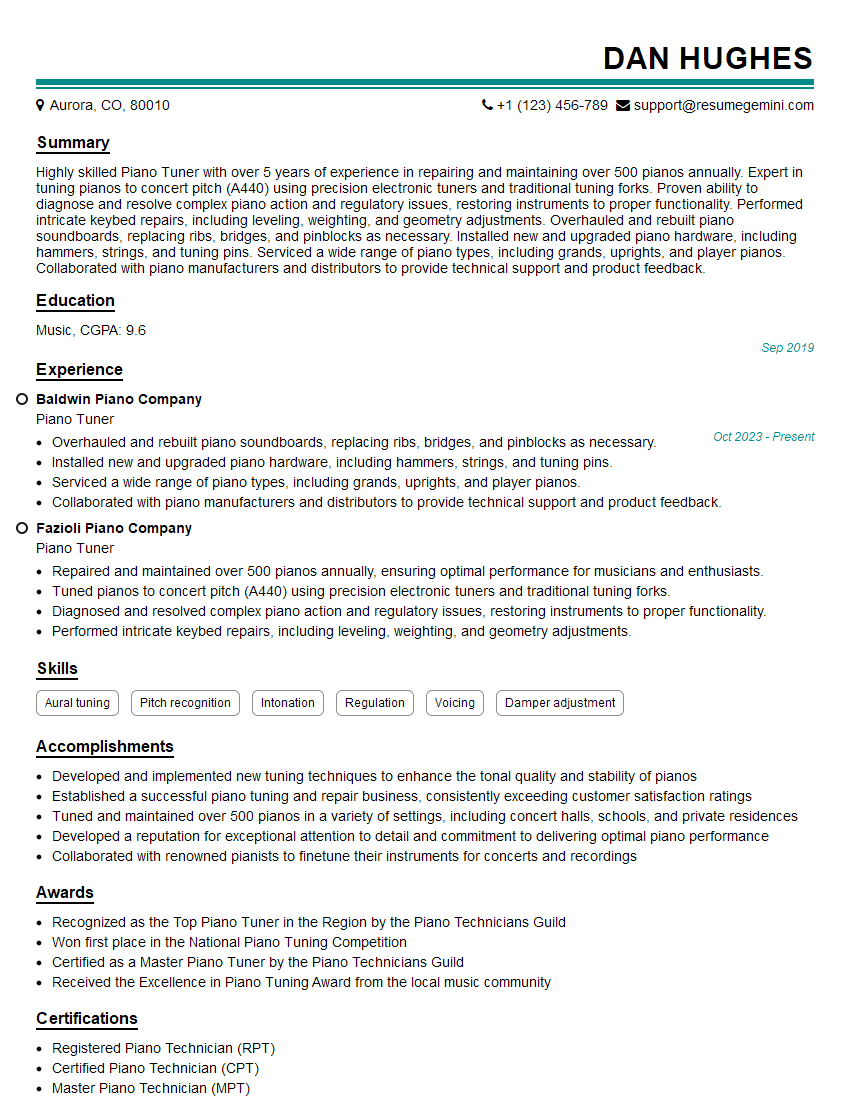
Piano Tuner Resume Sample
Explore more articles
Users Rating of Our Blogs
Share Your Experience
We value your feedback! Please rate our content and share your thoughts (optional).
What Readers Say About Our Blog
Very informative content, great job.
good