Interviews are more than just a Q&A session—they’re a chance to prove your worth. This blog dives into essential Pinking Machine Operation interview questions and expert tips to help you align your answers with what hiring managers are looking for. Start preparing to shine!
Questions Asked in Pinking Machine Operation Interview
Q 1. What types of fabrics are best suited for pinking shears?
Pinking shears, while versatile, work best with certain fabrics. Think of it like this: you wouldn’t use a butter knife to cut a steak; you need the right tool for the job. Generally, woven fabrics that aren’t too delicate or too thick respond best.
- Ideal Fabrics: Cotton, linen, lightweight canvas, denim (lighter weights). These fabrics offer enough structure to hold their shape after the pinking, but aren’t so heavy that they put excessive strain on the shears.
- Fabrics to Avoid: Very stretchy fabrics (like jersey knits), extremely delicate fabrics (like chiffon or silk), and very thick, heavy fabrics (like upholstery materials). These can cause the shears to jam, dull quickly, or produce an uneven cut.
For example, pinking the edges of a cotton shirt before hemming will prevent fraying and add a nice decorative touch, whereas trying to pink a thick wool coat could result in a frustrating and potentially damaging experience.
Q 2. Explain the process of threading a pinking machine.
Threading a pinking machine is similar to threading a sewing machine, but with a few key differences. It’s crucial to follow your machine’s specific instructions, but the general process is as follows:
- Locate the threading path: Your machine’s manual will illustrate the threading path. It usually involves guiding the thread through various tension discs and guides.
- Wind the bobbin: Most pinking machines use a bobbin. Wind it with the appropriate thread, ensuring it’s wound evenly to prevent tangles and skipped stitches.
- Insert the bobbin: Place the wound bobbin into its casing, making sure it’s oriented correctly as per your machine’s instructions.
- Thread the needle: Carefully thread the needle, ensuring the thread passes correctly through the tension discs and exits at the needle.
- Test run: Once threaded, do a test run with a scrap piece of fabric to confirm the thread feeds correctly and the stitching is clean.
Remember, proper threading is vital for preventing broken threads, skipped stitches, and ultimately, damage to your machine.
Q 3. How do you adjust the blade tension on a pinking machine?
Blade tension adjustment is crucial for a clean, even cut. Too loose, and the blades won’t cut properly; too tight, and you risk breaking them or straining the motor. The method differs slightly depending on the machine model, but generally:
- Locate the tension knob: Consult your machine’s manual to locate the blade tension adjustment knob or screw. It’s usually found near the blade assembly.
- Small adjustments: Turn the knob slightly, test the cut on scrap fabric, and repeat until you achieve the desired cut. Small adjustments are key. Don’t try to make large adjustments at once.
- Visual inspection: Observe the blade movement and the quality of the cut. A correctly adjusted blade will produce a clean, even pinked edge. If the edge is uneven or frayed, the tension needs adjusting.
Think of it like tuning a musical instrument – it requires patience and careful adjustments to achieve the perfect sound (or cut!).
Q 4. Describe the different types of pinking machine blades and their uses.
Pinking machine blades vary, offering diverse cutting styles. The choice depends on the desired aesthetic and fabric type. Common types include:
- Standard Pinking Blade: This creates the classic jagged edge, excellent for preventing fraying in most fabrics. It’s the most common type.
- Serpentine Blade: This produces a more decorative, wave-like edge, often used for ornamental purposes.
- Micro-Pinking Blade: These blades create finer pinking cuts, suitable for delicate fabrics or where a less pronounced edge is preferred.
For example, a standard blade is ideal for general sewing projects, a serpentine blade adds an extra touch of flair to garments, and a micro-pinking blade is suited for finer fabrics like silk.
Q 5. What are the common causes of skipped stitches on a pinking machine?
Skipped stitches are a common frustration with pinking machines. Several factors can contribute:
- Improper Threading: Incorrectly threaded needles or bobbins are the most frequent culprits.
- Dull Blades: Dull blades can fail to grip and cut the fabric properly, leading to skipped stitches.
- Incorrect Tension: Both needle and bobbin tension should be correctly adjusted. Too loose, and stitches will be loose; too tight, and they’ll be skipped.
- Fabric Type: Extremely stretchy or slippery fabrics can sometimes cause skipped stitches.
- Damaged Parts: Check for broken or damaged machine parts such as the feed dogs or needle mechanism.
Troubleshooting involves carefully checking each of these factors systematically. Start by re-threading the machine completely, examining the blades for dullness, and then adjusting tension. Only consider more complex repairs if the initial checks yield no solution.
Q 6. How do you maintain a pinking machine to ensure optimal performance?
Regular maintenance is key for a long-lasting, high-performing pinking machine.
- Clean Regularly: Remove fabric scraps, lint, and dust from the blade area and around the machine using a brush or compressed air. This prevents build-up that can obstruct the blades.
- Oil the Blades: Use a high-quality sewing machine oil to lubricate the blades and moving parts. This reduces friction and extends their lifespan. Refer to your machine’s manual for specific lubrication instructions.
- Sharpen the Blades: Over time, blades will dull. Depending on your machine, you might be able to sharpen them yourself or you may need to replace them. A sharp blade is essential for a clean cut.
- Check Tension Regularly: Periodically check and adjust the blade tension to maintain optimal cutting performance.
Regular maintenance is like preventative healthcare; it’s far better to address small issues before they become major problems.
Q 7. What safety precautions should be taken when operating a pinking machine?
Safety is paramount when using any power tool, and a pinking machine is no exception.
- Keep Hands Away: Always keep fingers and hands clear of the blades, especially when the machine is running. Use a fabric guide or other assistive tool to feed fabric.
- Proper Setup: Ensure the machine is securely placed on a stable surface and that all guards are in place.
- Unplug When Not in Use: Always unplug the machine before cleaning, maintaining, or making adjustments.
- Use the Right Blades: Make sure to use blades that are appropriate for the fabric type and thickness.
- Seek Professional Help: If you are unsure about any aspect of operating or maintaining the machine, seek assistance from a qualified technician.
Remember, a moment of carelessness can lead to serious injury. Always prioritize safety!
Q 8. How do you identify and resolve a broken needle on a pinking machine?
A broken pinking machine needle is usually easily identified by a noticeable bend, break, or dull point. You’ll likely see skipped stitches or inconsistent cutting. Resolution is straightforward:
- Safety First: Always unplug the machine before performing any maintenance.
- Access the Needle: Consult your machine’s manual for the correct needle removal procedure. Generally, you’ll need to loosen a screw or clamp holding the needle in place.
- Remove the Broken Needle: Carefully remove the damaged needle.
- Insert a New Needle: Install a new needle of the correct type and size for your machine (specified in your manual). Ensure it’s securely fastened.
- Test: Run a test on scrap fabric to verify proper functioning. Inconsistent cutting or skipped stitches indicate a potential issue beyond just the needle, such as blade misalignment or tension problems.
Remember, using the wrong type of needle can damage your machine. Always refer to your machine’s manual for specific needle recommendations.
Q 9. How would you handle a jammed fabric in a pinking machine?
A fabric jam is a common pinking machine problem. It usually occurs when the fabric is too thick, improperly fed, or the machine is overloaded. The steps to handle this are:
- Unplug the Machine: Always disconnect the power supply before attempting to resolve a jam.
- Identify the Jam: Carefully inspect the area where the fabric is stuck. Often, it’s near the blade assembly or the feed dogs.
- Remove the Jam: Gently pull the fabric backwards from the feed area. Avoid forcing the fabric, as this could damage the machine. If necessary, use tweezers or small, blunt tools to carefully remove any trapped threads or pieces of fabric.
- Inspect for Damage: Once the jam is cleared, check for any signs of damage to the fabric or the machine itself.
- Resume Operation: If everything looks good, try to feed the fabric more slowly. If the jam persists, check the machine’s tension and blade alignment.
To prevent future jams, ensure the fabric is properly fed, avoid overloading the machine with too much fabric, and use the appropriate machine speed for the type of material you are cutting.
Q 10. What are the typical speed settings for different fabric types?
Pinking machine speed varies greatly depending on fabric weight and type. There’s no single ‘correct’ speed; it’s about finding the optimal balance between cutting quality and efficiency. Think of it like driving: you drive slower on a winding mountain road and faster on a clear highway.
- Lightweight Fabrics (Silk, Chiffon): Lower speeds are crucial to prevent stretching or tearing. Start with the slowest setting and gradually increase if needed.
- Medium-Weight Fabrics (Cotton, Linen): A moderate speed works well. You can adjust based on the fabric’s thickness and weave.
- Heavy-Weight Fabrics (Denim, Canvas): Slower speeds are usually required to avoid straining the machine and ensure a clean cut. Even with heavier fabrics, you’ll want to avoid stalling the motor.
Always start at a slower speed and gradually increase until you find the optimal balance between cutting quality and throughput. Over-speeding can lead to inaccurate cuts, damage to the blades, and even breakage.
Q 11. Explain the importance of regular lubrication for a pinking machine.
Regular lubrication is essential for a pinking machine’s longevity and efficient operation. It’s like keeping your car’s engine well-oiled—it reduces friction, prevents wear and tear, and extends the lifespan of vital parts.
Lack of lubrication results in increased friction, leading to:
- Increased wear on moving parts: This leads to premature failure of components like the motor, gears, and blade assembly.
- Overheating: Friction generates heat, which can damage the machine’s internal components.
- Reduced efficiency: The machine will require more power and may stall more often, slowing down production.
- Noisy Operation: A machine lacking lubrication will often make squeaking or grinding noises.
Consult your machine’s manual for specific lubrication points and recommended lubricants. A high-quality sewing machine oil is usually sufficient.
Q 12. Describe the process of cleaning a pinking machine.
Cleaning a pinking machine regularly ensures optimal performance and prevents buildup that could hinder cutting or cause damage. This process is simple but crucial.
- Unplug the Machine: Safety first! Disconnect the power before starting.
- Remove Lint and Debris: Use a soft brush, compressed air, or a vacuum cleaner with a brush attachment to remove lint, dust, and fabric scraps from the machine’s exterior and accessible internal areas. Pay close attention to the area around the blades and feed dogs.
- Clean the Blades: Use a lint-free cloth dampened with a gentle cleaner (not harsh solvents!) to wipe down the blades. A toothbrush can be helpful for reaching crevices.
- Lubricate (as needed): After cleaning, apply a few drops of high-quality sewing machine oil to the specified lubrication points.
- Inspect for Damage: Examine the blades and other parts for any signs of damage or wear.
Regular cleaning—ideally after each use or at least weekly—prevents buildup that can dull the blades or cause jams.
Q 13. How do you detect and correct blade misalignment?
Blade misalignment significantly impacts the quality of the pinking cut, often resulting in uneven or jagged edges. Detection is usually visual; you’ll see an uneven cut or a noticeable ‘wobble’ in the blade movement. Correction involves careful adjustment, best done with reference to the machine’s manual:
- Unplug the Machine: Safety is paramount before making adjustments.
- Locate Adjustment Screws: Your machine’s manual will guide you to the blade alignment screws; they usually allow for minute adjustments.
- Make Minor Adjustments: Turn the screws slightly; a tiny adjustment can make a big difference. Test frequently. Too much adjustment can lead to further issues.
- Test the Alignment: Cut a test piece of fabric. If the cut is still uneven, repeat the adjustment process until satisfactory. Over-tightening can damage the blades.
Incorrect adjustments can damage the blades; if unsure, consult a professional repair technician. Consistent, accurate cuts depend on proper alignment.
Q 14. What are the signs of a worn-out pinking machine blade?
A worn-out pinking machine blade shows several telltale signs:
- Jagged or uneven cuts: The most obvious sign; instead of a clean, consistent pinking edge, the cuts are rough and irregular.
- Dull or nicked edges: The blade’s cutting edge becomes visibly dull or shows minor nicks and chips, indicating wear and tear.
- Increased resistance during cutting: A worn blade will require more force to cut through fabric than a sharp one, potentially straining the motor and causing the machine to stall.
- Skipped stitches (if it has an integrated stitch mechanism): Worn blades can interfere with stitch formation if the machine features integrated stitching.
Addressing this requires blade replacement. Always use blades specifically designed for your model. Replacing the blades restores the machine’s ability to produce clean and consistent pinking cuts.
Q 15. How do you determine the appropriate blade pressure for various fabrics?
Determining the correct blade pressure for various fabrics is crucial for achieving clean, even cuts and preventing damage. Think of it like adjusting the pressure on a pencil – too light, and the line is faint; too heavy, and you tear the paper. With fabrics, the principle is similar. Heavier fabrics, like denim or canvas, require more pressure to cut cleanly through the fibers, while lighter fabrics, such as silk or chiffon, need significantly less to avoid stretching or tearing.
I typically start with a medium pressure setting and then adjust based on the fabric’s weight and texture. For heavier fabrics, I’ll gradually increase the pressure until I achieve a smooth, consistent cut. Conversely, for delicate fabrics, I’ll reduce the pressure, often testing on a scrap piece first. The machine’s pressure adjustment knob (usually a screw or lever) is used for this, allowing for fine-tuned control.
Experience plays a vital role. I’ve learned over time to recognize the feel of the fabric as it passes through the blades, allowing me to make subtle pressure adjustments on-the-fly to optimize the cut. For instance, a slightly uneven cut might indicate the need for a minor pressure increase, while a jagged or frayed edge points towards excessive pressure or potentially a dull blade.
Career Expert Tips:
- Ace those interviews! Prepare effectively by reviewing the Top 50 Most Common Interview Questions on ResumeGemini.
- Navigate your job search with confidence! Explore a wide range of Career Tips on ResumeGemini. Learn about common challenges and recommendations to overcome them.
- Craft the perfect resume! Master the Art of Resume Writing with ResumeGemini’s guide. Showcase your unique qualifications and achievements effectively.
- Don’t miss out on holiday savings! Build your dream resume with ResumeGemini’s ATS optimized templates.
Q 16. Explain the different types of pinking machine malfunctions and their solutions.
Pinking machine malfunctions can range from minor inconveniences to serious issues. Common problems include blade misalignment, causing uneven cuts; dull blades resulting in frayed edges or inefficient cutting; improper tension leading to skipped stitches or fabric bunching; and jammed blades due to thicker fabrics or foreign objects. Motor malfunctions are also possible, manifesting as no power or erratic operation.
- Blade Misalignment: Solution: Carefully realign the blades using the machine’s adjustment screws. This often involves precise visual inspection and minor adjustments until cuts are straight.
- Dull Blades: Solution: Sharpening is necessary. For some machines, blades can be sharpened professionally, while others require replacement. A sharp blade will yield a clean, precise cut, not a rough one.
- Improper Tension: Solution: Check and adjust the fabric tension settings. Too much tension can cause the fabric to bunch; too little can lead to skipped stitches. The ideal tension will allow for a smooth, consistent feed of material.
- Jammed Blades: Solution: Carefully remove any obstructions from the blades, ensuring power is off. This might involve using tweezers or compressed air (never your fingers!). Inspect blades for damage after clearing the jam.
- Motor Malfunction: Solution: This often requires professional help. It could be a simple fuse, a wiring issue, or a more serious motor problem requiring repair or replacement.
Q 17. How do you ensure consistent cutting quality across different fabric types?
Consistent cutting quality across different fabric types depends on a few key factors. First, blade sharpness is paramount. A sharp blade makes cleaner cuts regardless of fabric type. Second, appropriate blade pressure is essential, as previously discussed. Third, the machine’s speed and feed rate should be considered. Delicate fabrics require a slower speed and gentler feeding to avoid damage, while sturdier fabrics can handle a faster pace.
My approach involves testing the settings on scrap pieces of each fabric before starting the actual project. This allows me to fine-tune the pressure and speed for optimal results. I also regularly inspect the blades for sharpness and alignment to ensure consistent performance. Regular maintenance, including cleaning and lubrication, is also vital for consistent and reliable operation. Remember, a well-maintained machine performs consistently better.
Q 18. What is the procedure for changing the pinking machine blade?
Changing the pinking machine blade is a straightforward process, but safety is crucial. Always unplug the machine before starting. The procedure varies slightly depending on the machine’s model, but the general steps are:
- Disengage the blade: Consult your machine’s manual for the specific procedure to disengage or release the blade mechanism. This often involves loosening screws or levers.
- Remove the old blade: Carefully remove the old blade, paying attention to its orientation. Some blades are specifically designed for a particular side; reversing it can lead to improper cutting.
- Insert the new blade: Align the new blade with the existing mechanism, ensuring it’s correctly positioned.
- Secure the blade: Tighten any screws or levers to secure the new blade firmly in place.
- Test the blade: Before cutting actual fabric, test the blade on a scrap piece to ensure it’s cutting correctly.
It’s highly recommended to consult your specific machine’s manual for detailed instructions and safety precautions. Incorrect installation can lead to injury or damage to the machine.
Q 19. Describe your experience with different brands of pinking machines.
Throughout my career, I’ve worked with several brands of pinking machines, including Singer, Janome, and Juki. Each brand offers unique features and performance characteristics. Singer machines are known for their reliability and ease of use, making them a popular choice for beginners and experienced users alike. Janome machines often feature advanced stitch options and precision engineering, while Juki machines are frequently favored in industrial settings for their robustness and high-speed capabilities.
My experience has taught me that the best brand depends on individual needs and preferences. For example, a home sewer might prioritize ease of use and affordability, while a tailor might prefer a machine with advanced features for precise work. Industrial applications demand durability and high throughput, necessitating a different set of criteria for machine selection. Understanding these nuances helps in choosing the right equipment for each specific task.
Q 20. How do you measure the blade sharpness of a pinking machine?
Measuring the sharpness of a pinking blade directly isn’t as simple as using a gauge like with a knife. Instead, the assessment relies on visual inspection and testing. First, visually inspect the blade for any signs of chipping, nicks, or dulling. A sharp blade will have crisp, clearly defined teeth, while a dull blade will exhibit rounded or worn-down teeth.
The best way to determine sharpness is through a simple test cut on a scrap piece of fabric. A sharp blade will produce a clean, even cut without fraying or jagged edges. Conversely, a dull blade will produce frayed edges or a cut that isn’t clean or consistent. This test cut helps identify subtle dulling that might not be immediately obvious through visual inspection alone.
Q 21. How do you address inconsistent cutting length on a pinking machine?
Inconsistent cutting length on a pinking machine usually points to a few issues: blade misalignment, blade damage, or improper tension.
- Blade Misalignment: As mentioned previously, misaligned blades result in uneven cuts. Careful realignment, using the machine’s adjustment screws, is necessary.
- Blade Damage: Damaged or worn blades can cause inconsistencies. If the issue persists after realignment, the blades likely require sharpening or replacement. This is often a cost-effective solution.
- Improper Tension: Uneven fabric feed due to improper tension can also lead to variations in cutting length. Adjust the fabric tension settings to ensure a consistent and even feed of the material through the blades. This might involve experimenting with slightly higher or lower settings.
A systematic approach is key. Start by checking for misalignment, then assess blade condition, and finally adjust tension. By addressing these potential problems one at a time, you’ll usually find the source of inconsistent cutting length.
Q 22. How would you troubleshoot a pinking machine that is producing ragged edges?
Ragged edges on a pinking machine usually stem from a few key issues. The most common culprits are a dull or damaged blade, improper tension, or incorrect feed. Think of it like trying to cut a thick piece of steak with a dull knife – you’ll get a messy, uneven cut.
My troubleshooting process starts with a visual inspection. I’ll check the blade for any nicks, chips, or rust. A slightly dull blade might still produce acceptable results, but significant damage requires replacement. Next, I’ll examine the tension settings – if the fabric isn’t held firmly, the blade won’t cut cleanly. Finally, I’ll verify the machine’s feed mechanism is consistent; a jerky feed will create uneven edges.
- Step 1: Blade Inspection and Replacement: Carefully remove and inspect the blade. Replace if damaged. Remember to always unplug the machine before handling any parts.
- Step 2: Tension Adjustment: Consult the machine’s manual for adjusting the tension settings. Experiment with small adjustments until you achieve clean cuts.
- Step 3: Feed Mechanism Check: Inspect the feed dogs for obstructions or damage. Clean and lubricate as needed.
If the problem persists after these steps, it may indicate a more serious mechanical issue requiring professional repair.
Q 23. What are the key differences between different types of pinking machine drives (e.g., direct drive vs. belt drive)?
Pinking machines employ different drive systems, each with its own advantages and disadvantages. Direct drive machines, often found in more modern industrial models, have the motor directly connected to the cutting mechanism. This results in higher efficiency, increased power, and smoother operation. Think of it as a car with a powerful engine directly connected to the wheels; quicker response and more precision.
Belt drive machines, more common in older models, use a belt to transmit power from the motor to the cutting mechanism. While simpler in design and often more affordable, they can be less efficient and prone to slippage, leading to inconsistent cutting speed and potential wear on the belt. It’s like using a bicycle chain – sometimes there might be a little slippage, reducing efficiency.
- Direct Drive: Higher efficiency, smoother operation, more precise cuts, typically more expensive.
- Belt Drive: Simpler design, less expensive, potential for slippage and reduced efficiency.
The choice between these drive systems depends on factors like budget, desired precision, and the volume of work. For high-volume production, a direct drive system is generally preferred.
Q 24. Describe your experience with maintaining and repairing pinking machine parts.
My experience with pinking machine maintenance and repair is extensive. I’m proficient in replacing blades, adjusting tension mechanisms, cleaning and lubricating moving parts, and troubleshooting common malfunctions. I’ve even worked on repairing more complex internal components like feed dogs and motor assemblies.
For example, I once had to repair a machine where the feed dogs were misaligned, causing uneven cuts. After carefully disassembling the section of the machine containing the feed dogs, I cleaned the parts, re-aligned the dogs according to the manufacturer’s specifications, and reassembled the machine. This restored the machine’s functionality and ensured perfectly even cuts. Regular preventative maintenance, such as lubricating the moving parts and cleaning the machine after each use, significantly extends the machine’s lifespan and ensures its optimal performance. I strongly believe in following the manufacturer’s maintenance schedule and documenting all repairs performed.
Q 25. How do you handle a situation where the pinking machine is producing uneven cuts?
Uneven cuts on a pinking machine are usually caused by blade issues, improper tension, or problems with the feed mechanism. The process of addressing this is similar to troubleshooting ragged edges, but with a slightly different focus.
My approach involves systematically checking each potential cause:
- Blade Alignment: Verify that the blade is properly aligned and secured. Misalignment will lead to uneven cuts. Often a simple adjustment will solve this problem.
- Tension Consistency: Ensure consistent fabric tension throughout the cutting process. Inconsistent tension causes variations in the cut.
- Feed Dog Alignment and Function: Check the alignment and function of the feed dogs. If the feed dogs are not moving smoothly and consistently, it will result in an uneven cut.
- Internal Mechanical Issues: If the issue persists, further investigation may be necessary. This could involve checking for worn or damaged internal components.
Remember, taking the time to carefully inspect and adjust these components will significantly improve the quality of your cuts. Sometimes, a small adjustment can make all the difference.
Q 26. Explain your understanding of different stitch types and their applications in relation to pinking machines
While pinking machines primarily create a decorative, serrated edge, the stitch type used before pinking influences the final product’s quality and durability. The pinking action itself doesn’t involve stitches; it’s a separate cutting process. However, the type of stitch used before pinking is crucial.
For instance, a strong, even stitch, like a lockstitch or a serger stitch, is essential to prevent fraying before and after the pinking process. A weak or uneven stitch will leave the edges susceptible to unraveling, negating the benefit of the pinking. Choosing the right stitch depends on the fabric type and its intended use. For example, a zigzag stitch might be appropriate for stretchy fabrics to prevent breakage, while a straight stitch is sufficient for heavier, less prone to fraying materials.
Q 27. How familiar are you with different safety regulations regarding industrial pinking machine operation?
Safety is paramount when operating industrial pinking machines. I’m well-versed in all relevant safety regulations, including OSHA guidelines for machine operation and maintenance. This includes proper machine guarding, ensuring the machine is grounded, using appropriate personal protective equipment (PPE) like safety glasses and cut-resistant gloves, and understanding emergency shut-off procedures.
Regular inspections of the machine’s safety features, such as emergency stops and guards, are crucial to prevent accidents. I meticulously follow all safety protocols, including lockout/tagout procedures during maintenance and repairs. My training emphasizes the importance of preventing injuries and maintaining a safe working environment.
Q 28. How do you ensure the quality of your work consistently meets company standards?
Maintaining consistent quality involves a multi-faceted approach. It begins with regular machine maintenance and inspection, ensuring the blades are sharp, tension is correct, and the feed mechanism is functioning smoothly. Beyond the machine itself, meticulous attention to detail during the cutting process is vital. This includes accurately setting the fabric under the blade to avoid uneven cuts and ensuring consistent fabric tension to avoid warping or damage.
Regular quality checks are essential. I use visual inspection to ensure the edges are cleanly cut and uniformly serrated. I also periodically test the machine with different fabrics to verify consistent performance across various material types. Documenting my work, including maintenance records and any adjustments made, aids in maintaining quality control and streamlining the troubleshooting process.
Key Topics to Learn for Pinking Machine Operation Interview
- Machine Setup and Operation: Understanding the different types of pinking machines, their components, and the proper procedures for setup, including blade adjustments, tension settings, and feed mechanisms.
- Fabric Handling and Feeding: Mastering techniques for efficiently and safely feeding various fabrics through the machine, minimizing wrinkles and ensuring consistent cuts. This includes understanding fabric types and their impact on operation.
- Safety Procedures and Regulations: Demonstrating knowledge of all relevant safety protocols, including proper machine maintenance, emergency shut-off procedures, and personal protective equipment (PPE) requirements.
- Troubleshooting and Maintenance: Familiarity with common issues encountered during operation, such as blade adjustments, thread breakage, and jamming. Knowing basic maintenance procedures to prevent downtime and ensure optimal performance.
- Quality Control and Inspection: Understanding the importance of quality control and how to identify and address defects in the pinked edges. This includes knowing industry standards and quality checks.
- Production Efficiency and Optimization: Demonstrating an understanding of optimizing production speed while maintaining quality and safety. This may include knowledge of different production techniques and strategies.
- Understanding Different Pinking Blade Types and Applications: Knowing the various blade types and when each is appropriate for different fabrics and projects.
Next Steps
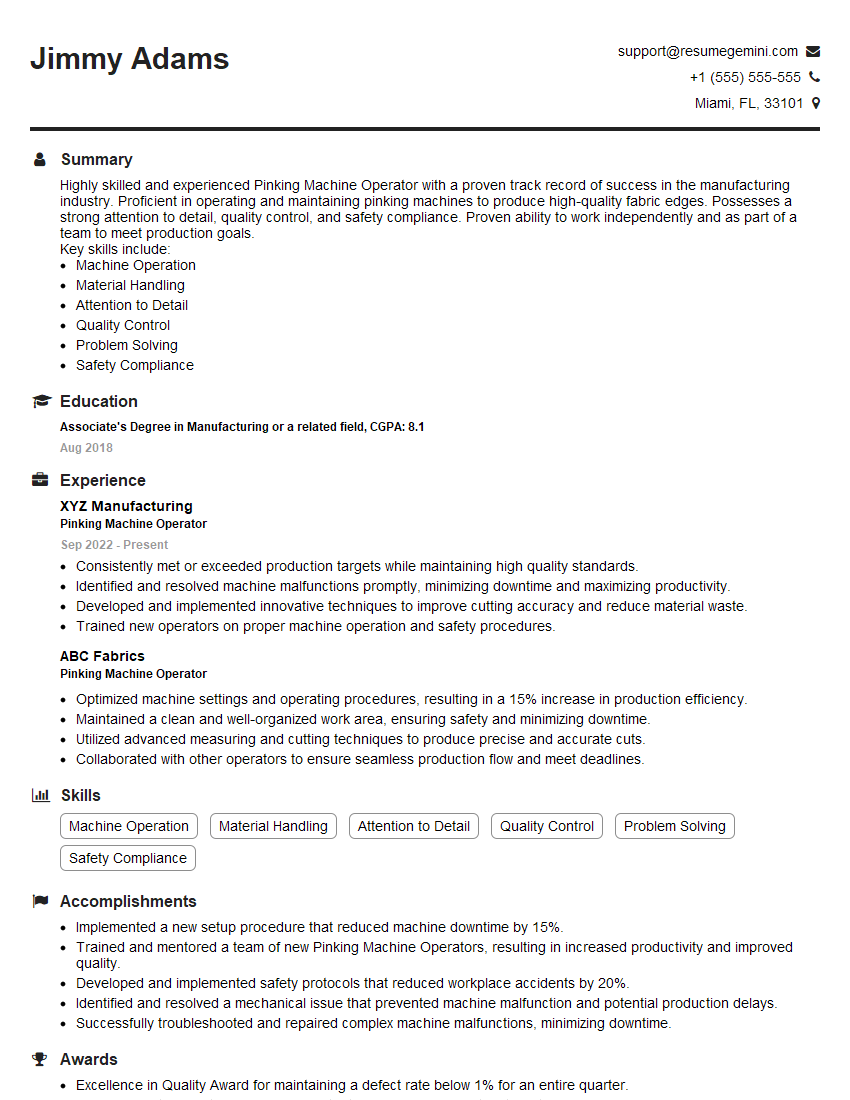
Mastering Pinking Machine Operation opens doors to exciting career opportunities in the textile and garment industry, offering growth potential and specialized skills highly valued by employers. To significantly boost your job prospects, it’s crucial to create a resume that is both professional and ATS (Applicant Tracking System) friendly. ResumeGemini is a trusted resource to help you build a compelling resume that highlights your skills and experience effectively. Examples of resumes tailored to Pinking Machine Operation are available within ResumeGemini to guide you in crafting your own impactful application.
Explore more articles
Users Rating of Our Blogs
Share Your Experience
We value your feedback! Please rate our content and share your thoughts (optional).
What Readers Say About Our Blog
Very informative content, great job.
good