The right preparation can turn an interview into an opportunity to showcase your expertise. This guide to Platen Press Operation interview questions is your ultimate resource, providing key insights and tips to help you ace your responses and stand out as a top candidate.
Questions Asked in Platen Press Operation Interview
Q 1. Explain the principle of operation of a platen press.
A platen press works on a simple yet effective principle: direct pressure applied to both sides of a substrate (like paper or fabric) to transfer an image or design. Imagine a giant sandwich maker! One side holds an inked image (often from a relief plate), the other holds the blank material. The platen – two flat, parallel surfaces – come together with immense pressure, transferring the ink from the image to the substrate. This direct pressure ensures a clean, sharp impression, particularly useful for detailed work or thick substrates.
This pressure isn’t just brute force; it’s carefully controlled for consistent results. The amount of pressure directly impacts the quality of the print, affecting sharpness, ink density, and even substrate damage if improperly adjusted.
Q 2. Describe the different types of platen presses and their applications.
Platen presses come in various types, each suited for different applications:
- Arbor Presses: These are manually operated and are best for small-scale jobs, prototyping, or embossing. They’re simpler to use and maintain but offer limited productivity.
- Hydraulic Platen Presses: These use hydraulic power for greater pressure control and much higher forces. They are commonly used for larger-scale production runs, especially when dealing with thicker materials or requiring deep embossing.
- Pneumatic Platen Presses: Utilizing compressed air, these offer good control and faster cycle times than hydraulic presses but usually have lower maximum pressure capabilities. They’re a middle ground between manual and hydraulic options.
- Electric Platen Presses: More modern presses employing electric motors to provide controlled pressure. These often offer precise digital control and automated features enhancing efficiency and accuracy.
Applications range widely; from printing business cards and labels (smaller presses) to industrial applications like embossing leather goods, creating custom patches, and even specialized tasks within electronics manufacturing (larger presses). The choice of press depends heavily on production volume, material type, and the intricacy of the design.
Q 3. How do you set up a platen press for a specific job?
Setting up a platen press for a job involves several crucial steps:
- Plate Preparation: Ensuring the printing plate (whether it’s a relief plate, a cliché, or something else) is securely mounted and properly inked. This includes checking for any damage to the plate that could affect the print quality.
- Material Selection and Positioning: Choosing the right substrate for the job and carefully positioning it within the press. Accurate positioning ensures consistent impressions and prevents misalignment.
- Pressure Adjustment: Adjusting the pressure according to the material thickness and desired impression depth. This is crucial to avoid damaging the substrate or getting a weak impression. We typically start with minimal pressure and gradually increase it while monitoring the result.
- Test Print: Always run a test print to check for alignment, ink distribution, and pressure consistency before committing to a full run. Adjustments can be made at this stage to refine the process.
- Final Setup Confirmation: Once satisfied with the test print, conduct a final review of the settings to ensure they are optimal for a high-quality, efficient run.
For example, a thicker leather piece will require significantly higher pressure than a thin sheet of paper to get a crisp impression.
Q 4. What safety precautions must be taken when operating a platen press?
Safety is paramount when operating a platen press. Here are critical precautions:
- Proper Training: Never operate a press without receiving proper training. Understand the machine’s controls and safety features fully.
- Personal Protective Equipment (PPE): Always wear appropriate safety glasses, gloves, and potentially hearing protection, especially for larger or louder models.
- Clear Work Area: Ensure the area around the press is free from obstructions. This prevents accidents and allows for efficient movement.
- Machine Guards: Never operate a press with damaged or missing safety guards. Report any malfunction immediately.
- Emergency Stop: Know the location and proper use of the emergency stop button. Practice using it in a training setting.
- Lockout/Tagout Procedures: Before performing maintenance or adjustments, follow the correct lockout/tagout procedures to prevent accidental activation.
Ignoring these precautions can lead to serious injuries such as crushed fingers, hand injuries, and even more severe accidents due to malfunctioning equipment. Safety should always be the top priority.
Q 5. How do you adjust the pressure on a platen press?
Pressure adjustment methods vary depending on the press type. Manually operated presses often use a hand wheel or lever to control pressure. Hydraulic and pneumatic presses usually have pressure gauges and adjustment valves or controls. Electric presses often have digital displays and controls for precise adjustments.
The process generally involves:
- Initial Setting: Start with a low pressure, gradually increasing it as needed based on the material and desired impression.
- Monitoring: Closely monitor the print quality during adjustments. Too little pressure results in a light impression; too much can damage the substrate or the plate.
- Fine-Tuning: Make small, incremental adjustments until the optimal pressure is achieved. It often involves a series of test prints to confirm.
For instance, when printing on a delicate fabric, you’d start with minimal pressure and carefully increase it until you see a clean impression without any distortion or damage to the fabric.
Q 6. How do you ensure proper ink distribution on a platen press?
Proper ink distribution ensures consistent and high-quality prints. Key factors include:
- Ink Viscosity: The ink should have the correct viscosity (thickness) for the job. Too thick, and it won’t spread evenly; too thin, and it will bleed excessively.
- Ink Application: The ink should be applied evenly to the printing plate. Consistent application prevents variations in ink density across the print.
- Plate Cleaning: A clean plate is essential. Ink residue can clog details and lead to inconsistencies in the print.
- Press Speed: For some presses, the press speed impacts ink distribution. Slower speeds often allow for more even ink transfer.
- Substrate Type: The absorbency of the substrate plays a role; more absorbent materials might require slight adjustments to ink application.
Think of painting a wall—uneven paint application will result in an uneven finish. Similarly, uneven ink application on a platen press will yield an inconsistent print.
Q 7. Explain the process of making makeready on a platen press.
Makeready refers to the entire setup process before printing commences. It’s a crucial stage ensuring high-quality prints and minimizing waste. The steps include:
- Plate Preparation: Mounting the printing plate correctly, ensuring it’s secure, and carefully inking it to achieve even ink coverage. This often involves using appropriate ink rollers and techniques.
- Substrate Preparation: Gathering and preparing the substrate, ensuring it is free of defects or inconsistencies. This could involve cutting, stacking, or other processes as per the project requirements.
- Alignment: Precision alignment is key. Ensuring the plate is perfectly aligned with the substrate guarantees consistent registration of the image or design across the entire print run. This is often accomplished using registration marks on the plate and careful adjustments to the press.
- Pressure Adjustment: Setting the optimal pressure based on substrate thickness and desired impression depth. This is done via test prints as mentioned earlier.
- Test Print & Adjustment: Running a series of test prints to ensure the print quality and alignment meet expectations. Adjustments are made to fine-tune the process until the desired results are achieved.
- Final Preparation for Run: Ensuring the press is ready for full production. This may include cleaning any excess ink and prepping the materials for a smooth printing workflow.
A well-executed makeready minimizes waste by reducing the number of spoiled prints, and it ensures consistency throughout the production run, ultimately producing a high-quality output.
Q 8. How do you identify and troubleshoot common platen press malfunctions?
Troubleshooting platen press malfunctions begins with careful observation. Listen for unusual noises – grinding, clicking, or excessive humming – which can indicate worn bearings, loose components, or motor issues. Look for obvious signs like ink smudging, uneven impression, or paper jams. A systematic approach is key.
- Ink Smudging/Uneven Impression: This often points to problems with impression pressure, platen surface condition (dents, scratches), or incorrect makeready (setup). Check pressure settings and inspect the platen for damage. Clean the platen thoroughly if necessary.
- Paper Jams: These are typically caused by incorrect paper feed, warped platens, or gripper issues. Examine the feed mechanism and ensure the paper is properly aligned. Adjust grippers or check for obstructions.
- Mechanical Issues: Unusual noises often signal more serious problems like worn bearings, a failing motor, or damage to the press’s mechanical components. These require professional servicing.
- Electrical Problems: If the press fails to power on, check fuses, power cords, and electrical connections. Electrical malfunctions demand immediate attention from a qualified technician.
Remember, always power down the press before performing any maintenance or repairs. A well-maintained logbook documenting maintenance and repairs is invaluable in identifying recurring problems and preventing future breakdowns.
Q 9. What are the common causes of printing defects on a platen press?
Printing defects on a platen press can stem from various sources, often interconnected. It’s a process of elimination to pinpoint the exact cause.
- Ink Problems: Incorrect ink viscosity, insufficient ink distribution, or contaminated ink can lead to uneven coverage, mottling, or ghosting.
- Plate Issues: Damaged or improperly prepared plates are a frequent culprit. Look for scratches, worn images, or improper etching.
- Paper Problems: Using unsuitable paper stock (wrong weight, moisture content, or texture) can result in poor ink transfer, wrinkling, or even paper jams.
- Pressure Issues: Incorrect impression pressure yields light or heavy impressions, or uneven coverage. Adjusting the impression cylinder’s position is crucial here.
- Registration Issues: Poor registration leads to misaligned colors or elements in multicolor printing. This points to issues with plate positioning or press setup.
- Temperature and Humidity: Extremes in temperature and humidity can affect ink drying and paper handling, causing issues like sticking or offsetting.
For example, if you see streaking in your print, it may be due to insufficient ink or a problem with the ink roller system. If the images are blurry, it could be a result of worn plates or improper impression pressure. Careful inspection and testing are key.
Q 10. How do you maintain and clean a platen press?
Maintaining and cleaning a platen press is crucial for longevity and consistent print quality. It involves both daily and periodic tasks.
- Daily Cleaning: Wipe down the platen surface with a lint-free cloth, removing excess ink and debris. Clean ink rollers and other ink delivery components. Check the paper feed mechanism for any obstructions.
- Periodic Maintenance: This includes more thorough cleaning, lubrication of moving parts (following manufacturer’s recommendations), and inspection for wear and tear. Check for loose screws or bolts, and tighten them as necessary.
- Plate Cleaning: Plates should be cleaned after each use to remove ink and prevent buildup. Use appropriate cleaning solvents, following manufacturer’s instructions.
- Platen Inspection: Regularly inspect the platen surface for any scratches, dents, or damage that can affect printing quality.
Think of it like maintaining a car – regular check-ups and cleaning prevent larger, more costly problems down the road. Keeping a detailed maintenance log is important for tracking tasks and identifying potential issues before they become major problems.
Q 11. Describe the different types of platen press plates and their uses.
Platen press plates come in various types, each suited for specific applications.
- Metal Plates: These are the most common type, typically made of zinc, magnesium, or aluminum. They’re durable and allow for precise image reproduction. They require specialized processing (etching or photopolymerization) to create the printing image.
- Polymer Plates: Polymer plates, often made of photopolymer materials, offer advantages such as ease of use and shorter processing times. They are less durable than metal plates but are suitable for shorter runs.
- Rubber Plates: Rubber plates, known for their flexibility and resilience, are often used for embossing or debossing applications. They can handle thicker substrates effectively.
The choice of plate depends on the type of job, run length, and budget. For high-volume jobs requiring precise detail, metal plates are preferred. For shorter runs or special effects, polymer or rubber plates might be more suitable.
Q 12. What is the role of impression cylinders in a platen press?
Impression cylinders, while not always explicitly present in all platen press designs (some use a flat platen on both sides), play a critical role in presses that incorporate them. They’re essential for applying even pressure across the printing surface.
In presses that utilize them, they act as the counter-pressure element to the platen. They are cylindrical and carefully positioned to ensure consistent contact with the platen and the substrate throughout the printing process. Precise adjustment of the impression cylinder is crucial for achieving the optimal impression pressure required for clear and clean prints without damaging the substrate.
Think of it like a roller applying consistent pressure to ensure every part of your image is printed with even force. Without proper functioning of the impression cylinder (or equivalent pressure mechanism), you risk uneven print quality, light or heavy impressions, and possible substrate damage.
Q 13. How do you adjust the platen press to achieve accurate registration?
Accurate registration is crucial in multicolor printing, ensuring that different colors align precisely. Adjusting a platen press for accurate registration involves a multi-step process.
- Plate Positioning: Precisely position each printing plate on the platen, using registration marks or guides provided on the plates and the press itself.
- Side Guides: Use side guides to ensure proper alignment of the paper or substrate during feeding.
- Test Prints: Print test sheets and carefully check the registration of colors or elements. Make adjustments as needed, using the fine adjustment controls on the press.
- Iterative Adjustments: Registration is an iterative process; minor adjustments may be needed after each test print until perfect alignment is achieved.
Accurate registration is a skill developed through experience. It’s crucial to take your time and make small, incremental adjustments until the desired result is achieved. Using a magnifying glass can help identify even minor misalignments.
Q 14. How do you handle different types of substrates on a platen press?
Handling different substrates on a platen press requires careful consideration of their properties. Each substrate presents unique challenges.
- Paper Weight and Thickness: Adjust the impression pressure based on the paper’s weight and thickness. Thicker substrates require more pressure, while thinner substrates need less to avoid damage.
- Paper Surface: Coated or textured papers may require adjustments to ink transfer. For example, a glossy paper may require less pressure to prevent smudging, compared to an uncoated paper.
- Moisture Content: Paper’s moisture content can affect its handling and the print quality. Adjust accordingly depending on the environmental conditions.
- Non-Paper Substrates: When printing on materials other than paper (e.g., fabrics, plastics), special care is needed to choose the right ink and adjust pressure to avoid damaging the substrate or achieving poor adhesion.
Experimentation and careful observation are key to mastering the handling of various substrates on a platen press. Start with small test prints to identify the optimal settings for each substrate.
Q 15. What are the limitations of a platen press compared to other printing methods?
Platen presses, while excellent for specific applications, have limitations compared to other printing methods like offset or digital printing. Their primary limitation is speed; they’re significantly slower for large print runs. The print area is also restricted by the size of the platen, making them unsuitable for large format printing. Furthermore, they generally lack the sophisticated color management and automation features found in modern offset presses, leading to potentially less consistent color reproduction across large runs and more manual intervention. Finally, the setup and makeready time for each job can be comparatively longer, impacting overall productivity.
For example, if you need to print thousands of brochures, an offset press would be far more efficient. However, for small, intricate jobs requiring precise pressure and texture, a platen press might be the ideal choice.
Career Expert Tips:
- Ace those interviews! Prepare effectively by reviewing the Top 50 Most Common Interview Questions on ResumeGemini.
- Navigate your job search with confidence! Explore a wide range of Career Tips on ResumeGemini. Learn about common challenges and recommendations to overcome them.
- Craft the perfect resume! Master the Art of Resume Writing with ResumeGemini’s guide. Showcase your unique qualifications and achievements effectively.
- Don’t miss out on holiday savings! Build your dream resume with ResumeGemini’s ATS optimized templates.
Q 16. How do you calculate the required ink and pressure for a specific job?
Calculating the required ink and pressure is crucial for achieving high-quality prints. It’s not a simple formula, but rather a process guided by experience and testing. The ink requirement depends on the type of ink (oil-based, water-based, etc.), the paper stock (its absorbency), the desired color density, and the image complexity. Too little ink leads to faint prints; too much leads to smudging and slow drying. Pressure is equally critical. Insufficient pressure results in light impressions; excessive pressure can damage the paper or the printing plates.
I typically start with a test print using a small amount of ink and a moderate pressure setting. I then adjust these parameters based on the resulting print. This iterative process continues until the desired print quality and ink coverage are achieved. This process is often aided by specialized ink gauges and pressure indicators for precision.
Think of it like baking a cake; you need the right amount of ingredients (ink) and the oven temperature (pressure) just right for the perfect result.
Q 17. Explain the importance of proper makeready in achieving high-quality prints.
Proper makeready is paramount to achieving high-quality prints on a platen press. It’s the meticulous process of preparing the press for a specific printing job. This includes carefully setting up the printing plates or blocks, ensuring they are correctly aligned and positioned, choosing the appropriate paper stock, selecting the correct ink and adjusting the ink rollers, and meticulously adjusting the pressure to provide a perfect impression. Skipping or rushing this step can lead to misaligned prints, inconsistent ink coverage, and damaged paper.
Imagine trying to build a house without a proper foundation. Makeready is the foundation of a successful print job. A well-executed makeready minimizes waste, ensures consistent print quality, and reduces production time in the long run. I always prioritize this step, employing a checklist and thorough inspection before commencing the print run.
Q 18. Describe your experience with different types of inks used in platen printing.
My experience encompasses a range of inks used in platen printing. I’ve worked extensively with oil-based inks, known for their vibrant colors and excellent print quality, although their slow drying time can be a limitation. Water-based inks, on the other hand, are environmentally friendly and faster drying, but may not offer the same vibrancy as oil-based inks. I have also experience with specialized inks like metallic inks for creating shimmering effects or UV inks for added durability. The choice of ink heavily depends on the specific job requirements, budget, and substrate.
For instance, I recently used metallic ink to create luxurious business cards, while a fast-drying water-based ink was used for a large quantity of flyers requiring quick turnaround times. The selection process always begins with considering the job requirements and the properties of different inks.
Q 19. How do you ensure consistent print quality throughout a long run?
Maintaining consistent print quality throughout a long run requires diligent monitoring and adjustments. This includes regularly checking the ink levels, ensuring the rollers are distributing the ink evenly, and monitoring the pressure to prevent inconsistencies. Periodically inspecting the printed sheets for any variations in color or impression is also crucial. Addressing minor adjustments promptly prevents larger issues later in the run.
For example, I’ve encountered situations where the ink starts drying out over a long run, leading to lighter prints. In such cases, I add more ink and slightly adjust the ink rollers to ensure the even distribution. Maintaining a consistent environment, such as temperature and humidity, is also important, especially for inks that are sensitive to these changes.
Q 20. Describe your experience with troubleshooting and repairing platen press mechanisms.
Troubleshooting and repairing platen press mechanisms require a good understanding of mechanical systems and problem-solving skills. I’ve encountered issues ranging from minor adjustments of the platen pressure to more complex repairs involving the rollers, gears, and electrical components. My approach involves systematically identifying the problem, tracing the source of the malfunction, and then making the necessary repairs or replacements. Preventive maintenance plays a key role in minimizing these issues.
For instance, I once encountered a situation where the platen wasn’t closing evenly, resulting in uneven impressions. Through careful observation and testing, I identified a misaligned component in the pressure mechanism, which was subsequently adjusted, resolving the issue. Documentation and access to technical manuals is also extremely helpful in this context.
Q 21. What is your experience with preventative maintenance of platen presses?
Preventative maintenance is essential for prolonging the lifespan and ensuring the optimal performance of a platen press. My preventative maintenance routine includes regular cleaning of all components, lubrication of moving parts, checking for wear and tear on rollers and other parts, and ensuring that the electrical system is functioning correctly. This proactive approach reduces the likelihood of breakdowns, minimizes downtime, and ultimately enhances the quality and consistency of prints. A scheduled maintenance program is crucial, and I typically follow a set checklist to ensure thoroughness.
For example, I regularly clean the ink rollers to prevent ink build-up, which can affect the quality of the print and even damage the rollers. I also lubricate the moving parts regularly to prevent friction and wear, which prolongs the lifespan of the components. This ensures minimal downtime and provides peace of mind.
Q 22. How familiar are you with different types of platen press accessories?
Platen presses, while seemingly simple machines, benefit from a range of accessories to enhance efficiency, precision, and safety. My familiarity extends to several key categories:
- Temperature Control Devices: These include thermocouples for accurate temperature monitoring and controllers for maintaining consistent heat throughout the platen. Accurate temperature control is crucial for consistent curing and bonding in various applications. For example, in embossing leather, precise temperature management prevents scorching or uneven embossing.
- Pressure Gauges and Regulators: These are vital for controlling the pressure applied during the pressing cycle. Different materials require different pressures, and accurate pressure control ensures consistent results and prevents damage to the material or the press itself. In bookbinding, for instance, insufficient pressure might lead to weak binding, while excessive pressure could crush the pages.
- Jigs and Fixtures: These custom-designed tools hold materials in place during pressing, ensuring accurate alignment and consistent results, particularly crucial for intricate designs or when working with multiple pieces simultaneously. Think of producing personalized corporate gifts with precisely positioned logos – jigs are essential.
- Safety Equipment: This includes safety guards to protect operators from moving parts, heat shields to protect against burns, and appropriate personal protective equipment (PPE) like heat-resistant gloves and eye protection. Safety is paramount, and proper equipment minimizes risks considerably.
My experience encompasses using and maintaining a wide array of these accessories, ensuring optimal press performance and operator safety.
Q 23. Describe your experience with quality control checks during platen press operation.
Quality control is an integral part of every platen press operation I undertake. My approach involves a multi-stage process:
- Material Inspection: Before pressing begins, I meticulously inspect the materials for defects, inconsistencies, or damage. This includes checking for appropriate thickness, moisture content, and overall quality. Rejecting substandard materials prevents defects in the final product.
- Setup Verification: I meticulously verify the press settings, including temperature, pressure, and timing, ensuring they are correct for the specific material and application. This often involves cross-referencing settings with documented procedures or previous successful runs.
- In-Process Monitoring: During the pressing cycle, I monitor the process for any anomalies such as uneven heating, pressure fluctuations, or material slippage. Addressing these promptly prevents significant defects.
- Final Product Inspection: Once the pressing is complete, I conduct a thorough inspection of the finished product, checking for defects like wrinkles, blemishes, inadequate bonding or uneven curing. This involves careful visual examination, often with magnification tools if necessary.
- Documentation: I maintain detailed records of every press run, including materials used, settings employed, and quality control findings. This data provides valuable insights for process improvement and troubleshooting.
This systematic approach ensures consistent high-quality output and allows for continuous improvement of the process.
Q 24. How do you handle waste and disposal of materials during platen press operation?
Responsible waste management is crucial in platen press operation. My approach prioritizes minimizing waste and adhering to environmental regulations:
- Material Optimization: I strive to minimize material waste by accurately planning cuts and utilizing leftover material wherever possible. Careful planning, precise cutting techniques, and effective use of scrap material can significantly reduce waste.
- Waste Segregation: I segregate waste materials based on their type – paper, plastic, metal scraps, etc. – facilitating appropriate recycling or disposal.
- Recycling: I actively participate in recycling programs, ensuring that recyclable materials are properly processed rather than ending up in landfills.
- Hazardous Waste Handling: If dealing with any hazardous materials (e.g., certain adhesives or coatings), I follow strict safety procedures for handling, storage, and disposal, complying with all relevant regulations and company policies.
- Proper Disposal: Non-recyclable waste is disposed of through designated channels, ensuring compliance with local and national environmental regulations. This might involve using approved waste disposal services or adhering to company guidelines.
My commitment is to environmentally responsible operation, striving to minimize our environmental impact.
Q 25. What are your strengths and weaknesses related to platen press operation?
My strengths in platen press operation lie in my methodical approach, problem-solving skills, and commitment to quality. I’m adept at troubleshooting malfunctions, optimizing press settings for various materials, and consistently delivering high-quality output. I’m also a fast learner and readily adapt to new techniques and technologies.
A potential weakness could be a tendency to be overly meticulous, which might occasionally slightly slow down production if not carefully managed. I’m actively working to improve efficiency without compromising quality by focusing on streamlined workflows.
Q 26. Describe a situation where you had to solve a challenging problem on a platen press.
During a high-volume production run of embossed leather coasters, we encountered a recurring issue: the embossing on some coasters was uneven, creating a less-than-desirable aesthetic finish. Initially, we suspected variations in the leather itself. However, after thorough investigation, which included checking material consistency, pressure gauges, and temperature readings, we realized that the problem was related to the alignment of the coaster blanks within the jig. A slight misalignment during loading, not initially obvious, was causing inconsistent pressure distribution.
The solution was two-fold: First, we redesigned the jig with improved alignment guides to prevent misalignment. Secondly, we implemented a more rigorous quality check during the loading process to ensure proper placement before every press cycle. This resulted in significant improvement in the product quality and minimized waste. This experience highlighted the importance of thorough investigation and systematic problem-solving in achieving consistent, high-quality results.
Q 27. How do you stay updated with the latest technologies and advancements in platen press operation?
Staying abreast of the latest advancements in platen press operation is crucial for maintaining expertise and efficiency. I employ several strategies:
- Industry Publications and Trade Shows: I regularly read trade journals and magazines dedicated to printing, binding, and related industries. Attending industry trade shows offers direct exposure to the newest technologies and best practices.
- Online Resources and Webinars: I actively utilize online resources such as professional organizations’ websites and online courses that offer training and updates on platen press technology and maintenance.
- Manufacturer Resources: I engage with equipment manufacturers by attending webinars, reading technical manuals, and seeking support when needed. This ensures familiarity with the latest upgrades and maintenance recommendations for my specific press models.
- Networking with Peers: I maintain connections with other professionals in the field through industry groups and conferences. Exchanging information and experiences with colleagues provides valuable insights and perspectives.
This multi-faceted approach ensures my knowledge remains current and relevant, allowing me to continually optimize my operational efficiency and enhance the quality of my work.
Key Topics to Learn for Platen Press Operation Interview
- Machine Setup and Operation: Understanding the different types of platen presses, their functionalities, and the proper procedures for setting up jobs, including die selection, material placement, and pressure adjustments.
- Safety Procedures and Protocols: Demonstrating knowledge of safety regulations, emergency procedures, and best practices for preventing workplace accidents related to platen press operation. This includes proper lockout/tagout procedures and personal protective equipment (PPE) usage.
- Material Handling and Quality Control: Explaining your experience with handling various materials suitable for platen pressing, including understanding material properties and their impact on the pressing process. This also includes inspecting finished products for quality defects and implementing corrective actions.
- Troubleshooting and Maintenance: Discussing your ability to identify and resolve common issues encountered during platen press operation, such as malfunctions, jams, or inconsistencies in the finished product. Knowledge of basic preventative maintenance tasks is also crucial.
- Production Efficiency and Optimization: Showcasing your understanding of optimizing production processes to maximize efficiency, minimize downtime, and meet production targets. This might include techniques for improving setup times or identifying bottlenecks in the workflow.
- Understanding Die Cutting Principles: A strong grasp of the principles behind die cutting, including die construction, proper placement, and the impact of pressure and temperature on the final product.
Next Steps
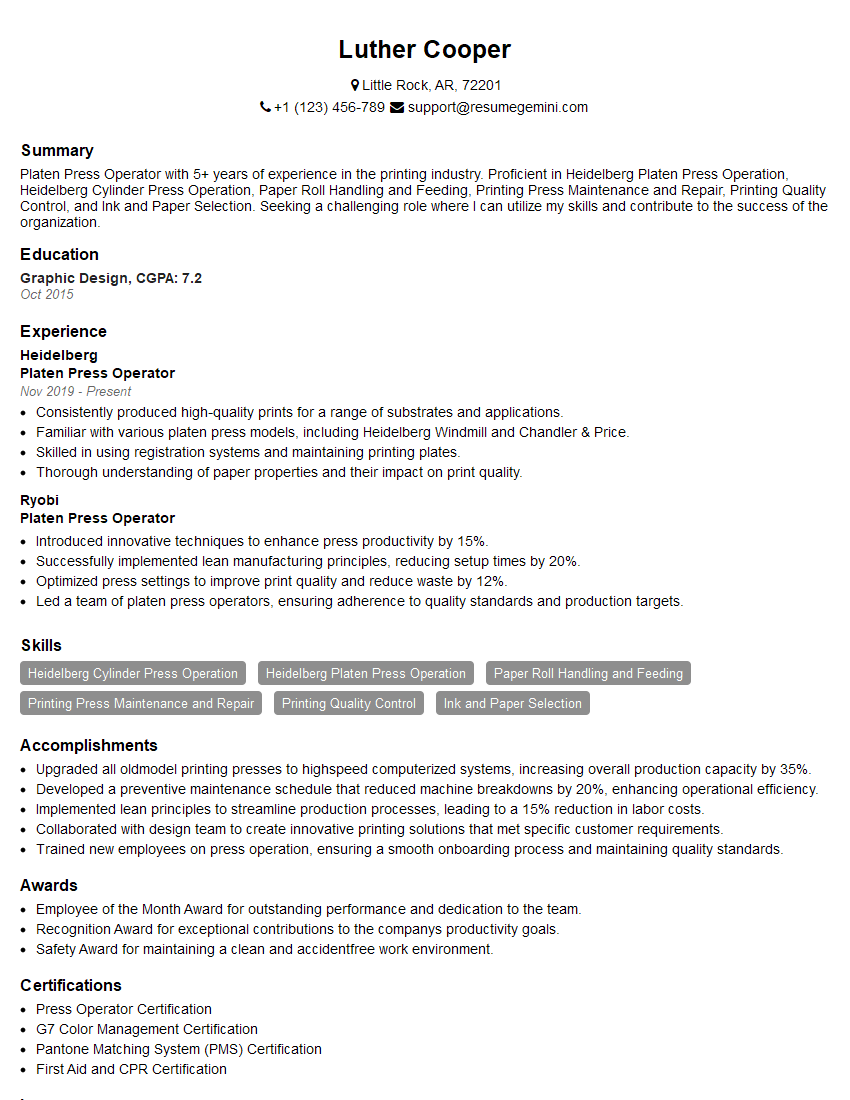
Mastering Platen Press Operation opens doors to rewarding careers in manufacturing and related industries. It’s a highly sought-after skill offering excellent opportunities for growth and advancement. To maximize your job prospects, creating a strong, ATS-friendly resume is essential. ResumeGemini is a trusted resource to help you build a professional and effective resume that highlights your skills and experience. We provide examples of resumes tailored to Platen Press Operation to guide you in crafting a compelling application. Take advantage of this valuable resource and showcase your expertise to prospective employers!
Explore more articles
Users Rating of Our Blogs
Share Your Experience
We value your feedback! Please rate our content and share your thoughts (optional).
What Readers Say About Our Blog
Very informative content, great job.
good