Interviews are more than just a Q&A session—they’re a chance to prove your worth. This blog dives into essential Play Design interview questions and expert tips to help you align your answers with what hiring managers are looking for. Start preparing to shine!
Questions Asked in Play Design Interview
Q 1. Explain your understanding of core gameplay loops.
A core gameplay loop is the fundamental cycle of actions a player repeats throughout a game to achieve a sense of progression and reward. Think of it as the game’s heartbeat. It typically involves a series of steps: a challenge is presented, the player takes action to overcome it, they receive feedback (rewards, progress), and the cycle repeats with increasing difficulty or complexity. Understanding and crafting engaging core loops is crucial for creating addictive and satisfying gameplay experiences.
For example, in a role-playing game (RPG), a core loop might be: explore the world → encounter enemies → engage in combat → defeat enemies and gain experience and loot → level up and become stronger → repeat. In a puzzle game, it could be: observe the puzzle → strategize a solution → execute the solution → receive feedback (success/failure) → attempt again or move to the next puzzle.
Effective core loops are designed to be intrinsically rewarding, providing a sense of accomplishment and motivating the player to continue playing. They need to be clear, concise, and easily understandable by the player.
Q 2. Describe your process for designing a compelling game mechanic.
Designing a compelling game mechanic starts with identifying a core gameplay loop and then crafting individual elements that contribute to that loop’s satisfaction. My process typically involves:
- Concept Brainstorming: I start by brainstorming various mechanics based on the game’s theme and genre, considering how each mechanic could contribute to the overall experience.
- Prototyping and Iteration: I quickly prototype different mechanics using tools like Unity or GameMaker Studio 2. This allows for rapid testing and feedback. Iteration is key – I constantly refine mechanics based on playtesting results.
- Playtesting and Refinement: I involve playtesters early and often. I collect qualitative and quantitative data on how players interact with the mechanics, focusing on player enjoyment, engagement, and frustration levels. This feedback directly influences design adjustments.
- Balancing and Tuning: After playtesting, I fine-tune the mechanics to ensure a satisfying balance between challenge and reward. This often involves adjusting numbers, probabilities, and feedback mechanisms.
- Integration: Once a mechanic is polished, I carefully integrate it into the overall gameplay loop. I focus on creating seamless transitions and intuitive interactions.
For example, when designing a resource management mechanic for a city-building game, I would prototype different systems for resource gathering and consumption, testing variations in resource scarcity, production rates, and building costs, constantly adjusting based on playtester feedback.
Q 3. How do you balance fun and challenge in game design?
Balancing fun and challenge is a delicate act, often described as finding the ‘flow state’. This state occurs when a player is fully immersed in the game, feeling challenged but not overwhelmed. The key lies in creating a difficulty curve that gradually increases, introducing new challenges as the player progresses.
Several techniques can help achieve this balance:
- Adjustable Difficulty Settings: Providing multiple difficulty settings allows players to tailor the experience to their skill level. This accommodates a broader audience.
- Skill-Based Progression: Gradually introduce more challenging content as the player improves their skills. This provides a sense of accomplishment.
- Meaningful Feedback: Clearly communicate the consequences of player actions, ensuring the player understands why they succeeded or failed. This promotes learning.
- Rewarding Risk-Taking: Encourage players to attempt challenging tasks by providing significant rewards for success. This keeps the game engaging.
- Player Agency: Empower players with choices that affect the difficulty and their chances of success. This encourages player investment and mastery.
In a platformer game, for instance, early levels might have simple jump mechanics and few obstacles. As the player progresses, more complex jump sequences, challenging obstacles, and environmental puzzles are introduced.
Q 4. What are some common pitfalls to avoid when designing game progression?
Game progression, if poorly designed, can lead to player frustration and attrition. Common pitfalls to avoid include:
- Grindy Progression: Requiring an excessive amount of repetitive tasks to unlock content. This can quickly become tedious and boring.
- Unclear Goals: Failing to provide clear and attainable goals for the player. Without clear objectives, players may feel lost and unmotivated.
- Unrewarding Progression: Providing minimal or unengaging rewards for the effort expended. Players need to feel a sense of accomplishment.
- Sudden Difficulty Spikes: Introducing dramatically harder content without proper preparation or warning. This can lead to overwhelming frustration.
- Artificial Gatekeeping: Restricting player progress through artificial means, such as paywalls or overly restrictive level designs, without providing meaningful challenge.
For example, a game that requires players to kill 1000 identical enemies to unlock a new area is a classic example of grindy progression. Instead, consider introducing variety in the enemies, offering environmental challenges or puzzle-solving elements to break up the monotony.
Q 5. How do you incorporate player agency into your designs?
Player agency refers to the feeling of control and choice a player experiences within the game. It’s crucial for creating engaging experiences that feel meaningful and personal. I incorporate player agency through several approaches:
- Meaningful Choices: Offering players choices that impact the story, gameplay, or world. These choices shouldn’t be meaningless; they should have tangible consequences.
- Character Customization: Allowing players to customize their character’s appearance and abilities, creating a unique and personal experience.
- Open-World Design: Providing players with freedom to explore the game world at their own pace, setting their own goals and objectives.
- Branching Narratives: Crafting a story that adapts based on the player’s choices and actions.
- Sandbox Elements: Creating a game environment where players are free to experiment and build, creating their own content or modifying the existing world.
For instance, in a narrative-driven RPG, offering choices in dialogue that affect the relationships with other characters and the direction of the story enhances player agency.
Q 6. Explain your experience with iterative design and playtesting.
Iterative design and playtesting are integral parts of my design process. It’s a continuous cycle of designing, testing, analyzing, and refining. I firmly believe that no design is perfect on the first attempt. Playtesting helps identify issues and gather feedback early, saving valuable time and resources later in development.
My typical iterative design process involves:
- Rapid Prototyping: Building quick and dirty prototypes to test core mechanics and concepts.
- Playtesting Sessions: Conducting regular playtesting sessions with diverse groups of players. This includes observing how players interact with the game, gathering feedback, and recording data.
- Data Analysis: Analyzing quantitative and qualitative data to identify areas for improvement. Heatmaps, player feedback forms, and session recordings are helpful tools.
- Iteration and Refinement: Implementing design changes based on playtesting feedback and data analysis. This process is repeated iteratively until the game reaches a satisfactory level.
- Usability Testing: Assessing the game’s user interface (UI) and user experience (UX) to ensure it’s intuitive and easy to use.
I’ve found that early and frequent playtesting, combined with iterative design, significantly improves the quality and playability of my game designs. It’s not simply about fixing bugs but also about understanding and refining the player experience.
Q 7. How do you use data to inform your design decisions?
Data plays a critical role in informing my design decisions. While qualitative feedback from playtesting provides invaluable insights into player experience, quantitative data helps identify trends and patterns that might be missed otherwise. I use data from various sources:
- Gameplay Metrics: Tracking metrics like player completion rates, time spent in specific areas, and frequency of certain actions. This data helps identify areas that are engaging or frustrating.
- Player Feedback Surveys: Gathering player feedback through surveys or questionnaires to understand their opinions and preferences.
- Heatmaps and Session Recordings: Analyzing heatmaps to identify areas of interest and frustration within game levels. Session recordings help understand player decision-making processes.
- Analytics Platforms: Using analytics platforms such as Google Analytics (for web games) or proprietary in-game analytics to track player behavior and engagement.
For example, if the data shows a significant drop-off rate in a particular level, I might investigate the level’s difficulty, confusing elements, or lack of rewards. This data-driven approach allows for more objective and effective decision-making during the design process.
Q 8. Describe a time you had to overcome a significant design challenge.
One significant design challenge I faced was balancing complexity with accessibility in a mobile strategy game. Initially, our design was too intricate, overwhelming new players and leading to high attrition rates. We had a deep, nuanced system of resource management, unit types, and strategic options, but players were struggling to grasp the core mechanics.
To overcome this, we implemented a phased tutorial system. Instead of overwhelming players with all the information upfront, we introduced new mechanics gradually, through a series of increasingly challenging scenarios. Each scenario focused on mastering a specific element of gameplay, building upon previously learned skills. We also simplified the user interface, prioritizing key information and using clear visual cues. This iterative approach, combined with careful A/B testing of different tutorial variations, allowed us to significantly improve player retention and positive feedback.
Furthermore, we introduced a simplified ‘casual’ mode alongside the existing ‘expert’ mode. This provided players a less demanding entry point, allowing them to learn the fundamentals without the pressure of complex strategic decisions. The ‘casual’ mode offered a more streamlined experience, hiding some of the advanced features and simplifying the resource management aspects. This allowed us to cater to a wider range of player skill levels and preferences.
Q 9. What are some of your favorite game design examples and why?
Some of my favorite game design examples include Civilization V for its elegant blend of strategic depth and accessible gameplay, Papers, Please for its unique premise and compelling narrative that emerges from simple mechanics, and Portal 2 for its innovative puzzle design and masterful use of humor and environmental storytelling.
- Civilization V: Its intuitive interface and well-paced tutorial make a complex strategy game accessible to newcomers, while still offering endless strategic possibilities for seasoned players. The game excels at creating emergent gameplay where seemingly small decisions can lead to significant long-term consequences.
- Papers, Please: This game demonstrates how simple mechanics can create a compelling and deeply engaging experience. The core gameplay loop of examining documents is deceptively simple, but the emergent narrative and the moral dilemmas it presents are incredibly rich and thought-provoking.
- Portal 2: This game showcases exceptional puzzle design that blends challenging mechanics with witty writing and memorable characters. The puzzles are cleverly designed to teach players new mechanics without feeling overwhelming, creating a consistently satisfying experience.
Q 10. How do you approach designing for different player skill levels?
Designing for different skill levels requires a multifaceted approach focusing on difficulty scaling and player agency. This involves providing options and challenges that cater to different skill levels without creating a frustrating experience for less experienced players or a monotonous one for experts.
- Difficulty Settings: Offering various difficulty levels (e.g., Easy, Normal, Hard) is a fundamental approach. These settings might adjust enemy AI difficulty, resource availability, or the complexity of puzzles.
- Adaptive Difficulty: More sophisticated systems adjust the difficulty dynamically based on the player’s performance. For instance, a game might increase the challenge if the player is progressing too quickly or reduce it if they are struggling.
- Optional Challenges: Including optional challenges, such as bonus objectives or hidden paths, allows skilled players to engage with additional content without forcing casual players to tackle them.
- Tutorial Systems: A comprehensive and well-designed tutorial system is critical for new players. This system should provide gradual introductions to the core mechanics, escalating in complexity as the player gains experience.
- Accessibility Options: Consider providing accessibility options such as customizable controls, difficulty adjustments, and visual/audio cues to ensure that players with different abilities can enjoy the game.
Q 11. What is your preferred game design documentation method?
My preferred method is a combination of tools, adapting to the project’s complexity. For smaller projects, a well-organized Google Doc or similar document works effectively. For larger projects, however, I find a collaborative tool like Confluence or Notion, combined with visual aids like Miro or Figma, invaluable.
My documentation typically includes:
- Game Design Document (GDD): This outlines the core game mechanics, overall game structure, story beats, art style, target audience, and marketing strategy. This often includes detailed descriptions of each game mechanic, game flow diagrams, and wireframes.
- Level Design Documents: These detail the specifics of each individual level, including layouts, enemy placement, puzzles, and environmental storytelling elements.
- Technical Design Documents: These cover the technical aspects of the game, like programming specifications, data structures, and networking details. This is usually handled in collaboration with the programming team.
- UI/UX Design Documents: These documents detail the design and functionality of user interfaces, ensuring a consistent and intuitive user experience. These often include mockups and prototypes.
Maintaining version control (like using Google Docs’ revision history or Git for code) is essential for tracking changes and collaboration.
Q 12. How do you ensure your designs are accessible to a wide audience?
Ensuring accessibility requires a proactive approach throughout the design process. It’s not something added as an afterthought, but a fundamental consideration from the conceptualization stage onwards.
- Diverse Representation: This goes beyond simply including characters from diverse backgrounds; it means authentically reflecting diverse perspectives and experiences within the game’s narrative and mechanics. Avoid stereotypes.
- Visual Design: Sufficient color contrast, clear fonts, and alternative text for images are crucial for visually impaired players. Consider adjusting brightness and contrast settings.
- Auditory Design: Closed captions, audio descriptions, and clear sound design that provides feedback for actions are crucial for hearing impaired players. Sound should be used to enhance gameplay not exclusively rely on it.
- Input Methods: Allow players to utilize different input methods like controllers, keyboard, and mouse, as well as touch input for mobile devices. Consider providing remapping options for controls.
- Cognitive Accessibility: Avoid overwhelming players with too much information at once. Use clear and concise language, provide sufficient time for decision-making, and create a user interface that is intuitive and easy to navigate.
- Testing: Engage accessibility testers and user groups representing a wide range of disabilities during the development process to identify and address potential barriers early.
Q 13. Explain your understanding of different game genres and their conventions.
Understanding game genres and their conventions is critical for effective game design. Genres establish player expectations and provide a framework for developing engaging gameplay experiences.
Examples of genres and their conventions:
- First-Person Shooters (FPS): Emphasis on fast-paced action, realistic (or stylized) weaponry, and competitive or cooperative multiplayer gameplay. Conventions include aiming, shooting, health management, and weapon upgrades. Examples include Call of Duty and Halo.
- Role-Playing Games (RPG): Focus on character development, narrative storytelling, and player choice. Conventions include character classes, skill trees, inventory management, and dialogue systems. Examples include The Witcher 3 and Final Fantasy XIV.
- Real-Time Strategy (RTS): Emphasis on strategic resource management, base building, and army control in real-time. Conventions include base construction, unit production, resource gathering, and combat management. Examples include StarCraft II and Age of Empires.
- Puzzle Games: Focus on solving a series of interconnected puzzles or challenges. Conventions include clear goals, logical problem-solving, and progressively increasing difficulty. Examples include Portal and The Witness.
- Platformers: Emphasis on precise movement, jumping, and overcoming environmental obstacles. Conventions include jumping mechanics, precise movement controls, and level design focused on platforming challenges. Examples include Super Mario Odyssey and Celeste.
Knowing these conventions allows designers to leverage established expectations while also introducing innovative elements that surprise and delight players. Deviating from conventions requires a careful consideration of player expectations and the potential for alienating the target audience.
Q 14. How do you handle feedback from playtesters?
Handling playtester feedback is a crucial part of the iterative design process. It allows for identifying areas of improvement and refining the game experience before release.
My approach involves:
- Structured Playtesting Sessions: Conducting structured playtesting sessions with a diverse group of players, recording their gameplay and collecting both qualitative and quantitative data. This could involve questionnaires or post-session interviews.
- Observational Analysis: Observing playtesters directly allows for identifying issues that players might not articulate verbally. This often reveals unexpected gameplay patterns or usability problems.
- Data Analysis: Analyzing quantitative data like completion rates, playtime, and player progression highlights potential issues and success points. This data can be used to inform design decisions.
- Feedback Synthesis: Consolidating feedback from multiple sources, identifying recurring issues, and prioritizing improvements based on their impact. Not all feedback is equal; critical bugs and major gameplay issues should take precedence.
- Iterative Design: Using feedback to iterate on the design, making adjustments and improvements based on the gathered data and player comments. This might involve revising game mechanics, updating levels, or refining the user interface. Often requires A/B testing different solutions.
- Clear Communication: Providing clear and timely feedback to playtesters, explaining the design decisions and rationale behind changes (or why certain changes aren’t feasible).
Q 15. How do you incorporate player feedback into your design process?
Player feedback is the lifeblood of iterative game design. It’s not just about collecting opinions; it’s about understanding the player experience and using that understanding to improve the game. My approach involves multiple touchpoints throughout the development cycle.
- Early Feedback (Pre-Alpha/Alpha): I utilize playtesting sessions with a small, diverse group of players. These sessions are informal, focusing on observing player behavior and gathering qualitative data through direct observation and post-session interviews. We’re looking for major issues, pain points in the core gameplay loop, and initial reactions to core mechanics.
- Mid-Stage Feedback (Beta): This stage involves larger-scale beta testing, often using online platforms. Here, we collect both quantitative data (metrics like completion rates, playtime, and drop-off points) and qualitative data (surveys, forums, bug reports). This helps refine mechanics, balance gameplay, and identify areas for polish.
- Post-Launch Feedback: Ongoing feedback is crucial post-launch. We monitor player reviews, social media discussions, and in-game analytics to identify long-term issues, areas for improvement, and opportunities for new content. We use in-game feedback mechanisms like surveys and suggestion boxes to directly engage players.
Analyzing feedback involves careful consideration of the context – understanding why players feel a certain way is as important as what they say. For example, if players are struggling with a boss fight, we might need to adjust its difficulty, provide clearer cues, or even redesign its mechanics entirely.
Career Expert Tips:
- Ace those interviews! Prepare effectively by reviewing the Top 50 Most Common Interview Questions on ResumeGemini.
- Navigate your job search with confidence! Explore a wide range of Career Tips on ResumeGemini. Learn about common challenges and recommendations to overcome them.
- Craft the perfect resume! Master the Art of Resume Writing with ResumeGemini’s guide. Showcase your unique qualifications and achievements effectively.
- Don’t miss out on holiday savings! Build your dream resume with ResumeGemini’s ATS optimized templates.
Q 16. Describe your experience with user research methods in game design.
User research is integral to my design process. I’ve employed a variety of methods, adapting my approach based on the project’s stage and goals.
- Surveys: Used for gathering quantitative data on player demographics, preferences, and opinions on specific features. I design surveys carefully, avoiding leading questions and using a mix of question types (multiple choice, rating scales, open-ended).
- Focus Groups: These moderated discussions provide rich qualitative data by allowing players to interact and share insights in a group setting. It’s excellent for uncovering underlying motivations and understanding player perspectives on the game’s overall design.
- Playtesting: As mentioned earlier, this is crucial throughout the development lifecycle. It involves observing players interacting with the game, noting their actions, frustrations, and moments of enjoyment. I use a combination of think-aloud protocols (where players verbalize their thought process) and post-session interviews.
- A/B Testing: This is particularly useful post-launch. We might test different UI elements, monetization strategies, or level designs to determine which versions perform best based on key metrics.
For example, in a recent project, we used A/B testing to compare two different tutorial designs. One used a linear, step-by-step approach, while the other used a more exploratory, hands-on approach. By tracking completion rates and player engagement, we determined that the exploratory approach led to a higher retention rate.
Q 17. How familiar are you with game design tools and software?
I’m proficient in a range of game design tools and software. My experience spans from industry-standard engines to specialized tools depending on the project’s needs.
- Game Engines: I’m highly experienced with Unity and Unreal Engine, capable of designing and implementing game mechanics, level design, UI, and more. I understand the intricacies of these engines and can leverage their capabilities to optimize performance and create high-quality experiences.
- Level Design Software: I utilize tools like Blender and 3ds Max for creating 3D environments and assets.
- Prototyping Tools: I’m comfortable using tools like Twine, Stencyl, and GameMaker Studio for rapid prototyping and iterative development. This allows me to quickly test core mechanics and gameplay loops before investing significant time in full-scale production.
- Data Analysis Software: I regularly use spreadsheet software (Excel, Google Sheets) and analytics platforms (e.g., Firebase, Amplitude) to track and analyze player behavior and game performance data.
My experience extends beyond simply knowing how to use these tools; I understand the underlying principles of game development and can leverage these tools to create efficient and effective workflows.
Q 18. How do you prioritize features during game development?
Feature prioritization is a crucial skill in game development, as resources are always limited. My approach is based on a combination of factors, using a framework that prioritizes impact and feasibility.
- Value vs. Effort: I use a simple matrix to plot features based on their perceived value to the player experience and the effort required to implement them. High-value, low-effort features get top priority.
- Minimum Viable Product (MVP): I focus on identifying the core features that are absolutely essential for a functional and engaging game. These are the features that deliver the core gameplay loop and player experience. Non-essential features are added in subsequent iterations.
- User Research Insights: Feedback from playtesting and user research heavily informs feature prioritization. Features that address player pain points or directly contribute to a better player experience often take precedence.
- Technical Feasibility: I assess the technical feasibility of each feature, considering the team’s skills and available resources. Features that are overly complex or require significant technological breakthroughs might be delayed or even removed.
For instance, in one project, we prioritized the core gameplay loop (a unique puzzle mechanic) over advanced graphics or a complex narrative, allowing us to release a solid MVP that was well-received and iterated upon later.
Q 19. Describe your approach to prototyping and iteration in game design.
Prototyping and iteration are central to my design philosophy. I believe in building, testing, and refining continuously, avoiding the “build-it-all-at-once” approach.
- Rapid Prototyping: I start with simple prototypes, often using tools that allow for quick iteration. These prototypes focus on core mechanics and gameplay loops, allowing me to test fundamental concepts early. For example, a simple paper prototype might be sufficient to test the interaction between players and a specific game mechanic.
- Iterative Refinement: Based on the results of testing, I refine the prototypes, iteratively improving mechanics, UI, and overall game flow. Each iteration is informed by feedback and data, guiding design decisions toward a more polished and engaging experience.
- Playtesting at Each Stage: Playtesting is integrated throughout the prototyping process. Each iteration is tested with players to gather feedback and identify areas for improvement.
- Vertical vs. Horizontal Slicing: I might use vertical slicing (developing a single feature from start to finish) to test a specific component thoroughly or horizontal slicing (building multiple features partially) to understand how different aspects interact with each other.
For example, in a recent project, we prototyped the core combat system using a simple tool. After several iterations of playtesting and refinement, we migrated the finalized core mechanics to the game engine for full-fledged development.
Q 20. How do you measure the success of a game design?
Measuring the success of a game design is multifaceted and goes beyond simple sales figures. A successful game provides a compelling and engaging experience that keeps players coming back for more.
- Player Retention: High player retention rates indicate a captivating game that fosters engagement. Analyzing daily/weekly active users and churn rates is crucial.
- Player Engagement Metrics: Metrics such as average session length, playtime, level completion rates, and in-game achievements all provide insights into player involvement and enjoyment.
- User Reviews and Feedback: Positive player reviews and constructive feedback signal a positive player experience and provide valuable insights for future development. Negative feedback should be carefully analyzed to identify areas needing improvement.
- Monetization Metrics (if applicable): For monetized games, metrics like average revenue per user (ARPU), conversion rates, and customer lifetime value (CLTV) measure the game’s financial success.
- Community Engagement: A thriving community around the game, active forums, and social media engagement indicate the game has fostered a sense of connection amongst players.
Ultimately, a successful game achieves its design goals, providing a satisfying and enjoyable experience for its target audience, resulting in positive player reception and potentially, sustainable revenue.
Q 21. Explain your understanding of game economy and monetization strategies.
Game economy and monetization strategies are critical for the long-term sustainability of a game, especially in free-to-play models. My understanding encompasses both the design of the in-game economy and the implementation of effective monetization methods.
- In-Game Economy Design: This involves designing a balanced system where players can earn and spend in-game currency or resources. It needs to be fair and rewarding, encouraging player engagement without being exploitative. Careful consideration must be given to the scarcity and value of in-game items.
- Monetization Strategies: The choice of monetization strategy depends on the game’s genre and target audience. Common strategies include:
- In-App Purchases (IAPs): Selling cosmetic items, power-ups, or premium currency. Careful consideration is needed to avoid pay-to-win scenarios and ensure fair play.
- Subscriptions: Offering players access to premium content or features for a recurring fee.
- Advertising: Integrating non-intrusive ads into the gameplay experience.
- Battle Passes: Providing players with tiered rewards for completing in-game challenges.
- Balancing Gameplay and Monetization: The most important aspect is ensuring that monetization doesn’t compromise the core gameplay experience. A well-designed game economy rewards skillful play and strategic choices, rather than simply rewarding purchases.
For instance, I’ve worked on a free-to-play mobile game where we implemented a battle pass system alongside cosmetic IAPs. The battle pass provided players with significant value, encouraging engagement, while cosmetic purchases added a layer of personalization without affecting gameplay balance. This approach allowed us to achieve a sustainable revenue stream while maintaining a positive player experience.
Q 22. How do you maintain a consistent design vision throughout a project?
Maintaining a consistent design vision throughout a project is crucial for creating a cohesive and enjoyable player experience. It’s like building a house – you need a strong blueprint from the start. This involves creating a comprehensive game design document (GDD) that outlines the core mechanics, art style, narrative themes, and overall tone. This document serves as the central reference point for the entire team.
Beyond the GDD, regular team meetings and design reviews are essential. These sessions help to identify inconsistencies early on, allowing for timely corrections and preventing costly rework later. Visual aids such as mood boards and style guides ensure everyone understands the intended aesthetic. For example, if the game aims for a whimsical, cartoonish style, the entire team needs to adhere to that aesthetic across character design, environments, and user interface.
Finally, establishing clear communication channels and fostering a collaborative environment where everyone feels comfortable voicing their concerns or suggestions contributes to maintaining design consistency. Regular playtesting also helps to identify any deviations from the vision and provides valuable feedback for iterative improvements.
Q 23. How do you collaborate effectively with other members of a game development team?
Effective collaboration in game development hinges on open communication, mutual respect, and a shared understanding of the project goals. I believe in utilizing various collaboration tools such as project management software (Jira, Trello) to track tasks, deadlines, and progress. Regular stand-up meetings and sprint reviews ensure everyone is on the same page.
Active listening and constructive feedback are paramount. I strive to create a safe space where team members can freely express their ideas and concerns without fear of judgment. This encourages creative brainstorming and problem-solving. For instance, when working with programmers, I clearly articulate my design needs, using visual references and mockups to avoid misunderstandings. Similarly, I actively seek feedback from artists and writers to ensure the gameplay and narrative are well-integrated and enhance each other.
Conflict resolution is also a key aspect of collaboration. Instead of focusing on blame, I prefer a problem-solving approach, encouraging team members to collaboratively identify the root cause of any conflict and work towards a mutually agreeable solution. This collaborative approach fosters a positive and productive team dynamic.
Q 24. Describe your process for creating a compelling narrative within a game.
Crafting a compelling narrative begins with identifying the core themes and message I want to convey. This involves brainstorming key elements such as characters, setting, plot points, and overarching conflicts. I often use storyboarding and mind-mapping techniques to visualize the narrative flow and character arcs.
Next, I develop character profiles, detailing their motivations, relationships, and backstories. This ensures that their actions and dialogue are consistent and believable. I then outline the key plot points and develop a detailed narrative structure, ensuring a clear beginning, rising action, climax, and resolution. Throughout this process, I actively seek feedback from writers and other team members to ensure the narrative is engaging and aligns with the game’s overall vision.
For example, in a narrative-driven adventure game, I might start by creating a detailed world-building document, outlining the history, culture, and political landscape of the game’s setting. This sets the stage for a more immersive and believable narrative.
Q 25. How do you balance narrative and gameplay mechanics?
Balancing narrative and gameplay mechanics is a delicate art, requiring careful consideration of how each element supports and enhances the other. The narrative shouldn’t simply be a passive backdrop; it should actively drive the gameplay and vice versa. For example, the player’s choices within the game could directly impact the story’s progression and outcomes.
One effective approach is to integrate narrative elements into the gameplay mechanics. For example, a puzzle could be designed around a character’s backstory or a specific event in the story. Another approach is to use gameplay mechanics to reveal aspects of the narrative. For example, exploring the game world could uncover hidden clues and backstory information. This interwoven approach ensures that the narrative feels organic and deeply integrated into the overall gameplay experience, rather than an afterthought.
It’s crucial to avoid overwhelming the player with excessive exposition. Instead, I prefer to convey narrative information gradually, allowing the player to piece together the story through gameplay and environmental storytelling. This creates a more engaging and immersive experience.
Q 26. How do you design for different platforms (PC, mobile, console)?
Designing for different platforms requires a deep understanding of each platform’s unique capabilities and limitations. PC games often offer greater flexibility in terms of graphics fidelity and control schemes. Mobile games need to be optimized for touch-based controls and shorter play sessions, while console games need to be tailored to the specific controller and user interface conventions of that console.
The process involves adapting the game’s user interface, controls, and visual presentation to fit the specific platform. For instance, a complex control scheme designed for a PC might be simplified for a mobile game using intuitive touch gestures. Similarly, high-resolution graphics suitable for a PC might need to be scaled down for mobile devices to maintain optimal performance. Usability testing on each target platform is crucial to identify and address any platform-specific issues.
Furthermore, I consider the target audience for each platform. The audience on mobile might prefer shorter, more casual games, while PC players might be looking for more complex and immersive experiences. This informs my design choices, from the gameplay mechanics to the overall game length and monetization strategy.
Q 27. Explain your understanding of game balancing and tuning.
Game balancing and tuning are iterative processes aimed at creating a fair and engaging gameplay experience. It involves adjusting various game parameters, such as enemy health, damage output, item drop rates, and experience point values to ensure that the game is neither too easy nor too difficult.
I utilize data-driven approaches, collecting player statistics and feedback to identify areas that need adjustment. This data might reveal that a particular enemy is too powerful, or a specific item is overpowered. Based on this information, I make iterative adjustments, carefully testing each change to ensure that the intended effect is achieved without creating new imbalances.
For example, if data shows that players are consistently dying to a particular boss, I might reduce the boss’s health, increase the amount of damage players deal, or add additional checkpoints to make the encounter more manageable. This iterative process requires patience, attention to detail, and a willingness to adapt based on player feedback and gameplay data.
Q 28. What are some emerging trends in game design that excite you?
Several emerging trends in game design excite me. One is the increasing use of procedural generation, allowing for vast and unpredictable game worlds. This drastically expands replayability as no two playthroughs are ever exactly alike. Imagine a role-playing game with procedurally generated dungeons, quests, and even character backstories – each playthrough offers a unique experience.
Another is the growing focus on player agency and meaningful choices. Games are moving beyond linear narratives towards offering players significant influence over the story’s progression and outcome, creating stronger player investment and emotional connection.
Finally, the advancements in AI and machine learning are creating possibilities for more dynamic and responsive game environments and non-player characters (NPCs). This opens up opportunities for more realistic and engaging interactions between the player and the game world.
Key Topics to Learn for Play Design Interview
- Game Mechanics & Systems Design: Understanding core game mechanics, player agency, feedback loops, and systems thinking to create engaging gameplay experiences. Practical application: Designing a simple mechanic and explaining its impact on player experience.
- Player Experience (PX) & User Research: Analyzing player behavior, conducting user research, and iterating on design based on data and feedback. Practical application: Describing a method for gathering and interpreting player feedback.
- Level Design & World Building: Creating compelling and engaging game environments, considering narrative, pacing, and challenge design. Practical application: Outlining the key considerations for designing a level with a specific player goal in mind.
- Game Balance & Economy: Understanding how to design fair and engaging progression systems, balancing reward systems, and creating compelling in-game economies. Practical application: Explaining strategies for tuning difficulty and reward systems.
- Narrative Design & Storytelling: Integrating compelling narratives within gameplay, using various storytelling techniques to immerse players in the game world. Practical application: Describing how to weave narrative elements into a game’s mechanics.
- Playtesting & Iteration: Implementing effective playtesting strategies, analyzing playtest data, and iteratively improving game design based on feedback. Practical application: Discussing different playtesting methodologies and their strengths and weaknesses.
- Accessibility & Inclusivity: Designing games that are accessible and enjoyable for a wide range of players, considering diverse needs and abilities. Practical application: Identifying and addressing potential accessibility barriers in a game design.
Next Steps
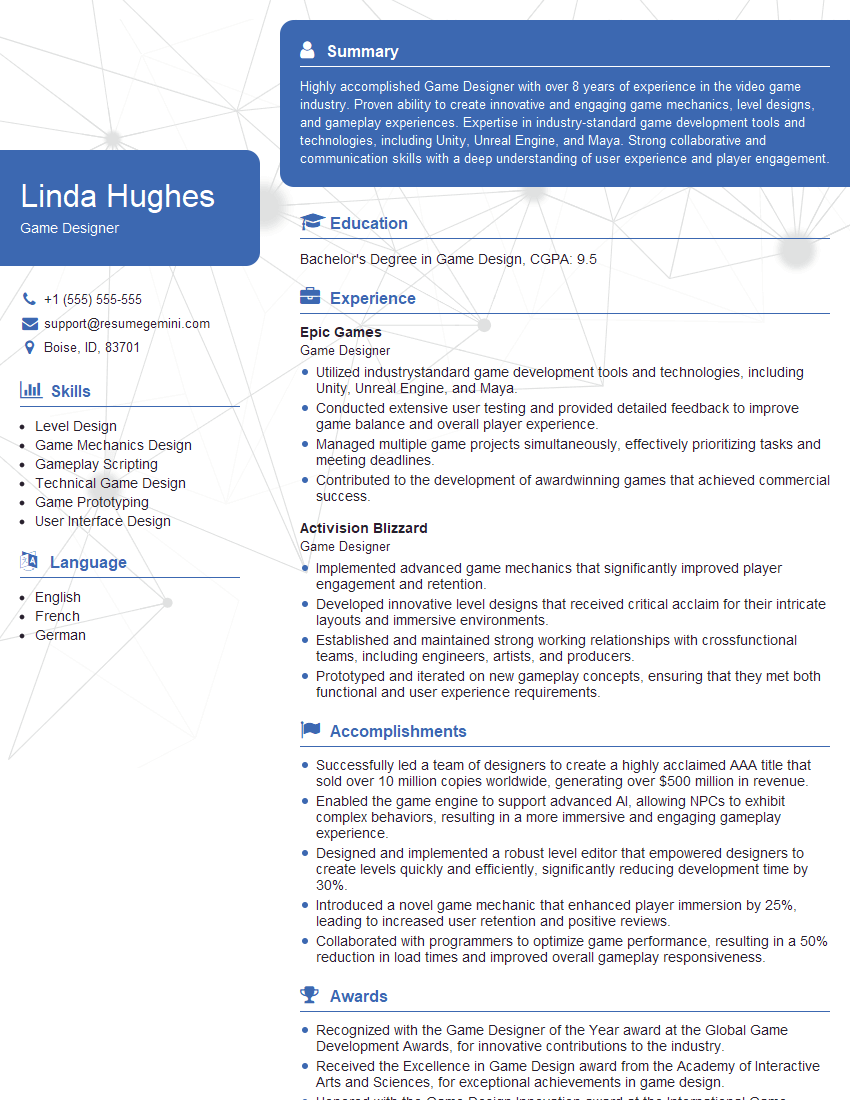
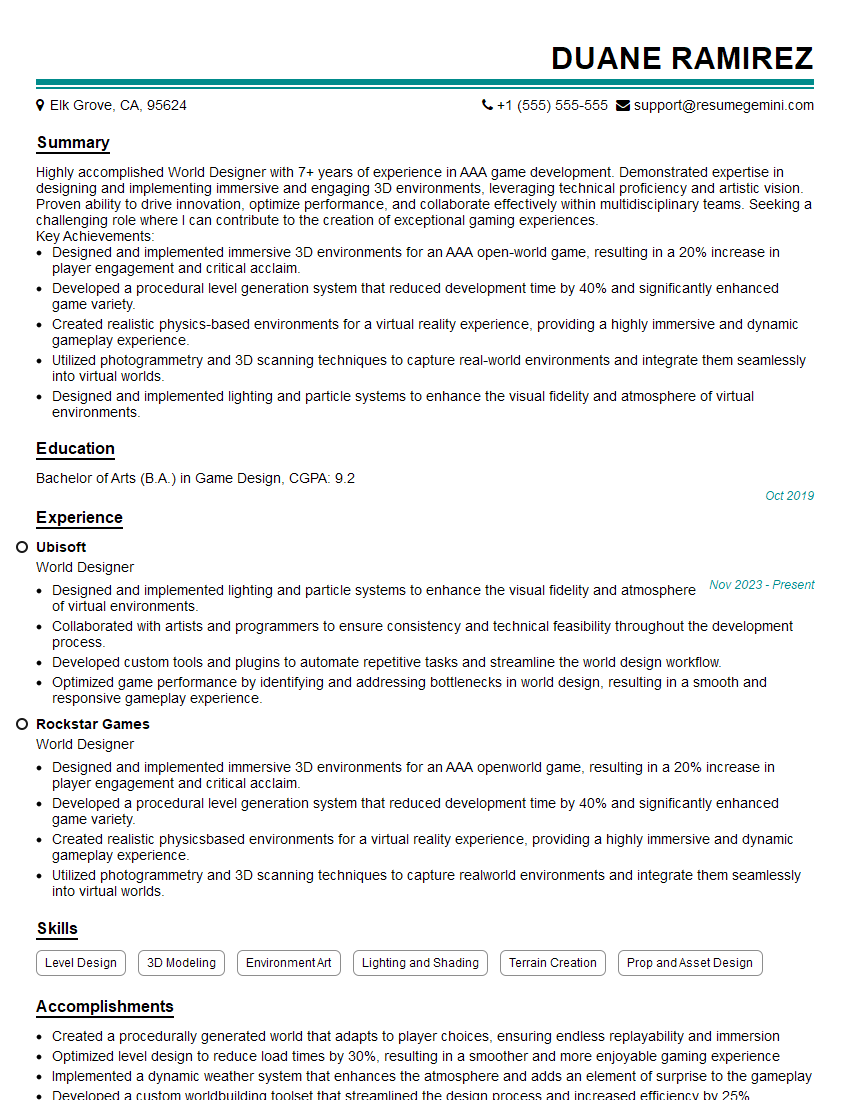
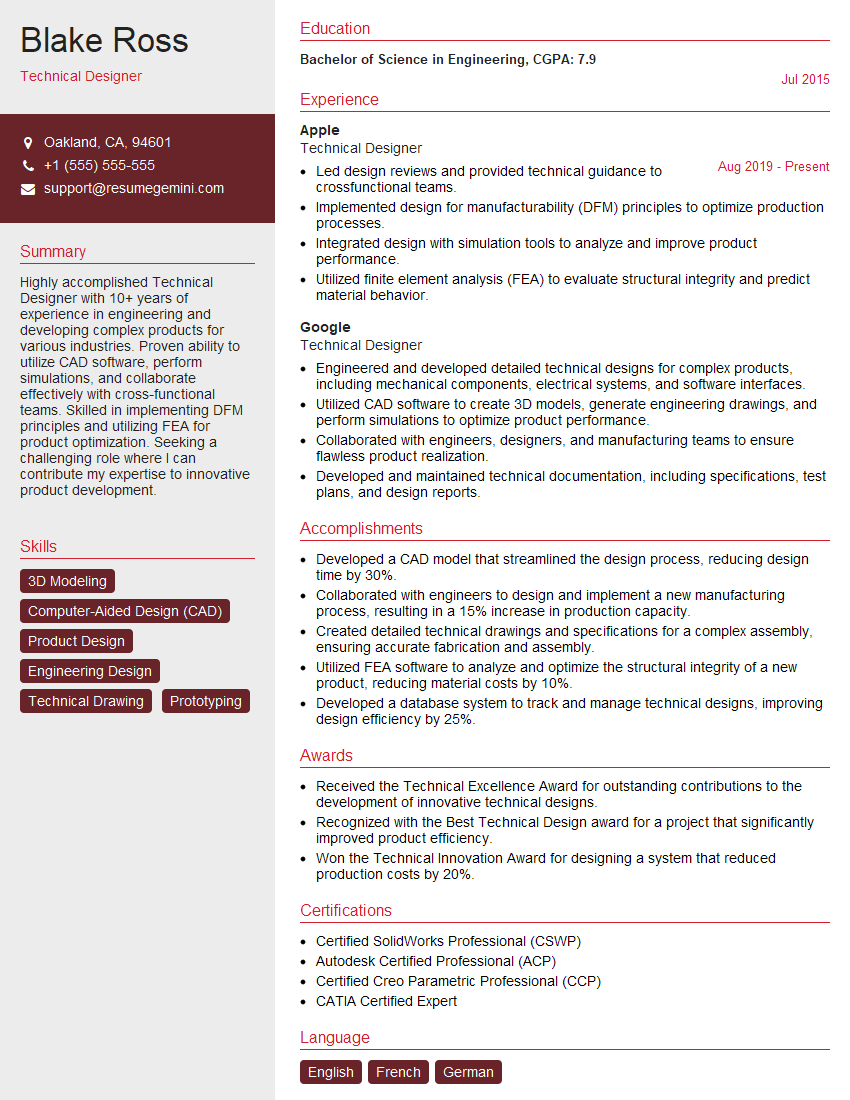
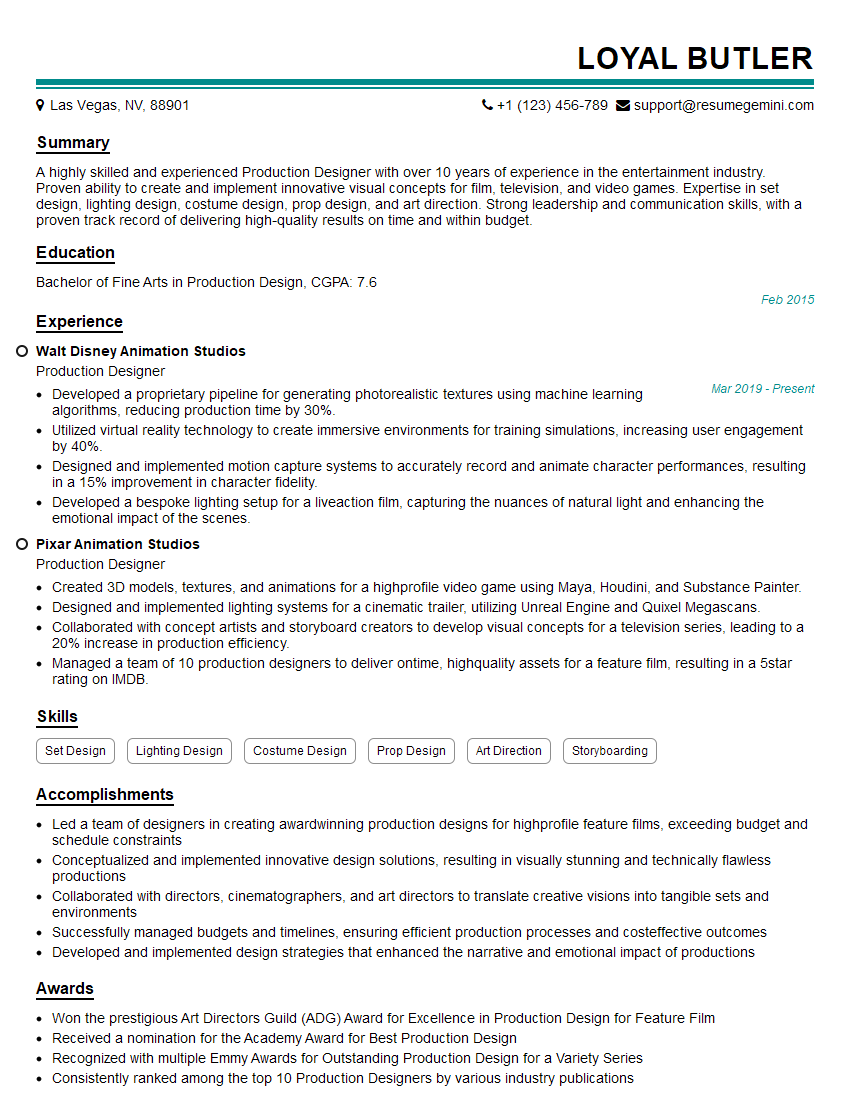
Mastering Play Design opens doors to exciting and rewarding careers in the gaming industry. To maximize your job prospects, crafting a strong, ATS-friendly resume is crucial. ResumeGemini is a trusted resource that can help you build a professional and impactful resume, showcasing your skills and experience effectively. Examples of resumes tailored to Play Design are available to guide you through the process. Invest in your future – invest in your resume.
Explore more articles
Users Rating of Our Blogs
Share Your Experience
We value your feedback! Please rate our content and share your thoughts (optional).
What Readers Say About Our Blog
Very informative content, great job.
good