Preparation is the key to success in any interview. In this post, we’ll explore crucial Sewer Maintenance interview questions and equip you with strategies to craft impactful answers. Whether you’re a beginner or a pro, these tips will elevate your preparation.
Questions Asked in Sewer Maintenance Interview
Q 1. What are the common causes of sewer line blockages?
Sewer line blockages are a common nuisance, often stemming from a combination of factors. Think of your sewer line as a river; anything that restricts the flow will eventually cause a backup. The most frequent culprits are:
- Grease and Fats: Cooking oils and fats solidify in pipes, creating a sticky buildup that traps other debris.
- Tree Roots: Roots seeking water and nutrients can infiltrate sewer pipes, causing significant blockages and potentially damaging the pipe itself.
- Sanitary Products: Wipes, feminine hygiene products, and cotton balls, despite marketing claims, often don’t fully break down and can clog pipes.
- Foreign Objects: Accidental dropping of items like toys, rags, or construction debris can lead to obstructions.
- Sediment and Mineral Buildup: Over time, minerals and sediment can accumulate on pipe walls, restricting flow and eventually leading to blockages. This is particularly common in older pipes.
- Improper Waste Disposal: Flushing inappropriate items down the toilet or disposing of grease improperly.
Addressing these issues requires a multi-pronged approach, including educating homeowners about proper waste disposal and regular maintenance schedules.
Q 2. Describe your experience with sewer jetting equipment.
I have extensive experience operating various sewer jetting equipment, from smaller, portable units ideal for residential applications to larger, truck-mounted systems for commercial and industrial use. My expertise includes not only the safe and efficient operation of these machines but also understanding their limitations and knowing when to select the appropriate equipment for a specific job.
For instance, I’ve used high-pressure water jetting to clear blockages caused by grease buildup in a restaurant’s sewer line. The high-pressure water stream effectively cut through the grease, restoring the flow. In another instance, I used a combination of different sized nozzles on a truck mounted jetter to clear a main line blockage that was suspected to be caused by tree roots. Proper nozzle selection is crucial for effectiveness and minimizing damage to the pipe. I’m also proficient in maintaining and troubleshooting the equipment, ensuring optimal performance and minimizing downtime.
Q 3. How do you identify and locate sewer line leaks?
Locating sewer leaks requires a combination of techniques, as a leak might not always manifest as a visible surface problem. The initial steps usually involve visual inspection for signs of water saturation around the ground surface or unusual plant growth.
- Dye Testing: A non-toxic dye is introduced into the sewer line upstream of the suspected leak. If a leak is present, the dye will appear in the ground or nearby water source.
- Leak Detection Equipment: Acoustic listening devices, ground penetrating radar (GPR), and sewer cameras can pinpoint leaks by detecting changes in sound waves, underground anomalies or visually assessing the pipe for cracks.
- Manhole Inspections: Checking manholes for unusual water levels or inflow/outflow rates can help locate leaks. A visual inspection often reveals obvious cracks and damaged sections of the pipes.
The choice of method depends on factors such as the suspected location of the leak, access to manholes, and the available budget. Combining multiple methods often yields the most accurate results.
Q 4. Explain the process of sewer line CCTV inspection.
Sewer line CCTV inspection is a non-invasive method for visually assessing the condition of sewer pipes. It involves inserting a small, waterproof camera attached to a flexible cable into the sewer line. The camera transmits images to a monitor above ground, providing a detailed view of the pipe’s interior.
The process typically involves:
- Access Point Identification: Determining the best access points, usually manholes, to insert the camera.
- Camera Insertion: Carefully inserting the camera cable into the sewer line, navigating any bends or obstructions.
- Inspection: Observing the video feed on the monitor, noting any defects, blockages, or root intrusions.
- Data Recording: Recording the video and creating a detailed report outlining findings, including the location and severity of any problems.
- Report Generation: Creating a comprehensive report that includes video footage and still images, along with recommendations for repairs or maintenance.
CCTV inspection provides invaluable information for planning repairs, preventing future problems, and determining the overall condition of the sewer system. It is far less disruptive than traditional excavation methods for assessment.
Q 5. What are the different types of sewer pipe materials and their pros/cons?
Several materials are used in sewer pipe construction, each with advantages and disadvantages:
- Vitrified Clay Pipe (VCP): Durable, resistant to corrosion, and relatively inexpensive. However, it can be brittle and prone to breakage during installation or ground settlement.
- Cast Iron Pipe (CIP): Strong and durable, with excellent resistance to corrosion. However, it’s heavy and expensive.
- PVC Pipe (Polyvinyl Chloride): Lightweight, corrosion-resistant, and relatively inexpensive, making it a popular choice. However, it’s less resistant to high temperatures and can become brittle over time with prolonged UV exposure (if not buried deeply).
- High-Density Polyethylene (HDPE): Very flexible, highly resistant to corrosion, and can withstand ground shifts well. It’s more expensive initially, but its durability can make it cost effective in the long term.
The selection of pipe material depends on factors such as soil conditions, budget constraints, the diameter and length of the pipe, and the expected lifespan of the system.
Q 6. How do you perform preventative maintenance on sewer lines?
Preventative sewer line maintenance is crucial for preventing costly repairs and ensuring the long-term health of the system. Think of it as regular checkups for your home’s plumbing.
- Regular Inspections: Scheduled inspections, including CCTV inspections, to identify potential problems early.
- Grease Trap Maintenance: For commercial properties, regular cleaning and maintenance of grease traps to prevent grease buildup in the sewer lines.
- Root Removal: Periodic root removal to prevent root intrusion and blockages. This can involve chemical treatments or mechanical removal.
- Flushing and Cleaning: Regularly flushing the sewer lines with water to remove sediment and debris buildup. This can be done using high-pressure water jetting or other flushing methods.
- Education and Awareness: Educating homeowners about proper waste disposal practices and the importance of avoiding flushing inappropriate items.
A proactive maintenance program is significantly more cost-effective in the long run than reacting to emergencies.
Q 7. What safety precautions do you take when working in a sewer environment?
Safety is paramount when working in a sewer environment. The confined spaces, potential for hazardous gases, and exposure to sewage create significant risks. My safety procedures include:
- Confined Space Entry Permit System: Following strict procedures for entering confined spaces, including atmospheric testing for hazardous gases (methane, hydrogen sulfide) before entry.
- Personal Protective Equipment (PPE): Using appropriate PPE, including respirators, protective clothing, gloves, and eye protection.
- Ventilation and Atmospheric Monitoring: Ensuring adequate ventilation and continuous atmospheric monitoring to prevent exposure to hazardous gases.
- Rescue Procedures: Having established rescue procedures and trained personnel available in case of emergency.
- Proper Communication: Maintaining clear communication with crew members both inside and outside the sewer.
- Lockout/Tagout Procedures: If working near equipment or machinery, strictly following lockout/tagout procedures.
Ignoring safety precautions in this kind of environment can have severe consequences. Safety is not just a procedure; it’s a mindset that must be ingrained in every aspect of the work.
Q 8. Describe your experience with sewer line repair techniques.
Sewer line repair techniques vary greatly depending on the nature and location of the damage. My experience encompasses a wide range, from simple spot repairs to complex, large-scale projects. For instance, I’ve handled:
- Point repairs: These involve patching smaller cracks or holes using epoxy resins or specialized sealants. Think of it like patching a hole in a tire – a relatively quick fix for minor damage. I’ve successfully used this method to address localized pipe damage caused by root intrusion in numerous residential settings.
- Pipe bursting: This trenchless method uses a bursting head to break up the old pipe and simultaneously pull a new pipe into place. It’s ideal for replacing damaged sections without extensive excavation. We recently used this technique to replace a significant section of clay pipe under a busy city street, minimizing disruption.
- Cured-in-place pipe (CIPP): This involves inserting a resin-saturated liner into the damaged pipe and curing it in place to form a new pipe within the old one. This is particularly effective for repairing long sections of pipe with minimal disruption. I’ve overseen numerous CIPP projects, both in residential and commercial settings, resulting in significant cost and time savings compared to traditional excavation.
- Traditional excavation and replacement: While more disruptive, sometimes full excavation is necessary for significant damage or complete pipe failure. It’s a more labor-intensive approach, but it allows for a thorough inspection and replacement of the entire section if needed. In one instance, we uncovered a severe collapse of a Victorian-era sewer line requiring complete replacement using modern PVC piping.
My expertise extends to identifying the most appropriate repair technique based on factors like pipe material, damage extent, accessibility, and budget considerations.
Q 9. How do you handle emergency sewer line situations?
Emergency sewer line situations require immediate action to prevent significant damage and health hazards. My approach follows a structured protocol:
- Assessment: Rapidly assess the situation to determine the severity and potential impact. This includes identifying the location of the blockage or break, the extent of the flooding, and any potential safety hazards.
- Emergency Response: Depending on the severity, I dispatch a team equipped for emergency response. This could involve using high-pressure water jets to clear blockages, installing temporary bypass systems to divert flow, or deploying emergency pumps to manage overflowing sewage.
- Containment: Focus on containing the spill or leak to prevent further environmental contamination. This might involve using sandbags, absorbent materials, or deploying specialized containment booms.
- Temporary Repair: Implement temporary repairs to stabilize the situation until a permanent solution can be implemented. This could involve patching holes, using clamps to seal breaks, or deploying temporary bypass systems.
- Permanent Repair: Once the immediate threat is mitigated, we schedule a comprehensive inspection and undertake permanent repairs, following the procedures outlined in our standard operating procedures. Detailed documentation of the emergency, temporary, and permanent repairs are critical for insurance claims and future reference.
Effective communication with clients, relevant authorities (e.g., environmental agencies), and the emergency response team is crucial throughout the entire process. I’ve successfully managed numerous emergency situations, minimizing disruption and preventing significant environmental and health risks.
Q 10. What is your experience with different sewer cleaning methods?
I’m experienced with a variety of sewer cleaning methods, each suitable for different situations. These include:
- High-pressure water jetting: This uses high-pressure water jets to dislodge and remove debris, grease, and other blockages. It’s effective for clearing clogs and cleaning pipe walls. I’ve utilized this method extensively, particularly in addressing grease build-up in commercial kitchens.
- Mechanical cleaning: This involves using rotating cleaning tools, such as sewer snakes or drain augers, to break up and remove obstructions. These are effective in handling various types of blockages, including tree roots. We’ve successfully used this approach in numerous situations involving root intrusion in aging sewer lines.
- Vacuum trucks: These trucks use powerful suction to remove debris, sludge, and liquids from sewer lines. They’re essential for removing large quantities of accumulated materials. A recent large-scale project required the use of several vacuum trucks to clear years’ worth of accumulated sediment.
- Closed-circuit television (CCTV) inspection: While not a cleaning method itself, CCTV is vital for assessing the condition of the sewer lines before and after cleaning to ensure its efficacy and identify potential issues.
Choosing the appropriate method depends on the type and severity of the blockage, the size and material of the sewer line, and accessibility. I always prioritize the most effective and environmentally friendly option.
Q 11. Explain the process of sewer rehabilitation techniques (e.g., cured-in-place pipe).
Sewer rehabilitation techniques aim to restore the structural integrity and functionality of damaged sewer lines without extensive excavation. Cured-in-place pipe (CIPP) is a leading trenchless technology for this. The process involves:
- Inspection: A thorough CCTV inspection is crucial to identify the extent and location of the damage. This determines the length of pipe requiring rehabilitation.
- Preparation: The existing pipe is cleaned using high-pressure water jetting to remove any debris or obstructions that could interfere with the liner installation.
- Liner Insertion: A felt liner impregnated with resin is inverted and pulled into the damaged pipe section. This typically involves using specialized equipment to ensure accurate placement and complete coverage.
- Curing: The resin-saturated liner is cured using hot water or steam, causing it to expand and bond tightly to the existing pipe, forming a new structural pipe within the old one.
- Inspection (Post-Rehab): A final CCTV inspection verifies the integrity of the newly installed liner and confirms a successful rehabilitation.
Other rehabilitation techniques include pipe bursting and point repairs, but CIPP offers significant advantages for long sections of damaged pipe. I’ve personally managed several large-scale CIPP projects, resulting in substantial cost savings and minimal disruption to the surrounding environment and infrastructure.
Q 12. How do you interpret sewer line inspection reports?
Sewer line inspection reports, typically generated from CCTV inspections, are crucial for assessing the condition of sewer lines. I interpret these reports by focusing on several key aspects:
- Pipe material and condition: Identifying the type of pipe (e.g., PVC, clay, cast iron) and its overall condition (e.g., cracks, corrosion, root intrusion).
- Blockages and obstructions: Identifying the location, type, and extent of any blockages, including grease buildup, debris, or tree roots.
- Structural integrity: Assessing the structural soundness of the pipe, noting any signs of sagging, collapse, or misalignment.
- Infiltration/Inflow: Detecting points of infiltration (water entering the sewer from the ground) or inflow (water entering from other sources).
- Joint condition: Evaluating the condition of pipe joints, checking for leakage or separation.
I use this information to prioritize repairs, develop comprehensive maintenance plans, and justify the need for rehabilitation or replacement projects to clients. For example, a report showing significant root intrusion and pipe cracks would lead me to recommend a CIPP rehabilitation, whereas isolated minor cracks might warrant only spot repairs.
Q 13. What are the common regulations and permits related to sewer maintenance?
Sewer maintenance is heavily regulated to protect public health and the environment. Regulations vary by jurisdiction but commonly include:
- Permits: Most sewer work, especially excavation or significant repairs, requires permits from local authorities. This includes notification of excavation plans to avoid damaging underground utilities.
- Environmental regulations: Strict regulations exist to prevent sewage spills and contamination of water bodies. Proper handling and disposal of wastewater and removed debris are critical.
- Safety regulations: Occupational Safety and Health Administration (OSHA) regulations must be strictly followed to ensure worker safety during all aspects of sewer maintenance, including confined space entry protocols and personal protective equipment (PPE) usage.
- Building codes: Building codes dictate standards for sewer line installation and maintenance to ensure proper functionality and longevity. These codes cover pipe material, slope, and connections.
- Cross-connection control: Regulations exist to prevent backflow of contaminated water into the potable water supply.
Staying current with all applicable regulations and obtaining necessary permits is paramount to avoid penalties and ensure compliance. I make sure our team receives regular training on relevant regulations and best practices.
Q 14. How do you manage a team of sewer maintenance technicians?
Managing a team of sewer maintenance technicians requires strong leadership, communication, and organizational skills. My approach focuses on:
- Clear communication: Maintaining open and clear communication about job assignments, safety procedures, and project updates is crucial. Regular team meetings and individual check-ins help keep everyone informed.
- Effective training: Ensuring the team receives regular training on new technologies, safety procedures, and best practices keeps the team competent and up-to-date.
- Safety prioritization: Safety is my top priority. I ensure that all team members strictly adhere to safety regulations and use appropriate PPE. Regular safety briefings and training are part of our routine.
- Performance management: Regular performance reviews and feedback help to identify strengths and areas for improvement within the team. I actively support the professional development of each member.
- Problem-solving: Encouraging a collaborative approach to problem-solving fosters teamwork and efficiency. I encourage the team to bring ideas and solutions to the table.
By fostering a culture of safety, collaboration, and continuous improvement, I strive to build a high-performing and motivated team capable of handling the challenges of sewer maintenance efficiently and effectively.
Q 15. Describe your experience with sewer system mapping and GIS.
Sewer system mapping using GIS (Geographic Information System) is crucial for efficient maintenance. It involves creating a detailed digital representation of the entire sewer network, including the location and attributes of pipes, manholes, cleanouts, and other infrastructure. My experience encompasses utilizing GIS software to input, manage, and analyze this data. This allows for efficient planning of maintenance activities, leak detection, and emergency response. For example, I’ve used GIS to identify areas with high rates of blockages based on historical data and prioritize preventative maintenance in those locations. I’m proficient in using GIS software to create maps showing pipe diameters, materials, slopes, and age, which is essential for informed decision-making regarding repairs and upgrades. I also have experience with integrating asset management software with the GIS system for a comprehensive overview of the sewer network’s condition and lifespan.
Career Expert Tips:
- Ace those interviews! Prepare effectively by reviewing the Top 50 Most Common Interview Questions on ResumeGemini.
- Navigate your job search with confidence! Explore a wide range of Career Tips on ResumeGemini. Learn about common challenges and recommendations to overcome them.
- Craft the perfect resume! Master the Art of Resume Writing with ResumeGemini’s guide. Showcase your unique qualifications and achievements effectively.
- Don’t miss out on holiday savings! Build your dream resume with ResumeGemini’s ATS optimized templates.
Q 16. What are the environmental considerations involved in sewer maintenance?
Environmental considerations in sewer maintenance are paramount. Improper maintenance can lead to significant pollution of surface and groundwater. We must prioritize minimizing the release of sewage and associated contaminants into the environment. This includes careful handling of sludge and screenings, proper disposal of hazardous materials encountered during cleaning operations, and adhering to all relevant environmental regulations. For instance, I ensure that all excavation and repair work is conducted to minimize soil erosion and the impact on local ecosystems. We also monitor discharge points to ensure compliance with water quality standards. Preventing overflows and ensuring the integrity of the sewer system are key to protecting public health and the environment.
Q 17. What are the different types of sewer manholes and their function?
Sewer manholes serve as access points for inspection, maintenance, and repair of sewer lines. There are various types, each with a specific function.
- Standard Manholes: These are the most common type, typically cylindrical structures made of concrete or brick, providing access to the sewer line for cleaning and inspection.
- Drop Manholes: Used where there’s a significant change in elevation in the sewer line, allowing for gravity flow adjustments. They’re deeper than standard manholes.
- Combination Manholes: Combine the functions of a standard manhole and a drop manhole, accommodating both changes in elevation and access for maintenance.
- Flow Control Manholes: These incorporate structures to regulate the flow of sewage, often used in areas prone to flooding or high flow rates.
Q 18. How do you deal with sewer backups and overflows?
Sewer backups and overflows are serious issues requiring immediate action. My approach involves a multi-step process:
- Assessment: Quickly determine the extent and location of the backup or overflow, identifying affected areas and potential sources.
- Emergency Response: Implement immediate measures to contain the overflow and prevent further environmental damage. This may involve deploying temporary pumps or using absorbent materials.
- Investigation: Conduct a thorough investigation to pinpoint the cause, whether it’s a blockage, a collapsed pipe, or a problem with the pumping system.
- Repair/Cleaning: Based on the investigation, implement appropriate repairs or cleaning procedures. This may include jetting, using a sewer snake, or replacing damaged sections of the pipe.
- Prevention: Following the repair, implement preventative measures to minimize the risk of future backups or overflows, which might involve regular inspections or system upgrades.
Q 19. What is your experience with different types of sewer pumps?
My experience includes working with various sewer pumps, each suited for specific tasks and flow conditions.
- Submersible Pumps: These are placed directly into the wastewater, ideal for pumping from wet wells or sumps. They are efficient and require less space.
- Non-submersible Pumps: These are located outside the wastewater and pump from a suction point, suitable for handling larger volumes and more challenging applications.
- Centrifugal Pumps: Commonly used due to their efficiency in moving large volumes of wastewater at moderate pressures.
- Positive Displacement Pumps: Used for handling thicker or more viscous materials. They can pump sewage with higher solids content.
Q 20. Describe your problem-solving approach to a complex sewer line issue.
When faced with a complex sewer line issue, I employ a systematic problem-solving approach. This typically involves:
- Defining the Problem: Clearly identifying the issue, gathering data on flow rates, blockages, and any other relevant symptoms.
- Data Collection: Employing various tools such as CCTV inspection, flow monitoring, and manhole inspections to gather data.
- Hypothesis Formation: Developing several possible explanations for the problem based on the gathered data.
- Testing and Verification: Testing each hypothesis through further investigation and analysis. This might involve targeted excavations or more detailed inspections.
- Solution Implementation: Once the cause is confirmed, implementing the most effective and cost-efficient solution, which could involve pipe lining, repair, or replacement.
- Monitoring and Evaluation: Closely monitoring the system after the repair to ensure that the problem is resolved and to identify any potential future issues.
Q 21. How do you maintain accurate records and documentation of sewer maintenance activities?
Maintaining accurate records is critical for efficient sewer maintenance. We utilize a combination of digital and physical records. Digital records include GIS databases, asset management software, and inspection reports stored securely. These databases track the location, condition, and maintenance history of every component of the sewer system. Physical records such as inspection logs, repair work orders, and as-built drawings are maintained in a secure and organized manner. All data is regularly updated to ensure its accuracy and reliability. This systematic record-keeping allows for informed decision-making, effective budget allocation, and improved response times in emergency situations. A clear audit trail of all maintenance activities is essential for compliance and accountability.
Q 22. What software or tools are you familiar with for sewer maintenance management?
In my years of experience in sewer maintenance, I’ve become proficient in several software and tools designed to streamline operations and enhance efficiency. These range from Computerized Maintenance Management Systems (CMMS) like Fiix or UpKeep, which allow for scheduling, tracking repairs, and managing assets, to Geographic Information Systems (GIS) software such as ArcGIS, which aids in mapping sewer lines and identifying problem areas. For field work, we utilize specialized inspection cameras with recording capabilities for detailed visual assessments of pipe conditions. Data from these inspections can be uploaded directly into the CMMS for record-keeping and analysis. Finally, specialized software packages designed for sewer modeling and hydraulic analysis help in planning and designing preventative maintenance activities.
For example, in a recent project, we used a CMMS to track the preventative maintenance schedule for all 200 manholes across a particular district. This ensured timely cleaning and inspection, preventing potential blockages and minimizing costly emergency repairs. Using the GIS software allowed us to visualize the network and quickly identify the optimal route for maintenance crews.
Q 23. Explain your understanding of OSHA regulations pertaining to sewer work.
OSHA regulations surrounding sewer work are crucial for worker safety. They center around the inherent dangers of confined spaces, trenching, and exposure to hazardous materials. Specifically, OSHA’s regulations for confined spaces (29 CFR 1910.146) mandate a comprehensive permit-required confined space entry program. This includes atmospheric testing before entry to ensure adequate oxygen levels and the absence of hazardous gases like methane or hydrogen sulfide. Proper ventilation, rescue plans, and attendant personnel are all essential components. Furthermore, OSHA’s regulations for trenching and excavation (29 CFR 1926.650-652) require protective systems like shoring, sloping, or shielding to prevent cave-ins, a significant risk in sewer maintenance. Personal Protective Equipment (PPE) such as hard hats, safety harnesses, respirators, and protective clothing are absolutely mandatory. I’m extensively trained in these regulations and ensure their strict adherence in every project.
For instance, in one project, we encountered a collapsed sewer line that required confined space entry. Before anyone entered, we performed a thorough atmospheric test, confirmed that a safe oxygen level existed, and had a rescue plan in place. The crew was equipped with appropriate PPE, and a standby person monitored the conditions throughout the operation. This adherence to OSHA regulations ensured the safety of the team.
Q 24. How do you ensure the quality of your sewer maintenance work?
Ensuring quality in sewer maintenance requires a multi-faceted approach. First, it starts with meticulous planning and proper documentation. We use detailed pre- and post-inspection reports with photographic and video evidence to track work completed. This creates a clear audit trail. Second, our team follows stringent standard operating procedures (SOPs) for every task, from cleaning and inspection to repairs. These SOPs outline the best practices, ensuring consistency and quality. Third, we regularly calibrate and maintain our equipment (inspection cameras, cleaning tools, etc.) to ensure accuracy and reliability. Finally, a crucial aspect is quality control checks during and after the project. This involves supervisors reviewing the work completed, ensuring that it meets the required standards and the client’s specifications. Internal quality audits are conducted periodically to continually improve our processes and identify areas for enhancement.
For example, after completing a sewer line repair, we always conduct a post-repair inspection using our sewer camera to confirm the integrity of the repair and the flow of wastewater. Any discrepancies are immediately addressed, guaranteeing high-quality workmanship.
Q 25. What are the signs of potential sewer collapse?
Several signs can indicate a potential sewer collapse. These are often subtle initially, but becoming increasingly alarming as the situation worsens. One of the most significant indicators is a noticeable sag in the ground surface above the sewer line. This is often accompanied by cracks in pavements, driveways, or building foundations. Another sign is unusually slow drainage or frequent backups in drains and toilets, suggesting a partial blockage due to a weakened pipe. Also, unusual sounds such as gurgling or unusual noises emanating from the sewer line can be an indication of problems. Finally, the presence of sinkholes or sudden ground subsidence indicates a severe and potentially imminent collapse.
For instance, we once responded to a call about slow drainage in a neighborhood. Upon investigation, we discovered a significant sag in the road surface and cracks in nearby foundations. This indicated a weakening of the sewer line beneath, and further investigation confirmed a significant risk of collapse. Immediate action was taken to prevent a major incident.
Q 26. Describe your experience with working in confined spaces.
I have extensive experience working in confined spaces, always adhering strictly to OSHA’s confined space entry regulations. This includes thorough atmospheric monitoring, utilizing appropriate respiratory protection, and having a trained attendant present at all times. I understand the challenges of working in such environments, such as limited space, poor ventilation, and the potential for hazardous atmospheres. My training covers rescue techniques and emergency procedures specific to confined space rescues. We use specialized lighting and communication systems to maintain awareness and communication within the confined space.
I recall one instance where we had to repair a collapsed section of a sewer line. The space was very confined and had limited access, but our adherence to safety protocols ensured a successful repair without any incidents. The use of specialized equipment and team communication were crucial to working in such a demanding environment.
Q 27. How familiar are you with trench safety procedures?
Trench safety procedures are paramount for any sewer work involving excavation. I am thoroughly familiar with OSHA’s requirements for trenching and excavation, which focus on protecting workers from cave-ins. These procedures include proper shoring, sloping, or shielding of trenches to maintain stability. Soil type analysis is crucial to determine the appropriate protection methods. We always ensure proper inspection of the trench before, during, and after work. Appropriate protective systems are chosen according to soil conditions. Furthermore, adequate access and egress, along with worker safety equipment such as hard hats, safety harnesses, and high-visibility clothing are crucial. A spotter is usually present to monitor the trench and warn workers of any potential hazards.
We never compromise on trench safety. In one project, we encountered unstable soil conditions. Instead of proceeding with the usual method, we employed specialized trench boxes, providing extra protection to our workers, preventing any accidents during excavation.
Q 28. Describe your experience with root intrusion removal in sewer lines.
Root intrusion is a common problem in sewer lines, leading to blockages and damage. I have extensive experience in various root removal techniques. Mechanical methods include using sewer cleaning equipment, such as root cutters and high-pressure water jets, to physically remove the roots. Chemical methods involve the use of root-killing agents, which are injected into the sewer line to eliminate the roots. The choice of method depends on the severity of the intrusion and the type of pipe. We always follow environmentally sound practices, ensuring the chosen method doesn’t negatively affect the environment. After root removal, we often perform a thorough inspection using a sewer camera to confirm the effectiveness of the procedure. In addition to removal, we will assess the condition of the pipe to prevent future issues.
In one case, we used a combination of mechanical and chemical methods to deal with severe root intrusion in a large diameter sewer line. The high-pressure water jet removed most of the bulk roots, followed by chemical treatment to prevent regrowth. A post-treatment inspection confirmed the success of the process.
Key Topics to Learn for Sewer Maintenance Interview
- Sewer System Basics: Understanding gravity sewers, force mains, lift stations, and their interconnectivity.
- Preventive Maintenance: Developing and implementing schedules for regular inspections, cleaning, and repairs to minimize disruptions and costly emergencies. This includes understanding the use of various inspection technologies.
- Troubleshooting and Repair: Identifying and resolving common sewer line issues such as blockages, leaks, and collapses using appropriate tools and techniques. This includes understanding root intrusion mitigation.
- Safety Procedures: Adhering to OSHA regulations and company safety protocols related to confined space entry, hazardous materials handling, and personal protective equipment (PPE).
- Pipe Materials and Construction: Familiarity with various pipe materials (e.g., PVC, concrete, clay) and their respective strengths and weaknesses. Understanding different sewer line construction methods.
- Wastewater Treatment Fundamentals: Basic understanding of wastewater treatment processes and their connection to the sewer maintenance function.
- Equipment Operation and Maintenance: Proficiency in operating and maintaining specialized equipment such as jetters, sewer cameras, and vacuum trucks.
- Record Keeping and Reporting: Accurate documentation of maintenance activities, repairs, and inspections for regulatory compliance and future reference.
- Problem-Solving and Decision Making: Analyzing situations, identifying root causes of problems, and selecting effective solutions under pressure.
- Teamwork and Communication: Collaborating effectively with colleagues, supervisors, and other stakeholders to ensure smooth operations.
Next Steps
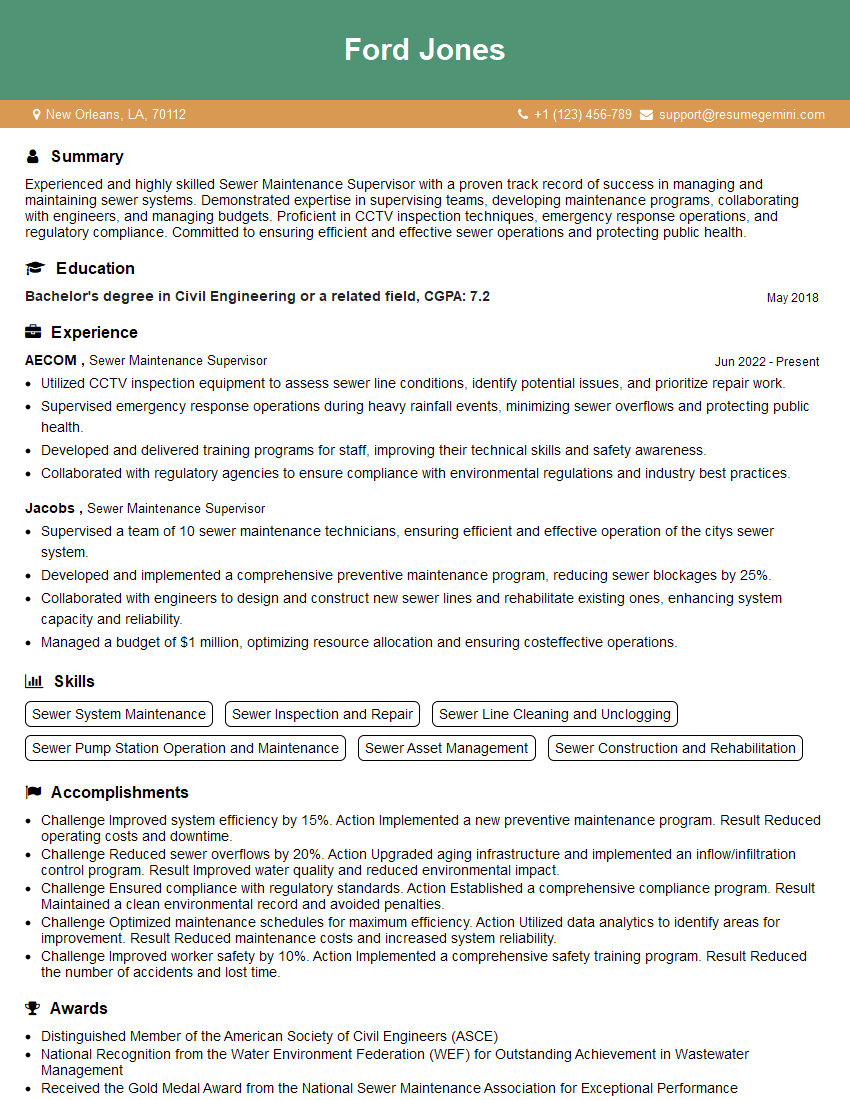
Mastering sewer maintenance is crucial for a rewarding and stable career path offering excellent opportunities for growth and specialization. A strong resume is your key to unlocking these opportunities. Creating an ATS-friendly resume is vital to getting your application noticed by employers. ResumeGemini can help you craft a compelling and effective resume that highlights your skills and experience in sewer maintenance. Use ResumeGemini to build a professional resume that showcases your qualifications. Examples of resumes tailored to Sewer Maintenance are available within ResumeGemini.
Explore more articles
Users Rating of Our Blogs
Share Your Experience
We value your feedback! Please rate our content and share your thoughts (optional).
What Readers Say About Our Blog
Very informative content, great job.
good