The thought of an interview can be nerve-wracking, but the right preparation can make all the difference. Explore this comprehensive guide to Plumbing Basics interview questions and gain the confidence you need to showcase your abilities and secure the role.
Questions Asked in Plumbing Basics Interview
Q 1. What are the different types of pipes used in plumbing systems?
Plumbing systems utilize a variety of pipes, each chosen based on factors like pressure, temperature, and the type of fluid being transported. The most common materials include:
- Copper: Durable, resistant to corrosion, and widely used for hot and cold water supply lines. It’s known for its longevity but can be more expensive than other options.
- PVC (Polyvinyl Chloride): A lightweight, inexpensive plastic pipe commonly used for drainage and waste lines. It’s easy to install but can be susceptible to damage from extreme temperatures.
- CPVC (Chlorinated Polyvinyl Chloride): A stronger and more heat-resistant version of PVC, suitable for hot water lines. It’s a good balance between cost and durability.
- PEX (Cross-linked Polyethylene): A flexible plastic pipe gaining popularity due to its ease of installation and resistance to freezing. It’s often used in renovations because it requires fewer fittings.
- Cast Iron: A heavy-duty, durable material traditionally used for drainage and sewer lines. While strong, it’s more expensive and less commonly used in new constructions due to its weight and susceptibility to corrosion.
- Galvanized Steel: Once a common choice, galvanized steel pipes are now less frequently used because they are prone to corrosion and can lead to mineral buildup.
The choice of pipe material depends heavily on the application and the specific needs of the plumbing system. For instance, a high-pressure system might necessitate copper or CPVC, while a drain system might utilize PVC.
Q 2. Explain the function of a pressure regulator.
A pressure regulator, also known as a pressure reducing valve (PRV), controls the water pressure entering a home or building. Think of it as a gatekeeper for your water pressure. High water pressure can damage fixtures and appliances, leading to leaks and premature failure. The PRV reduces high incoming pressure to a safe and consistent level, usually around 50-60 PSI (pounds per square inch). This protects your plumbing system and ensures even water flow throughout your house. It does this by using a spring-loaded diaphragm or piston to restrict water flow as pressure increases, maintaining a preset output pressure.
For example, if your city’s water supply pressure is consistently high, a pressure regulator installed at the main water line ensures that your plumbing system isn’t subjected to this excessive pressure, preventing potential problems down the line.
Q 3. How do you identify and repair a leaking faucet?
A leaking faucet is a common plumbing problem. Identifying the leak source is the first step. Most leaks stem from worn-out O-rings, cartridges, or washers within the faucet’s internal mechanism. To repair a dripping faucet:
- Identify the faucet type: Is it a compression, cartridge, or ball faucet? Each type has a different repair procedure.
- Turn off the water supply: Locate the shut-off valves under the sink and turn them off to prevent further water wastage.
- Disassemble the faucet: Carefully remove the handles, screws, and other components to access the internal parts. Refer to a diagram or online resources specific to your faucet model if needed.
- Inspect and replace worn parts: Check for worn O-rings, washers, or cartridges. These are usually inexpensive and readily available at hardware stores. Replace them with new parts that match the specifications of your faucet.
- Reassemble the faucet: Put everything back together carefully, ensuring all parts are correctly seated and tightened.
- Turn the water supply back on: Check for leaks. If the leak persists, re-examine your work or consult a professional plumber.
Remember to always consult your faucet’s manual or online resources for specific repair instructions tailored to your model. Trying a DIY repair on a complex faucet without appropriate knowledge could lead to further damage.
Q 4. Describe the process of installing a toilet.
Installing a toilet involves several steps and requires careful attention to detail. The process generally includes:
- Prepare the floor: Ensure the floor is level and clean.
- Position the toilet: Carefully place the toilet base over the wax ring (a sealant preventing leaks) and the closet flange (the pipe extending from the floor).
- Connect the water supply: Attach the supply line to the toilet’s fill valve and the shut-off valve on the wall.
- Bolt the toilet: Secure the toilet to the floor using the bolts that go through the flange and into the toilet base.
- Connect the drain: Ensure the toilet horn fits snugly into the closet flange to prevent leaks.
- Caulk the base: Apply caulk around the base of the toilet to seal it against the floor.
- Test for leaks: Run water through the toilet and check for leaks around the base and the connections.
This process is more involved than it sounds and requires tools like a wrench and a level. Improper installation can lead to leaks and other plumbing issues. It’s best to consult a professional if you are unsure about any part of the process. Remember safety is key; always turn off the water supply before beginning any work.
Q 5. What are the common causes of low water pressure?
Low water pressure can be caused by a number of factors, affecting either the main water supply or the internal plumbing:
- Main water line issues: Problems with the city’s water supply, a clogged main line, or a leak in the main line before the house can all cause low pressure.
- Sediment buildup: Mineral deposits and sediment accumulating in pipes over time can restrict water flow, reducing pressure.
- Clogged pipes: Blockages in pipes due to debris, mineral buildup, or corrosion can dramatically reduce water pressure.
- Faulty pressure regulator: A malfunctioning or improperly adjusted pressure regulator can restrict water flow.
- Leaky faucets or fixtures: Small leaks might not be immediately apparent but over time can significantly decrease pressure as water leaks out without being replenished.
- Air in the pipes: Air pockets trapped in the pipes can impede water flow and lead to reduced pressure.
Troubleshooting low water pressure requires systematically checking these possibilities, starting with the main water supply and then inspecting individual fixtures and pipes.
Q 6. How do you unclog a drain using a plunger?
A plunger is a simple but effective tool for unclogging drains. The key is to create a seal to effectively push the clog through the pipe. To unclog a drain with a plunger:
- Ensure a good seal: Fill the sink or tub with enough water to cover the cup of the plunger completely.
- Create a seal: Press the plunger firmly onto the drain opening, ensuring there are no air gaps around the edges. The tighter the seal, the more effective the plunger will be.
- Pump up and down: Push and pull the plunger up and down vigorously for at least 20-30 seconds. The rhythmic movement creates pressure that can dislodge the clog.
- Check for results: Remove the plunger and see if the water drains freely. If not, repeat the process or try another method.
- If unsuccessful: If the plunger fails to clear the blockage, consider using a drain snake or calling a plumber.
Remember that different plungers are designed for different drain types. A flange plunger (with a rubber flap) is ideal for toilets, while a cup plunger is suitable for sinks and tubs. Always remember to be careful when handling drain plungers to prevent any accidental injuries.
Q 7. Explain the purpose of a water heater and its different types.
A water heater provides hot water to a household or building. They come in various types, each with its own pros and cons:
- Conventional Tank Water Heaters: These are the most common type. They store a set amount of hot water in a tank, constantly heating it to maintain a set temperature. They’re relatively inexpensive to purchase but can be less energy-efficient if the tank is oversized or poorly insulated.
- Tankless Water Heaters (On-Demand): These heaters don’t store water; instead, they heat water on demand as it’s needed. They’re very energy-efficient as they only heat the water used, but they can be more expensive upfront and may have higher initial energy costs.
- Heat Pump Water Heaters: These use electricity to move heat from the surrounding air into the water, making them highly energy-efficient compared to traditional electric water heaters, but they tend to heat water more slowly.
- Solar Water Heaters: These utilize solar energy to heat water, making them environmentally friendly and cost-effective in sunny climates. However, they can be more expensive to install and may require a backup system for cloudy days or during peak demand.
The choice of water heater depends on factors such as budget, energy efficiency requirements, available space, and climate. For instance, a large family might benefit from a larger-capacity tank water heater, whereas a small apartment might be better suited to a compact tankless model. Energy-efficiency is a critical consideration, especially with rising energy costs.
Q 8. How do you troubleshoot a running toilet?
A running toilet is a common plumbing problem, often caused by a faulty flapper, fill valve, or chain. Troubleshooting involves a systematic approach to identify the culprit.
- Check the Flapper: The flapper is a rubber seal at the bottom of the tank that controls water flow into the bowl. If it’s not sealing properly, water will constantly leak into the bowl. Look for cracks, tears, or debris preventing a good seal. Replace the flapper if necessary – it’s a simple and inexpensive fix.
- Inspect the Fill Valve: The fill valve regulates the water level in the tank. If it’s malfunctioning, it may overfill the tank, causing water to constantly overflow into the bowl. Check for leaks or blockages around the valve. Replacing the fill valve is often straightforward.
- Examine the Chain: The chain connects the handle to the flapper. If it’s too loose or tangled, it may prevent the flapper from sealing completely. Adjust the chain length or untangle it. Sometimes, a simple adjustment solves the problem.
- Check for Leaks at the Tank Base: Inspect the base of the toilet tank for any signs of leakage. A crack or loose seal could be the source of the problem and may require more extensive repairs.
Remember to turn off the water supply to the toilet before starting any repairs.
Q 9. What are the safety precautions when working with gas lines?
Working with gas lines is inherently dangerous due to the risk of fire, explosion, and asphyxiation. Safety is paramount. Never attempt gas line work without proper training and certification.
- Proper Ventilation: Always work in a well-ventilated area to prevent gas buildup. Open windows and doors.
- Leak Detection: Before working on any gas line, use a leak detector to ensure there are no existing leaks. Never use a flame to check for leaks.
- Shut-Off Valves: Locate and know how to operate the shut-off valves for the gas line. Turn off the gas supply before any work begins.
- Proper Tools: Use only tools specifically designed for gas line work. Improper tools can damage the line and create a leak.
- No Smoking/Open Flames: Absolutely no smoking or open flames near gas lines during any repair or maintenance.
- Professional Assistance: For any significant gas line work, consult with a qualified and licensed gas fitter or plumber. They possess the expertise and equipment to handle gas lines safely.
In short: If you are not a qualified professional, call a professional! Gas leaks are extremely dangerous.
Q 10. Describe the different types of pipe fittings.
Pipe fittings are crucial components that connect pipes of various sizes, materials, and orientations. They serve many functions like changing direction, joining pipes, or reducing/increasing pipe size.
- Couplings: Join two pipes of the same diameter end-to-end.
- Elbows: Change the direction of a pipe, typically 45 or 90 degrees.
- Tees: Create a branch line, allowing for three pipe connections.
- Reducers/Adapters: Connect pipes of different diameters.
- Unions: Allow for easy disconnection and reconnection of pipes without cutting.
- Nipples: Short lengths of pipe with threads on both ends, used to connect fittings.
- Caps: Close off the end of a pipe.
Different materials require specific fittings. For example, copper pipes often use compression fittings or solder fittings, while PVC pipes utilize solvent weld fittings. Each type requires different techniques and tools.
Q 11. Explain the concept of water hammer and how to prevent it.
Water hammer is the loud banging sound heard in pipes when water flow is suddenly stopped. Imagine a speeding train suddenly hitting the brakes—that’s similar to the shockwave created by water hammer.
It happens when water, having momentum, quickly stops. This creates a pressure surge that can damage pipes and fittings.
- Air Chambers: Installing air chambers, which are small, capped vertical pipes connected to the main water line, absorb the shock of the pressure surge. The air inside compresses, cushioning the impact.
- Water Hammer Arrestors: These devices use a spring-loaded mechanism or other systems to absorb the pressure wave.
- Check Valves: Preventing backflow can help minimize water hammer.
- Proper Pipe Support: Loose pipes can vibrate more significantly, amplifying water hammer. Securely support and clamp pipes to minimize vibrations.
Preventing water hammer protects your plumbing system and saves you from costly repairs.
Q 12. How do you test for water leaks using a pressure gauge?
Testing for water leaks with a pressure gauge involves isolating a section of the plumbing system and observing pressure changes over time.
- Isolate the Section: Turn off the water supply to the section you want to test, and turn off all appliances.
- Attach the Gauge: Attach a pressure gauge to the isolated section of the pipe.
- Record the Initial Pressure: Note the initial pressure reading on the gauge.
- Monitor the Pressure: Observe the pressure reading over a period of time (e.g., 30 minutes, 1 hour). A drop in pressure indicates a leak.
- Calculate the Leak Rate: The rate of pressure drop will indicate the severity of the leak. A steady drop signals an active leak.
This method allows for precise identification and quantification of leaks, helping pinpoint their location.
Q 13. What are the steps to solder copper pipes?
Soldering copper pipes is a common plumbing technique requiring precision and safety. Improper soldering can lead to leaks and damage.
- Preparation: Clean the ends of the copper pipes thoroughly to remove any dirt, grease, or oxides using sandpaper or wire brush. Apply flux to the surfaces to be soldered.
- Fitting: Fit the pipe and fitting together firmly, ensuring the connection is secure.
- Heating: Using a propane torch or similar, apply heat evenly to the joint, focusing on the fitting. The flux helps the solder flow evenly.
- Soldering: Once the fitting is hot enough (the flux will turn clear), apply the solder to the joint. The heat from the fitting will melt the solder and it will flow into the joint.
- Cooling: Allow the solder to cool completely before testing the joint for leaks.
Important safety note: Always work in a well-ventilated area, wear appropriate safety glasses, and use caution when handling hot materials and open flame.
Q 14. How do you install a water meter?
Installing a water meter requires specific knowledge and often needs to comply with local regulations and building codes. It’s usually best left to qualified professionals.
In general terms, the process involves:
- Preparing the Connection: The water line needs to be properly prepared for the meter installation; this might require cutting and threading the pipe.
- Installing the Meter: The meter is inserted into the water line between the main water supply and the building.
- Connecting the Meter: Connections are made using appropriate fittings, ensuring a watertight seal.
- Testing for Leaks: After installation, the meter and connections are thoroughly tested for leaks.
- Final Inspection: A final inspection might be needed depending on the location and local codes to ensure the meter installation meets requirements.
It’s crucial to follow local regulations and building codes when installing a water meter. In most jurisdictions, this is the work of a licensed plumber.
Q 15. Explain the function of a P-trap.
A P-trap is a crucial plumbing fixture designed to prevent sewer gases from entering your home. Imagine it like a small, upside-down U-shaped pipe. This U-shape holds a certain amount of water, acting as a seal. When wastewater flows through the trap, it pushes the water down, but the seal remains intact, preventing gases from rising back up. Without a P-trap, unpleasant odors and potentially harmful gases from the sewer system would easily enter your house through drains.
How it works: Wastewater flows into the drain, through the P-trap, and into the main drain line. The water in the bend remains, creating a water seal. The seal prevents sewer gases from escaping. If the water in the P-trap evaporates (due to infrequent use of the drain), the seal breaks, and sewer gases can enter.
Practical Application: You’ll find P-traps under sinks, showers, and other plumbing fixtures. They are essential for maintaining a healthy and odor-free living environment. Regularly checking that your P-traps contain water is crucial for ensuring their proper function.
Career Expert Tips:
- Ace those interviews! Prepare effectively by reviewing the Top 50 Most Common Interview Questions on ResumeGemini.
- Navigate your job search with confidence! Explore a wide range of Career Tips on ResumeGemini. Learn about common challenges and recommendations to overcome them.
- Craft the perfect resume! Master the Art of Resume Writing with ResumeGemini’s guide. Showcase your unique qualifications and achievements effectively.
- Don’t miss out on holiday savings! Build your dream resume with ResumeGemini’s ATS optimized templates.
Q 16. What are the different types of valves used in plumbing?
Plumbing valves control the flow of water in a system. There are various types, each serving a specific purpose:
- Gate Valves: These are like on/off switches, fully opening or closing the water flow. They’re not ideal for precise flow control but are robust and reliable.
- Globe Valves: These provide more precise flow regulation. A disc or plug within the valve controls the flow, allowing for fine-tuning of water pressure.
- Ball Valves: These use a rotating ball with a hole to control water flow. They are quick to operate and provide a full on/off function. They are very durable and relatively low maintenance.
- Check Valves: These are one-way valves, allowing water to flow in only one direction. They prevent backflow, protecting your system from contamination or damage.
- Butterfly Valves: Similar to ball valves, these use a rotating disc to control flow. They are often used in larger diameter pipes for applications like main water supply lines.
- Angle Valves: These change the direction of water flow by 90 degrees and typically provide on/off control.
Example: A gate valve might be used on a main water line, while a globe valve would be more suitable for regulating water flow to a showerhead.
Q 17. How do you read and interpret plumbing blueprints?
Plumbing blueprints are technical drawings showing the layout of plumbing systems. Reading them requires familiarity with plumbing symbols and conventions. The blueprints will show the location of fixtures (sinks, toilets, etc.), the pipe sizes and materials, the routing of pipes, and the location of valves.
How to interpret:
- Familiarize yourself with symbols: Each symbol represents a specific fixture or component. Reference sheets or legends usually accompany the blueprints.
- Understand pipe sizing: Pipe sizes are typically indicated by numbers (e.g., 1/2″, 1″, etc.).
- Identify pipe materials: The blueprint will specify whether the pipes are PVC, copper, etc.
- Follow pipe routing: Trace the pipes to understand how they connect fixtures and the main lines.
- Note valve locations: Identify the locations of valves for shut-off or regulation purposes.
Practical Application: Contractors use plumbing blueprints to install and repair systems. They provide a detailed plan for the entire plumbing infrastructure of a building.
Q 18. What is the difference between PVC and CPVC pipes?
Both PVC (Polyvinyl Chloride) and CPVC (Chlorinated Polyvinyl Chloride) are common types of plastic plumbing pipes, but they have key differences.
- PVC: Is more rigid and less expensive than CPVC. It’s suitable for cold water applications and drain lines where high temperatures are not a factor.
- CPVC: Is more flexible and resistant to higher temperatures than PVC. It’s often used for hot water systems and applications where higher pressure or temperatures are expected.
Key Difference: The key distinction lies in their temperature resistance. CPVC can handle hotter water (up to 200°F), whereas PVC is generally limited to below 140°F. Using PVC for hot water lines could lead to pipe deformation or failure.
Practical Application: PVC is common in drain, waste, and vent (DWV) systems. CPVC is the better choice for hot water distribution lines.
Q 19. Describe the different types of drain cleaning tools and their applications.
Various tools are used for drain cleaning, each with a specific application:
- Plumber’s snake (or drain auger): A flexible metal cable used to dislodge clogs from drains. It’s effective for hair, grease, and other obstructions in pipes.
- Drain plunger: A simple but effective tool for clearing minor clogs. Use a cup plunger for sinks and a flange plunger for toilets.
- Chemical drain cleaners: These are strong chemicals that break down clogs. Use cautiously and according to the manufacturer’s instructions, as they can damage pipes and are environmentally hazardous.
- Hydro-jetting equipment: This uses high-pressure water jets to blast away clogs, making it effective for severe blockages.
- Drain camera: Used to visually inspect the inside of a drainpipe to identify the location and nature of a clog before attempting to clear it.
Practical Application: A plumber’s snake is the most versatile tool for tackling various drain clogs, while hydro-jetting is reserved for severe blockages that are difficult to clear with simpler methods. Chemical drain cleaners should be used as a last resort.
Q 20. How do you determine the appropriate pipe size for a given application?
Appropriate pipe sizing is crucial for efficient water flow and pressure. Factors influencing pipe size include:
- Flow rate: Higher flow rates require larger pipes to avoid pressure loss.
- Water pressure: Lower pressure necessitates larger pipes to maintain adequate flow.
- Pipe length: Longer pipes experience more friction, so larger pipes may be needed to compensate.
- Fixture type: Different fixtures (showers, toilets, etc.) have varying flow requirements.
Determining pipe size: Plumbing codes and charts provide guidelines for appropriate pipe sizing based on flow rates and fixture requirements. A professional plumber uses these resources and their expertise to calculate the proper pipe diameter for each section of the system to ensure optimal performance and avoid issues like low water pressure or slow drainage.
Example: A main water line supplying multiple fixtures will need a larger diameter pipe than a branch line leading to a single sink.
Q 21. What are the common causes of sewer backups?
Sewer backups are a significant plumbing problem. Common causes include:
- Tree roots: Roots can penetrate sewer lines, causing blockages.
- Grease buildup: Grease solidifies in pipes, restricting flow and eventually causing backups.
- Foreign objects: Flushing inappropriate items (e.g., wipes, sanitary products) down the toilet.
- Blockages from debris: Sand, dirt, or other debris can build up over time.
- Improper slope in pipes: Inadequate slope prevents proper drainage, allowing waste to accumulate.
- Collapsed or damaged pipes: Aging or deteriorated pipes can collapse, restricting or blocking flow.
- High water table: A high water table can exert pressure on the sewer line, contributing to backups.
Practical Application: Regular maintenance, such as clearing grease from drains and avoiding flushing inappropriate items, can help prevent sewer backups. Regular sewer line inspections can identify potential problems before they cause major issues.
Q 22. Explain the process of installing a shower valve.
Installing a shower valve is a crucial plumbing task requiring precision and adherence to safety protocols. The process generally involves several key steps. First, you must shut off the water supply to the shower, usually through valves located behind the wall or under the sink. Next, carefully remove the old valve using appropriate tools, taking note of its configuration for later reference. This often involves unscrewing the trim, removing the cartridge, and disconnecting the water supply lines. Before installing the new valve, it’s essential to thoroughly clean the area to remove any debris or old sealant. Then, install the new valve, ensuring a tight and secure fit. Pay close attention to the valve’s orientation and the alignment of the water supply lines. After installation, carefully connect the new water supply lines, ensuring proper sealing to prevent leaks. Finally, reassemble the shower trim and test the valve for proper operation, checking for leaks and ensuring hot and cold water function correctly. Always refer to the manufacturer’s instructions for the specific model of valve being installed.
Example: When installing a pressure-balanced shower valve, it’s crucial to follow the specific instructions provided by the manufacturer. Improper installation can lead to scalding or insufficient hot water. These valves have internal mechanisms that maintain a consistent water temperature even when there are pressure fluctuations in the hot or cold water supply lines. Understanding these mechanisms is crucial for successful installation.
Q 23. How do you repair a broken pipe?
Repairing a broken pipe depends heavily on the type of pipe, the location of the break, and the severity of the damage. Minor leaks can sometimes be fixed with pipe sealant or repair clamps, while more significant breaks often require replacing the damaged section of pipe. The first step is always to shut off the water supply to the affected area to prevent further water damage. For small leaks in metal pipes, applying a pipe sealant or epoxy resin may suffice. For larger holes, pipe clamps that are appropriately sized for the pipe diameter can be employed. For broken sections of pipe, you will need to cut out the damaged area, using a pipe cutter or hacksaw. Then, you’ll need to fit new pipe of the same diameter and material, using appropriate couplings and fittings. Secure the joints with sealant to prevent leaks. Finally, turn the water supply back on and carefully check for leaks.
Example: Repairing a PVC pipe requires different techniques than repairing a copper pipe. PVC pipes are often joined using solvent cement, while copper pipes may use compression fittings or soldering. Always use the correct tools and materials for the specific pipe type to ensure a successful and safe repair.
Q 24. What are the building codes and regulations related to plumbing?
Building codes and regulations related to plumbing vary by location but generally aim to ensure public health and safety, prevent water waste, and maintain structural integrity. Common requirements include using approved materials, proper venting to prevent sewer gases from entering the building, correct sizing of pipes to handle water flow, and ensuring that the plumbing system is properly grounded to prevent electrical shocks. Specific requirements often relate to water pressure, fixture specifications (like toilet flushing mechanisms and low-flow showerheads), and the installation of backflow preventers to stop contamination of the potable water supply. It’s essential to always consult with the local building authority to understand specific requirements for a project. Ignoring these regulations can lead to costly fines and potential health hazards.
Example: Many jurisdictions mandate the use of low-flow toilets and showerheads to conserve water, reducing water usage and promoting sustainability. These regulations often specify the maximum gallons per flush (gpf) allowed for toilets and the maximum gallons per minute (gpm) allowed for showerheads.
Q 25. Describe your experience with different types of plumbing fixtures.
My experience encompasses a wide range of plumbing fixtures, including toilets (low-flow, dual-flush, and standard), faucets (compression, cartridge, and ball), shower valves (pressure-balanced and thermostatic), sinks (various materials and styles), and bathtubs (standard and whirlpool). I’m familiar with the installation, repair, and maintenance procedures for each type. This includes understanding their internal mechanisms, identifying common issues, and selecting appropriate replacement parts. My expertise extends to understanding the differences between various fixture materials, their durability, aesthetic considerations, and compliance with building codes. I’ve worked with both residential and commercial settings, providing expertise for a diverse range of applications.
Example: I’ve successfully replaced a problematic cartridge in a kitchen faucet, eliminating a persistent drip and conserving water. Understanding the inner workings of cartridge faucets allowed me to diagnose the specific issue and efficiently perform the repair.
Q 26. What are the environmental concerns related to plumbing and how to mitigate them?
Environmental concerns related to plumbing primarily center around water conservation and the prevention of water pollution. Outdated fixtures and leaky pipes contribute significantly to water wastage. Addressing these concerns involves installing low-flow fixtures, regularly inspecting for and promptly repairing leaks, and implementing water-saving measures. Preventing water pollution involves proper disposal of hazardous waste, avoiding the use of harmful chemicals, and ensuring that greywater (wastewater from showers, sinks, and washing machines) is handled appropriately. Properly maintained plumbing systems are crucial to reducing the risk of waterborne diseases. Using environmentally-friendly cleaning products is also part of responsible plumbing practices.
Example: Installing a low-flow toilet can significantly reduce household water consumption, and repairing a persistent leak can save gallons of water daily.
Q 27. How do you troubleshoot a sump pump?
Troubleshooting a sump pump involves a systematic approach. First, check the power supply to ensure the pump is receiving electricity. Next, inspect the float switch; it should rise and fall freely and trigger the pump to activate when the water level reaches a certain point. If the pump doesn’t activate, examine the impeller for obstructions – debris or clogs can prevent proper operation. Then, check the discharge line for any blockages. A clogged discharge line prevents the pumped water from exiting, thus disabling the pump. Inspect the check valve to ensure it prevents backflow. If the pump runs but doesn’t effectively remove water, this could indicate a failing pump motor or worn-out impeller. Regular maintenance, such as cleaning the pump and its surrounding area of debris, can prevent many issues.
Example: I once encountered a sump pump that wouldn’t turn on. Upon inspection, I found a rodent had built a nest inside the pump, completely blocking the impeller. After removing the nest, the pump functioned correctly.
Q 28. Describe your experience working with different types of plumbing tools.
My experience with plumbing tools is extensive, encompassing a variety of hand and power tools. I’m proficient in using pipe wrenches, basin wrenches, adjustable wrenches, pliers (including channel-lock and slip-joint), pipe cutters (both hand and power), hacksaws, soldering torches and equipment, and various types of fittings and couplings. I’m also adept at using drain snakes, augers, and plumbing cameras for clearing clogs and performing inspections. I understand the safe and proper application of each tool, and regularly maintain my tools to ensure they remain in good working condition. Choosing the right tool for the job is paramount in achieving efficient and safe repairs.
Example: When working with copper pipes, I use a propane torch and flux to create strong and reliable solder joints. Using the correct flux and applying even heat are essential for successful soldering.
Key Topics to Learn for Plumbing Basics Interview
- Water Supply Systems: Understanding pressure, flow rates, and the components of a typical water supply system (pipes, valves, fittings). Practical application: Troubleshooting low water pressure issues.
- Drainage Systems: Knowledge of gravity drainage, vent systems, and the role of traps in preventing sewer gases from entering the building. Practical application: Identifying and resolving common drainage blockages.
- Pipe Materials and Fittings: Familiarity with different pipe materials (copper, PVC, PEX) and their respective applications. Understanding various types of fittings and their functions. Practical application: Selecting appropriate pipe and fittings for a specific project.
- Plumbing Codes and Regulations: Awareness of local plumbing codes and regulations regarding installations and safety. Practical application: Ensuring compliance with codes during installations and repairs.
- Basic Plumbing Tools and Equipment: Familiarity with common hand tools and power tools used in plumbing. Practical application: Selecting the right tool for a specific task and understanding safe usage.
- Water Heaters: Understanding different types of water heaters (tankless, tank), their operation, maintenance, and troubleshooting. Practical application: Diagnosing and repairing common water heater problems.
- Troubleshooting and Repair Techniques: Developing problem-solving skills to identify and resolve common plumbing issues. Practical application: Methodical approaches to finding leaks, fixing running toilets, and unclogging drains.
- Safety Procedures: Understanding and adhering to safety protocols when working with water, gas, and electrical systems. Practical application: Safe handling of tools and materials to prevent accidents.
Next Steps
Mastering Plumbing Basics is crucial for career advancement, opening doors to higher-paying positions and specialized roles. A well-crafted resume is your key to unlocking these opportunities. An ATS-friendly resume ensures your application gets noticed by recruiters and hiring managers. Use ResumeGemini to build a professional and impactful resume that highlights your skills and experience effectively. ResumeGemini provides examples of resumes tailored to Plumbing Basics to help you get started. Take the next step in your career journey today!
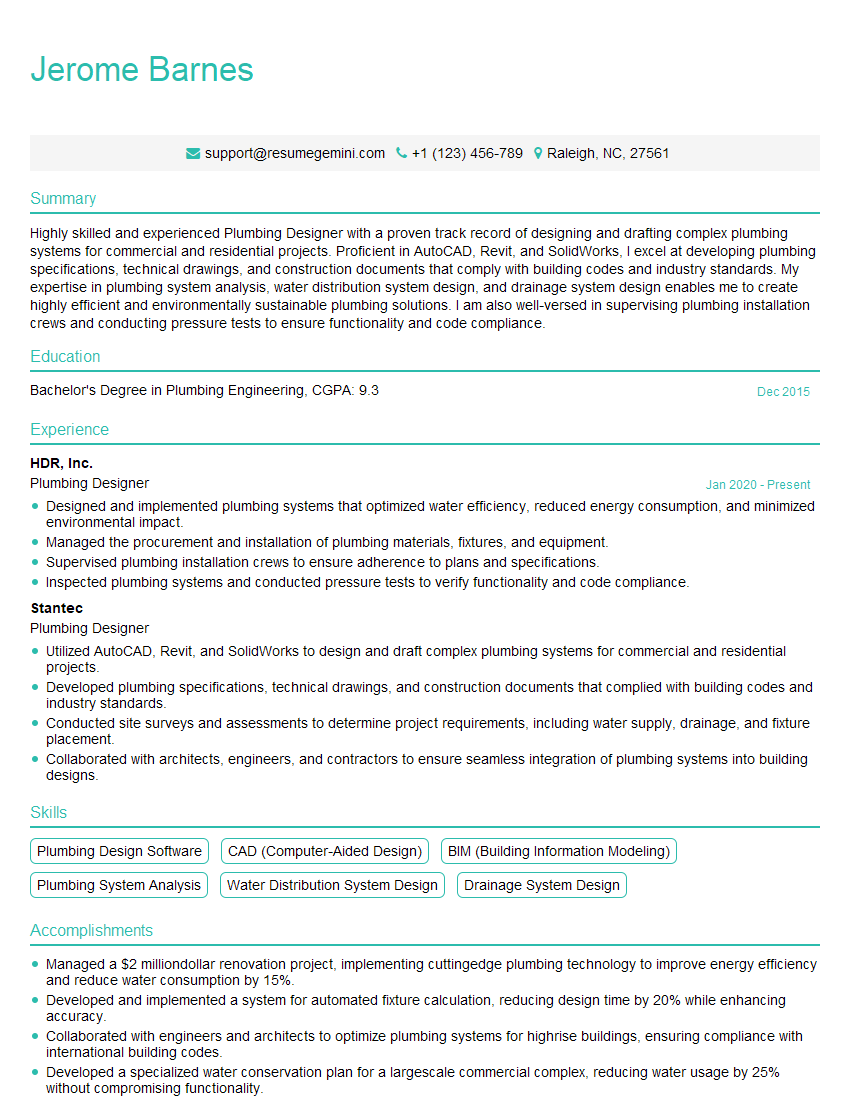
Plumbing Designer Resume Sample
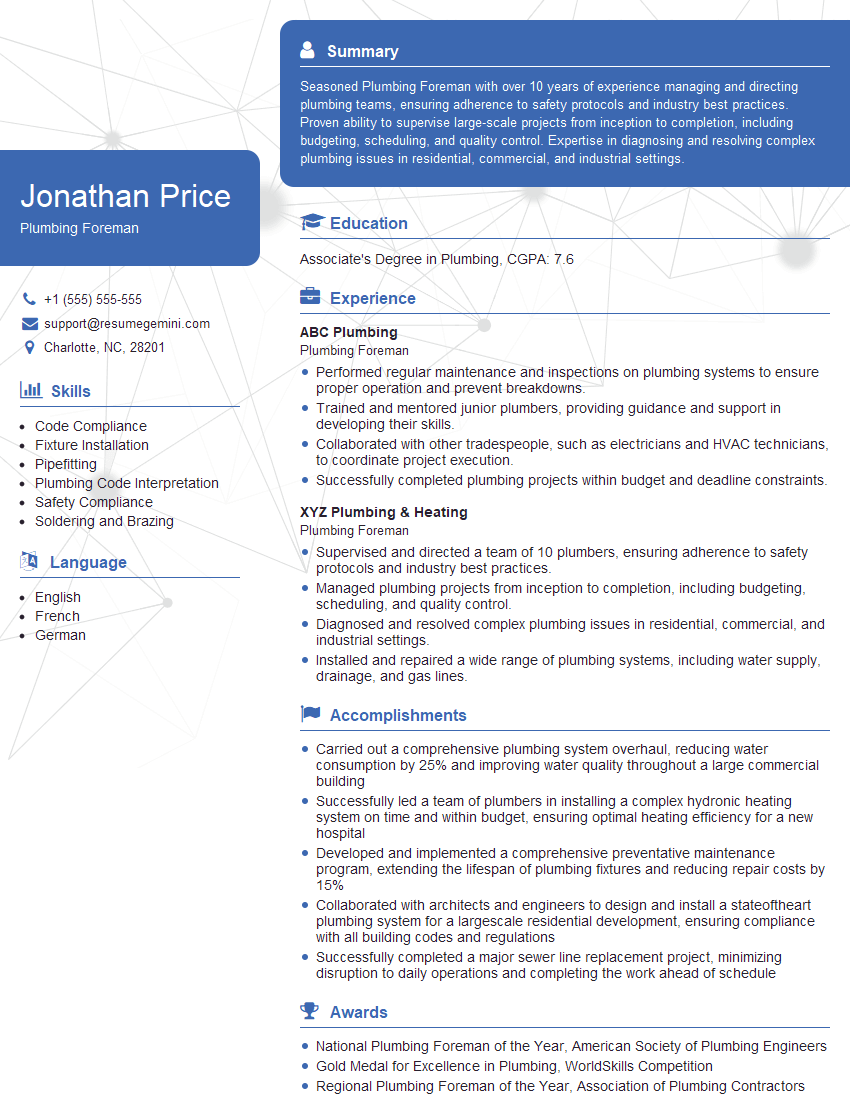
Plumbing Foreman Resume Sample

Plumbing Technician Resume Sample
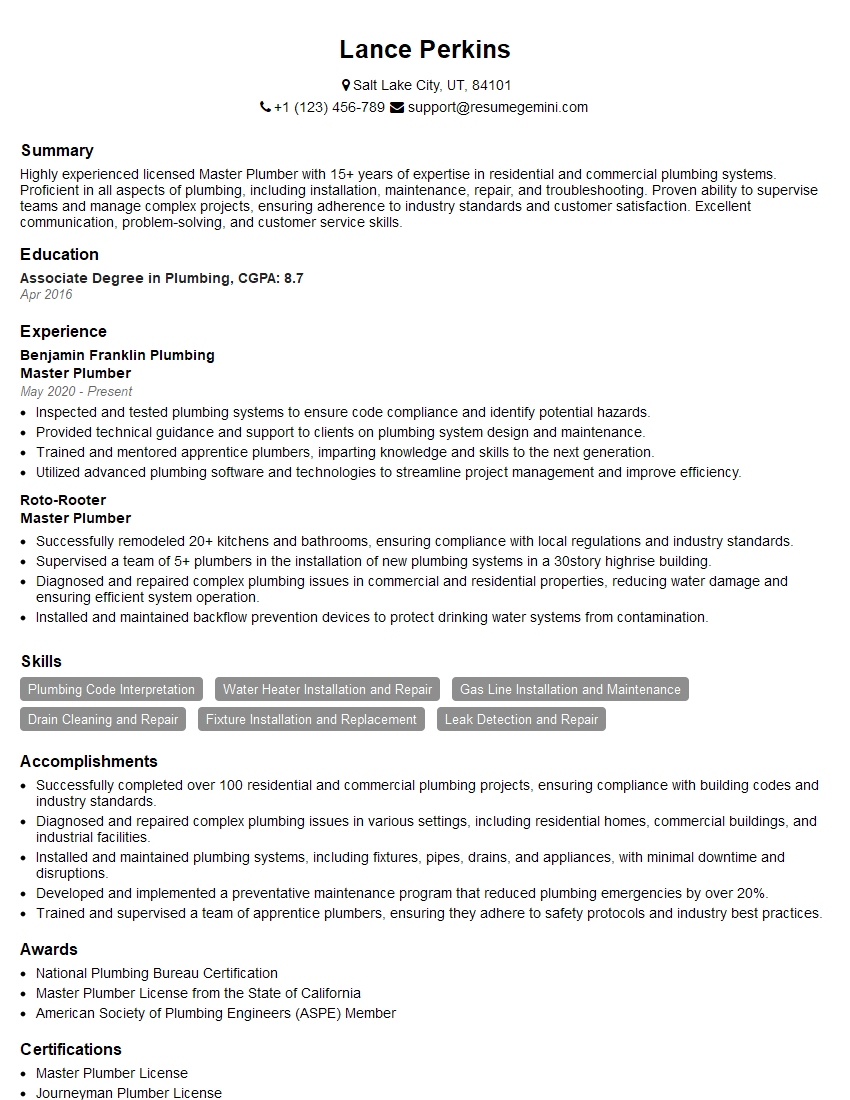
Master Plumber Resume Sample
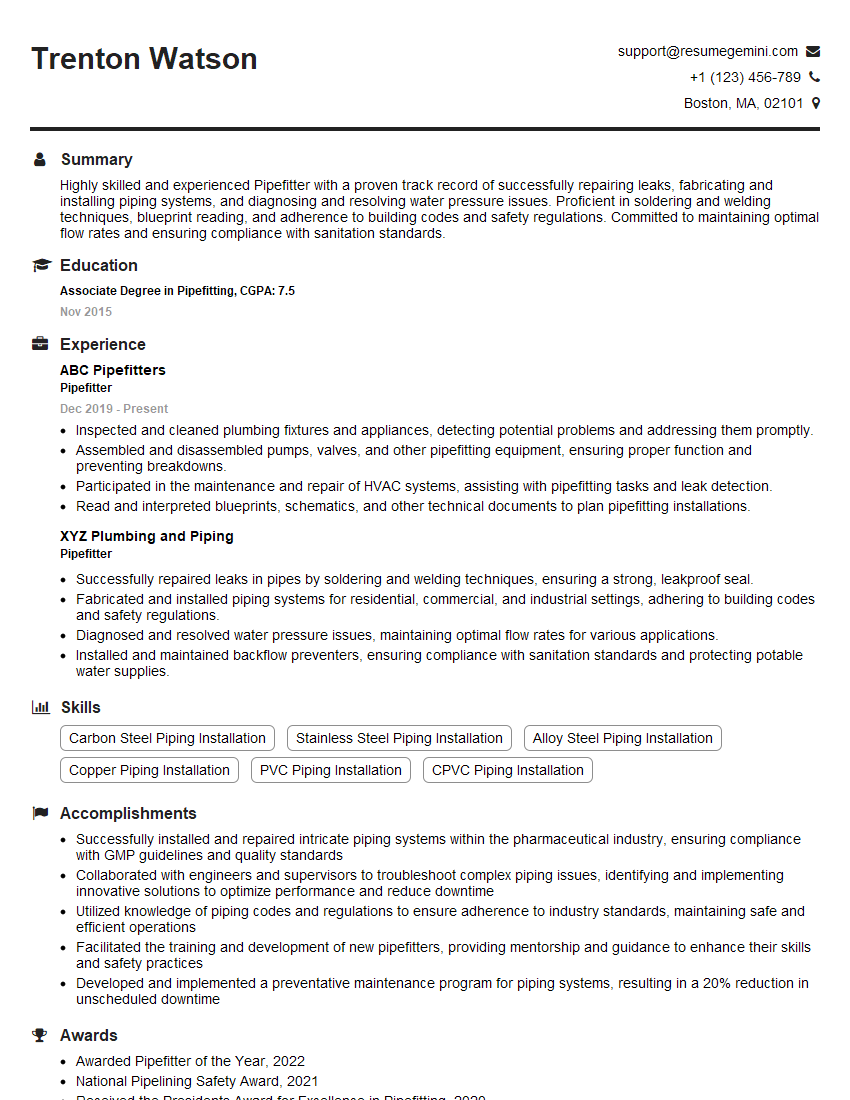
Pipefitter Resume Sample
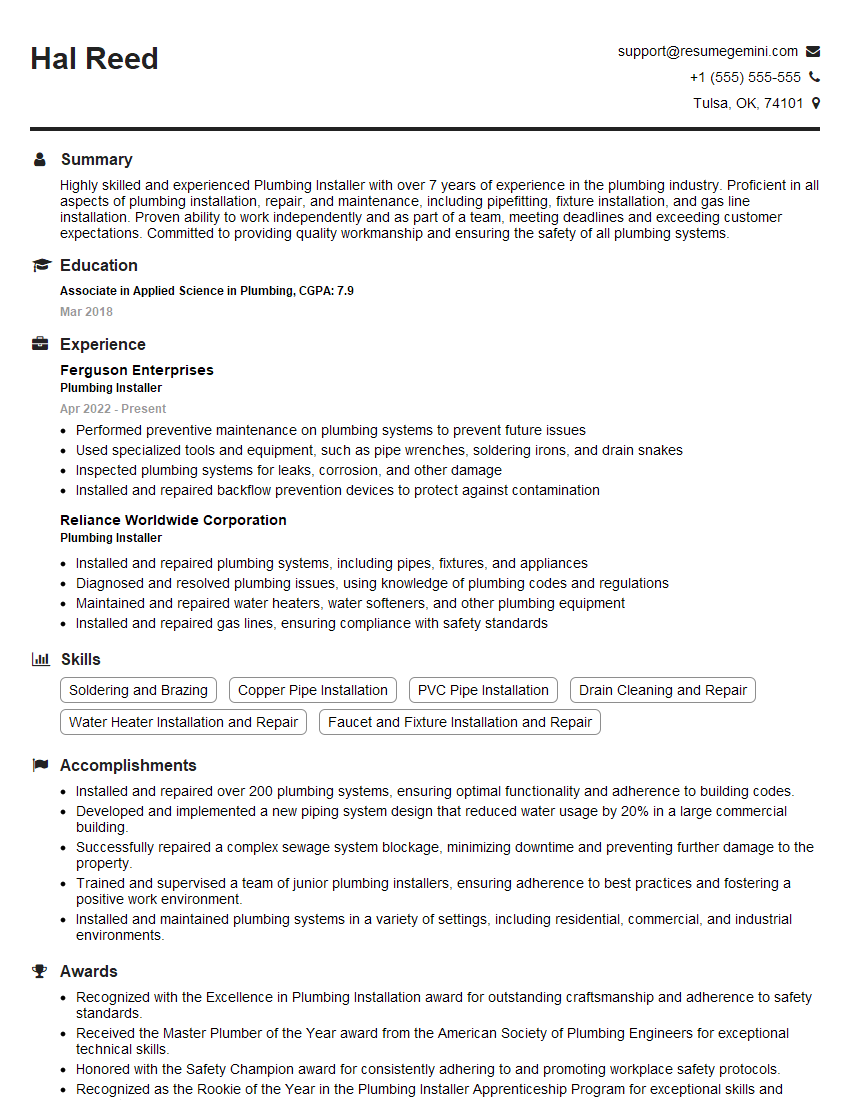
Plumbing Installer Resume Sample
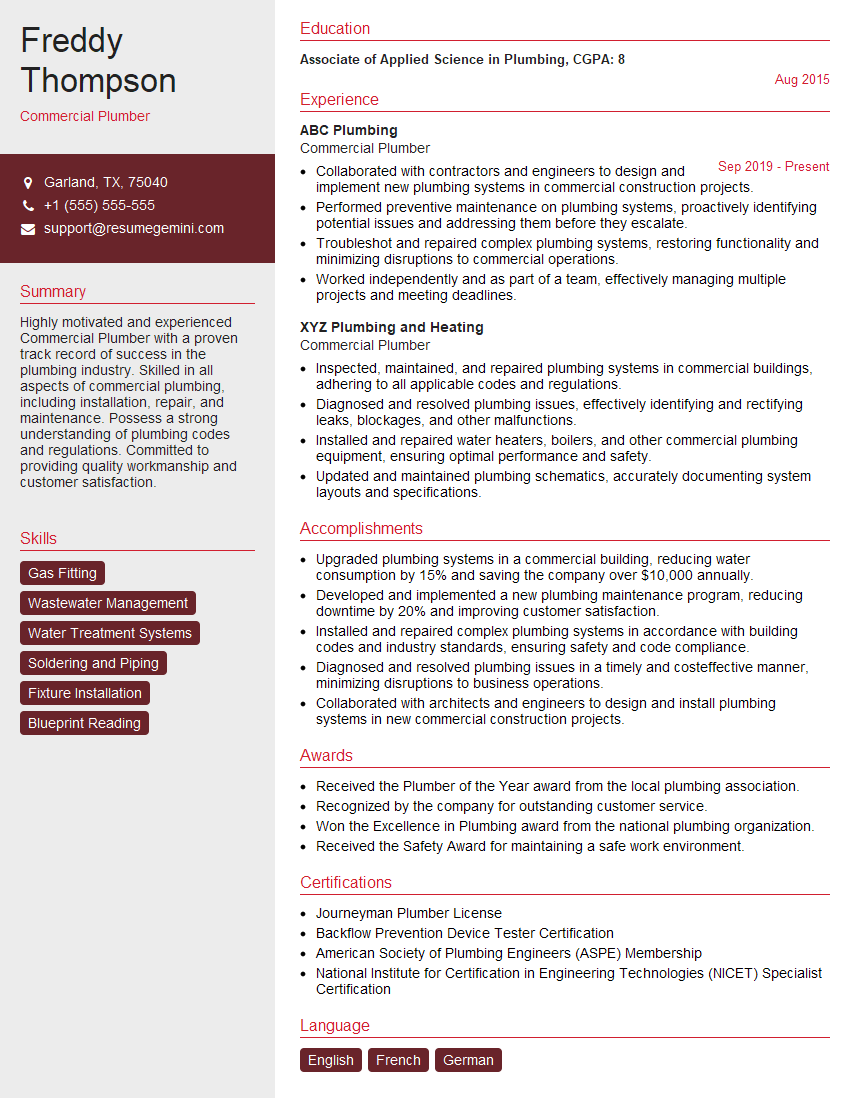
Commercial Plumber Resume Sample
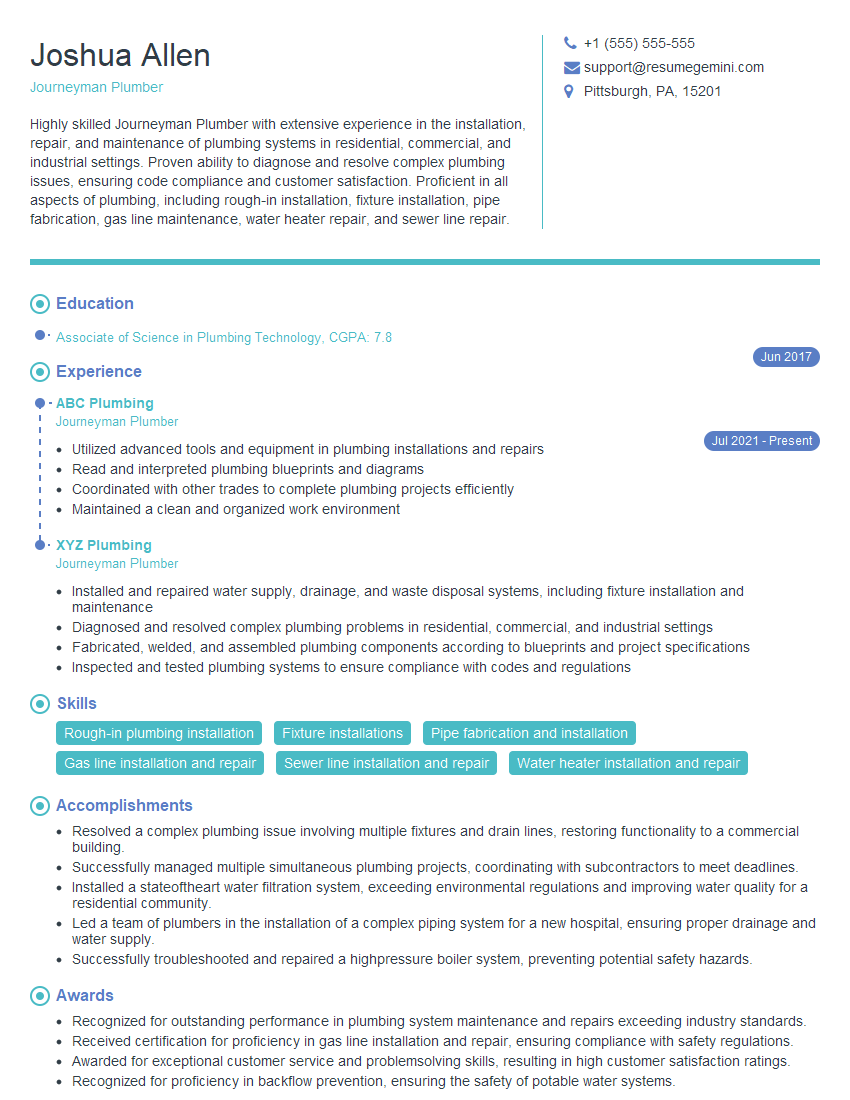
Journeyman Plumber Resume Sample
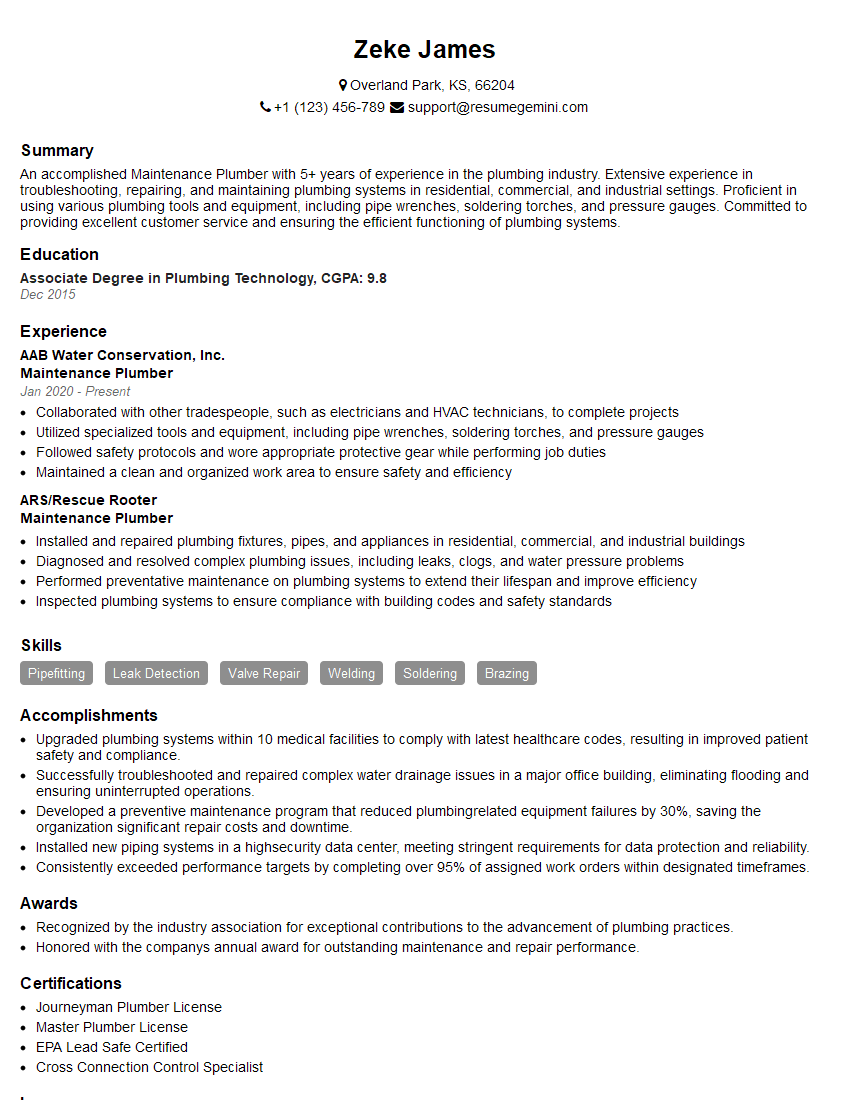
Maintenance Plumber Resume Sample
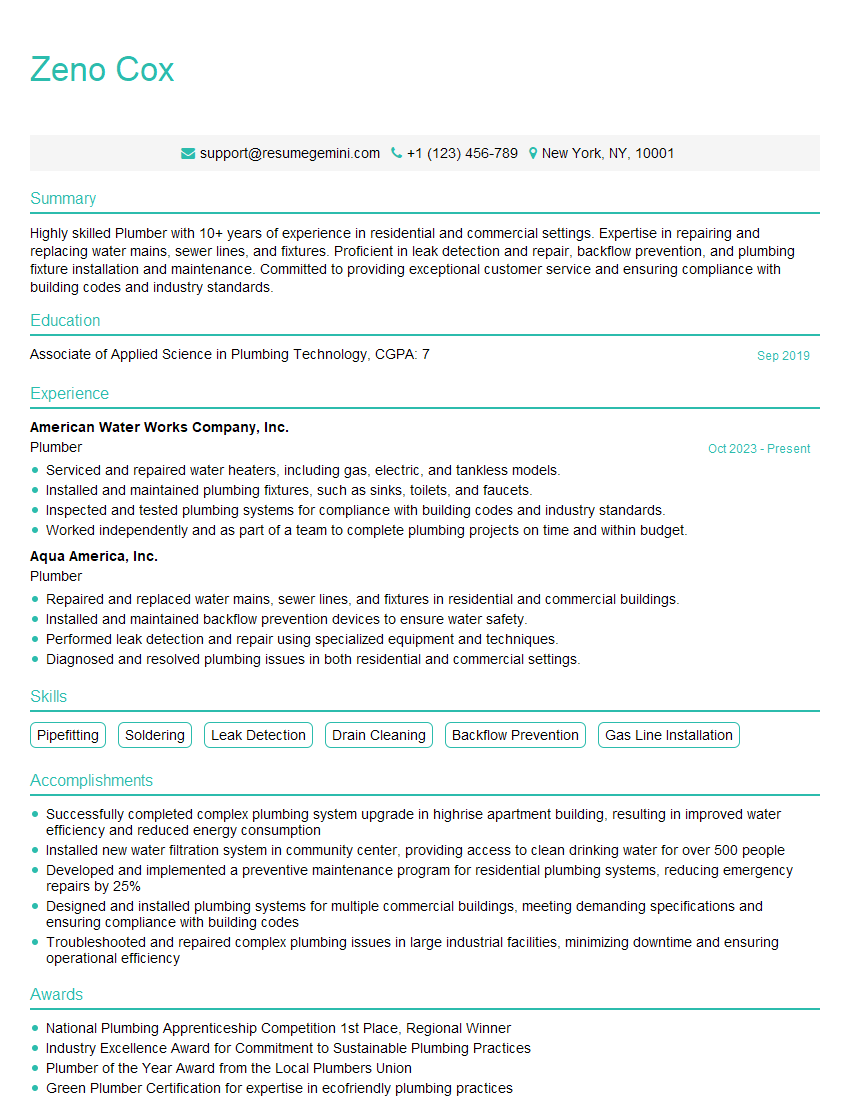
Plumber Resume Sample

Residential Plumber Resume Sample
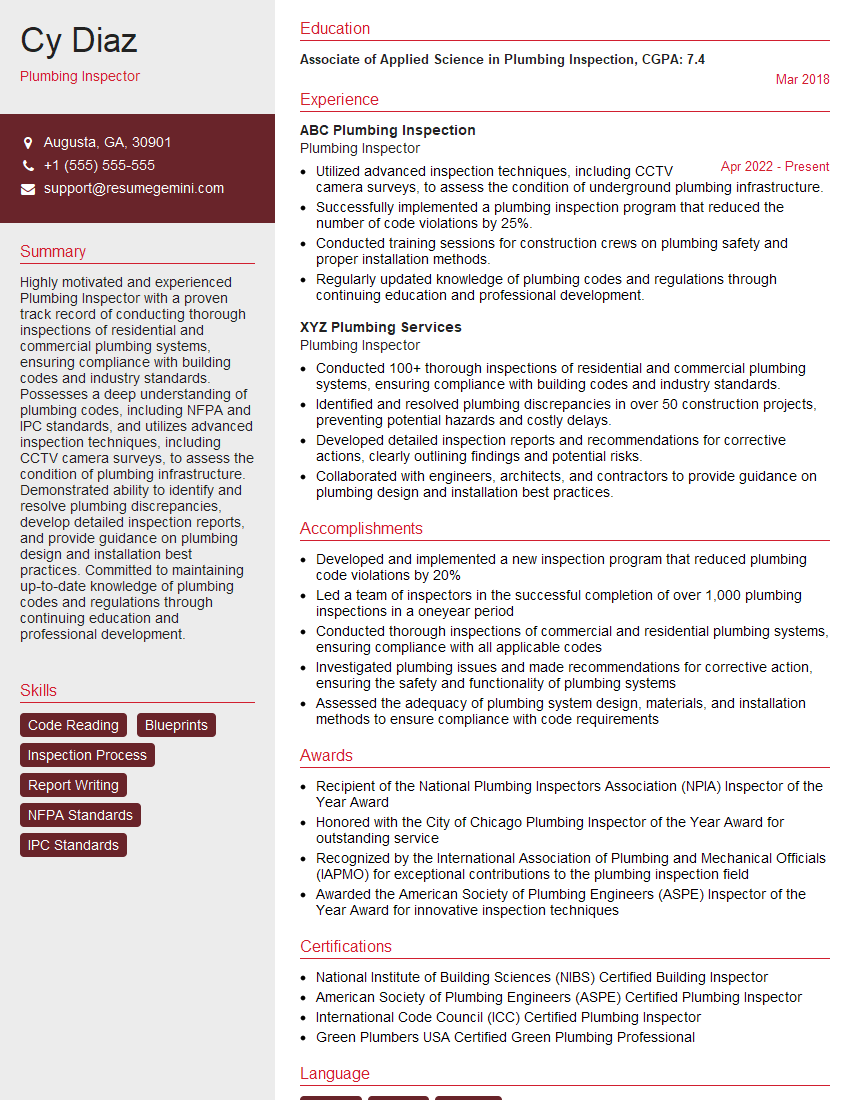
Plumbing Inspector Resume Sample
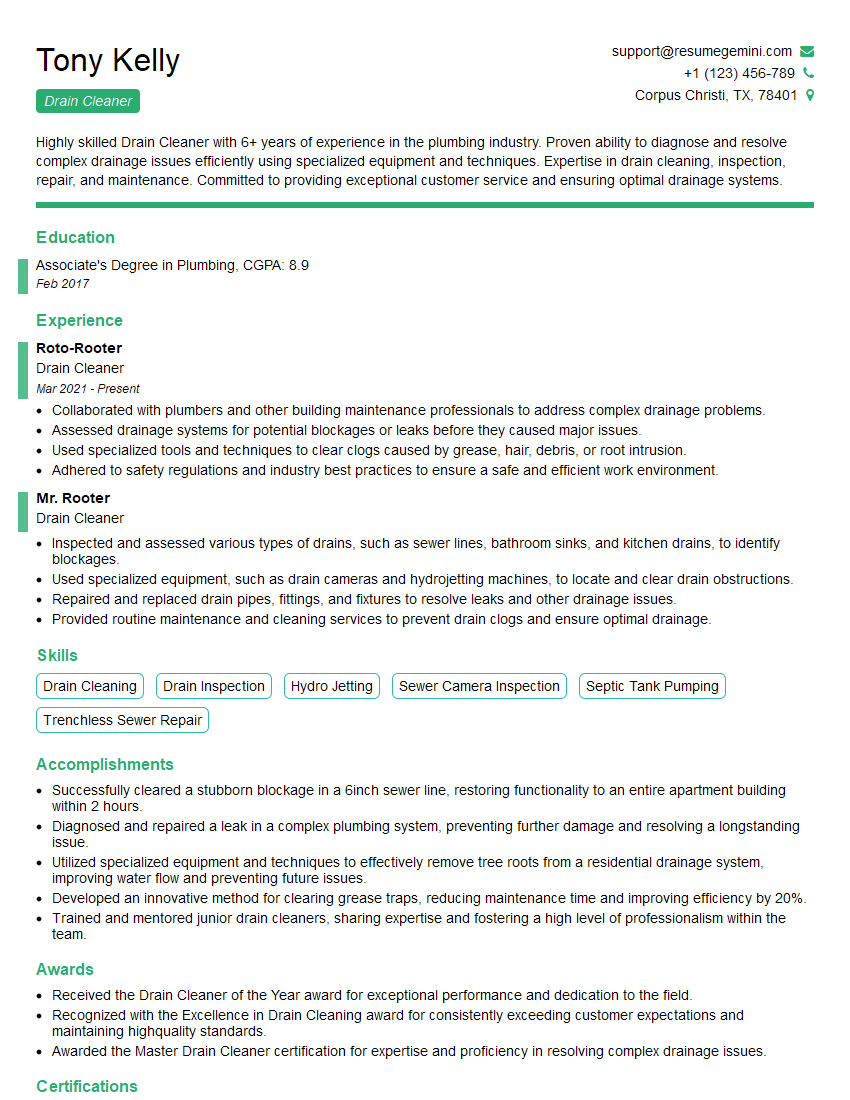
Drain Cleaner Resume Sample
Explore more articles
Users Rating of Our Blogs
Share Your Experience
We value your feedback! Please rate our content and share your thoughts (optional).
What Readers Say About Our Blog
Very informative content, great job.
good