Feeling uncertain about what to expect in your upcoming interview? We’ve got you covered! This blog highlights the most important Power Electronics and Inverters interview questions and provides actionable advice to help you stand out as the ideal candidate. Let’s pave the way for your success.
Questions Asked in Power Electronics and Inverters Interview
Q 1. Explain the working principle of a three-phase inverter.
A three-phase inverter converts DC power from a source like a battery or solar panel into three-phase AC power. Imagine it as a sophisticated switch that rapidly toggles the DC voltage to create a simulated AC waveform. This is achieved using six switching devices (typically IGBTs or MOSFETs) arranged in a bridge configuration. Each switch controls one leg of the three-phase output. By controlling the switching sequence and timing of these devices, we can generate a desired AC waveform.
Let’s visualize a simple example. In a three-phase system, we have three phases (A, B, C) shifted 120 degrees apart. The inverter switches operate in a sequence such that, at any given time, two switches are ‘on’ and the remaining four are ‘off’, creating a path for current to flow from the DC source to the AC load. This switching sequence carefully creates the 120-degree phase shift necessary for a balanced three-phase AC output. For instance, if switches A+, B- are on, we get a positive voltage on phase A relative to phase B. By carefully orchestrating the switching pattern, we generate the desired AC waveform on each phase. This waveform isn’t perfectly sinusoidal; techniques like Pulse Width Modulation (PWM) are employed to refine it.
Q 2. Describe different PWM techniques used in inverters and their advantages/disadvantages.
Pulse Width Modulation (PWM) is crucial for controlling the output voltage and frequency of an inverter. Several techniques exist:
- Sine-PWM (SPWM): This is the most common technique. The switching frequency is much higher than the output frequency. The width of each pulse is modulated according to a sine wave, creating an approximate sine wave at the output. It’s simple to implement but might produce considerable harmonic distortion, especially at low switching frequencies.
- Space Vector PWM (SVPWM): SVPWM offers better harmonic performance and DC bus utilization compared to SPWM. It calculates the optimal switching states by considering the vector representation of the three-phase voltages. This method produces less harmonic distortion but is more computationally complex.
- Carrier-Based PWM: In this technique, a high-frequency triangular carrier wave is compared with three sinusoidal modulating waves (one for each phase). The switching states are determined by the intersection points. Different carrier waves can be used to adjust the harmonic content. This technique is commonly used in industry for its relative simplicity and controllability.
Advantages and Disadvantages: SPWM is easy to implement but generates more harmonics; SVPWM minimizes harmonics but is more complex; Carrier-based PWM offers a balance between complexity and harmonic performance. The choice depends on the specific application requirements, balancing harmonic content, efficiency, and computational overhead.
Q 3. How do you select appropriate switching devices for a specific power electronics application?
Selecting appropriate switching devices is critical for inverter design and depends heavily on the application’s power level, switching frequency, voltage and current ratings, and operating temperature. Key factors include:
- Power rating (Voltage and Current): The device must handle the voltage and current levels of the application without failure. Consider peak and RMS values.
- Switching frequency: Higher switching frequencies generally lead to reduced filter size but require devices with faster switching speeds. The trade-off between switching frequency, efficiency and cost needs careful analysis.
- Switching losses: These losses increase with switching frequency. Devices with low switching losses are important for higher efficiency.
- Conduction losses: These are proportional to the current flowing through the device and the on-state resistance. Devices with low on-resistance (RDS(on) for MOSFETs) are preferable.
- Operating temperature: The device’s thermal characteristics and junction temperature must be considered, especially in high-power applications. Adequate heatsinking is crucial.
- Cost and Availability: A balance between performance and affordability is important.
For example, in a high-power application, IGBTs (Insulated Gate Bipolar Transistors) are often preferred for their high current and voltage handling capabilities. MOSFETs (Metal-Oxide-Semiconductor Field-Effect Transistors) might be favored in lower power applications where fast switching speeds are prioritized. Careful consideration of these factors ensures selecting the optimal device for the specific application requirements.
Q 4. What are the different types of power losses in a power inverter and how to minimize them?
Power losses in a power inverter can significantly impact its efficiency. Major loss components include:
- Switching losses: Energy is dissipated during the switching transitions of the devices (turn-on and turn-off). These losses are proportional to switching frequency and increase with higher power levels.
- Conduction losses: Power is lost due to the resistance of the switching devices and other components (e.g., diodes, inductors). These are proportional to the square of the current and are more significant at higher currents.
- Gate losses: Power is consumed to charge and discharge the gate capacitance of the switching devices. These losses are relatively small compared to switching and conduction losses but can still be significant at high switching frequencies.
- Core losses (inductors/transformers): Energy is dissipated in the magnetic cores due to hysteresis and eddy currents.
- Capacitor losses: Energy is lost due to ESR (Equivalent Series Resistance) and leakage current in capacitors.
Minimizing Losses: Several strategies can be used to reduce these losses. Selecting devices with low RDS(on) and fast switching speeds reduces conduction and switching losses. Careful design of the gate drive circuitry minimizes gate losses. Optimizing switching frequency balances performance against switching losses. Using high-quality inductors and capacitors with low core losses and ESR minimizes those components’ losses. Thermal management through adequate heatsinking prevents overheating and improves efficiency.
Q 5. Explain the concept of harmonic distortion in inverters and methods for mitigation.
Harmonic distortion in inverters refers to the presence of unwanted frequency components (harmonics) in the output waveform, which is ideally a pure sine wave. These harmonics are multiples of the fundamental frequency (e.g., 3rd, 5th, 7th, etc.). High harmonic content can lead to increased heating in the motor or load, poor power factor, and electromagnetic interference (EMI).
Mitigation Techniques:
- Improved PWM Techniques: SVPWM and other advanced PWM techniques generate waveforms with significantly reduced harmonic content compared to basic SPWM.
- Passive Filters: LC filters (combinations of inductors and capacitors) are commonly used to attenuate specific harmonics. However, these filters can be bulky and inefficient at high power levels.
- Active Filters: Active filters actively compensate for harmonic currents by injecting currents of opposite polarity. They are more efficient than passive filters but add cost and complexity.
- Multiple Pulse Width Modulation (MPWM): This technique involves using several pulses per half-cycle to reduce the harmonic distortion. It reduces the magnitude of lower order harmonics.
The choice of mitigation technique depends on the severity of the harmonic distortion, cost constraints, and application requirements. In many cases, a combination of techniques provides the best results.
Q 6. Describe different control strategies for DC-DC converters (e.g., buck, boost, buck-boost).
DC-DC converters change the voltage level of a DC power source. Common topologies include buck, boost, and buck-boost converters. Their control strategies aim to regulate the output voltage to a desired value despite variations in input voltage or load current.
- Buck Converter: Reduces the input voltage. Common control strategies include:
- Pulse Width Modulation (PWM): The duty cycle of the switching element is modulated to control the output voltage. A feedback loop compares the actual output voltage with the desired voltage and adjusts the duty cycle accordingly.
- Peak Current Mode Control: The converter switches when the inductor current reaches a peak value. This helps to limit the peak inductor current and improve stability.
- Boost Converter: Increases the input voltage. Control strategies often employ PWM, similar to the buck converter.
- Buck-Boost Converter: Can both increase or decrease the input voltage. Control strategies using PWM with feedback loops are common.
In all cases, a feedback loop plays a crucial role. It compares the measured output voltage to the desired reference voltage, then generates an error signal that is used to adjust the duty cycle of the switching element, maintaining the desired output voltage.
Q 7. Explain the working principle of a BLDC motor drive.
A BLDC (Brushless DC) motor drive uses an inverter to control the speed and torque of a BLDC motor. BLDC motors have permanent magnets on the rotor and windings on the stator. The drive uses hall sensors or back-EMF sensing to determine the rotor position. The inverter then switches the stator windings in a specific sequence to create a rotating magnetic field, which interacts with the rotor magnets to generate torque.
The working principle involves:
- Position Sensing: Hall sensors or back-EMF sensing determines the rotor position.
- Commutation: The inverter switches the windings in a sequence determined by the rotor position to create the rotating magnetic field. This process is called commutation.
- Speed Control: The inverter controls the frequency and amplitude of the switching sequence to control the speed of the motor. This usually involves PWM control, modulating the switching signals’ duty cycle to vary the voltage applied to the motor windings.
- Torque Control: The drive controls the current in the windings to control the motor’s torque. A current controller is often integrated within the drive system.
The control strategy can be either open-loop (using only the position sensor for commutation) or closed-loop (using feedback from speed or torque sensors for precise control). Closed-loop control is usually preferred for more demanding applications requiring accurate speed and torque regulation.
Q 8. How do you design a suitable heat sink for power electronic components?
Designing a suitable heat sink for power electronic components is crucial for ensuring reliable and efficient operation. The process involves careful consideration of several factors, including the power dissipation of the component, the ambient temperature, and the desired operating temperature. Think of it like this: the heat sink is the radiator for your power electronics, keeping them from overheating.
Step-by-step design process:
- Determine power dissipation (Pd): This is the amount of heat generated by the component, usually specified in the datasheet. It’s often expressed in Watts (W).
- Specify the maximum junction temperature (Tjmax): This is the highest temperature the semiconductor junction can withstand without damage, again found in the datasheet.
- Define the ambient temperature (Ta): This is the surrounding temperature where the heat sink will operate.
- Calculate the thermal resistance (Rth): This represents the resistance to heat flow. We need to determine the maximum allowable thermal resistance between the junction and the ambient (Rthja) using the formula: Rthja = (Tjmax – Ta) / Pd.
- Select a heat sink: Based on the calculated Rthja, choose a heat sink with a thermal resistance (Rth) that is equal to or less than the maximum allowable. Heat sink datasheets provide this crucial information. Consider factors like size, weight, and cost.
- Thermal interface material (TIM): A high-quality TIM like thermal grease or pad is essential to minimize the thermal resistance between the component and the heat sink. Think of this as the lubricant for efficient heat transfer.
- Verification: After installation, consider thermal testing to validate that the junction temperature remains within safe limits under various operating conditions.
Example: Let’s say a MOSFET dissipates 50W (Pd), its maximum junction temperature is 150°C (Tjmax), and the ambient temperature is 40°C (Ta). The maximum allowable thermal resistance is (150°C – 40°C) / 50W = 2.2°C/W. We need a heat sink with Rthja ≤ 2.2°C/W.
Q 9. Discuss different methods for filtering harmonics in power converters.
Filtering harmonics in power converters is vital to ensure compliance with grid regulations and to protect sensitive loads. Harmonics are unwanted sinusoidal frequencies present in the output voltage or current due to the switching nature of power converters. These can cause overheating, equipment malfunctions, and increased noise.
Several methods exist for harmonic filtering:
- Passive Filters: These utilize simple components like inductors and capacitors to create a resonant circuit that attenuates specific harmonic frequencies. A common design is an L-filter (inductor in series, capacitor in parallel). This is cost-effective but less flexible in addressing a wide range of harmonics.
- Active Filters: These use power electronic circuits to actively counteract harmonics. They ‘sense’ the harmonic content and generate compensating currents or voltages to cancel them out. Active filters are more flexible and can adapt to changing harmonic patterns, but they are more complex and expensive.
- Hybrid Filters: These combine passive and active filter techniques, offering a balance between cost and performance. The passive filter handles the larger, more consistent harmonics, while the active filter tackles the smaller, more dynamic ones.
- Multilevel Converters: These converters utilize multiple voltage levels to reduce the harmonic content at their source. This inherently produces a cleaner output waveform, requiring less filtering. This is a more expensive and complex method.
Example: In a grid-tied inverter, a passive LCL filter (inductor-capacitor-inductor) is often used to meet grid standards for harmonic distortion. The filter’s design requires careful consideration of the resonant frequency to effectively attenuate the dominant harmonics.
Q 10. Explain the role of gate drivers in power electronics.
Gate drivers play a crucial role in power electronics by providing the necessary control signals to switch power semiconductor devices like IGBTs and MOSFETs quickly and reliably. Think of them as the high-speed signal amplifiers and shapers for your power switches.
Key functions of gate drivers:
- Signal Amplification: Power semiconductor devices need significant current to rapidly turn ON and OFF. The gate driver amplifies the relatively weak control signal from the controller to provide this necessary current.
- Signal Shaping: Gate drivers often shape the input signal to ensure a fast and controlled switching transition, minimizing switching losses and electromagnetic interference (EMI).
- Level Shifting: They may need to shift the voltage level of the control signal to match the gate-source voltage requirements of the power device.
- Protection: Gate drivers incorporate protection mechanisms against over-voltage, under-voltage, and short-circuit conditions, enhancing the reliability of the entire system.
Consequences of Poor Gate Drive Design: Slow switching can lead to increased switching losses, overheating, and reduced efficiency. Poor signal shaping can generate EMI, which can affect other components and comply with regulations. Lack of protection can lead to device failure.
Q 11. What are the different types of power semiconductor devices?
Power semiconductor devices are the heart of power electronic systems, acting as electronic switches that control the flow of power. Different devices are better suited for different applications based on their characteristics.
Types of Power Semiconductor Devices:
- MOSFETs (Metal-Oxide-Semiconductor Field-Effect Transistors): Known for their fast switching speeds, relatively low on-resistance, and ease of control. Widely used in applications requiring high switching frequencies like motor drives and inverters.
- IGBTs (Insulated Gate Bipolar Transistors): Combine the advantages of both MOSFETs (easy control) and BJTs (high current handling). They are popular in high-power applications such as industrial drives and renewable energy systems.
- Thyristors (SCRs, Triacs, GTOs): These are more mature technologies. SCRs (Silicon Controlled Rectifiers) are unidirectional and require a gate pulse to turn ON and a current reversal to turn OFF. Triacs are bidirectional versions of SCRs. GTOs (Gate Turn-Off Thyristors) offer improved turn-off capability.
- SiC MOSFETs and SiC JFETs (Silicon Carbide): These are wide-bandgap semiconductor devices offering superior performance compared to silicon-based devices. They exhibit higher switching frequencies, lower on-resistance, and ability to operate at higher temperatures. However, they are currently more expensive.
- GaN FETs (Gallium Nitride): Similar to SiC devices, GaN FETs also provide high switching speeds, low on-resistance, and high efficiency. They are emerging as a strong competitor to SiC devices.
The choice of device depends on the specific application requirements, considering factors such as power level, switching frequency, cost, and operating temperature.
Q 12. How do you select an appropriate transformer for a specific power application?
Selecting an appropriate transformer for a specific power application requires careful consideration of several key parameters. The transformer is essential for voltage transformation and isolation.
Key parameters for transformer selection:
- Power Rating (VA or kVA): The transformer must have a power rating that exceeds the expected load demand to avoid overloading.
- Input and Output Voltages: Determine the required turns ratio based on the desired voltage transformation.
- Frequency: Transformers are designed for specific frequencies; mismatch can lead to reduced efficiency or damage.
- Core Material: Different core materials (e.g., ferrite, silicon steel) offer different characteristics in terms of saturation flux density, losses, and cost. The core material choice influences the size and weight of the transformer.
- Isolation: Transformers provide galvanic isolation, separating the input and output circuits electrically. The level of isolation required depends on the application’s safety standards.
- Efficiency: The efficiency of the transformer determines its power losses, affecting the overall system efficiency and operating temperature.
- Temperature Rise: Ensure the transformer can operate within its temperature rating under the expected load conditions. Overheating can lead to reduced lifespan.
Example: Designing a power supply for a 12V DC load requires a transformer with appropriate primary and secondary windings for voltage transformation and then rectification to obtain 12V DC from the mains voltage (e.g., 230VAC). The transformer rating should be chosen to meet the power requirement of the 12V load plus some margin for safety.
Q 13. What are the advantages and disadvantages of using different types of capacitors in power electronics?
Capacitors are essential components in power electronics, used for energy storage, filtering, and voltage clamping. Different types of capacitors offer distinct advantages and disadvantages.
Types of Capacitors and their characteristics:
- Electrolytic Capacitors: These offer high capacitance for their size, making them suitable for energy storage and filtering in DC applications. However, they have a limited lifespan, polarity sensitivity (most types), and a relatively high Equivalent Series Resistance (ESR).
- Ceramic Capacitors: Offer excellent high-frequency performance and stability but have lower capacitance for the same volume compared to electrolytics. They are commonly used in high-frequency switching circuits.
- Film Capacitors (e.g., polypropylene, polyester): Known for high stability, low ESR, and low losses at higher frequencies. They are suitable for filtering applications and are more robust than electrolytics but generally less compact.
- Supercapacitors (Ultracapacitors): Store significantly more energy than conventional capacitors. Useful in applications requiring large energy bursts but have lower energy density compared to batteries.
Trade-offs: Electrolytic capacitors are cheap and have high capacitance but are sensitive to voltage spikes and have a shorter lifespan. Film capacitors are more expensive, but they are more reliable and have a longer lifespan.
Example: In a DC-DC converter, electrolytic capacitors are often used for bulk energy storage, while ceramic capacitors may be used for high-frequency noise filtering.
Q 14. Explain the concept of power factor correction (PFC).
Power Factor Correction (PFC) is a technique used to improve the power factor (PF) of a load, making the current drawn by the load more in phase with the voltage. A low power factor results in higher current draw for the same active power, increasing losses and stressing the power system. Imagine trying to fill a bucket using a leaky hose – some water is wasted, and you need a larger pump (higher current). PFC is like patching up the leaks, making the process much more efficient.
Importance of High Power Factor:
- Reduced Losses: Lower current draw reduces losses in the power system.
- Improved Efficiency: Higher efficiency leads to energy savings.
- Compliance with Grid Regulations: Utility companies usually impose penalties for low power factor.
Methods for PFC:
- Passive PFC: Uses passive components (inductors and capacitors) to improve the power factor. This is relatively simple and inexpensive but less effective than active PFC.
- Active PFC: Uses power electronic circuits (like boost converters) to shape the input current to be nearly sinusoidal and in phase with the voltage. This significantly improves the power factor and is more effective.
Example: In a switched-mode power supply (SMPS), active PFC is commonly implemented to meet efficiency and grid compliance standards. This improves overall energy efficiency and reduces the load on the electricity grid.
Q 15. How to analyze the stability of a closed-loop control system in power electronics?
Analyzing the stability of a closed-loop control system in power electronics is crucial for ensuring reliable operation. We primarily use techniques from control theory, adapting them to the unique characteristics of power electronic systems, which are often nonlinear and time-varying.
One common approach is using Bode plots and Nyquist plots to assess the system’s frequency response. These graphical methods help determine gain and phase margins, which directly indicate stability. A sufficient gain margin ensures the system remains stable even with variations in gain, while a sufficient phase margin provides robustness against phase shifts caused by delays or parasitic elements.
Another powerful tool is state-space analysis. By representing the system using state equations, we can analyze its eigenvalues. Eigenvalues with negative real parts indicate stability, while positive real parts indicate instability. This approach allows for a more comprehensive understanding of the system’s dynamics.
Small-signal modeling is often employed to linearize the nonlinear power electronic system around an operating point. This simplification facilitates the application of linear control techniques. We can then use techniques like root locus analysis to visualize how the system’s poles move as parameters change, revealing potential instability regions.
Finally, simulation tools such as PSIM or MATLAB/Simulink are indispensable. These tools allow us to create detailed models, including nonlinearities and switching behavior, to analyze the system’s stability under various operating conditions. Simulation lets us test different control strategies and verify the effectiveness of our stability analysis.
Career Expert Tips:
- Ace those interviews! Prepare effectively by reviewing the Top 50 Most Common Interview Questions on ResumeGemini.
- Navigate your job search with confidence! Explore a wide range of Career Tips on ResumeGemini. Learn about common challenges and recommendations to overcome them.
- Craft the perfect resume! Master the Art of Resume Writing with ResumeGemini’s guide. Showcase your unique qualifications and achievements effectively.
- Don’t miss out on holiday savings! Build your dream resume with ResumeGemini’s ATS optimized templates.
Q 16. What are the different types of resonant converters?
Resonant converters utilize the principle of resonance to achieve zero-voltage switching (ZVS) or zero-current switching (ZCS), reducing switching losses and improving efficiency. There are several types, primarily categorized by the resonant tank circuit’s topology:
- Series Resonant Converter (SRC): The resonant tank is connected in series with the switch and load. The resonant current naturally goes to zero, enabling ZCS.
- Parallel Resonant Converter (PRC): The resonant tank is connected in parallel with the switch and load. This topology facilitates ZVS.
- Series-Parallel Resonant Converter (SPRC): Combines aspects of both SRC and PRC, offering a balance of ZVS and ZCS benefits.
- LLC Resonant Converter: This topology uses a coupled inductor in the resonant tank, providing flexibility in controlling the output voltage and improving efficiency over a wider range of operating conditions. It’s commonly used in high-power applications like server power supplies.
- LCC Resonant Converter: Similar to LLC, but utilizes a capacitor in the resonant tank instead of the coupled inductor. It offers good performance and is often used for high-frequency applications.
The choice of resonant converter depends on factors such as the desired output voltage, power level, and efficiency requirements. For instance, LLC converters are popular in high-power applications due to their soft-switching capabilities and wide operational range, while SRC and PRC are often preferred for simpler control schemes and easier design.
Q 17. Discuss the challenges in high-frequency power conversion.
High-frequency power conversion, while offering advantages such as smaller component sizes and higher switching frequencies, presents several significant challenges:
- Increased switching losses: Even with soft-switching techniques, higher frequencies lead to increased switching losses due to the faster rise and fall times of the switching waveforms. This can reduce efficiency and require advanced cooling solutions.
- Electromagnetic Interference (EMI): High-frequency switching generates substantial EMI, requiring careful design to meet stringent regulatory standards. This involves using shielded components, proper layout design, and EMI filters.
- Parasitic effects: At high frequencies, parasitic capacitances and inductances, which are usually negligible at lower frequencies, become significant, affecting the converter’s performance and stability. Careful consideration of PCB layout and component selection is crucial.
- Component limitations: Higher switching frequencies demand components with faster switching speeds and lower losses. This can translate to higher costs and potentially reduced component availability.
- Control system complexity: Designing stable and efficient control systems for high-frequency converters is challenging. The faster switching dynamics require more sophisticated control algorithms and compensation techniques.
Overcoming these challenges requires careful attention to component selection, PCB layout, EMI filtering, advanced control techniques, and thermal management. Simulation and prototyping play a critical role in optimizing high-frequency converter designs.
Q 18. How do you perform EMC testing for power electronic devices?
EMC testing for power electronic devices is essential to ensure compliance with international standards and to prevent interference with other electronic equipment. The process typically involves several steps:
- Conducted EMI testing: This evaluates the conducted emissions from the device through the power lines. Measurements are typically made using a Line Impedance Stabilization Network (LISN) to simulate the impedance of the power grid.
- Radiated EMI testing: This assesses the radiated emissions from the device in an anechoic chamber (a shielded room designed to absorb electromagnetic waves). Measurements are taken at various distances and frequencies.
- Immunity testing: This verifies the device’s resistance to external electromagnetic disturbances. The device is subjected to various types of electromagnetic fields to assess its robustness.
- Safety testing: This confirms the device’s safety, including aspects like dielectric strength, creepage distances, and ground bonding. It often includes high-voltage testing to verify isolation and protection against electric shocks.
Specific tests are dictated by relevant standards such as CISPR 22 (for industrial equipment) or CISPR 14 (for household appliances). Testing often uses specialized equipment like spectrum analyzers and EMI receivers. Successful EMC testing requires careful design considerations, including appropriate shielding, filtering, and grounding techniques.
Q 19. Explain the design considerations for a high-efficiency power supply.
Designing a high-efficiency power supply involves optimizing various aspects of the circuit to minimize power losses. Key considerations include:
- Choosing efficient components: Using low-resistance MOSFETs, diodes with low forward voltage drops, and high-quality capacitors reduces conduction and switching losses.
- Implementing soft-switching techniques: Techniques like ZVS or ZCS significantly reduce switching losses, enhancing efficiency. Resonant converters are prime examples.
- Optimizing the control strategy: An efficient control algorithm minimizes switching frequency variations and keeps the system operating near its optimal efficiency point. Modern digital control techniques often provide better performance.
- Minimizing conduction losses: Selecting appropriate component ratings and optimizing the circuit’s current paths helps to reduce resistive losses.
- Thermal management: Effective heat dissipation is crucial. Using appropriate heat sinks, fans, and thermal interface materials prevents overheating and maintains efficiency.
- Minimizing parasitic effects: Reducing parasitic capacitances and inductances through careful PCB layout minimizes additional losses.
The design process often involves trade-offs. For example, higher switching frequencies can reduce the size of components but increase switching losses. Simulation tools and careful analysis are essential to optimize efficiency while meeting other design requirements.
Q 20. What are the safety considerations when designing high-power inverters?
Safety is paramount when designing high-power inverters. Several key considerations need to be addressed:
- High voltage isolation: High-power inverters typically operate at high voltages, necessitating robust isolation techniques to protect users from electric shock. This includes using appropriate insulation materials, maintaining sufficient creepage and clearance distances, and employing protective barriers.
- Overcurrent protection: Fuses, circuit breakers, and overcurrent sensing circuits protect the inverter and connected loads from excessive currents. These mechanisms quickly disconnect the power supply in case of a fault.
- Overtemperature protection: High-power inverters can generate significant heat, requiring thermal management and overtemperature protection. Thermal sensors and cooling systems prevent damage from overheating.
- Grounding and bonding: Proper grounding and bonding are crucial to prevent electric shock hazards and ensure EMC compliance. Grounding reduces the risk of stray currents and prevents interference with other electronic systems.
- Short-circuit protection: Mechanisms such as fast-acting fuses or electronic short-circuit detection systems protect the inverter and connected loads from short circuits.
- Arc flash protection: High-power inverters can produce dangerous arc flashes, requiring measures like enclosure design, arc flash relays, and personal protective equipment.
Compliance with relevant safety standards, such as UL, IEC, or CE, is mandatory for high-power inverters. Rigorous testing is necessary to verify the effectiveness of safety features.
Q 21. Describe different protection mechanisms used in power electronics circuits.
Power electronics circuits employ various protection mechanisms to ensure reliable and safe operation. These mechanisms are often layered to provide redundancy and comprehensive protection:
- Overcurrent protection: Fuses, circuit breakers, and current-limiting circuits protect against excessive currents that can damage components or cause fires.
- Overvoltage protection: Zener diodes, metal-oxide varistors (MOVs), and voltage clamping circuits protect against overvoltages that can damage components.
- Undervoltage protection: Low-voltage lockout circuits prevent operation under unsafe low-voltage conditions.
- Overtemperature protection: Thermal sensors and thermal switches trigger protection mechanisms, such as fan activation or system shutdown, to prevent overheating.
- Short-circuit protection: Fast-acting fuses and electronic short-circuit detection circuits quickly interrupt the current flow in case of a short circuit.
- Ground fault protection: Ground fault detectors quickly interrupt the circuit if a ground fault occurs, minimizing electric shock hazards.
- Soft-start circuits: Limit inrush currents during startup, protecting components from damage due to high initial currents.
The specific protection mechanisms used depend on the application and the potential hazards. Redundant protection schemes are often used to enhance reliability and safety. The effectiveness of these mechanisms is usually verified through simulations and testing.
Q 22. How do you perform fault diagnosis in power electronics systems?
Fault diagnosis in power electronics systems is a crucial aspect of ensuring reliable operation. It involves systematically identifying the root cause of a malfunction. This process typically begins with observing symptoms like unusual noises, overheating, or unexpected voltage/current readings. Then, we progress through a series of diagnostic steps:
- Visual Inspection: Checking for obvious physical damage like burnt components or loose connections.
- Measurement and Data Acquisition: Using oscilloscopes, multimeters, and current probes to analyze waveforms and identify anomalies in voltage, current, and switching patterns. For example, a short circuit might manifest as an abnormally high current draw.
- Software-based Diagnostics: Many modern power electronics systems incorporate embedded systems with diagnostic capabilities. This allows for real-time monitoring and the detection of faults based on predefined thresholds or patterns. These systems may log fault events and provide detailed error messages.
- Specialized Tests: Depending on the system, specific tests might be necessary. For instance, a gate drive test on an IGBT module can reveal issues with the control signals that turn the semiconductor on and off.
- Component-Level Testing: If the above steps don’t pinpoint the problem, we may need to test individual components – like diodes, capacitors, or the control IC – using dedicated test equipment to isolate the faulty part.
A systematic approach, combining these methods, ensures efficient and accurate fault diagnosis. For instance, in a recent project involving a solar inverter, a seemingly random shutdown was traced to a faulty capacitor causing excessive ripple current, eventually detected through careful waveform analysis.
Q 23. What are the differences between hard switching and soft switching techniques?
Hard switching and soft switching are two contrasting techniques for turning power semiconductor devices on and off. The core difference lies in how the switching transition occurs.
- Hard Switching: In hard switching, the current and voltage in the device change abruptly, leading to significant switching losses. Think of it like slamming a door shut – quick but potentially damaging. These losses manifest as heat, reducing efficiency and potentially causing component damage. The fast voltage and current transitions can generate electromagnetic interference (EMI).
- Soft Switching: Soft switching techniques aim to minimize these losses by ensuring that either the voltage or the current is zero during the switching instant. Imagine gently closing a door – slower, quieter, and less likely to cause damage. Common soft switching techniques include zero-voltage switching (ZVS) and zero-current switching (ZCS). These techniques involve auxiliary circuits that help shape the voltage and current waveforms, reducing switching losses substantially.
The choice between hard and soft switching depends on factors like switching frequency, voltage level, and power rating. High-power applications often benefit from soft switching to improve efficiency and reliability, whereas lower-power applications may find hard switching simpler and less expensive.
Q 24. Explain the concept of space vector modulation (SVM).
Space Vector Modulation (SVM) is a sophisticated pulse-width modulation (PWM) technique used in three-phase inverters to generate sinusoidal output waveforms with minimal harmonic distortion. Instead of switching between individual voltage vectors, SVM strategically combines several vectors to synthesize the desired output voltage.
Imagine you want to reach a specific point on a map. Instead of taking a direct route, SVM acts like finding an optimal path by combining multiple smaller steps. It uses eight basic voltage vectors and two zero vectors to approximate the desired voltage vector. The duty cycle of each vector is calculated to achieve the closest possible approximation to the sinusoidal reference. This results in better harmonic performance compared to traditional PWM methods.
The benefits of SVM include reduced harmonic distortion, higher DC-link utilization, and improved output voltage quality. It’s particularly beneficial in applications demanding high-quality output waveforms, such as motor drives and grid-tied inverters, where harmonic distortion can lead to issues like motor heating or grid instability.
Q 25. Describe the role of dead time in PWM inverters and its impact on performance.
Dead time in PWM inverters refers to a small delay introduced between turning off one switch and turning on another switch in the same leg. This is crucial to prevent shoot-through faults. A shoot-through occurs when both the upper and lower switches in a leg are simultaneously on, causing a short circuit across the DC bus. This can lead to catastrophic failure of the inverter.
The dead time prevents this by ensuring that there’s a brief interval where both switches are off, eliminating the possibility of a short circuit. However, introducing dead time also has some negative consequences:
- Harmonic Distortion: Dead time introduces non-linearity into the switching pattern, leading to increased harmonic content in the output waveform. This can affect the performance of the load or the grid.
- Output Voltage Distortion: The output waveform is slightly distorted due to the missing samples during the dead time.
Proper dead time selection is vital for a balance between preventing shoot-through and minimizing the negative impacts on output quality. The optimal dead time depends on factors such as switching frequency, device characteristics, and control strategy. In high-frequency inverters, shorter dead times are possible, while lower-frequency designs often require longer dead times.
Q 26. Discuss the effect of temperature on power semiconductor devices.
Temperature significantly impacts the performance and lifespan of power semiconductor devices. Increased temperature generally leads to:
- Increased Leakage Current: Higher temperatures allow more current to leak through the device, reducing efficiency and increasing power losses.
- Reduced Breakdown Voltage: The voltage at which the device breaks down decreases with temperature, making it more susceptible to failure.
- Increased Switching Losses: Higher temperatures can slow down the switching process, leading to increased switching losses and reduced efficiency.
- Reduced Lifetime: Elevated temperatures accelerate the aging process of the devices, shortening their lifespan.
Conversely, extremely low temperatures can also affect performance. For example, some devices may exhibit increased on-resistance at very low temperatures, limiting their current-carrying capability.
Therefore, effective thermal management is critical in power electronics design. This involves techniques like using heat sinks, fans, and other cooling solutions to maintain the operating temperature within the device’s specifications. In high-power applications, liquid cooling might be necessary.
Q 27. How do you evaluate the efficiency of a power converter?
Evaluating the efficiency of a power converter involves determining how effectively it converts input power to output power. The primary metric used is efficiency (η), calculated as:
η = (Pout / Pin) * 100%
where Pout is the output power and Pin is the input power.
To accurately assess efficiency, precise measurements of input and output power are needed. This usually involves measuring voltage and current on both sides of the converter. Various methods exist, ranging from simple calculations using multimeters to more advanced techniques using power analyzers that can capture detailed waveform data and perform complex calculations, considering factors like power factor and harmonic distortion.
Beyond the overall efficiency, it’s also essential to analyze different loss components within the converter. This includes conduction losses (power dissipated in the on-state resistance of semiconductors), switching losses (power dissipated during switching transitions), and gate drive losses (power consumed by the gate drive circuitry). Identifying the dominant loss mechanisms can guide optimization efforts.
For instance, in a motor drive application, efficiency is paramount, and we may analyze the losses in the IGBTs, diodes, and the gate drivers to optimize the design, perhaps by implementing soft switching techniques or using more efficient semiconductor devices.
Q 28. Explain the design considerations for a grid-tied inverter.
Designing a grid-tied inverter involves several key considerations to ensure safe and reliable operation while meeting grid codes and standards.
- Output Voltage and Current Quality: The inverter’s output must closely match the grid’s voltage and frequency, with minimal harmonic distortion. This often necessitates sophisticated control techniques like SVM.
- Grid Synchronization: The inverter needs to accurately synchronize its output with the grid’s phase and frequency to avoid issues like islanding (the inverter powering a portion of the grid independently). This typically involves using a phase-locked loop (PLL) to track the grid’s characteristics.
- Protection Mechanisms: Robust protection features are crucial to safeguard the inverter and the grid from faults. This includes overcurrent protection, overvoltage protection, and ground fault detection.
- Islanding Prevention: Mechanisms to prevent islanding are critical for safety. The inverter must automatically disconnect from the grid if the grid voltage drops below a certain threshold.
- Power Factor Correction (PFC): Maintaining a high power factor reduces reactive power flow and improves grid stability. PFC techniques may be implemented to ensure the inverter draws current in phase with the voltage.
- Safety Compliance: Meeting safety standards (like IEC 62109-1 or UL 1741 SA) is essential. This involves implementing proper insulation, grounding, and protective devices.
- EMI/EMC Compliance: The inverter needs to comply with Electromagnetic Interference (EMI) and Electromagnetic Compatibility (EMC) standards to minimize the impact of its electromagnetic emissions on other equipment.
Effective design involves careful consideration of all these aspects. For example, a grid-tied solar inverter requires precise control to maximize power extraction from solar panels while maintaining grid compliance and safety.
Key Topics to Learn for Power Electronics and Inverters Interview
Ace your next Power Electronics and Inverters interview by mastering these fundamental concepts. Remember, a strong understanding of both theory and practical applications is key.
- Power Semiconductor Devices: Deep understanding of MOSFETs, IGBTs, and their switching characteristics, including switching losses and gate drive circuits. Consider exploring different device topologies and their trade-offs.
- DC-DC Converters: Familiarize yourself with buck, boost, buck-boost, and Cuk converters. Be prepared to discuss their operating principles, control strategies (e.g., PWM), and design considerations.
- Inverters: Master the operation of different inverter topologies (e.g., H-bridge, multilevel inverters). Understand their applications in motor drives, renewable energy systems, and grid integration. Be ready to discuss harmonic analysis and filtering techniques.
- Control Techniques: A solid grasp of control strategies like PI controllers, space vector modulation (SVM), and field-oriented control (FOC) is crucial. Be able to explain their advantages and limitations.
- Power System Analysis: Understand fundamental power system concepts such as three-phase systems, power factor correction, and harmonic distortion. Practice analyzing simple circuits involving power electronic components.
- Practical Applications: Be ready to discuss real-world applications of power electronics and inverters, such as electric vehicle drives, renewable energy integration (solar, wind), and industrial motor control systems. Highlight your experience with relevant projects or coursework.
- Troubleshooting and Problem-Solving: Practice diagnosing common faults in power electronic systems. Be prepared to discuss your approach to troubleshooting and problem-solving in a systematic manner.
Next Steps
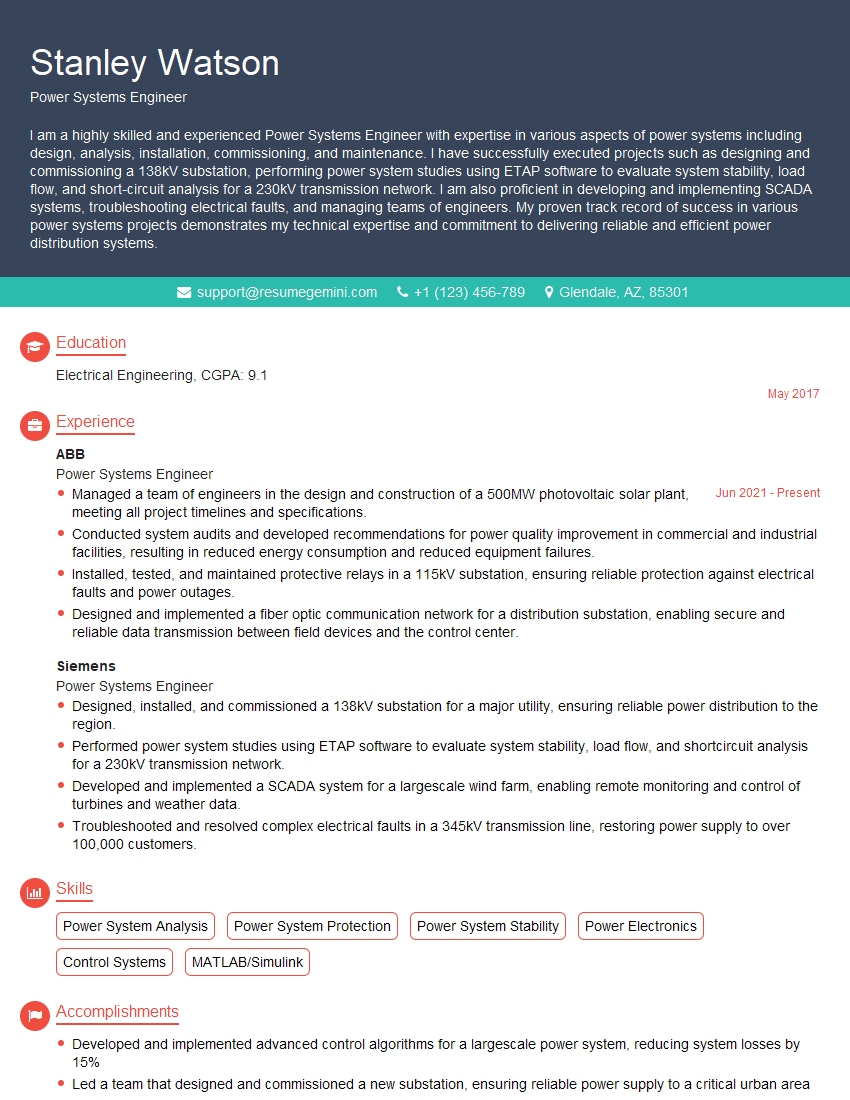
Mastering Power Electronics and Inverters opens doors to exciting career opportunities in a rapidly growing field. To maximize your chances of landing your dream job, a well-crafted resume is essential. An ATS-friendly resume is crucial for getting past applicant tracking systems and landing an interview. To help you create a truly compelling resume that showcases your skills and experience effectively, we recommend using ResumeGemini. ResumeGemini provides you with the tools and resources to build a professional resume that highlights your unique strengths. Examples of resumes tailored to Power Electronics and Inverters are available to further guide your resume building process.

Explore more articles
Users Rating of Our Blogs
Share Your Experience
We value your feedback! Please rate our content and share your thoughts (optional).
What Readers Say About Our Blog
good