Interviews are more than just a Q&A session—they’re a chance to prove your worth. This blog dives into essential Power Line Design interview questions and expert tips to help you align your answers with what hiring managers are looking for. Start preparing to shine!
Questions Asked in Power Line Design Interview
Q 1. Explain the difference between transmission and distribution lines.
Transmission and distribution lines are both crucial parts of the power system, but they serve different purposes and operate at different voltage levels. Think of it like a river system: transmission lines are the main river, carrying vast amounts of power long distances from generating stations, while distribution lines are the smaller tributaries branching out to deliver electricity to individual consumers.
- Transmission Lines: High-voltage lines (typically 110 kV and above) designed to carry large amounts of power over long distances, often hundreds of kilometers. They connect power plants to substations.
- Distribution Lines: Lower-voltage lines (typically below 69 kV) that take power from substations and distribute it to smaller substations and eventually to homes and businesses. They are characterized by their lower voltage and shorter lengths.
The key differences lie in voltage level, power capacity, line length, and the types of equipment used. Transmission lines utilize more robust and expensive infrastructure due to the higher voltages and longer distances involved.
Q 2. Describe the factors considered when selecting conductor materials for power lines.
Selecting conductor materials for power lines involves a careful balancing act between various factors. The ideal material offers high conductivity to minimize power loss, high tensile strength to withstand stress from weight and wind, good corrosion resistance for longevity, and affordability. Let’s look at the key considerations:
- Conductivity: Aluminum is favored due to its high conductivity and relatively low weight compared to copper. Copper, while offering superior conductivity, is significantly more expensive.
- Tensile Strength: The conductor must withstand significant stress from its own weight, wind, ice loading, and thermal expansion. High-strength aluminum alloys, sometimes reinforced with steel cores, are common choices.
- Corrosion Resistance: Exposure to the elements necessitates corrosion resistance. Aluminum naturally forms a protective oxide layer, enhancing its durability. Coatings or specialized alloys might be used to further improve this.
- Cost: The material’s price plays a significant role, especially considering the vast quantities used in power line construction. Aluminum’s lower cost makes it economically attractive.
- Temperature Considerations: The conductor’s resistance changes with temperature. This needs to be factored into the design for efficient power transfer and to prevent overheating.
Often, a compromise is struck – for example, using aluminum conductor steel-reinforced (ACSR) wire, which combines the conductivity of aluminum with the strength of steel.
Q 3. What are the various types of power line towers and their applications?
Power line towers are designed to support conductors and ensure the reliable transmission and distribution of electricity. The type of tower used depends on factors like voltage level, terrain, environmental conditions, and span length. Here are some common types:
- Lattice Towers: These are the most common type, constructed from interconnected steel members forming a lattice structure. They are strong, versatile, and can be designed for various voltage levels and spans. They are well-suited for a variety of terrains.
- Self-Supporting Towers: These towers stand independently without guy wires, making them suitable for areas where space is limited or ground conditions are unsuitable for anchoring guy wires.
- Suspension Towers: These towers support conductors that are suspended between them. They are typically used in long-distance transmission lines.
- Angle Towers: Used at points where the line changes direction. They are specially designed to withstand the extra stresses created by the angle.
- Dead-end Towers: These towers are used at the termination points of a transmission line or where the line is anchored to prevent sagging.
For instance, in mountainous regions, self-supporting towers might be preferred due to challenging terrain, while lattice towers are commonly used in flat areas. The choice involves a thorough analysis of the specific conditions and requirements.
Q 4. How do you calculate sag and tension in power line conductors?
Calculating sag and tension in power line conductors is crucial for ensuring the stability and safety of the line. Sag is the vertical distance between the conductor and its lowest point, while tension is the force in the conductor. These are interdependent and influenced by several factors, including conductor weight, temperature, wind load, and ice accumulation.
The calculation typically involves complex equations considering the catenary curve (the shape a hanging conductor assumes under its own weight). Simplified methods use parabolic approximations, particularly for shorter spans.
Simplified Parabolic Method:
- Sag (S) ≈ (wL²)/(8T), where w is the weight per unit length of the conductor, L is the span length, and T is the horizontal tension.
- Tension (T) is determined based on allowable stress in the conductor material and safety factors.
More sophisticated methods employ computer software that considers various factors and performs iterative calculations to achieve an optimal balance between sag and tension, ensuring the line remains within safety limits and minimizes conductor stress.
In practice, these calculations are critical for determining the height of towers, the spacing between conductors, and the overall design of the power line, ensuring sufficient clearance from the ground and obstacles.
Q 5. Explain the importance of grounding in power line design.
Grounding in power line design is paramount for safety and reliable operation. It provides a low-resistance path for fault currents to flow to the earth, preventing dangerous voltage buildup and protecting equipment and personnel. Think of it as a safety valve, diverting potentially hazardous energy away from harm.
- Protection against Lightning Strikes: Grounding effectively channels lightning currents into the earth, preventing damage to the equipment and minimizing the risk of electrical shock.
- Fault Current Diversion: In case of a fault, grounding diverts the fault current to the earth, minimizing the voltage surge and preventing damage to the system.
- Personnel Safety: Grounding ensures that the voltage on equipment and structures is kept at earth potential, minimizing the risk of electric shock.
- System Stability: Grounding contributes to system stability by ensuring that the potential of the system is properly referenced to the earth.
Effective grounding involves using low-resistance ground rods, ground wires, and proper connections to ensure a reliable path for fault currents. The resistance of the grounding system is carefully measured and maintained to ensure its effectiveness.
Q 6. Describe different types of insulators used in power line construction.
Insulators are critical components in power line design, providing electrical insulation between conductors and towers, preventing current from flowing to the ground. Different types exist, each suited to specific applications and voltage levels:
- Pin-type Insulators: These are relatively simple and inexpensive insulators, suitable for lower voltages. The conductor is attached to a pin at the top of the insulator.
- Suspension Insulators: Used for higher voltages, these consist of multiple insulator units strung together, increasing the overall insulation strength. This allows for greater flexibility in handling high voltage levels and variations in sag.
- Strain Insulators: These are heavier-duty insulators used at points of high tension in the line, such as at tower angles or dead ends.
- Post Insulators: These insulators are used in substations and other applications requiring high-strength and creepage distance (the shortest distance between energized conductors).
- Polymer Insulators: These are increasingly used as a cost-effective and lightweight alternative to porcelain or glass insulators. They offer high strength and good dielectric properties.
The selection of insulators depends on the voltage level, the environmental conditions (e.g., pollution, humidity), and the mechanical stresses involved. The design must ensure sufficient creepage distance to prevent flashover, even under adverse conditions.
Q 7. What are the safety regulations and standards you must adhere to in power line design?
Adhering to safety regulations and standards is paramount in power line design. Failure to do so can lead to serious accidents, equipment damage, and environmental hazards. These regulations cover various aspects of design, construction, operation, and maintenance.
Key Standards and Regulations (examples, specific standards vary by region):
- National Electrical Safety Code (NESC): Provides comprehensive guidelines for the design, construction, operation, and maintenance of electrical supply and communication lines in many countries.
- IEEE Standards: The Institute of Electrical and Electronics Engineers publishes numerous standards related to power systems, including those related to power line design.
- OSHA Regulations: The Occupational Safety and Health Administration sets standards to protect workers involved in the design, construction, and maintenance of power lines.
- International Standards (IEC): The International Electrotechnical Commission develops international standards for electrical engineering, which influence national regulations.
These standards cover aspects such as clearance requirements (distance between lines and ground), conductor and insulator selection, grounding, lightning protection, and safety procedures during construction and maintenance. Compliance is strictly enforced to ensure the safety of workers and the public.
Regular inspections, maintenance, and adherence to strict safety protocols throughout the entire lifecycle of the power line are essential for ensuring safe and reliable operation.
Q 8. How do you account for environmental factors (e.g., wind, ice) in power line design?
Environmental factors significantly impact power line design, potentially causing damage or failure. We incorporate these factors through meticulous calculations and robust design choices. For example, wind loading is accounted for by using specialized software that simulates wind forces on conductors and structures. This software considers factors like wind speed, direction, and terrain. The results dictate the conductor’s sag and tension, and the strength required for the supporting structures (towers and poles). Ice loading, particularly crucial in colder climates, is similarly addressed. We determine the potential weight of ice accretion on conductors and insulators using historical data and meteorological forecasts. This data directly influences the choice of conductor material and size, insulator type, and tower design to ensure structural integrity under heavy ice conditions. In some cases, we might even incorporate de-icing systems for critical lines.
For instance, designing a line for a coastal region might necessitate stronger structures to withstand high wind speeds and saltwater corrosion. In contrast, a mountainous area would require careful consideration of avalanche risk and increased wind speeds at higher altitudes, leading to specialized tower designs and possibly shorter spans to reduce the overall load on individual structures.
Q 9. Explain the process of right-of-way acquisition for power line projects.
Right-of-way (ROW) acquisition is a complex legal and logistical process. It begins with identifying the optimal route for the power line, considering factors like environmental impact, land ownership, and accessibility. We then conduct title searches to identify all landowners along the proposed route. Next, we engage in negotiations with each landowner, offering fair market value compensation for the easement or land purchase. This often involves multiple meetings, appraisals, and legal reviews. In some cases, eminent domain (the right of government to take private property for public use with just compensation) may be necessary if negotiations fail. Throughout the process, we are mindful of regulatory compliance at the local, state, and federal levels, including environmental permits and approvals. It’s crucial to maintain transparency and effective communication with all stakeholders to facilitate a smooth and timely process.
Imagine needing to acquire ROW for a high-voltage line across farmland. It might involve multiple landowners, each with their own concerns about land usage and compensation. We would need to thoroughly assess the impact on their land, carefully negotiate fair compensation, and manage any concerns about environmental disruption. It’s a process that requires meticulous planning, legal expertise, and robust community engagement.
Q 10. What software and tools are commonly used in power line design?
Power line design relies heavily on specialized software and tools. For example, PLS-CADD is a widely used software for structural design and analysis of transmission lines, allowing engineers to model the line’s geometry, calculate sag and tension, and analyze the structural strength of towers and conductors under various loading conditions. EasyPower and similar power system analysis software are used for load flow, fault current, and stability studies, ensuring the system’s reliability and safety. Geographic Information Systems (GIS) software like ArcGIS is crucial for mapping, route planning, and analyzing environmental factors. In addition to this, we utilize CAD software for detailed design and drafting of structures and components. Specialized software for modeling ice accretion, wind profiles, and conductor galloping are also employed for thorough analysis in challenging environmental conditions. Finally, data management and collaboration tools such as project management software are essential for effective teamwork and efficient design workflows.
Q 11. Describe your experience with power system studies (e.g., load flow, fault analysis).
I have extensive experience performing various power system studies, including load flow, fault analysis, and stability studies. Load flow studies help determine the voltage and power flow throughout the system under normal operating conditions. This is essential for ensuring adequate voltage levels and preventing overloading. Fault analysis examines the system’s behavior during faults (short circuits), determining the fault current levels and the impact on various components. This is crucial for protective relay coordination and equipment sizing. Stability studies assess the system’s ability to maintain synchronism and stability following disturbances, such as faults or loss of generation. My experience includes using industry-standard software and following established engineering practices to conduct these studies accurately and efficiently, often using software like PSS/E or PowerWorld Simulator. For instance, I’ve used load flow analysis to optimize the placement of reactive compensation devices to improve voltage profiles on a long transmission line.
Q 12. How do you ensure the reliability and stability of a power line system?
Ensuring the reliability and stability of a power line system is paramount. This involves a multi-faceted approach, starting with meticulous design that accounts for environmental factors and potential contingencies. Redundancy is a key element, with multiple paths and protection systems in place to prevent widespread outages. Regular maintenance and inspection programs are essential for early detection and repair of potential problems. Advanced monitoring systems and SCADA (Supervisory Control and Data Acquisition) systems provide real-time data on system performance, enabling proactive intervention. Protective relays and circuit breakers are vital components that quickly isolate faults, preventing cascading failures. Finally, effective communication and coordination between operators and maintenance crews are crucial for efficient response to incidents and restoration of service. Imagine a system with redundant lines and quick-acting circuit breakers; if a fault occurs on one line, the others can seamlessly maintain power supply, illustrating the effectiveness of robust design and protection.
Q 13. What are the challenges associated with designing power lines in mountainous or densely populated areas?
Designing power lines in mountainous or densely populated areas presents unique challenges. In mountainous terrain, accessibility is a major issue, often requiring helicopters for construction and maintenance. The variable terrain and extreme weather conditions require specialized tower designs and stronger conductors to withstand high winds, ice, and potential avalanches. In densely populated areas, minimizing the environmental impact and adhering to strict zoning regulations is vital. The proximity of structures necessitates careful route selection and possibly undergrounding certain sections to reduce visual impact and risks. Right-of-way acquisition becomes more complex, requiring extensive community engagement and potentially higher compensation for land use. For instance, designing a line through a national park would necessitate thorough environmental impact assessments and strict adherence to regulations.
Q 14. Explain the concept of power line routing and optimization.
Power line routing and optimization is a critical aspect of design, aiming to find the most efficient and cost-effective path for the transmission line while minimizing environmental impact and land acquisition costs. This involves using GIS software to analyze various potential routes, considering factors like terrain, land use, environmental sensitivities, and proximity to existing infrastructure. Optimization algorithms are used to evaluate different routes based on various criteria, such as minimizing the total length of the line, reducing the number of towers required, and minimizing environmental impact. These algorithms often consider factors like cost of land acquisition, construction difficulties, and potential environmental damage. The process also incorporates stakeholder consultation and regulatory approvals to ensure a responsible and feasible solution. For example, an algorithm might compare multiple routes, considering factors like construction cost, environmental impact scores, and land acquisition costs, to identify the most optimal path for the power line.
Q 15. What are the different types of protection schemes used for power lines?
Power line protection schemes are crucial for ensuring the reliability and safety of the electrical grid. These schemes are designed to detect and mitigate faults, protecting both equipment and personnel. They can be broadly categorized into several types:
- Overcurrent Protection: This is the most fundamental type, using fuses or circuit breakers to interrupt the current flow when it exceeds a predetermined threshold, indicative of a fault. Think of it like a circuit breaker in your home – if the current gets too high, it trips to prevent a fire.
- Distance Protection: This scheme measures the impedance along the power line. A fault will cause a change in impedance, triggering the protection relay to isolate the faulty section. It’s more sophisticated than overcurrent protection as it pinpoints the fault location more accurately.
- Differential Protection: This compares the current entering and leaving a protected zone. Any discrepancy suggests a fault within that zone, initiating a trip signal. Imagine it like comparing the weight of goods entering and leaving a warehouse; any difference implies a problem.
- Pilot Protection: This uses communication channels (fiber optic cables or power line carrier communication) between substations to quickly detect and isolate faults. It’s very fast and highly effective for long transmission lines.
- Ground Fault Protection: This is specifically designed to detect faults involving ground. It’s essential for safety and preventing damage to equipment.
The choice of protection scheme depends on factors like line length, voltage level, fault current levels, and system configuration. Often, multiple schemes are used in combination for comprehensive protection.
Career Expert Tips:
- Ace those interviews! Prepare effectively by reviewing the Top 50 Most Common Interview Questions on ResumeGemini.
- Navigate your job search with confidence! Explore a wide range of Career Tips on ResumeGemini. Learn about common challenges and recommendations to overcome them.
- Craft the perfect resume! Master the Art of Resume Writing with ResumeGemini’s guide. Showcase your unique qualifications and achievements effectively.
- Don’t miss out on holiday savings! Build your dream resume with ResumeGemini’s ATS optimized templates.
Q 16. How do you design for lightning protection in power lines?
Designing for lightning protection in power lines is paramount, as lightning strikes can cause significant damage and outages. The key is to provide a safe path for the lightning current to flow to the ground, minimizing the impact on the power line equipment. This typically involves:
- Overhead Ground Wires (Shield Wires): These are conductors placed above the phase conductors, acting as a lightning rod, intercepting strikes and diverting the current to ground through grounding systems. Think of them as an umbrella for the power lines.
- Lightning Arresters (Surge Arresters): These are devices installed at substations and along the line to divert the surge currents to ground, protecting equipment from voltage spikes. They act as a safety valve, diverting the excess energy away from sensitive components.
- Effective Grounding: This is the foundation of lightning protection. Grounding systems must offer low impedance paths to ensure the lightning current is safely dissipated into the earth. Poor grounding can lead to serious damage and even fire.
- Insulation Coordination: Choosing the right insulation levels for the equipment and conductors can help withstand lightning-induced overvoltages. It’s a balancing act between cost and safety.
The design considers factors like the lightning strike frequency in the area, the line’s length and configuration, and the type of equipment being protected. Sophisticated computer models are often used to simulate lightning strikes and assess the effectiveness of the protection scheme.
Q 17. Describe your experience with different types of power line conductors (ACSR, etc.).
I have extensive experience with various power line conductors, including the widely used Aluminum Conductor Steel-Reinforced (ACSR) conductors. ACSR conductors combine the high conductivity of aluminum with the tensile strength of steel. The steel core provides mechanical strength, allowing for longer spans and reducing the number of support structures needed. This is a significant cost saving.
I’ve also worked with:
- All-Aluminum Conductors (AAC): These are lighter than ACSR but have lower tensile strength, limiting span lengths. They are often used in lower-voltage distribution lines.
- Aluminum Conductor Alloy Reinforced (ACAR): These offer a balance between the conductivity of aluminum and the strength of an alloy core.
- High-Temperature Low-Sag (HTLS) Conductors: These are specially designed to withstand higher temperatures and have lower sag, making them suitable for challenging terrain or high ambient temperatures.
My experience includes selecting the appropriate conductor based on ampacity (current-carrying capacity), mechanical strength requirements, sag and tension calculations, and economic considerations. The selection process often involves using specialized software to perform detailed analysis and ensure optimal performance.
Q 18. What are the considerations for designing underground power lines?
Designing underground power lines presents unique challenges compared to overhead lines. Key considerations include:
- Cost: Undergrounding is significantly more expensive than overhead lines due to the excavation, trenching, cable installation, and backfilling involved. This often dictates the use of more compact and robust designs.
- Cable Selection: The choice of cable depends on voltage level, current capacity, soil conditions, and environmental factors. High-voltage cables require special insulation and shielding to prevent breakdown and maintain safety.
- Thermal Considerations: Underground cables generate heat during operation, which needs to be managed to prevent overheating and premature cable failure. Soil thermal resistivity and cable spacing are crucial factors.
- Fault Location and Repair: Locating and repairing faults in underground cables is much more difficult and time-consuming than with overhead lines. Sophisticated cable testing and fault location equipment are often necessary.
- Environmental Impact: Minimizing the environmental impact of the excavation and cable installation is important, including considerations for soil erosion, habitat disruption, and the potential for groundwater contamination.
Careful planning and detailed design are essential to mitigate these challenges and create a reliable and cost-effective underground power system. Specialized software is often used for thermal analysis and cable sizing calculations.
Q 19. Explain the importance of surge arresters in power line protection.
Surge arresters, also known as lightning arresters, are vital components in power line protection. They are designed to protect equipment from transient overvoltages caused by lightning strikes, switching operations, and other disturbances. These overvoltages can severely damage or destroy sensitive equipment like transformers, circuit breakers, and other substation apparatus.
Surge arresters operate by diverting the surge current to ground, limiting the voltage across the protected equipment. They typically employ metal-oxide varistors (MOVs) or other non-linear devices that have a very low resistance when subjected to high voltage, effectively clamping the voltage at a safe level. Once the surge subsides, the arrester returns to a high-impedance state, ceasing to conduct current. Think of them as a ‘voltage valve’ that opens only during overvoltage events.
The proper selection and placement of surge arresters are crucial for effective protection. The selection criteria include the voltage level, surge current capacity, and energy absorption capabilities. They are often strategically placed at substations and along the power line, providing protection for critical equipment.
Q 20. How do you manage project timelines and budgets for power line design projects?
Managing project timelines and budgets for power line design projects requires a structured approach. I typically use a combination of techniques:
- Detailed Project Planning: This involves a thorough breakdown of the project into smaller, manageable tasks with clearly defined deliverables and deadlines. Critical Path Method (CPM) analysis helps identify the most critical tasks and potential bottlenecks.
- Resource Allocation: Careful planning of personnel, equipment, and materials is crucial. This involves forecasting resource needs and managing potential delays.
- Budgeting and Cost Control: Developing a comprehensive budget that covers all aspects of the project, including design, engineering, procurement, and construction. Regular monitoring and tracking of expenses are essential for staying within budget.
- Risk Management: Identifying potential risks and developing mitigation strategies to prevent or minimize their impact on the project schedule and budget.
- Communication and Collaboration: Maintaining clear communication with the project team, stakeholders, and contractors is vital for successful project management. Regular meetings and progress reports are key.
Software tools like project management software (MS Project, Primavera P6) are often utilized to track progress, manage resources, and analyze potential schedule impacts.
Q 21. Describe your experience working with different stakeholders in power line projects.
Power line projects involve a wide range of stakeholders, including utilities, landowners, government agencies, environmental groups, and contractors. Effective collaboration with these stakeholders is crucial for successful project completion.
My experience includes:
- Communication and Engagement: Proactive communication and engagement strategies to keep all stakeholders informed throughout the project lifecycle. This often includes public meetings, presentations, and written correspondence.
- Negotiation and Conflict Resolution: Negotiating and resolving conflicts that may arise between different stakeholders, ensuring a collaborative environment.
- Permitting and Regulatory Compliance: Navigating the permitting process and ensuring compliance with relevant regulations and standards.
- Environmental Impact Assessment: Working with environmental agencies to assess and mitigate the environmental impacts of the project.
- Community Relations: Building and maintaining strong relationships with local communities and addressing their concerns.
Building trust and rapport with stakeholders is critical for successful project delivery. A transparent and collaborative approach minimizes conflict and ensures that the project aligns with the interests of all parties involved.
Q 22. How do you handle conflicts or disagreements during power line design projects?
Conflict resolution in power line design is crucial for successful project delivery. My approach is collaborative and data-driven. I believe in fostering open communication from the outset, ensuring all stakeholders – engineers, environmental consultants, landowners, and regulatory bodies – have a clear understanding of the project goals and constraints.
When disagreements arise, I facilitate constructive dialogue, focusing on the underlying issues rather than personalities. We use a structured approach, often involving:
- Clearly Defining the Problem: Articulating the specific point of contention with objective data. For instance, if there’s a disagreement on conductor sag calculations, we revisit the relevant standards and input data.
- Brainstorming Solutions: Exploring multiple options to address the conflict, considering the technical, economic, and environmental implications of each.
- Risk Assessment: Evaluating the potential risks associated with each proposed solution, including project delays, cost overruns, or environmental impacts.
- Decision-Making Framework: Applying a pre-agreed decision-making process, perhaps a weighted scoring system, to objectively evaluate the options and arrive at a consensus.
- Documentation: Meticulously documenting all decisions, rationale, and compromises reached to maintain transparency and accountability.
For example, in one project, a disagreement arose about the optimal route for a transmission line through a sensitive ecological area. By involving ecologists, engaging in thorough environmental impact assessments, and presenting multiple route options with detailed comparative analyses, we were able to reach a mutually acceptable solution minimizing environmental disturbance.
Q 23. What are the key considerations for the environmental impact assessment of power line projects?
Environmental impact assessment (EIA) for power line projects is paramount. It’s a multi-faceted process aiming to identify, predict, evaluate, and mitigate the potential environmental consequences of the project. Key considerations include:
- Visual Impacts: Assessing the visual impact on landscapes, considering factors like line height, conductor type, and the presence of natural features. Mitigation might include using techniques to minimize the visual prominence of the line, such as strategically placed vegetation screening.
- Habitat Disturbance: Evaluating potential impacts on flora and fauna, including habitat fragmentation, disruption of migration patterns, and impacts on endangered species. Measures such as avoiding sensitive habitats, minimizing clearing of vegetation, and implementing habitat restoration programs are crucial.
- Electromagnetic Fields (EMF): Assessing the potential health effects of EMF generated by power lines. Mitigation strategies could involve selecting appropriate conductor configurations and maintaining sufficient distances from residences.
- Water Resources: Evaluating impacts on water bodies, including potential changes in water flow, water quality, and aquatic habitats during construction and operation. Mitigation strategies include implementing erosion and sediment control measures and avoiding water bodies where possible.
- Air Quality: Assessing potential impacts from construction activities and the operation of the line (though typically minimal). Mitigation involves utilizing best practices for dust control and emission reduction.
- Noise Pollution: Assessing noise levels generated during construction and operation. Mitigation includes using noise barriers and employing quieter equipment.
A robust EIA will involve field surveys, modeling studies, and stakeholder consultation, leading to a comprehensive environmental management plan. This ensures the project minimizes its ecological footprint while complying with all relevant environmental regulations.
Q 24. Explain your understanding of power system harmonics and their mitigation.
Power system harmonics are non-sinusoidal currents and voltages at frequencies that are multiples of the fundamental frequency (typically 50Hz or 60Hz). They’re primarily caused by non-linear loads, such as power electronics (rectifiers, inverters, and variable speed drives) which are increasingly prevalent in modern power systems. Harmonics can lead to several problems, including:
- Overheating of equipment: Harmonic currents can cause excessive heating in transformers and cables, potentially leading to failures.
- Increased losses: Harmonics increase power losses in transmission and distribution systems.
- Malfunction of sensitive equipment: Harmonics can interfere with the operation of sensitive electronic devices.
- Resonance: Harmonics can resonate with the system’s natural frequencies, causing voltage distortion and potential instability.
Mitigation strategies involve a combination of techniques:
- Passive Filters: These are tuned circuits that absorb specific harmonic frequencies. They’re cost-effective for addressing a limited range of harmonics.
- Active Filters: These use power electronics to actively compensate for harmonic currents, providing more flexible and precise harmonic control. They’re more expensive but offer greater flexibility.
- Harmonic Source Control: Minimizing harmonic generation at the source, such as using harmonic-reducing equipment and optimizing the design of power electronic devices.
- System Design Considerations: Careful system design can minimize the impact of harmonics, for example, by using appropriately rated transformers and cables.
For instance, in a project involving a large industrial facility with significant harmonic generation, we incorporated active filters into the design to mitigate harmonic distortion and ensure the stability of the power system.
Q 25. Describe your experience with power flow analysis software (e.g., PSS/E, PowerWorld Simulator).
I have extensive experience with power flow analysis software, including PSS/E and PowerWorld Simulator. These tools are indispensable for power system planning and operation. My expertise encompasses:
- Steady-State Analysis: Performing load flow studies to determine voltage profiles, power flows, and system losses under various operating conditions. This helps identify potential overloads and voltage violations.
- Transient Stability Analysis: Simulating the system’s response to disturbances, such as faults and sudden load changes. This is crucial for assessing the system’s ability to maintain stability after a disturbance.
For example, using PSS/E, I can model a three-phase fault and observe the system response to determine if protective relays operate correctly and prevent cascading failures. - Dynamic Simulation: Modeling the dynamic behavior of generators, loads, and other system components. This allows for a more detailed assessment of system stability and control performance.
- Optimal Power Flow (OPF): Utilizing OPF studies to optimize system operation, minimizing losses and improving voltage profiles. This helps to improve the efficiency and reliability of the power system.
- State Estimation: Using measured data to estimate the real-time state of the power system. This information can be used for monitoring and control.
My experience extends to building detailed models of power systems, including transmission lines, transformers, generators, and loads, using these software packages. I’m proficient in interpreting the results of these analyses to identify potential problems and propose solutions.
Q 26. How do you ensure compliance with relevant codes and standards (e.g., IEEE, IEC)?
Compliance with relevant codes and standards, such as IEEE and IEC standards, is non-negotiable in power line design. My approach involves a multi-stage process:
- Early Identification of Applicable Standards: At the project’s outset, I identify all relevant standards and regulations, including those related to safety, environmental protection, and construction practices. This includes national and international standards.
- Design to Standards: Throughout the design process, the design is rigorously checked against the applicable standards. For example, conductor sag calculations are validated against the relevant IEEE standards, ensuring adequate clearance from ground and obstacles.
- Verification and Validation: Independent verification and validation of the design are performed to ensure compliance. This may involve internal reviews, peer reviews, and third-party audits.
- Documentation: Detailed documentation of the design process and compliance with standards is maintained. This includes design calculations, test reports, and compliance statements.
- Regular Updates: Staying abreast of any changes or updates to relevant standards is crucial to ensure continued compliance. This involves regular review of updated standards and industry best practices.
Failure to comply with standards can have serious consequences, ranging from project delays and cost overruns to safety hazards and legal liabilities. My commitment to adherence to standards is unwavering.
Q 27. What are your strategies for managing risks in power line design projects?
Risk management is integrated throughout the power line design process. My strategies include:
- Risk Identification: Proactively identifying potential risks throughout the project lifecycle, including technical, environmental, regulatory, and financial risks. This often involves brainstorming sessions and HAZOP (Hazard and Operability) studies.
- Risk Assessment: Evaluating the likelihood and potential impact of each identified risk. This involves quantifying the risks where possible, using techniques such as fault tree analysis.
- Risk Mitigation: Developing and implementing strategies to mitigate identified risks. These may include design changes, contingency planning, and risk transfer mechanisms (e.g., insurance).
- Risk Monitoring and Control: Continuously monitoring and controlling identified risks throughout the project. This involves regular risk reviews and updates to the risk management plan.
- Contingency Planning: Developing detailed contingency plans to address unforeseen events or circumstances. This may involve alternative design options or strategies to manage unexpected delays or cost overruns.
For example, in a project involving construction in a remote area, we identified the risk of logistical delays due to inclement weather. To mitigate this, we developed a detailed contingency plan outlining alternative transportation routes and construction schedules to minimize the impact of potential weather disruptions.
Q 28. Explain your familiarity with different types of power line maintenance strategies.
Power line maintenance strategies aim to ensure the reliable and safe operation of the transmission and distribution systems. There are various strategies, broadly categorized as:
- Preventive Maintenance: This involves scheduled inspections and maintenance activities performed at regular intervals to prevent equipment failures. Examples include visual inspections of conductors and insulators, testing of protective relays, and cleaning of insulators.
- Predictive Maintenance: This relies on monitoring the condition of equipment to predict potential failures before they occur. Techniques such as vibration analysis, infrared thermography, and partial discharge testing help identify developing problems.
- Corrective Maintenance: This involves repairs or replacements necessitated by equipment failures. While essential, it’s reactive and often more costly and disruptive than preventive or predictive maintenance.
- Condition-Based Maintenance: This combines aspects of preventive and predictive maintenance, tailoring maintenance activities based on the actual condition of the equipment. Sensors and monitoring systems provide data to guide maintenance decisions.
The optimal maintenance strategy depends on various factors, including the age and condition of the equipment, the cost of maintenance, and the consequences of equipment failure. A well-defined maintenance plan is crucial to balancing maintenance costs with system reliability and safety. A robust strategy typically involves a mix of these approaches, employing preventive maintenance for routine tasks and predictive maintenance for high-value equipment to optimize resource allocation.
Key Topics to Learn for Power Line Design Interview
- Conductor Selection and Sizing: Understanding ampacity, sag calculations, and the impact of different conductor materials (aluminum, copper, ACSR) on line performance and cost-effectiveness.
- Line Routing and Design: Applying principles of surveying, GIS mapping, and environmental considerations to optimize power line placement, minimizing environmental impact and construction costs. This includes practical application in navigating terrains and regulatory hurdles.
- Structural Design of Transmission Towers: Analyzing tower designs based on wind load, ice load, and conductor tension. Understanding various tower types and their suitability for different environments and voltage levels.
- Power System Analysis: Applying knowledge of power flow studies, short-circuit calculations, and stability analysis to ensure the reliability and efficiency of the designed power lines.
- Protection and Relaying: Understanding protective relaying schemes to safeguard the power line from faults and other system disturbances. This involves practical application in selecting appropriate relays and coordinating their operation.
- Electrical Safety and Regulations: Demonstrating a thorough understanding of relevant safety standards and regulations (e.g., OSHA, NEC) to ensure compliance and worker safety throughout the design and construction phases.
- Economic Analysis and Project Management: Evaluating project costs, developing budgets, and managing timelines for power line projects, demonstrating understanding of cost-benefit analysis techniques.
- Software Proficiency: Highlighting experience with relevant power system design software (mention specific software if applicable, e.g., PLS-CADD, ETAP). Understanding the practical applications of these tools is key.
Next Steps
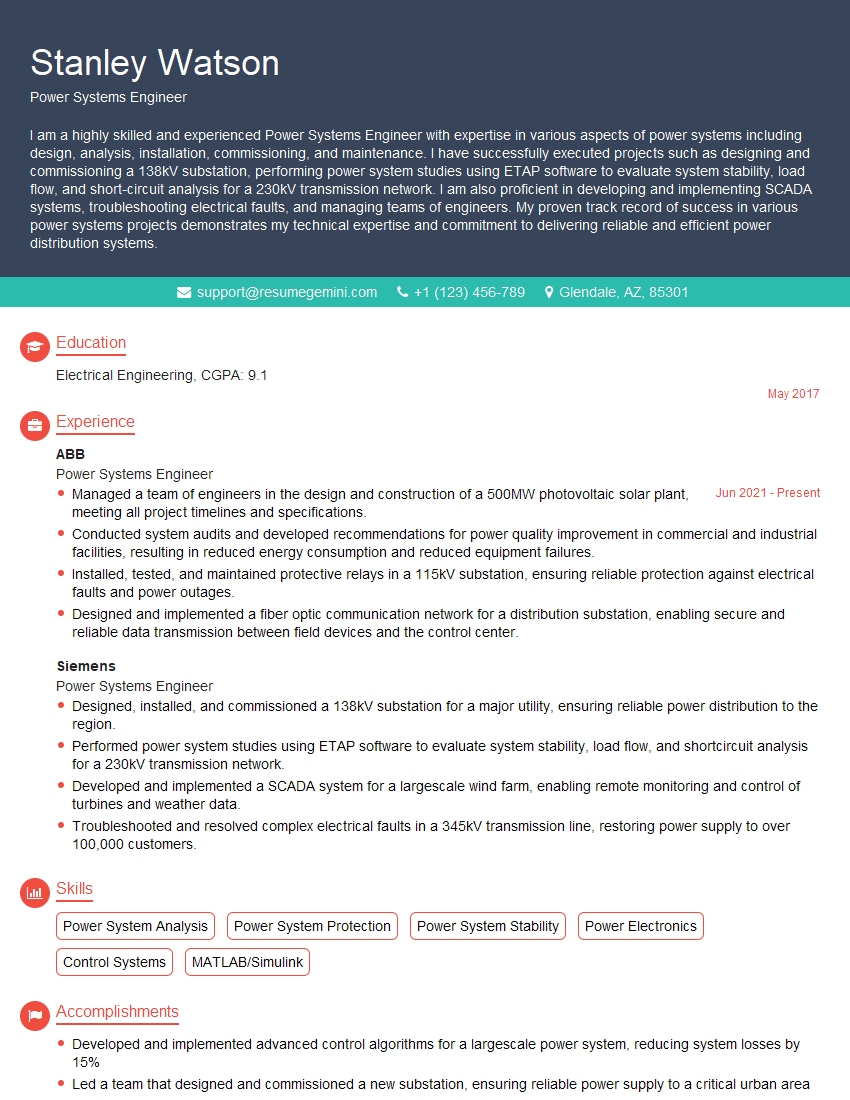
Mastering Power Line Design opens doors to exciting career opportunities in a growing industry, offering diverse roles with significant impact on infrastructure development. To maximize your job prospects, creating a strong, ATS-friendly resume is crucial. ResumeGemini is a trusted resource that can help you build a professional and impactful resume tailored to the Power Line Design field. Examples of resumes tailored to this industry are provided to help you get started. Invest time in crafting a compelling resume – it’s your first impression with potential employers.
Explore more articles
Users Rating of Our Blogs
Share Your Experience
We value your feedback! Please rate our content and share your thoughts (optional).
What Readers Say About Our Blog
Very informative content, great job.
good