Interviews are more than just a Q&A session—they’re a chance to prove your worth. This blog dives into essential Power Management Techniques interview questions and expert tips to help you align your answers with what hiring managers are looking for. Start preparing to shine!
Questions Asked in Power Management Techniques Interview
Q 1. Explain the difference between linear and switching regulators.
Linear and switching regulators are two fundamental types of DC-to-DC converters, differing primarily in their efficiency and how they regulate voltage. A linear regulator works by dissipating excess power as heat. Think of it like a water faucet – you control the flow (voltage) by partially obstructing the pipe. The energy lost is converted to heat in the regulator itself. This makes them simple to design but inherently inefficient, especially at higher input voltages or with significant load current variations.
In contrast, a switching regulator uses a switching element (like a MOSFET) to rapidly switch the input voltage on and off, creating a pulsed output. This pulsed output is then smoothed by a filter to produce a regulated DC voltage. Imagine this as a pump that switches on and off to regulate the water flow. Much less energy is wasted as heat. This results in significantly higher efficiency, particularly beneficial in battery-powered applications.
- Linear Regulator: Simple design, low noise, low cost, inefficient, significant heat dissipation.
- Switching Regulator: High efficiency, complex design, can generate noise, requires more components.
For instance, a linear regulator might be suitable for low-power applications requiring very low noise, like powering a sensitive analog sensor. However, a switching regulator would be preferred for a laptop power adapter, where efficiency is crucial for battery life.
Q 2. Describe different power loss mechanisms in a power supply.
Power loss in a power supply stems from several mechanisms, broadly categorized as conduction losses, switching losses, and core losses (in inductive components).
- Conduction Losses: These are caused by the resistance of conductors (wires, traces on PCBs, and components themselves). The power loss is given by I2R, where I is the current and R is the resistance. Minimizing trace width and using low-resistance materials are crucial to reduce this loss.
- Switching Losses: Present in switching regulators, these losses occur during the transitions of the switching element (MOSFET, IGBT). Energy is dissipated as heat during the ‘on’ and ‘off’ switching times. Careful selection of switching frequency and components with low switching losses is critical.
- Core Losses: In inductors and transformers, these losses are due to hysteresis and eddy currents in the magnetic core material. Hysteresis loss is related to the energy required to magnetize and demagnetize the core, while eddy currents are induced circulating currents in the core due to changing magnetic fields. These losses can be minimized by using materials with low hysteresis and high resistivity.
- Other Losses: These include losses in diodes, capacitors, and control circuitry. Each component contributes a small amount of power loss.
Effective power supply design requires careful consideration of all these loss mechanisms to optimize efficiency. For example, in a high-frequency switching power supply, minimizing switching losses might involve using fast-switching MOSFETs and advanced gate-driving techniques. In a transformer-based supply, choosing a core material with low hysteresis and high resistivity is essential to minimizing core losses.
Q 3. What are the key considerations for designing a battery management system (BMS)?
Designing a robust and safe Battery Management System (BMS) necessitates a multi-faceted approach. Key considerations include:
- Cell Balancing: Ensuring all cells in a battery pack have similar voltages to maximize lifespan and capacity. Active balancing techniques are more efficient but require additional circuitry, while passive balancing is simpler but slower.
- State of Charge (SOC) Estimation: Accurately estimating the remaining battery charge. This often involves using algorithms that combine voltage, current, and temperature measurements.
- State of Health (SOH) Estimation: Assessing the overall health of the battery pack over time. This helps predict remaining lifespan and schedule replacements before failure.
- Over-voltage, Under-voltage, and Over-current Protection: Implementing protection circuits to prevent damage from exceeding safe operating limits. This is critical for safety and to prevent catastrophic battery failure.
- Over-temperature Protection: Monitoring battery temperature and implementing mechanisms (e.g., thermal shutdown) to prevent overheating, which can severely degrade battery performance and lead to fire hazards.
- Short-circuit Protection: Quickly detecting and interrupting short circuits to prevent damage to the battery and other system components. Fuses, circuit breakers, or sophisticated electronic protection are used here.
- Communication Interface: Providing a means to monitor the battery’s status and control its operation, typically using a communication protocol such as CAN or I2C.
The design choices within a BMS will be heavily influenced by the battery chemistry (Li-ion, lead-acid, etc.), the application’s safety requirements (automotive, aerospace, consumer electronics), and the overall system architecture.
Q 4. How do you choose the appropriate power supply topology for a specific application?
Choosing the right power supply topology depends heavily on the application’s specific requirements. There’s no one-size-fits-all answer, but a structured approach is key. Here’s a process:
- Define Specifications: Start by clearly defining the input voltage range, output voltage and current requirements, efficiency targets, size constraints, cost budget, and noise requirements. For example, a high-power application in a server might prioritize efficiency, while a portable device might prioritize size and weight.
- Consider Efficiency: Switching regulators generally offer far higher efficiency than linear regulators, making them suitable for higher-power applications where energy conservation is crucial. However, linear regulators might be preferred for applications demanding low noise.
- Evaluate Input Voltage Range: A wide input voltage range might necessitate a topology that handles fluctuations well. Flyback or buck-boost converters are often favored here.
- Assess Output Voltage Regulation: How tightly must the output voltage be regulated? Some topologies offer better regulation than others. A buck converter, for instance, is very effective for step-down voltage conversion with good regulation.
- Analyze Output Current Requirements: The required output current will influence component selection and thermal design. High currents often require more robust components and potentially a more sophisticated cooling system.
- Consider Size and Cost: Smaller form factors often require surface-mount components and potentially more costly integrated circuits. Cost-effectiveness must be balanced against performance requirements.
By systematically considering these factors, you can select the optimal topology. For instance, a low-power, low-noise application might utilize a linear regulator, while a high-power, high-efficiency application in a data center would likely employ a sophisticated multi-stage switching topology, perhaps incorporating PFC.
Q 5. Explain the concept of power factor correction (PFC).
Power Factor Correction (PFC) is a technique used to improve the power factor of AC-DC power supplies. The power factor is a measure of how efficiently the load draws power from the AC supply. A power factor of 1.0 (or 100%) indicates perfect efficiency, while a lower power factor indicates that the load is drawing reactive power, which does not contribute to useful work and leads to increased current draw and losses in the power grid.
Many AC-DC converters draw current in short pulses, creating a non-sinusoidal current waveform which leads to a low power factor. PFC circuits are designed to make the input current waveform resemble a sine wave, which results in a power factor closer to 1.0. This is typically accomplished through the use of a boost converter operating in a continuous conduction mode (CCM) or in discontinuous conduction mode (DCM). These boost converters usually employ a control loop to shape the input current to follow the input voltage.
Benefits of PFC include reduced harmonic distortion in the AC power grid, improved efficiency of the power supply, and reduced stress on the power grid infrastructure. For instance, in a large data center, using PFC in all servers significantly improves the overall energy efficiency and reduces the load on the facility’s power distribution system.
Q 6. What are the different types of power converters?
Power converters are classified by their function and topology. Some common types include:
- AC-DC Converters (Rectifiers): Convert AC input voltage to a DC output voltage. Examples include bridge rectifiers, controlled rectifiers, and those incorporating PFC.
- DC-DC Converters: Convert a DC input voltage to a different DC output voltage. These include linear regulators, buck converters (step-down), boost converters (step-up), buck-boost converters (step-up or step-down), and more complex topologies like Ćuk and SEPIC converters.
- DC-AC Converters (Inverters): Convert DC input voltage to an AC output voltage. These are used in applications like solar power systems and uninterruptible power supplies (UPS).
- AC-AC Converters: Convert AC input voltage to a different AC output voltage or frequency. These are commonly used in power distribution systems.
The choice of converter type depends on the application. A simple bridge rectifier might suffice for charging a battery from mains power, while a complex multi-stage DC-DC converter with PFC might be necessary for a high-efficiency, high-power server power supply. Each type has advantages and disadvantages in terms of cost, efficiency, size, complexity, and noise characteristics.
Q 7. Describe your experience with different power semiconductor devices (e.g., MOSFETs, IGBTs).
My experience with power semiconductor devices encompasses extensive work with MOSFETs and IGBTs, across various power levels and applications.
- MOSFETs (Metal-Oxide-Semiconductor Field-Effect Transistors): I’ve used MOSFETs extensively in high-frequency switching applications, especially in DC-DC converters. I’m familiar with selecting appropriate MOSFETs based on parameters like RDS(on) (on-resistance), gate charge, switching speed, and voltage/current ratings. Experience includes designing gate drivers to ensure efficient and reliable switching. For example, I optimized the gate driver design in a high-frequency buck converter to reduce switching losses and improve efficiency.
- IGBTs (Insulated Gate Bipolar Transistors): IGBTs have been primarily used in higher-power applications, particularly where efficiency and robust switching capabilities are paramount. This includes work on inverter designs for motor drives and high-power DC-DC converters. Key considerations in selecting IGBTs include their voltage and current ratings, switching speed, and thermal management. For instance, in a motor drive application, careful consideration of IGBT junction temperature is critical to prevent premature failure.
My experience extends to evaluating different semiconductor technologies, selecting the most appropriate devices for a given application, and designing the necessary drive circuits for efficient and reliable operation. I’m also proficient in simulating the behavior of these devices using specialized software to optimize the design and predict performance.
Q 8. How do you analyze power supply efficiency?
Analyzing power supply efficiency involves assessing how effectively a power supply converts input power to output power. The key metric is efficiency, typically expressed as a percentage. A higher percentage indicates less power loss as heat.
We utilize several methods:
- Measurement: Using precision power meters to measure input and output power directly. The efficiency is then calculated as (Output Power / Input Power) * 100%. For instance, if the output is 100W and the input is 110W, the efficiency is approximately 91%.
- Data Sheet Analysis: Checking the manufacturer’s specifications, which usually provide efficiency curves at various load conditions. This is convenient, but always verify the data with your own measurements under operational conditions.
- Simulation: Employing software tools like PSIM or PLECS to model the power supply and predict its efficiency under different scenarios, allowing for optimization before building a prototype.
Understanding efficiency is crucial because losses translate to wasted energy, increased heat generation, and reduced system lifespan. A poorly efficient power supply can significantly impact the overall system’s cost-effectiveness and reliability. For example, a data center with hundreds of servers, each with inefficient power supplies, could see massive energy and cost overruns.
Q 9. Explain different thermal management techniques for power electronics.
Thermal management in power electronics is critical because power losses generate heat, which can damage components and reduce performance. Effective thermal management involves several techniques:
- Heat Sinks: Passive cooling solutions that increase the surface area for heat dissipation to the surrounding air. The size and material of the heat sink are crucial factors; larger, higher-conductivity materials (like aluminum or copper) are more effective.
- Fans: Active cooling that forces air across the heat sink, accelerating heat transfer. Fan selection depends on airflow requirements and noise limitations.
- Liquid Cooling: A more effective method using liquid (often water or specialized coolants) to transfer heat away from components. It’s ideal for high-power applications where air cooling is insufficient.
- Thermal Interface Materials (TIMs): Materials like thermal grease or pads placed between components and heat sinks to minimize thermal resistance and improve heat transfer.
- Thermal Vias: Through-hole vias in printed circuit boards (PCBs) that provide a path for heat to escape to the other side of the board, improving overall heat dissipation.
The choice of technique depends on factors like power density, ambient temperature, and cost constraints. A small, low-power device might use a simple heat sink, while a high-power server might require a sophisticated liquid cooling system.
Q 10. What are the key design considerations for high-frequency switching power supplies?
Designing high-frequency switching power supplies offers advantages such as smaller size and higher efficiency. However, it presents unique challenges:
- Switching Losses: Higher frequencies lead to increased switching losses in transistors, necessitating careful selection of components with low switching times and low on-resistance. Techniques like zero-voltage switching (ZVS) and zero-current switching (ZCS) can mitigate these losses.
- EMI/EMC: Higher switching frequencies generate more electromagnetic interference (EMI), requiring careful PCB layout and the use of EMI filters to meet electromagnetic compatibility (EMC) standards.
- Component Selection: Components like inductors, capacitors, and transformers must be chosen to handle the higher frequencies and currents, often requiring smaller, more specialized parts.
- Layout Considerations: Careful PCB layout is crucial to minimize parasitic inductance and capacitance, which can affect efficiency and stability. Short, wide traces for power paths are essential.
- Control Loop Design: The control loop must be designed to handle the faster dynamics of high-frequency switching, ensuring stability and accurate voltage regulation.
For example, designing a high-frequency power supply for a laptop requires careful attention to all these aspects to ensure efficiency, compact size, and compliance with EMI/EMC regulations. Poor design in any of these areas will lead to inefficiencies, instability, or even failure.
Q 11. How do you handle EMI/EMC issues in power supply design?
Handling EMI/EMC issues in power supply design is crucial for ensuring compliance with regulatory standards and preventing interference with other electronic devices. Strategies include:
- Shielding: Enclosing the power supply within a metallic enclosure to reduce radiated emissions.
- Filtering: Utilizing input and output filters to attenuate conducted EMI. These typically include common-mode and differential-mode chokes and capacitors.
- PCB Layout: Careful layout techniques, including using ground planes, shielding sensitive components, and keeping high-current traces short and wide to minimize radiated emissions.
- Component Selection: Choosing components with low EMI emissions, such as shielded inductors and capacitors.
- EMI/EMC Testing: Rigorous testing according to relevant standards (e.g., CISPR 22, FCC Part 15) to verify compliance.
Imagine a power supply in a medical device: improper EMI/EMC handling could lead to malfunctions, jeopardizing patient safety. Similarly, in a high-frequency trading system, noise from power supplies could corrupt signals, leading to financial losses.
Q 12. Explain the importance of power integrity analysis.
Power integrity analysis is crucial for ensuring that a power supply delivers clean, stable power to its load. It involves analyzing voltage drops, noise, and transient events on the power rails to prevent malfunctions. Imagine it as ensuring a smooth and consistent flow of electricity to your devices.
Key aspects include:
- Voltage Drop Analysis: Analyzing the voltage drop across power distribution networks to identify potential voltage sags or drops that could affect device operation.
- Noise Analysis: Assessing different types of noise (explained in the next question) and determining their impact on sensitive circuits.
- Decoupling Capacitor Placement: Ensuring proper placement of decoupling capacitors to reduce noise and provide sufficient energy storage for transient events.
Neglecting power integrity analysis can lead to system instability, malfunctions, data corruption (think of a computer hard drive losing data due to power fluctuations), and component failures. For instance, in a high-speed digital system, noise on the power rails can affect data integrity, causing errors.
Q 13. What are the different types of power supply noise and how do you mitigate them?
Power supply noise manifests in various forms:
- Conducted Noise: Noise that travels through the power supply’s conductors. This can include high-frequency switching noise, ripple voltage, and ground bounce.
- Radiated Noise: Noise that propagates through space as electromagnetic waves. This is often generated by high-frequency switching transients.
Mitigation techniques depend on the type of noise:
- Filtering: Using various filters (LC filters, Pi filters) to attenuate noise at specific frequencies. These are typically placed at the input and output of the power supply.
- Grounding: Proper grounding practices to minimize ground loops and reduce noise coupling.
- Decoupling Capacitors: Placing capacitors close to integrated circuits to provide local energy storage and reduce voltage fluctuations.
- Careful PCB Layout: Minimizing loop areas, using proper ground planes, and keeping high-current and low-current traces separated.
For instance, a noisy power supply in an audio amplifier would introduce audible hum or buzz; poor power quality in a hospital setting could interfere with medical equipment, potentially jeopardizing patient safety.
Q 14. How do you perform power supply transient analysis?
Power supply transient analysis involves examining the power supply’s response to sudden changes in load current or input voltage. This is crucial for evaluating the system’s stability and robustness under dynamic conditions.
Methods include:
- Simulation: Using software tools like SPICE or PSIM to simulate transient events and observe the system’s response. This is efficient and helps avoid costly hardware tests.
- Experimental Measurement: Using oscilloscopes and other measurement equipment to measure the voltage and current waveforms during transient events. This is vital to validate simulation results.
The analysis focuses on key parameters like:
- Overshoot/Undershoot: How much the voltage exceeds or falls below the nominal value during a transient event.
- Rise/Fall Time: How quickly the voltage changes during a transient event.
Transient analysis helps ensure that the power supply can withstand unexpected changes, avoiding damage to sensitive components or disruption of system operation. For example, a server powering down must be able to handle the sudden drop in load without causing voltage spikes that could damage other devices.
Q 15. Describe your experience with power supply simulation tools (e.g., PSIM, LTSpice).
My experience with power supply simulation tools like PSIM and LTSpice is extensive. I’ve used them extensively throughout my career for both designing and troubleshooting power supply systems. PSIM, with its powerful graphical interface and component library, is excellent for modeling complex systems like switching converters, while LTSpice provides a more hands-on, SPICE-based approach, ideal for detailed circuit analysis and simulations. For example, I recently used PSIM to model a high-efficiency buck converter for a battery-powered device, allowing me to optimize component selection and predict performance under various load conditions before prototyping. In another project, I leveraged LTSpice to analyze the transient response of a flyback converter to ensure stability and minimize overshoot. My proficiency extends beyond simple simulations; I’m adept at creating custom models for less common components and incorporating control algorithms directly into the simulation to fine-tune system behavior.
Career Expert Tips:
- Ace those interviews! Prepare effectively by reviewing the Top 50 Most Common Interview Questions on ResumeGemini.
- Navigate your job search with confidence! Explore a wide range of Career Tips on ResumeGemini. Learn about common challenges and recommendations to overcome them.
- Craft the perfect resume! Master the Art of Resume Writing with ResumeGemini’s guide. Showcase your unique qualifications and achievements effectively.
- Don’t miss out on holiday savings! Build your dream resume with ResumeGemini’s ATS optimized templates.
Q 16. Explain the concept of load regulation and line regulation.
Load regulation and line regulation are crucial parameters that define the stability and quality of a power supply. Line regulation refers to the power supply’s ability to maintain a constant output voltage despite variations in the input voltage. Think of it like this: your power supply is a water faucet, and the input voltage is the water pressure from the main line. Line regulation ensures a consistent water flow (output voltage) even if the pressure from the main line fluctuates (input voltage changes). A good power supply will exhibit low line regulation, meaning minimal output voltage change with input voltage variation. Load regulation describes the power supply’s ability to maintain a constant output voltage despite changes in the output current (the load). Sticking with our water faucet analogy, load regulation ensures consistent water flow regardless of how much you open the faucet (changes in load). Again, a good power supply exhibits low load regulation, showing minimal output voltage change with varying load currents. These are often expressed as percentages: a smaller percentage indicates better regulation.
Q 17. How do you design for fault tolerance and protection in a power supply?
Designing for fault tolerance and protection in a power supply is paramount to ensure safety and reliability. This involves multiple layers of protection. Firstly, overcurrent protection is essential; circuits like current limiters or fuses will disconnect the load if the current exceeds a safe threshold, preventing damage to components. Overvoltage protection is equally critical, using components like Zener diodes or voltage clamps to shunt excess voltage to ground, protecting the load from voltage spikes. Short-circuit protection is achieved similarly, using fast-acting fuses or electronic switches to immediately interrupt the current flow in case of a short. Thermal protection is crucial, incorporating thermal sensors and shutdown mechanisms to prevent overheating, which can lead to component failure. Beyond these basic protections, more advanced designs may incorporate features like input voltage undervoltage lockout, to prevent the supply from operating when the input voltage is too low, and output voltage monitoring with feedback loops to maintain precise regulation even under varying conditions. Redundancy, such as using multiple power supplies in parallel, can be added for mission-critical applications to ensure continuous operation even if one supply fails.
Q 18. What are your experiences with different power supply control techniques (e.g., PWM, PFM)?
I have extensive experience with both Pulse Width Modulation (PWM) and Pulse Frequency Modulation (PFM) control techniques in power supplies. PWM is the most common, where the switching frequency remains constant while the pulse width is adjusted to regulate the output voltage. Think of it like controlling brightness with a dimmer switch – the frequency of light waves is constant, but the duration of each light pulse determines the overall brightness. PWM offers good efficiency and precise control, especially at higher power levels, but it can generate more electromagnetic interference (EMI). PFM, on the other hand, keeps the pulse width constant but varies the switching frequency to regulate the output. It’s analogous to controlling a pump’s flow by changing how often it pumps, while keeping the amount of water pumped per stroke the same. PFM is often more efficient at lower power levels and generates less EMI, but its control accuracy can be less precise than PWM, particularly in dynamic load conditions. The choice depends on the specific application requirements. I’ve used PWM in high-power industrial applications where precision and efficiency are crucial, and PFM in low-power portable devices where EMI reduction is important.
Q 19. Describe your experience with different types of batteries (e.g., Li-ion, NiMH).
My experience encompasses a wide range of battery technologies, including Lithium-ion (Li-ion) and Nickel-Metal Hydride (NiMH) batteries. Li-ion batteries are dominant due to their high energy density, long cycle life (depending on chemistry), and relatively low self-discharge rate. However, they require careful management to prevent overcharging, over-discharging, and overheating. I’ve worked extensively with various Li-ion chemistries, such as LiFePO4 (LFP), NMC (Nickel Manganese Cobalt), and NCA (Nickel Cobalt Aluminum), each with its own performance characteristics and safety considerations. NiMH batteries offer a robust alternative, boasting high current capabilities and a generally safer operating profile compared to Li-ion, though they have lower energy density and a shorter cycle life. I’ve used NiMH batteries in applications requiring high discharge rates, where their robustness and cost-effectiveness proved advantageous. My experience includes selecting appropriate batteries based on specific application needs, considering factors such as energy density, power density, cycle life, safety, and cost. The selection process often involves extensive testing and modelling to validate performance and ensure safety.
Q 20. Explain the concept of state of charge (SOC) and state of health (SOH) estimation.
State of Charge (SOC) represents the remaining charge in a battery, expressed as a percentage of its total capacity. Imagine a fuel gauge in a car – SOC tells you how much charge is left. Accurate SOC estimation is crucial for managing battery usage and preventing deep discharge, which can damage the battery. Various techniques are employed, including coulomb counting (integrating the current over time), voltage monitoring (relating voltage to charge), and model-based approaches (using electrochemical models to estimate SOC). State of Health (SOH) indicates the overall health of the battery, reflecting its capacity degradation over time. It represents the current capacity relative to its initial capacity and is critical for predicting battery life and assessing when replacement is needed. SOH estimation often involves observing battery performance indicators such as capacity fade, impedance changes, and internal resistance, using complex algorithms to analyze data and predict future performance.
Q 21. How do you design for safety in battery management systems?
Designing for safety in Battery Management Systems (BMS) is paramount. A well-designed BMS incorporates several key features: Overcharge protection prevents charging beyond the maximum voltage limit, preventing overheating and potential thermal runaway. Overdischarge protection ensures the battery is not discharged below the minimum voltage, protecting against cell damage. Overcurrent protection limits the current flow to prevent excessive heating and damage during high discharge rates. Temperature monitoring and protection use temperature sensors to detect excessive heating, activating cooling mechanisms or shutting down the system to prevent thermal runaway. Cell balancing is essential for maintaining uniform charge levels in each cell within a battery pack, maximizing battery lifespan and safety. Finally, short-circuit protection immediately interrupts the current flow in case of a short circuit, preventing damage and potential hazards. These safety mechanisms are designed with multiple layers of redundancy to ensure reliable protection in case of multiple failures. Regular diagnostics and fault reporting also add another layer of safety in a BMS.
Q 22. What are the challenges of managing power in portable devices?
Power management in portable devices presents unique challenges due to the inherent limitations of size, weight, and available energy. Think of a smartphone – it needs to pack a lot of functionality into a small space, and its battery life is crucial for user experience. The primary challenges include:
- Minimizing power consumption: Every component, from the processor to the display, consumes power. Minimizing this consumption is paramount for maximizing battery life. This often requires careful selection of low-power components and efficient software algorithms.
- Optimizing energy harvesting (if applicable): Some portable devices might incorporate energy harvesting techniques (e.g., solar panels), which present challenges in efficient energy capture and storage.
- Thermal management: High power density in small devices can lead to significant heat generation, requiring efficient thermal management solutions to prevent overheating and component failure. This often involves specialized heat sinks or other thermal management techniques.
- Battery life prediction and management: Accurately predicting remaining battery life and managing power consumption to extend it are crucial. This involves sophisticated algorithms that monitor power usage and adapt accordingly.
- Efficient charging: Rapid and efficient charging is desired, but this requires careful consideration of charging currents, temperature, and the overall health of the battery to prevent damage.
For example, in designing a smartwatch, we might use ultra-low-power processors, implement power-saving modes (like dimming the display or turning off certain sensors), and optimize the software to minimize unnecessary background processes. The interplay of hardware and software optimization is key.
Q 23. Explain your experience with different power budgeting techniques.
My experience encompasses various power budgeting techniques, including static and dynamic power budgeting.
- Static power budgeting: This involves pre-allocating a fixed amount of power to each component or subsystem based on average power consumption. It’s simpler to implement but less flexible and might not adapt well to varying workloads. I’ve used this approach in projects where predictability and simplicity were prioritized, such as in a simple embedded system controlling a sensor network.
- Dynamic power budgeting: This approach adjusts power allocation based on real-time power consumption and system demands. It’s more complex but offers superior efficiency, adapting to changing conditions. A great example is a smartphone, where the processor’s clock speed and voltage can be dynamically adjusted based on the application’s needs. I’ve extensively used dynamic power budgeting in the design of power-aware multimedia processors.
- Power gating: This involves completely shutting off power to inactive components or subsystems when not needed. It’s very effective for significant power savings but requires careful control and potentially more complex hardware.
In one project involving a low-power wireless sensor node, I combined static and dynamic power budgeting. A static budget was set for essential functions, while dynamic power management was employed for the radio communication, enabling it to only transmit when data was available and shutting down during idle periods.
Q 24. Describe your experience with power system modeling and analysis.
Power system modeling and analysis are crucial for predicting performance and optimizing power consumption. My experience includes using both analytical and simulation techniques.
- Analytical modeling: This involves using mathematical equations and circuit analysis to represent the power system. This is useful for understanding fundamental relationships and performing quick estimations. I often use this approach for initial design exploration and back-of-the-envelope calculations.
- Simulation modeling: I frequently employ simulation tools like SPICE and MATLAB/Simulink to model the behavior of the power system under different operating conditions. These simulations allow for detailed analysis of transient responses, power losses, and thermal effects, often revealing potential issues not apparent in simpler models.
For instance, when designing a power supply for a high-power LED driver, I used SPICE simulations to model the switching behavior of the power converter, analyze voltage ripple, and ensure adequate thermal performance. The simulations helped optimize component values and identify potential stability issues before prototyping.
Q 25. How do you optimize power consumption in embedded systems?
Optimizing power consumption in embedded systems is a multifaceted challenge requiring a holistic approach. The strategies I use typically involve:
- Hardware optimization: Choosing low-power components (processors, memory, peripherals), employing efficient power conversion techniques (e.g., buck converters), and incorporating power gating mechanisms are crucial. For example, choosing a low-power microcontroller with integrated peripherals eliminates the need for external components and reduces power consumption.
- Software optimization: Efficient coding practices, minimizing computations, and using power-saving modes in the software are paramount. This includes employing sleep modes, reducing clock frequency when possible, and using optimized data structures and algorithms. I often use profiling tools to identify power-hungry code sections and optimize them.
- Real-time operating system (RTOS) selection: Choosing an RTOS optimized for power management is essential. Many RTOSes offer features like power-saving scheduling algorithms and mechanisms to easily put peripherals into low-power states.
- System architecture optimization: Careful consideration of the system architecture, including the selection of suitable buses and communication protocols, impacts overall power efficiency. Using low-power communication protocols, such as SPI instead of I2C, can significantly reduce power consumption.
For example, in one project involving a battery-powered sensor node, we optimized power consumption by using a low-power microcontroller, implementing a low-duty-cycle sampling scheme, and using efficient power management techniques such as putting the radio transceiver to sleep when not in use.
Q 26. How do you select appropriate capacitors and inductors for power supply design?
Selecting appropriate capacitors and inductors for power supply design depends on several factors. The key considerations are:
- Capacitor Selection: The primary role is to provide filtering and energy storage. Factors influencing capacitor selection include:
- Capacitance value: Determined by the required filtering and ripple voltage specifications.
- Voltage rating: Must exceed the maximum voltage experienced in the circuit.
- ESR (Equivalent Series Resistance): Low ESR is crucial for minimizing power losses and voltage ripple. Ceramic capacitors usually exhibit lower ESR.
- ESL (Equivalent Series Inductance): High ESL can impact high-frequency performance. Smaller capacitors generally have lower ESL.
- Temperature coefficient: Important for stability over temperature ranges.
- Inductor Selection: Inductors are vital for energy storage in switching power supplies. Key factors include:
- Inductance value: Determined by the power supply specifications.
- Current rating: Must exceed the maximum current flowing through the inductor.
- DC resistance (DCR): Low DCR minimizes power losses.
- Saturation current: The inductor should not saturate at the maximum operating current.
- Core material: Different core materials have different saturation characteristics and losses.
In practice, I often use simulation tools to fine-tune component values and ensure optimal performance. For example, I might simulate different capacitor and inductor combinations to minimize voltage ripple and maximize efficiency. The choice of component technology (e.g., ceramic, electrolytic, film) also plays a significant role, dictated by the application’s requirements for size, cost, and performance.
Q 27. Explain the concept of energy harvesting and its applications.
Energy harvesting involves capturing ambient energy sources like solar, vibration, or thermal energy and converting it into usable electrical energy. This eliminates or reduces reliance on traditional batteries, making devices more autonomous.
- Solar energy harvesting: Uses photovoltaic cells to convert sunlight into electricity. Common applications include solar-powered calculators, remote sensors, and satellites.
- Vibration energy harvesting: Employs piezoelectric materials that generate electricity when subjected to mechanical stress or vibrations. Used in applications like self-powered sensors in bridges or machinery.
- Thermal energy harvesting: Utilizes temperature differences to generate electricity, often using thermoelectric generators (TEGs). Applications include powering sensors in remote locations or waste heat recovery.
The key challenge in energy harvesting lies in the often low power density of ambient sources. Efficient energy conversion and storage mechanisms are vital. Furthermore, careful consideration must be given to the variability and intermittency of ambient energy sources. I’ve worked on projects incorporating solar energy harvesting into wireless sensor networks, where the intermittent nature of sunlight necessitated sophisticated power management strategies and energy storage.
Q 28. Describe your experience with power management ICs and their selection criteria.
Power management ICs (PMICs) are integrated circuits designed to handle various aspects of power management in electronic systems. My experience includes selecting and using PMICs in diverse applications.
- Selection criteria: Several factors guide PMIC selection:
- Supported voltage rails: The PMIC must provide the necessary voltage levels for the system’s components.
- Current capabilities: The PMIC must provide sufficient current for all components at peak loads.
- Efficiency: Higher efficiency means less power loss and longer battery life.
- Integration level: Highly integrated PMICs combine multiple functions (e.g., voltage regulators, charge controllers, battery monitors), simplifying design and reducing component count.
- Size and package: Crucial for space-constrained applications.
- Cost: A balance must be struck between performance and cost.
- Experience examples: I’ve used PMICs from various manufacturers like Texas Instruments and Analog Devices in projects ranging from portable medical devices to industrial control systems. In one project, a highly integrated PMIC significantly simplified the design of a battery-powered wearable sensor, reducing component count, board area, and development time. The PMIC’s integrated battery charger and low quiescent current were key to achieving extended battery life.
PMIC selection involves a careful trade-off between features, performance, and cost to meet the specific requirements of the application. Thorough evaluation of datasheets and simulation are essential steps in the selection process.
Key Topics to Learn for Power Management Techniques Interview
- Power Semiconductor Devices: Understanding the operation and characteristics of MOSFETs, IGBTs, and other power switching devices is crucial. Explore their limitations and trade-offs in different applications.
- DC-DC Converters: Master the principles of various DC-DC converter topologies (buck, boost, buck-boost, etc.). Be prepared to discuss their efficiency, control strategies (PWM, etc.), and transient response.
- AC-DC and DC-AC Converters: Familiarize yourself with rectifier circuits, inverters, and their control methods. Understand harmonic analysis and power factor correction techniques.
- Power Factor Correction (PFC): Deeply understand the importance of PFC in power systems and various techniques used to achieve high power factor, including passive and active PFC methods.
- Thermal Management: Discuss heat dissipation techniques in power electronics, including heatsinks, thermal vias, and cooling strategies. Be able to analyze thermal models and predict temperature rises.
- Control Systems for Power Converters: Understand the design and implementation of control loops for power converters, including feedback control, stability analysis, and dynamic response.
- Renewable Energy Integration: Explore the challenges and solutions for integrating renewable energy sources (solar, wind) into power grids, including power conditioning and grid synchronization.
- Power System Efficiency and Loss Minimization: Analyze different sources of power loss in various power management systems and discuss techniques to minimize them, focusing on practical implications and trade-offs.
- Power Quality and Harmonics: Understand the impact of harmonics on power systems and methods to mitigate them, including filtering techniques and harmonic compensation.
- Power System Protection and Fault Analysis: Familiarize yourself with protection schemes against overcurrent, overvoltage, and other faults. Be able to analyze the impact of faults on power system stability.
Next Steps
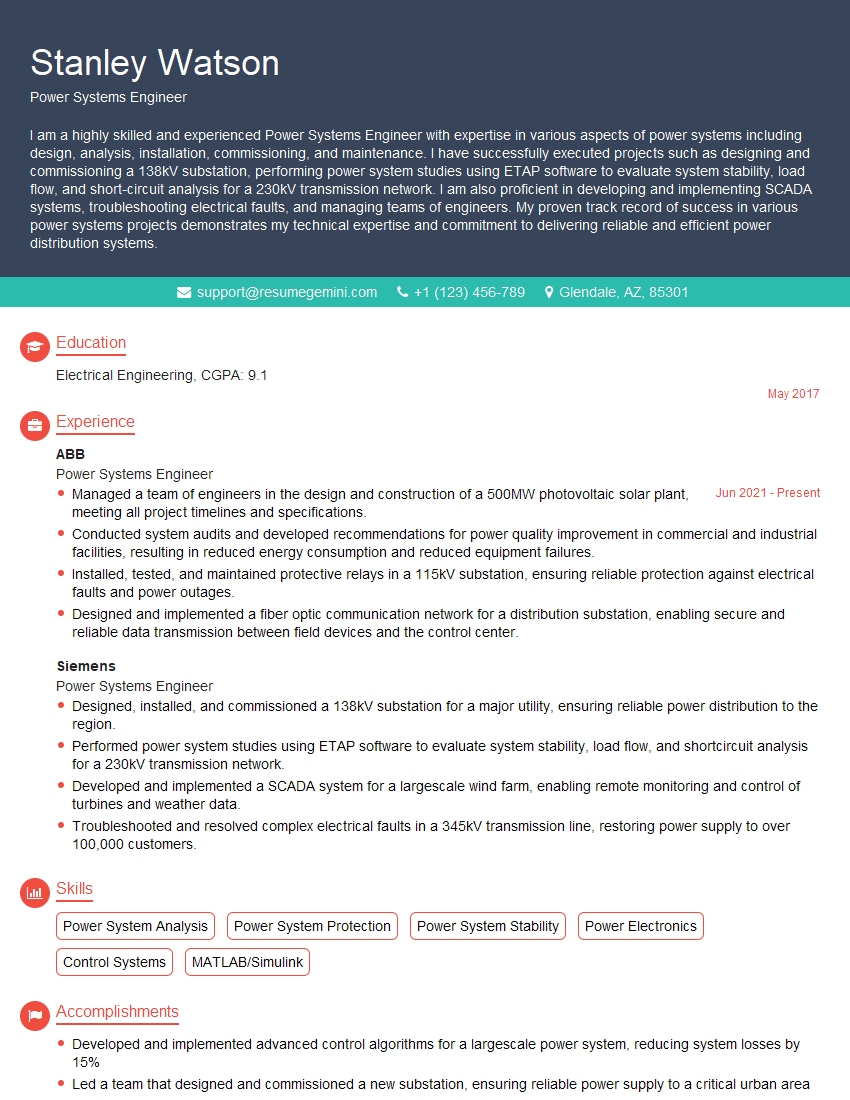
Mastering Power Management Techniques opens doors to exciting career opportunities in various sectors, including renewable energy, automotive, and industrial automation. A strong understanding of these techniques is highly sought after, making you a competitive candidate. To further enhance your job prospects, creating an ATS-friendly resume is crucial. ResumeGemini is a trusted resource that can help you build a professional and impactful resume, showcasing your skills and experience effectively. Examples of resumes tailored to Power Management Techniques are available to help guide you. Take advantage of these resources to elevate your job search and land your dream role.
Explore more articles
Users Rating of Our Blogs
Share Your Experience
We value your feedback! Please rate our content and share your thoughts (optional).
What Readers Say About Our Blog
Very informative content, great job.
good