Feeling uncertain about what to expect in your upcoming interview? We’ve got you covered! This blog highlights the most important Power Supply Design interview questions and provides actionable advice to help you stand out as the ideal candidate. Let’s pave the way for your success.
Questions Asked in Power Supply Design Interview
Q 1. Explain the difference between linear and switching power supplies.
Linear and switching power supplies represent two fundamentally different approaches to converting input voltage to a desired output voltage. Think of it like this: a linear regulator is like a water valve – it controls the flow of water (current) by partially restricting it, dissipating excess energy as heat. A switching regulator, on the other hand, acts like a pump that quickly turns on and off, delivering precisely controlled pulses of water (current). This allows for much greater efficiency.
Linear Power Supply: A linear regulator uses a simple transistor to regulate the output voltage. It works by maintaining a constant voltage drop across the transistor. This means any excess voltage is dissipated as heat, making them inherently inefficient, especially at higher input voltages. They are simple to design but are unsuitable for high-power applications.
Switching Power Supply (SMPS): An SMPS uses a switching element (typically a MOSFET) to rapidly switch the input voltage on and off. This chopped voltage is then filtered to produce a smooth DC output. By switching, the energy isn’t wasted as heat; it’s efficiently transferred to the output. This makes them much more efficient than linear regulators, especially for high-power applications. While more complex to design, the higher efficiency and smaller size make them dominant in modern electronics.
Q 2. What are the advantages and disadvantages of different power supply topologies (e.g., Buck, Boost, Buck-Boost, Flyback, Forward)?
Different power supply topologies offer varying advantages and disadvantages depending on the application requirements. Let’s examine some common ones:
- Buck Converter: This topology steps down the voltage. Advantages: High efficiency, simple design, good for low-voltage, high-current applications. Disadvantages: Output voltage is always less than input voltage.
- Boost Converter: This topology steps up the voltage. Advantages: Can achieve high output voltages, suitable for applications needing a voltage higher than the input. Disadvantages: Lower efficiency than buck converters, more complex control circuitry.
- Buck-Boost Converter: This topology can step the voltage up or down. Advantages: Versatile, can produce an output voltage higher or lower than the input. Disadvantages: More complex than buck or boost converters, can have lower efficiency.
- Flyback Converter: This topology uses a transformer for isolation, allowing for higher voltage isolation and smaller component sizes. Advantages: Galvanic isolation, high voltage conversion ratio. Disadvantages: Can be less efficient than other topologies, requires careful design of the transformer.
- Forward Converter: Similar to flyback, but energy is transferred directly to the output during the on-time of the switch, not stored in the transformer. Advantages: Simpler than flyback, can achieve higher efficiency. Disadvantages: Less common than flyback for high voltage isolation applications.
The choice of topology depends critically on the specific application constraints: input voltage range, required output voltage and current, efficiency requirements, size constraints, and cost.
Q 3. Describe the operation of a buck converter and its key components.
A buck converter, also known as a step-down converter, efficiently reduces a higher input voltage to a lower output voltage. Imagine it as a controlled switch that regulates the amount of energy passed to the output. It achieves this using a few key components:
- Switching Element (MOSFET): This rapidly switches on and off, controlling the flow of current to the inductor.
- Inductor (L): This stores energy when the switch is on and releases it when the switch is off, smoothing the output current.
- Capacitor (C): This filters the ripple current from the inductor, providing a smooth DC output voltage.
- Diode (D): This acts as a one-way valve, allowing current to flow to the output capacitor when the switch is off.
- Control IC: This regulates the duty cycle of the MOSFET based on feedback from the output voltage, ensuring stable output voltage despite load changes.
The operation is a cycle of switching the MOSFET on and off. When the MOSFET is on, current flows through the inductor, storing energy. When the MOSFET is off, the inductor releases this energy through the diode to the output capacitor. The duty cycle (the percentage of time the switch is on) determines the output voltage. A higher duty cycle results in a higher output voltage.
Q 4. How do you design for efficiency in a switching power supply?
Designing for efficiency in a switching power supply requires meticulous attention to detail at every stage. Think of it like minimizing friction in a machine – every small loss adds up. Key strategies include:
- Choosing efficient components: Use MOSFETs with low on-resistance (RDS(on)), low-ESR capacitors, and inductors with low DC resistance. These components directly impact power loss.
- Optimized switching frequency: A higher switching frequency reduces the size of the inductor and capacitor, but increases switching losses. A well-chosen frequency balances these trade-offs.
- Minimizing conduction losses: Lowering the on-resistance of MOSFETs and the DC resistance of inductors directly impacts conduction losses. Using appropriate gate drive circuits to minimize switching time also helps.
- Minimizing switching losses: Properly designing the gate drive circuit to minimize the time the MOSFET spends in its transition states (between fully on and fully off) reduces switching losses.
- Using synchronous rectification: Employing a second MOSFET in place of a diode for the freewheeling path, greatly reduces voltage drop and energy dissipation, especially at higher currents.
- Thermal management: Effective heat sinking and appropriate thermal design are crucial to ensure components operate within their safe temperature ranges and maintain efficiency.
Careful analysis of each component’s losses through simulations and measurements is essential to optimize for maximum efficiency.
Q 5. Explain the concept of power factor correction (PFC) and its importance.
Power Factor Correction (PFC) is a crucial aspect of power supply design, particularly for AC-DC converters. It addresses the issue of poor power factor caused by non-linear loads, such as SMPSs. Imagine trying to fill a bucket with water using a leaky bucket; you’re wasting water (power). Similarly, without PFC, significant power is wasted due to harmonic currents.
Importance: A low power factor leads to increased power losses in the power grid, inefficient use of energy, and potential penalties from utility companies. PFC improves the power factor closer to unity (1), reducing these problems. Furthermore, compliance with international standards often mandates PFC for certain power levels.
Q 6. What are the different types of PFC circuits?
There are primarily two types of PFC circuits:
- Passive PFC: This method uses simple components like capacitors and inductors to improve the power factor. It’s relatively inexpensive and simple to implement but provides limited improvement.
- Active PFC: This approach employs a boost converter to draw a nearly sinusoidal current from the AC line. It results in a much higher power factor compared to passive PFC and is often required for higher-power applications. Active PFC can achieve power factors of 0.95 or higher, significantly improving efficiency.
The choice between passive and active PFC depends on the desired power factor improvement, cost constraints, and regulatory requirements. High power applications necessitate active PFC for compliance and efficiency.
Q 7. How do you select appropriate components (e.g., inductors, capacitors, MOSFETs) for a power supply design?
Selecting appropriate components is critical for the performance and reliability of a power supply. This involves a careful consideration of several parameters:
- Inductors: Key parameters include inductance (L), saturation current (Isat), DC resistance (DCR), and core material. The inductor must handle the required current without saturating, minimizing losses due to DCR.
- Capacitors: Essential parameters are capacitance (C), equivalent series resistance (ESR), voltage rating, and ripple current rating. The capacitor needs sufficient capacitance to filter out ripple current and handle the expected ripple current without overheating.
- MOSFETs: Critical parameters include RDS(on), voltage rating, current rating, switching speed, and gate charge. The MOSFET needs sufficient current handling capability and a low RDS(on) to minimize conduction losses. Switching speed affects switching losses.
Component selection usually involves a trade-off between cost and performance. For instance, a lower RDS(on) MOSFET may be more expensive, but improves efficiency. Component datasheets must be carefully studied to ensure parameters meet the design specifications. Simulations and thermal analysis are crucial steps to validate the component choices and predict their performance under expected operating conditions.
Q 8. Explain the importance of thermal management in power supply design.
Thermal management in power supply design is paramount because excessive heat can drastically reduce component lifespan, leading to premature failure and system instability. Think of it like this: a car engine needs a cooling system; similarly, a power supply needs effective heat dissipation to operate reliably. Components like transistors, diodes, and capacitors generate heat during operation due to power losses. If this heat isn’t managed properly, it causes the internal temperature to rise beyond their operational limits, leading to decreased efficiency, performance degradation, and potential catastrophic failure. Effective thermal management strategies include:
- Appropriate heatsinks: These increase the surface area for heat dissipation, allowing for more efficient cooling. The size and material of the heatsink are crucial and must be chosen based on power dissipation and ambient temperature.
- Fans: Forced-air cooling with fans helps accelerate the heat transfer away from components. The fan’s airflow rate and placement are crucial design considerations.
- Thermal interface materials (TIMs): These materials, such as thermal grease or pads, improve thermal conductivity between heat-generating components and their heatsinks, ensuring effective heat transfer.
- Convection and conduction: The design of the power supply enclosure needs to promote natural convection by having adequate space for air circulation. Conductive paths are also carefully considered to route heat away from sensitive components.
Proper thermal management extends the lifespan of the power supply, improves reliability, enhances efficiency, and ensures safety by preventing overheating-related hazards.
Q 9. How do you design for EMI/EMC compliance in a power supply?
Designing for EMI/EMC (Electromagnetic Interference/Electromagnetic Compatibility) compliance is crucial for preventing power supplies from emitting or being susceptible to unwanted electromagnetic radiation. This is essential to avoid interference with other electronic devices and to meet regulatory standards. Imagine a radio constantly being interrupted by static – that’s what EMI can cause to nearby electronics. Key design strategies include:
- Shielding: Using conductive enclosures or shielding materials to prevent electromagnetic radiation from escaping or entering the power supply. Metal enclosures are commonly used for this purpose.
- Filtering: Implementing input and output filters to attenuate high-frequency noise. These filters typically use capacitors and inductors arranged in specific configurations, such as Pi filters or L-filters.
- Layout considerations: Careful PCB layout is crucial to minimizing EMI. This involves keeping high-frequency signal traces short, using ground planes effectively to reduce loop areas, and separating sensitive and noisy components. For example, switching transistors should be placed strategically to minimize radiated emissions.
- Common-mode chokes: These are used to suppress common-mode noise present on input lines, which can propagate to other devices.
- Proper grounding: Establishing a low-impedance ground plane to minimize ground loops and ensure proper signal integrity.
Testing, such as conducted and radiated emission tests, is done to ensure the power supply meets relevant standards like CISPR 22, FCC Part 15, or IEC 61000-4.
Q 10. What are common troubleshooting techniques for power supply issues?
Troubleshooting power supply issues requires a systematic approach. Imagine a car that won’t start – you wouldn’t just randomly start replacing parts. Similarly, a methodical approach is crucial for power supply diagnostics. Here’s a typical workflow:
- Visual inspection: Check for obvious signs of damage, such as burnt components, loose connections, or bulging capacitors. This simple step can often pinpoint the problem quickly.
- Input voltage measurement: Verify that the input voltage is within the acceptable range. A low input voltage can lead to many problems.
- Output voltage measurement: Check if the output voltage(s) are correct. Use a digital multimeter (DMM) to accurately measure the voltage and compare it to the expected value. Look for excessive ripple or noise.
- Current measurement: Measure the current drawn by the load. An abnormally high current could indicate a short circuit in the load.
- Component testing: Use a DMM or specialized component testers to check individual components like capacitors, diodes, and transistors. This helps isolate faulty components.
- Signal tracing: Use an oscilloscope to analyze voltage waveforms and identify any anomalies, such as excessive ripple or switching noise.
- Thermal analysis: Check the temperature of components using a thermal camera or a thermocouple. Excessive heat is a clear indication of a problem.
Troubleshooting involves careful observation, measurement, and analysis. Keeping good documentation during the process can greatly assist in pinpointing and resolving the issue.
Q 11. Explain the concept of voltage regulation and its importance.
Voltage regulation refers to the ability of a power supply to maintain a constant output voltage despite variations in input voltage or load current. Think of it as a faucet that maintains a consistent water flow rate even when the water pressure fluctuates. It’s incredibly important because many electronic circuits require a stable voltage to operate correctly. Fluctuations in voltage can lead to malfunction, data corruption, and even damage to sensitive components. A good voltage regulator ensures that the output voltage remains within a specified tolerance, protecting the connected devices and improving system reliability. The level of regulation is usually expressed as a percentage or as a specific voltage range.
Q 12. What are the different types of voltage regulators?
There are several types of voltage regulators, each with its own advantages and disadvantages:
- Linear regulators: These regulators work by dissipating excess voltage as heat. They are simple to design but can be inefficient, especially at higher input voltages or current.
- Switching regulators: These regulators use switching elements (transistors) to efficiently convert input voltage to output voltage. They offer much higher efficiency than linear regulators but are more complex to design.
- Buck regulators (step-down): Reduce the input voltage to a lower output voltage.
- Boost regulators (step-up): Increase the input voltage to a higher output voltage.
- Buck-boost regulators: Can either increase or decrease the input voltage.
- Charge pump regulators: Use capacitors to generate higher or lower voltages, typically used for small voltage increases or inversions. Often found in low-power applications.
The choice of regulator type depends on factors like input voltage, output voltage, required current, efficiency requirements, and complexity constraints.
Q 13. How do you calculate the efficiency of a power supply?
The efficiency of a power supply is the ratio of output power to input power, expressed as a percentage. It indicates how much of the input power is effectively converted to useful output power, while the rest is lost as heat. A higher efficiency is desirable, as it minimizes energy waste and reduces heat generation. The formula for calculating efficiency (η) is:
η = (Output Power / Input Power) * 100%Where:
- Output Power = Output Voltage (Vout) * Output Current (Iout)
- Input Power = Input Voltage (Vin) * Input Current (Iin)
For example, if a power supply has an input voltage of 230V and draws 1A, the input power is 230W. If the output voltage is 5V at 20A, then the output power is 100W. The efficiency would be (100W / 230W) * 100% = 43.5%. Higher efficiency power supplies are generally achieved through sophisticated switching topologies and optimized component selection.
Q 14. Explain the concept of ripple voltage and how to minimize it.
Ripple voltage is the unwanted AC component superimposed on the DC output of a power supply. Imagine listening to a radio and hearing a faint hum – that’s analogous to ripple voltage. It’s undesirable because it can interfere with the operation of sensitive electronic circuits. High ripple voltage can cause malfunction, noise, and instability. Minimizing ripple voltage involves:
- Larger filter capacitors: Capacitors are used to smooth the output voltage by storing energy during the peaks of the rectified waveform and releasing it during the troughs. Larger capacitance reduces the ripple voltage.
- Low-ESR capacitors: Equivalent series resistance (ESR) in the capacitor contributes to ripple voltage. Using capacitors with low ESR minimizes this effect.
- LC filters: Combining inductors and capacitors in a filter network effectively suppresses ripple voltage, especially at higher frequencies.
- Proper design of switching regulators: In switching regulators, ripple voltage is mainly determined by the switching frequency and the filter components. Choosing appropriate switching frequencies and careful filter design are crucial.
- Optimized control loops: In some regulators, feedback loops are used to actively minimize ripple voltage by dynamically adjusting the output voltage.
Ripple voltage is usually measured using an oscilloscope and should be kept within the specifications of the connected circuitry.
Q 15. Describe different protection mechanisms used in power supplies (e.g., over-current, over-voltage, short-circuit protection).
Power supply protection mechanisms are crucial for ensuring the safety of both the power supply itself and the connected equipment. They act as safeguards against various fault conditions. Common protection mechanisms include:
- Over-current protection: This prevents excessive current from flowing through the circuit. It typically involves a current-sensing element (e.g., a current transformer or shunt resistor) that triggers a shutdown mechanism (e.g., a fuse, circuit breaker, or electronic switch) when the current exceeds a predefined limit. Think of it like a circuit breaker in your home – it trips to prevent a fire hazard if too much current is drawn.
- Over-voltage protection: This protects against voltage spikes or surges that can damage sensitive components. Zener diodes, clamping circuits, or active voltage regulators can be employed. Similar to a surge protector for your electronics, it absorbs excess voltage, preventing damage to your device.
- Short-circuit protection: This handles the scenario where the output terminals are directly connected, resulting in a very high current. Similar mechanisms as over-current protection are used, but the response time is often faster due to the potentially destructive nature of a short circuit.
- Over-temperature protection: This protects against excessive heat buildup within the power supply, often using a thermistor to monitor the temperature and trigger a shutdown if a threshold is exceeded. Think of it as a safety thermostat preventing overheating.
- Under-voltage lockout (UVLO): This prevents the power supply from operating if the input voltage is too low. This is essential to protect the power supply’s components from damage and to ensure reliable operation.
These protection mechanisms usually work in coordination, providing multiple layers of safety. The choice of mechanism and its design parameters depend on the specific application and the power supply’s specifications.
Career Expert Tips:
- Ace those interviews! Prepare effectively by reviewing the Top 50 Most Common Interview Questions on ResumeGemini.
- Navigate your job search with confidence! Explore a wide range of Career Tips on ResumeGemini. Learn about common challenges and recommendations to overcome them.
- Craft the perfect resume! Master the Art of Resume Writing with ResumeGemini’s guide. Showcase your unique qualifications and achievements effectively.
- Don’t miss out on holiday savings! Build your dream resume with ResumeGemini’s ATS optimized templates.
Q 16. How do you perform load transient analysis for a power supply?
Load transient analysis assesses how a power supply responds to sudden changes in load current. It’s crucial for ensuring stability and meeting performance requirements. The process typically involves:
- Defining Load Transient Profiles: Identify the expected changes in load current, including magnitude, duration, and frequency. This often requires understanding the application’s load characteristics.
- Simulating the Transient Response: Use simulation tools like LTSpice or PSIM to model the power supply and apply the defined load transient profiles. This involves accurately modeling the power supply’s components (switches, inductors, capacitors, controllers), as well as the load itself.
- Analyzing Output Voltage and Current: Observe the output voltage and current waveforms during the transient. Key parameters to examine include overshoot, undershoot, settling time, and the maximum allowable ripple.
- Optimizing Control Loop: If the transient response doesn’t meet specifications (e.g., excessive overshoot or slow settling time), the control loop parameters (e.g., compensator gains, loop bandwidth) need to be adjusted. This iterative process involves simulation and analysis until the desired performance is achieved.
- Hardware Verification: After successful simulation, the power supply should be tested under real-world load transients to validate the design. A load transient generator is typically used to apply realistic load changes.
For example, a server power supply needs to handle rapid load changes as servers spin up and down. Accurate load transient analysis is paramount to ensure the power supply can maintain a stable output voltage despite these fluctuations.
Q 17. What are the different types of feedback control loops used in power supplies?
Power supplies employ various feedback control loops to regulate the output voltage and/or current. The most common types are:
- Voltage-Mode Control: This is the simplest and most common type. It directly regulates the output voltage by comparing it to a reference voltage and using the error signal to adjust the duty cycle of the switching element. Think of a thermostat – it senses the temperature and adjusts the heating or cooling based on the difference from the setpoint.
- Current-Mode Control: This focuses on regulating the inductor current, indirectly controlling the output voltage. It provides faster transient response and better line and load regulation but can be susceptible to subharmonic oscillations if not carefully designed. It’s like controlling a car’s speed by monitoring the engine’s RPM rather than the car’s speed directly.
- Hysteresis Control: This type uses a simple comparator that switches the control signal based on whether the inductor current falls within a defined band. It is simple to implement but can lead to variable switching frequency, making noise and EMI filtering more challenging. It’s like a simple on/off switch responding to a specific range.
- Average Current Mode Control: This is a variation of current mode control, offering improved stability and efficiency compared to the basic current mode control. It’s often used for high-power applications because it limits peak current stresses.
The choice of control loop depends on various factors, including the power supply’s specifications, efficiency requirements, cost constraints, and transient response needs. Complex power supplies might even combine several control loops for optimal performance.
Q 18. Explain the design considerations for high-frequency switching power supplies.
High-frequency switching power supplies offer advantages in size and weight reduction compared to their lower-frequency counterparts. However, designing them requires addressing specific challenges:
- Switching Losses: Higher switching frequencies lead to increased switching losses in the power semiconductors. This necessitates careful selection of components with low on-resistance and fast switching speeds. Efficient gate drivers are also crucial.
- EMI/RFI Noise: High-frequency switching generates significant electromagnetic interference (EMI) and radio frequency interference (RFI). Careful layout, shielding, and the use of EMI filters are essential to meet regulatory standards.
- Component Selection: Choosing appropriate components is critical. High-frequency operation requires components with lower parasitic capacitances and inductances. High-speed diodes and specialized gate drivers are often needed.
- Thermal Management: Increased switching losses result in greater heat generation, requiring effective thermal management solutions, such as heat sinks and fans. High-frequency designs often necessitate advanced thermal analysis and design strategies.
- Layout Considerations: The PCB layout is crucial to minimize EMI and optimize performance. Careful attention should be paid to trace lengths, ground planes, and component placement. Control loops and high-frequency switching signals need to be separated properly.
For instance, the design of a laptop power adapter necessitates a high-frequency design to minimize size and weight while meeting stringent efficiency and EMI regulations. These considerations highlight the importance of holistic design that considers power electronic design, PCB layout, thermal management, and EMI control in an integrated manner.
Q 19. What are the trade-offs between different power supply topologies?
Several power supply topologies exist, each with its own strengths and weaknesses. The trade-offs involve efficiency, cost, size, complexity, and controllability:
- Buck Converter: Simple, efficient for step-down applications, but limited to output voltages lower than the input. Commonly used in DC-DC converters for computers.
- Boost Converter: Efficient for step-up applications, but can have higher voltage stress on components. Used in applications requiring a higher output voltage than input, like battery chargers.
- Buck-Boost Converter: Can step up or step down voltage, more complex than buck or boost. Suitable for situations requiring adjustable output voltage.
- Flyback Converter: Simple, isolates the input and output, suitable for high-voltage applications but lower efficiency. Commonly found in off-line power supplies.
- Forward Converter: Similar to flyback but with a higher efficiency. Usually more complex to control.
- Full-Bridge Converter: Higher efficiency at higher power levels than other topologies but more complex control and higher component count. Used in high-power applications.
The selection depends on the specific application requirements. For example, a high-efficiency, low-cost application might favor a buck converter, while a high-voltage application requiring isolation might use a flyback converter. Cost, efficiency, component count, and complexity need to be considered before choosing a topology.
Q 20. How do you perform power supply simulations using software tools (e.g., LTSpice, PSIM)?
Power supply simulations using software like LTSpice or PSIM are essential for verifying the design’s performance before building a prototype. The steps generally include:
- Schematic Entry: Create the power supply schematic using the software’s component libraries. Accurately model all components, including their parasitic elements (like ESR of capacitors and DCR of inductors).
- Parameter Definition: Specify component values and operational parameters (e.g., input voltage, output voltage, load current). Choose accurate component models from the libraries to enhance simulation accuracy.
- Simulation Setup: Define the simulation type (e.g., transient analysis, AC analysis, noise analysis). Specify the simulation duration and other parameters as required by the particular analysis.
- Simulation Run: Execute the simulation and observe the results. Monitor key waveforms like output voltage, current, and switching node voltages.
- Analysis and Optimization: Analyze the simulation results to assess the design’s performance. Modify parameters and component values iteratively to optimize the design’s efficiency, stability, and transient response. For example, adjust compensator components in the control loop for better transient behavior.
- Verification and Validation: Compare the simulated results with the specifications. If discrepancies exist, refine the model or design until satisfactory results are achieved. This step ensures that the simulation adequately represents the real-world behavior.
For example, to simulate a buck converter, you’d model the MOSFET, inductor, diode, and control circuit in LTSpice. By running a transient analysis, you could observe the output voltage ripple, efficiency, and transient response to load changes.
Q 21. Explain the concept of magnetic design in power supplies.
Magnetic design is a critical aspect of power supply design, focusing on the inductors and transformers. The key considerations include:
- Core Material Selection: The core material significantly affects the inductor’s or transformer’s performance and efficiency. Factors include saturation flux density, core losses, and cost. Ferrite cores are common for high-frequency applications, while powdered iron cores are suitable for lower frequencies.
- Core Geometry: The core’s shape and size affect inductance, saturation current, and magnetic field leakage. Different core shapes (E-I, toroidal, pot core) offer different trade-offs.
- Winding Design: The number of turns, wire gauge, and winding technique determine the inductance and losses. Interleaved windings can improve the performance and reduce losses in high-current applications.
- Air Gap: An air gap is often introduced to control the inductance and prevent core saturation. The gap’s size is a critical design parameter, affecting inductance and core losses.
- Losses: Magnetic components suffer from core losses (hysteresis and eddy current losses) and copper losses (resistance of the windings). Minimizing these losses is essential for efficiency.
Magnetic design involves trade-offs between size, weight, cost, and performance. Simulation tools can help optimize the design, predicting performance before physical prototyping. Accurate modeling of core losses is crucial for predicting efficiency.
Q 22. How do you choose the appropriate switching frequency for a power supply?
Choosing the right switching frequency for a power supply is a crucial design decision that impacts efficiency, cost, and size. It’s a balancing act between several factors. Think of it like choosing the right gear for a bicycle – too low, and you’re inefficient; too high, and things get noisy and inefficient again.
- Efficiency: Higher frequencies generally lead to smaller components (inductors and capacitors), reducing losses. However, extremely high frequencies increase switching losses in the transistors themselves, diminishing efficiency gains. The sweet spot is often found in the range of 50kHz to 500kHz for many applications.
- Component Size and Cost: Higher frequencies allow for smaller magnetics (inductors) and capacitors. Smaller components mean a smaller, cheaper PCB. But very high frequencies demand more expensive, specialized components capable of handling the faster switching speeds.
- EMI/EMC: Higher frequencies generate more electromagnetic interference (EMI). Careful design, including shielding and filtering, is essential to meet regulatory standards (like those from UL, IEC, and EN). A lower frequency can simplify the EMI filtering process.
- Audio Noise: Switching frequencies can generate audible noise. It’s critical to choose a frequency that is outside the range of human hearing (generally above 20kHz) or to employ techniques to minimize audible noise.
In practice, I typically start with a frequency range based on the application’s power level and requirements. Then, I use simulations and prototyping to refine the choice, optimizing for efficiency, component costs, and EMI compliance. For example, a low-power application for a portable device might use a lower frequency (e.g., 50kHz), while a high-power server supply might operate at a higher frequency (e.g., 300kHz) to reduce component size.
Q 23. What are some common failure modes of power supplies?
Power supplies, while seemingly simple, are complex systems prone to various failure modes. These can be broadly categorized as:
- Component Failures: This is the most common cause, encompassing failures of capacitors (electrolytic capacitor bulging or leakage being particularly prevalent), inductors (short circuits or open circuits), transistors (overheating or short circuits), diodes (short circuits or open circuits), and other passive components (resistors, fuses).
- Thermal Issues: Overheating can lead to component degradation, solder joint failures, or even fire hazards. This is often exacerbated by poor thermal management – insufficient heatsinking or inadequate airflow.
- Overvoltage/Undervoltage Events: Protection circuits can fail, leading to excessive voltage on the output or insufficient voltage for the load, causing damage to the load or the power supply itself. This is often caused by faulty feedback loops or other control circuitry issues.
- Short Circuits: A short circuit anywhere in the power supply, either internally or externally (due to a faulty load), can lead to catastrophic failures. Proper protection circuitry, like fuses and overcurrent protection, is essential.
- EMI/EMC-related Issues: Poorly designed power supplies can radiate excessive electromagnetic interference, disrupting nearby equipment. This could lead to a failure of equipment, not necessarily the power supply itself, however, regulatory non-compliance may result in the supply being deemed unsafe.
Identifying failure modes requires a systematic approach, encompassing thorough testing (discussed in a later response) and careful analysis of failure symptoms. Root cause analysis is critical to prevent similar failures in the future.
Q 24. Describe your experience with PCB layout considerations for power supplies.
PCB layout is paramount in power supply design; it directly impacts performance, efficiency, and reliability. Think of it as the ‘plumbing’ of the power supply – if poorly designed, the system won’t work effectively.
- Power Plane Design: Wide, low-impedance power and ground planes are crucial to minimize voltage drops and noise. These planes act as reservoirs of power, ensuring stable voltage to the components. It’s like having a large water tank – you won’t experience large pressure fluctuations during use.
- Component Placement: Critical components, particularly high-speed switching transistors, should be placed close to their associated components, minimizing trace lengths and inductance. This reduces switching noise and improves efficiency.
- Routing Considerations: High-current traces need to be wide and thick to minimize resistive losses. Sensitive analog circuitry should be separated from high-frequency switching circuitry using appropriate shielding and grounding techniques to minimize noise coupling.
- EMI/EMC Considerations: Careful routing and component placement are essential to minimize EMI radiation. Techniques like using ferrite beads and filtering components are vital. It is important to account for compliance testing early in the design process.
- Thermal Management: PCB layout should facilitate effective heat dissipation. Components generating significant heat should be placed where airflow is maximized. Copper planes can act as effective heat sinks.
In my experience, I use tools like Altium Designer and Allegro to design PCBs, leveraging their advanced capabilities for power plane design, thermal analysis, and signal integrity simulations. I always design with testability in mind. Adding test points makes debugging and troubleshooting much easier.
Q 25. How do you handle thermal design challenges in high-power applications?
Thermal management is particularly challenging in high-power applications. Overheating can lead to catastrophic component failures and system instability. It’s similar to how a car engine needs a cooling system to prevent overheating.
- Heatsinks: These are essential for dissipating heat from power transistors and other high-power components. The design of the heatsink – size, material, and surface area – is crucial. Larger surface area is always better.
- Thermal Interface Materials (TIMs): TIMs, such as thermal grease or pads, ensure effective heat transfer between the component and the heatsink. Air gaps between the components and the heatsink drastically reduces heat transfer efficiency.
- Forced Air Cooling: Fans can significantly improve heat dissipation, especially in high-power applications. Careful design of airflow paths within the enclosure is needed.
- Thermal Simulation: Software tools allow for detailed thermal simulation to predict temperature profiles and identify potential hotspots. This helps to optimize the heatsink design and airflow path before building the actual system.
- Conduction Cooling: For higher power applications, conduction cooling using a heat pipe can be beneficial in transferring heat away from the high-power components.
I use thermal simulation software like ANSYS and FloTHERM to model the thermal behavior of high-power designs. This allows for iterative design improvements, minimizing the risk of overheating issues in the final product.
Q 26. Explain your experience with different power supply testing and validation methods.
Testing and validation are crucial for ensuring the reliability and safety of a power supply. It’s like test driving a car before purchase.
- Functional Testing: This involves verifying that the power supply meets its specified output voltage, current, and efficiency requirements under various load conditions. These tests should include load transients, short-circuit protection, and overvoltage protection tests.
- EMI/EMC Testing: This is critical for ensuring compliance with regulatory standards. Measurements include conducted and radiated emissions, as well as susceptibility testing.
- Thermal Testing: This involves measuring the temperatures of key components under various operating conditions to identify potential hotspots and verify adequate cooling.
- Reliability Testing: This usually involves accelerated life testing, such as high-temperature operating life (HTOL) tests, to assess the long-term reliability of the components.
- Safety Testing: This ensures the power supply meets safety standards and includes high-voltage insulation testing, dielectric strength testing, and ground continuity testing.
I have extensive experience using test equipment like oscilloscopes, power analyzers, spectrum analyzers, and thermal cameras to perform these tests. Automated testing is also used wherever possible to improve testing throughput and consistency. Test reports document every aspect of testing and are essential for compliance with standards.
Q 27. Describe your experience with regulatory standards relevant to power supply design (e.g., UL, IEC, EN).
Regulatory compliance is a non-negotiable aspect of power supply design. Failure to meet standards can lead to product recalls, legal issues, and reputational damage. It’s like building a house to code.
- UL (Underwriters Laboratories): UL standards cover safety aspects of electrical products, ensuring they don’t pose a fire or shock hazard. This often involves stringent testing for overvoltage, overcurrent, and insulation resistance.
- IEC (International Electrotechnical Commission): IEC standards are international standards addressing various aspects of electrical safety and performance. These are often adopted by national regulatory bodies.
- EN (European Norms): EN standards are European standards, often harmonized with IEC standards, covering safety and electromagnetic compatibility (EMC).
- Other Regional Standards: There are many other regional standards that may need to be considered depending on the intended market, such as the FCC (Federal Communications Commission) regulations in the US for EMI.
In my experience, I’m proficient in understanding and implementing the necessary design measures to ensure compliance with relevant standards. This includes designing for appropriate clearances, creepage distances, insulation materials, and EMI/EMC filtering. I work closely with testing labs to ensure all products meet the required standards before they are released to market. A detailed understanding of the standards and their impact on the design process is paramount throughout the project lifecycle.
Key Topics to Learn for Power Supply Design Interview
- Fundamentals of Power Conversion: Understanding different topologies like linear regulators, switching regulators (buck, boost, buck-boost, etc.), and their applications in various systems.
- Practical Application: Analyzing efficiency, thermal management, and component selection for specific power supply designs based on load requirements and specifications. This includes understanding power dissipation and heatsink design.
- Control Loop Design: Grasping the principles of feedback control, stability analysis, and compensation techniques to ensure stable and efficient operation of switching regulators.
- EMI/EMC Considerations: Familiarity with electromagnetic interference and compatibility standards and techniques for minimizing noise and ensuring compliance.
- Power Supply Simulation and Modeling: Proficiency in using simulation tools (e.g., SPICE) to analyze and optimize power supply designs before physical prototyping.
- Troubleshooting and Diagnostics: Developing problem-solving skills to identify and resolve issues in power supply circuits through systematic analysis and measurement techniques.
- Safety Standards and Regulations: Knowledge of relevant safety standards (e.g., UL, IEC) and regulatory compliance for power supply designs.
- Advanced Topics (for senior roles): Exploring concepts like digital power control, power factor correction (PFC), and multi-phase converters.
Next Steps
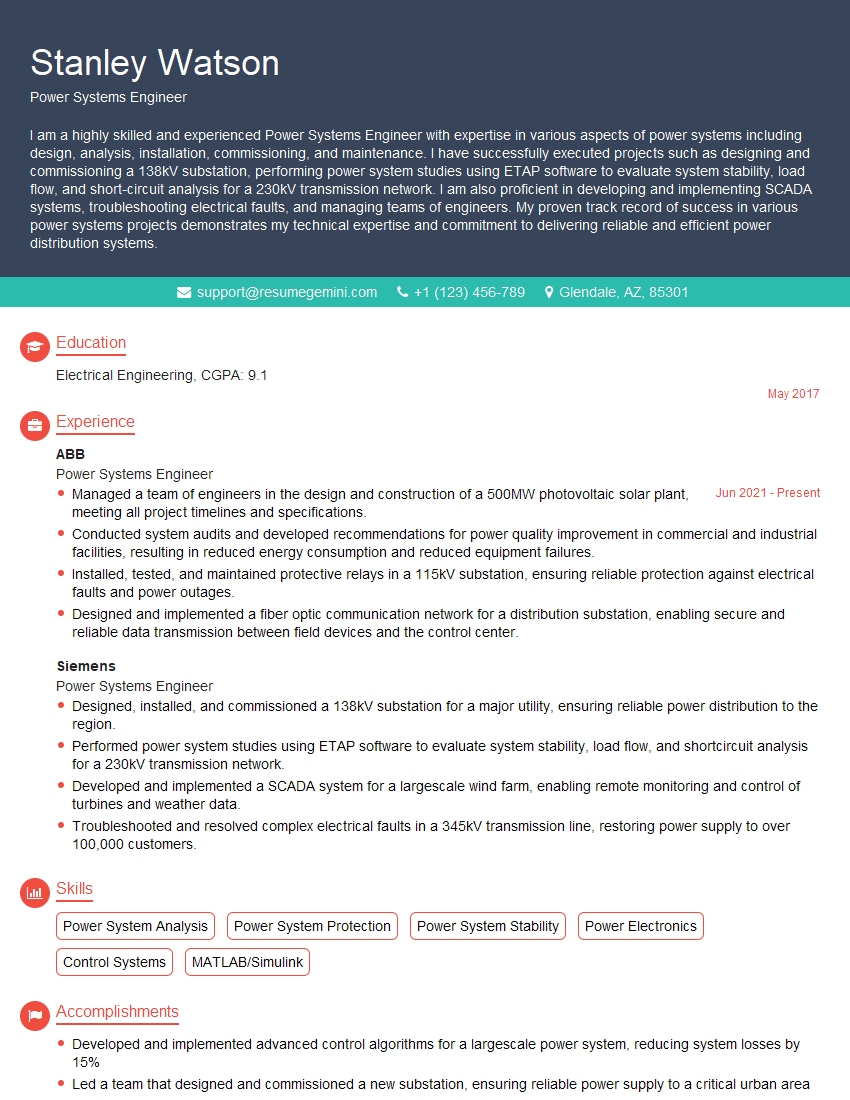
Mastering Power Supply Design opens doors to exciting and rewarding careers in various industries, from consumer electronics to renewable energy. A strong understanding of these concepts is highly valued by employers and significantly enhances your career prospects. To make your skills shine, invest time in crafting an ATS-friendly resume that effectively showcases your expertise. ResumeGemini is a trusted resource that can help you create a professional and impactful resume. We provide examples of resumes tailored specifically to Power Supply Design to give you a head start. Take the next step in your career journey – build a winning resume with ResumeGemini!
Explore more articles
Users Rating of Our Blogs
Share Your Experience
We value your feedback! Please rate our content and share your thoughts (optional).
What Readers Say About Our Blog
Very informative content, great job.
good