Cracking a skill-specific interview, like one for Reed Making and Repair, requires understanding the nuances of the role. In this blog, we present the questions you’re most likely to encounter, along with insights into how to answer them effectively. Let’s ensure you’re ready to make a strong impression.
Questions Asked in Reed Making and Repair Interview
Q 1. Describe the different types of cane used in reed making.
The type of cane used significantly impacts a reed’s sound and responsiveness. We primarily use Arundo donax, also known as giant reed, for its strength, elasticity, and acoustic properties. However, even within Arundo donax, there’s variation. Cane from different regions, even different parts of the same field, will have subtle differences in density and hardness.
- Hard Cane: Denser, providing a brighter, more resistant tone. It’s ideal for reeds requiring a strong projection, like those used in a loud orchestral setting.
- Medium Cane: A balance of hardness and flexibility, offering versatility and a good response across a range of dynamics. Many players prefer this for its all-around usability.
- Soft Cane: Less dense, offering a darker, more mellow tone with a quicker response. This is often preferred for chamber music or solo work where a more intimate sound is desirable.
The age and growing conditions of the cane also affect its properties. Older cane is generally harder, while cane grown in drier conditions tends to be denser than cane grown in more humid climates. Recognizing these variations is crucial for selecting the right cane for a specific instrument and playing style.
Q 2. Explain the process of gouging a reed.
Gouging is the initial shaping of the cane blank, creating the basic profile of the reed. It’s a crucial step because it lays the foundation for the reed’s overall responsiveness and tone. I typically use a specialized gouging knife, holding the cane blank firmly and carefully removing material to achieve the desired thickness and curvature.
The process begins with determining the thickness of the cane blank based on the instrument and player’s preference. Then, I use the gouging knife to progressively remove material, paying attention to the overall shape and ensuring uniformity. The process requires a steady hand and a keen eye for detail. The gouging should be even and consistent, avoiding any sudden changes in thickness or shape. Think of it like sculpting – each stroke gradually reveals the desired form.
Once the initial gouging is complete, I usually use a mandrel to help maintain a consistent profile while working on the more refined shaping process. The mandrel serves as a reliable guide, ensuring that the reed’s curvature remains consistent across its length. The experience guides my intuition as I proceed, as each reed needs specific care and attention.
Q 3. What are the common issues encountered during reed making?
Reed making, especially at a professional level, presents a few common challenges. One frequent problem is uneven gouging, leading to inconsistencies in the reed’s response and tone. This often stems from a lack of control or pressure during the initial shaping.
- Cracks and splits in the cane: This can occur due to improper handling, overly aggressive shaping, or using cane with inherent weaknesses.
- Reed too hard or too soft: This is directly related to the cane selection and the level of material removed during gouging and scraping. Experience helps in determining the correct amount.
- Difficult to tune or unstable response: This often indicates a problem with the tip opening, the length of the cane blank, or inconsistencies in the overall profile of the reed. Often requires adjustments with scraping and fine tuning.
- Wobbling or uneven vibrations: This might stem from slight imperfections in the shaping process, particularly in the blade or the heart (the thickest part).
Addressing these issues requires a combination of careful attention to detail, a well-maintained set of tools, and a solid understanding of cane behavior. Regular practice and refinement of technique are key to mitigating these issues.
Q 4. How do you achieve the desired thickness and profile of a reed?
Achieving the desired thickness and profile is paramount. It’s a balance of art and science. The thickness determines the reed’s stiffness and resistance, while the profile dictates the airflow and the resulting sound. We achieve this through a combination of tools and techniques.
Thickness: The initial gouging sets the overall thickness, but fine-tuning is done through careful scraping. Specialized files and scraping tools are used to gradually remove small amounts of material from specific areas. Measuring tools like calipers are essential for maintaining consistent thickness across the reed, particularly at the tip and the heart. I often use various measuring tools to make sure all sections are correctly shaped.
Profile: The profile is refined using similar scraping techniques, shaping the reed’s curvature to influence the air flow. The mandrel helps establish the profile during the initial shaping and plays a vital role in consistent curve control. A slight change in profile can significantly impact the reed’s response and sound. This part requires meticulous work; even minor changes are significant. The profile influences the flexibility and the way the reed interacts with the mouthpiece.
Experience plays a crucial role in determining the optimal thickness and profile. Over time, you develop an intuition for how different adjustments will affect the reed’s playing characteristics.
Q 5. Describe different methods for shaping and scraping a reed.
Shaping and scraping are refined processes integral to reed making. Multiple techniques and tools are employed.
- Scraping: This is predominantly done using specialized scraping knives or files. The goal is to remove very small amounts of material to fine-tune the thickness and profile of the reed, achieving a smooth, even surface. Different types of knives, ranging from curved to flat, have unique properties and are well suited for different stages and aspects.
- Filing: Files are typically used to remove larger amounts of material at initial stages of refinement, before scraping takes over for final adjustments.
- Sanding: Fine sandpaper is used to achieve a very smooth surface, reducing friction and improving the reed’s responsiveness. This is important because any inconsistencies during sanding could produce unwanted vibration.
- Using a mandrel: A mandrel is a cylindrical tool used to shape and maintain the reed’s curvature as one works on the shaping processes.
The choice of technique depends on the desired outcome and the specific area being worked on. For example, scraping is generally preferred for making subtle adjustments to the tip, while filing might be more appropriate for correcting significant imperfections in the overall thickness. A combination of these techniques is commonly applied in crafting the perfect reed.
Q 6. How do you test and adjust the reed’s playing characteristics?
Testing and adjusting a reed’s playing characteristics involve a combination of subjective evaluation and objective measurements. The subjective part relies on playing the reed, assessing its response, tone quality, and overall feel. I look for factors like ease of response, intonation across the range, evenness of tone, and overall projection.
Objective assessment can include using a reed-measuring gauge to check the tip opening and overall thickness. These measurements give a quantifiable aspect to the overall assessment, assisting in fine-tuning the reed. Once the reed shows promising signs, I’ll play it extensively on the instrument and make small adjustments such as:
- Adjusting the tip opening: This affects the reed’s resistance and responsiveness, which requires very precise adjustment.
- Refining the scraping: Scraping can remove material from the reed and improve the response or tone, for instance, if the reed feels too stiff.
- Modifying the curve: Fine adjustments to the reed’s curve can modify its vibration behavior.
It’s an iterative process: I test, adjust, test again, until I achieve the desired balance of responsiveness, tone quality, and intonation. This process depends on the specific instrument and the player’s requirements.
Q 7. Explain the importance of cane moisture content in reed making.
Cane moisture content is absolutely crucial. Cane is a hygroscopic material, meaning it absorbs and releases moisture from the surrounding environment. This impacts its stiffness and elasticity, directly influencing the reed’s performance.
Proper moisture content ensures the reed is neither too stiff (dry) nor too soft (wet). A reed that’s too dry will be hard to play, unresponsive, and produce a harsh tone. Conversely, a reed that’s too wet will be unstable, prone to buzzing, and may not produce a clear tone. The ideal moisture content is often achieved by storing the reed blanks in controlled humidity to allow the cane to acclimate and reach a stable state.
Maintaining a suitable environment is crucial for both reed making and reed playing. Fluctuations in humidity can drastically affect the reed’s behavior, making it challenging to maintain consistency in tone and response. Therefore, a well-controlled environment during the entire process is critical. This applies not only to storing the reed blanks, but also to the work environment where reed making occurs and how the finished reed is stored and maintained after completion.
Q 8. How do you identify and repair cracks in a reed?
Identifying and repairing cracks in a reed requires a keen eye and a steady hand. Small cracks, often hairline fractures, can significantly impact the reed’s performance, leading to leaks and inconsistent tone. Larger cracks may require more extensive repair or replacement.
Identification: I use a strong magnifying glass or a jeweler’s loupe to thoroughly examine the reed, paying close attention to the tip, the vamp (the area near the tip), and the sides. Cracks often appear as thin lines, sometimes barely visible to the naked eye. They might be accompanied by a slight discoloration or a change in the cane’s texture. Feeling the reed gently can also help identify a crack, as there may be a subtle difference in surface smoothness.
Repair: Minor cracks, especially those not affecting the playing surface, can sometimes be stabilized with a thin layer of high-quality reed glue. I apply the glue meticulously, ensuring it doesn’t clog the reed’s pores or affect its vibration. The reed is then carefully clamped until the glue is completely dry. Larger cracks, however, often require more invasive repairs, possibly involving filling the crack with a suitable material before gluing. In severe cases, re-shaping the reed might be necessary, or even replacement is the best option. It’s crucial to minimize the disruption of the reed’s natural shape and structure during the repair process.
Q 9. Describe your experience with different types of reed tools and equipment.
Over the years, I’ve become proficient with a wide array of reed tools and equipment. My toolkit includes essential items like:
- Reed knives: I use different types depending on the reed and the task, from fine-bladed knives for delicate shaping to more robust ones for initial cane preparation. The sharpness of the blade is paramount for clean cuts.
- Reed gauges: These are crucial for achieving consistent thickness and ensuring proper dimensions across the reed. Different gauges are used for various reed types and sizes.
- Reed shapers: These tools help to create the profile of the reed, achieving the desired curve and shaping the tip. I have several, each designed for a specific purpose.
- Mandrels: These are essential for creating the initial shape of the reed blank and are crucial for consistency.
- Files and sandpaper: I use these for fine adjustments to the reed, removing minor imperfections or further shaping the tip.
- Magnifying glass/loupe: These instruments help in inspecting the cane for flaws and in making fine adjustments.
- Clamps: Essential for holding the reed during gluing and shaping.
- High-quality reed glue: A critical component for repairs and adjustments, chosen for its strength, flexibility, and ability to avoid clogging the reed.
The choice of tool greatly depends on the type of reed (e.g., clarinet, saxophone, oboe), the desired sound, and the necessary repairs.
Q 10. How do you maintain reed tools and equipment?
Maintaining reed tools and equipment is crucial for producing high-quality reeds. Proper maintenance ensures the tools remain sharp, precise, and safe to use. My maintenance routine includes:
- Regular cleaning: After each use, I clean my knives and other tools with a soft cloth and a suitable cleaning agent. This removes any cane residue or glue that may dull the blades or clog mechanisms.
- Sharpening: My reed knives are professionally sharpened regularly. A sharp blade is crucial for precise cuts and avoids damaging the cane.
- Storage: Tools are stored in a protective case or container, away from moisture and dust. Knives are stored carefully to prevent accidental damage.
- Inspection: Before each use, I inspect all tools for damage, ensuring they are in perfect working condition.
Neglecting tool maintenance can lead to inconsistent reed quality, potential injury, and unnecessary tool replacement.
Q 11. Explain the process of selecting cane for different instruments.
Cane selection is critical for reed making. The type of cane, its hardness, and its moisture content all significantly influence the final reed’s quality and performance. The process involves careful consideration of several factors.
Instrument Type: Different instruments require different cane characteristics. For example, clarinet reeds typically require cane that’s more pliable and responsive, while oboe reeds might need a harder, denser cane to produce a more focused tone. Saxophone reeds often lie somewhere in between.
Player Preferences: Individual players often have preferences for specific cane types or brands. Some players favor cane with a certain degree of hardness or flexibility.
Cane Grades: Cane is graded according to its hardness and density, often using a numerical system. Higher numbers generally indicate harder cane, suitable for players seeking a brighter, more powerful sound. Lower numbers represent softer cane, often preferred for a warmer, more mellow tone.
Visual Inspection: Visual inspection is also crucial. I examine the cane for imperfections, knots, or discoloration. High-quality cane will have a smooth, even texture and be free from defects.
Testing: Experimentation is also part of the selection process. I might try out different types of cane to find the best match for a particular player and instrument.
Q 12. Describe the factors influencing reed lifespan.
Numerous factors influence the lifespan of a reed, impacting its playing quality and durability. A well-made reed, properly cared for, can last several weeks, while others may only last a few days. Key influences include:
- Cane Quality: The quality of the cane directly affects the reed’s lifespan. High-quality cane will generally last longer and retain its shape better.
- Reed Making Technique: The skill and precision of the reed maker are crucial. A well-made reed, with the correct thickness and profile, will last significantly longer.
- Playing Technique: Aggressive playing can shorten a reed’s life. Using excessive force or playing for extended periods without rest can wear down the reed quickly.
- Moisture: Exposure to excessive moisture can cause the cane to soften and warp. Proper drying and storage are important.
- Temperature: Extreme temperature changes can affect the reed’s stability and lifespan.
- Cleaning and Storage: Regular cleaning of saliva and careful storage in a protective case can significantly extend its lifespan.
- Mouthpiece: The fit between the reed and the mouthpiece will affect performance. A poorly matched combination may cause premature reed wear.
Q 13. How do you troubleshoot issues with reed response and intonation?
Troubleshooting reed response and intonation problems requires a systematic approach. I typically start by carefully examining the reed for any visible issues such as cracks, unevenness in thickness, or damage to the tip.
Response Issues (poor response): If the reed is unresponsive, I look at the tip opening. A reed that’s too closed will feel stiff and unresponsive. I might carefully open it slightly using a file or knife. Conversely, a reed that’s too open may feel mushy and weak; this will require careful reshaping and reducing the overall opening. The thickness of the reed at the tip and vamp also plays a crucial role. Unevenness in these areas can be addressed using files or sandpaper, but great care is needed to ensure a consistent feel and response.
Intonation Problems: Intonation issues are often addressed by adjusting the overall length of the reed and the thickness of different parts of the reed. A reed that’s too short will typically play sharp, while a reed that’s too long will play flat. I might adjust the overall length using scissors or a knife with extreme care, paying attention to consistency of the reed’s dimensions. Uneven thickness affects pitch in localized areas, and requires precision work with files to re-establish uniform thickness.
Holistic Approach: Sometimes, issues are caused by a combination of factors. Therefore, a holistic approach that considers all aspects of the reed’s construction and the player’s technique is often necessary. For example, an issue may not just be the reed itself, but also related to the mouthpiece or the player’s embouchure. I always emphasize careful observation and detailed analysis before attempting any adjustments.
Q 14. Explain the impact of temperature and humidity on reed performance.
Temperature and humidity significantly affect reed performance. Cane is a natural material highly sensitive to changes in its environment.
Temperature: Extreme temperatures can cause the cane to warp or crack. High temperatures can dry out the cane, making it brittle and prone to cracking. Low temperatures can make the cane less responsive, potentially impacting intonation. Ideally, reeds should be kept at a stable, moderate temperature.
Humidity: Humidity is arguably even more impactful. High humidity can soften the cane, making it mushy and unresponsive. Low humidity, on the other hand, will dry the cane out causing brittleness. A balanced humidity level is critical for maintaining the reed’s structural integrity and vibratory properties. Ideal humidity levels for storing reeds are typically around 50-60% relative humidity. I often suggest to my students that they keep their reeds in airtight containers with a humidity control device to provide a stable environment.
Practical Implications: Consider these environmental effects when playing. If you perform in a particularly dry or humid environment, you may need to adjust your reed selection or adjust your embouchure accordingly. Storing reeds in a stable environment will prolong their lifespan and maintain consistent playability.
Q 15. Describe the process of storing and preserving reeds.
Proper reed storage is crucial for extending their lifespan and maintaining playability. Think of it like storing fine wine – you wouldn’t leave it in direct sunlight! The ideal environment is cool, dry, and stable.
- Temperature: Avoid extreme temperatures. Room temperature (around 68-72°F or 20-22°C) is best.
- Humidity: Humidity levels should be moderate, around 40-60%. Too much humidity can cause the cane to become soft and soggy, while too little can make it brittle and prone to cracking. A good humidity-controlled case or a simple container with a damp sponge (not soaking wet!) can help.
- Storage Container: Keep reeds in a protective case or container that prevents them from being crushed or exposed to dust and dirt. A reed case designed specifically for this purpose is ideal, as it maintains a stable environment.
- Avoid Direct Sunlight and Heat Sources: Never leave reeds near radiators, windows exposed to direct sunlight, or other heat sources. These factors can dramatically reduce the reed’s lifespan.
Example: I once had a student whose reeds were constantly cracking. It turned out they were keeping them in their car, which was subjected to extreme temperature fluctuations. Moving them to a properly humidified case solved the problem immediately.
Career Expert Tips:
- Ace those interviews! Prepare effectively by reviewing the Top 50 Most Common Interview Questions on ResumeGemini.
- Navigate your job search with confidence! Explore a wide range of Career Tips on ResumeGemini. Learn about common challenges and recommendations to overcome them.
- Craft the perfect resume! Master the Art of Resume Writing with ResumeGemini’s guide. Showcase your unique qualifications and achievements effectively.
- Don’t miss out on holiday savings! Build your dream resume with ResumeGemini’s ATS optimized templates.
Q 16. How do you customize reeds for different players’ needs?
Customizing reeds involves fine-tuning various aspects to match a player’s specific needs and preferences. It’s an art as much as a science!
- Strength: Reeds are categorized by strength (e.g., 2, 2.5, 3, etc.). A stronger reed offers greater resistance, producing a louder, brighter tone, suitable for louder playing styles or larger halls. A weaker reed is more responsive, producing a softer tone, ideal for quieter passages or smaller venues. I’ll adjust the reed strength by carefully scraping the cane to alter its stiffness.
- Tip Opening: The opening of the reed’s tip significantly impacts the tone’s response and sound. Widening the tip creates a more open, free-blowing reed. Conversely, a narrower opening creates resistance, making the reed less responsive. This is also adjusted through careful scraping.
- Balance: A well-balanced reed vibrates evenly across its entire length. I often address balance issues by carefully adjusting the thickness or length of the cane.
- Response: I often make adjustments based on a player’s embouchure (mouth shape and pressure) and playing style. A musician who favors quick response needs a reed with different characteristics than one who plays with a more laid-back approach.
Example: One clarinetist preferred a dark, full tone for their romantic repertoire but wanted something much more responsive for their jazz work. It involved crafting two unique sets of reeds—one with a wider tip and slightly softer cane, the other more resistant.
Q 17. What are the common problems associated with different types of reeds (e.g., single, double)?
Different reed types present unique challenges.
- Single Reeds (e.g., clarinet, saxophone): Common problems include:
- Chipping: Often caused by hard playing or improper cleaning.
- Warpage: Caused by uneven moisture or handling.
- Unbalanced Vibration: Results in an uneven tone quality.
- Double Reeds (e.g., oboe, bassoon): Double reeds face similar challenges, but with added complexities due to their two-blade structure:
- Uneven Blade Thickness: Creates inconsistencies in vibration and tone.
- Misalignment of Blades: Impacts response and tone quality.
- Splitting: Common due to the delicate nature of the double reed.
- Hard-to-Control Response: Can be incredibly sensitive to adjustments, requiring a more refined approach.
Example: A bassoonist brought in a reed with a split blade. A small repair often suffices, but if the damage is extensive, a new reed would be necessary.
Q 18. How do you deal with chipped or broken cane during repair?
Dealing with chipped or broken cane requires a delicate touch and the right tools. The goal is to minimally interfere with the reed’s structure while ensuring stability and proper vibration.
- Assessment: Evaluate the extent of the damage. A tiny chip may be easily repaired, while a significant break could render the reed irreparable.
- Cleaning: Gently clean the area around the break to remove any loose cane fragments.
- Repair (Minor Chips): For minor chips, I often use a fine-grit sandpaper to smooth the edges, blending the chipped area seamlessly with the rest of the cane. The key is to maintain the original shape and thickness of the cane as much as possible.
- Repair (Significant Breaks): More significant damage often necessitates a more involved approach. Unfortunately, a reed with a major break is generally difficult to salvage. There are some specialized glues for cane, but a repair in this case may not result in a satisfactory playing reed.
Example: A small chip on the tip can usually be buffed out; however, a crack that extends significantly down the blade will compromise the reed’s vibration and is almost certainly unrepairable.
Q 19. Describe your process for assessing the condition of a damaged reed.
Assessing a damaged reed involves a systematic approach, starting with visual inspection and extending to functional tests.
- Visual Inspection: Carefully examine the reed for cracks, chips, warpage, or other visible defects. Look closely at the tip opening, sides, and the entire length of the cane.
- Moisture Check: Assess the moisture content of the reed. A reed that’s too dry will be brittle, while a reed that’s too wet will be soft and unresponsive.
- Functional Test: Try playing the reed to evaluate its response, tone quality, and overall playability. Pay attention to its resistance, clarity of tone, and ease of vibration.
- Listen Carefully: The sounds a reed makes during a test can tell you a lot about its condition. Raspy, uneven sounds indicate problems that need correction.
Example: A warped reed will vibrate unevenly and have a distorted sound. A dry reed will be brittle and easily crack, while a soaked reed will be sluggish and unresponsive.
Q 20. Explain your methods for gluing or repairing a broken reed.
Gluing a broken reed is a delicate operation requiring the right adhesive and meticulous technique.
- Choosing the Glue: Use a high-quality cane glue specifically designed for reed repair. This is crucial because regular glues can weaken the cane or leave residues which affect vibration.
- Surface Preparation: Clean and dry the broken surfaces thoroughly. Any dirt or debris can prevent proper adhesion.
- Application: Apply a small amount of glue to one of the broken surfaces. Avoid using too much, as excess glue will create a build-up, impacting the reed’s performance.
- Joining the Surfaces: Carefully align the broken pieces and firmly press them together. Hold them in place for a few minutes to allow the glue to set.
- Curing: Allow the glued reed to cure according to the glue manufacturer’s instructions. This typically involves several hours or even overnight, in a controlled environment, away from direct sunlight and heat.
- Shaping: Once cured, gently reshape the glued area to blend it smoothly with the rest of the reed’s surface. Use sandpaper or other appropriate tools to maintain the original shape and profile.
Example: I find applying minimal pressure after the joining and carefully supporting the repair during the curing process is essential for getting good results.
Q 21. How do you identify and correct issues with reed balance and strength?
Reed balance and strength are interconnected aspects that profoundly affect playability. Identifying and correcting issues requires a keen ear and a steady hand.
- Assessing Balance: An unbalanced reed will vibrate unevenly, producing a wavering or buzzy tone. Inspect the reed carefully for irregularities in thickness or cane density. The blade must vibrate equally along its length.
- Correcting Balance: To correct balance, carefully scrape the thicker areas of the cane to reduce their mass and promote even vibration. Use a fine-grit sandpaper or specialized reed scraping tools.
- Assessing Strength: A reed that’s too strong will be difficult to play, requiring excessive embouchure pressure, while a reed that’s too weak will be unresponsive and produce a thin sound.
- Correcting Strength: To adjust strength, focus on the overall thickness of the cane. Scraping away more cane will weaken it, whereas leaving it thicker will strengthen it. I adjust the strength by carefully and evenly scraping the cane along its length, maintaining a consistent thickness.
Example: One might need to reduce the cane thickness on one side to adjust balance, or remove a little cane from the whole length to alter strength without affecting balance.
Q 22. Describe your experience working with different types of reed materials (e.g., cane, synthetic).
My experience spans a wide range of reed materials, primarily focusing on cane and synthetic reeds. Cane reeds, traditionally harvested from Arundo donax, offer a unique warmth and responsiveness that many musicians prefer. However, cane’s inherent variability—in density, hardness, and moisture content—requires considerable expertise in selection and processing. I’ve worked with cane from various regions, each possessing subtle differences in characteristics which impact the final reed’s performance. This requires adapting my shaping techniques and adjustments to achieve optimal results.
Synthetic reeds, on the other hand, offer consistency and predictability. While they lack the nuanced tonal qualities of some cane reeds, their durability and consistent performance make them a reliable option for students and professional musicians who require a less maintenance-intensive reed. I’ve worked extensively with several major brands of synthetic reeds, understanding their strengths and weaknesses and tailoring their shaping to maximize their potential. This includes modifying their profiles to address specific player needs, such as improving response or extending the range.
- Cane: I specialize in selecting appropriate cane for various instrument types and playing styles, considering factors like player embouchure, musical genre, and desired tone quality.
- Synthetic: I fine-tune synthetic reeds, often improving their response and intonation through careful scraping and adjustments to the tip and vamp.
Q 23. What is your experience in working with professional musicians?
I’ve had the pleasure of collaborating with numerous professional musicians across diverse genres, from classical and jazz to contemporary and world music. Working with professionals often involves a deeper level of collaboration and customization. They often have very specific requirements for their reeds—a particular strength in a certain register, a specific response, or a unique tonal quality. This means understanding their playing style and adapting my reed-making techniques to match their individual needs. For instance, a classical oboist may require a reed with a slower response and a more focused tone, while a jazz clarinetist might require a brighter, more responsive reed. Through careful communication and a rigorous testing process, I aim to deliver reeds that perfectly complement their musical expression.
One memorable experience involved creating a custom set of reeds for a renowned clarinetist preparing for a demanding concert tour. His feedback on each prototype, his meticulous attention to detail, and the resulting performance were invaluable lessons in the symbiotic relationship between reed maker and performer.
Q 24. How do you handle client feedback or complaints regarding reed quality?
Client feedback is crucial to my process. I handle both positive and negative feedback with equal care, viewing them as opportunities for improvement. When a client expresses dissatisfaction, my first step is to actively listen and understand the specific issues. This might involve discussing their playing technique, the instrument’s condition, or their performance environment. I then carefully examine the reed itself, often using a microscope to assess minute details that could be affecting the reed’s performance.
Depending on the issue, the solution may involve adjusting the reed, providing a replacement, offering alternative cane or synthetic options, or making modifications to my process. Transparency and open communication are key—I aim to maintain a positive relationship with all my clients, fostering trust and ensuring their satisfaction.
Positive feedback, of course, is equally valued. It reaffirms my approach and provides valuable insights that further refine my techniques. I regularly incorporate client suggestions and preferences into my future work.
Q 25. Describe your approach to quality control in reed making and repair.
Quality control is paramount in reed making. My approach is multi-faceted and begins with meticulous selection of raw materials. I carefully inspect cane for flaws and select only the highest quality pieces. For synthetic reeds, I ensure they are sourced from reliable suppliers known for their quality and consistency.
During the crafting process, I utilize various tools and techniques to maintain consistency and precision. This includes using specialized knives, gauges, and templates to ensure uniformity in shaping. I regularly calibrate my instruments to prevent discrepancies. Throughout the process, I employ multiple checks—visually inspecting the finished reeds for flaws, and then carefully testing them for playability, intonation, and responsiveness. This often involves a play-testing stage with different instruments.
Data collection plays a significant role. I meticulously maintain records of cane batches, shaping parameters, and client feedback, allowing me to identify trends and consistently refine my processes for higher quality and reliability.
Q 26. What software or technology do you utilize to aid in reed-making?
While reed-making is largely a hands-on craft, technology plays a supportive role. I don’t rely on complex software for the actual shaping process—the feel and artistry are critical and best done manually. However, I use digital tools for organization, communication, and record-keeping. This includes using spreadsheets to track client details, reed specifications, and cane sources. I also utilize digital photography and microscopy to document reed characteristics and potential imperfections. This allows for better analysis of successful and unsuccessful reeds, leading to refinement of my technique over time.
For communication, email and project management software are critical for coordinating with clients, scheduling appointments, and managing orders. These tools streamline communication and reduce the risk of misunderstandings.
Q 27. How do you stay updated with the latest advancements in reed making techniques?
Staying current in reed making requires a multi-pronged approach. I regularly attend workshops and conferences to learn from other experienced reed makers and explore new techniques. Networking with fellow professionals through online forums and in-person events provides invaluable opportunities for sharing knowledge and insights.
I actively engage with the latest literature, articles, and research on cane cultivation, reed-making techniques, and material science. This keeps me abreast of advancements and encourages ongoing refinement of my methods. Furthermore, continuous experimentation and refining my own techniques based on feedback and experience are crucial for staying at the forefront of the craft.
Q 28. Describe your experience in teaching or mentoring others in reed making.
I have extensive experience teaching and mentoring others in reed making. My teaching approach combines demonstration, hands-on practice, and individualized feedback. I tailor my instruction to each student’s skill level and learning style, using various methods such as visual aids, clear explanations, and personalized guidance. My aim is to equip students with the fundamental skills and understanding necessary for successful reed making. I find great satisfaction in watching my students develop their skills and confidently create their own high-quality reeds. Mentorship extends beyond formal instruction; I am always available to answer questions and provide support to my former students, fostering a continued learning environment.
Key Topics to Learn for Your Reed Making and Repair Interview
- Reed Selection and Preparation: Understanding different reed materials (cane, synthetic), their properties, and appropriate preparation techniques for various instruments.
- Gouging and Shaping: Mastering the techniques of gouging, shaping, and scraping reeds to achieve optimal voicing and response. Practical application includes demonstrating understanding of blade angles, pressure application, and achieving desired thicknesses.
- Reed Finishing and Adjustment: Understanding the importance of proper finishing techniques (e.g., tipping, shaping the tip, scraping the sides) and making adjustments to achieve accurate intonation and response. Problem-solving here involves troubleshooting common issues such as uneven response, cracking, or unwanted buzzing.
- Troubleshooting and Repair: Diagnosing and repairing common reed problems such as cracks, chips, and uneven voicing. This includes understanding the cause of these problems and applying appropriate solutions.
- Understanding Instrument-Specific Reed Requirements: Recognizing the unique characteristics and requirements of different instruments (clarinet, saxophone, oboe, etc.) and adapting reed making techniques accordingly.
- Maintenance and Care: Understanding proper reed storage and maintenance techniques to prolong their lifespan and maintain optimal playing condition.
- Tools and Equipment: Familiarity with various tools used in reed making and repair, understanding their proper usage and maintenance.
Next Steps
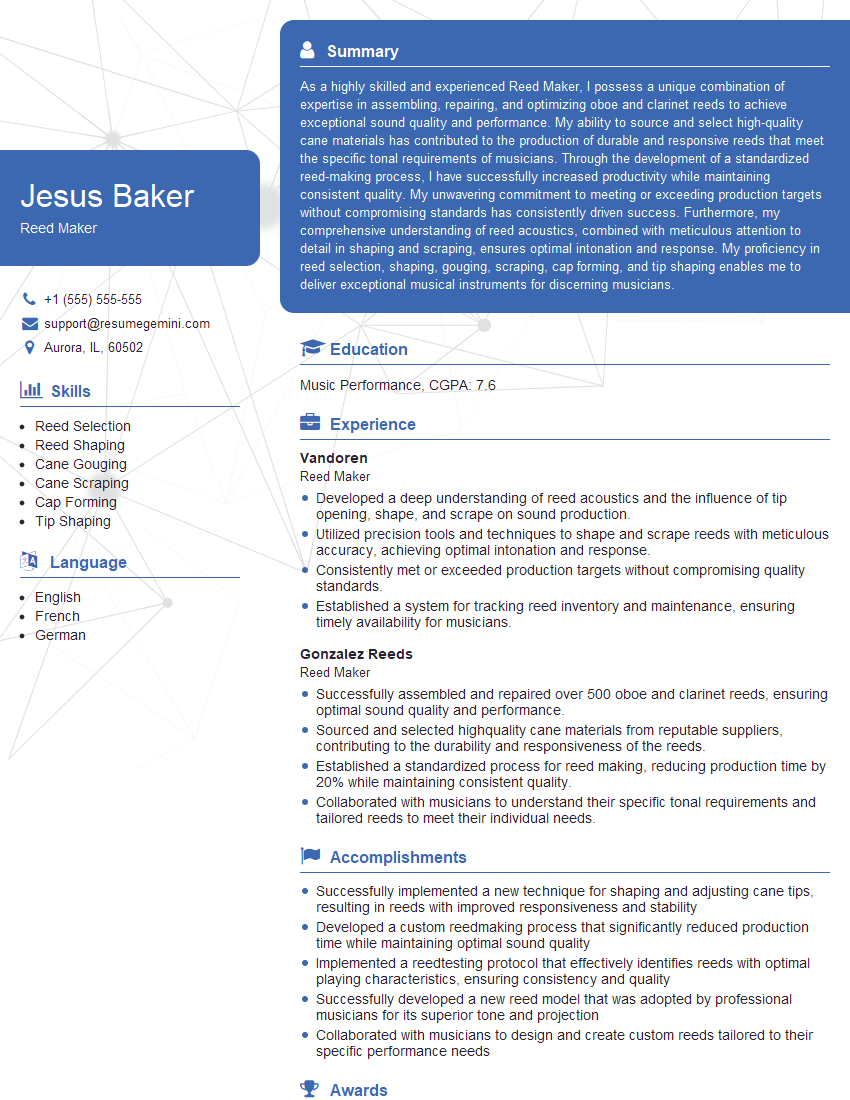
Mastering reed making and repair opens doors to diverse and rewarding career opportunities in music and instrument repair. A strong understanding of these skills demonstrates dedication, precision, and a high level of technical proficiency – all highly valued by employers. To significantly increase your chances of landing your dream job, crafting an ATS-friendly resume is crucial. ResumeGemini is a trusted resource that can help you build a professional resume tailored to highlight your unique skills and experience. Examples of resumes specifically tailored for Reed Making and Repair professionals are available to guide you.
Explore more articles
Users Rating of Our Blogs
Share Your Experience
We value your feedback! Please rate our content and share your thoughts (optional).
What Readers Say About Our Blog
Very informative content, great job.
good