Interviews are opportunities to demonstrate your expertise, and this guide is here to help you shine. Explore the essential Prepress and Postpress Processes interview questions that employers frequently ask, paired with strategies for crafting responses that set you apart from the competition.
Questions Asked in Prepress and Postpress Processes Interview
Q 1. Explain the difference between RGB and CMYK color spaces.
RGB and CMYK are two different color models used in different stages of the printing process. RGB (Red, Green, Blue) is an additive color model used for screen displays. It works by adding light; the more light, the brighter the color. Think of your computer or phone screen – it emits light to create colors. CMYK (Cyan, Magenta, Yellow, Key – black) is a subtractive color model used in printing. It works by subtracting light from white; the more ink, the darker the color. Imagine mixing paint – you start with white and add colors to darken it.
The key difference lies in their application: RGB is for digital displays, while CMYK is for print. Converting from RGB to CMYK can be tricky, as some colors that appear vibrant on screen may not reproduce accurately in print due to the limitations of ink mixing. This is why a calibrated monitor and color management software are essential for accurate color reproduction in print.
Q 2. Describe the process of creating a printing plate.
Creating a printing plate involves transferring the digital artwork onto a physical plate that will be used to print. The exact process depends on the printing method, but the general steps are as follows:
- Image Preparation: The digital file is prepared with the correct color mode (CMYK), resolution, and trapping settings.
- RIP (Raster Image Processor): The digital file is processed by a RIP, which converts the vector or raster image into a format suitable for the plate-making process.
- Plate-Making: This is where the actual plate is created. Common methods include:
- Computer-to-plate (CTP): This is the most common method, using lasers to expose a photosensitive plate. It’s highly efficient and accurate.
- Film Output and then Plate Making: Older methods may involve creating a film positive first, then using the film to expose a plate. This is less common now.
- Plate Processing: The exposed plate is processed to develop the image and harden the non-image areas.
- Quality Control: The plate is inspected for any defects before mounting onto the printing press.
For example, a CTP system using violet laser technology would directly expose the plate based on the RIP’s output, eliminating the need for film and resulting in higher accuracy and faster turnaround times.
Q 3. What are the common types of paper finishes and their applications?
Paper finishes significantly impact the look and feel of a printed piece. Common finishes include:
- Coated: Offers a smooth, glossy surface ideal for high-quality images and vibrant colors. Frequently used for magazines and brochures.
- Uncoated: Provides a more natural, textured feel. Suitable for stationery, business cards, or eco-friendly applications. Ink tends to absorb more.
- Matte: Offers a smooth, non-reflective surface, reducing glare. Good for documents where readability is important.
- Gloss: Provides a high-shine, reflective surface. Enhances vibrancy, but can be prone to fingerprints.
- Varnished (UV): A protective coating adds durability and shine. Protects against scratches and fading.
- Embossed: Creates a raised design, adding texture and visual interest. Commonly used for business cards or invitations.
The choice of finish depends heavily on the project. A glossy magazine cover demands a coated finish for sharp images, while a wedding invitation might benefit from an embossed finish for a luxurious feel.
Q 4. How do you ensure color consistency across different printing processes?
Ensuring color consistency across different printing processes requires a robust color management system. Key steps include:
- Color Profiling: Creating accurate profiles for all devices involved – monitors, printers, and printing plates – ensures that colors are consistent throughout the workflow. This involves using a spectrophotometer to measure the color output of each device.
- Standard Color Spaces: Utilizing a standard color space, like sRGB or Adobe RGB for digital files, and then a proper conversion to CMYK for printing, minimizes discrepancies.
- Proofing: Soft proofing, using software to simulate the final printed output, and hard proofing, producing a physical proof using the same paper and inks, are essential to check color accuracy before mass production. Soft proofing helps catch potential issues early. Hard proofing ensures the color is accurately represented in the final product.
- Press Calibration: Regularly calibrating the printing press ensures consistent ink density and color balance. This is done by adjusting the ink keys and performing color bars (test strips of color) to fine-tune the output.
- Using a Color Management Software: Using color management software (CMS) like Adobe Acrobat Pro allows for color conversion, profiling, and managing the whole workflow for consistency.
Think of it like baking a cake – you need precise measurements and consistent ingredients to ensure the final product tastes the same every time. Color management is the recipe for consistent color printing.
Q 5. What are some common prepress quality control checks?
Prepress quality control is crucial for a successful print job. Common checks include:
- File Integrity: Verifying the file is in the correct format (CMYK), resolution, and has no missing fonts or linked images.
- Image Resolution: Ensuring images are at the appropriate resolution for the printing process to avoid pixelation or blurring.
- Color Accuracy: Checking color consistency and preventing unexpected color shifts by employing soft and hard proofing methods.
- Trapping: Checking for proper trapping to prevent gaps between colors and ensure smooth color transitions.
- Bleed and Margins: Verifying that important elements are within safe margins and bleed extends beyond the trim line to compensate for cutting inaccuracies.
- Font Verification: Checking that fonts are embedded or outlined to prevent font substitution issues.
- Imposition Check: Ensuring the pages are correctly arranged on the printing sheets before printing (if applicable).
These checks are typically performed using preflight software and by experienced prepress operators to catch problems before they reach the printing press, saving time and resources.
Q 6. Explain the importance of trapping in prepress.
Trapping in prepress is the process of intentionally overlapping colors to prevent small gaps from appearing between them during printing. This is because slight misregistrations – where the colors don’t perfectly align – can occur due to the mechanical nature of printing presses. The overlapping compensates for this misregistration.
Without trapping, tiny white gaps could appear between colors, particularly noticeable on fine lines or small text. This is especially important for fine details and sharp color transitions. There are different trapping methods, including spread trapping (expanding the darker color into the lighter color) and choke trapping (reducing the lighter color to overlap the darker color). The method used depends on the specific print job and the colors involved.
Imagine trying to fit two colored jigsaw pieces together. Without trapping (overlapping), a tiny gap would be visible between them. Trapping ensures a clean, seamless fit.
Q 7. What are the different types of binding methods?
Binding methods determine how the pages of a printed document are assembled. Common methods include:
- Saddle Stitch: Pages are folded in half and stapled along the spine. Suitable for magazines and brochures with a relatively low page count.
- Perfect Binding: The edges of the pages are glued together, creating a square spine. Commonly used for books and softcover publications.
- Case Binding: A hardcover binding where pages are sewn together, then glued into a cover. This is used for high-quality books and documents.
- Wire-O Binding: Pages are punched with holes and bound using wire or metal coils. Suitable for calendars, notebooks, and documents requiring easy page turning.
- Spiral Binding: Similar to wire-O, but uses plastic coils instead of metal.
- Lay-flat Binding: Pages are bound in a way that allows them to lie completely flat when opened. Often used for high-end photo books.
The best binding method depends on the number of pages, desired look, and budget. A simple brochure might use saddle stitch, while a high-end novel would typically use case binding.
Q 8. Describe the process of die-cutting.
Die-cutting is a post-press process that uses a sharp, custom-shaped blade to cut shapes, forms, or perforations into a printed sheet or other material. Think of it like using a cookie cutter, but on a much larger scale and with incredibly precise accuracy. The process involves creating a steel rule die—a precisely engineered metal plate with the desired shape cut into it—which is then used to cut through the material.
The process typically involves placing the printed material onto a die-cutting press, where the die is pressed firmly onto the substrate. The pressure from the press forces the blade to cut through the material, creating the desired shapes. This is commonly used for creating unique shapes for business cards, packaging, labels, and promotional materials.
For example, imagine you’re printing a box of chocolates. Die-cutting is essential for creating the individual shapes that will hold each chocolate piece within its box. The precision required to accurately cut out numerous intricate shapes makes die-cutting a crucial part of many packaging workflows.
Q 9. What are some common postpress finishing techniques?
Common post-press finishing techniques significantly enhance the visual appeal and functionality of printed materials. They can be broadly categorized into:
- Cutting and Finishing: Die-cutting (as discussed previously), creasing (scoring the paper to allow for easy folding), trimming (cutting the edges to achieve a neat finish), and perforating (creating pre-defined lines of weakness for easy tearing).
- Binding and Finishing: Saddle stitch (stapling folded sheets together), perfect binding (gluing the edges of pages together), wire-o binding (using wire to bind pages together), case binding (for books and publications).
- Surface Enhancement: Embossing (creating a raised design), debossing (creating an indented design), foil stamping (adding metallic or colored foil to create a glossy effect), UV coating (applying a protective layer that adds gloss and durability).
- Other techniques: Laminating (covering with a protective film), varnishing (applying a clear or colored coating), numbering (adding sequential numbers), and various other specialized options.
The choice of technique depends largely on the nature of the printed product and the desired outcome. For instance, a high-end brochure might require embossing, UV coating, and perfect binding, while a simple leaflet might only need saddle stitching and trimming.
Q 10. How do you troubleshoot common printing issues?
Troubleshooting printing issues requires a systematic approach. My first step is to identify the type of issue: is it a color problem, registration problem, or a substrate issue? Then, a methodical approach using the following steps:
- Visual Inspection: Carefully examine the printed output to pinpoint the problem’s location and characteristics.
- Check the Proof: Compare the printed output to the approved digital proof to determine if the issue originated in pre-press or during the printing process.
- Examine the Plates/Film: If the issue is related to color or registration, inspect the printing plates or film for damage, scratches, or improper exposure.
- Assess Press Settings: Verify the printing press’s settings, including ink density, speed, and pressure, as incorrect settings can lead to inconsistencies.
- Substrate Analysis: Check the quality of the paper or other substrates used for printing. Issues like moisture content or inconsistencies can significantly impact the final result.
- Ink and Chemicals: Analyze the inks and other printing chemicals to see if there are any issues with their quality, consistency or compatibility.
- Cleanliness of equipment: Ensure that all printing equipment is thoroughly cleaned and maintained.
For example, if there’s a color mismatch, I’d first check the color profiles, then the plates, followed by the ink density settings. It’s a process of elimination, guided by experience and a deep understanding of the printing workflow.
Q 11. Explain the role of imposition in prepress.
Imposition is a crucial pre-press process that arranges pages of a document in a specific order on a printing sheet before printing. Think of it like a complex jigsaw puzzle, where each piece (page) needs to be placed perfectly to create the final image once the sheet is folded and cut. The goal is to maximize efficiency and minimize waste during the printing and finishing stages.
The arrangement is meticulously planned to ensure that when the printed sheet is folded and cut, the pages fall into the correct sequence. The software used for imposition carefully considers the orientation of pages, the type of binding (e.g., saddle-stitch, perfect binding), and the size of the printing sheet.
For instance, a 16-page booklet would require a specific imposition layout to ensure the pages are correctly ordered after folding. Incorrect imposition leads to pages appearing out of order, making the final product unusable. The efficiency of the press also relies heavily on well-planned imposition. For example, using imposition software, we can achieve fewer sheets for the same number of pages, thus saving time, resources and money.
Q 12. What software are you proficient in for prepress/postpress work?
My prepress and postpress workflow expertise involves proficiency in several industry-standard software applications. I’m highly skilled in Adobe Creative Suite (InDesign, Photoshop, Illustrator), which are essential for creating and preparing print-ready files. My experience extends to prepress workflow automation software such as Esko Suite, including ArtiosCAD and PackEdge for packaging design and preflighting.
Moreover, I’m adept at using imposition software like Impostrip and other RIP (Raster Image Processor) software for controlling and managing the output to different printers. Finally, I have working knowledge of color management software such as X-Rite i1Profiler for ensuring accurate color reproduction.
Q 13. How do you manage color profiles in prepress?
Color profile management in prepress is paramount for achieving accurate and consistent color reproduction across different devices and stages of the printing workflow. It involves assigning and using specific color profiles to ensure that colors appear as intended from the design stage to the final printed product.
The process usually involves converting the source color space (e.g., sRGB from a design file) to the press’s color space (e.g., CMYK). Software like Adobe Acrobat and dedicated color management tools play a crucial role in the process by applying the appropriate color transformations. I ensure that all color profiles are carefully selected and assigned based on the target output device (printing press) and the substrate. Regular calibration and profiling of equipment are essential to maintain accuracy.
For example, using a wrong color profile can lead to the printed colors appearing significantly different from the original design—far from what was intended. Accurate color management is a core skill and is crucial to the success of a printing operation.
Q 14. What is your experience with different types of printing presses?
My experience encompasses a wide range of printing presses, including:
- Offset Lithographic Presses: I’ve worked extensively with both sheet-fed and web offset presses, understanding their capabilities and limitations for various print jobs, such as books, magazines, and brochures.
- Digital Presses: I’m familiar with various digital printing technologies, including toner-based presses (Xerox, HP Indigo) and inkjet presses (HP Scitex, Canon Océ), which provide flexibility for short-run and personalized printing.
- Flexographic Presses: I have experience in the packaging industry, using flexographic presses for printing on flexible substrates like films and foils. This involves a different workflow and set of considerations compared to other press types.
My hands-on experience with these different press types allows me to effectively prepare files for each and make informed decisions about the optimal printing method for any given project.
Q 15. Describe your experience with PDF workflows in prepress.
PDF workflows are the backbone of modern prepress. My experience spans creating press-ready PDFs from various design software like Adobe InDesign, Illustrator, and Photoshop. This involves ensuring the PDF is compliant with industry standards such as PDF/X-1a or PDF/X-4, depending on the printing requirements. I meticulously check for embedded fonts, color spaces (typically CMYK for print), image resolution, and correct bleed and trim settings. I’m proficient in using preflight tools to automatically identify potential problems like missing fonts or low-resolution images, preventing costly errors later. For complex projects, I often create multiple PDFs – one for each printing unit – streamlining the process and avoiding complications.
For example, in a recent project involving a multi-page brochure with various special effects, I created separate PDFs for the different sections, making sure each adhered to the specified color profile. This allowed for efficient and effective printing by different presses within the facility.
Career Expert Tips:
- Ace those interviews! Prepare effectively by reviewing the Top 50 Most Common Interview Questions on ResumeGemini.
- Navigate your job search with confidence! Explore a wide range of Career Tips on ResumeGemini. Learn about common challenges and recommendations to overcome them.
- Craft the perfect resume! Master the Art of Resume Writing with ResumeGemini’s guide. Showcase your unique qualifications and achievements effectively.
- Don’t miss out on holiday savings! Build your dream resume with ResumeGemini’s ATS optimized templates.
Q 16. How do you handle color variations between proofs and final prints?
Color consistency between proofs and final prints is crucial. Discrepancies arise from variations in the printing process, paper, and ink. I address this through several strategies. First, using a calibrated monitor and proofer is essential for accurate onscreen representation of colors. Second, I specify the exact paper stock and ink type for the proof and the final print to minimize variation. Third, I employ color management profiles, ICC profiles, that translate colors from the design software to the output device accurately. Finally, we use a color control strip in each print run. This strip includes color patches that allow for precise adjustments to ensure consistency throughout the job.
If differences still persist, I work closely with the press operators, adjusting the ink settings on the press to match the proof. Sometimes, slight adjustments in the design are necessary to account for printing limitations.
Q 17. What is your experience with variable data printing?
Variable data printing (VDP) is a powerful tool for personalized marketing and communication. My experience includes managing VDP jobs from data preparation to final print. This involves working with databases, ensuring the data is correctly formatted and merged with the design template. I’m proficient in using VDP software, which allows me to personalize elements like names, addresses, and images on individual pieces within a large print run. I also ensure the final output is checked for accuracy to avoid any errors in the personalized information, as any mistake in a personalized piece could be very damaging.
For instance, I managed a large-scale personalized postcard campaign for a client. We used a database containing customer information, and I created a template that dynamically populated fields with individual names, addresses, and personalized messages. The result was a highly targeted and effective marketing campaign.
Q 18. How do you manage large print jobs efficiently?
Managing large print jobs efficiently requires careful planning and execution. I utilize project management software to track deadlines, resources, and progress. This involves breaking down the job into smaller, manageable tasks, assigning responsibilities, and setting realistic timelines. Pre-flight checks and proofing are performed at each stage to catch potential errors early, which is cheaper than fixing issues in the later stages. Automated workflows, wherever possible, such as automated imposition and prepress checks, help increase efficiency. Close communication with the client, printers and all stakeholders is key to avoid delays and ensure everyone is informed throughout the process.
For a recent large-format poster campaign, I implemented a workflow that automated imposition and color management, saving significant time and reducing the risk of errors. Regular meetings with the team helped keep things on schedule, and a well-defined checklist meant nothing was missed.
Q 19. Describe your experience with different finishing equipment.
My experience with finishing equipment encompasses a wide range of technologies. This includes various folding machines (e.g., buckle folders, perfect binders), cutting machines, die-cutting machines, laminators, and binding equipment (e.g., saddle stitch, wire-o binding, case binding). I understand the capabilities and limitations of each machine and select the appropriate equipment based on the project’s specifications. I’m also familiar with digital finishing techniques, which offer flexibility and speed, especially for shorter runs. Understanding the proper setup and maintenance of this equipment is essential for high-quality results and preventing damage to the printed materials.
For instance, in one project requiring a high-end presentation book, I used a case-binding machine to create a professional, durable product. For a large-scale brochure, we utilized a high-speed buckle folder to manage the high volume efficiently.
Q 20. What is your experience with quality control procedures in postpress?
Quality control (QC) in postpress is crucial for delivering a flawless final product. My QC procedures include a visual inspection of every sheet for defects like misprints, smudging, or creases. We utilize automated quality control systems such as print inspection scanners for high volume print jobs that automatically detect flaws beyond the capacity of human detection. We also have a detailed checklist that covers all aspects of the finishing process, including proper folding, cutting, and binding. Any defects found are documented, and corrective actions are taken to prevent recurrence. Sampling and inspecting a percentage of the entire job allows us to confirm the quality of the entire print run.
One example involved a large print run of magazines. Our automated QC system flagged a slight color variation in a specific section. We identified the cause (a minor press issue) and corrected it before the entire print run was completed.
Q 21. How do you calculate the cost of a print job?
Calculating the cost of a print job involves several factors. First, the material costs: paper, ink, and any special finishing materials. Second, the labor costs: prepress, printing, and postpress operations. Third, the machine costs: the running costs and depreciation of the equipment used. Fourth, overhead costs: rent, utilities, and administrative expenses. Finally, profit margins are added to ensure the business remains financially sustainable. Different pricing models exist, including cost-plus pricing and value-based pricing. Accurate cost estimation requires detailed knowledge of all the processes involved and reliable cost data for materials and labor. The use of estimating software can help streamline the process.
For example, to estimate a cost for 1000 brochures, I’d consider the cost of the paper, the ink, the die-cutting if it’s needed, the folding, the binding, the labor for each stage, the machine running cost, and overhead costs, all of which are then summed and a margin added to find the final price.
Q 22. What is your experience with different types of substrates?
My experience with substrates is extensive, encompassing a wide range of materials used in printing. This includes various paper types – from lightweight papers like 20lb bond used for everyday documents to heavy cover stocks like 130lb C2S (coated two-sides) used for brochures and book covers. I’ve also worked with numerous specialty papers, including textured papers, recycled papers, and even synthetic substrates like plastics and vinyl for specific applications requiring durability or water resistance. Beyond paper, my experience extends to cardboards (various thicknesses and types, including corrugated board for packaging), and even fabrics for unique printing projects.
Understanding the properties of each substrate is crucial. For instance, a lightweight paper might be unsuitable for a high-resolution image due to show-through, whereas a thicker, coated stock would be ideal. Similarly, choosing the right substrate for a particular finishing process is key; some substrates are better suited for folding and binding than others.
- Example: Choosing a glossy coated paper for a high-impact magazine cover versus using an uncoated stock for a rustic wedding invitation.
- Example: Selecting a durable synthetic substrate for outdoor signage that needs to withstand weather conditions.
Q 23. Describe your experience with automated finishing systems.
My experience with automated finishing systems is significant, covering various technologies like high-speed folding machines, perfect binding lines, saddle-stitch systems, and cutting and creasing equipment. I’m proficient in operating and troubleshooting these systems, understanding the intricacies of each process and their respective parameters (like folding patterns, stitch settings, and cutting tolerances).
I’ve worked extensively with systems from leading manufacturers, gaining hands-on experience with their control panels, maintenance procedures, and quality control checks. This includes preventative maintenance like regular cleaning and lubrication, troubleshooting malfunctions, and performing minor repairs. I’m also familiar with the integration of these systems into larger workflow automation solutions, improving efficiency and reducing manual intervention.
Example: In a recent project, I optimized the settings of a perfect binding machine to increase production speed by 15% without compromising binding quality, significantly reducing turnaround time.
Q 24. How do you troubleshoot problems with binding or finishing equipment?
Troubleshooting binding and finishing equipment involves a systematic approach. I start by identifying the specific problem – is it a jam, inaccurate cutting, inconsistent binding, or something else? I then use a combination of observation (checking for physical obstructions or misalignments), diagnostic tools (if available, like system error codes), and my knowledge of the machine’s operational parameters to pinpoint the cause.
My troubleshooting strategy includes:
- Visual Inspection: A thorough check for obvious issues like jams, misaligned components, or worn parts.
- Error Code Analysis: Referencing the machine’s manual to understand the meaning of any error codes displayed.
- Testing and Adjustment: Making incremental adjustments to settings (e.g., pressure, speed, alignment) to observe their effects on the issue.
- Component Checks: Inspecting individual components – rollers, belts, blades – for wear or damage.
- Calibration: If necessary, recalibrating the machine according to manufacturer specifications.
If the problem persists after these steps, I escalate the issue to a qualified technician, providing detailed information about my findings to expedite the repair process.
Q 25. Explain your understanding of different paper weights and their suitability for various applications.
Paper weight, measured in pounds (lbs) or grams per square meter (gsm), significantly impacts a print job’s final outcome. Lighter papers (e.g., 20lb bond) are suitable for everyday documents, offering cost-effectiveness but potentially showing show-through with heavier ink coverage. Medium-weight papers (e.g., 60lb offset) provide good print quality and are suitable for brochures or flyers. Heavier papers (e.g., 100lb cover) offer greater durability and stiffness, ideal for book covers or high-end packaging.
The choice of paper weight depends on the application:
- Lightweight papers (20-30lb): Office documents, low-cost leaflets.
- Medium-weight papers (60-80lb): Brochures, flyers, letterheads.
- Heavyweight papers (100lb+): Book covers, business cards, high-end packaging.
It’s also crucial to consider the type of paper (coated or uncoated) and its finish (glossy, matte, etc.), as these factors influence print quality and overall aesthetic.
Q 26. What is your experience with working under tight deadlines?
Working under tight deadlines is a regular part of the print production environment, and I thrive in this fast-paced setting. I’ve consistently delivered high-quality work within strict time constraints, relying on strong organizational skills, efficient workflow management, and proactive communication.
Example: In one instance, we faced an unexpectedly urgent request for 5,000 brochures with a deadline just three days away. By prioritizing tasks, delegating where possible, and working overtime in a controlled and efficient manner with my team, we successfully delivered the project on time and met all quality standards.
My ability to prioritize tasks and make sound decisions under pressure ensures that projects are completed efficiently and to the client’s satisfaction, even in challenging circumstances.
Q 27. How do you prioritize tasks in a busy print production environment?
Prioritizing tasks in a busy print production environment requires a clear understanding of project deadlines, client priorities, and resource availability. I typically use a combination of techniques:
- Deadline-driven prioritization: Tasks with the closest deadlines are tackled first.
- Dependency analysis: Tasks that are prerequisites for other tasks are prioritized to avoid bottlenecks.
- Client priority: Urgent client requests or those with higher value are given precedence.
- Resource allocation: Tasks are assigned based on the availability of personnel and equipment.
- Project Management Software: Utilizing project management software (like Jira or Asana) to manage tasks, track progress, and maintain transparency.
This approach ensures that the most critical tasks are addressed first, maximizing efficiency and minimizing the risk of delays.
Q 28. Describe your experience with client communication and handling revisions.
Client communication and handling revisions are essential aspects of my role. I believe in proactive and transparent communication throughout the entire print production process. I start by establishing clear communication channels and expectations with the client from the initial briefing stage, providing regular updates on progress, and addressing any concerns promptly.
When handling revisions, I maintain a detailed record of changes requested. I ensure these revisions are clearly understood, confirmed with the client, and implemented accurately. I also provide the client with proofs of the revised work to ensure they are satisfied before proceeding to the final printing stage.
Example: I once managed a complex project involving multiple revisions. By clearly documenting each change, providing timely updates to the client, and actively seeking clarification when necessary, I successfully navigated the revision process, maintaining client satisfaction and completing the project on schedule.
Key Topics to Learn for Prepress and Postpress Processes Interview
- Prepress: File Preparation & Management: Understanding file formats (PDF, TIFF, JPEG, etc.), color spaces (CMYK, RGB), image resolution, and preflighting techniques for print-ready files. Practical application: Troubleshooting common file issues like missing fonts or incorrect color profiles.
- Prepress: Proofing & Color Management: Importance of soft proofing and hard proofing methods, color calibration, and achieving consistent color across different printing processes. Practical application: Explaining the difference between a digital proof and a press proof, and identifying potential color discrepancies.
- Postpress: Finishing Techniques: Knowledge of various finishing options like cutting, folding, binding (perfect binding, saddle stitch, wire-o), lamination, and embossing. Practical application: Selecting the appropriate finishing techniques based on project requirements and budget constraints.
- Postpress: Quality Control: Implementing quality checks at each stage of the postpress process to ensure consistency and accuracy. Practical application: Identifying and resolving issues like misaligned cuts or incorrect folding.
- Print Production Workflow: Understanding the entire workflow from initial design to final delivery, including scheduling, communication, and managing deadlines. Practical application: Optimizing workflow for efficient and cost-effective production.
- Digital Printing vs. Offset Printing: Understanding the advantages and disadvantages of each printing method, and when each is best suited for a particular project. Practical application: Recommending the most appropriate printing method for a given job specification.
- Print Technology and Equipment: Familiarity with various printing presses, cutting machines, and binding equipment. Practical application: Troubleshooting minor equipment malfunctions and understanding maintenance procedures.
- Problem-solving and Troubleshooting: Ability to identify and resolve technical issues that may arise during prepress and postpress processes. Practical application: Developing strategies for addressing unexpected challenges in a timely manner.
Next Steps
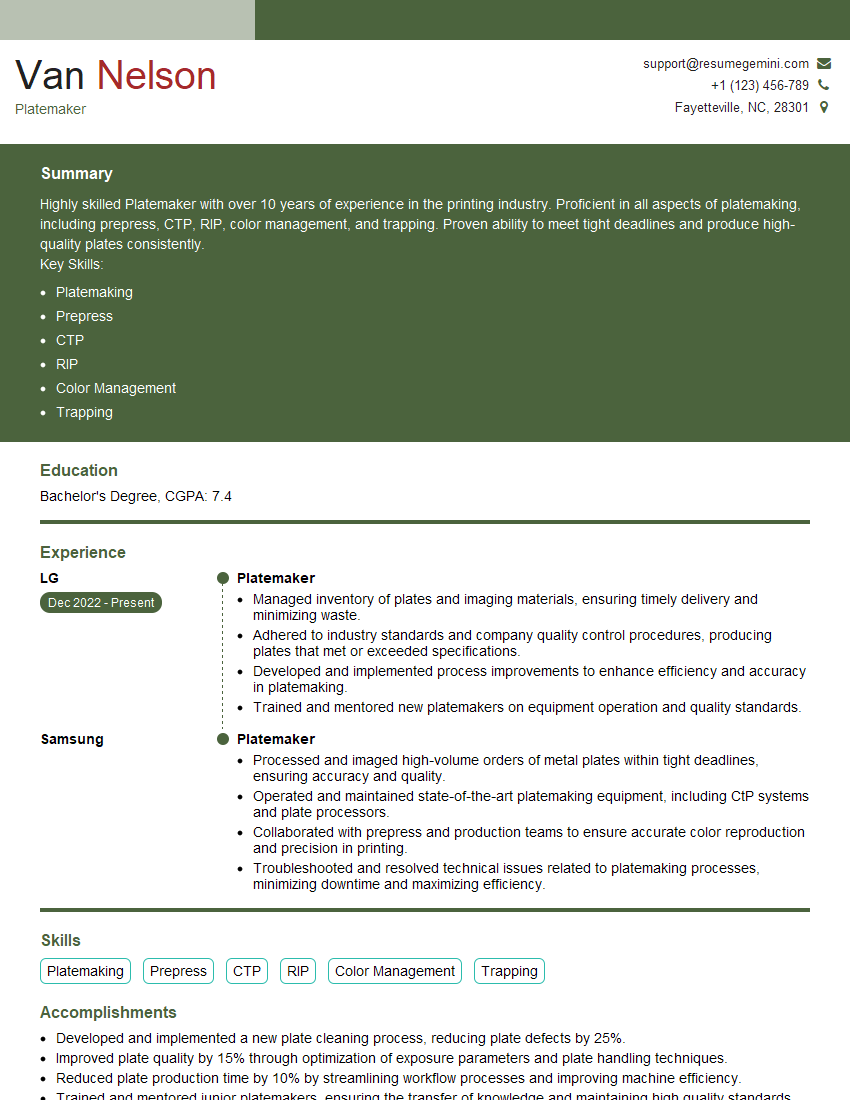
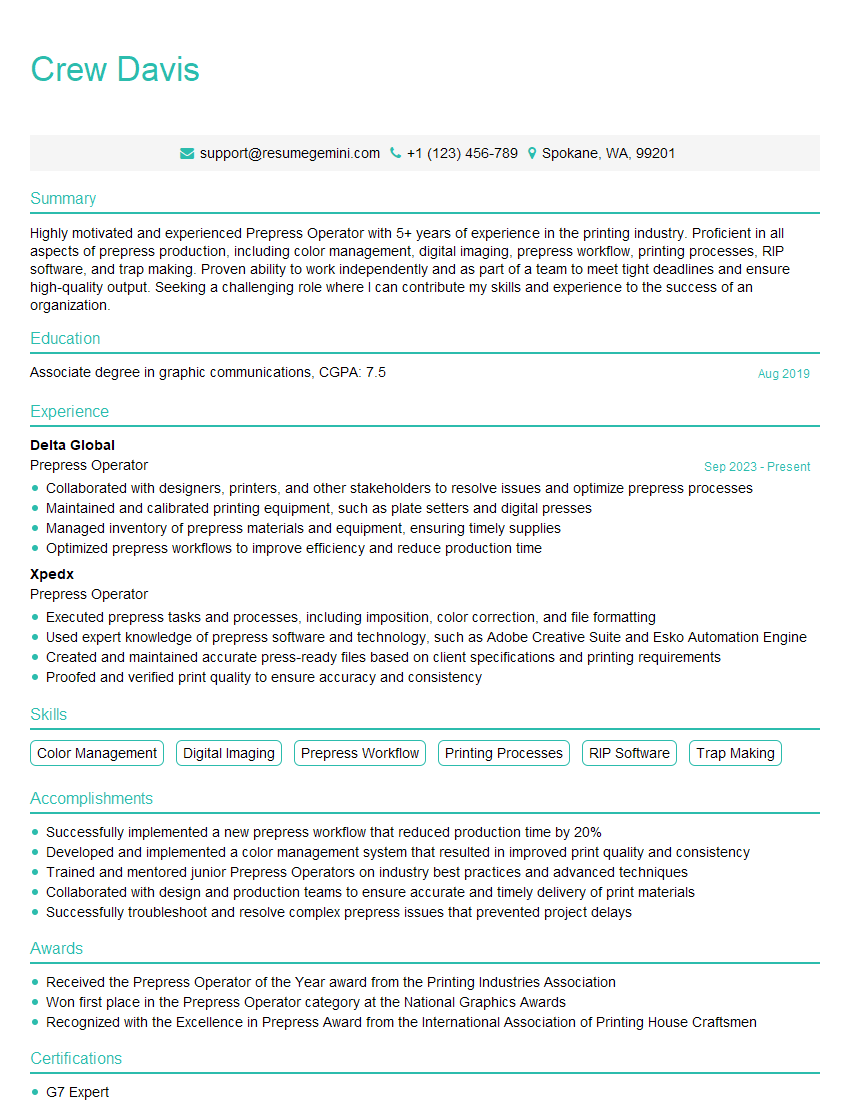
Mastering Prepress and Postpress Processes is crucial for career advancement in the printing and publishing industries. A strong understanding of these processes demonstrates technical expertise and problem-solving skills highly valued by employers. To maximize your job prospects, create an ATS-friendly resume that effectively highlights your skills and experience. ResumeGemini is a trusted resource for building professional resumes that get noticed. Use ResumeGemini to craft a compelling resume that showcases your capabilities; examples of resumes tailored to Prepress and Postpress Processes are provided to guide you.



Explore more articles
Users Rating of Our Blogs
Share Your Experience
We value your feedback! Please rate our content and share your thoughts (optional).
What Readers Say About Our Blog
Very informative content, great job.
good