Preparation is the key to success in any interview. In this post, we’ll explore crucial Elevator Testing Methods interview questions and equip you with strategies to craft impactful answers. Whether you’re a beginner or a pro, these tips will elevate your preparation.
Questions Asked in Elevator Testing Methods Interview
Q 1. Describe the different types of elevator testing methods.
Elevator testing encompasses various methods, each designed to assess specific aspects of the system’s performance and safety. These methods can be broadly categorized into:
- Acceptance Testing: This initial testing verifies that the newly installed elevator meets all the specified requirements and safety standards before it’s put into service. It involves rigorous checks of all components and systems.
- Periodic Inspection and Testing: This is ongoing and mandated by safety codes. It covers visual inspections, functional tests, and safety device checks to ensure the elevator remains safe and compliant. Frequency depends on elevator type and usage.
- Load Testing: This crucial test determines the elevator’s capacity and structural integrity by subjecting it to various weights, exceeding its rated capacity to ensure safety margins. It helps identify weak points.
- Performance Testing: Evaluates the elevator’s speed, acceleration, deceleration, and overall travel time to ensure it meets performance specifications. Precise measurements and data logging are critical here.
- Safety Device Testing: This focuses on individual safety components like emergency brakes, limit switches, and safety gears. Each device undergoes specific tests to confirm functionality and reliability.
- Non-Destructive Testing (NDT): Techniques like ultrasonic testing or magnetic particle inspection may be used to detect hidden flaws in structural components without damaging the elevator.
The specific combination of tests depends on factors like elevator type, age, location, and relevant codes.
Q 2. Explain the importance of load testing in elevator safety.
Load testing is paramount for elevator safety because it reveals potential structural weaknesses and ensures the elevator can handle its intended load and beyond, providing a critical safety margin. Imagine an elevator designed for 10 people; load testing goes beyond this capacity to verify the system can withstand unexpected overloads. This testing prevents catastrophic failures like cable snapping or structural collapse, which could lead to serious injury or death. It also allows for the early identification of any degradation in the structural integrity over time, ensuring that the elevator remains safe for its intended lifespan.
During load testing, we gradually increase the weight until it surpasses the rated load by a significant factor. We monitor all relevant parameters like cable tension, structural stress, and the performance of the safety mechanisms. Any deviations from expected values indicate potential problems that need addressing before the elevator is used.
Q 3. What are the common safety regulations and codes for elevator testing?
Elevator safety regulations and codes vary by jurisdiction, but they generally adhere to international standards like those from ASME (American Society of Mechanical Engineers) and ISO (International Organization for Standardization). Key regulations cover:
- Regular Inspections: Mandatory periodic inspections by certified inspectors to verify compliance.
- Safety Device Requirements: Specific standards for safety devices like governors, buffers, and emergency brakes.
- Load Capacity: Clear specifications for maximum load and occupancy.
- Emergency Communication Systems: Requirements for emergency phones and two-way communication.
- Maintenance Records: Detailed maintenance logs are required to track repairs and inspections.
- Accessibility Standards: Compliance with accessibility standards for people with disabilities.
Failure to comply with these regulations can result in hefty fines, suspension of elevator operation, and potentially legal action if an incident occurs due to non-compliance.
Q 4. How do you perform a thorough inspection of elevator safety devices?
Inspecting elevator safety devices requires a systematic approach. It’s not just a visual check; it involves functional testing. For example:
- Governors: We verify that the governor activates correctly at the predetermined overspeed, engaging the safety brake. This often involves a controlled test with a simulated overspeed condition.
- Safety Gears: We check that the safety gears engage and grip the guide rails when the elevator car exceeds the safe speed. Again, simulated conditions are used for testing.
- Buffers: We inspect the buffers for wear and tear and ensure they can absorb the impact in case of a fall. This includes checking buffer travel and compression capabilities.
- Limit Switches: We test these switches to verify that they stop the elevator car at the top and bottom terminal floors, preventing overtravel.
- Emergency Brakes: We manually activate the emergency brakes to confirm proper engagement and holding power.
Detailed documentation of each test, including observations and measurements, is crucial for record-keeping and compliance. Any issues found during this inspection must be reported and immediately addressed.
Q 5. What are the key performance indicators (KPIs) you would monitor during elevator testing?
Key Performance Indicators (KPIs) during elevator testing focus on safety, efficiency, and reliability. Examples include:
- Door Opening/Closing Times: Ensuring smooth and timely door operation.
- Travel Time: Measuring the time taken for the elevator to travel between floors.
- Acceleration/Deceleration Rates: Checking for smooth and comfortable acceleration and deceleration.
- Leveling Accuracy: Verifying that the elevator stops precisely at the floor level.
- Safety Device Response Times: Measuring the time it takes for safety devices to activate.
- Mean Time Between Failures (MTBF): Tracking the time between elevator malfunctions, indicative of overall system reliability.
These KPIs are measured and recorded throughout the testing process. Deviations from the established benchmarks indicate potential issues that require investigation and corrective action. Tracking these KPIs over time provides valuable data for preventive maintenance scheduling.
Q 6. Describe your experience with different elevator control systems and their testing.
My experience encompasses various elevator control systems, including traditional relay logic systems, programmable logic controllers (PLCs), and modern microprocessor-based systems. Each system requires a different testing approach:
- Relay Logic Systems: Testing involves checking individual relays, contacts, and wiring to ensure correct operation of the logic circuits. This often involves creating test scenarios to simulate various elevator operating conditions.
- PLCs: Testing includes verifying the PLC program logic, input/output signals, and communication with other elevator components. Specialized software tools are used for programming, monitoring, and diagnostics.
- Microprocessor-Based Systems: These systems require comprehensive testing of the embedded software, communication protocols, and various sensors and actuators. Advanced diagnostic tools and software are frequently used for this process.
Regardless of the control system, a thorough understanding of the system’s architecture, programming, and interfacing is essential for effective testing. I use a combination of automated testing and manual checks to ensure comprehensive coverage.
Q 7. How do you troubleshoot common elevator malfunctions during testing?
Troubleshooting elevator malfunctions during testing follows a systematic approach. It often starts with:
- Gathering Information: Documenting the specific malfunction, its frequency, and any preceding events.
- Visual Inspection: A thorough examination of all visible components for any obvious damage or wear.
- Diagnostic Tools: Utilizing specialized diagnostic tools to access system data and identify error codes or other diagnostic information.
- Systematic Testing: Isolating the problem by performing tests on individual components or subsystems. This might involve checking sensors, motors, control circuits, or safety devices.
- Testing Logic Circuits: For older systems, systematically verifying that the relay logic or PLC program is functioning correctly.
- Reviewing Maintenance Logs: Checking maintenance history for clues on recurring issues or previous repairs.
In many cases, the problem can be traced to a simple issue such as a loose connection or a faulty sensor. However, some malfunctions might require more in-depth analysis and potentially specialized expertise.
Q 8. Explain the process of documenting test results and reporting findings.
Documenting elevator test results and reporting findings is crucial for ensuring safety and compliance. It involves meticulously recording all aspects of the testing process, from initial inspection to final analysis. This ensures transparency, traceability, and facilitates future maintenance and troubleshooting.
- Detailed Test Procedures: We start by documenting the specific test procedures followed, including the relevant safety standards and codes adhered to (e.g., ASME A17.1). This ensures that the testing is repeatable and verifiable.
- Data Logging: During testing, we use specialized software and data loggers to capture real-time data like speed, acceleration, door operation times, and emergency stop functionality. This data is vital for identifying potential problems and verifying compliance.
- Observation Recording: We meticulously document any observations made during the tests, noting any unusual sounds, vibrations, or malfunctions. Photographs or videos may be included to provide a visual record.
- Report Generation: After the tests, a comprehensive report is generated. This report summarizes the findings, highlights any non-conformances or defects identified, and provides recommendations for corrective actions. The report includes detailed graphs and charts derived from the collected data to illustrate our findings clearly.
- Compliance Statement: The final report includes a statement confirming whether the elevator complies with all applicable safety standards and regulations. If non-compliances exist, the report will detail the necessary corrective actions and their urgency.
For example, if a test reveals inconsistent braking performance, the report would detail the specifics of the issue, including relevant data points (e.g., braking distance variations), and suggest specific repairs or adjustments.
Q 9. What safety precautions do you take while performing elevator testing?
Safety is paramount in elevator testing. We employ stringent safety protocols throughout the entire process. This includes:
- Lockout/Tagout Procedures: Before commencing any tests, we implement rigorous lockout/tagout (LOTO) procedures to ensure that the power to the elevator is completely isolated, preventing accidental activation during testing.
- Personal Protective Equipment (PPE): All personnel involved wear appropriate PPE, including hard hats, safety glasses, and high-visibility clothing. Depending on the specific tasks, this may also include fall protection equipment.
- Controlled Access: The testing area is secured to restrict access to authorized personnel only. Clear signage is used to warn others of the ongoing testing activities.
- Emergency Procedures: We have well-defined emergency procedures in place, including communication protocols and evacuation plans, in case of unexpected events.
- Regular Inspections: Before and after each test, we perform thorough visual inspections of the elevator and its components to identify any potential hazards.
Imagine testing the emergency brake system. We would ensure complete power isolation before manually engaging the system, observing its performance meticulously, and documenting every detail.
Q 10. How do you ensure compliance with relevant safety standards during testing?
Ensuring compliance with safety standards is a core component of our elevator testing process. We achieve this by:
- Reference to Codes and Standards: We strictly adhere to relevant safety standards like ASME A17.1 (in the US) or equivalent international standards. These standards define performance criteria for different aspects of the elevator system.
- Regular Audits: We regularly audit our testing procedures to ensure that they are up-to-date and aligned with the latest safety regulations and best practices.
- Calibration and Verification: All testing equipment is calibrated and verified regularly to guarantee accuracy and reliability of the test results. We use certified calibration laboratories for this.
- Documentation Review: We thoroughly review all documentation, including test procedures, data logs, and reports, to ensure that they are complete, accurate, and meet the requirements of the relevant standards.
- Third-Party Inspections (if required): For critical projects or specific client requirements, we engage third-party inspection agencies to verify our work and confirm compliance with relevant regulations.
For instance, if we are testing the elevator’s door safety system, we would meticulously check against the requirements outlined in the relevant safety standards, ensuring that the door closing force, obstacle detection, and emergency reversal functionalities meet specified parameters. Any deviations from these standards are clearly documented and addressed.
Q 11. Explain your experience with non-destructive testing methods for elevators.
Non-destructive testing (NDT) methods are invaluable for assessing the structural integrity of elevator components without causing damage. My experience encompasses various NDT techniques, including:
- Visual Inspection: A fundamental method used to identify surface defects, corrosion, or wear and tear on cables, ropes, and other components.
- Ultrasonic Testing: Employed to detect internal flaws or cracks in metal components, like the elevator car frame or hoisting machinery. Ultrasonic waves are used to scan the material and identify discontinuities.
- Magnetic Particle Inspection: Used to detect surface and near-surface cracks in ferromagnetic materials. Magnetic particles are applied to the surface and reveal any cracks by adhering to the magnetic flux leakage.
- Dye Penetrant Inspection: This technique is used to identify surface-breaking flaws in non-porous materials. A dye is applied to the surface and then a developer reveals any cracks.
For example, ultrasonic testing would be used to examine the elevator ropes for internal wire breaks. The results are meticulously documented, allowing us to determine the remaining service life and recommend replacement if necessary.
Q 12. Describe your experience with different types of elevator malfunctions and their testing.
My experience includes diagnosing and testing a wide range of elevator malfunctions. These include:
- Door Malfunctions: Issues such as slow door closing, improper door alignment, or failure of safety mechanisms.
- Mechanical Issues: Problems with the hoisting mechanism, cables, or counterweights, often requiring detailed mechanical inspections and load tests.
- Electrical Problems: Malfunctions in the control system, motor problems, or wiring issues requiring detailed electrical diagnostics and testing.
- Hydraulic System Problems: In hydraulic elevators, issues with the hydraulic pump, valves, or fluid leaks. This includes testing the hydraulic pressure and fluid levels.
- Emergency Stop Failures: Testing the functionality of emergency stops and ensuring the safety mechanisms operate as intended.
For instance, if an elevator is experiencing inconsistent stopping accuracy, we would systematically test the braking system, inspect the control system for anomalies, and analyze the data from the elevator’s control unit to identify the root cause. This might involve detailed electrical diagnostics, mechanical inspections, and even using specialized software to analyze the braking patterns.
Q 13. How do you handle unexpected issues or complications during elevator testing?
Handling unexpected issues during elevator testing requires a calm, systematic approach. Our process includes:
- Safety First: The immediate priority is to ensure the safety of all personnel involved. If necessary, the testing is immediately stopped, and the area is secured.
- Problem Assessment: We carefully assess the nature of the unexpected issue, its potential impact on safety, and the best course of action.
- Root Cause Analysis: We initiate a root cause analysis to identify the underlying reason for the complication. This often involves reviewing the test data, inspecting the elevator system, and consulting technical manuals.
- Corrective Actions: Based on the root cause analysis, we implement appropriate corrective actions. This may involve repairs, adjustments, or modifications to the elevator system.
- Documentation: All unexpected issues, the corrective actions taken, and their impact on the test results are meticulously documented in the test report.
For example, if a cable snaps during a load test, safety procedures would be immediately implemented, the area secured, and a thorough investigation initiated to determine the cause (e.g., material fatigue, manufacturing defects). The report would then clearly document this event, its root cause, and the actions taken to prevent recurrence.
Q 14. What software or tools are you familiar with for elevator testing and data analysis?
My experience encompasses various software and tools for elevator testing and data analysis:
- Data Acquisition Systems (DAQ): We use DAQ systems to collect real-time data during elevator tests. These systems capture data from various sensors and transducers, providing detailed insights into the elevator’s performance.
- Specialized Elevator Testing Software: Specific software applications are used to control tests, analyze data, and generate reports. These packages often allow for detailed visualization of data, facilitating the identification of potential issues.
- Spreadsheet Software (Excel, Google Sheets): Used to organize and analyze the collected data, creating charts and graphs to illustrate key findings.
- CAD Software: CAD software assists in reviewing the elevator’s design, comparing test results with design specifications, and simulating scenarios.
- PLC Programming Software: Familiarity with PLC programming is necessary for understanding and testing the elevator’s control system.
For example, a DAQ system might capture data on the elevator’s acceleration and deceleration profiles during a normal operation test. This data is then analyzed using specialized software to identify any deviations from the expected performance parameters.
Q 15. Describe your experience with different types of elevator systems (hydraulic, traction, etc.)
My experience encompasses a wide range of elevator systems, primarily hydraulic and traction elevators. Hydraulic elevators, which use a piston and fluid to lift the car, are commonly found in low-rise buildings due to their simpler mechanics. I’ve worked extensively on testing these systems, focusing on the hydraulic fluid pressure, piston seals, and overall efficiency. Traction elevators, which use counterweights and cables, are more prevalent in high-rise buildings due to their ability to reach greater heights. My work with traction systems involved extensive testing of the hoisting machinery, cables, governors, and safety mechanisms like overspeed governors and buffers. I’ve also had limited exposure to machine-room-less (MRL) elevators, which are becoming increasingly popular for their space-saving design; these often utilize gearless traction systems requiring specialized testing protocols focused on energy efficiency and regenerative braking capabilities. In each case, my approach involves thorough inspection, performance testing, and adherence to all relevant safety codes.
Career Expert Tips:
- Ace those interviews! Prepare effectively by reviewing the Top 50 Most Common Interview Questions on ResumeGemini.
- Navigate your job search with confidence! Explore a wide range of Career Tips on ResumeGemini. Learn about common challenges and recommendations to overcome them.
- Craft the perfect resume! Master the Art of Resume Writing with ResumeGemini’s guide. Showcase your unique qualifications and achievements effectively.
- Don’t miss out on holiday savings! Build your dream resume with ResumeGemini’s ATS optimized templates.
Q 16. How do you verify the accuracy of elevator leveling and door operation during testing?
Verifying elevator leveling and door operation requires precision and meticulous testing. Leveling accuracy is checked using a level gauge, ensuring the car stops within the allowed tolerance (typically a few millimeters) at each floor. We systematically test each floor, documenting any deviations from the specified level. Door operation is tested to ensure smooth and safe closing, with tests for proper alignment, obstruction detection, and emergency reversal functionality. This includes checking the time it takes to close, the force exerted, and the response time of the safety mechanisms if an obstacle is encountered. We use specialized tools to measure the door pressure and travel time. Any discrepancies are documented and addressed before the system is deemed operational. Imagine the frustration of consistently arriving a few inches off the floor; that’s what precise leveling testing prevents.
Q 17. Explain the process of testing elevator emergency braking systems.
Testing elevator emergency braking systems is crucial for passenger safety. This typically involves a controlled activation of the emergency brakes, often using the designated emergency stop buttons. We simulate various scenarios, such as overspeed conditions or cable breakage (though typically using simulated scenarios in a controlled environment), to verify the effectiveness of the braking systems. We meticulously check the brake engagement time, braking distance, and the overall stopping force. Data is meticulously recorded to compare against manufacturer specifications and safety regulations. We also check the functionality of the emergency lighting and communication systems during the brake test. The whole process is carefully documented and reviewed to ensure compliance with safety standards. Think of it like a rigorously controlled crash test for your elevator.
Q 18. Describe your experience with the testing and commissioning of new elevator installations.
Testing and commissioning new elevator installations is a multi-stage process that begins with initial inspections to confirm that the equipment has been installed according to specifications. This then progresses through functional testing of individual components, culminating in integrated system tests. We perform comprehensive tests of all aspects of the elevator’s operation, including leveling, door operation, speed control, emergency braking systems, and safety mechanisms. We use specialized testing equipment and software to collect data, monitor performance, and identify any defects or areas requiring adjustment. Once all tests are passed, and all safety requirements are met, a final inspection is conducted with the relevant authorities and stakeholders before the elevator is approved for use. The entire process is documented in detailed reports, including all test results and any corrective actions taken.
Q 19. How do you perform a risk assessment before conducting elevator testing?
A thorough risk assessment is paramount before any elevator testing commences. This involves identifying potential hazards, assessing their likelihood and severity, and implementing control measures to mitigate risks. We consider aspects like working at heights, exposure to electrical hazards, potential mechanical failures, and the risks posed by moving parts. This assessment considers the specific type of elevator, the age and condition of the equipment, and the experience level of the testing team. We use standardized risk assessment methodologies and create a detailed risk assessment document outlining the identified hazards, potential consequences, assigned risk levels, and recommended control measures, which range from personal protective equipment (PPE) requirements to work permits and lock-out/tag-out procedures to ensure a safe working environment for everyone involved.
Q 20. What is your experience with elevator modernization projects and associated testing?
My experience with elevator modernization projects involves a similar, though often more complex, testing regime than new installations. These projects often involve replacing obsolete components while maintaining the existing structure. Testing in these scenarios focuses not just on the new components but also on the integration with the older parts of the system. We conduct rigorous tests to ensure compatibility and seamless operation between new and old equipment. This includes testing aspects like control systems, safety interlocks, and communication protocols between the updated and legacy components. The process involves careful planning, documentation, and thorough testing to ensure a smooth transition and continued safe operation of the modernized elevator. This can involve unique challenges – for example, adapting testing procedures to account for parts that may no longer be produced or documented.
Q 21. Explain the importance of preventative maintenance in relation to elevator testing.
Preventative maintenance is inextricably linked to elevator testing. Regular maintenance significantly reduces the likelihood of failures and extends the lifespan of elevator systems. This includes scheduled inspections, lubrication, and adjustments to key components. By identifying and addressing minor issues early, we can prevent them from escalating into major problems requiring extensive repairs or replacements. Preventative maintenance directly impacts the frequency and intensity of required testing, because a well-maintained system is less likely to require extensive testing to identify problems. It ensures the ongoing safety and reliability of the system, minimizing disruptions and maximizing uptime. It’s like regularly servicing your car – it prevents bigger issues later down the road.
Q 22. How do you manage and interpret data collected during elevator testing?
Managing and interpreting data from elevator testing involves a multi-step process. First, we meticulously collect data from various sources, including sensors embedded within the elevator system (measuring speed, acceleration, door operation, etc.), manual observations during tests, and any diagnostic reports from the elevator’s control system. This data is often vast and diverse, encompassing numerical readings, time-stamped events, and even qualitative observations like sounds or vibrations.
Next, the data undergoes a thorough cleaning and validation process to identify and address any outliers or inconsistencies. This might involve comparing sensor readings against expected values or using statistical methods to remove noise. For example, if a sensor momentarily reads an impossible speed, we’d flag it and investigate the cause – perhaps a temporary electrical interference.
Following data cleaning, we use specialized software and statistical analysis to interpret the results. This could involve plotting graphs of speed and acceleration profiles to identify anomalies like jerky movements or excessive deceleration. We also compare the collected data against industry standards and the elevator’s specifications to determine if it meets safety and performance requirements. For instance, we might assess if door opening times are within acceptable limits or if the elevator’s braking system performs as designed under various emergency scenarios. Finally, we generate comprehensive reports summarizing the findings, highlighting any areas of concern or non-compliance, and offering recommendations for corrective actions.
Q 23. Describe your experience working with elevator manufacturers and contractors.
I’ve had extensive experience collaborating with both elevator manufacturers and contractors. My work with manufacturers often involves participating in the testing and validation of new elevator designs and components. This includes assisting in the development of test protocols, conducting rigorous testing to ensure compliance with safety standards, and providing feedback to improve design and performance. One notable project involved testing a new regenerative drive system, where we meticulously measured energy efficiency under various load conditions.
My interactions with contractors are primarily focused on the inspection and maintenance of existing elevator systems. This involves conducting thorough inspections, identifying potential safety hazards, and verifying that the elevators are functioning correctly and are compliant with regulations. I’ve worked with contractors on several high-rise building projects, where I performed extensive testing on multiple elevator banks, ensuring their safety and optimal operation for high traffic situations. In one instance, I collaborated with a contractor to diagnose and resolve a recurring malfunction in a traction elevator, leading to efficient repairs and preventing potential downtime.
Q 24. How do you communicate technical information effectively to non-technical stakeholders?
Communicating complex technical information to non-technical stakeholders requires a clear and concise approach. I avoid using technical jargon as much as possible and instead use simple analogies and visual aids to explain concepts. For example, when explaining elevator braking systems, I might compare the braking mechanism to the brakes in a car, highlighting the similarities in the function and safety considerations.
I also prioritize storytelling. Sharing real-world examples of elevator malfunctions and how they were solved helps to illustrate the importance of testing and maintenance in a relatable manner. For presentations, I leverage visuals like graphs and diagrams to demonstrate data effectively. Written reports are structured with clear summaries and easy-to-understand explanations, keeping the technical details confined to appendices for those who require more in-depth information. I always encourage questions and strive to respond in a way that promotes understanding rather than confusion.
Q 25. What are the latest advancements in elevator technology that impact testing methods?
Recent advancements in elevator technology have significantly influenced testing methods. The rise of machine learning and artificial intelligence is transforming predictive maintenance. Sensors embedded in modern elevators collect vast amounts of data that AI algorithms can analyze to predict potential failures before they occur, minimizing downtime and maximizing safety. This necessitates new testing methods focusing on validating the accuracy and reliability of these AI-driven predictive systems.
Another major development is the increasing use of digital twins. A digital twin is a virtual replica of an elevator system, allowing for simulations and testing in a virtual environment before deployment. This approach helps optimize designs, identify potential issues early on, and reduce the need for extensive physical testing. Furthermore, the integration of IoT (Internet of Things) technology allows for remote monitoring and diagnostics, requiring testers to adapt their methods to incorporate data analysis from remote sources. These advancements demand a continuous learning approach, constantly updating testing methodologies to keep pace with technology.
Q 26. How do you ensure the confidentiality and security of test data and reports?
Confidentiality and security of test data and reports are paramount. We implement robust security measures throughout the testing process, beginning with secure data collection methods. This includes using encrypted devices and secure data transfer protocols to prevent unauthorized access during data transmission and storage. All data is stored on secure servers with restricted access, using strong passwords and encryption techniques.
Access to test data and reports is limited to authorized personnel only, through role-based access control. We maintain strict protocols for data handling, including clear guidelines on data retention and disposal. Furthermore, all reports are carefully reviewed before distribution, ensuring sensitive information is appropriately redacted before sharing with clients or other stakeholders. Regular security audits and updates are conducted to ensure the ongoing integrity and confidentiality of our data systems. Compliance with relevant data privacy regulations is also strictly adhered to.
Q 27. Describe a challenging elevator testing situation you encountered and how you overcame it.
One challenging situation involved testing a newly installed high-speed elevator system in a skyscraper. During load testing, we encountered unexpected vibrations at high speeds. Initial analysis pointed towards a potential imbalance in the counterweights, but further investigation revealed a resonance issue between the elevator car and the guide rails at a specific frequency. This resonance amplified the vibrations, creating a potentially dangerous situation.
To overcome this, we systematically analyzed the vibrations using advanced sensors and data acquisition systems. By carefully analyzing the frequency response of the system, we pinpointed the exact resonant frequency. We then worked with the elevator manufacturer to implement damping solutions to mitigate the vibrations. This involved adding strategically placed dampers to the guide rails to absorb the resonant energy. After implementing these modifications, we retested the system, verifying that the vibrations were significantly reduced to safe levels, ensuring the elevator’s safe and smooth operation.
Q 28. What are your career goals related to elevator testing and safety?
My career goals center around advancing the safety and reliability of elevator systems through innovative testing and inspection methods. I aspire to become a recognized expert in the field, contributing to the development of new testing standards and technologies. I am particularly interested in exploring the application of AI and machine learning to enhance predictive maintenance and proactively identify potential safety hazards.
Furthermore, I aim to contribute to the development of comprehensive training programs for elevator technicians and inspectors, ensuring that the industry maintains high standards of competence and safety. Ultimately, I envision a future where elevator-related accidents are significantly reduced through advanced technologies and a well-trained workforce. My commitment to improving elevator safety is deeply rooted in a strong belief that people should feel safe and secure using these essential systems.
Key Topics to Learn for Elevator Testing Methods Interview
- Safety Testing Procedures: Understanding and applying various safety standards and regulations (e.g., ASME A17.1) in elevator testing, including emergency stop mechanisms, door safety, and overload protection.
- Functional Testing: Practical application of testing procedures to verify elevator functions such as door operation, hoisting and lowering, leveling accuracy, and emergency lighting.
- Performance Testing: Analyzing and interpreting data related to elevator speed, acceleration, deceleration, and overall performance to ensure compliance with specifications and optimal efficiency.
- Non-Destructive Testing (NDT): Familiarizing yourself with NDT methods used to assess the structural integrity of elevator components without causing damage, such as ultrasonic testing and visual inspection.
- Code Compliance and Documentation: Thorough understanding of relevant building codes and regulations, and the importance of meticulously documenting all testing procedures and results.
- Troubleshooting and Diagnostics: Developing problem-solving skills to identify and resolve issues encountered during testing, using diagnostic tools and techniques.
- Specific Elevator Types and Systems: Gaining knowledge of various elevator systems (hydraulic, traction, machine room-less) and adapting testing methods accordingly.
- Modernization and Retrofit Testing: Understanding the unique challenges and testing requirements associated with elevator modernization and retrofit projects.
Next Steps
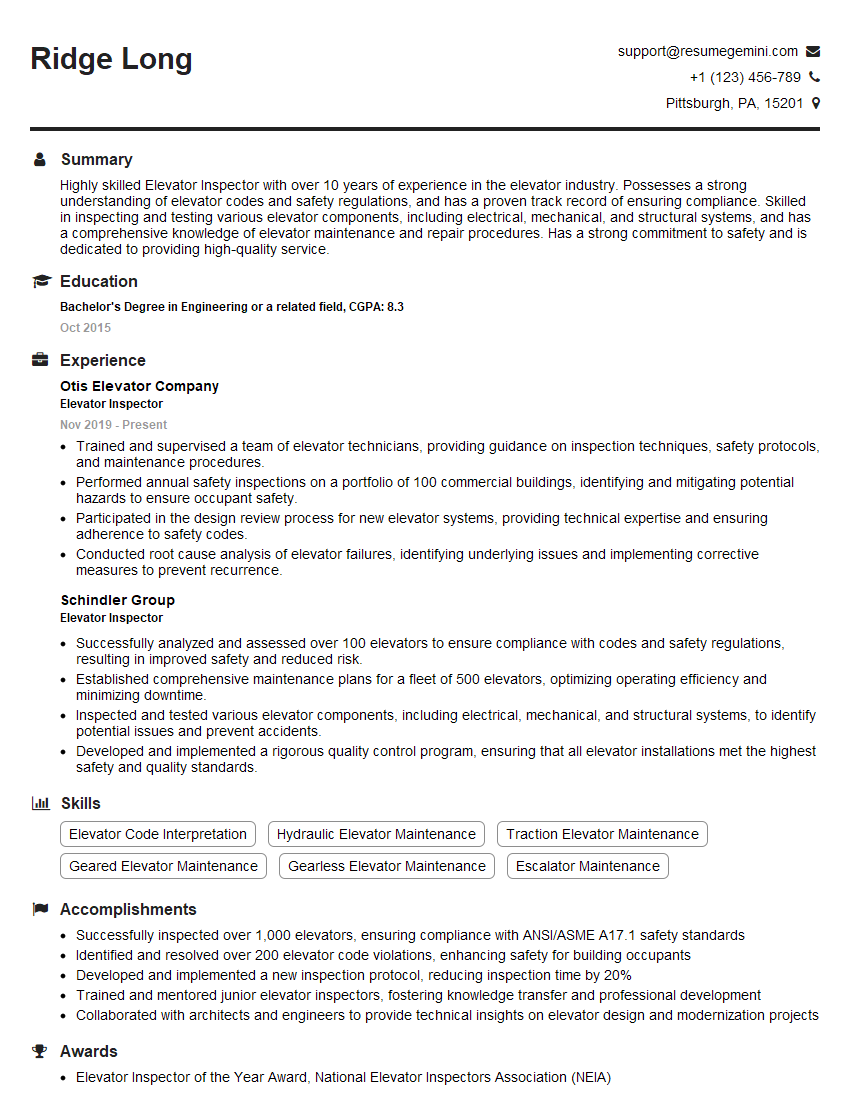
Mastering Elevator Testing Methods opens doors to exciting career opportunities in a vital industry focused on safety and innovation. A strong understanding of these methods significantly enhances your value to potential employers. To maximize your job prospects, it’s crucial to present your skills effectively. Building an ATS-friendly resume is key to getting noticed by recruiters. We recommend using ResumeGemini, a trusted resource, to craft a compelling and impactful resume. ResumeGemini offers examples of resumes tailored specifically to the Elevator Testing Methods field, helping you showcase your qualifications effectively. Invest the time to create a standout resume and land your dream job!
Explore more articles
Users Rating of Our Blogs
Share Your Experience
We value your feedback! Please rate our content and share your thoughts (optional).
What Readers Say About Our Blog
Very informative content, great job.
good