Interviews are opportunities to demonstrate your expertise, and this guide is here to help you shine. Explore the essential Production Sewing interview questions that employers frequently ask, paired with strategies for crafting responses that set you apart from the competition.
Questions Asked in Production Sewing Interview
Q 1. What types of sewing machines have you operated?
Throughout my career, I’ve become proficient in operating a wide variety of sewing machines, from basic single-needle machines to industrial high-speed models. This includes:
- Single-needle, straight-stitch machines: These are workhorses for straight seams, ideal for mass production of simple garments or components. I’ve used these extensively for tasks such as assembling shirt panels or creating basic seams on trousers.
- Single-needle, lockstitch machines: These machines produce a more durable and secure stitch than simpler models. I’ve utilized these for heavier fabrics and items requiring greater strength.
- Industrial overlock machines (sergers): I have extensive experience with sergers for finishing seams, creating professional-looking edges that prevent fraying and add durability. These are crucial for efficient production in apparel manufacturing.
- Coverstitch machines: Used for creating a professional, flat, and flexible finish, often seen on hems and necklines. I’ve employed these to give a high-quality finish to many projects.
- Twin-needle machines: These machines simultaneously use two needles and threads to create two parallel stitches, often used for creating decorative stitching or double seams. I’ve used these for tasks like creating double-stitched hems.
My experience spans different brands and models, giving me a versatile skillset applicable across various production settings.
Q 2. Describe your experience with different sewing machine needles and threads.
Selecting the right needle and thread is critical for achieving high-quality stitches and preventing machine damage. The type of needle depends on the fabric type and the desired stitch, while the thread should match the needle and fabric in terms of weight and material.
For example:
- Fine needles (sizes 8-12) are used for lightweight fabrics like silk or chiffon, with fine threads like polyester or silk.
- Medium needles (sizes 14-16) are suitable for medium-weight fabrics like cotton and linen, using medium-weight threads like cotton or all-purpose polyester.
- Heavy-duty needles (sizes 18 and above) are used for thick fabrics like denim or canvas, requiring heavier-duty threads like polyester or nylon.
Different needle types also exist for specific purposes, like ballpoint needles for knits (to prevent snags) and leather needles for thicker materials. Thread types include polyester, cotton, silk, nylon, and rayon, each with differing strengths, textures, and suitability for different fabrics and sewing techniques. Improper selection leads to broken needles, skipped stitches, or poor seam quality. Years of experience have given me the intuition to instantly select the correct needle and thread for any fabric and project.
Q 3. How do you maintain sewing machines to ensure optimal performance?
Regular maintenance is key to ensuring optimal sewing machine performance. My routine includes:
- Daily Cleaning: Removing lint, dust, and thread scraps from the bobbin area, feed dogs, and shuttle race. This prevents jams and improves stitch quality. I use a small brush and compressed air for this task.
- Weekly Lubrication: Applying a few drops of sewing machine oil to the moving parts as indicated by the machine’s manual. This reduces friction and extends the machine’s lifespan. Over-lubrication is just as harmful as neglecting it!
- Monthly Inspection: Checking the tension of the upper and lower threads, adjusting as needed. I also inspect the needle for bending or damage, replacing it as necessary. A bent needle can easily ruin a project or cause costly repairs.
- Periodic Servicing: Professional servicing every 6-12 months (depending on usage) to ensure everything is in perfect working order. This often involves cleaning, lubricating, and adjusting internal components that require specialist tools and knowledge.
Consistent attention to maintenance avoids costly breakdowns and ensures consistently high-quality stitches.
Q 4. What are your troubleshooting skills when a sewing machine malfunctions?
Troubleshooting sewing machine malfunctions requires a systematic approach. My process usually involves:
- Identify the Problem: Pinpoint the exact issue – is the machine skipping stitches, making noise, not feeding fabric properly, or something else?
- Check the Obvious: Ensure the needle is correctly inserted and not bent; verify the bobbin is correctly wound and inserted; check the thread for tangles or knots, and examine the tension settings.
- Systematic Elimination: If the problem persists, I methodically check each component—needle, thread, bobbin case, tension dials, feed dogs—eliminating possibilities one by one. I often begin with the most common culprits first, such as a bent or damaged needle.
- Consult the Manual: The machine’s manual provides valuable troubleshooting information specific to that model.
- Seek Professional Help: If the issue remains unresolved after thorough troubleshooting, I don’t hesitate to seek assistance from a qualified sewing machine technician. Trying to fix complex internal problems can lead to further damage.
I’ve learned through experience that a calm, methodical approach is essential when troubleshooting, preventing unnecessary frustration and ensuring efficient problem resolution.
Q 5. What is your experience with various sewing techniques (e.g., straight stitch, zigzag stitch, blind stitch)?
My sewing technique expertise encompasses a wide range of stitches, each with its own application and purpose:
- Straight Stitch: The most fundamental stitch, used for seams, topstitching, and other construction elements. The stitch length and tension can be adjusted to suit the fabric and desired result.
- Zigzag Stitch: Used for finishing raw edges to prevent fraying, creating decorative stitches, and sewing stretchy fabrics. The width and length of the zigzag can be altered dramatically.
- Blind Stitch: Creates an almost invisible seam, often used for hems and attaching linings. Proper tension and needle positioning are crucial for this technique.
- Overlock Stitch (Serger): Creates a professional finish on seams and edges, preventing fraying. This is usually done with a specialized overlock sewing machine.
- Decorative Stitches: Many machines offer a range of decorative stitches to add a personalized touch to projects. I’ve utilized many of these for added aesthetics, sometimes for brand identification.
My proficiency in these techniques allows me to adapt quickly to diverse sewing projects and maintain consistent quality.
Q 6. How do you ensure quality control during the sewing process?
Maintaining quality control throughout the sewing process is paramount. My approach involves several key steps:
- Pre-Sewing Inspection: Carefully examining the fabric for defects (holes, stains, inconsistencies) before beginning. This prevents wasting time and materials on flawed pieces.
- Consistent Seam Allowance: Using accurate measurements and maintaining consistent seam allowances throughout the sewing process ensures a well-fitting garment or product.
- Regular Stitch Checks: Periodically checking stitch quality to ensure consistent tension and proper needle penetration. Uneven stitches indicate a problem that needs immediate attention.
- Post-Sewing Inspection: Carefully inspecting each completed piece for defects before moving to the next stage. This includes checking seam alignment, stitch quality, and overall finish.
- Documentation: Keeping records of any issues encountered, including solutions and adjustments made. This aids in identifying trends and improving processes.
Implementing these quality control measures ensures that only high-quality finished goods are produced. It also helps with identifying and addressing issues, minimizing waste and improving efficiency.
Q 7. What are your experience with different fabric types and their sewing requirements?
Experience with diverse fabric types is essential in production sewing. Each fabric presents unique challenges and requires specialized techniques:
- Woven Fabrics (Cotton, Linen, Silk): These fabrics require different needle types and thread weights. Cotton and linen are durable and can handle stronger stitches, while silk is delicate and requires fine needles and threads.
- Knit Fabrics (Jersey, Rib Knit): These stretchy fabrics need special attention; using a ballpoint needle prevents snagging and skipped stitches. A zigzag stitch or overlock stitch is often preferred for finishing edges.
- Leather and Suede: These materials require heavy-duty needles and specialized thread. A walking foot can be necessary to feed the material evenly.
- Synthetic Fabrics (Polyester, Nylon): These fabrics often melt when punctured by a heated needle, so a reduced stitch length and careful feeding are required.
My experience allows me to adapt my sewing techniques to different fabric types, ensuring consistent quality and efficiency regardless of the material. Understanding the characteristics of each fabric type is fundamental to successful garment production.
Q 8. Describe your experience with pattern reading and interpretation.
Pattern reading and interpretation are fundamental to successful garment production. It’s like reading a map for a tailor – it guides every step of the sewing process. My experience involves not just understanding the individual pieces, but also grasping the overall construction and fit of the garment. This includes identifying different markings, such as notches, grainlines, and seam allowances. I’m proficient in interpreting various pattern formats, from traditional paper patterns to digital designs using CAD software. For instance, I’ve worked with patterns for complex garments like tailored jackets, where precise pattern interpretation is critical to achieve a clean, professional finish. A small error in understanding the pattern can lead to significant issues in the final product; therefore, meticulous attention to detail is paramount.
I can easily identify alterations required for different body types or design changes, and I can efficiently grade patterns to accommodate various sizes. I can also adapt patterns from one style to another, which requires strong understanding of construction techniques and pattern design principles. A recent example involves adapting a simple dress pattern to incorporate a more structured bodice, requiring me to modify the pattern pieces and incorporate additional features like boning channels.
Q 9. How do you handle production deadlines and prioritize tasks?
Meeting production deadlines in a fast-paced sewing environment demands effective prioritization and task management. I use a combination of techniques, including creating detailed production schedules, breaking down large tasks into smaller, manageable steps, and constantly monitoring progress. Think of it like orchestrating a symphony – each section (task) needs to be completed in time to contribute to the overall harmonious performance (on-time delivery).
I utilize project management tools to track deadlines and allocate resources efficiently. For instance, I’ve implemented Kanban boards to visualize workflow, identify bottlenecks, and ensure a smooth flow of production. If unforeseen delays occur, I proactively communicate with the team and management, identifying alternative solutions to minimize impact. This might involve re-allocating resources or adjusting priorities based on the urgency and impact of each task. My experience has taught me that open communication and proactive problem-solving are essential in navigating production challenges and delivering products on time.
Q 10. What is your experience with different types of sewing machine attachments?
My experience encompasses a wide range of sewing machine attachments, each designed for specific tasks. These attachments are like specialized tools in a craftsman’s toolbox, each enhancing efficiency and quality. I’m adept at using attachments like different types of presser feet (e.g., zipper foot, buttonhole foot, blind hem foot) for various stitch types and fabrics. I’m familiar with different types of needles – from those designed for delicate fabrics to heavy-duty needles for leather. I also have experience with specialized attachments such as gathering feet, ruffler feet, and even those used for embroidery stitches.
For example, using a blind hem foot allows for an almost invisible hem finish, crucial for high-quality garments. The ability to quickly and efficiently switch between attachments ensures minimal downtime and optimized production. Understanding the function of each attachment and its impact on stitch quality and speed is essential for maximizing productivity and achieving a high-quality output. I regularly train new operators on the proper usage and maintenance of these attachments to maintain consistent quality across the production line.
Q 11. How do you manage a team of sewing machine operators?
Managing a team of sewing machine operators requires strong leadership, communication, and delegation skills. It’s about fostering a collaborative environment where each individual feels valued and empowered. I believe in leading by example, demonstrating a commitment to quality and efficiency. My approach focuses on clear communication of expectations, regular feedback sessions, and providing ongoing training and support.
I utilize various techniques to motivate and mentor my team, including setting realistic goals, recognizing and rewarding achievements, and addressing concerns proactively. For instance, if an operator is struggling with a particular technique, I provide personalized training and support, ensuring they understand the procedure and can perform it efficiently. I also encourage open communication by creating a comfortable space for operators to voice their concerns or suggestions. A well-trained, motivated team is crucial for achieving high-quality production, meeting deadlines, and maintaining a positive work environment. I find that investing in my team’s growth ultimately results in a more efficient and productive operation.
Q 12. How do you identify and resolve quality issues in sewn garments?
Identifying and resolving quality issues is a crucial aspect of garment production. It’s a continuous process of inspection and improvement. My approach involves a multi-step process starting with regular quality checks throughout the production process. This includes inspecting fabric before cutting, monitoring stitch quality during sewing, and conducting final inspections before packaging. Think of it like a detective work – you need to identify the root cause of the problem, not just the symptom.
Common issues I encounter include inconsistent stitching, skipped stitches, fabric defects, and inaccurate seam allowances. To address these, I first analyze the issue to pinpoint the root cause – is it due to faulty equipment, improper machine settings, operator error, or fabric defects? Once identified, the appropriate corrective action is implemented, which might involve adjusting machine tension, retraining operators, replacing faulty equipment, or rejecting substandard fabric. Maintaining detailed records of these quality issues and corrective actions allows for continuous improvement and the prevention of similar problems in the future. Documenting these instances helps to identify recurring issues and implement systemic changes to prevent future occurrences.
Q 13. What is your experience with industrial sewing equipment maintenance?
Industrial sewing equipment maintenance is vital for ensuring consistent production and minimizing downtime. Regular maintenance is like giving your car a regular service – it keeps it running smoothly and prevents larger problems later on. My experience covers preventative maintenance, including regular cleaning, lubrication, and adjustments of sewing machines. I am familiar with troubleshooting common issues and performing minor repairs. I’m also adept at identifying when more complex repairs are necessary and contacting qualified technicians.
I’m proficient in maintaining various components, such as needles, presser feet, bobbins, and timing mechanisms. For example, I know how to adjust the tension and feed dogs to optimize stitching for various fabric types. I understand the importance of adhering to manufacturer’s guidelines for maintenance and regularly updating my knowledge on new maintenance procedures. Preventative maintenance not only extends the lifespan of the equipment, but also significantly improves stitch quality and reduces the risk of production delays due to machine malfunction.
Q 14. Explain your understanding of different sewing machine tensions and their impact on the stitch quality.
Sewing machine tension plays a crucial role in stitch quality. Think of it as the balance between the upper and lower threads – they need to work in harmony to create a perfect stitch. There are different types of tensions involved – upper thread tension, controlled by a dial on the machine, and bobbin tension, which is usually pre-set but can be adjusted in some models. Improper tension leads to various stitch problems. For instance, too much upper tension can cause the fabric to pucker, while too little can result in loose stitches. Conversely, improper bobbin tension can cause loops to form on the underside of the fabric.
The correct tension depends on the fabric type, needle size, thread type, and stitch type. A heavier fabric might require higher tension than a delicate one. Similarly, using a thicker thread necessitates adjustments to the tension settings. My expertise lies in identifying the optimal tension settings for different sewing situations and fabrics through experimentation and practical experience. I always use test pieces to fine-tune the tension before beginning a large production run to ensure a consistent and high-quality stitch throughout the garment. Mastering this skill is crucial for achieving professional-grade results and minimizing waste due to stitch quality issues.
Q 15. How familiar are you with safety regulations in a sewing environment?
Safety is paramount in a sewing environment. My familiarity extends to comprehensive knowledge of OSHA (Occupational Safety and Health Administration) regulations, as well as industry best practices. This includes, but is not limited to, proper machine guarding to prevent entanglement, the correct use of personal protective equipment (PPE) like safety glasses and finger guards, safe handling of needles and sharps, ergonomic workstation setup to prevent repetitive strain injuries, and emergency procedures in case of accidents, such as fire or equipment malfunction. I’ve actively participated in safety training programs and always ensure a clean and organized workspace to minimize trip hazards. For example, I’ve implemented a system for regularly inspecting machines for loose parts and immediately reporting any issues to ensure a safe working environment for everyone.
Career Expert Tips:
- Ace those interviews! Prepare effectively by reviewing the Top 50 Most Common Interview Questions on ResumeGemini.
- Navigate your job search with confidence! Explore a wide range of Career Tips on ResumeGemini. Learn about common challenges and recommendations to overcome them.
- Craft the perfect resume! Master the Art of Resume Writing with ResumeGemini’s guide. Showcase your unique qualifications and achievements effectively.
- Don’t miss out on holiday savings! Build your dream resume with ResumeGemini’s ATS optimized templates.
Q 16. Describe your experience with different cutting and preparation methods for sewing.
My experience encompasses a wide range of cutting and preparation methods. I’m proficient in manual cutting using various cutting tools, from shears and rotary cutters to electric knives, tailoring my approach to the fabric type and pattern complexity. I also have extensive experience with automated cutting systems, including computerized cutting tables and laser cutters, which significantly increase efficiency for large-scale production. Preparation methods involve accurate pattern marking, grading (sizing), notching, and pre-treating fabrics such as pre-washing to prevent shrinkage. For example, I’ve optimized a cutting layout for a particular denim pattern to minimize waste by arranging the pattern pieces strategically using computer-aided design (CAD) software before transferring the layout onto the fabric. This led to a 15% reduction in fabric waste for that particular run.
Q 17. How do you manage fabric waste effectively?
Fabric waste management is crucial for both cost-effectiveness and environmental responsibility. My strategies involve several key steps: careful planning and efficient nesting of patterns to minimize fabric usage, utilizing scraps for smaller projects or sample making, and implementing a system for sorting and storing reusable scraps. We also explore innovative solutions such as using fabric remnants for creating product packaging or donating excess material to schools or charitable organizations. For instance, I implemented a system where fabric scraps were categorized and stored, leading to a significant decrease in waste and increased utilization of material, directly impacting our bottom line.
Q 18. How do you prioritize tasks to meet production goals?
Prioritizing tasks to meet production goals requires a systematic approach. I utilize methods like Kanban or other visual task management systems to track progress and identify bottlenecks. This involves analyzing the production schedule, considering factors such as order urgency, fabric availability, and machine capacity. High-priority tasks, such as rush orders, are tackled first, while balancing workload to avoid delays. For example, I’ve used a Kanban board to visualize the workflow, allowing the team to easily identify and address any delays in the production process. This resulted in improved on-time delivery and increased productivity.
Q 19. What is your understanding of production line efficiency and optimization?
Production line efficiency and optimization are paramount. My understanding encompasses various lean manufacturing principles such as reducing waste (muda), optimizing workflow (kaizen), and improving quality control (poka-yoke). I analyze production data to identify bottlenecks and areas for improvement, focusing on streamlining processes, reducing setup times, and improving worker ergonomics. For example, I identified a bottleneck in the stitching process and, through process analysis, found the solution was a more efficient thread-feeding mechanism and optimized stitch settings. This improved throughput by 10%.
Q 20. Describe your experience with computerized sewing machines.
I have extensive experience with computerized sewing machines, including programming different stitch patterns, adjusting stitch length and width, and utilizing advanced features like automatic trimming and thread cutting. My skills involve troubleshooting common issues, understanding machine maintenance, and optimizing stitch settings for different fabrics. For example, I successfully programmed a computerized sewing machine to execute a complex decorative stitch pattern for a high-end garment line, increasing efficiency and precision compared to manual stitching.
Q 21. How do you ensure consistency in stitching across multiple garments?
Consistency in stitching is crucial for quality control. This involves meticulous attention to detail, proper machine calibration, regular maintenance, and the use of standardized stitch settings for each garment. Employing detailed work instructions and visual aids, alongside operator training ensures consistent stitch quality across different operators. Implementing quality checks at various stages of the process—including regular stitch quality inspections—also helps maintain consistency. For example, I developed a detailed checklist for each stitch type, including specific stitch length, width, and tension settings. This led to a significant improvement in the consistency of stitching across different garments and operators.
Q 22. What is your familiarity with different sewing machine foot types and their uses?
My familiarity with sewing machine feet is extensive. Different feet are crucial for achieving specific stitches and handling various fabric types. Think of them as specialized tools for a surgeon – each designed for a precise task.
- General-purpose foot: This is your workhorse, suitable for most basic stitching tasks.
- Zipper foot: Allows for close stitching alongside zippers, essential for clean zipper installations.
- Buttonhole foot: Creates consistent buttonholes, vital for consistent garment quality. There are variations for different buttonhole styles.
- Blind hem foot: Creates nearly invisible hems, crucial for a professional finish.
- Walking foot: Prevents fabric slippage, particularly useful for layered fabrics or difficult materials like leather or denim.
- Rolled hem foot: Creates narrow, rolled hems, perfect for delicate fabrics like chiffon.
- Cording foot: Attaches cording or piping to fabric, adding a decorative or structural element.
Understanding the nuances of each foot allows for precise control and the creation of high-quality garments. For instance, using a walking foot for a multi-layered denim jacket ensures even stitching and prevents puckering, whereas a rolled hem foot would be preferred for a delicate silk blouse.
Q 23. How do you handle challenging fabrics (e.g., leather, silk)?
Challenging fabrics like leather and silk require specialized techniques and adjustments to the sewing machine. It’s about adapting to the unique properties of each material.
- Leather: Requires a strong needle (typically leather needles), reduced stitch length, and often a walking foot to prevent slippage. A sharp, heavy-duty blade for precise cutting is essential to avoid tearing. Using a roller foot can also help glide smoothly over thicker sections.
- Silk: Needs a fine needle (silk needles), a reduced stitch length, and slow sewing speeds to avoid breakage. A thin, lightweight fabric will also need a gentler touch to avoid puckering or damage. Using a walking foot can help prevent delicate fabrics from shifting.
For both, pre-treating the fabric is vital. For leather, conditioning is crucial, while silk may benefit from a light spray of water to prevent snagging. The key is patience and attention to detail. I have successfully made numerous leather jackets and silk blouses, demonstrating my capacity to handle these materials proficiently.
Q 24. What experience do you have with different types of stitching patterns?
My experience encompasses a wide range of stitching patterns, from basic straight stitches to complex decorative techniques. Proficiency in these patterns is critical for adapting to different designs and garment types.
- Straight stitch: The foundation of sewing, used for seams, hems, and many other applications.
- Zigzag stitch: Provides added strength and prevents fraying. Variations of zigzag are used for decorative stitching, finishing edges, and creating overlock seams.
- Satin stitch: Creates a dense, smooth, decorative stitch often used for appliqué work.
- Blind hem stitch: Creates a nearly invisible hem stitch which is useful for both aesthetic and functional considerations.
- Decorative stitches: These enhance the garment’s appearance. My experience ranges from simple to complex designs, incorporating different stitch lengths and patterns for creative effects.
I’m skilled in applying these stitches effectively for various purposes, understanding which stitch best complements a specific fabric and construction technique. For example, a zigzag stitch is useful for finishing raw edges of denim to prevent fraying, whilst a satin stitch could be beautifully applied to add embroidery to a child’s dress.
Q 25. Describe a situation where you had to solve a complex sewing problem. How did you approach it?
In a previous role, we faced a challenge with a new fabric – a blend of linen and silk that was prone to puckering during the assembly of a tailored jacket. The high-quality linen had a tendency to stretch and the silk was delicate.
My approach was systematic:
- Analysis: I identified the cause as differential feed during sewing (the top and bottom layers of fabric were feeding through the machine at uneven rates).
- Testing: I experimented with various needle types, stitch lengths, tension settings, and different presser feet, keeping meticulous notes.
- Solution: The use of a walking foot combined with precise tension adjustments and a slightly reduced stitch length resolved the issue, providing even feed and preventing puckering.
- Documentation: I documented my findings to share with the team, enhancing the overall efficiency of our production process.
This experience highlighted the importance of methodical problem-solving and attention to detail in production sewing.
Q 26. How do you stay updated on the latest advancements and techniques in the production sewing industry?
Staying updated is crucial in this dynamic industry. I employ several strategies:
- Industry Publications: I regularly read trade magazines and online journals focusing on sewing technology and garment construction.
- Workshops and Seminars: I actively participate in workshops and seminars offered by sewing equipment manufacturers and industry associations.
- Online Courses: I utilize online learning platforms to deepen my knowledge of new techniques and software for pattern making and production management.
- Networking: Connecting with other professionals in the industry via online forums and industry events keeps me abreast of current trends and challenges.
This multi-faceted approach ensures I remain at the forefront of advancements in production sewing.
Q 27. What are your strengths and weaknesses related to Production Sewing?
My strengths lie in my problem-solving abilities, meticulous attention to detail, and adaptability to new techniques and materials. I excel at working efficiently and effectively within a team environment. I am proficient in operating various sewing machines and possess a keen eye for quality control.
An area for development is my experience with large-scale automated sewing systems. While my knowledge base is growing, hands-on experience in this domain would significantly enhance my capabilities.
Q 28. What are your salary expectations for this role?
My salary expectations are commensurate with my experience and the requirements of this role. I am open to discussing a competitive compensation package based on a comprehensive understanding of the role’s responsibilities and benefits.
Key Topics to Learn for Your Production Sewing Interview
- Sewing Machine Operation & Maintenance: Understanding various sewing machine types, their functionalities, troubleshooting common malfunctions (e.g., needle breakage, thread jams), and basic preventative maintenance procedures.
- Production Techniques & Efficiency: Mastering efficient stitching techniques for speed and accuracy, understanding production quotas and timelines, and optimizing workflow for maximum output.
- Quality Control & Standards: Recognizing and addressing quality defects in garments, adhering to industry standards and company specifications, and understanding quality control processes.
- Fabric & Material Knowledge: Familiarity with different fabric types (e.g., cotton, silk, synthetics), their properties, and appropriate sewing techniques for each. Understanding the impact of fabric choice on garment construction and durability.
- Safety Procedures & Regulations: Adherence to workplace safety protocols, proper use of sewing equipment, and awareness of potential hazards in a production environment.
- Teamwork & Communication: Collaborating effectively with colleagues on assembly lines, communicating issues promptly, and contributing to a positive team environment. Understanding how to work within a team to meet production goals.
- Problem-Solving & Adaptability: Demonstrating the ability to identify and resolve problems quickly and efficiently, adapting to changing production requirements, and finding solutions to unexpected challenges on the production line.
Next Steps
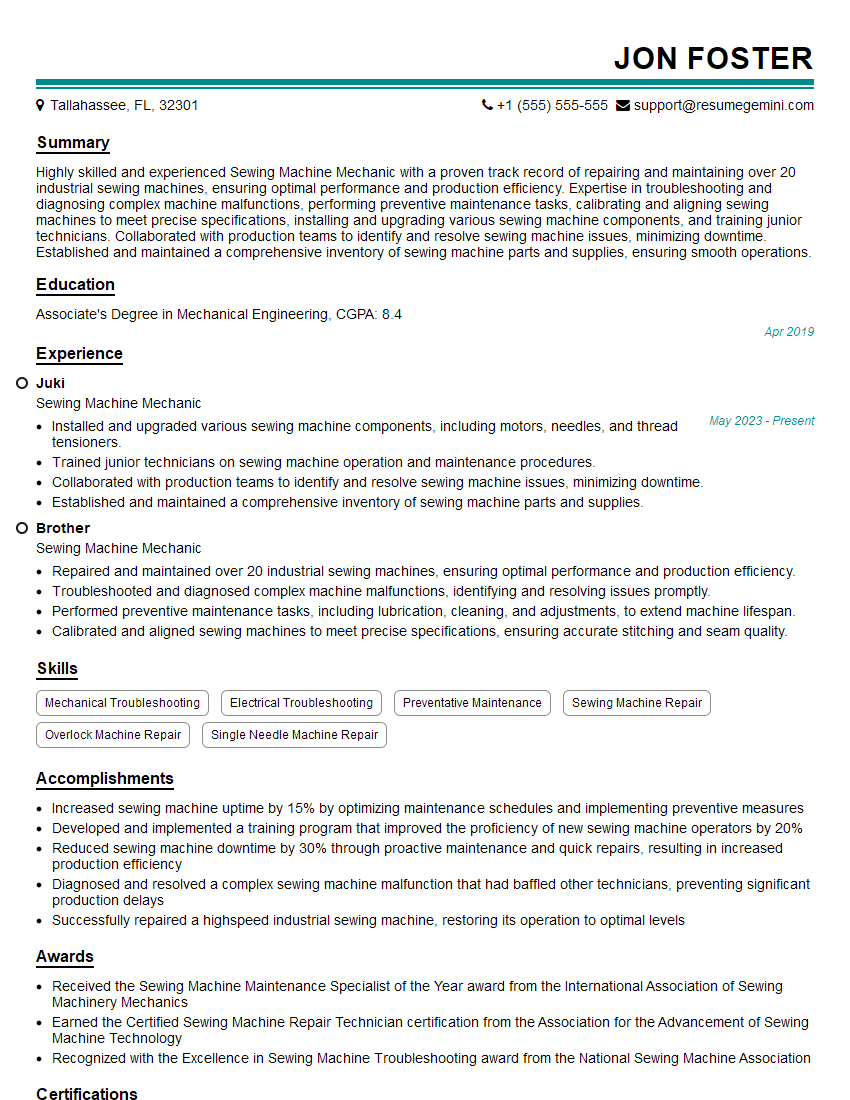
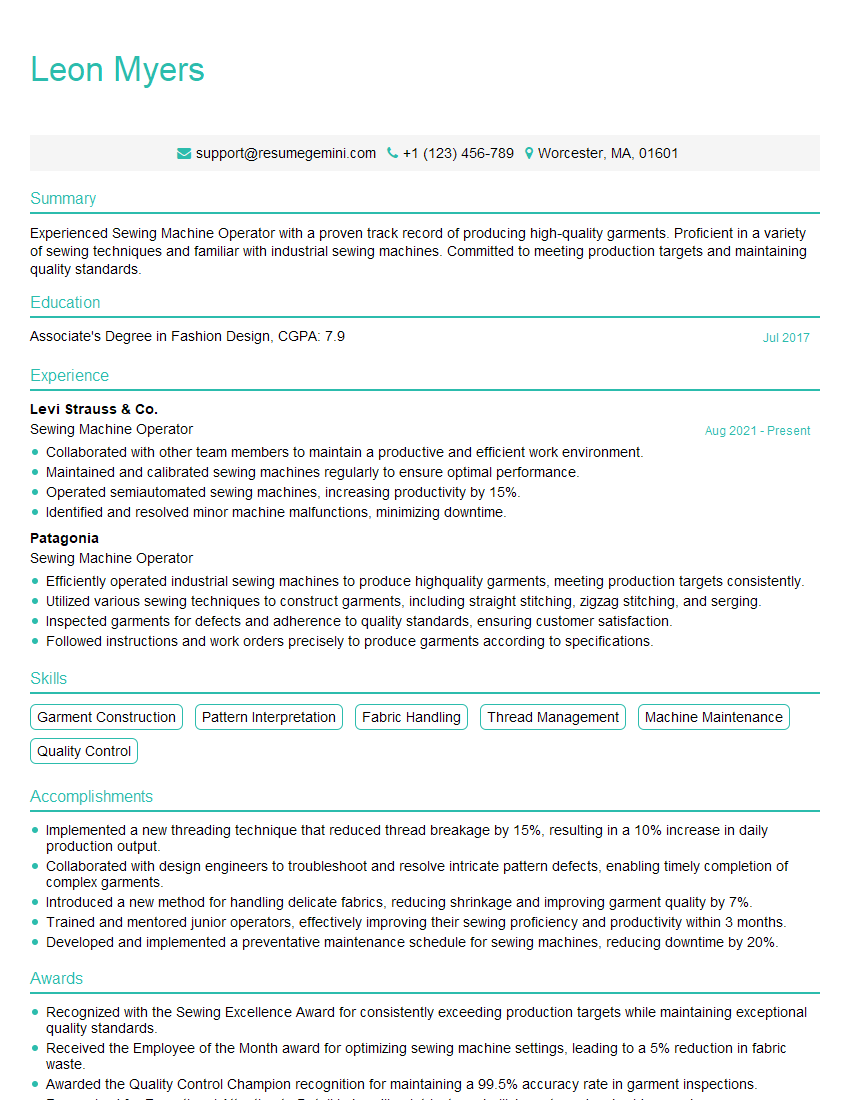
Mastering Production Sewing opens doors to a rewarding career with excellent growth potential, offering opportunities for advancement and specialization. A strong resume is crucial for showcasing your skills and experience to potential employers. Creating an ATS-friendly resume is vital to ensuring your application is seen by hiring managers. To enhance your resume and increase your chances of landing your dream job, we recommend using ResumeGemini, a trusted resource for building professional resumes. Examples of resumes tailored to Production Sewing are available to help you get started.
Explore more articles
Users Rating of Our Blogs
Share Your Experience
We value your feedback! Please rate our content and share your thoughts (optional).
What Readers Say About Our Blog
Very informative content, great job.
good