Interviews are more than just a Q&A session—they’re a chance to prove your worth. This blog dives into essential Proficiency in Intelligence Software interview questions and expert tips to help you align your answers with what hiring managers are looking for. Start preparing to shine!
Questions Asked in Proficiency in Intelligence Software Interview
Q 1. Explain your experience with different intelligence software platforms.
My experience with intelligence software platforms spans a wide range, encompassing both commercial and open-source solutions. I’ve worked extensively with platforms like Palantir Gotham, which excels in its ability to handle massive datasets and visualize complex relationships between entities. I’m also proficient in using open-source tools like Maltego, which is invaluable for link analysis and OSINT (Open-Source Intelligence) gathering. In previous roles, I’ve also utilized platforms specializing in specific intelligence domains, such as those focused on geospatial analysis or financial crime investigation. My experience includes not only using these platforms but also configuring them, customizing workflows, and training other analysts on their effective usage. For example, in one project, I integrated Palantir Gotham with our existing CRM system to enrich customer profiles with intelligence data, significantly improving our risk assessment capabilities.
Q 2. Describe your proficiency in data mining and analysis techniques within intelligence software.
Data mining and analysis are at the core of my intelligence work. My proficiency includes techniques like link analysis (identifying connections between individuals, organizations, and events), social network analysis (mapping relationships and identifying key players), and anomaly detection (finding unusual patterns or outliers that may indicate suspicious activity). I use these techniques in conjunction with various algorithms, including clustering and classification algorithms, implemented within the intelligence software platforms mentioned earlier. For example, I once used a combination of link analysis and anomaly detection within Palantir Gotham to identify a previously unknown network involved in fraudulent activities. The platform’s visualization capabilities were instrumental in unraveling the complex web of relationships and transactions, leading to the successful disruption of the network.
Beyond these, I am experienced with text mining and Natural Language Processing (NLP) to extract valuable information from unstructured data like emails and news articles. This often involves using regular expressions (regex) and other pattern-matching techniques to identify keywords, entities, and relationships. A specific example involved using NLP to analyze thousands of social media posts to identify early warning signs of a potential civil unrest.
Q 3. How familiar are you with various data visualization tools used in intelligence analysis?
My familiarity with data visualization tools is extensive. I regularly use tools integrated within intelligence platforms such as Palantir Gotham’s built-in visualization capabilities and also leverage external tools like Tableau and Gephi. I understand the importance of choosing the right visualization technique for the type of data and the intended audience. For instance, I use network graphs to visualize relationships, heatmaps to show patterns and correlations, and timelines to track events over time. I’m proficient in creating dashboards and reports that effectively communicate complex intelligence findings to both technical and non-technical stakeholders. A clear and concise visualization is crucial for effective decision-making, so I always strive for clarity and simplicity in my presentations.
Q 4. What experience do you have with threat modeling and risk assessment using intelligence software?
Threat modeling and risk assessment are integral parts of my work. I use intelligence software to identify potential threats, assess their likelihood and impact, and develop mitigation strategies. My process typically involves identifying potential vulnerabilities, analyzing the capabilities and intentions of adversaries, and evaluating the effectiveness of existing security controls. I often use structured threat modeling methodologies, such as STRIDE (Spoofing, Tampering, Repudiation, Information disclosure, Denial of service, Elevation of privilege), to systematically identify potential risks. In one project, I used Palantir Gotham to model the potential impact of a cyberattack on our critical infrastructure, allowing us to prioritize mitigation efforts and allocate resources effectively. The platform allowed for a dynamic and interactive threat modeling process, facilitating collaboration among various stakeholders and enabling efficient scenario planning.
Q 5. Explain your understanding of data security and privacy concerns within the context of intelligence software.
Data security and privacy are paramount in intelligence work. I am keenly aware of the ethical and legal implications of handling sensitive information. My experience includes working with data governed by strict regulations, such as GDPR and CCPA. I understand the importance of data encryption, access control, and data anonymization techniques to protect sensitive data from unauthorized access and misuse. I am also familiar with various security protocols and best practices for securing intelligence databases and platforms. I prioritize data minimization, only collecting and retaining data that is necessary for legitimate purposes. Furthermore, I’m experienced in implementing and auditing security controls to ensure compliance with relevant regulations and internal policies.
Q 6. Describe your experience with the development or maintenance of intelligence databases.
I have significant experience in the development and maintenance of intelligence databases. This includes designing database schemas, implementing data quality controls, and ensuring data integrity. I’m familiar with various database management systems (DBMS), including relational databases like PostgreSQL and MySQL, and NoSQL databases like MongoDB. My experience extends to working with both structured and unstructured data, often integrating multiple data sources into a unified intelligence database. In one project, I led the development of a new database to support a national-level counterterrorism investigation, ensuring the system was scalable, secure, and easily accessible to authorized analysts. The process involved meticulous planning, collaboration with database administrators, and rigorous testing to ensure data accuracy and consistency. Data governance and metadata management were also critical components of this endeavor.
Q 7. How proficient are you in using SQL or other database querying languages within intelligence software?
I’m highly proficient in SQL and other database querying languages. I regularly use SQL to query, manipulate, and analyze data within intelligence databases. My skills extend to advanced SQL techniques, such as joins, subqueries, and window functions, allowing me to extract complex insights from large datasets. I also have experience with other querying languages like Cypher (for graph databases) and specialized query languages used within specific intelligence software platforms. For instance, I have used SQL extensively to generate reports, analyze trends, and identify patterns within large datasets within Palantir Gotham. A specific example involved writing complex SQL queries to identify financial transactions linked to a specific criminal organization, helping to uncover their financial networks and ultimately aiding in their prosecution.
Q 8. Explain your experience with geospatial intelligence software and applications.
Geospatial intelligence (GEOINT) software and applications are crucial for analyzing location-based data to understand events and situations. My experience spans several platforms, including ArcGIS, QGIS, and Google Earth Pro. I’ve used these tools to perform tasks such as:
- Mapping and visualization: Creating thematic maps illustrating troop movements, infrastructure damage, or population density changes from satellite imagery and other geospatial data sources.
- Spatial analysis: Employing techniques like buffer analysis to determine areas of risk or proximity analysis to identify relationships between different points of interest. For instance, I once used buffer analysis to determine the potential impact zone of a chemical spill, using real-time data feeds and GIS software to inform emergency response efforts.
- Data integration: Combining various data types—satellite imagery, sensor data, social media posts with geolocation tags—to create a comprehensive situational understanding. A project I worked on involved integrating sensor data from drones with high-resolution satellite images to map deforestation patterns in the Amazon rainforest.
- 3D modeling and simulation: Building 3D models of terrain and structures to aid in mission planning and analysis, understanding the impact of elevation, terrain complexity etc on strategic considerations.
My proficiency extends to understanding different coordinate systems, projections, and data formats like Shapefiles, GeoTIFFs, and KML files.
Q 9. How familiar are you with open-source intelligence (OSINT) gathering and analysis techniques using specific software?
Open-source intelligence (OSINT) is invaluable for gathering information from publicly available sources. I’m proficient in utilizing various software tools to gather and analyze OSINT, including:
- Social media monitoring tools: Tools like Brand24 and Talkwalker help track mentions of key individuals or events across various platforms, identifying trends and potential threats. I’ve used these tools to monitor online discussions during political campaigns, identifying potential misinformation campaigns or emerging social unrest.
- Web scraping tools: Software such as Scrapy allows me to extract structured data from websites, enabling the collection of large datasets for analysis. For example, I used web scraping to gather news articles related to a specific event, analyzing the sentiment and narrative around it.
- Data aggregation and analysis tools: Tools like Maltego are helpful for visualizing connections between entities and sources discovered through OSINT, providing a visual representation of complex relationships.
My OSINT work always adheres to ethical guidelines and legal constraints, ensuring responsible data acquisition and analysis.
Q 10. Describe your experience with natural language processing (NLP) techniques applied to intelligence data.
Natural Language Processing (NLP) is crucial for extracting meaning from textual data, a large part of intelligence work. My experience includes using NLP techniques such as:
- Sentiment analysis: Determining the emotional tone (positive, negative, neutral) of text data to understand public opinion or assess the risk level of a situation. This is very helpful in analyzing social media posts to anticipate potential societal upheaval or gauge public trust in an event or organization.
- Topic modeling: Identifying key themes and topics in large text corpora to summarize and categorize information efficiently. This is used to organize large volumes of documents from intercepted communications or news reports, making them much more manageable.
- Named entity recognition (NER): Identifying and classifying named entities (persons, organizations, locations, etc.) to extract key information from unstructured text. For instance, identifying key players and their locations involved in a conflict from intercepted communication.
- Text summarization: Condensing large volumes of text into concise summaries to save time and focus on important details. This is regularly applied in threat assessment and strategic planning.
I have experience with various NLP libraries, including NLTK and spaCy, and utilize these tools to process and analyze intelligence data from various sources.
Q 11. What is your experience with machine learning algorithms applied to intelligence data analysis?
Machine learning (ML) algorithms are powerful tools for analyzing large and complex datasets in intelligence. My experience involves applying various algorithms such as:
- Classification: Using algorithms like Support Vector Machines (SVMs) and Random Forests to categorize data points into predefined classes (e.g., classifying emails as spam or not spam, identifying potential threats). This assists in prioritizing intelligence findings and streamlining analysis.
- Regression: Predicting continuous values using algorithms like linear regression to forecast trends or estimate future events (e.g., predicting the likelihood of future conflicts based on historical data).
- Clustering: Using algorithms like k-means to group similar data points together to identify patterns and anomalies (e.g., identifying clusters of suspicious financial transactions).
- Anomaly detection: Identifying unusual patterns in data that deviate from the norm, indicating potential threats or outliers. A real world example would be identifying fraudulent transactions based on spending patterns of an individual.
I have practical experience with Python libraries such as scikit-learn and TensorFlow, and am comfortable building and deploying ML models for intelligence analysis. I always focus on model interpretability and validation to ensure accurate and trustworthy results.
Q 12. Explain your understanding of different data formats and structures commonly used in intelligence software.
Intelligence data comes in various formats and structures. My experience encompasses working with:
- Structured data: Data organized in relational databases (e.g., SQL databases) and spreadsheets (e.g., CSV files). This is common for storing structured information such as personnel records or financial transactions.
- Semi-structured data: Data with some organizational structure, such as XML or JSON files. This often includes data from various sources like social media feeds.
- Unstructured data: Data without a predefined format, such as text documents, images, and audio files. This might include intercepted communications or satellite imagery.
Understanding the nuances of each data type and its limitations is crucial for accurate analysis. I have experience converting data between formats and leveraging the strengths of each to make the analysis richer.
Q 13. How do you ensure the accuracy and reliability of data within intelligence software applications?
Ensuring data accuracy and reliability is paramount in intelligence. My approach involves:
- Source verification: Critically evaluating the credibility and trustworthiness of data sources. This involves considering the source’s reputation, bias, and potential motives.
- Data validation: Employing techniques to check data for inconsistencies, errors, and anomalies. This involves cross-referencing information across different sources and performing data quality checks.
- Data provenance tracking: Maintaining a detailed record of the origin and handling of data to ensure transparency and accountability.
- Version control: Maintaining multiple versions of data and analysis to allow for review and revision.
By following rigorous procedures and utilizing various quality control techniques, I strive to minimize errors and ensure the reliability of the analysis produced.
Q 14. Describe your experience with data cleaning and preprocessing techniques.
Data cleaning and preprocessing is an essential step in any intelligence analysis workflow. My experience includes:
- Handling missing values: Addressing missing data points through imputation techniques or exclusion, depending on the context and the impact of missing data.
- Outlier detection and handling: Identifying and managing outliers to prevent them from skewing analysis. This could involve removing outliers or investigating the cause of the anomaly.
- Data transformation: Converting data into a suitable format for analysis (e.g., normalizing or standardizing data).
- Feature engineering: Creating new features from existing data to improve model performance or provide additional insights. This might involve creating new variables that better capture relevant relationships in the data.
Proficient data cleaning helps improve the accuracy and effectiveness of subsequent analytical processes and ensures the insights derived are sound and reliable.
Q 15. Explain your experience with data fusion and integration from multiple sources within intelligence software.
Data fusion, in the context of intelligence software, involves combining data from disparate sources – think satellite imagery, social media feeds, financial transactions, and human intelligence reports – to create a more comprehensive and accurate understanding of a situation. Integration, on the other hand, is the process of making these diverse data sources interoperable and accessible within a single analytical environment. My experience encompasses both aspects. I’ve worked extensively with platforms that utilize ETL (Extract, Transform, Load) processes to ingest data from various formats (CSV, XML, JSON, databases) and map them into standardized schemas.
For instance, in one project, we integrated data from a geospatial intelligence system showing troop movements with financial transaction data revealing suspicious payments to suspected insurgents. This fusion revealed previously unseen correlations, leading to a more accurate assessment of the threat landscape. We used a combination of proprietary software and open-source tools like Python libraries (Pandas, GeoPandas) to clean, transform, and link these diverse data sets, ensuring data quality and integrity through rigorous validation checks throughout the process.
Another key aspect of my experience is managing the complexities of data provenance and security. Tracking the origin and trustworthiness of each data point is critical for maintaining the integrity of intelligence analysis. We implemented robust metadata management systems and employed strict access control mechanisms to ensure data security and comply with relevant regulations.
Career Expert Tips:
- Ace those interviews! Prepare effectively by reviewing the Top 50 Most Common Interview Questions on ResumeGemini.
- Navigate your job search with confidence! Explore a wide range of Career Tips on ResumeGemini. Learn about common challenges and recommendations to overcome them.
- Craft the perfect resume! Master the Art of Resume Writing with ResumeGemini’s guide. Showcase your unique qualifications and achievements effectively.
- Don’t miss out on holiday savings! Build your dream resume with ResumeGemini’s ATS optimized templates.
Q 16. How do you prioritize and manage competing tasks and deadlines in intelligence analysis workflows?
Prioritizing tasks in intelligence analysis is crucial, as we often face multiple urgent and competing demands. My approach involves a combination of techniques including using a project management system (e.g., Jira or Asana) to track tasks and deadlines, applying prioritization frameworks such as the Eisenhower Matrix (Urgent/Important), and regularly reviewing and adjusting my schedule as priorities evolve.
A key factor is effective communication with stakeholders to ensure alignment on priorities. For example, if I’m faced with a high-priority, time-sensitive request alongside several other important tasks, I proactively communicate the potential impact of shifting priorities and propose a revised timeline for the other tasks, always seeking consensus and transparent communication.
Moreover, I break down complex tasks into smaller, manageable sub-tasks, creating a clear roadmap and setting realistic deadlines for each. This allows me to track progress effectively, identify potential bottlenecks early, and stay focused on delivering high-quality work within the given constraints. Regularly reviewing my to-do list and adapting to unexpected delays is essential to maintaining productivity and meeting deadlines.
Q 17. Describe a situation where you had to troubleshoot and resolve a technical issue within intelligence software.
In one instance, our intelligence platform experienced an unexpected outage, disrupting access to critical data during a sensitive operation. Initially, the system displayed a generic error message, providing little diagnostic information. My troubleshooting started with systematically checking the obvious: network connectivity, server status, and application logs. I found that the issue stemmed from a database connection failure caused by an unexpected surge in data volume.
My approach involved systematically escalating the issue, consulting with the IT support team, and reviewing the system’s error logs to determine the root cause. It turned out that a recent software update had inadvertently introduced a bottleneck in the database query process. Once identified, we reverted the update to a previous stable version. We then implemented temporary measures to manage the database load and simultaneously worked on a long-term solution to improve scalability and prevent future occurrences. The incident highlighted the importance of robust error handling, comprehensive logging, and a well-defined escalation process in intelligence software operation.
Q 18. How do you collaborate effectively with other analysts and stakeholders in an intelligence setting?
Effective collaboration is paramount in intelligence analysis. I prioritize clear and concise communication, utilizing various tools depending on the situation. For instance, we use secure messaging platforms for real-time communication and collaboration tools like shared workspaces (e.g., SharePoint, Google Workspace) to share documents, track progress, and facilitate brainstorming sessions. Regular team meetings, formal briefings, and informal knowledge-sharing sessions are also crucial in maintaining a coordinated effort.
I believe in active listening and fostering a respectful and inclusive environment where everyone feels comfortable sharing their insights. I also utilize visualization tools, such as interactive dashboards and maps, to present complex data in a clear and understandable manner. This facilitates shared understanding and ensures everyone remains informed about the analysis process and its findings.
In situations requiring input from external stakeholders, I strive to anticipate their needs, frame my communications clearly, and tailor my approach to ensure engagement and understanding. For example, when presenting to senior management, I focus on concise summaries of key findings and actionable intelligence, whilst with technical experts, I may delve into more detailed technical aspects.
Q 19. How familiar are you with different intelligence methodologies and frameworks?
I’m familiar with various intelligence methodologies and frameworks, including the intelligence cycle (planning & direction, collection, processing, analysis, production, dissemination), the Diamond Model of Intrusion Analysis (intruder, victim, infrastructure, capability), and various analytical techniques such as structured analytic techniques (SAT) like hypothesis generation, matrixes, and scenario planning.
My understanding of these frameworks informs my approach to intelligence analysis, allowing me to structure my work effectively, identify potential biases, and produce high-quality intelligence products. For instance, understanding the intelligence cycle allows me to proactively identify potential bottlenecks and ensure the smooth flow of information across different stages of the analysis process. Similarly, utilizing the Diamond Model helps contextualize observed activities and assess the potential impact and scope of threats.
I also have experience applying various analytic techniques depending on the specific challenge. For instance, when dealing with a complex issue with multiple variables, I may use a matrix to visually represent relationships, enabling a more methodical analysis of potential correlations. In scenarios requiring predicting future outcomes, I often apply scenario planning, helping to generate a range of possible future scenarios based on current data and potential future events.
Q 20. Explain your understanding of the ethical implications of using intelligence software.
Ethical considerations are paramount when using intelligence software. The potential for misuse, including biases embedded in algorithms, privacy violations through data collection and analysis, and the potential for misinterpretations leading to unjust actions, necessitates a strong ethical framework.
I’m mindful of the importance of data privacy and security, adhering to all relevant regulations and organizational policies. This includes employing secure data storage and access control mechanisms, and ensuring all data processing activities are compliant with privacy laws. Furthermore, I strive to use algorithms and analytical techniques in a way that is fair, unbiased, and transparent, acknowledging the potential limitations and biases inherent in the data and algorithms.
Regular ethical review of my work is a critical part of my process. This involves critically evaluating the potential impact of my analysis and taking steps to mitigate any potential risks or harms. Open communication with stakeholders about potential ethical considerations and the limitations of the analysis is essential in building trust and ensuring responsible use of intelligence software.
Q 21. What is your experience with reporting and presenting intelligence findings using specialized software?
I possess extensive experience in reporting and presenting intelligence findings using specialized software, including ArcGIS for mapping, Tableau and Power BI for data visualization, and dedicated intelligence analysis platforms. I’m proficient in creating various types of intelligence products, ranging from concise executive summaries to detailed analytical reports with supporting evidence.
My reports are designed to be clear, concise, and tailored to the audience. For example, a report for senior management will focus on key findings and recommendations, while a report for a technical audience might include more detailed methodology and data analysis. The use of visualisations (charts, graphs, maps) is crucial in communicating complex information effectively.
I ensure that all reporting adheres to strict security protocols and maintains confidentiality of sensitive information. My work also incorporates quality assurance steps, including rigorous fact-checking and peer review to guarantee the accuracy and reliability of the intelligence products delivered. This systematic approach contributes to the production of credible and impactful intelligence reports.
Q 22. Describe your experience with the development or implementation of intelligence software automation workflows.
My experience with intelligence software automation workflows spans several years and various projects. I’ve been involved in the full lifecycle, from requirements gathering and design to implementation, testing, and deployment. For instance, in a recent project involving counter-terrorism intelligence, we automated the process of analyzing social media data. This involved developing a workflow that ingested data from various sources, applied natural language processing (NLP) techniques to extract key entities and relationships, and visualized the findings on interactive dashboards. This significantly reduced the time required for analysts to identify potential threats, from days to hours. Another example involved automating the fusion of HUMINT (Human Intelligence) reports with SIGINT (Signals Intelligence) data, creating a more comprehensive and actionable intelligence picture. This was achieved through the development of custom scripts and the integration of various intelligence software packages. These projects highlighted the importance of clear, well-defined workflows that are robust, scalable, and easy to maintain.
- Requirement Gathering: Close collaboration with intelligence analysts to understand their needs and translate them into technical specifications.
- Design and Development: Utilizing appropriate programming languages (e.g., Python, Java) and intelligence software APIs to build automated workflows.
- Testing and Validation: Rigorous testing to ensure accuracy, efficiency, and security.
- Deployment and Maintenance: Deploying the workflow to a production environment and providing ongoing support and maintenance.
Q 23. How do you stay current with the latest advancements and best practices in intelligence software and technology?
Staying current in the rapidly evolving field of intelligence software and technology requires a multi-faceted approach. I regularly attend industry conferences and webinars, participate in online forums and communities, and actively engage with professional organizations. I also subscribe to several leading journals and publications dedicated to intelligence analysis and technological advancements. Furthermore, I invest time in online courses and certifications to expand my skills in areas such as machine learning, data visualization, and cybersecurity. A crucial aspect is hands-on experience – I frequently experiment with new tools and techniques, applying them to real-world datasets or simulated scenarios to assess their effectiveness. This continuous learning process ensures I’m always up-to-date on the latest best practices and emerging technologies. For example, I recently completed a course on advanced geospatial intelligence analysis, incorporating new techniques in predictive policing.
Q 24. Explain your understanding of different types of intelligence (e.g., HUMINT, SIGINT, OSINT).
My understanding of different intelligence types is fundamental to my work. HUMINT, or Human Intelligence, relies on information gathered from human sources, such as informants or spies. This often involves cultivating relationships, managing sources, and ensuring the reliability of information. SIGINT, or Signals Intelligence, involves intercepting and analyzing electronic signals, like communications and radar data. This requires specialized technical skills and sophisticated signal processing techniques. OSINT, or Open-Source Intelligence, leverages publicly available information from various sources, including the internet, media, and academic publications. This involves employing advanced search techniques, data mining, and social media analysis. I’m proficient in working with all three types, understanding their strengths and limitations, and integrating them to create a more holistic intelligence picture. For example, a terrorist threat assessment might incorporate HUMINT from an informant, SIGINT from intercepted communications, and OSINT from social media posts.
Q 25. How do you ensure the integrity and confidentiality of sensitive intelligence data?
Ensuring the integrity and confidentiality of sensitive intelligence data is paramount. My approach involves adhering to strict security protocols, using encryption techniques for data storage and transmission, and employing access control mechanisms to limit access to authorized personnel only. This includes implementing robust authentication and authorization systems and regularly auditing access logs to detect any unauthorized activity. Data loss prevention (DLP) tools are also employed to monitor and prevent sensitive data from leaving the secure network. Furthermore, I am well-versed in data anonymization and sanitization techniques to protect the identities of sources and minimize the risk of data breaches. Regular security awareness training for all personnel involved in handling sensitive data is also crucial. My experience in working with classified data has instilled in me a deep understanding of the importance of information security.
Q 26. Describe your experience with using intelligence software to support decision-making processes.
I’ve extensively utilized intelligence software to support decision-making processes across various domains. For instance, in a counter-narcotics operation, I used geospatial intelligence software to analyze drug trafficking routes, identify key players, and predict future trafficking patterns. This supported law enforcement agencies in prioritizing their resources and developing effective strategies to disrupt drug smuggling networks. In another project focused on financial crime, I used network analysis software to visualize complex financial transactions, identify suspicious patterns, and uncover hidden connections between individuals and entities involved in money laundering schemes. The insights generated from the software assisted investigators in building strong cases and bringing perpetrators to justice. In all cases, the software’s role wasn’t merely to process data, but to generate actionable intelligence that directly influenced decision-making.
Q 27. How do you evaluate the effectiveness of intelligence software tools and techniques?
Evaluating the effectiveness of intelligence software tools and techniques involves a multi-faceted approach. Firstly, I assess the accuracy and reliability of the results generated by the software. This involves comparing the software’s output with other sources of intelligence and validating its findings. Secondly, I examine the efficiency of the tool in terms of speed and resource utilization. Does it significantly reduce the time and effort required for analysts to process data and reach conclusions? Thirdly, I consider the usability of the software, evaluating its interface, ease of use, and overall user experience. A well-designed tool enhances analyst productivity and minimizes errors. Finally, I assess the impact of the tool on the overall decision-making process. Does it lead to better-informed decisions and improved outcomes? Key metrics might include the reduction in analysis time, improvement in accuracy of predictions, and ultimately, the success rate of operations informed by the intelligence produced.
Q 28. What are your salary expectations for this role?
My salary expectations for this role are commensurate with my experience and expertise, and align with the industry standards for professionals with my skills and accomplishments. I am open to discussing a competitive salary range based on the specific details of the position and the compensation package offered. I am confident that my contributions will significantly benefit your organization, and I am eager to discuss this further.
Key Topics to Learn for Proficiency in Intelligence Software Interview
- Data Acquisition & Ingestion: Understanding various data sources, formats, and methods for importing and processing intelligence data. Consider exploring techniques for handling structured and unstructured data.
- Data Analysis & Visualization: Mastering techniques for analyzing large datasets, identifying patterns and anomalies, and effectively visualizing findings using charts, graphs, and dashboards. Practice interpreting complex data to draw meaningful conclusions.
- Data Mining & Pattern Recognition: Explore algorithms and techniques for extracting valuable insights from raw intelligence data. Focus on practical applications such as identifying trends, predicting future events, and uncovering hidden relationships.
- Intelligence Reporting & Communication: Learn how to effectively communicate complex intelligence findings to diverse audiences through clear, concise, and compelling reports. Practice structuring reports logically and supporting claims with evidence.
- Software-Specific Functionality: Develop a deep understanding of the specific software’s features, capabilities, and limitations. Familiarize yourself with its user interface, data manipulation tools, and reporting functionalities.
- Security & Privacy Considerations: Understand the importance of data security and privacy in handling sensitive intelligence information. Explore best practices for protecting data from unauthorized access and ensuring compliance with relevant regulations.
- Problem-Solving & Critical Thinking: Practice approaching complex intelligence problems systematically, using critical thinking skills to analyze information, identify biases, and develop effective solutions.
Next Steps
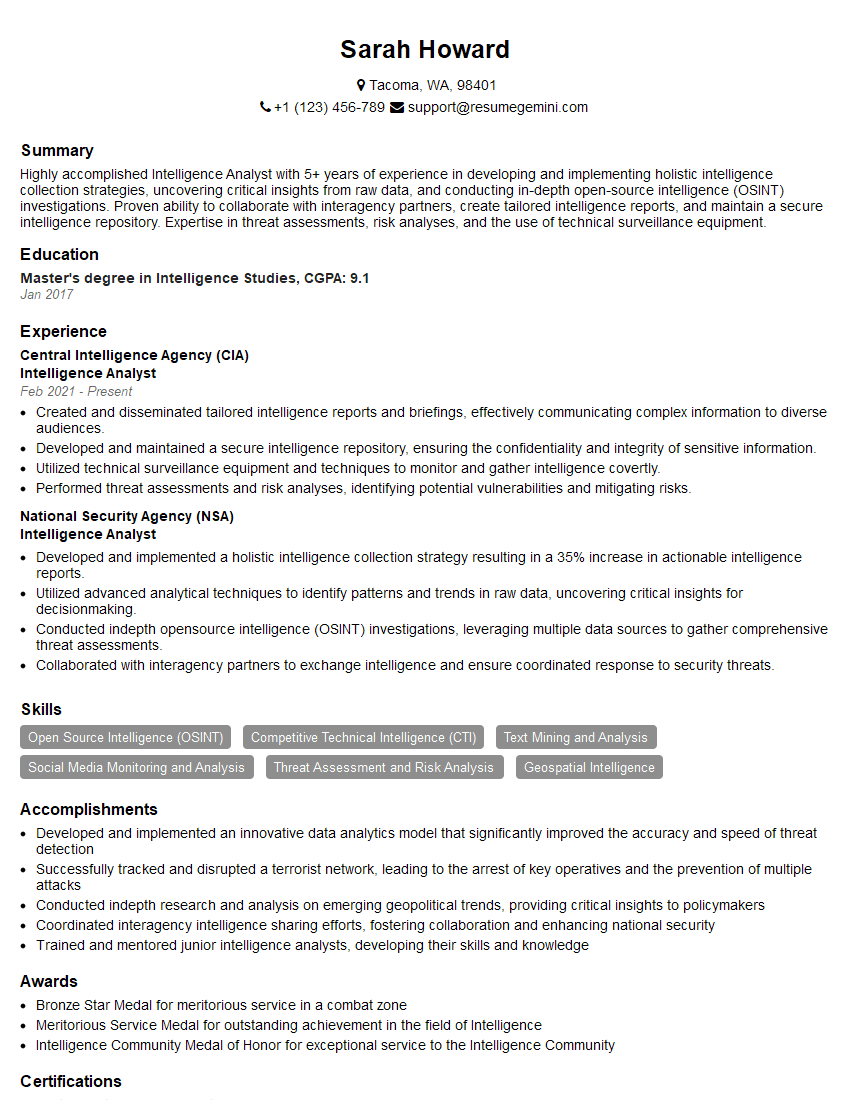
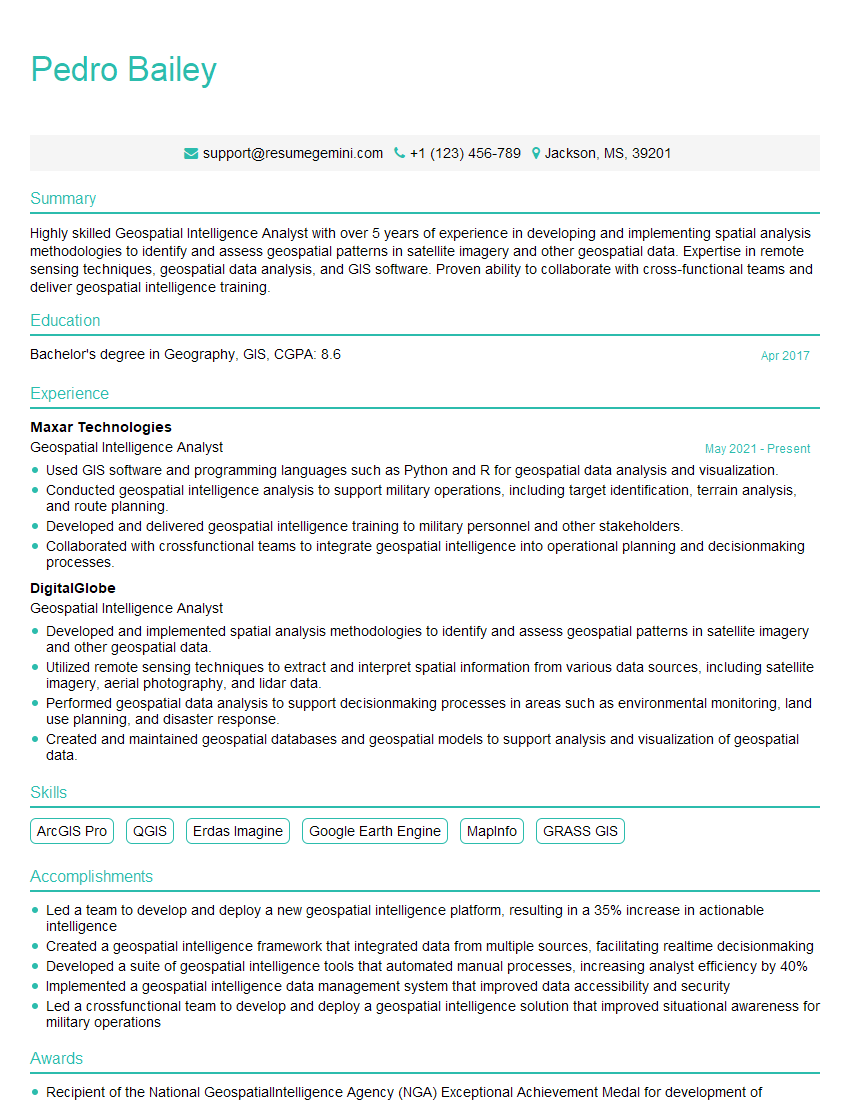
Mastering proficiency in intelligence software is crucial for career advancement in the field of intelligence analysis, cybersecurity, and related sectors. It opens doors to high-demand roles and allows you to contribute meaningfully to critical decision-making processes. To significantly increase your chances of landing your dream job, it’s essential to present your skills effectively. Crafting an ATS-friendly resume is key. We highly recommend using ResumeGemini to build a professional and impactful resume that highlights your expertise. ResumeGemini offers examples of resumes tailored to Proficiency in Intelligence Software to help you get started. Invest the time to create a compelling representation of your skills and experience – it’s an investment in your future success.
Explore more articles
Users Rating of Our Blogs
Share Your Experience
We value your feedback! Please rate our content and share your thoughts (optional).
What Readers Say About Our Blog
Very informative content, great job.
good