Every successful interview starts with knowing what to expect. In this blog, we’ll take you through the top Proficient in Orchestral and Band Instrumentation interview questions, breaking them down with expert tips to help you deliver impactful answers. Step into your next interview fully prepared and ready to succeed.
Questions Asked in Proficient in Orchestral and Band Instrumentation Interview
Q 1. Describe the standard instrumentation of a full symphony orchestra.
A full symphony orchestra boasts a rich and varied instrumentation, typically encompassing four main sections: strings, woodwinds, brass, and percussion. Within these sections, the specific number of players can vary depending on the size and budget of the orchestra, as well as the composer’s requirements. However, a standard configuration would include:
- Strings: First and second violins (typically the largest sections), violas, cellos, and double basses.
- Woodwinds: Flutes (usually 2, sometimes a piccolo), oboes (2), clarinets (2 at minimum, often including a bass clarinet), bassoons (2).
- Brass: French horns (typically 4), trumpets (3 or more), trombones (2 or 3, often including a bass trombone), tuba (1).
- Percussion: A broad range of instruments, including timpani (kettledrums), snare drum, bass drum, cymbals, triangle, xylophone, and various other auxiliary percussion instruments; the exact instruments will depend on the piece.
It’s important to note that many modern orchestral scores also incorporate harp, piano, and sometimes other instruments like mandolin or guitar when the composition calls for it. Think of the iconic harp glissandos in Debussy’s works or the rhythmic punch of a piano in certain contemporary pieces.
Q 2. What are the common ranges and registers of the woodwind family?
The woodwind family is characterized by its wide range of timbres and expressive capabilities. The ranges generally overlap, offering flexibility to composers. Here’s a breakdown:
- Flute: Typically spans from middle C (C4) to high C (C7), with a bright, clear tone. The piccolo, a smaller flute, plays an octave higher.
- Oboe: Ranges from B♭3 to approximately G6, known for its warm, slightly reedy tone.
- Clarinet: Has a vast range, often extending from E♭3 to approximately C7. The tone varies between registers, from a mellow sound in the lower register to a brighter, more agile sound in the upper register. Bass clarinets extend the range significantly lower.
- Bassoon: Covers a lower range than the other woodwinds, usually from B♭2 to approximately F5, with a rich, sonorous tone. Its deep voice is essential to the orchestral texture.
These ranges are approximate and can be extended slightly by skilled players, but this gives a good overview of the typical playing registers for each instrument.
Q 3. Explain the differences between a concert band and a symphony orchestra.
While both concert bands and symphony orchestras are instrumental ensembles, significant differences exist in instrumentation and sound. Think of it like this: a symphony orchestra is a large, detailed painting, while a concert band is a vibrant, perhaps slightly more informal mural.
- Instrumentation: Symphony orchestras primarily feature string instruments, creating a rich, layered sound. Concert bands, on the other hand, consist mainly of woodwinds and brass, with percussion, and often lacking strings entirely. The absence of strings dramatically changes the harmonic and textural possibilities.
- Sound and Style: Symphony orchestras are known for their wide dynamic range, subtle nuances, and ability to portray a vast array of emotions. Concert bands often have a more boisterous, bright, and outward sound, sometimes with a less nuanced dynamic range. The repertoire also tends to be different, reflecting these stylistic differences.
- Size: Symphony orchestras are generally larger than concert bands, though both sizes can vary dramatically.
In essence, the choice between a symphony orchestra and a concert band depends on the desired sonic palette and musical style. Each has its unique strengths and aesthetic appeal.
Q 4. Discuss the challenges of balancing the different sections in an orchestral arrangement.
Balancing different sections in an orchestral arrangement is crucial for creating a cohesive and clear musical texture. It’s a delicate art that demands a deep understanding of each instrument’s sonic characteristics and their interplay. The challenge lies in:
- Volume and Timbre: Strings generally have a greater dynamic range, meaning they can play both extremely soft and loud passages. Brass instruments can project powerfully but are limited in their soft dynamic range, while woodwinds have unique timbral strengths that must be considered in order to avoid muddiness and ensure clarity.
- Register Overlap: Some instruments may have overlapping ranges, creating potential for conflicts in the overall sound if not carefully planned. A good arranger would use the natural sonic contrasts for enriching the musical texture, rather than allowing the instruments to clash.
- Instrumentation Considerations: The score itself affects the balance. A piece with many brass parts might overpower the strings unless carefully orchestrated.
The process involves careful consideration of instrumentation, dynamics (loudness and softness), orchestration (distribution of the musical material), and rehearsal processes to ensure a homogeneous blend of the sounds of each section. I often utilize recording software to ensure that the different sections are not only audible, but that their interplay contributes to a richer overall sound.
Q 5. How would you address intonation issues in a brass section?
Intonation issues in the brass section are common and can significantly impact the overall musical quality. Addressing them requires a multi-faceted approach:
- Individual Tuning: Each player needs to ensure their instrument is properly tuned before a rehearsal. This involves checking the valves or slides and tuning the instrument against a reliable pitch reference.
- Ensemble Tuning: After individual tuning, I often have the brass section play together on a simple chord or scale to identify any discrepancies. This allows to address collective intonation problems.
- Lip Slurs and Embouchure: Brass players need to develop accurate embouchure and be adept at executing lip slurs for smooth transitions across registers.
- Warm-ups: A focused warm-up routine designed to improve intonation is fundamental.
- Breathing techniques: This is often overlooked, but proper breathing technique is crucial for consistent intonation.
I’ll often work with the brass section individually and collectively, offering feedback on embouchure, breath support, and the use of lip slurs. Occasionally, I might use tuning aids, including electronic tuners, to help players pinpoint intonation issues.
Q 6. Describe your approach to conducting rehearsals with a diverse ensemble.
Conducting rehearsals with a diverse ensemble requires sensitivity, effective communication, and a clear understanding of individual musical backgrounds. My approach focuses on:
- Respectful Communication: I ensure that my instructions are clear and tailored to the group’s needs, using inclusive language and being mindful of cultural differences.
- Individual Attention: I acknowledge that each musician has their own experience and style. I work to understand the players’ perspective, offering tailored feedback and guidance, and focusing on constructive criticism.
- Collaborative Approach: I foster a collaborative environment where musicians feel comfortable sharing their ideas and concerns. This also leads to better understanding across the sections.
- Clear Expectations: I set clear expectations for rehearsal etiquette and performance standards from the outset. This prevents conflicts and provides a frame of reference for musicians.
Building trust and rapport is key to managing a successful rehearsal, and respecting the individual styles contributes to a better atmosphere for creating music.
Q 7. What strategies do you use to maintain musicians’ motivation and engagement?
Maintaining musicians’ motivation and engagement is vital for a successful ensemble. I employ strategies that prioritize both the artistic process and the well-being of the musicians:
- Challenging Repertoire: Selecting challenging but rewarding repertoire can foster a sense of accomplishment and deepen musical skills.
- Positive Reinforcement: Regularly acknowledging and praising musicians’ efforts reinforces their sense of value and encourages continued dedication.
- Collaboration and Feedback: Creating a collaborative space where musicians feel comfortable sharing ideas and receiving constructive feedback contributes to their motivation and engagement.
- Social Events: Organizing social gatherings, such as post-rehearsal get-togethers, builds camaraderie and fosters team spirit.
- Individual Growth: Tailoring rehearsals to incorporate individual skill-building exercises helps keep performers stimulated and excited about their progress.
Keeping the rehearsals dynamic and engaging, combined with highlighting the shared musical goals, helps to keep a sense of purpose and shared experience.
Q 8. Explain the role of a librarian in an orchestral setting.
The orchestral librarian is a crucial, often unsung, hero of the musical world. Their role extends far beyond simply shelving music. They are responsible for the meticulous organization, maintenance, and preparation of all musical scores and parts used by the orchestra. This involves a deep understanding of orchestral instrumentation and the physical handling of often delicate and valuable materials.
- Score and Part Management: They meticulously check, collate, and organize scores and individual parts for each musician, ensuring accuracy and completeness. This includes dealing with any necessary repairs or replacements.
- Part Preparation: Librarians often prepare parts for performances, which might involve photocopying, binding, or even creating parts from scratch for newly commissioned works. This requires understanding of engraving software and meticulous attention to detail.
- Maintaining the Library: They maintain a comprehensive catalogue and database of the orchestra’s music library, often using specialized software to track scores, parts, and their usage. This ensures easy retrieval and minimizes the risk of loss or damage.
- Collaboration with Conductor and Musicians: Librarians work closely with the conductor and musicians to meet their specific needs. They may consult on various editions or provide advice on optimal performance materials.
Think of them as the orchestra’s memory keeper, ensuring that every musician has the correct music at the right time, in perfect condition, contributing significantly to a smooth and successful performance.
Q 9. How would you handle a conflict between musicians during a performance?
Conflicts between musicians during a performance are rare but can be disruptive. My approach would focus on swift, discreet intervention to minimize disruption to the audience and maintain the flow of the performance.
- Immediate Assessment: I would first quickly assess the nature and severity of the conflict. Is it a minor disagreement, a misunderstanding, or something more serious? Observing body language can be crucial.
- Discrete Intervention: If possible, I’d address the issue discretely, perhaps by a quiet word during a break or by utilizing a designated stage manager to relay a message. The goal is to de-escalate without drawing attention.
- Post-Performance Discussion: For more significant conflicts, a private conversation after the performance would be necessary. This would involve understanding the root cause of the conflict and finding a solution that works for all involved. Mediation, if necessary, may be employed.
- Documentation: In cases of repeated or serious conflicts, it would be important to document the issues to inform future strategies for managing the ensemble.
Preventing conflicts is key. Clear communication, rehearsal protocols, and fostering a collaborative environment are crucial to minimizing tension.
Q 10. What software do you use for music notation and arrangement?
My experience encompasses several industry-standard software programs for music notation and arrangement. I’m proficient in Sibelius and Finale, two of the most widely used options. I also have experience with Dorico, known for its advanced features and its ability to handle large scores with efficiency. The choice of software often depends on the specific project requirements and personal preferences, but my familiarity with these ensures versatility.
For example, Sibelius’s ease of use makes it excellent for quick sketches and revisions, while Finale offers more advanced features for detailed engraving and score preparation. Dorico’s strengths lie in its speed and efficiency for complex projects.
Q 11. What is your experience with score preparation and editing?
Score preparation and editing are integral parts of my work. My experience includes:
- Proofreading and Correcting: I meticulously check scores and parts for errors in notation, ensuring accuracy and consistency.
- Part Extraction: I’m proficient in extracting individual parts from full scores, often using software to ensure accuracy and efficiency.
- System Editing: I can manage and edit large scores and parts, ensuring correct page turns and layout for optimal performance.
- Preparing for different instrumentation: I can adapt scores for various orchestral configurations, including chamber versions or arrangements for smaller ensembles.
- Creating Cue Sheets: Preparing cue sheets for conductors and stage managers, ensuring effective communication during the performance.
Accuracy is paramount. A single misplaced note can significantly impact a performance. My attention to detail and experience ensure that the final product is flawless and ready for performance.
Q 12. Describe your familiarity with different musical styles and periods.
My familiarity with musical styles and periods is extensive, encompassing a broad range from the Baroque to contemporary music. This includes:
- Baroque: Bach, Handel – Understanding the ornamentation, continuo realization, and stylistic nuances of this period.
- Classical: Haydn, Mozart, Beethoven – Knowledge of classical forms, structure, and orchestral techniques.
- Romantic: Schubert, Brahms, Wagner – Familiarity with the larger orchestral forces, expressive harmonies, and dramatic structures of Romantic music.
- 20th and 21st Century: Stravinsky, Schoenberg, contemporary composers – Understanding atonal and serial techniques, extended techniques, and the diverse styles of modern composers.
This broad knowledge allows me to adapt my approach to different musical contexts and to assist musicians in understanding the stylistic requirements of the repertoire.
Q 13. How do you adapt your conducting techniques for different ensemble sizes and musical styles?
Adapting conducting techniques is essential for different ensemble sizes and musical styles. My approach involves:
- Adjusting Baton Technique: Larger ensembles require broader, more encompassing gestures, while smaller groups benefit from more subtle and precise movements.
- Tempo and Dynamics: The tempo and dynamic range appropriate for a large Romantic symphony would differ significantly from that of a chamber ensemble playing a Baroque piece.
- Articulation and Phrasing: Different musical styles require different approaches to articulation and phrasing. A Baroque piece may demand precise and detached articulation, while a Romantic work may call for a more legato style.
- Eye Contact and Communication: Maintaining effective communication with musicians is crucial, regardless of ensemble size. This involves clear gestures and expressive eye contact.
For example, conducting a string quartet requires a much more intimate and precise approach than leading a full symphony orchestra. The subtle nuances of expression become critical when fewer musicians are present.
Q 14. How would you conduct a rehearsal with musicians of varying skill levels?
Rehearsing musicians with varying skill levels requires a sensitive and adaptable approach. My strategy would focus on creating a supportive and inclusive learning environment:
- Individual Attention: I would provide individual attention to musicians who need additional support, offering specific guidance and addressing individual challenges.
- Differentiated Instruction: I would adapt my instruction to meet the different learning styles and skill levels of the musicians. This might involve providing simplified exercises or focusing on specific techniques.
- Positive Reinforcement: Positive reinforcement is vital in building confidence and encouraging musicians of all levels. Celebrating successes, no matter how small, fosters a positive atmosphere.
- Collaborative Learning: I would encourage collaborative learning, allowing more experienced musicians to mentor and support those with less experience.
- Clear Expectations: Setting clear expectations and providing constructive feedback are essential in guiding musicians toward improved performance.
The goal is to ensure that all musicians feel valued and supported, fostering a sense of teamwork and mutual respect, leading to a cohesive and successful performance.
Q 15. Explain your understanding of musical form and structure.
Musical form and structure are the blueprints of a composition, dictating how musical ideas are presented and developed. Think of it like the architecture of a building; it needs a solid foundation and a logical progression to be effective. Forms like sonata form, rondo form, and theme and variations each have specific structural guidelines, but composers often blend and adapt these to create unique pieces.
Sonata Form: Typically features three sections: exposition (presentation of themes), development (exploration and transformation of themes), and recapitulation (return of themes, often in the tonic key). Think of Beethoven’s 5th Symphony; its iconic opening motif is the foundation, developed and transformed throughout the movement, then triumphantly returned in the recapitulation.
Theme and Variations: A single melody (the theme) is repeated multiple times, each time with variations in rhythm, harmony, melody, or instrumentation. Consider the many variations on a theme found in Bach’s Goldberg Variations – each variation retains a core element of the original while offering a unique musical perspective.
Rondo Form: Characterized by a recurring main theme (A) interspersed with contrasting episodes (B, C, etc.). Mozart’s Piano Concertos frequently employ this form, with the catchy main theme providing a sense of unity amidst the diverse episodes.
Understanding form helps in analyzing, performing, and even composing music. It’s crucial for musicians to grasp the structure to ensure a coherent and impactful performance.
Career Expert Tips:
- Ace those interviews! Prepare effectively by reviewing the Top 50 Most Common Interview Questions on ResumeGemini.
- Navigate your job search with confidence! Explore a wide range of Career Tips on ResumeGemini. Learn about common challenges and recommendations to overcome them.
- Craft the perfect resume! Master the Art of Resume Writing with ResumeGemini’s guide. Showcase your unique qualifications and achievements effectively.
- Don’t miss out on holiday savings! Build your dream resume with ResumeGemini’s ATS optimized templates.
Q 16. What is your approach to selecting repertoire for a concert program?
Selecting repertoire is a crucial aspect of concert programming. My approach is multifaceted, considering several key elements:
Audience Engagement: I carefully consider the intended audience, their musical preferences, and their level of familiarity with different styles and composers. A program for a youth orchestra would differ significantly from a program for an adult chamber music group.
Musical Cohesion: I strive for a program that flows naturally, creating a compelling narrative throughout the concert. I look for contrasts and connections between pieces, ensuring a balance of styles, moods, and instrumentation.
Ensemble Capabilities: I take into account the technical skills and limitations of the ensemble. Choosing pieces that push the group’s abilities while remaining attainable fosters growth and prevents frustration.
Artistic Vision: I aim for a program that expresses a particular theme or idea, potentially reflecting a historical period, a composer’s oeuvre, or a specific emotional landscape. A thematic approach provides a unified context for the audience.
Duration and Balance: The program must be appropriately timed to fit the allotted performance slot, balancing longer works with shorter pieces to avoid audience fatigue and maintain a captivating pace.
I often start by identifying a central piece or composer that inspires the direction of the whole program and then build outward, seeking pieces that complement and contrast with this anchor.
Q 17. Discuss your experience with working with percussion instruments.
My experience with percussion instruments spans a broad range, from orchestral timpani and snare drum to a wide variety of mallet percussion and world percussion instruments. I’ve worked extensively with both traditional and contemporary percussion techniques.
I’ve had the pleasure of working with ensembles where I not only play percussion, but also help prepare and maintain the instruments. This includes things like tuning timpani for optimal resonance, replacing mallets, and making sure that all the instruments are in proper working order. This practical experience has given me great insight into the challenges and nuances of playing each instrument.
I’ve also had the opportunity to work with composers on new works involving percussion sections, collaborating with them to ensure the parts are not only playable but also effective musically. In one project, I worked directly with a composer to explore the extended techniques of the vibraphone – using specialized mallets and striking techniques to achieve a wider range of timbres and effects that were integral to the composer’s vision. This collaborative approach is essential in bringing innovative works to life.
Q 18. How familiar are you with the capabilities of various electronic instruments?
I’m quite familiar with the capabilities of various electronic instruments, ranging from synthesizers and samplers to digital audio workstations (DAWs). My experience includes working with both hardware and software-based instruments in various contexts.
My understanding goes beyond simply playing the instruments; I’m adept at integrating electronic sounds into both traditional orchestral settings and contemporary electronic music projects. I understand the principles of sound synthesis, effects processing, and MIDI implementation, allowing me to effectively create or manipulate sounds to achieve specific musical goals.
For instance, I’ve worked on projects where electronic instruments were used to augment the orchestral palette, providing textures and sounds not readily available from traditional instruments. In one particular project, we used synthesizers to create ethereal soundscapes that complemented the haunting melodies of a string quartet.
Q 19. How would you ensure the accuracy of a score during a performance?
Ensuring score accuracy during a performance requires a multi-pronged approach, beginning long before the actual performance.
Careful Score Preparation: This starts with ensuring the chosen score is a reliable edition, free of errors. I often compare multiple editions, and if necessary, consult experts for clarification on ambiguous passages or potential errors.
Thorough Rehearsal: Rehearsals are crucial for identifying and correcting mistakes. I employ attentive listening during rehearsals and actively encourage musicians to identify and flag anything questionable.
Detailed Part Marking: During rehearsals, I work with individual players to mark any challenging passages in their parts. This may include phrasing markings, fingerings, articulations, or dynamic markings to guide them through demanding sections.
Cueing System: A well-defined cueing system is indispensable for ensuring continuity in case of a missed entrance. This ensures that even if one musician has trouble, the performance can recover smoothly.
Experienced Musicians: Choosing skilled and reliable musicians is an essential aspect. Experience and dedication contribute significantly to accuracy.
Combining meticulous preparation with the collaboration of experienced musicians helps establish a robust safeguard against mistakes during the performance.
Q 20. How do you manage time effectively during rehearsals and performances?
Effective time management during rehearsals and performances hinges on planning, clear communication, and adaptability.
Detailed Rehearsal Plans: Before each rehearsal, I create a schedule outlining the sections to be covered, allowing for efficient use of time. This plan is flexible to accommodate unexpected issues that may arise.
Prioritization: I prioritize the most challenging aspects of the repertoire early in the rehearsal process. This ensures sufficient time is allocated to address difficulties and achieve musical mastery.
Clear Communication: I maintain open communication with musicians, clearly articulating my expectations, providing feedback promptly, and encouraging questions and suggestions.
Efficient Breaks: Strategically placed breaks allow musicians to rest and refocus, enhancing both productivity and attention span.
Adaptability: Unexpected events inevitably occur, and I am prepared to adjust the rehearsal schedule accordingly. Being flexible ensures that the overall goals are met despite unforeseen circumstances.
During performances, having a well-rehearsed ensemble and a clear understanding of the performance logistics allows for a smooth and timely presentation. A well-structured run-through prior to the performance is also essential for the success of any large musical undertaking.
Q 21. Describe your experience with budget management within a musical organization.
My experience with budget management in musical organizations involves meticulous tracking of expenses, careful planning, and resourceful allocation of funds.
This includes creating and managing budgets for projects such as concerts, recordings, and educational programs. My approach always begins with a thorough needs assessment, identifying all anticipated expenses: venue rentals, musician fees, printing costs, marketing, and travel. I then establish a realistic budget, ensuring a balance between artistic ambition and financial responsibility. I often explore fundraising avenues, applying for grants, and organizing fundraising events to supplement available funding.
In one instance, I successfully managed a tight budget for a large-scale orchestral production. By negotiating favorable rates with venues and vendors, securing sponsorships, and exploring cost-effective production solutions, I ensured that the performance was realized without exceeding the established budget. This experience taught me the importance of prioritizing expenses, exploring multiple options, and having a clear strategy to manage finances effectively.
Q 22. What are your strategies for creating a positive and productive rehearsal environment?
Creating a positive and productive rehearsal environment is paramount for achieving musical excellence. My strategy is multifaceted and focuses on building trust, fostering clear communication, and maintaining a respectful atmosphere.
- Clear Expectations: I begin by clearly outlining rehearsal goals, expectations for attendance and preparation, and the overall vision for the performance. This ensures everyone is on the same page from the start.
- Positive Reinforcement: I prioritize celebrating successes, both large and small. Praising individual and collective achievements boosts morale and encourages continued effort. For example, I might highlight a particularly nuanced passage played well by the oboe section.
- Constructive Feedback: I provide constructive criticism in a supportive and encouraging manner, focusing on solutions rather than criticism. I utilize specific examples rather than generic statements. Instead of saying “That section was sloppy,” I might say, “Let’s focus on the rhythmic precision of the eighth notes in bars 17-20, and work on coordinating our entrances.”
- Open Communication: I encourage open dialogue and create a safe space for musicians to express their concerns or ideas. This fosters a sense of ownership and shared responsibility.
- Efficient Time Management: I plan rehearsals meticulously, ensuring that time is used effectively. This respects the musicians’ time and keeps the rehearsal focused and engaging.
Q 23. How do you foster a collaborative spirit among ensemble members?
Fostering collaboration is crucial for creating a cohesive ensemble. I achieve this through several techniques:
- Sectionals: Regular sectional rehearsals allow musicians to work closely together, strengthening their individual parts and their contribution to the overall sound. This allows for specialized coaching tailored to individual instrument families.
- Collaborative Problem-Solving: I encourage musicians to contribute their ideas and help identify solutions to musical challenges. This involves actively listening to their suggestions and incorporating them when appropriate. For instance, during a particularly challenging passage, I might ask the musicians to brainstorm ways to create smoother transitions.
- Team-Building Activities: While less directly musical, casual interactions outside of rehearsals can help create a stronger sense of camaraderie. This could be something simple, such as a shared lunch or informal chat before a rehearsal.
- Peer Learning: I encourage musicians to learn from each other, sharing their expertise and offering support. This could involve mentoring newer musicians by more experienced ones.
- Shared Goals: Emphasizing the common goal of producing a stunning performance fosters a unified effort toward a shared vision.
Q 24. Explain the importance of proper microphone placement in an orchestral setting.
Proper microphone placement is critical in achieving a balanced and clear orchestral recording or live performance. It directly impacts the overall sonic quality and perception of the music. Poor placement can lead to unwanted resonances, muddiness, feedback, and an uneven balance between sections.
- Individual Instrument Placement: The placement needs to consider individual instruments’ acoustic properties. For example, brass instruments, which are naturally louder, might require additional distance or attenuation. Conversely, quieter instruments such as flutes might need closer miking to be clearly audible.
- Section Balancing: Microphones need to be carefully positioned to create a balance between different sections (strings, woodwinds, brass, percussion). This can require meticulous experimentation and adjustments during sound checks.
- Room Acoustics: The acoustic characteristics of the performance space must be taken into consideration. Reflections from walls and ceilings can significantly affect the sound, and microphone placement should be optimized to minimize unwanted effects and highlight desirable ones.
- Types of Microphones: Different microphone types (condenser, dynamic) have different frequency responses and sensitivities. The chosen microphone type should complement the instrument it is capturing.
- Distance and Angle: The distance between the microphone and the instrument, as well as the microphone’s angle, heavily influence the resulting sound. Careful adjustments are necessary to capture optimal timbre and avoid proximity effect (bass boost).
Q 25. How do you maintain the balance between musicality and technical precision?
Maintaining a balance between musicality and technical precision is a constant challenge, but it’s essential for compelling musical performance. I address this by:
- Phrasing and Articulation: I emphasize the importance of phrasing and articulation, stressing that musical expression should never compromise technical accuracy. I work with musicians to ensure the technical aspects serve the music, not the other way around.
- Intonation and Rhythm: Intonation and rhythmic accuracy are fundamental to a clean performance. We work consistently on these throughout rehearsals, making it a high priority.
- Dynamic Control: Dynamic control is vital for musical expression. I work with musicians to develop their dynamic range and understanding of how dynamics can add emotional depth to the music.
- Balance and Blend: Ensuring a balanced and blended sound across all sections is crucial. This requires constant attention to sectional balance and individual players’ contribution to the whole.
- Contextual Understanding: I encourage musicians to understand the music’s context and interpret it with depth and nuance. They learn to communicate the composer’s intentions through their playing.
Q 26. Describe your experience with conducting different types of musical compositions (e.g., symphonies, concertos, overtures).
My experience encompasses a wide range of musical compositions, from large-scale symphonies to intimate concertos and dramatic overtures. I’ve conducted works by various composers, spanning different historical periods and styles. This diverse experience has honed my ability to adapt my conducting approach to the specific demands of each piece.
- Symphonies: Conducting symphonies requires managing a large ensemble, attention to intricate textures, and ability to shape the overall narrative arc of the piece. The focus is often on grand gestures and large-scale architectural structure.
- Concertos: Concertos require a nuanced approach to balance the soloist with the orchestra, ensuring both receive equal prominence. This involves careful listening to the soloist and making real-time adjustments to the ensemble’s dynamics and phrasing to support the soloist’s interpretation.
- Overtures: Overtures often demand a dramatic and expressive interpretation, showcasing the orchestra’s virtuosity and creating a powerful opening statement. The emphasis lies on creating a strong and immediate impact.
In each case, my preparation includes thorough analysis of the score, study of the composer’s style and intentions, and careful consideration of the unique challenges presented by the particular composition.
Q 27. How would you deal with a musician who is consistently late to rehearsals?
Consistent lateness to rehearsals is disruptive and disrespectful to both the ensemble and the conductor. My approach would be a multi-step process:
- Initial Conversation: A private conversation with the musician to understand the reasons for their lateness. This is done in a respectful and supportive manner, aiming to address underlying issues rather than immediately resorting to punishment.
- Finding Solutions: Collaboratively finding solutions, such as adjustments to rehearsal schedules or addressing personal challenges impacting punctuality. If the lateness stems from a personal issue, I would try to be understanding and offer support or suggest external resources if appropriate.
- Consequences: If the problem persists despite the initial conversation and attempts at solutions, more serious consequences would follow. This could include loss of playing time or even dismissal from the ensemble, depending on the severity and persistence of the issue. The consequences are clearly communicated beforehand to ensure transparency and fairness.
- Documentation: Maintaining clear documentation of the incidents, conversations, and consequences ensures accountability and consistency in addressing lateness.
The goal is not to punish but to create a respectful and productive environment for all ensemble members.
Q 28. What are your long-term career goals in orchestral/band instrumentation?
My long-term career goals involve continued growth and contribution to the field of orchestral and band instrumentation. I aspire to:
- Expand my conducting repertoire: I plan to expand the range of musical works I conduct, tackling increasingly challenging and diverse compositions.
- Mentor and educate: I aim to mentor and educate young musicians, sharing my experience and passion for orchestral and band music.
- Collaborate with renowned musicians and ensembles: I aim to collaborate with leading musicians and ensembles, contributing to innovative and high-quality musical projects.
- Further develop my knowledge and expertise: I will maintain my commitment to ongoing learning, staying abreast of contemporary trends and continuing to refine my skills as a conductor and music educator.
- Contribute to the advancement of orchestral and band music: Ultimately, my goal is to contribute to the enrichment of the musical landscape and help foster a greater appreciation for orchestral and band music amongst audiences.
Key Topics to Learn for Proficient in Orchestral and Band Instrumentation Interview
- Orchestral Instrument Families: Deep understanding of the characteristics, ranges, and techniques of string, woodwind, brass, and percussion instruments. Consider practical examples of how these families interact within an orchestral setting.
- Band Instrumentation: Knowledge of common band instruments and their roles in various musical styles. Explore the differences and similarities between orchestral and band arrangements.
- Music Theory Fundamentals: Solid grasp of key signatures, time signatures, rhythm, harmony, and form. Be prepared to discuss how these elements affect performance and interpretation.
- Sight-Reading and Transposition: Demonstrate your ability to quickly and accurately read unfamiliar music and transpose between different keys. Prepare examples showcasing your proficiency.
- Ensemble Playing and Collaboration: Discuss your experience in collaborative settings, emphasizing listening skills, blend, and balancing within an ensemble. Highlight problem-solving instances within a group performance context.
- Performance Practice and Styles: Knowledge of different historical periods and their associated performance practices. Be ready to discuss stylistic nuances and interpretations.
- Instrument Specific Techniques: Demonstrate mastery of advanced techniques specific to your primary instrument(s). Be ready to explain these techniques theoretically and practically.
- Score Reading and Analysis: Ability to analyze orchestral and band scores, identifying instrumental parts, harmonic progressions, and overall structure. Prepare examples of your analytical skills.
- Aural Skills: Demonstrate strong skills in melodic and harmonic dictation, and sight-singing. Explain how these skills contribute to performance accuracy and understanding.
- Troubleshooting and Problem Solving: Discuss how you’ve overcome challenges in rehearsals or performances, demonstrating your ability to adapt and find solutions in a collaborative setting.
Next Steps
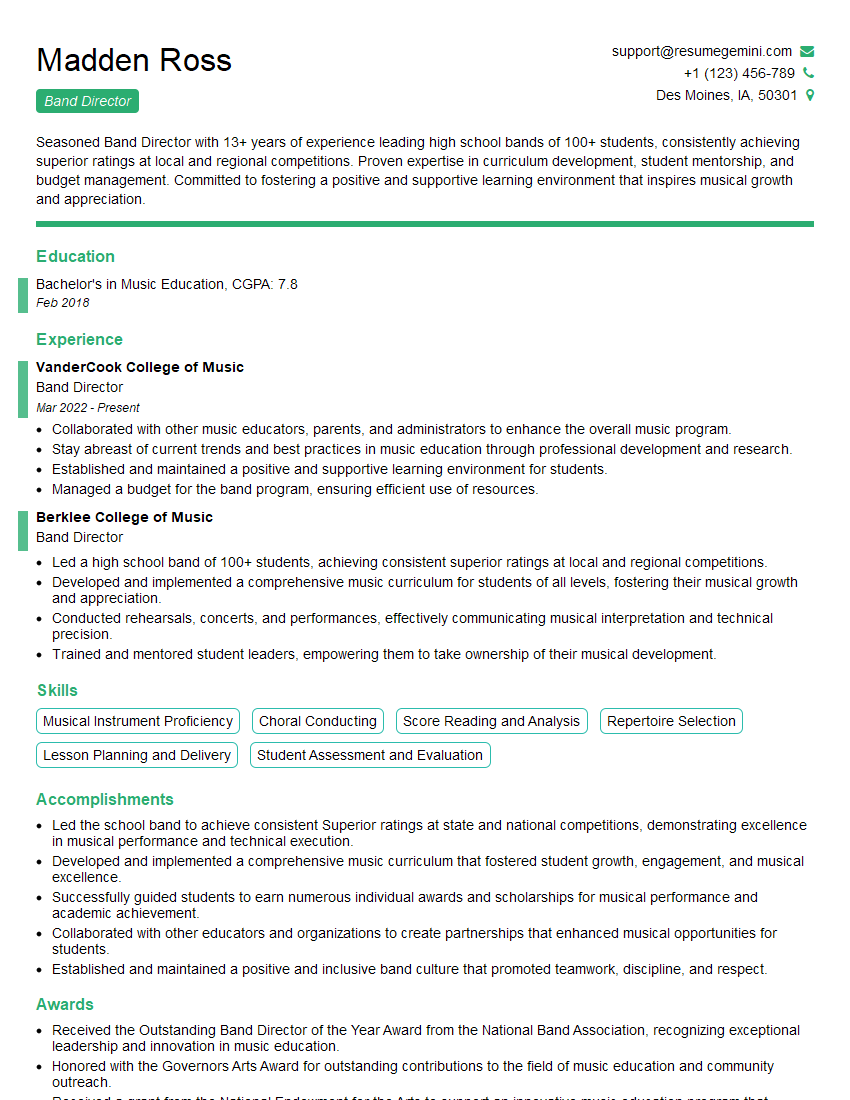
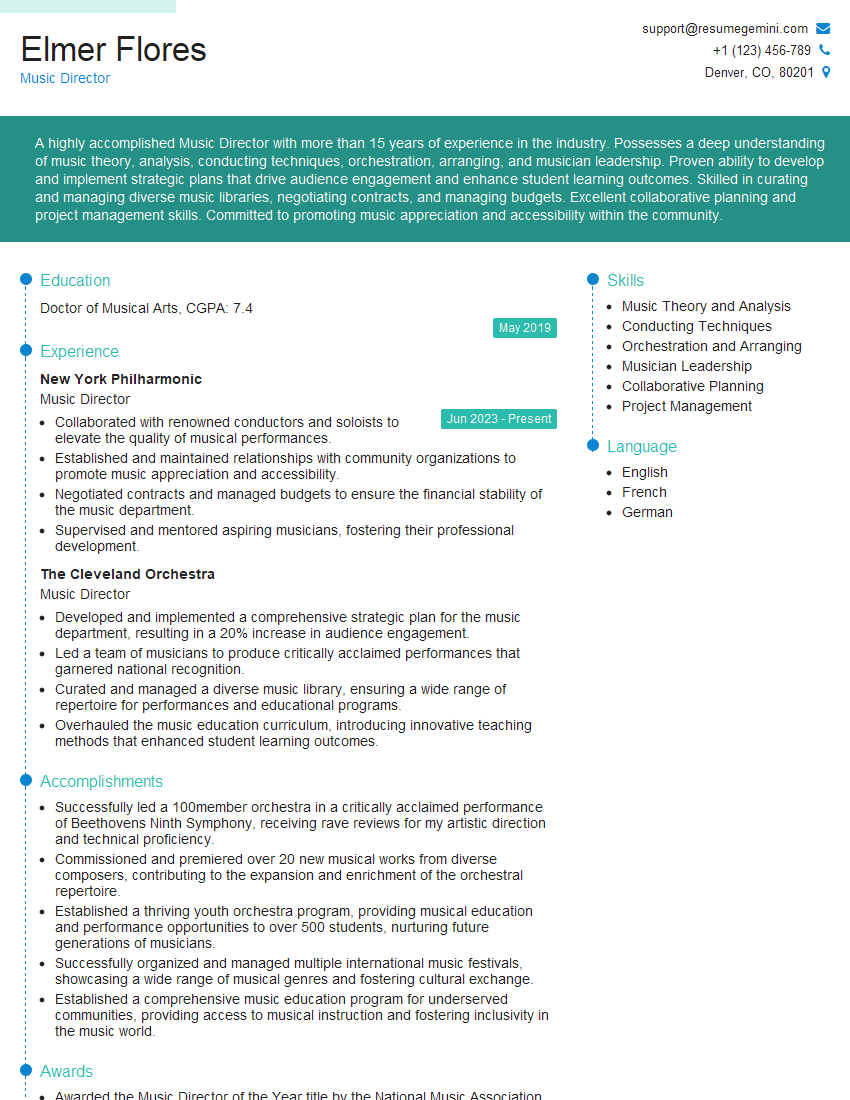
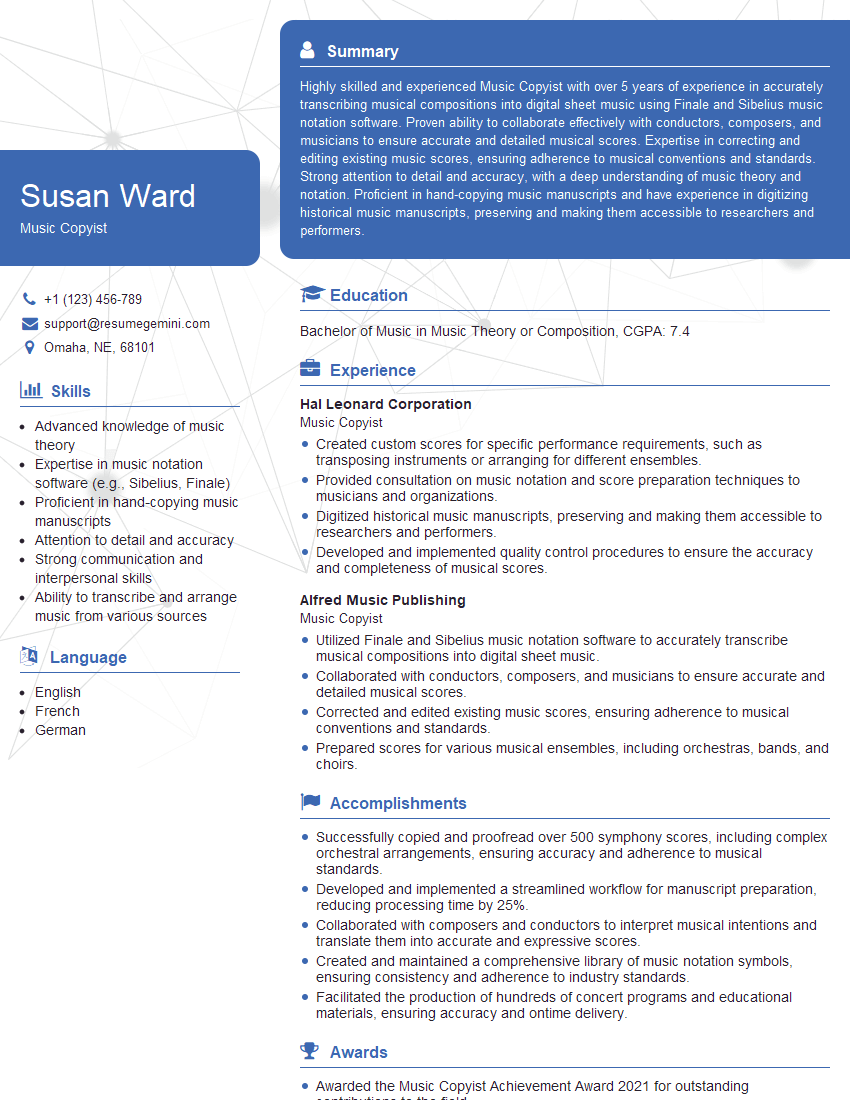
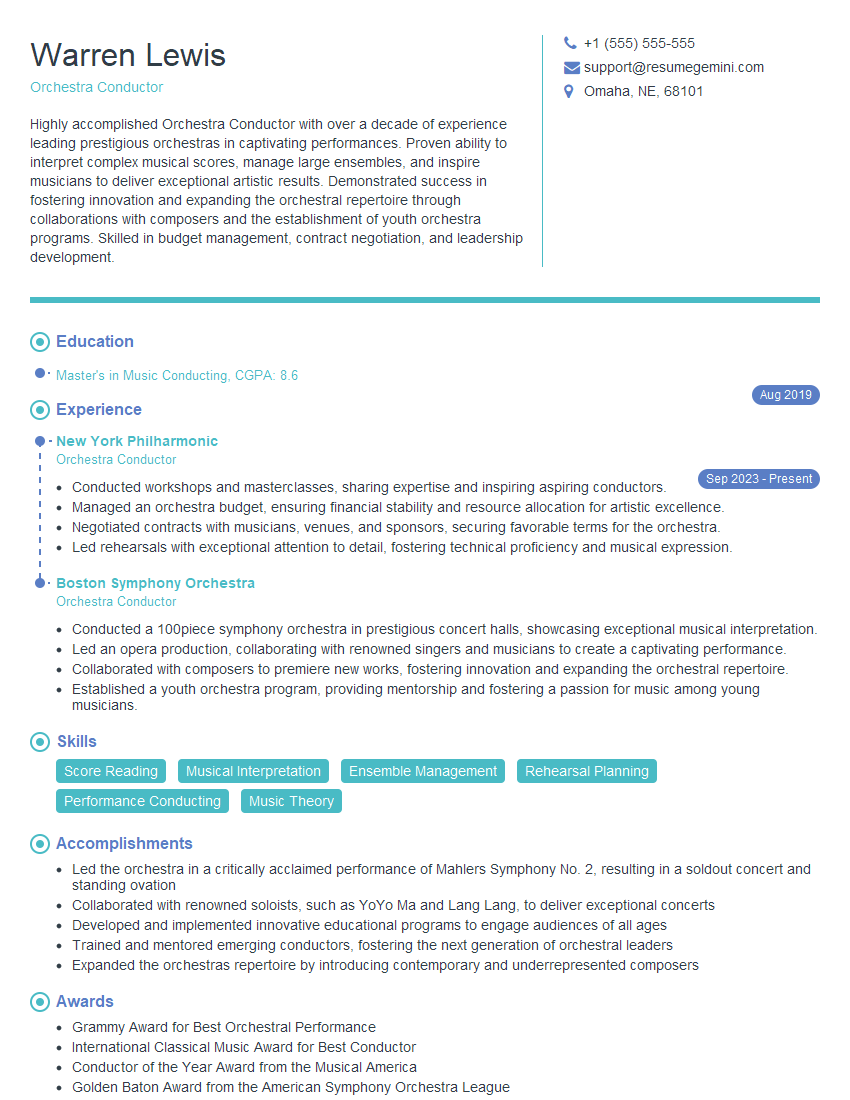
Mastering Proficient in Orchestral and Band Instrumentation opens doors to diverse and rewarding careers in performance, education, and music technology. To significantly boost your job prospects, create a compelling and ATS-friendly resume that highlights your skills and experience effectively. ResumeGemini is a trusted resource that can help you craft a professional resume tailored to your unique qualifications. We provide examples of resumes specifically designed for candidates proficient in Orchestral and Band Instrumentation to help you get started. Take the next step in your career journey today!
Explore more articles
Users Rating of Our Blogs
Share Your Experience
We value your feedback! Please rate our content and share your thoughts (optional).
What Readers Say About Our Blog
Very informative content, great job.
good