Preparation is the key to success in any interview. In this post, we’ll explore crucial Sensor System Operation and Interpretation interview questions and equip you with strategies to craft impactful answers. Whether you’re a beginner or a pro, these tips will elevate your preparation.
Questions Asked in Sensor System Operation and Interpretation Interview
Q 1. Explain the different types of sensors and their applications.
Sensors are devices that detect and respond to some type of input from the physical environment. They convert this input into a measurable signal, which can then be processed and interpreted. There’s a vast array of sensor types, each designed for specific applications. Here are a few key categories:
- Temperature Sensors: These measure temperature. Examples include thermocouples (measuring temperature differences by voltage), thermistors (resistance changes with temperature), and infrared (IR) sensors (measuring emitted thermal radiation). Applications range from industrial process control to weather monitoring and medical equipment.
- Pressure Sensors: These measure pressure, often using strain gauges or capacitive elements. They’re vital in automotive applications (tire pressure monitoring), weather forecasting (barometric pressure), and industrial process control.
- Optical Sensors: This broad category encompasses many technologies. Photodiodes and phototransistors measure light intensity, crucial for light meters and optical communication. Image sensors (like CMOS and CCD) form the basis of digital cameras and many imaging systems. LIDAR uses lasers for distance measurement, crucial in autonomous vehicles.
- Accelerometers: These measure acceleration, crucial in many applications like smartphones (orientation detection), automotive safety systems (airbag deployment), and inertial navigation systems.
- Gyroscopes: These measure angular velocity or rotation rate, often used in conjunction with accelerometers for more comprehensive motion tracking. Applications include drones, robotics, and motion-sensing gaming controllers.
- Proximity Sensors: These detect the presence or absence of an object without physical contact, often using infrared light or ultrasonic waves. They find applications in robotics (obstacle avoidance), smartphones (screen proximity sensing), and automated manufacturing.
The choice of sensor depends entirely on the application’s specific requirements, considering factors like accuracy, range, response time, cost, and power consumption.
Q 2. Describe the process of sensor calibration and its importance.
Sensor calibration is the process of establishing a known relationship between the sensor’s output and the corresponding physical quantity it measures. It ensures the sensor’s readings are accurate and reliable. This involves comparing the sensor’s readings to a known standard, usually a high-precision instrument. The process typically involves adjusting internal parameters or creating a calibration curve to compensate for systematic errors.
Importance of Calibration: Accurate calibration is paramount for accurate measurements. Uncalibrated sensors can lead to incorrect data interpretation, resulting in faulty decision-making. For example, an uncalibrated temperature sensor in a medical device could lead to incorrect diagnoses or treatment. Regular calibration is crucial, especially for sensors used in safety-critical applications or those subjected to wear and tear.
The calibration process often involves using known input values and observing the sensor’s response. A calibration curve (often a polynomial fit) is then generated to map input values to sensor readings. This curve is then used to correct future sensor readings, compensating for errors.
Q 3. How do you handle noisy sensor data?
Noisy sensor data is a common problem. Noise refers to unwanted signals that interfere with the true sensor readings. This noise can stem from various sources including electromagnetic interference (EMI), thermal noise, and quantization errors.
Handling noisy data involves several techniques:
- Filtering: This is a common approach using digital signal processing (DSP) techniques to remove high-frequency noise. Moving average filters, median filters, and Kalman filters are popular choices. The choice depends on the type of noise and the desired signal characteristics. For example, a moving average filter can smooth out random fluctuations.
- Data Smoothing: Techniques like moving averages or polynomial fitting can reduce the impact of random noise by averaging out variations over a short period. However, this can blur sharp changes in the true signal.
- Outlier Rejection: Identifying and removing data points that deviate significantly from the majority of readings. This can be achieved using statistical methods such as the standard deviation.
- Calibration: A well-calibrated sensor will inherently produce less noise. Calibration helps remove systematic errors and biases in the signal.
Consider this example: In a robotic arm controlling a delicate assembly process, even minor jitters due to noise can cause inaccuracies. Applying appropriate filtering techniques ensures smooth and reliable robot movement.
Q 4. What are common sensor error sources and how do you mitigate them?
Sensor errors can arise from various sources, impacting the accuracy and reliability of measurements. Common sources include:
- Systematic Errors: These are consistent and predictable errors, often caused by sensor bias, drift, or non-linearity. For example, a temperature sensor might consistently read 2°C higher than the actual temperature.
- Random Errors: These are unpredictable variations in the sensor readings, stemming from noise or interference. Examples include thermal noise and EMI.
- Environmental Factors: Temperature, pressure, humidity, and electromagnetic fields can all influence sensor readings. For example, a pressure sensor’s accuracy might change with temperature variations.
- Sensor Degradation: Over time, sensors can degrade due to wear, tear, or aging, leading to increased noise or bias.
Mitigation Strategies:
- Calibration: Regular calibration helps correct systematic errors.
- Shielding and Filtering: Shielding the sensor from environmental factors and applying signal filtering reduces the impact of noise.
- Compensation: Incorporating temperature or pressure sensors to compensate for the effects of these environmental factors on the primary sensor.
- Redundancy: Using multiple sensors to measure the same quantity allows for cross-checking and error detection. Averaging the readings can also reduce random errors.
- Sensor Selection: Choosing a sensor suitable for the environment and application.
Q 5. Explain the concept of sensor fusion and its benefits.
Sensor fusion is the process of combining data from multiple sensors to generate a more accurate and comprehensive understanding of the environment than any single sensor could provide. It’s particularly beneficial when individual sensors have limitations or are prone to noise.
Benefits of Sensor Fusion:
- Improved Accuracy: Combining data from various sensors helps to cancel out individual sensor errors and provides a more reliable estimate.
- Increased Reliability: If one sensor fails, the system can still operate using data from other sensors.
- Enhanced Performance: Fusion allows the extraction of information not readily available from individual sensors.
- Robustness: The system is more robust to noise and uncertainties.
Example: In autonomous driving, sensor fusion combines data from cameras, LIDAR, radar, and GPS to create a detailed 3D map of the surroundings, ensuring safer and more reliable navigation. Each sensor provides a partial picture, but when fused, they provide a much more complete and accurate perception.
Q 6. Describe your experience with different sensor communication protocols (e.g., I2C, SPI, UART).
I have extensive experience with various sensor communication protocols, including I2C, SPI, and UART. Each protocol has its strengths and weaknesses, making them suitable for different applications.
- I2C (Inter-Integrated Circuit): A two-wire serial communication protocol, I2C is simple to implement and requires minimal wiring. It’s well-suited for low-bandwidth, short-distance communication, often used in embedded systems and sensor networks. I’ve used it extensively with MEMS sensors, such as accelerometers and gyroscopes.
// Example I2C code (pseudocode) write_i2c(sensor_address, register_address, data); data = read_i2c(sensor_address, register_address); - SPI (Serial Peripheral Interface): A four-wire (MOSI, MISO, SCK, CS) full-duplex synchronous serial communication protocol, SPI offers higher bandwidth than I2C. It’s commonly used for high-speed data transfer between a microcontroller and peripherals like ADCs, DACs, and flash memory. I’ve integrated various high-speed sensors using SPI in data acquisition systems.
- UART (Universal Asynchronous Receiver/Transmitter): A simple serial communication protocol commonly used for communication between microcontrollers and computers or other devices. UART is asynchronous, meaning it doesn’t need a clock signal for synchronization. It’s often used in applications requiring human-readable output or long-distance communication, particularly where the simplicity of the protocol is advantageous.
My experience encompasses selecting the appropriate protocol based on factors like data rate requirements, distance, number of sensors, power consumption, and ease of integration.
Q 7. How do you determine the accuracy and precision of a sensor?
Determining the accuracy and precision of a sensor is crucial for understanding its performance and reliability. Accuracy refers to how close the sensor’s readings are to the true value, while precision refers to how consistent the readings are over repeated measurements.
Accuracy: This is typically assessed by comparing the sensor’s readings to a known standard under controlled conditions. The difference between the sensor’s reading and the true value represents the error. Accuracy is often expressed as a percentage of full-scale or as an absolute error.
Precision: This is measured by taking multiple readings under identical conditions and calculating the standard deviation or variance. A smaller standard deviation indicates higher precision. Precision can be affected by noise and random errors.
Methods for determining accuracy and precision:
- Calibration: Comparing sensor readings to a known standard (e.g., a calibrated thermometer) under various conditions.
- Statistical Analysis: Performing multiple measurements and calculating statistical parameters like mean, standard deviation, and variance to quantify precision.
- Data Sheet Review: Reviewing the sensor’s datasheet, which usually provides specifications on accuracy and precision.
It’s important to note that a sensor can be precise but not accurate (consistent errors), or accurate but not precise (high variability). Both are critical aspects of sensor performance.
Q 8. What are the key performance indicators (KPIs) for sensor systems?
Key Performance Indicators (KPIs) for sensor systems are crucial for evaluating their effectiveness and reliability. They broadly fall into categories of accuracy, precision, reliability, and efficiency.
- Accuracy: This refers to how closely the sensor’s readings match the true value. We often express this as a percentage error or in terms of a standard deviation from the true value. For example, a temperature sensor with an accuracy of ±0.5°C means its readings will be within 0.5°C of the actual temperature.
- Precision: Precision measures the consistency of repeated measurements. A high-precision sensor will produce very similar readings under the same conditions, even if those readings are slightly off from the true value. We often use metrics like standard deviation to quantify precision.
- Reliability: This KPI focuses on the sensor’s ability to function correctly over time and under various operating conditions. Mean Time Between Failures (MTBF) is a common metric here – a higher MTBF indicates better reliability.
- Efficiency: This involves aspects like power consumption, data throughput, and processing speed. A highly efficient sensor system minimizes resource usage while delivering timely and accurate data. For example, a lower power consumption is crucial for battery-powered sensors in remote locations.
- Resolution: This is the smallest increment of change that the sensor can detect and accurately measure.
- Range: This refers to the span of values that the sensor can measure.
- Linearity: This describes how closely the sensor’s output follows a linear relationship with the measured quantity.
The specific KPIs chosen will depend heavily on the application. A sensor in a critical system like a medical device will have far stricter requirements for accuracy and reliability than a sensor monitoring ambient light in a smart home.
Q 9. Explain your experience with sensor data acquisition and logging systems.
My experience with sensor data acquisition and logging systems spans several projects. I’ve worked extensively with both hardware and software components, from designing custom circuits for data acquisition to developing and implementing robust logging solutions.
In one project involving environmental monitoring, we used a network of sensors measuring temperature, humidity, and soil moisture. The data was acquired using Arduino microcontrollers, which then transmitted data wirelessly via LoRaWAN to a central server. We built a custom logging system using Python and a PostgreSQL database, ensuring data integrity through redundancy and regular backups. This system utilized timestamping to accurately record the time of each measurement and included error handling to manage potential data loss due to network issues.
In another project, I integrated various industrial sensors into an existing SCADA system. This required careful configuration of communication protocols (e.g., Modbus, Profibus), data validation, and integration with the existing system’s database. I implemented real-time data visualization and alarming capabilities to ensure immediate response to critical events. This involved working with both proprietary and open-source software.
Throughout these projects, I have focused on efficient data management, data quality control, and ensuring that the logging system can handle large volumes of data while maintaining performance.
Q 10. How do you troubleshoot malfunctioning sensors?
Troubleshooting malfunctioning sensors is a systematic process requiring a combination of technical expertise and problem-solving skills. My approach typically involves the following steps:
- Initial Assessment: Start by reviewing the sensor’s specifications and comparing its current readings to expected values. Look for obvious signs of damage or issues (e.g., loose connections, physical damage).
- Data Analysis: Analyze the sensor’s data stream for patterns or anomalies. Look for drift, sudden spikes, or unusual noise. Plotting the data visually is very helpful.
- Calibration Check: If possible, calibrate the sensor against a known standard. This helps determine whether the issue is with the sensor itself or with its calibration.
- Environmental Factors: Consider environmental factors that might be affecting the sensor’s readings (e.g., temperature, humidity, electromagnetic interference). If necessary, try to control these factors to see if they are causing the problem.
- Hardware Checks: Inspect the sensor’s connections, wiring, and power supply. Use multimeters and other diagnostic tools to identify any hardware faults.
- Software Checks: Check the sensor’s firmware, drivers, and associated software for bugs or configuration issues. Consider updating the firmware if necessary.
- Sensor Replacement: If all other steps fail to identify and resolve the issue, replace the sensor. Sometimes sensors simply fail due to age or wear.
For example, if a pressure sensor is consistently reading lower than expected, I’d check for potential leaks in the system, ensure correct calibration, and examine the wiring for any breaks. I’d analyze the data for trends and patterns to see if there is any correlation between external factors and the inaccurate readings.
Q 11. Describe your experience with different signal processing techniques (e.g., filtering, smoothing).
I have significant experience applying various signal processing techniques to improve the quality and interpretability of sensor data. This includes filtering, smoothing, and other advanced methods.
Filtering: I frequently use digital filters to remove unwanted noise from sensor signals. Low-pass filters are useful for removing high-frequency noise, while high-pass filters remove low-frequency drifts. For example, in a system monitoring vibrations, a low-pass filter could help isolate the dominant vibration frequency from high-frequency noise introduced by the sensor itself. I’ve used both Finite Impulse Response (FIR) and Infinite Impulse Response (IIR) filters depending on the specific application requirements.
Smoothing: Techniques like moving averages are commonly used to smooth noisy signals and highlight underlying trends. A simple moving average replaces each data point with the average of its neighboring points, effectively reducing short-term fluctuations. More sophisticated smoothing techniques, such as Savitzky-Golay filtering, offer better preservation of signal features while reducing noise.
Other Techniques: Depending on the specific sensor and application, I have also employed techniques like wavelet transforms for denoising, Fourier transforms for frequency analysis, and Kalman filtering for state estimation. The choice of technique depends on the characteristics of the noise, the desired level of smoothing, and the computational resources available.
Example (Python with a moving average):
import numpy as np
def moving_average(x, w):
    return np.convolve(x, np.ones(w), 'valid') / w
Q 12. How do you ensure the security of sensor data?
Sensor data security is paramount, especially in applications dealing with sensitive information. My approach to securing sensor data involves a multi-layered strategy:
- Encryption: Data encryption, both in transit and at rest, is essential to protect against unauthorized access. I use robust encryption algorithms like AES (Advanced Encryption Standard) to encrypt data before transmission and store it securely in encrypted databases.
- Authentication and Authorization: Strict authentication protocols, such as multi-factor authentication, are implemented to verify the identity of users accessing the sensor data. Access control lists (ACLs) regulate which users have access to specific data points. This ensures only authorized personnel can view and manipulate the data.
- Data Integrity Checks: Hashing and digital signatures are used to verify the integrity of the sensor data. Any unauthorized modification or tampering will be immediately detected.
- Network Security: Firewalls and intrusion detection systems (IDS) protect the sensor network from unauthorized access and cyberattacks. Regular security audits and penetration testing are conducted to identify and address vulnerabilities.
- Secure Communication Protocols: Secure communication protocols, such as TLS/SSL, are used for all data transmissions to ensure confidentiality and prevent eavesdropping.
- Regular Updates and Patching: All software and firmware components are regularly updated and patched to address security vulnerabilities.
The specific security measures implemented will depend on the sensitivity of the data, the level of risk, and the regulatory requirements. For example, a system monitoring critical infrastructure will demand much higher security standards than a system monitoring weather conditions.
Q 13. Explain your experience with sensor network design and deployment.
My experience with sensor network design and deployment involves several key aspects, ranging from initial planning and hardware selection to final deployment and maintenance. I’ve worked on both small-scale projects and large-scale deployments involving hundreds of sensors.
The design phase includes determining the appropriate sensor types, their placement and density, communication protocols (e.g., wireless, wired), power sources, data processing and storage solutions, and security measures. Considerations include sensor range, power consumption, environmental factors, and the desired data accuracy and resolution. For example, in an agricultural setting, soil moisture sensors might be strategically placed to reflect variations across different parts of a field.
Deployment involves careful installation and configuration of each sensor node, testing network connectivity, and establishing a reliable communication link between the sensors and the central data processing unit. This often includes developing procedures for maintaining and calibrating the sensors over time. In one project, deploying environmental sensors in a remote forest, we accounted for terrain, power availability, and wildlife considerations.
Throughout the process, careful planning and attention to detail are essential to ensure the network’s functionality and reliability. I’ve utilized network simulation tools to optimize network topology and resource allocation, improving overall efficiency and robustness.
Q 14. Describe your experience with real-time data processing of sensor data.
Real-time data processing of sensor data is crucial for many applications requiring immediate responses or dynamic control. My experience in this area centers around designing efficient algorithms and utilizing appropriate hardware and software to process data with minimal latency.
In one project involving a robotic arm controlled by multiple sensors, we used a real-time operating system (RTOS) to ensure timely processing of sensor feedback. This involved carefully optimizing algorithms for speed and minimizing communication overhead. We used a custom-built data processing pipeline that ensured the robot could react to changes in its environment within milliseconds. The algorithms involved filtering the sensor data, performing kinematic calculations, and generating control signals.
Another application involved real-time anomaly detection in a manufacturing process. Here, we implemented a streaming data processing system using Apache Kafka and Apache Flink. This allowed us to process large volumes of sensor data in real-time and detect anomalies based on predefined rules and machine learning models. The system would immediately alert operators to any deviations from normal operating parameters, enabling prompt interventions to prevent issues.
Choosing the right hardware and software infrastructure is critical for real-time processing. This includes high-speed data acquisition devices, powerful processors, efficient programming languages, and optimized algorithms. The key challenge is balancing the need for speed and responsiveness with the accuracy of the processing and analysis.
Q 15. How do you handle large volumes of sensor data?
Handling large volumes of sensor data efficiently involves a multi-pronged approach focusing on data reduction, efficient storage, and optimized processing. Think of it like managing a massive library – you can’t just throw everything on the floor; you need a system.
Data Reduction Techniques: Before storage, we often employ techniques like downsampling (reducing the sampling rate), data aggregation (averaging data points over time), and feature extraction (extracting only the most relevant information). For example, instead of storing every second of temperature data from a sensor, we might average the temperature over a minute.
Efficient Storage: Cloud-based solutions like AWS S3 or Google Cloud Storage are ideal for storing large datasets. Database systems like InfluxDB or TimescaleDB, designed for time-series data, offer optimized querying and retrieval. This is akin to using a well-organized library catalog system instead of randomly searching through books.
Optimized Processing: Parallel processing frameworks like Apache Spark or Dask are crucial for analyzing large datasets. They divide the workload among multiple processors, significantly reducing processing time. Imagine having many librarians working simultaneously to categorize and answer user inquiries.
Data Compression: Algorithms like gzip or zlib can significantly reduce the storage space required for the data. This is equivalent to using smaller, more efficient books in our library.
The choice of techniques depends on the specific application, data characteristics, and available resources. A careful balance between data preservation and computational efficiency is key.
Career Expert Tips:
- Ace those interviews! Prepare effectively by reviewing the Top 50 Most Common Interview Questions on ResumeGemini.
- Navigate your job search with confidence! Explore a wide range of Career Tips on ResumeGemini. Learn about common challenges and recommendations to overcome them.
- Craft the perfect resume! Master the Art of Resume Writing with ResumeGemini’s guide. Showcase your unique qualifications and achievements effectively.
- Don’t miss out on holiday savings! Build your dream resume with ResumeGemini’s ATS optimized templates.
Q 16. What are your experiences with sensor data visualization and reporting?
Data visualization and reporting are critical for understanding sensor data. They transform raw numbers into actionable insights. I’ve used various tools to create compelling visuals and reports throughout my career. Think of it as translating data from a foreign language into one everyone understands.
Tools: I’m proficient with tools like Grafana, Tableau, and Power BI. These allow interactive dashboards, real-time monitoring, and custom report generation. I’ve used them extensively to visualize everything from temperature trends in a manufacturing plant to network traffic patterns in a data center.
Techniques: I use a range of visualization techniques, including line graphs (for time-series data), scatter plots (for correlations), heatmaps (for spatial data), and histograms (for data distributions). The choice of visualization depends heavily on what aspect of the data we need to emphasize. For instance, a line graph is perfect for showing temperature fluctuations over time, while a heatmap might show temperature distribution across a room.
Reporting: I create reports which clearly communicate findings and insights to both technical and non-technical audiences. This usually involves a blend of visuals, concise summaries, and key performance indicators (KPIs). A good report should tell a story with the data.
In one project, I used Grafana to create a real-time dashboard displaying temperature, humidity, and pressure readings from sensors deployed in a remote environment. This allowed us to monitor conditions remotely and proactively address any potential issues.
Q 17. Explain the concept of sensor drift and how to compensate for it.
Sensor drift is the gradual change in sensor readings over time, even when the measured quantity remains constant. Imagine a clock that slowly starts running faster or slower – its readings aren’t accurate anymore. This can be caused by various factors such as temperature changes, aging components, or mechanical wear.
Compensation Techniques: Several techniques can mitigate sensor drift.
Calibration: Regularly calibrating the sensor against a known standard is essential. This involves adjusting the sensor’s output to match the true value. It’s like adjusting the clock to the correct time.
Data Filtering: Applying digital filters, like moving averages or Kalman filters, can smooth out short-term fluctuations and reduce the impact of drift. This is like averaging out minor inconsistencies in the clock’s timing.
Software Compensation: Developing software algorithms that compensate for known drift patterns. These algorithms might learn the drift profile over time and correct the readings accordingly. This could involve machine learning techniques to predict and correct for drift.
Temperature Compensation: If temperature is a major contributor to drift, using a temperature sensor alongside the main sensor and applying a temperature-dependent correction factor is crucial. Think of this as adjusting the clock based on the room temperature.
The best compensation technique depends on the sensor type, the magnitude of the drift, and the application’s requirements. A combination of approaches is often necessary for optimal accuracy.
Q 18. Describe your experience with sensor selection and specification.
Sensor selection and specification involve choosing the right sensor for a given application based on several crucial factors. It’s like choosing the right tool for a job; a hammer won’t work for screwing in a screw.
Measurement Requirements: First, clearly define what needs to be measured (e.g., temperature, pressure, humidity, light). Next, specify the required accuracy, resolution, and range. For example, measuring room temperature doesn’t require the same accuracy as measuring the temperature of a scientific experiment.
Environmental Considerations: The sensor must withstand the expected environmental conditions (temperature, humidity, pressure, vibration). A sensor designed for indoor use might not survive in a harsh industrial setting.
Cost and Availability: The cost of the sensor, its availability, and the overall system cost must be taken into account. Sometimes a slightly less accurate, but significantly cheaper sensor is a viable option.
Interface and Communication: How will the sensor communicate with the system? (e.g., analog, digital, I2C, SPI, wireless). Selecting a compatible interface simplifies integration.
Power Consumption: Consider the power consumption, especially if the sensor is battery-powered. Low power consumption is vital for long-term deployments.
I’ve been involved in several sensor selection processes, including choosing pressure sensors for a pipeline monitoring system and selecting optical sensors for a robotic vision application. Each required careful consideration of all these factors.
Q 19. How do you validate the performance of a sensor system?
Validating the performance of a sensor system is crucial to ensure its accuracy and reliability. This involves a series of tests to compare its output to known standards or expected behavior.
Accuracy and Precision Tests: Compare the sensor’s measurements to known standards or reference sensors under controlled conditions. This will determine how close the measurements are to the true values (accuracy) and how consistent the measurements are (precision). It’s similar to verifying the accuracy of a scale by weighing a known weight multiple times.
Linearity Test: Assess how well the sensor’s output changes linearly with the input. Non-linearity can introduce significant errors.
Stability Test: Monitor the sensor’s readings over time under constant conditions to determine its stability and susceptibility to drift. This might involve long-term monitoring to determine how much drift occurs over time.
Repeatability and Reproducibility Tests: Check if the sensor gives the same reading when measuring the same quantity multiple times (repeatability) and if different sensors of the same type give similar readings (reproducibility).
Environmental Tests: Test the sensor’s performance under various environmental conditions (temperature, humidity, pressure) to assess its robustness.
Noise Analysis: Evaluate the level of noise in the sensor’s readings and identify its sources.
Documentation of these tests and their results is essential for demonstrating system performance and compliance with standards.
Q 20. What programming languages and tools are you proficient in for sensor data analysis?
My proficiency in programming languages and tools for sensor data analysis is extensive and spans several domains.
Languages: I’m highly proficient in Python, with experience using libraries such as NumPy, Pandas, Scikit-learn, and TensorFlow for data manipulation, analysis, and machine learning tasks. I also have experience with MATLAB, particularly useful for signal processing and control systems applications, and C/C++, for embedded systems programming.
Tools: I regularly use Jupyter Notebooks for interactive data analysis, scripting, and visualization. I leverage version control systems like Git for collaborative projects, and I’m familiar with various database systems, including SQL and NoSQL options, for storing and managing sensor data. My experience extends to cloud computing platforms like AWS and Google Cloud for large-scale data processing and analysis.
In a recent project, I used Python with Pandas and Scikit-learn to develop a machine learning model to predict equipment failure based on sensor data from manufacturing equipment.
Q 21. Explain your understanding of different sensor technologies (e.g., capacitive, inductive, optical).
My understanding of different sensor technologies is broad, encompassing many types and principles of operation.
Capacitive Sensors: These sensors measure changes in capacitance, which is the ability of a capacitor to store electrical charge. They are commonly used to measure proximity, position, and liquid levels. A simple example is a proximity sensor in a smartphone screen, which detects a finger’s presence.
Inductive Sensors: These sensors utilize the principle of electromagnetic induction to detect the presence of metallic objects. They work by creating a magnetic field and measuring changes in inductance when a metal object is nearby. These are frequently used in industrial applications for proximity sensing and metal detection.
Optical Sensors: This broad category includes many types, such as photoresistors, photodiodes, and CCD/CMOS image sensors. Photoresistors change resistance based on the intensity of light, photodiodes generate a current proportional to light intensity, and CCD/CMOS sensors capture images. Applications range from simple light meters to complex imaging systems in robotics and medical imaging.
Other technologies: My expertise also includes other technologies, such as piezoelectric (measuring pressure and acceleration), ultrasonic (measuring distance), and thermal (measuring temperature).
Understanding the strengths and limitations of each technology allows for informed sensor selection to meet the specific requirements of any given project.
Q 22. Describe your experience with embedded systems related to sensor operation.
My experience with embedded systems and sensor operation spans over eight years, encompassing various projects from industrial automation to environmental monitoring. I’ve worked extensively with microcontrollers like Arduino and STM32, programming them to interface with diverse sensors, including accelerometers, gyroscopes, pressure sensors, and GPS modules. A key aspect of my work involves optimizing firmware for power efficiency and real-time data acquisition. For instance, in a recent project involving a smart irrigation system, I designed firmware that polled soil moisture sensors at specific intervals, minimizing power consumption while ensuring timely data collection for efficient water management. This required careful consideration of interrupt handling, data buffering, and communication protocols like I2C and SPI. I’m also proficient in using real-time operating systems (RTOS) for managing concurrent sensor data streams and ensuring timely task execution.
Q 23. How do you handle data inconsistencies from multiple sensors?
Handling data inconsistencies from multiple sensors is a crucial aspect of reliable sensor system design. This often involves employing several strategies. First, I perform a thorough sensor calibration process, comparing readings against known standards or using sensor fusion techniques to improve accuracy. Then, data validation techniques are implemented to identify outliers or improbable readings. For example, a simple range check can eliminate readings outside of physically plausible bounds. More sophisticated methods include employing Kalman filters or moving averages to smooth out noisy data and minimize the impact of outliers. If a sensor consistently produces unreliable data, I would investigate potential causes – like sensor degradation, malfunctioning wiring, or environmental interference – before implementing a data rejection strategy. Finally, I might incorporate a redundancy mechanism, using multiple sensors to measure the same parameter and taking a weighted average of the valid readings, enhancing robustness and minimizing the impact of single-sensor failures. This redundancy might be implemented using voting schemes or statistical methods to prioritize reliable sensor data.
Q 24. Explain your knowledge of different sensor mounting techniques and their impact on performance.
Sensor mounting techniques significantly influence accuracy and longevity. The choice depends on the specific sensor, its environment, and the application. For instance, mounting an accelerometer on a vibrating surface requires dampening techniques to minimize vibrational noise. This might involve using vibration-dampening materials or strategically positioning the sensor to reduce exposure to vibrations. Conversely, a temperature sensor needs proper thermal contact with the measured object for accurate readings; this can involve using thermal paste or ensuring tight mechanical coupling. For outdoor applications, weatherproofing is crucial – sensors might be housed in sealed enclosures, or specific weatherproof sensors might be employed. Incorrect mounting can introduce systematic errors – for example, mounting a tilt sensor at an angle will introduce a bias in its readings. Therefore, a detailed mounting plan is necessary, incorporating environmental considerations and minimizing sources of error to guarantee optimal performance.
Q 25. How do you ensure the reliability and maintainability of sensor systems?
Ensuring reliability and maintainability involves a multi-faceted approach. Firstly, I focus on selecting high-quality, robust sensors from reputable manufacturers. Secondly, I incorporate redundant sensors and data validation techniques (as discussed previously) to handle potential failures and inconsistencies. Thirdly, the system design includes features for easy diagnostics and troubleshooting, such as self-tests, error codes, and logging capabilities. These features provide insights into sensor performance and allow rapid identification and resolution of problems. Furthermore, I utilize modular designs to facilitate easy replacement or repair of individual components. For example, sensors might be mounted on easily accessible PCBs. Finally, regular calibration and maintenance procedures are established to ensure the continued accuracy and reliability of the system. Documentation is also crucial, outlining the system architecture, calibration procedures, and troubleshooting steps. This facilitates maintenance and updates over time, extending the lifespan and reliability of the sensor system.
Q 26. What are your experiences with different sensor testing methodologies?
My experience encompasses various sensor testing methodologies. These range from simple calibration checks – comparing sensor readings against known standards – to more sophisticated methods. I’ve utilized statistical process control (SPC) techniques to monitor sensor performance over time, identifying trends and potential degradation. Environmental testing is crucial, simulating realistic operating conditions, including temperature extremes, humidity, and vibration, to ensure robustness. I’ve also used automated test equipment (ATE) for high-throughput testing of large numbers of sensors, ensuring consistent quality. Moreover, I employ signal analysis techniques, examining frequency responses and noise levels, to characterize sensor performance in detail. Specific testing methodologies are chosen based on sensor type, application requirements, and regulatory compliance.
Q 27. Explain your understanding of sensor life cycle management.
Sensor lifecycle management begins with careful selection based on application requirements, including accuracy, range, environmental factors, and cost. Then, proper installation and initial calibration are performed. Ongoing monitoring is critical, using data logging and analysis to track sensor performance and identify potential degradation or drift. Regular calibration and maintenance are scheduled to ensure ongoing accuracy. Finally, end-of-life considerations, including sensor replacement, data archival, and disposal, are planned. This proactive approach minimizes downtime, ensures data quality, and optimizes overall system efficiency and cost-effectiveness. For instance, predictive maintenance, using data analysis to predict potential failures, can be implemented to minimize unexpected downtime.
Q 28. Describe a challenging sensor system project you worked on and how you overcame the challenges.
One challenging project involved developing a sensor system for monitoring structural health in a large bridge. The challenge stemmed from the harsh environmental conditions (extreme temperatures, high winds, and corrosive elements), the need for high accuracy and reliability, and the difficulty in accessing the sensors for maintenance. To overcome these challenges, we employed highly durable, weatherproof sensors with extended operating temperature ranges. A wireless communication system was implemented to eliminate the need for extensive wiring, simplifying installation and maintenance. Furthermore, we developed sophisticated data processing algorithms to filter out noise caused by environmental factors and detect subtle changes in the bridge’s structural integrity. Redundancy was built into the system, with multiple sensors measuring the same parameters. Data from the sensors was processed using machine learning algorithms to predict potential structural issues before they became critical. The project’s success demonstrated the importance of a holistic design approach, considering environmental factors, sensor selection, robust communication protocols, data analysis, and the implementation of machine learning for early failure detection.
Key Topics to Learn for Sensor System Operation and Interpretation Interview
- Sensor Fundamentals: Understanding various sensor types (e.g., optical, acoustic, thermal), their operating principles, and limitations. This includes exploring signal-to-noise ratios and calibration techniques.
- Data Acquisition and Processing: Familiarize yourself with data acquisition systems, analog-to-digital conversion, signal conditioning, and noise reduction methods. Practical application includes understanding how to select appropriate sampling rates and filters for different sensor applications.
- Signal Interpretation and Analysis: Master techniques for analyzing sensor data, including signal processing algorithms (e.g., Fourier transforms, filtering), statistical analysis, and pattern recognition. Consider how to identify anomalies and trends within the data.
- System Integration and Calibration: Understand the process of integrating various sensors into a complete system, including considerations for power management, communication protocols, and system calibration procedures. Practical application includes troubleshooting system malfunctions and optimizing system performance.
- Sensor System Applications: Explore diverse applications of sensor systems across various industries (e.g., environmental monitoring, industrial automation, medical devices). Understanding specific applications will demonstrate your breadth of knowledge.
- Troubleshooting and Problem-solving: Develop your ability to diagnose and resolve issues related to sensor malfunction, data errors, and system failures. Practice formulating strategies for debugging and identifying root causes.
- Safety and Regulations: Understand relevant safety procedures and regulations associated with the operation and maintenance of sensor systems, especially in industrial or hazardous environments.
Next Steps
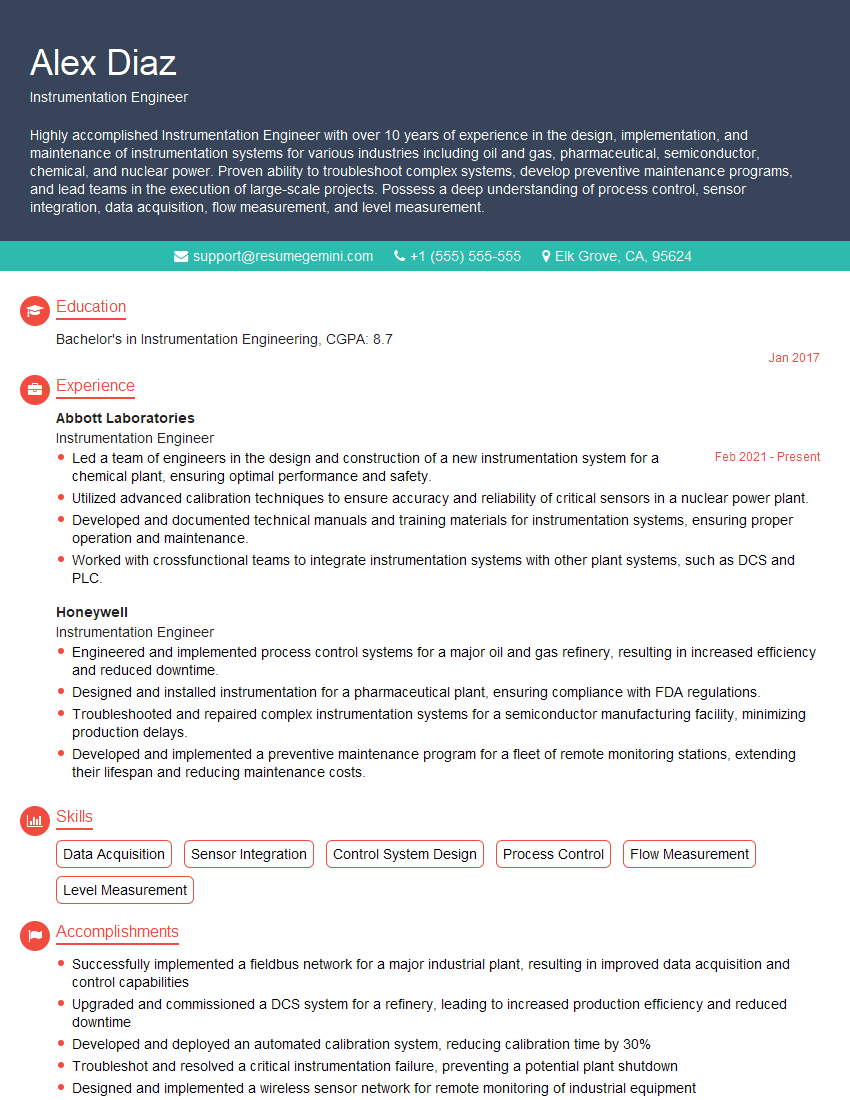
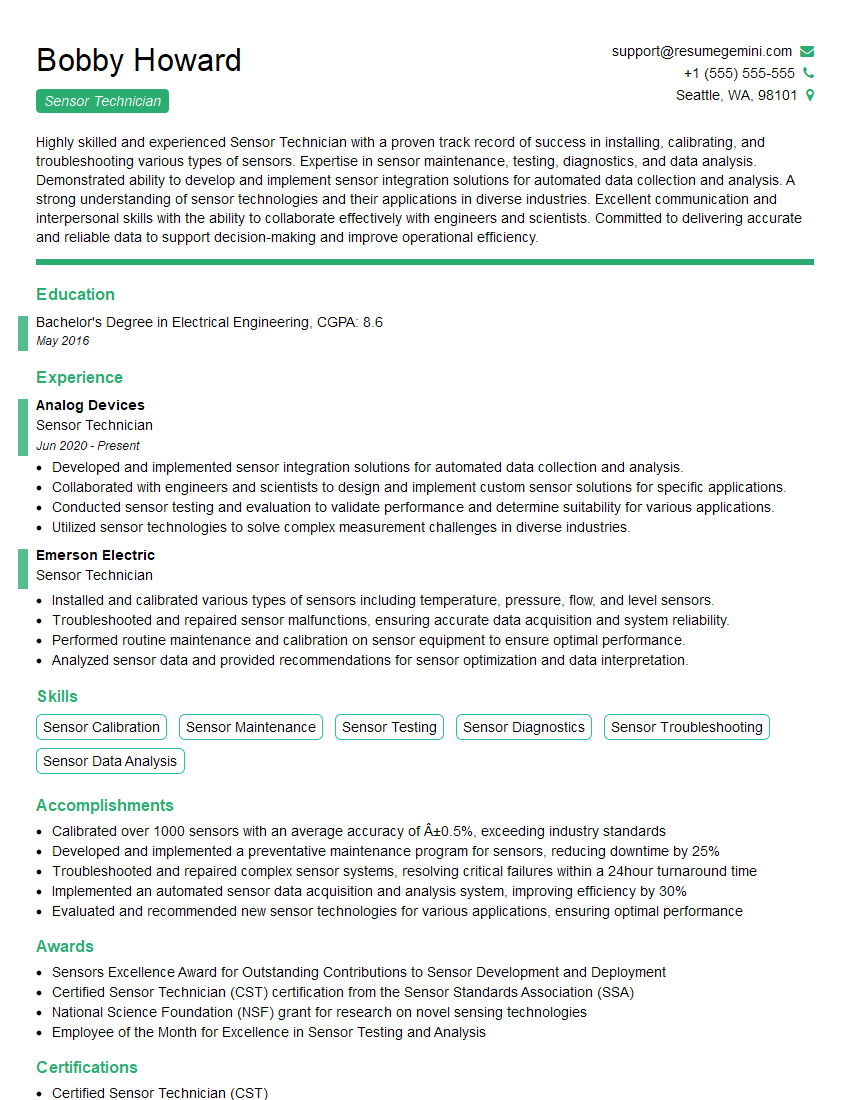
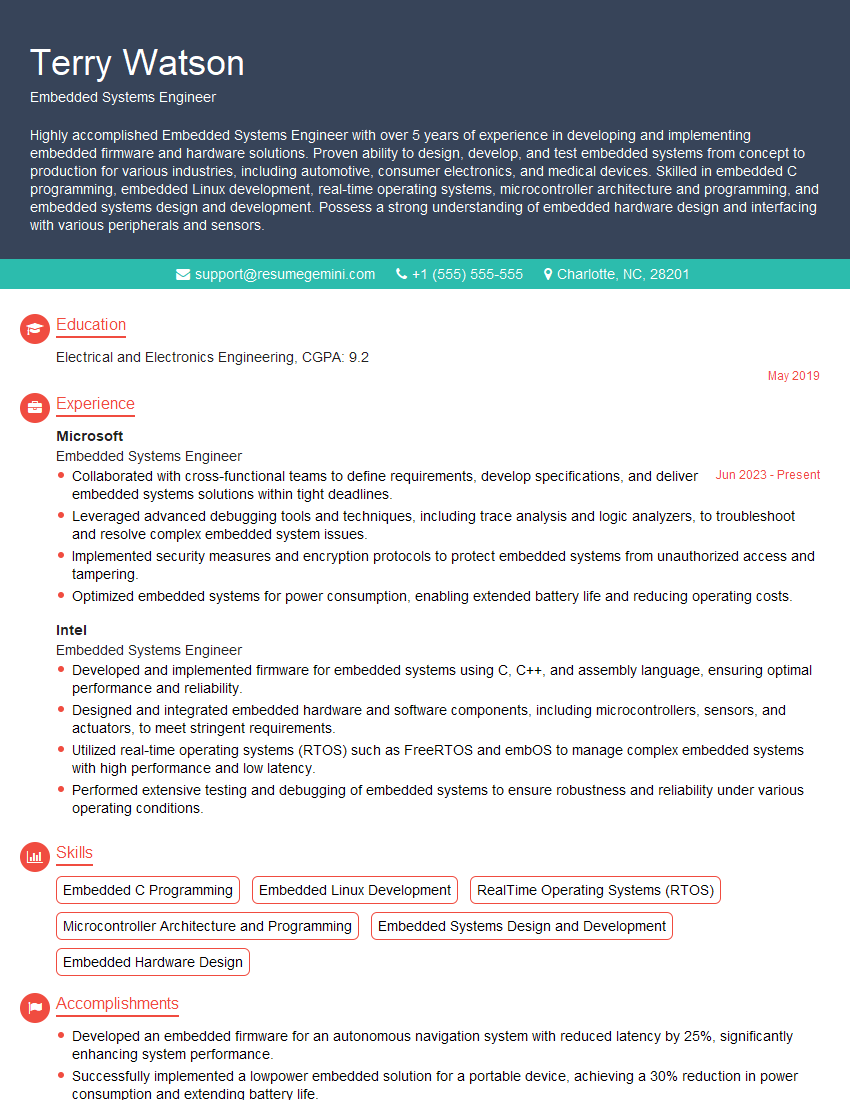
Mastering Sensor System Operation and Interpretation is crucial for career advancement in a rapidly evolving technological landscape. A strong understanding of these principles opens doors to exciting opportunities and higher-level roles within your field. To maximize your job prospects, creating a compelling and ATS-friendly resume is essential. ResumeGemini is a trusted resource to help you craft a professional and effective resume that showcases your skills and experience. We provide examples of resumes tailored specifically to Sensor System Operation and Interpretation to guide you through the process, ensuring your qualifications stand out to potential employers.


Explore more articles
Users Rating of Our Blogs
Share Your Experience
We value your feedback! Please rate our content and share your thoughts (optional).
What Readers Say About Our Blog
Very informative content, great job.
good