Cracking a skill-specific interview, like one for Proficient in Sibelius and Finale, requires understanding the nuances of the role. In this blog, we present the questions you’re most likely to encounter, along with insights into how to answer them effectively. Let’s ensure you’re ready to make a strong impression.
Questions Asked in Proficient in Sibelius and Finale Interview
Q 1. Explain your experience with Sibelius’s expression maps.
Sibelius’s expression maps are a powerful tool for automating the application of musical expressions. Think of them as templates that link specific note properties (like dynamics or articulation) to a visual representation in the score. Instead of manually entering each crescendo, for example, you can create a map that automatically applies a crescendo symbol based on the dynamic range of a passage.
For instance, I might create a map where any notes with a dynamic of p receive a piano marking, mf gets a mezzo-forte, and so on. This significantly speeds up the scoring process and ensures consistency across the entire piece. I frequently use expression maps for things like bowing indications for string parts or articulation choices for wind instruments. The flexibility is immense; I can even create custom maps to represent unusual performance markings, tailoring them to the specific demands of the composition and the composer’s style.
Beyond simple dynamics, expression maps can handle complex articulations, tempo changes, and even custom symbols. The key is understanding how to define the parameters within the map to precisely reflect your musical intent. One particularly useful application is applying consistent articulation markings to repeated figures. Instead of manually adding each staccato or legato mark, the map can do it automatically, saving substantial time and effort.
Q 2. How do you handle complex layering and formatting in Finale?
Managing complex layering and formatting in Finale often involves strategic use of layers, styles, and the Score Manager. Imagine a dense orchestral passage: you’ve got multiple instruments, each with their own nuances of dynamics, articulations, and possibly even multiple voices per instrument. To maintain clarity and prevent visual clutter, I employ a layering system. Each instrument group (strings, woodwinds, brass, etc.) might reside on its own layer, allowing me to easily show and hide sections for editing or proofing.
Styles are crucial for consistency. I create reusable styles for different instrument groups, defining their staff size, spacing, and default noteheads. This ensures the score looks professional and maintains uniformity. The Score Manager acts as my central control panel, enabling me to easily rearrange layers, adjust system breaks, and fine-tune the overall visual organization. I often use the ‘Measure Attributes’ dialog to handle things like automatic spacing adjustments or creating custom spacing rules within sections of the score.
Troubleshooting complex layouts often involves carefully examining the layer visibility and order within the Score Manager. Is a certain instrument hidden accidentally? Is the layer order correct to ensure the proper visual overlap? I’ve learned to meticulously check these details to prevent hidden notes or overlapping text from creating a confusing score. It’s not just about aesthetics; it’s about clarity and ease of reading for the performers.
Q 3. Describe your workflow for creating a full orchestral score in Sibelius.
My workflow for creating a full orchestral score in Sibelius is highly iterative and involves several key stages. First, I’ll sketch out the piece in piano reduction, using Sibelius’s powerful notation tools for efficient note entry and editing. Then I’ll start instrumenting, one section at a time, focusing on one instrument group (strings, for example) before moving to the next. This allows for a methodical approach where I can thoroughly consider each instrument’s part within the context of the whole.
Sibelius’s features like the ‘Multiple Staff’ entry, ‘Paste Special’ for copying with transposition, and the ‘Smart Shapes’ for creating custom symbols are invaluable in this stage. I heavily rely on using templates for consistent formatting across all instrument parts. Once the instrumentation is complete, I concentrate on refining the dynamics, articulations, and expression markings, using expression maps where possible. Throughout this entire process, I frequently utilize Sibelius’s playback to hear how the music sounds and make adjustments accordingly. This continuous feedback loop ensures a smooth, well-balanced final result.
Finally, I perform a rigorous proofreading, checking for errors in notation, consistency in formatting, and clarity in the overall layout. This meticulous approach minimizes errors and delivers a professional-looking score that is easy for musicians to read and perform. Using Sibelius’s powerful printing and exporting tools, I can output the score in a variety of formats to meet the needs of the performers or publisher.
Q 4. How do you efficiently manage multiple staves and systems in Finale?
Efficiently managing multiple staves and systems in Finale hinges on a combination of techniques. Firstly, I use the Score Manager extensively to organize and view the staves. It allows me to easily hide or show individual staves, rearrange their order, and create custom views for specific sections. This is particularly helpful when dealing with large orchestral scores with numerous instruments.
Secondly, I make liberal use of system breaks to ensure the score remains visually appealing and readable. Finale’s automatic system break function is a good starting point, but I often manually adjust them to optimize the layout. For example, I try to avoid breaking a phrase across systems or splitting important musical sections. Strategic use of system breaks maintains clarity and prevents unnecessary page turns during performances.
Finally, I create and maintain consistent formatting using Finale’s style options. Styles ensure that all staves maintain a similar appearance, improving readability and giving the score a professional polish. Combining these techniques—the Score Manager for organization, well-placed system breaks for readability, and consistent styles for visual appeal—results in a well-managed score, even with a high number of staves and systems.
Q 5. What are the advantages of using Sibelius’s playback features?
Sibelius’s playback features are a game-changer for composers. The immediate feedback provided helps catch errors early and allows for experimentation with different musical ideas. It’s like having a virtual orchestra at your disposal. Imagine writing a complex fugue—Sibelius allows you to instantly hear how the voices intertwine, identifying potential problems with voicing or counterpoint that might be missed by just looking at the score.
Beyond error detection, Sibelius’s playback facilitates creative exploration. I can experiment with different instrumentations, dynamics, and articulations in real-time. This iterative process allows me to refine the music organically, ensuring that the final composition is both well-notated and musically satisfying. The ability to quickly and easily adjust tempos, add articulations, and control playback volume significantly enhances this iterative refinement process.
Furthermore, Sibelius’s playback capability supports generating high-quality audio demos. These demos allow you to share your work with collaborators and clients efficiently, presenting the piece’s essence even in the early stages. This is invaluable for professional collaboration and project management.
Q 6. How do you troubleshoot playback issues in Finale?
Troubleshooting playback issues in Finale often requires a systematic approach. First, I check the instrument assignments within the score. Are the correct instruments selected for each staff? Sometimes an instrument might be accidentally unassigned or assigned to the wrong MIDI channel.
Next, I verify the MIDI setup. Are the correct MIDI devices and ports selected? Is there sufficient MIDI processing power? I’ve had instances where a lack of available MIDI resources created dropped notes or unexpected playback behavior. Checking the output volume settings for each instrument is also important; a muted instrument might inadvertently be the source of the problem.
If the issue remains, I’ll investigate the Finale playback settings themselves. Are the playback instruments properly configured? Are there any conflicting settings in the playback options? Lastly, I always check for corrupted files. A corrupted Finale file can lead to unpredictable behavior, including playback problems. Often, saving the file as a new version solves this issue.
Q 7. Describe your proficiency with music font management in Sibelius.
Music font management in Sibelius is crucial for achieving a polished and professional look. I maintain a well-organized library of music fonts, categorizing them by style (e.g., classical, modern, script) and ensuring I have multiple weights and styles within each family for stylistic variety.
I avoid installing unnecessary fonts to prevent conflicts and improve Sibelius’s responsiveness. When a new font is needed, I always thoroughly test its functionality and compatibility within Sibelius before integrating it into my regular workflow. I often use the Font Manager to preview fonts and compare their characteristics before making a selection. This allows me to make informed choices based on the stylistic demands of my projects.
One crucial aspect is understanding the nuances of different music fonts. Some are better suited for specific styles or eras of music. Knowing which font best represents a particular musical style is part of the artistic process. For example, I might use a more ornate font for a baroque piece and a cleaner, simpler font for a minimalist composition.
Q 8. How do you ensure consistent formatting across a large musical score in Finale?
Maintaining consistent formatting across a large Finale score relies on leveraging its powerful style management features. Think of styles as templates for your musical elements – they dictate everything from font size and spacing to notehead shapes and slurs.
My process starts with creating a comprehensive style set. I meticulously define styles for every element: headers, system spacing, clefs, noteheads (for different instruments and dynamics), rests, articulations, and more. I then carefully apply these styles consistently throughout the score, using Finale’s powerful ‘Select All’ and ‘Apply Style’ functions, rather than manually formatting each element.
For example, if I’m working on a symphony, I’ll have separate styles for the strings, woodwinds, brass, and percussion sections, ensuring each family’s notation maintains a consistent look. Should I need to make a global change (e.g., switching to a different font), I simply modify the master style, and the changes automatically propagate across the entire score. This saves immense time and guarantees visual uniformity.
Regular backups are also critical to preventing formatting issues, and Finale’s ‘Save As’ function with clear versioning helps immensely in managing multiple revisions.
Q 9. Explain your process for importing MIDI files into Sibelius.
Importing MIDI files into Sibelius is a straightforward process, but the results depend heavily on the quality of the MIDI file itself. A well-structured MIDI file with clear instrument definitions will result in a much cleaner import.
My typical workflow involves opening Sibelius and using the ‘File > Import > MIDI…’ command. Sibelius presents a dialog box to select the MIDI file and offers several options. Crucially, I pay attention to the ‘Instrument Mapping’ settings; Sibelius needs to understand which MIDI channels correspond to which Sibelius instruments. Incorrect mappings lead to instruments playing the wrong parts. I often manually adjust instrument assignments post-import to ensure accuracy.
After importing, I meticulously review the Sibelius score for inaccuracies. MIDI files often contain imperfections; Sibelius might misinterpret rhythmic nuances, dynamics, or articulations. I clean up these inconsistencies manually, ensuring the score reflects the composer’s intent. The process involves careful editing, often involving adjusting note durations, dynamics, and adding articulations missing from the original MIDI file.
Q 10. How do you export files from Finale in various formats (PDF, MusicXML, etc.)?
Exporting files from Finale in various formats is crucial for sharing and collaboration. Finale offers a range of export options through the ‘File > Export’ menu.
For high-quality print-ready scores, PDF is the preferred format. Finale’s PDF export is highly customizable, allowing adjustments to margins, page size, and resolution for optimal printing. MusicXML is essential for exchanging files with other notation software or DAWs. It retains much of the score’s structural information, including dynamics, articulations, and instrument assignments.
Other export options include various image formats (like PNG or TIFF) for individual sections or images; these are less ideal for complete scores but useful for presentations or web use. Finale also provides options for exporting parts, allowing easy distribution of individual instrument parts to performers. Before exporting, I always double-check the settings to ensure the exported file meets the intended use and quality standards, for example, ensuring sufficient resolution for a PDF meant for printing.
Q 11. What are some common challenges you face when engraving complex musical passages?
Engraving complex musical passages presents unique challenges. The complexity often stems from dense textures, intricate rhythms, or unusual notational demands.
One common challenge is managing overlapping notes and maintaining readability. Dense textures require careful spacing and the use of techniques like beaming, slurs, and tuplets to clarify the musical structure. Another significant hurdle is handling complex rhythms and irregular meter changes. Finale and Sibelius offer tools to handle these challenges – such as automatic tuplet creation and beaming algorithms, but manual adjustments are often necessary for optimal visual clarity.
Furthermore, unusual notational practices, such as microtones or non-standard rhythmic notation, require creative solutions. This may involve custom symbols, text annotations, or even creating custom spacing rules to ensure clarity and adherence to the composer’s specific intentions. It’s a constant balancing act between visual clarity, accuracy to the score, and the adherence to established engraving conventions.
Q 12. How do you utilize Sibelius’s scripting capabilities?
Sibelius’s scripting capabilities, using its proprietary language or through external scripts, open possibilities for automation and customization. This is invaluable for repetitive tasks and implementing advanced functionality.
I’ve used Sibelius scripting to automate tasks like reformatting scores to different page sizes, applying specific styles consistently, or creating customized reports. For instance, I wrote a script to automatically generate a parts list with individual instrument counts. This greatly improved efficiency, reducing time spent on manual processes.
While I’m not an expert programmer, the availability of online resources and Sibelius’s reasonably approachable scripting documentation allows me to learn and implement new scripts as needed. The ability to automate tedious tasks is a significant advantage when dealing with large or complex scores, greatly enhancing overall workflow.
Q 13. Describe your experience with Finale’s engraving tools and their customization options.
Finale’s engraving tools are extensive and highly customizable, allowing for precise control over the visual presentation of the score. The user interface is intuitive, but mastering its full potential takes time and practice.
The ‘Expression Set’ is a cornerstone of Finale’s engraving approach. It allows you to define and customize how elements such as dynamics, articulations, and ornaments are displayed. I frequently create custom expression sets to match the style of specific composers or musical periods. Fine-tuning spacing, adjusting stem directions, and managing the placement of slurs and ties are all handled through these flexible tools.
Furthermore, Finale’s sophisticated spacing algorithms can be customized to ensure consistent spacing across the score. It’s crucial to understand these algorithms and parameters, as it’s here that I can ensure a professional and consistent look and feel to the final product. The level of customization available means I can adapt the software to precisely match the style requirements of any project.
Q 14. How do you handle revisions and updates to existing scores in both Sibelius and Finale?
Handling revisions and updates in both Sibelius and Finale relies on a combination of careful version control and efficient workflow techniques. Simply put, consistent saving and clear versioning are essential.
In both programs, I routinely save different versions of the score, ideally using version numbers or descriptive names (e.g., ‘Score_v1.0’, ‘Score_v1.1_Revised_Chorus’). This practice allows me to easily revert to previous versions if necessary. Furthermore, I utilize the ‘Track Changes’ functionality (available in both programs) to monitor edits and revisions made to the score, ensuring that any adjustments, whether text, notes, or formatting, can be clearly identified and undone if needed. This helps track revisions clearly and is especially important when working collaboratively.
For major revisions, I often create entirely new versions of the file, carefully retaining the previous versions for reference. Using dedicated project folders with clearly named files is an important organizational element to keep everything clear and manageable.
Q 15. Compare and contrast the user interface and workflow of Sibelius and Finale.
Sibelius and Finale, while both powerful music notation software, offer distinct user interfaces and workflows. Sibelius boasts a more streamlined, intuitive interface, often praised for its ease of use, particularly for beginners. Its workspace is cleaner, focusing on a more visual approach to score creation. Finale, on the other hand, presents a more complex, feature-rich interface. While this can initially feel overwhelming, it allows for a deeper level of customization and control. Its workflow is often described as more powerful but steeper learning curve.
Workflow differences are also apparent. Sibelius often encourages a more direct, intuitive approach – placing tools and functions readily available. Finale, conversely, relies more heavily on menus and palettes, leading to a more deliberate, step-by-step workflow. Think of it like this: Sibelius is like a well-organized toolbox where everything is easy to find; Finale is more like a well-stocked workshop, with powerful tools, but requiring more knowledge to utilize them efficiently. For example, entering text in Sibelius is generally more straightforward, while Finale offers more granular control over text placement and formatting, particularly useful for highly detailed scores.
Career Expert Tips:
- Ace those interviews! Prepare effectively by reviewing the Top 50 Most Common Interview Questions on ResumeGemini.
- Navigate your job search with confidence! Explore a wide range of Career Tips on ResumeGemini. Learn about common challenges and recommendations to overcome them.
- Craft the perfect resume! Master the Art of Resume Writing with ResumeGemini’s guide. Showcase your unique qualifications and achievements effectively.
- Don’t miss out on holiday savings! Build your dream resume with ResumeGemini’s ATS optimized templates.
Q 16. How do you create and manage custom templates in Sibelius?
Creating and managing custom templates in Sibelius is a crucial skill for streamlining workflow. You start by creating a score as you normally would, meticulously arranging all the elements – staves, clefs, time signatures, instrument names, etc. – to your exact specifications. Once you’re satisfied, you simply go to File > Save As Template. Sibelius saves it as a .sibz file, ready for reuse. Managing these templates is easy; you can organize them into folders within the template directory, accessible from the File > New dialog. This allows you to quickly access specific templates based on ensemble size, genre, or any other criteria. For example, I have separate templates for string quartets, orchestral scores, and solo piano pieces, each with pre-set instrument assignments, page layouts, and system margins.
Q 17. Describe your experience with Finale’s human-readable score formatting features.
Finale’s human-readable score formatting is a standout feature. It enables you to create scores that are not only visually appealing but also easily understood by musicians. Its capabilities extend beyond simple note placement; Finale offers precise control over spacing, line breaks, and system layout. The software intelligently handles things like system breaks and avoids awkward hyphenations. For instance, you can use Finale’s features to automatically adjust spacing based on the complexity of the music, ensuring a consistent and readable score, even in densely-notated passages. I frequently utilize Finale’s ‘Auto-Spacing’ feature to ensure optimal readability, and its powerful text formatting options (font size, style, kerning) allow me to tailor the score’s presentation to the needs of the performer or publisher.
Q 18. How do you use Sibelius’s advanced typography features?
Sibelius’s advanced typography features are a game-changer for professional-quality scores. Beyond basic font selection, Sibelius lets you control kerning (spacing between individual letters), tracking (spacing between words), and even the position and alignment of individual text elements. You can create custom text styles and apply them consistently across your score, ensuring uniformity and readability. For instance, I regularly use these features to fine-tune the spacing of titles, composer names, and dynamic markings, ensuring they are both aesthetically pleasing and clear. The ability to use OpenType fonts allows for access to a vast library of typographic styles and ligatures, adding a level of sophistication unavailable in many other notation programs.
One specific example: I often use kerning to tighten the spacing between letters in slurs or hairpin markings for a more elegant visual effect. This seemingly small detail significantly enhances the overall quality and professionalism of the final product.
Q 19. How do you effectively utilize Finale’s playback tools for error detection?
Finale’s playback tools are invaluable for error detection. By carefully listening to the playback, I can identify errors in rhythm, pitch, or notation that might be missed during visual proofreading. The ability to isolate individual instruments or sections of the score through Finale’s mixer helps pinpoint the source of any discrepancies. Furthermore, I often use Finale’s score-following feature to visually see which notes are currently playing, allowing me to quickly identify any mismatches between what I see and what I hear. I found that using the playback tool with a metronome ensures accurate tempo and rhythm checks are performed during the editing stage.
Q 20. What are your preferred methods for creating articulations and dynamics in Sibelius?
Creating articulations and dynamics in Sibelius is very intuitive. Sibelius uses a straightforward palette system. Simply select the notes you want to affect, then click the articulation or dynamic you need from the palettes. Sibelius offers a rich selection of pre-defined articulations and dynamics, easily accessed through the context menus. For more precise control, I often use the ‘Expression’ tool, allowing for detailed positioning and fine-tuning of these markings. The flexibility in adjusting the size and positioning ensures a clean and readable score, even with complex musical passages. For example, I frequently use the ‘Expression’ tool to adjust the placement of staccato markings on fast passages to avoid any visual clutter.
Q 21. Explain your approach to creating and managing different instrument libraries in Finale.
Managing instrument libraries in Finale involves understanding Finale’s Sound Libraries and how to effectively utilize them. Finale comes with several built-in sound sets, but you can easily expand this by importing additional libraries from third-party vendors or creating your own. The process is relatively straightforward: You navigate to the Audio > Sounds menu, where you’ll find the options to add, remove, or organize sound sets. Each library usually contains various instrument patches (e.g., different types of violins, brass instruments, etc.). I organize my libraries logically, creating folders for different genres and instrument families. This way, I can quickly locate and load specific sounds based on the project at hand. It’s important to manage libraries efficiently to avoid clutter and to ensure optimal playback performance.
Q 22. How do you handle the transposition of musical passages in Sibelius?
Transposing in Sibelius is remarkably straightforward. Imagine you’ve written a beautiful melody, but your vocalist needs it a fifth higher. You don’t need to manually adjust each note! Sibelius offers several methods. The easiest is using the Transpose tool. You simply select the passage you want to move, and from the Tools menu, select Transpose. A dialog box appears, where you specify the interval of transposition – in our example, a perfect fifth. Sibelius intelligently adjusts all the notes, maintaining the melodic shape. Another method involves using the Edit > Transpose function, which offers similar controls.
For more complex scenarios, such as transposing only specific instruments within a score, you can utilize Sibelius’s powerful House Styles feature to create custom transposition rules, saving you time and ensuring consistency across your projects. For instance, you can define a style where all trumpet parts are automatically transposed to Bb, while the rest of the orchestra remains unchanged. This is especially valuable for large, intricate works.
Q 23. Describe your experience with the advanced layout options in Finale.
My experience with Finale’s advanced layout options is extensive. Think of it like having a sophisticated typesetting program specifically designed for music. Finale allows for unparalleled control over every aspect of the score’s appearance, far beyond simply placing notes on the page. I’ve frequently utilized features like custom spacing for complex rhythmic passages to ensure clarity, and employed Finale’s powerful system breaks and page layout tools to create visually appealing and easily readable scores. For example, I’ve used the dynamic text positioning tools to manage text placement in crowded areas, preventing overlaps and maintaining readability.
Finale’s engraving options are also crucial. I regularly fine-tune note spacing, beam placement, and articulation positioning to ensure professional-quality output. This involves adjusting parameters like minimum note spacing, slur curvature, and tuplet bracket positioning. Mastering these tools has enabled me to produce scores that adhere to the highest editorial standards, creating a polished and professional product.
Q 24. How do you ensure proper spacing and alignment in Sibelius’s score layout?
Proper spacing and alignment are critical for readability in Sibelius. Imagine a poorly spaced score—a visual jumble! Sibelius provides many tools to avoid this. Firstly, understanding Sibelius’s automatic spacing is key. Sibelius attempts to intelligently space notes, rests, and other elements. However, manual intervention is often necessary. I frequently use the space tool to fine-tune spacing, particularly in complex rhythmic passages or around articulations.
Furthermore, Sibelius offers excellent control over system breaks (where the music moves to a new line) and page breaks. I strategically place these to optimize page layout, ensuring a balanced and aesthetically pleasing presentation. Additionally, using Sibelius’s Text and Symbol tools to adjust the positioning of text and symbols is essential to maintain alignment and prevent overlaps. Mastering these tools is essential for creating professional-looking scores, ensuring both clarity and visual appeal.
Q 25. How do you utilize Finale’s advanced features for creating complex scores?
Finale’s advanced features are instrumental for handling complex scores. Think of orchestrating a large-scale opera – the sheer volume of parts and intricate musical ideas requires powerful tools. Finale’s multiple staff grouping is essential, allowing me to manage numerous instruments with ease. I’ve used this to create clean layouts for large orchestral scores, ensuring each section is clearly displayed without overwhelming the page.
Furthermore, Finale’s multiple percussion capabilities allow for precise notation of complex percussion parts, and the customizable palettes and symbol libraries allow me to incorporate specialized symbols or notations not readily available, tailoring my workflow to unique compositional demands. These are critical tools in managing the intricacies of complex compositions and ensuring a professional final product.
Q 26. What is your experience with using Sibelius’s plugin capabilities?
Sibelius’s plugin capabilities are powerful extensions of its core functionality. It’s like having a toolbox that you can constantly expand with specialized tools. I’ve used plugins for various tasks, from importing audio files to enhance my compositions to employing specialized notation tools for specific instruments (like those for complex guitar techniques).
For example, I’ve used plugins that generate realistic playback sounds, which are invaluable for reviewing and refining my work. Others offer advanced score analysis, providing useful insights into the harmonic structure and musical content of the score. The ability to extend Sibelius’s functionality via plugins makes it exceptionally adaptable and versatile.
Q 27. How would you create a specific type of musical notation (e.g., tablature) in Finale?
Creating tablature (tab) in Finale is relatively simple, once you understand its structure. Tablature represents musical notes as numbers on lines representing strings, making it easy for guitarists, bassists, and other fretted instrument players to read. In Finale, you begin by adding a new staff and selecting the ‘Tablature’ option. This sets up the staff with the appropriate number of lines to match your fretted instrument (e.g., six lines for a guitar).
Then, you input the notes using the standard note input methods, but Finale intelligently translates these notes into the appropriate tablature notation. You can also customize the appearance of the tab, altering things like font size, line spacing, and fret numbers. Mastering this process streamlines the creation of professional-looking tablature scores.
Q 28. Discuss your experience troubleshooting complex formatting issues in Sibelius or Finale.
Troubleshooting complex formatting issues requires a methodical approach. Imagine a score with overlapping text or improperly formatted beams—a nightmare! In such situations, I start by isolating the problem area. Often, it’s caused by conflicts in the software’s automatic formatting rules, or accidental manual adjustments.
In Sibelius and Finale, I frequently use the undo feature extensively to retrace my steps and identify the source of the error. Examining the software’s style settings (for example, examining house styles or individual instrument styles) often reveals unexpected or conflicting parameters. Sometimes, carefully reviewing the score’s underlying music data might reveal hidden problems. Online forums, help documents and expert consultations offer additional solutions for particularly challenging scenarios.
The key is patience and a systematic process of elimination. By meticulously reviewing the code, settings, and the musical material itself, one can often locate and correct even the most elusive formatting issues, resulting in a professional and polished score.
Key Topics to Learn for Proficient in Sibelius and Finale Interview
- Score Input and Editing: Mastering efficient input methods, including MIDI input, hand-entry, and copy/paste techniques, and advanced editing capabilities like manipulating regions, articulations, and expressions in both Sibelius and Finale.
- Notation and Formatting: Deep understanding of music notation principles and their implementation within the software. This includes proper formatting of scores, including system breaks, page layouts, and consistent stylistic choices.
- Playback and Audio Integration: Experience with virtual instruments, MIDI mapping, and audio editing within the software. Understanding how to troubleshoot playback issues and optimize audio settings for professional results.
- Advanced Features and Plugins: Familiarity with advanced features specific to each program (e.g., Sibelius’s scripting capabilities, Finale’s engraving options). Understanding how to leverage plugins to enhance workflow and achieve specific musical effects.
- File Management and Compatibility: Understanding file formats (MusicXML, etc.), importing and exporting scores between Sibelius and Finale, and troubleshooting compatibility issues.
- Workflow Optimization and Shortcuts: Demonstrating efficiency through the use of keyboard shortcuts, custom tool palettes, and personalized workflows for both Sibelius and Finale. Ability to explain your preferred methods and justify their effectiveness.
- Troubleshooting and Problem-Solving: Experience identifying and resolving common issues related to score corruption, playback problems, and plugin conflicts in both programs. A structured approach to debugging is key.
- Music Theory Fundamentals: While the focus is on software proficiency, a strong foundation in music theory is essential for effectively using Sibelius and Finale.
Next Steps
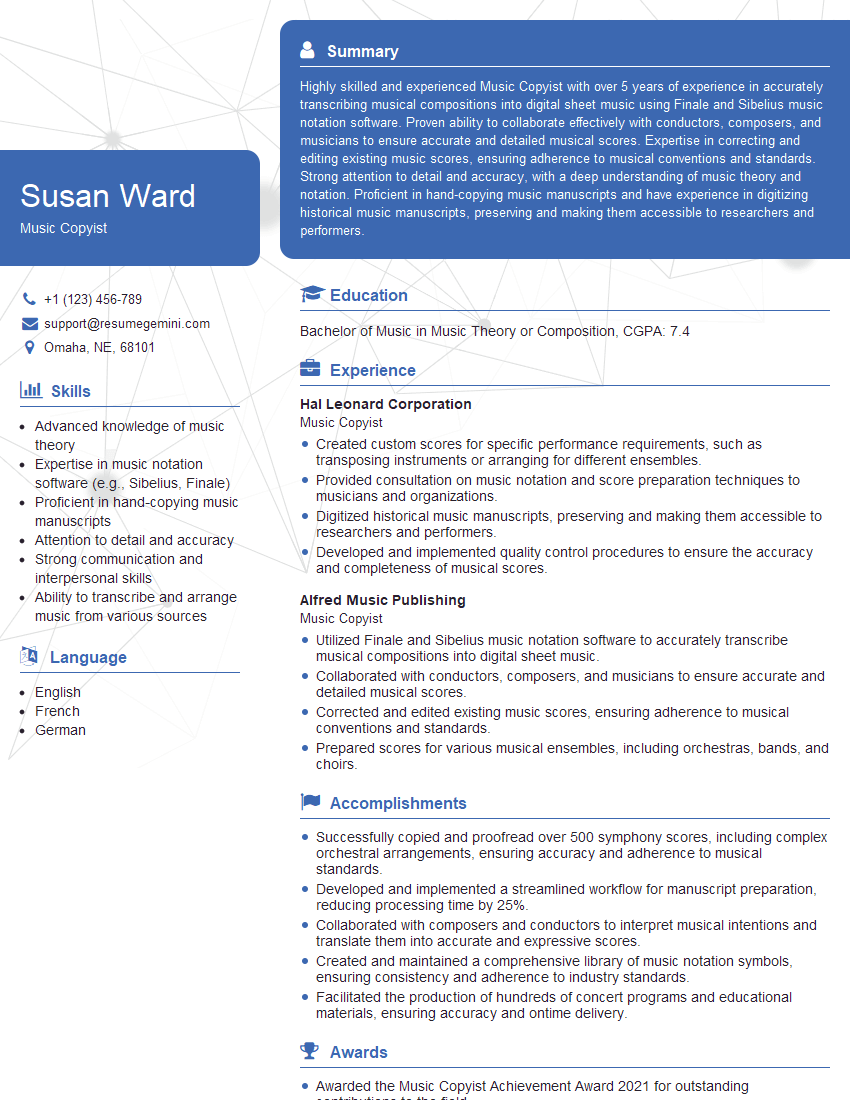
Mastering Sibelius and Finale opens doors to exciting opportunities in music composition, arranging, publishing, and education. Highlighting this proficiency on your resume is crucial for landing your dream job. To maximize your chances, creating an ATS-friendly resume is essential. ResumeGemini is a trusted resource to help you build a professional and impactful resume that will get noticed. We provide examples of resumes tailored to showcasing proficiency in Sibelius and Finale to help you get started. Invest the time to craft a compelling narrative – your skills and experience deserve to shine!
Explore more articles
Users Rating of Our Blogs
Share Your Experience
We value your feedback! Please rate our content and share your thoughts (optional).
What Readers Say About Our Blog
Very informative content, great job.
good