Interviews are more than just a Q&A session—they’re a chance to prove your worth. This blog dives into essential Proficient in using VOIP (Voice over Internet Protocol) interview questions and expert tips to help you align your answers with what hiring managers are looking for. Start preparing to shine!
Questions Asked in Proficient in using VOIP (Voice over Internet Protocol) Interview
Q 1. Explain the difference between SIP and H.323.
Both SIP (Session Initiation Protocol) and H.323 are signaling protocols used in VoIP, essentially acting as the phone system’s ‘dial tone’ and call management system. However, they differ significantly in architecture and approach.
SIP is a more modern, text-based protocol that’s simpler, more flexible, and widely adopted. It uses a request-response model, similar to how web browsers communicate with servers. Think of it like sending text messages to set up a call. Its flexibility allows for easy integration with other applications and scalability to large networks. It’s like a lightweight, adaptable messenger for your calls.
H.323, on the other hand, is a much older, complex, and call-centric protocol. It’s more of a complete package, defining not just how to initiate a call, but also the various call control features. Imagine it as a bulky, all-in-one landline phone system with lots of built-in features, but less adaptable to change or different applications. It’s less flexible and often requires specialized gateways for interoperability.
In short: SIP is like a streamlined, modern smartphone, while H.323 is more akin to a classic, feature-rich landline system. SIP’s simplicity and flexibility have made it the dominant protocol in modern VoIP deployments.
Q 2. Describe the process of setting up a basic VOIP system.
Setting up a basic VoIP system involves several key steps. Let’s assume a small office scenario.
- Choose a VoIP Provider: Select a provider that offers the features and scalability you need. Consider factors like pricing, reliability, and customer support. Many offer different plans based on the number of users and features.
- Obtain IP Phones or Softphones: IP phones are dedicated hardware devices, while softphones are software applications running on computers or smartphones. The choice depends on your budget and preferences.
- Network Configuration: Ensure your network has sufficient bandwidth and a stable internet connection. Consider Quality of Service (QoS) settings to prioritize VoIP traffic over other network activities. This is crucial for clear calls.
- Account Setup and Configuration: Follow the provider’s instructions to create accounts for each user and configure the IP phones or softphones with the necessary credentials. This usually involves entering your account information, such as username and password.
- Testing and Troubleshooting: Make test calls to ensure everything is working correctly. If you encounter issues, refer to the provider’s documentation or support resources.
For example, if using a provider like RingCentral or 8×8, you’ll follow their instructions for account creation and phone setup; if using a self-hosted solution like Asterisk, the initial configuration and ongoing maintenance are much more complex.
Q 3. What are the advantages and disadvantages of using VOIP?
VoIP offers numerous advantages, but also comes with some drawbacks.
- Advantages:
- Cost Savings: Significantly reduces long-distance and international call costs compared to traditional PSTN (Public Switched Telephone Network).
- Increased Flexibility: Enables remote work and communication from anywhere with an internet connection.
- Unified Communications: Integrates voice calls with other communication tools like messaging, video conferencing, and presence information.
- Scalability: Easy to add or remove users as needed, making it ideal for growing businesses.
- Advanced Features: Offers features like call recording, voicemail-to-email, auto-attendant, and more.
- Disadvantages:
- Dependence on Internet: Requires a stable internet connection; outages can disrupt calls.
- Quality Issues: Call quality can be affected by network congestion or poor internet speed. This is where QoS becomes important.
- Security Concerns: VoIP systems are susceptible to various security threats, such as eavesdropping and unauthorized access.
- Power Dependency: VoIP phones require power to operate.
For instance, a small business might save thousands annually on long-distance bills by switching to VoIP, but needs a reliable internet backup in case of outages.
Q 4. How does QoS (Quality of Service) relate to VOIP?
QoS (Quality of Service) is critical for VoIP because it prioritizes VoIP traffic over other network data. Think of it as a VIP lane for your calls on a busy highway.
VoIP relies on real-time data transmission; even slight delays or packet loss can significantly degrade call quality, leading to choppy audio, dropped calls, and increased jitter (variations in delay). QoS mechanisms, such as DiffServ (Differentiated Services) and MPLS (Multiprotocol Label Switching), assign different priorities to network packets. VoIP packets are marked as high-priority, ensuring they receive preferential treatment by network routers and switches. This reduces latency and packet loss.
Without QoS, other high-bandwidth applications, such as video streaming or file transfers, could compete for bandwidth and negatively impact the VoIP call’s quality. QoS ensures your calls get the bandwidth they need for a good experience.
Q 5. What are some common VOIP security threats?
VoIP systems face several security threats, which necessitates a robust security strategy.
- Eavesdropping: Unauthorized listening to calls through network interception.
- Call spoofing: Masking the caller ID to appear as a different number, often used for phishing or fraudulent calls.
- Denial-of-Service (DoS) attacks: Overwhelming the VoIP system with traffic to make it unavailable.
- Man-in-the-Middle (MitM) attacks: Intercepting communication between two parties to steal data or inject malicious code.
- Unauthorized access: Gaining access to the VoIP system’s administrative interface to make changes or steal information.
Mitigation strategies include strong passwords, encryption (like SRTP for secure RTP), firewalls, intrusion detection systems, and regular security audits. Choosing reputable providers with strong security features is also essential. A layered security approach is key to protecting your VoIP system.
Q 6. Explain the concept of codecs in VOIP.
Codecs (coder-decoders) are essential components of VoIP. They are algorithms that compress and decompress audio data for transmission over the network. Think of them as translators for your voice data.
They convert analog audio signals (your voice) into digital data for transmission and then back into analog audio at the receiving end. Different codecs offer varying levels of compression and quality. Higher compression reduces bandwidth usage, but may also reduce audio quality. Lower compression preserves audio fidelity, but consumes more bandwidth.
Common codecs include G.711 (high quality, high bandwidth), G.729 (low bandwidth, lower quality), and Opus (versatile codec that balances quality and bandwidth). The choice of codec depends on the network conditions and the desired audio quality.
For example, G.711 is often preferred for high-quality calls over high-bandwidth connections, while G.729 might be necessary for low-bandwidth situations like cellular connections to ensure calls are not dropped.
Q 7. How do you troubleshoot common VOIP issues?
Troubleshooting VoIP issues involves a systematic approach.
- Check Network Connectivity: Ensure your device has a stable internet connection. Ping your VoIP server to check network connectivity.
- Verify VoIP Settings: Check if the IP phone or softphone is properly configured with the correct credentials and settings.
- Examine Network Quality: Use network monitoring tools to check for packet loss, jitter, and latency. High latency is indicative of network congestion or distance to the server.
- Check Codec Compatibility: Make sure both ends are using compatible codecs. Codec mismatches can result in poor audio quality or failed calls.
- Review Firewall Settings: Confirm that your firewall isn’t blocking VoIP traffic. You may need to open specific ports for VoIP protocols.
- Check for Physical Issues: If using a hardware phone, ensure it’s properly connected and that the power is on.
- Contact Your Provider: If you can’t resolve the issue, contact your VoIP provider’s support team. They often have advanced diagnostic tools.
A simple example: If you’re experiencing poor call quality, start by checking your internet speed and latency. High latency points to a network issue; low bandwidth suggests you might need a higher-tier service or a different codec. Addressing these fundamental issues is the first step in effective troubleshooting.
Q 8. What are some common VOIP protocols?
Several protocols underpin VoIP communication, each playing a crucial role in different aspects of the call. The most common include:
- SIP (Session Initiation Protocol): This is arguably the most prevalent protocol, responsible for setting up, managing, and terminating VoIP calls. Think of it as the ‘master controller’ of the conversation. It handles everything from initial call signaling to transferring media streams.
- H.323: An older but still used protocol, particularly in enterprise environments. H.323 is more complex than SIP, offering features for gatekeeping and call admission control.
- MGCP (Media Gateway Control Protocol): This protocol works alongside others to control the media gateways that convert voice signals to IP packets and vice versa. You could think of it as coordinating the translation between two different languages.
- RTCP (RTP Control Protocol): This works hand-in-hand with RTP (Real-time Transport Protocol). While RTP is the actual carrier of the voice data, RTCP provides feedback on the quality of the stream, allowing for real-time adjustments.
- RTP (Real-time Transport Protocol): This protocol is responsible for the actual transportation of voice and video data across the network. It ensures that the audio or video streams are delivered in real time with minimal delay.
The choice of protocol often depends on the specific VoIP system’s architecture and the need for specific features. For example, SIP’s flexibility makes it the preferred protocol for most modern VoIP deployments, while H.323 might be favored in situations requiring robust call admission control features.
Q 9. What is Session Border Controller (SBC) and its role?
A Session Border Controller (SBC) acts as a security and management gateway between your internal VoIP network and the public internet or other networks. Think of it as a sophisticated bouncer for your VoIP calls. Its primary roles include:
- Security: SBCs protect your network from unauthorized access and denial-of-service attacks. They filter incoming and outgoing traffic, enforcing security policies to prevent malicious intrusion.
- Firewall and NAT Traversal: They handle Network Address Translation (NAT) issues, allowing VoIP calls to traverse firewalls and other network infrastructure elements without hindrance. This is critical as many home and business networks use NAT.
- Call Admission Control: SBCs manage call resources, ensuring that calls are not dropped due to network congestion. This is particularly important in high-traffic environments.
- Protocol Conversion: SBCs can convert between different VoIP signaling protocols (e.g., converting SIP to H.323), allowing interoperability between various systems.
- Media Transcoding: Some advanced SBCs can perform media transcoding, converting different codecs for compatibility between disparate devices.
In a real-world scenario, an organization using VoIP could deploy an SBC to connect its internal PBX to a cloud-based contact center platform. The SBC would secure the connection, manage call routing, and handle any protocol conversions necessary.
Q 10. Explain the concept of call routing in VOIP.
Call routing in VoIP determines how incoming calls are handled and directed to the appropriate destination. It’s similar to how a traditional phone system uses a switchboard, but is far more flexible and intelligent. It works by analyzing various factors, including:
- Caller ID: Identifying the caller can route them to a specific extension, department, or voicemail box based on pre-defined rules.
- Time of Day: Calls can be routed differently based on the time of day, perhaps directing calls to a voicemail after hours.
- Call Destination: Based on the dialed number, the system determines the appropriate route. This is often managed using dial plans.
- Presence Information: If the recipient’s status is known (e.g., available, busy, offline), the routing can intelligently manage the call, offering options such as forwarding or sending to voicemail.
Imagine a business with multiple departments. Call routing allows them to route calls to sales, support, or accounts receivable based on the number dialed or even the caller’s voice prompt input. A well-designed call routing system improves efficiency and customer experience.
Q 11. Describe your experience with different VOIP platforms (e.g., Asterisk, Cisco Unified Communications Manager).
I have extensive experience with several leading VoIP platforms, including Asterisk and Cisco Unified Communications Manager (CUCM).
Asterisk: I’ve utilized Asterisk, an open-source PBX, extensively for building custom VoIP solutions. I’ve worked on projects involving integrating Asterisk with various third-party applications using its robust API, creating custom dial plans for complex routing scenarios, and managing large-scale deployments. For instance, I built a custom IVR system for a small business using Asterisk, drastically improving their call handling efficiency and reducing wait times. This included developing custom prompts and integrating their CRM for efficient agent assignment.
Cisco Unified Communications Manager (CUCM): My work with CUCM has involved deploying and maintaining large enterprise-grade VoIP systems. This includes configuring phone devices, designing and implementing call routing strategies, troubleshooting complex issues, and ensuring system performance. A notable project involved migrating a large organization from a legacy phone system to CUCM, which required careful planning, extensive testing, and close collaboration with the client’s IT department.
My experience spans system design, installation, configuration, troubleshooting, and integration with various other technologies. I’m comfortable working with both open-source and proprietary platforms, adapting my approach to each system’s specific strengths and limitations.
Q 12. How do you ensure the quality of a VOIP call?
Ensuring VoIP call quality involves monitoring and managing several key factors. Think of it as a multi-faceted approach to keep your calls sounding crystal clear. The key aspects include:
- Network Quality: Sufficient bandwidth, low latency, and minimal packet loss are paramount. Monitoring network performance using tools like ping and traceroute can help identify bottlenecks. Troubleshooting network issues like jitter and latency requires a deep understanding of network protocols and performance metrics.
- Codec Selection: Choosing the right codec (coder-decoder) balances call quality and bandwidth usage. Higher-quality codecs (like G.729) require more bandwidth but deliver better audio. Lower-quality codecs (like G.711) are more bandwidth-efficient but can compromise quality in poor network conditions.
- Jitter Buffering: A jitter buffer helps to smooth out variations in packet arrival times, reducing choppy audio. Proper configuration is essential to prevent excessive delay.
- Quality of Service (QoS): Implementing QoS policies on the network prioritizes VoIP traffic over other applications, ensuring sufficient resources are available for calls even under heavy network load.
- Regular Testing and Monitoring: Using call quality monitoring tools to track metrics like MOS (Mean Opinion Score) is crucial to identify areas for improvement. Proactive monitoring can prevent issues before they affect users.
In practice, I often use a combination of network monitoring tools, VoIP-specific analytics platforms, and a deep understanding of the underlying protocols to identify and resolve call quality issues. A proactive approach, including regular testing and network optimization, is key to consistently high call quality.
Q 13. What are the different types of VOIP deployments?
VoIP deployments come in various forms, each with unique advantages and disadvantages. The most common types include:
- On-Premise: The VoIP system is hosted on the organization’s own servers and infrastructure. This offers greater control and customization, but requires significant investment in hardware, software, and IT expertise.
- Cloud-Based: The VoIP system is hosted in a cloud environment by a third-party provider (like a SaaS). This offers scalability, cost-effectiveness, and reduced maintenance overhead but requires reliance on the provider’s infrastructure and security.
- Hybrid: A combination of on-premise and cloud-based solutions. This approach allows organizations to leverage the strengths of both models, combining on-premise control with the scalability of the cloud.
The best deployment model depends on an organization’s size, technical expertise, budget, and specific needs. A small business may opt for a simple cloud-based solution, while a large enterprise with stringent security requirements might choose an on-premise or hybrid deployment.
Q 14. Explain the concept of call detail records (CDRs) in VOIP.
Call Detail Records (CDRs) are detailed logs of VoIP calls, capturing critical information about each conversation. Think of them as detailed receipts for every call made. This data is valuable for billing, reporting, and analyzing call patterns. A typical CDR includes:
- Caller ID: The number that initiated the call.
- Callee ID: The number that received the call.
- Call Start Time: When the call began.
- Call End Time: When the call ended.
- Call Duration: The length of the call.
- Call Type: Incoming, outgoing, internal, etc.
- Codec Used: The audio codec used during the call.
- Billing Information: Details for billing purposes.
CDRs are crucial for several reasons: They’re essential for generating invoices, identifying usage patterns (which can inform network optimization), troubleshooting call quality issues by correlating CDR data with network performance metrics, and detecting fraudulent activity. Analyzing CDRs can reveal valuable insights into call center performance, identifying areas for improvement in agent efficiency and customer service.
Q 15. What are some best practices for securing a VOIP system?
Securing a VoIP system is crucial to prevent unauthorized access, eavesdropping, and data breaches. It’s like securing your home – multiple layers of protection are necessary.
Strong Passwords and Authentication: Employ complex, unique passwords for all administrative accounts and user extensions. Consider multi-factor authentication (MFA) for added security. Think of this as a strong lock on your front door.
Firewall and Network Segmentation: Implement firewalls to control network traffic, limiting access to your VoIP system only from authorized IP addresses or networks. Segmenting your VoIP network from other networks further isolates it, similar to having a separate security system for your garage.
Secure Protocols: Utilize secure protocols like SRTP (Secure Real-time Transport Protocol) for media encryption and TLS (Transport Layer Security) for signaling. This is like using a coded language to protect your conversations.
Regular Software Updates and Patching: Keep your VoIP system, phones, and network equipment updated with the latest security patches to address known vulnerabilities. This is analogous to regularly updating your home’s security software.
Regular Security Audits: Conduct periodic security audits to identify and address potential weaknesses. It’s like a home inspection that proactively identifies risks.
Access Control Lists (ACLs): Implement ACLs on your routers and switches to further restrict network access, only permitting authorized devices to connect to your VoIP system. This is similar to having a guest list at a party.
By implementing these measures, you create a multi-layered security approach that significantly reduces the risk of security breaches.
Career Expert Tips:
- Ace those interviews! Prepare effectively by reviewing the Top 50 Most Common Interview Questions on ResumeGemini.
- Navigate your job search with confidence! Explore a wide range of Career Tips on ResumeGemini. Learn about common challenges and recommendations to overcome them.
- Craft the perfect resume! Master the Art of Resume Writing with ResumeGemini’s guide. Showcase your unique qualifications and achievements effectively.
- Don’t miss out on holiday savings! Build your dream resume with ResumeGemini’s ATS optimized templates.
Q 16. How do you handle issues related to network congestion affecting VOIP calls?
Network congestion is a common challenge with VoIP, leading to dropped calls, jitter (choppy audio), and latency (delay). Imagine a crowded highway – the more cars, the slower the traffic. Addressing this requires a multi-pronged approach:
Quality of Service (QoS): Prioritize VoIP traffic over other network traffic using QoS mechanisms like DiffServ or MPLS. This is like creating an express lane for VoIP data on your network.
Bandwidth Management: Ensure sufficient bandwidth is available for your VoIP system. This might involve upgrading your internet connection or optimizing network usage. It’s like ensuring you have enough road capacity for the volume of traffic.
Jitter Buffering: Utilize jitter buffers on your VoIP phones and gateways to smooth out variations in network latency. This is like a buffer zone that compensates for traffic variations.
Network Monitoring: Regularly monitor network performance using tools that track latency, jitter, and packet loss. This allows you to identify and address congestion proactively, like monitoring your highway traffic for bottlenecks.
Redundancy: Implement redundant network connections and equipment to provide failover protection in case of network outages. This is akin to having an alternate route in case your main highway is blocked.
By carefully managing bandwidth and prioritizing VoIP traffic, you can minimize the impact of network congestion.
Q 17. What is the role of a gateway in a VOIP system?
A gateway acts as a bridge between your VoIP system and the traditional Public Switched Telephone Network (PSTN). Think of it as a translator. It converts VoIP calls into a format the PSTN understands and vice versa.
For example, if you’re making a call from your VoIP phone to a landline, the gateway converts the digital VoIP signal into an analog signal compatible with the PSTN. Conversely, when receiving a call from a landline, the gateway converts the analog signal into a digital signal for your VoIP system.
Gateways are crucial for interoperability between VoIP and legacy phone systems. They facilitate communication between different technologies, often handling features like call routing, voicemail, and faxing.
Q 18. Explain your experience with VOIP integration with CRM systems.
I have extensive experience integrating VoIP systems with various CRM (Customer Relationship Management) systems. This integration streamlines customer interactions and improves efficiency. For example, in a previous role, we integrated a VoIP system with Salesforce. This allowed our sales team to:
Click-to-dial: Directly dial customer numbers from within Salesforce, saving time and reducing errors.
Call logging: Automatically log calls with timestamps and other details within the corresponding Salesforce record, providing a complete customer interaction history.
Screen pops: Automatically display the customer’s information on the screen when a call is received, allowing for immediate access to relevant details.
Call recording: Record calls for training, quality assurance, or compliance purposes.
This integration significantly improved call handling, team performance, and our ability to track and analyze customer interactions. The improved data capture also allows for better analysis of customer interactions and improves service.
Q 19. How do you monitor and manage a VOIP network?
Monitoring and managing a VoIP network involves proactive and reactive measures. It’s like maintaining a complex machine – regular checks and prompt maintenance are crucial.
Network Monitoring Tools: Use network monitoring tools to track key metrics such as latency, jitter, packet loss, CPU utilization, and bandwidth consumption. This gives you a real-time view of your network’s health.
Call Detail Records (CDRs): Analyze CDRs to identify trends in call duration, call volume, and other call-related metrics. This provides valuable insights into usage patterns and potential areas for improvement.
Performance Dashboards: Create dashboards to visualize key metrics and identify potential issues early on. A well-designed dashboard provides an at-a-glance overview of your network’s health.
Automated Alerts: Configure automated alerts to notify you of critical events such as high latency, network outages, or failed calls. This allows for swift intervention and minimizes disruption.
Regular Maintenance: Schedule regular maintenance tasks such as firmware updates, system backups, and hardware checks. Proactive maintenance helps prevent potential problems before they arise.
Effective monitoring and management ensure optimal performance, minimize downtime, and improve the overall user experience.
Q 20. Describe your experience with troubleshooting voice quality issues.
Troubleshooting voice quality issues requires a systematic approach. It’s like diagnosing a car problem – you need to systematically check different parts.
Identify the Symptoms: First, determine the nature of the problem. Is it static, choppy audio (jitter), one-way audio, or dropped calls?
Check Network Connectivity: Verify network connectivity and bandwidth. Tools like ping and traceroute can help identify network issues.
Examine QoS Settings: Check your QoS settings to ensure VoIP traffic is prioritized.
Test Jitter and Packet Loss: Use network monitoring tools to measure jitter and packet loss. High jitter or packet loss indicates network congestion or other issues.
Check VoIP Phone Settings: Ensure the VoIP phones are correctly configured and have the latest firmware.
Inspect Gateway Configuration: Check the gateway’s settings to rule out issues related to codec settings or other gateway-related configurations.
Isolate the Problem: Try isolating the problem by testing different phones, networks, or connections to determine the source of the issue.
By systematically checking these areas, you can pinpoint the root cause of voice quality issues and implement the necessary solutions.
Q 21. What are the different types of VOIP phones?
VoIP phones come in various types, each offering different features and capabilities. Think of it like choosing a car – different models offer different features.
Traditional Desk Phones: These resemble traditional landline phones but connect to a VoIP network. They often offer features like call waiting, hold, and speakerphone.
Softphones: Software-based phones that run on computers or mobile devices. They offer flexibility but require a reliable internet connection.
IP Phones: These phones connect directly to the VoIP network using Ethernet or Wi-Fi. They usually offer more advanced features than traditional desk phones.
Wireless IP Phones: These offer the convenience of cordless phones while still connecting to the VoIP network. Ideal for mobile users.
Video Phones: These enable video calls, making them suitable for video conferencing and other visual communication needs.
The choice of VoIP phone depends on individual needs and preferences. Factors such as features, budget, and network infrastructure influence the selection.
Q 22. Explain your understanding of NAT traversal in VOIP.
NAT traversal in VoIP refers to the methods used to enable communication between VoIP devices located behind Network Address Translators (NATs). NATs are commonly used in home and small office networks to conserve public IP addresses. However, they can hinder VoIP calls because they modify the source and destination IP addresses and ports, making it difficult for VoIP devices to directly communicate with each other.
Several techniques address this, including:
- Hole Punching: This technique involves both peers attempting to simultaneously establish connections through the NATs. They send initial packets that contain information about their internal and external addresses and ports. If successful, the NATs create temporary ‘holes’ allowing bidirectional communication.
- STUN (Session Traversal Utilities for NAT): STUN uses a publicly accessible server to help peers discover their public IP addresses and ports. This allows them to communicate directly, even if behind NATs.
- TURN (Traversal Using Relays around NAT): TURN is a more robust solution than STUN. If direct communication is impossible, TURN uses a relay server to facilitate communication between the peers. The peers send data to the TURN server, which then forwards it to the other peer.
Imagine trying to have a conversation with someone across a crowded room where everyone is using a translator. NAT traversal is like finding a way to connect directly, bypassing the translator as much as possible for clearer, faster conversation. Without proper NAT traversal, VoIP calls may fail, experience significant delays, or suffer from poor quality.
Q 23. Describe your experience with different VOIP billing systems.
My experience encompasses various VoIP billing systems, ranging from simple, prepaid models to complex, feature-rich platforms supporting diverse billing models.
- Prepaid systems: These are straightforward, ideal for individual users or small businesses. They usually involve purchasing a set amount of credit that’s consumed based on call duration or usage.
- Postpaid systems: These are more common in enterprise environments, invoicing users or departments based on monthly usage reports. They can incorporate call detail records (CDRs) for granular billing and reporting.
- Subscription-based systems: These offer bundled services at a fixed monthly rate, typically suited for users with predictable calling patterns.
- Hybrid models: Some systems combine elements of prepaid, postpaid, and subscription models to offer flexibility.
I’ve worked with systems using different databases (e.g., MySQL, PostgreSQL), integrating with CRM and ERP systems, and implementing custom reporting and analytics features. For example, in one project, I customized a billing system to automatically allocate calls to different cost centers within a large corporation based on the caller’s extension.
Q 24. How do you handle issues related to VoIP call latency?
High VoIP call latency (delay) is often caused by network issues, such as high packet loss, jitter (irregular arrival of packets), or insufficient bandwidth. Troubleshooting starts with identifying the bottleneck.
My approach involves:
- Network Monitoring: Employing tools to analyze network performance, specifically monitoring packet loss, jitter, and latency between endpoints. I’d use tools like Wireshark or specialized network monitoring platforms.
- QoS (Quality of Service): Implementing QoS policies to prioritize VoIP traffic over other network applications. This ensures sufficient bandwidth and reduces the impact of competing traffic.
- Jitter Buffering: Adjusting jitter buffer settings on VoIP endpoints. A larger buffer can absorb more jitter but introduces latency, and vice-versa. Finding the optimal balance is crucial.
- Codecs: Using appropriate codecs (audio compression algorithms). Low-bandwidth codecs reduce the impact of bandwidth limitations but can reduce call quality.
- Physical Infrastructure: Assessing the physical network infrastructure to identify potential cabling issues or equipment malfunctions.
For instance, I once resolved a high latency issue by identifying a congested network segment and implementing QoS policies to prioritize VoIP calls, leading to a significant improvement in call quality.
Q 25. What is your experience with VoIP scalability and expansion?
VoIP scalability and expansion involve designing and deploying systems capable of handling increased user numbers, traffic volume, and features without compromising performance or reliability.
My experience includes:
- Choosing scalable infrastructure: Opting for cloud-based solutions or using virtualized infrastructure (e.g., VMware, OpenStack) for easy expansion.
- Distributed architecture: Deploying systems across multiple servers or data centers to distribute the load and prevent single points of failure.
- Load balancing: Implementing load balancers to distribute traffic across multiple servers ensuring efficient resource utilization.
- Database optimization: Optimizing databases to handle larger data volumes and high query loads.
- Monitoring and alerts: Setting up robust monitoring and alerting systems to proactively identify potential issues and facilitate timely intervention.
In a previous role, I helped a company scale their VoIP system from 50 to 500 users by migrating to a cloud-based platform and implementing a distributed architecture. This allowed for smooth growth without impacting call quality or introducing significant latency.
Q 26. Explain your knowledge of SIP trunking.
SIP trunking replaces traditional PSTN (Public Switched Telephone Network) lines with a VoIP connection, using the Session Initiation Protocol (SIP) to establish and manage calls. Instead of individual phone lines, a SIP trunk provides a bundle of channels that handle multiple simultaneous calls.
Key benefits include:
- Cost Savings: Typically cheaper than traditional phone lines, especially for high call volume.
- Scalability: Easily add or remove channels as needed.
- Features: Access to advanced features like call recording, call queuing, and conferencing.
- Flexibility: Supports various VoIP providers and integrates with different PBX systems.
I have experience configuring and managing SIP trunks with various providers, including integrating them with different PBX systems and troubleshooting connectivity issues. For instance, I’ve worked on optimizing SIP trunk configurations to minimize call setup time and improve call quality.
Q 27. How do you troubleshoot problems with VoIP registration?
Troubleshooting VoIP registration problems involves systematically checking various aspects of the VoIP system and network.
My approach includes:
- Network Connectivity: Verify network connectivity between the VoIP phone and the PBX or SIP server, checking IP address, subnet mask, gateway, and DNS settings. Ping tests and traceroutes can be helpful.
- Firewall and NAT: Ensure that firewalls are not blocking the necessary ports (typically UDP ports 5060 and 5061 for SIP signaling, and other ports for media). NAT traversal techniques may need to be configured.
- SIP Server Configuration: Check the SIP server’s configuration, verifying the correct IP address, port, and credentials for the VoIP phone’s registration. Examine the SIP server’s logs for error messages.
- VoIP Phone Configuration: Confirm that the VoIP phone is properly configured with the correct SIP server address, credentials (username and password), and proxy settings.
- Certificates (if applicable): Ensure that any required SSL/TLS certificates are correctly installed and trusted by both the VoIP phone and the server.
For instance, I recently solved a registration problem by discovering that a firewall was blocking the UDP ports required for SIP signaling. After adjusting the firewall rules, registration was successfully established.
Q 28. What experience do you have with migrating from traditional PBX to VOIP?
Migrating from a traditional PBX to a VoIP system is a significant undertaking requiring careful planning and execution. It involves replacing on-premise hardware with cloud-based or software-based solutions.
My experience in such migrations includes:
- Needs Assessment: Thoroughly assessing the existing PBX system and user requirements to determine the optimal VoIP solution. This includes evaluating features, call volume, scalability needs, and budget.
- Planning and Design: Creating a detailed migration plan, including timelines, resource allocation, and communication strategies. This might involve phased rollout to minimize disruption.
- Number Porting: Managing the process of porting existing phone numbers to the new VoIP system, ensuring minimal downtime.
- VoIP System Configuration: Configuring the new VoIP system, including setting up users, extensions, call routing, and features.
- Testing and Training: Rigorous testing of the new VoIP system before cutover, followed by thorough user training.
- Post-Migration Support: Providing post-migration support to address any issues and ensure a smooth transition.
In a past project, I successfully migrated a company’s 200-extension PBX system to a cloud-based VoIP solution with minimal disruption. The phased rollout, combined with comprehensive testing and user training, ensured a smooth transition and high user adoption.
Key Topics to Learn for Proficient in using VOIP (Voice over Internet Protocol) Interview
- VOIP Architectures: Understanding different VOIP architectures (e.g., SIP, H.323) and their functionalities. Consider the pros and cons of each.
- Network Protocols: Familiarize yourself with essential protocols like RTP, RTCP, SDP, and their roles in VOIP communication. Be prepared to discuss their practical implications.
- QoS (Quality of Service): Mastering QoS mechanisms and their importance in ensuring clear and reliable VOIP calls. Discuss techniques for optimizing call quality over various network conditions.
- Security Considerations: Explore security protocols and measures used to protect VOIP communications from threats like eavesdropping and denial-of-service attacks. Think about authentication and encryption.
- Troubleshooting and Diagnostics: Develop your skills in troubleshooting common VOIP issues. Practice identifying and resolving problems related to call quality, connectivity, and network configurations.
- Practical Applications: Be ready to discuss real-world applications of VOIP, such as unified communications, contact centers, and business communication systems. Consider diverse use cases.
- Hardware and Software Components: Gain a solid understanding of the hardware and software components involved in a VOIP system, from IP phones and gateways to servers and software platforms.
- Scalability and Performance: Discuss the challenges and solutions related to scaling VOIP systems to accommodate growing user bases and increasing call volumes. Understand performance optimization strategies.
Next Steps
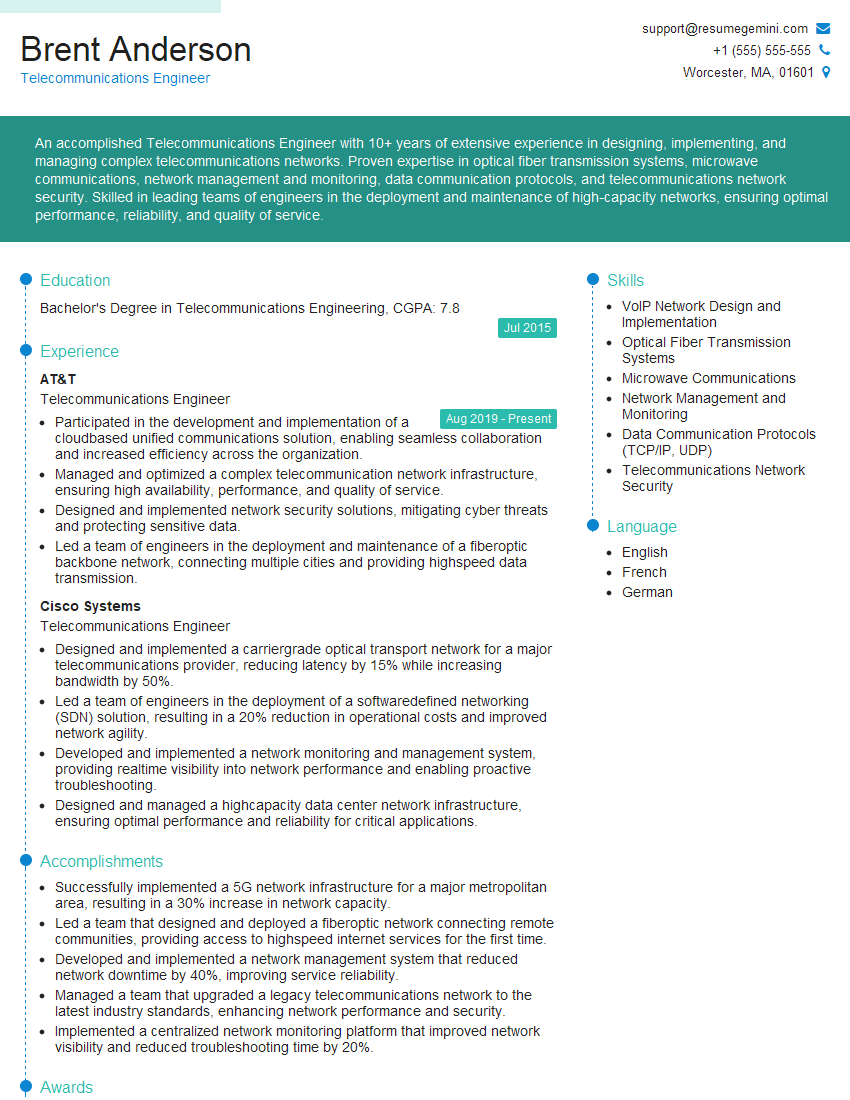
Mastering VOIP technologies significantly enhances your career prospects in the rapidly growing telecommunications and IT sectors. Demonstrating proficiency in VOIP opens doors to exciting roles and higher earning potential. To maximize your chances of landing your dream job, crafting an ATS-friendly resume is crucial. ResumeGemini is a trusted resource to help you build a compelling and effective resume that highlights your skills and experience. ResumeGemini provides examples of resumes tailored specifically to showcasing proficiency in VOIP, giving you a head start in the application process.

Explore more articles
Users Rating of Our Blogs
Share Your Experience
We value your feedback! Please rate our content and share your thoughts (optional).
What Readers Say About Our Blog
Very informative content, great job.
good