Feeling uncertain about what to expect in your upcoming interview? We’ve got you covered! This blog highlights the most important Project Development and Financing interview questions and provides actionable advice to help you stand out as the ideal candidate. Let’s pave the way for your success.
Questions Asked in Project Development and Financing Interview
Q 1. Explain the different phases of a typical project development lifecycle.
The project development lifecycle is a structured process that guides a project from its initial conception to its ultimate completion. Think of it like building a house; you wouldn’t start laying bricks without a blueprint and a plan! It typically involves several key phases:
- Initiation: Defining the project’s objectives, scope, and feasibility. This involves market research, preliminary cost estimations, and securing initial funding commitment.
- Planning: Developing a detailed project plan, including timelines, resource allocation, risk assessment, and budgeting. This is where the detailed blueprint for your ‘house’ is created.
- Execution: Implementing the project plan, managing resources, monitoring progress, and addressing any arising issues. This is the actual construction phase.
- Monitoring and Control: Tracking progress against the plan, identifying deviations, and taking corrective actions to ensure the project stays on track and within budget. Think regular site inspections and quality checks.
- Closure: Completing the project, handing over the deliverables, conducting a post-project review, and documenting lessons learned. This is the housewarming party and final paperwork.
Each phase is crucial and feeds into the next, ensuring a smooth and efficient project delivery. A poorly planned initiation phase, for instance, can lead to significant problems down the line, just like a poorly designed foundation can cause problems with a house.
Q 2. Describe your experience with financial modeling for project appraisal.
Financial modeling is an integral part of my work. I’ve extensively used various software like Excel and dedicated financial modeling programs to create detailed financial projections for project appraisal. For example, in a recent infrastructure project, I developed a model that incorporated revenue projections based on different traffic scenarios, operating costs, debt financing schedules, and tax implications. This enabled us to assess the project’s financial viability under different market conditions and risk scenarios. The model also helped to determine the optimal debt-to-equity ratio and financing structure.
My experience includes developing models that incorporate sensitivity analysis and scenario planning to explore the impact of various uncertainties, such as changes in interest rates, commodity prices, or regulatory approvals. This allowed stakeholders to make informed decisions by visualizing potential outcomes.
Q 3. How do you assess the financial viability of a project?
Assessing the financial viability of a project involves a multi-faceted approach. We look at several key metrics:
- Net Present Value (NPV): This metric discounts future cash flows back to their present value, indicating the project’s profitability. A positive NPV signifies a worthwhile investment.
- Internal Rate of Return (IRR): The discount rate at which the NPV of a project equals zero. It represents the project’s expected return on investment.
- Payback Period: The time it takes for the project to recover its initial investment. A shorter payback period indicates faster return of capital.
- Profitability Index (PI): The ratio of the present value of future cash flows to the initial investment. A PI greater than 1 suggests the project is worthwhile.
- Debt Service Coverage Ratio (DSCR): For projects with debt financing, this shows the ability to service the debt obligations from the project’s operating cash flow.
In addition to these financial indicators, we also conduct a thorough risk assessment and sensitivity analysis to understand the project’s resilience under various scenarios. For example, we might model the impact of a 10% increase in material costs on the project’s profitability.
Q 4. What are the key risks associated with project development and financing?
Project development and financing are inherently risky endeavors. Key risks include:
- Financial Risks: Unexpected cost overruns, inadequate funding, changes in interest rates, currency fluctuations, and unfavorable market conditions.
- Operational Risks: Delays in construction or project completion, equipment failures, supply chain disruptions, and labor disputes.
- Regulatory Risks: Changes in laws, regulations, or permits that impact the project’s feasibility or profitability.
- Political Risks: Political instability, changes in government policies, or expropriation risks, especially relevant in international projects.
- Environmental Risks: Environmental impact assessments, potential environmental damage, and compliance with environmental regulations.
Identifying and mitigating these risks is critical to successful project delivery. It’s like having a detailed emergency plan for your ‘house’ construction, ensuring that you’re prepared for unforeseen circumstances.
Q 5. How do you manage project risks and mitigate potential losses?
Risk management is a proactive and iterative process. We use a combination of strategies:
- Risk Identification: Thorough brainstorming sessions and workshops with stakeholders to identify potential risks.
- Risk Assessment: Analyzing the likelihood and potential impact of each identified risk.
- Risk Mitigation: Developing strategies to reduce the likelihood or impact of risks. This might involve contingency planning, insurance, or risk transfer through contracts.
- Risk Monitoring: Continuously tracking and monitoring risks throughout the project lifecycle. Regular reporting and review meetings are essential.
- Contingency Planning: Developing alternative plans and strategies to deal with unforeseen events. This might include having backup suppliers or additional funding reserves.
For instance, in a previous project involving a large-scale construction project, we implemented a robust risk management framework that identified potential weather-related delays. As a mitigation strategy, we built flexibility into the project schedule and included a weather contingency in the budget. This proved invaluable when unexpected storms delayed construction.
Q 6. Explain your understanding of discounted cash flow (DCF) analysis.
Discounted Cash Flow (DCF) analysis is a valuation method used to estimate the value of an investment based on its expected future cash flows. The core principle is that money received in the future is worth less than money received today due to factors such as inflation and opportunity cost. Think of it like this: would you rather have $100 today or $100 a year from now? Most people would choose today because they could invest that $100 and earn interest.
DCF analysis calculates the present value of future cash flows by discounting them using a discount rate that reflects the risk associated with the investment. The sum of these discounted cash flows represents the project’s net present value (NPV).
NPV = Σ (Ct / (1 + r)^t) - C0
Where: Ct = Cash flow at time t, r = Discount rate, t = Time period, C0 = Initial investment
Q 7. How do you evaluate the internal rate of return (IRR) of a project?
The Internal Rate of Return (IRR) is the discount rate that makes the net present value (NPV) of a project equal to zero. In simpler terms, it’s the rate at which the project’s expected returns equal its initial investment. It’s a crucial metric for evaluating project profitability.
IRR is calculated iteratively, usually through financial software or spreadsheet functions like Excel’s IRR function. You input the project’s cash flows (both positive and negative), and the function calculates the IRR. A higher IRR indicates a more attractive investment opportunity. For example, a project with a 20% IRR is generally considered better than a project with a 10% IRR, assuming all other factors are equal.
It’s important to compare the IRR to the project’s cost of capital (the minimum required rate of return). If the IRR exceeds the cost of capital, the project is considered financially viable.
Q 8. What are the different sources of financing available for project development?
Project financing draws from a diverse pool of sources, each with its own characteristics and risk profiles. These can be broadly categorized into debt financing and equity financing, further subdivided into various options.
- Debt Financing: This involves borrowing money that must be repaid with interest. Examples include:
- Bank loans: Traditional loans from commercial banks, often requiring collateral and strong creditworthiness.
- Syndicated loans: Loans provided by a group of banks, reducing risk for each individual lender and allowing for larger project sizes.
- Bond issuance: Raising capital by issuing bonds, which are essentially IOUs to investors.
- Private debt: Loans from private investment firms or other non-bank lenders, often offering more flexible terms but potentially higher interest rates.
- Equity Financing: This involves selling a share of ownership in the project in exchange for capital. Sources include:
- Venture capital: Funding from firms specializing in high-growth, high-risk ventures.
- Private equity: Investment from firms that acquire ownership stakes in established companies or projects.
- Angel investors: Wealthy individuals who invest in early-stage companies.
- Public equity offerings (IPO): Selling shares of the project to the public on a stock exchange.
- Other Sources: Beyond debt and equity, projects can leverage:
- Government grants and subsidies: Funding from government agencies to support projects aligned with public policy goals.
- Tax incentives: Reductions in tax liabilities to stimulate investment in specific projects.
- Project-specific financing: Structures tailored to the unique needs of a project, such as leasing or off-balance-sheet financing.
The optimal mix depends heavily on the project’s risk profile, stage of development, and the sponsor’s financial position.
Q 9. Explain your experience with debt financing and equity financing.
My experience spans diverse debt and equity financing structures across numerous projects. In one instance, we secured a syndicated loan for a large-scale infrastructure project. This involved coordinating with multiple banks, negotiating favorable terms (interest rates, repayment schedules, covenants), and ensuring the loan documentation meticulously addressed potential risks. The process required detailed financial modeling and extensive due diligence.
On the equity side, I’ve worked on several projects attracting private equity. This involved developing compelling investment memorandums highlighting the project’s potential returns, managing the due diligence process, and negotiating equity stakes and investor rights. Negotiations often focused on valuation, control, exit strategies, and risk-sharing mechanisms. For example, in a renewable energy project, we structured a preferred equity investment that allowed the investor to receive a higher return before the common equity holders. This balanced risk and reward effectively.
Q 10. How do you negotiate with lenders and investors?
Negotiation with lenders and investors is a crucial skill in project finance. It’s a collaborative process requiring strong communication, a deep understanding of the project’s financials, and a keen awareness of each party’s objectives. It’s not merely about price, but also about managing expectations and addressing concerns.
My approach centers on:
- Preparation: Thorough due diligence, robust financial modeling, and a clearly defined strategy are fundamental. I develop a detailed understanding of the lender’s/investor’s risk appetite and investment criteria.
- Value Proposition: I clearly articulate the project’s strengths, potential returns, and risk mitigation strategies. This often involves showcasing a compelling narrative and demonstrating a strong management team.
- Active Listening: I carefully listen to their concerns and tailor my arguments accordingly. Understanding their perspective is vital for finding common ground.
- Creative Solutions: Negotiation sometimes involves finding innovative solutions to address potential roadblocks. This could include structuring different payment schemes, offering performance-based incentives, or adjusting the risk-sharing mechanisms.
- Building Relationships: Strong relationships built on trust and transparency are essential for navigating complex negotiations. It’s about building a long-term partnership.
For instance, in one negotiation, we faced a lender hesitant about the project’s revenue projections. We addressed this by providing sensitivity analysis showing the project’s viability even under less favorable scenarios, and by incorporating performance-based milestones into the loan agreement.
Q 11. Describe your experience with structuring project finance transactions.
Structuring project finance transactions requires a multifaceted approach encompassing legal, financial, and technical considerations. I have extensive experience in structuring transactions for various projects including infrastructure, energy, and real estate. A typical structure involves identifying the project company, defining the ownership structure, and selecting appropriate financing instruments.
Key aspects include:
- Special Purpose Vehicle (SPV): Often, a separate legal entity (SPV) is created to hold the project’s assets and liabilities, isolating project risks from the sponsors.
- Debt Structure: Designing the debt structure, including the type of loans, repayment schedule, interest rates, and security packages offered to lenders.
- Equity Structure: Determining the equity contributions of various sponsors and investors, including their ownership shares and rights.
- Risk Allocation: Explicitly allocating project risks among the sponsors, lenders, and investors.
- Financial Close: Ensuring that all conditions precedent to loan disbursement are met before the financial close of the transaction.
For instance, in a recent project, we used a limited recourse financing structure to mitigate lender risk. This minimized the sponsors’ liability beyond the project’s assets.
Q 12. How do you prepare a comprehensive project financing proposal?
A comprehensive project financing proposal is a crucial document that persuades lenders and investors to support a project. It should be well-structured, easy to understand, and present a compelling investment opportunity. It typically includes:
- Executive Summary: A concise overview of the project, its financial projections, and the financing request.
- Project Description: A detailed description of the project’s objectives, technical aspects, and market analysis.
- Market Analysis: An assessment of the market demand for the project’s output or services.
- Technical Feasibility Study: An evaluation of the project’s technical viability and potential risks.
- Financial Projections: Detailed financial models forecasting revenue, expenses, cash flows, and returns on investment.
- Management Team: Information on the project’s management team and their experience.
- Risk Assessment: An identification and assessment of potential project risks and mitigation strategies.
- Financing Request: A clear statement of the financing needed, the proposed structure, and the repayment schedule.
- Appendices: Supporting documents such as permits, licenses, and technical reports.
A crucial element is to present realistic yet optimistic financial projections, supported by sound assumptions and sensitivity analysis. Clear communication is key to successfully navigating the proposal stage.
Q 13. What are the key considerations when selecting a project financing structure?
Choosing the right project financing structure is vital for project success. The optimal structure depends on several key factors:
- Project Risk: Higher-risk projects may require more equity financing and less debt to attract investors.
- Sponsor’s Financial Strength: Strong sponsors may access more debt financing, while weaker sponsors might need to rely more on equity.
- Project Size and Complexity: Larger and more complex projects often necessitate more sophisticated structures involving multiple lenders and investors.
- Regulatory Environment: Government regulations and policies can influence the choice of financing structure.
- Tax Implications: Tax laws and incentives can affect the financial attractiveness of different structures.
- Market Conditions: Prevailing interest rates and investor sentiment can influence the availability and cost of financing.
For instance, a low-risk project with a strong sponsor might leverage a simple debt financing structure, while a high-risk, complex project might employ a more complex structure involving a combination of debt, equity, and possibly government support.
Q 14. How do you analyze project sensitivity and uncertainty?
Analyzing project sensitivity and uncertainty is essential for making informed investment decisions. It involves assessing how changes in key variables (e.g., revenue, costs, interest rates) affect the project’s profitability and overall feasibility.
Methods include:
- Sensitivity Analysis: This involves systematically changing one variable at a time to assess its impact on key financial metrics, such as net present value (NPV) and internal rate of return (IRR).
- Scenario Analysis: This explores the project’s performance under different scenarios (e.g., optimistic, most likely, pessimistic). This provides a range of potential outcomes.
- Monte Carlo Simulation: This statistical technique simulates a large number of possible outcomes by assigning probability distributions to key variables. This offers a more comprehensive understanding of uncertainty.
The results from these analyses help to identify the project’s most critical risks and inform decision-making on risk mitigation strategies, contingency planning, and acceptable levels of uncertainty. For example, a sensitivity analysis may show that changes in commodity prices significantly affect the profitability of a mining project. Consequently, the project financing structure might incorporate price hedging or other risk mitigation measures.
Q 15. Explain your understanding of project cash flow management.
Project cash flow management is the process of planning, monitoring, and controlling the inflow and outflow of cash throughout a project’s lifecycle. It’s essentially about ensuring you have enough money at the right time to meet your obligations and maximize profitability.
This involves forecasting future cash flows based on the project’s budget, schedule, and anticipated revenue streams. We need to identify potential cash flow gaps and develop strategies to address them, such as securing additional financing or delaying non-critical expenditures. Regular monitoring is crucial, comparing actual cash flows against the forecast and making adjustments as needed. This often involves using specialized software to track invoices, payments, and expenses, generating regular reports that highlight areas of concern.
For example, in a construction project, we would carefully estimate the timing of payments from the client, the costs of materials and labor at each stage, and any potential delays that might impact cash flow. This allows us to proactively secure lines of credit or adjust the project timeline to avoid financial shortfalls.
Career Expert Tips:
- Ace those interviews! Prepare effectively by reviewing the Top 50 Most Common Interview Questions on ResumeGemini.
- Navigate your job search with confidence! Explore a wide range of Career Tips on ResumeGemini. Learn about common challenges and recommendations to overcome them.
- Craft the perfect resume! Master the Art of Resume Writing with ResumeGemini’s guide. Showcase your unique qualifications and achievements effectively.
- Don’t miss out on holiday savings! Build your dream resume with ResumeGemini’s ATS optimized templates.
Q 16. How do you monitor and control project costs?
Monitoring and controlling project costs involves a multi-pronged approach. First, we establish a detailed budget at the outset, breaking down costs into manageable categories (labor, materials, equipment, etc.). Then, we use a robust cost tracking system to monitor actual expenses against the budget. This requires regular reporting and analysis.
We utilize Earned Value Management (EVM) techniques to compare planned progress with actual progress and identify variances. This allows us to proactively address cost overruns. Regular progress meetings with the project team and stakeholders are key to staying on top of potential issues and implementing corrective actions.
For instance, if we find that material costs are exceeding the budget, we may need to explore alternative suppliers or negotiate better pricing. If labor costs are escalating, we might need to re-evaluate the staffing plan or implement more efficient work processes. Change management is vital; any significant deviations from the original plan should be formally documented and approved.
Q 17. How do you manage stakeholder expectations throughout the project lifecycle?
Managing stakeholder expectations requires proactive and consistent communication. It begins with clearly defining roles, responsibilities, and communication channels at the project’s inception. We establish realistic expectations by jointly developing a project charter that outlines goals, timelines, and deliverables. Regular updates, tailored to each stakeholder’s needs, are crucial.
For example, we’d provide high-level summaries to executive sponsors, while providing detailed progress reports to the project team. We employ various communication methods such as meetings, emails, newsletters, and project management software to ensure transparency and accessibility. Active listening and addressing concerns promptly are also vital. Formal escalation procedures should be established to manage conflicts or disputes.
In one project, regular stakeholder meetings helped address concerns about potential delays. By openly communicating the challenges and collaboratively developing mitigation strategies, we maintained trust and ensured buy-in from all stakeholders.
Q 18. Describe your experience with project reporting and communication.
My approach to project reporting and communication centers around clarity, consistency, and relevance. Reports should be concise, well-organized, and tailored to the audience. Key performance indicators (KPIs) are central to conveying project progress and identifying potential risks or issues.
I use various reporting tools, from simple spreadsheets to sophisticated project management software, to track progress, costs, and risks. Visualizations such as charts and graphs help communicate complex information effectively. Regular reports—weekly or monthly depending on the project—are crucial. These reports should include both progress updates and risk assessments. Transparency is key; stakeholders need to understand both successes and challenges.
For example, in a recent project, I used a project management software to generate automated reports that included key milestones achieved, budget variances, and outstanding issues. This allowed me to proactively identify and address potential problems before they escalated.
Q 19. What is your approach to resolving project conflicts and disputes?
Resolving project conflicts and disputes requires a proactive and collaborative approach. I aim to identify the root cause of the conflict before attempting to find a solution. Open communication and active listening are crucial. I encourage parties to express their perspectives and concerns without interruption. A structured approach, such as a facilitated meeting or mediation, can be helpful in complex situations.
If the conflict involves contractual disputes, I’ll consult relevant legal counsel. The goal is always to find a mutually acceptable solution that maintains positive working relationships. Documentation of the conflict, the resolution process, and the agreed-upon solution are essential for future reference. If necessary, I will escalate unresolved conflicts through established procedures.
In one instance, a dispute between two subcontractors was resolved through a facilitated meeting where we helped both parties identify their underlying concerns and negotiate a compromise that was acceptable to both.
Q 20. How do you ensure compliance with relevant regulations and standards?
Ensuring compliance with relevant regulations and standards is paramount. This begins with thorough due diligence at the project’s inception, identifying all applicable laws, regulations, and industry best practices. We then build these requirements into the project plan and incorporate compliance checks throughout the project lifecycle.
This involves regular audits and reviews to ensure adherence to environmental regulations, safety standards, and other relevant legislation. We maintain detailed records to demonstrate compliance. Training for project team members on relevant regulations is also crucial. Proactive risk management helps identify and mitigate potential non-compliance issues early on.
For example, in a construction project, we’d ensure compliance with building codes, environmental permits, and worker safety regulations. Regular inspections and documentation would be crucial to demonstrate compliance and prevent potential penalties or delays.
Q 21. What software and tools are you proficient in for project development and finance?
I am proficient in various software and tools for project development and finance. My experience includes using project management software like Microsoft Project, Primavera P6, and Asana for scheduling, resource allocation, and progress tracking. I am also skilled in using financial modeling software such as Excel, and specialized financial planning and analysis tools for budgeting, forecasting, and risk assessment.
Furthermore, I’m familiar with collaborative platforms like SharePoint and Slack for communication and document management. I am adept at using data visualization tools such as Tableau and Power BI for creating insightful reports and presentations. My proficiency extends to using specialized construction management software and ERP systems as needed for specific projects.
Q 22. How do you identify and assess environmental, social, and governance (ESG) risks?
Identifying and assessing Environmental, Social, and Governance (ESG) risks is crucial for responsible project development and financing. It involves a systematic process of understanding how a project might impact the environment, affect social equity, and adhere to good governance practices. This begins with a thorough materiality assessment, identifying the ESG issues most relevant to the specific project and its stakeholders.
- Environmental Risks: These encompass potential impacts on air and water quality, biodiversity, climate change, waste management, and resource depletion. For example, a large-scale construction project needs to assess its carbon footprint, potential for habitat disruption, and waste management plan.
- Social Risks: This involves considering the project’s impact on local communities, including potential displacement, health and safety impacts, labor practices, and community relations. A mining project, for instance, must address potential impacts on local livelihoods and ensure fair compensation for land use.
- Governance Risks: These center on ethical conduct, transparency, accountability, and compliance with laws and regulations. This includes considerations around bribery, corruption, and data privacy. A project financed through public funds must demonstrate strict adherence to public procurement regulations.
Assessment methods include stakeholder engagement, environmental impact assessments, social impact assessments, and due diligence reviews. We use established frameworks like the Global Reporting Initiative (GRI) standards or the Sustainability Accounting Standards Board (SASB) standards to guide our assessments and ensure consistency and comparability. The findings inform risk mitigation strategies, which are integrated into the project’s design, implementation, and monitoring phases.
Q 23. Describe your experience with public-private partnerships (PPPs).
I have extensive experience in Public-Private Partnerships (PPPs), having been involved in several large-scale infrastructure projects. PPPs leverage the strengths of both public and private sectors to deliver complex projects, combining public funding and regulatory expertise with private sector efficiency and innovation.
My experience encompasses all phases of a PPP, from initial project conceptualization and feasibility studies to structuring the partnership agreement, negotiating contracts, overseeing project implementation, and managing the long-term operational phase. I’m adept at navigating the complexities of risk allocation between public and private partners, developing robust financial models that account for both public subsidies and private returns, and managing stakeholder expectations across diverse groups.
For example, in one project, we structured a PPP for a new highway, where the private sector partner designed, built, and financed the highway while the public sector provided land, regulatory approvals, and a long-term concession agreement for toll revenue collection. This successfully leveraged private capital while ensuring alignment with public policy goals. Another project involved a PPP for a large-scale water treatment plant, where we had to carefully negotiate the risk allocation related to fluctuating water demand and environmental regulations.
Q 24. Explain your understanding of different types of project risk (e.g., political, economic, technological).
Project risk encompasses a wide spectrum of potential challenges that could impact a project’s timeline, budget, and success. Understanding these risks is critical for effective project management and financing.
- Political Risk: This involves uncertainties arising from changes in government policies, regulations, or political instability. For example, a change in government could lead to project delays or cancellation due to shifts in political priorities.
- Economic Risk: This encompasses macroeconomic factors like inflation, currency fluctuations, interest rate changes, and market demand. A sudden economic downturn could negatively impact project financing and feasibility.
- Technological Risk: This arises from technological obsolescence, unexpected technical challenges, or reliance on unproven technologies. For example, relying on a new, untested technology could cause significant delays and cost overruns.
- Financial Risk: This includes risks related to funding availability, cost overruns, and return on investment. Securing adequate financing at favorable terms is a key element of mitigating this risk.
- Operational Risk: This covers risks related to project management, construction, operations, and maintenance. Poor project management can lead to inefficiencies, delays, and cost overruns.
Identifying and assessing these risks is an iterative process, involving thorough due diligence, stakeholder consultations, and risk modeling. The result is a comprehensive risk register that informs mitigation strategies and contingency plans. It’s vital to ensure that all identified risks are adequately addressed throughout the project lifecycle.
Q 25. How do you prioritize projects based on strategic objectives and financial returns?
Prioritizing projects involves a balanced assessment of strategic alignment and financial returns. This isn’t simply about choosing the most profitable project but identifying projects that best contribute to overall organizational goals while yielding acceptable returns.
I typically employ a multi-criteria decision analysis (MCDA) approach, incorporating both qualitative and quantitative factors. This involves:
- Defining Strategic Objectives: Clearly articulating the organization’s strategic goals, such as market expansion, technological leadership, or social impact, which helps to frame the project selection criteria.
- Developing Evaluation Criteria: Defining criteria that reflect both strategic alignment (e.g., contribution to strategic goals, alignment with corporate values, market potential) and financial returns (e.g., net present value (NPV), internal rate of return (IRR), payback period). Weights are assigned to each criterion based on their relative importance.
- Scoring Projects: Each project is evaluated against the predefined criteria, and a score is assigned. This can involve expert judgment, quantitative analysis, or a combination of both.
- Ranking Projects: Projects are ranked based on their overall scores, allowing for a transparent and objective comparison. Projects with higher scores and a strong alignment with strategic objectives are prioritized.
This systematic approach ensures that resource allocation is optimized to maximize both strategic value and financial returns, avoiding the risk of focusing solely on short-term profits at the expense of long-term strategic objectives. Sensitivity analysis helps understand how project rankings might change based on variations in key assumptions, adding robustness to the decision-making process.
Q 26. How do you measure the success of a project development and financing initiative?
Measuring the success of a project development and financing initiative goes beyond simply completing the project on time and within budget. It requires a holistic assessment across multiple dimensions.
- Financial Performance: This assesses whether the project achieved its projected financial returns (NPV, IRR), achieved targeted cost savings, and delivered expected revenue streams. We track key financial metrics throughout the project lifecycle and compare actual results against forecasts.
- Strategic Alignment: This measures the extent to which the project contributed to the overall strategic objectives of the organization. We assess the project’s impact on market share, competitive advantage, and other relevant strategic metrics.
- ESG Impact: This evaluates the project’s environmental, social, and governance performance, assessing its impact on the environment, local communities, and ethical conduct. We regularly review compliance with ESG standards and environmental regulations.
- Operational Efficiency: This measures the project’s operational performance, including efficiency, productivity, reliability, and safety. Key performance indicators (KPIs) are used to monitor performance and identify areas for improvement.
- Stakeholder Satisfaction: This assesses the satisfaction of various stakeholders, including investors, communities, employees, and regulatory bodies. Surveys, feedback sessions, and stakeholder engagement are essential for gauging satisfaction levels.
A comprehensive success measurement framework encompasses all these elements, providing a balanced and nuanced assessment of project outcomes. This framework should be defined at the outset of the project, ensuring that appropriate data is collected and analyzed throughout the lifecycle to enable a robust post-completion evaluation.
Q 27. Describe a time you had to make a difficult decision regarding project finances.
During the development of a large-scale renewable energy project, we faced a significant funding shortfall due to unforeseen increases in raw material costs. The initial financial model had not adequately accounted for the volatility of commodity prices. This created a difficult decision: either significantly delay the project, potentially jeopardizing its feasibility and investor confidence, or find alternative financing sources at potentially less favorable terms.
After a thorough reassessment of the situation, including consultations with investors and exploring various funding options, we opted to restructure the project financing. This involved renegotiating terms with existing lenders, seeking additional equity investment from strategic partners, and implementing cost-cutting measures within the project design without compromising its overall integrity or long-term sustainability. It was a challenging process requiring considerable negotiation and creativity, but we successfully secured the necessary funding, allowing the project to proceed with minimal delay and protecting the investment of various stakeholders. The experience highlighted the critical importance of robust financial modeling and contingency planning in managing project risks effectively.
Q 28. What are your salary expectations for this role?
My salary expectations for this role are commensurate with my experience and the responsibilities involved. Considering my extensive background in project development and financing, my proven success in delivering complex projects, and my deep understanding of ESG considerations and PPP structures, I am seeking a compensation package in the range of [Insert Salary Range] annually.
However, I am open to discussing this further and would welcome the opportunity to learn more about the complete compensation and benefits package offered for this position.
Key Topics to Learn for Project Development and Financing Interview
- Project Scoping and Feasibility Analysis: Understanding market demand, identifying risks, and developing realistic project timelines and budgets. Practical application: Conducting a thorough market research analysis to validate a proposed renewable energy project.
- Financial Modeling and Forecasting: Creating accurate financial models to project profitability, assess risk, and secure funding. Practical application: Developing a discounted cash flow (DCF) model to evaluate the long-term viability of a large-scale infrastructure project.
- Funding Sources and Capital Structuring: Exploring various funding options (e.g., equity, debt, grants) and optimizing capital structure for maximum project value. Practical application: Comparing the advantages and disadvantages of using bank loans versus private equity for a real estate development project.
- Risk Management and Mitigation Strategies: Identifying and assessing potential risks throughout the project lifecycle and developing effective mitigation plans. Practical application: Implementing a comprehensive risk register to track and manage potential delays, cost overruns, and regulatory hurdles.
- Due Diligence and Transaction Management: Conducting thorough due diligence to assess the viability of potential investments and managing the transactional aspects of project financing. Practical application: Evaluating the environmental and social impacts of a proposed mining operation.
- Legal and Regulatory Compliance: Navigating the legal and regulatory landscape to ensure project compliance and minimize legal risks. Practical application: Understanding and adhering to environmental protection regulations related to a construction project.
- Project Appraisal and Evaluation Techniques: Utilizing various techniques (e.g., NPV, IRR, payback period) to evaluate project profitability and make informed investment decisions. Practical application: Using sensitivity analysis to determine the impact of variations in key variables on project profitability.
Next Steps
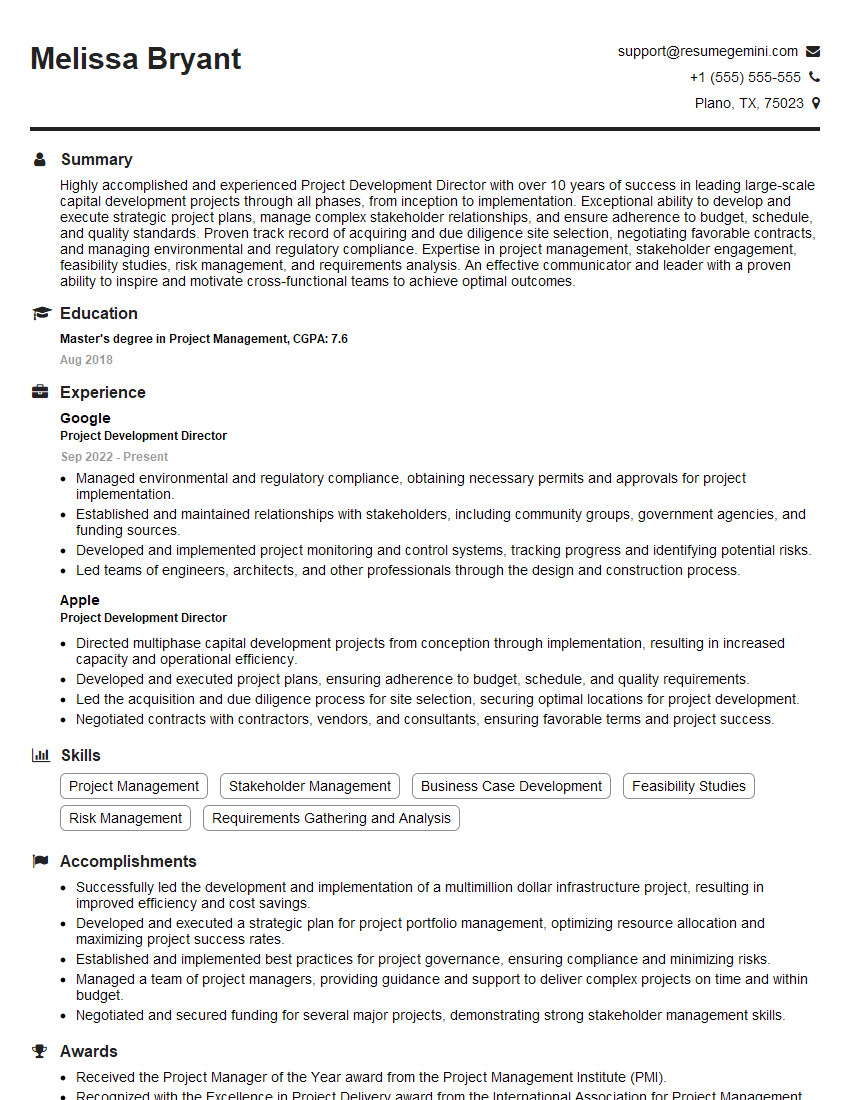
Mastering Project Development and Financing opens doors to exciting and impactful career opportunities in diverse sectors. To maximize your chances of securing your dream role, a strong, ATS-friendly resume is essential. ResumeGemini is a trusted resource to help you create a compelling and effective resume that highlights your skills and experience. ResumeGemini provides examples of resumes specifically tailored to the Project Development and Financing field, helping you present your qualifications in the most impactful way. Invest time in crafting a resume that reflects your unique strengths and showcases your readiness to excel in this dynamic field.
Explore more articles
Users Rating of Our Blogs
Share Your Experience
We value your feedback! Please rate our content and share your thoughts (optional).
What Readers Say About Our Blog
Very informative content, great job.
good