Feeling uncertain about what to expect in your upcoming interview? We’ve got you covered! This blog highlights the most important Prototyping Methods interview questions and provides actionable advice to help you stand out as the ideal candidate. Let’s pave the way for your success.
Questions Asked in Prototyping Methods Interview
Q 1. Explain the difference between low-fidelity and high-fidelity prototyping.
Low-fidelity and high-fidelity prototypes represent different stages in the design process, varying significantly in their level of detail and functionality. Think of it like building a house: a low-fidelity prototype is a rough sketch on a napkin, while a high-fidelity prototype is a detailed architectural model.
Low-fidelity prototypes prioritize speed and ease of creation. They use simple tools like paper, sticky notes, or basic wireframing software to quickly represent the basic structure and flow of an interface. They are excellent for early-stage testing and exploring various design concepts. They are less visually appealing but allow for quick iteration and feedback.
High-fidelity prototypes, on the other hand, closely mimic the final product’s look and feel. They utilize sophisticated design tools like Figma or Adobe XD to create interactive prototypes with detailed visuals, animations, and realistic functionality. They are used for later-stage testing, demonstrating the polished design to stakeholders, and gathering more nuanced user feedback.
In short: Low-fidelity prototypes are quick and dirty; high-fidelity prototypes are polished and detailed. The choice depends on the project stage and the type of feedback needed.
Q 2. What are the advantages and disadvantages of paper prototyping?
Paper prototyping, a low-fidelity method, offers several advantages and disadvantages:
- Advantages:
- Speed and Simplicity: Incredibly fast and easy to create, requiring minimal tools or expertise.
- Cost-Effectiveness: Very inexpensive, needing only paper, pens, and maybe some sticky notes.
- Flexibility: Easy to modify and iterate upon; changes can be made on the fly during user testing.
- Focus on Functionality: Encourages testers to concentrate on the user flow and functionality rather than the visual aspects.
- Disadvantages:
- Limited Visual Appeal: Lacks the polished look and feel of a digital prototype.
- Difficult to Simulate Complex Interactions: Challenging to represent sophisticated animations or transitions.
- Not Suitable for Complex Designs: Can become cumbersome and difficult to manage for very large or complex interfaces.
- No Interactive Elements: Cannot accurately reflect interactive elements like dropdown menus or animations.
For instance, I once used paper prototyping to quickly test the navigation flow of a new mobile app. It allowed me to quickly iterate on the design based on user feedback within a single session. However, for a complex web application, a higher-fidelity prototype would be more appropriate to accurately represent the interface.
Q 3. Describe your experience with different prototyping tools (e.g., Figma, Adobe XD, Axure).
I have extensive experience with several prototyping tools, each suited to different needs:
- Figma: My go-to for collaborative design and prototyping. Its real-time collaboration features are invaluable for team projects. I use Figma’s powerful prototyping capabilities to create highly interactive prototypes, including micro-interactions and animations, making it ideal for high-fidelity prototypes.
- Adobe XD: Excellent for creating visually stunning prototypes, especially for mobile and web applications. Its ease of use and intuitive interface make it great for quick prototyping and visual design.
- Axure RP: A powerful tool best suited for creating complex, interactive prototypes with advanced features like conditional logic and data-driven interactions. I typically use Axure when intricate workflows or dynamic content are essential for testing.
My choice of tool depends on the project’s complexity and the stage of the design process. For early-stage explorations, I might use a simpler tool like Adobe XD. For complex projects requiring advanced interactions, Axure is my preference, while Figma is my everyday choice for its collaboration features.
Q 4. How do you choose the right prototyping method for a given project?
Selecting the right prototyping method is crucial for efficient design. I consider several factors:
- Project Goals: What needs to be tested? Are we evaluating the overall flow or specific interactions? A simple paper prototype might suffice for early flow testing, while a high-fidelity prototype is necessary for detailed usability testing.
- Project Timeline: How much time is available? Low-fidelity methods are ideal for quick iterations. High-fidelity prototypes require more time and resources.
- Budget: The cost of using different tools and resources varies. Paper prototyping is free, while using sophisticated software involves licensing fees.
- Target Audience: Who will be testing the prototype? For initial stakeholder reviews, a less detailed prototype might be acceptable, but usability testing demands a more polished prototype.
- Complexity of the Design: Simple designs can be effectively tested with low-fidelity methods, whereas complex interfaces benefit from the detail offered by high-fidelity prototypes.
For example, a quick concept validation might use paper prototyping, while a final usability test will likely require a high-fidelity prototype built in Figma or a similar tool.
Q 5. What is iterative prototyping and why is it important?
Iterative prototyping is a cyclical process where prototypes are created, tested, and refined repeatedly based on user feedback. Imagine sculpting a clay figure – you start with a rough form, then repeatedly refine it based on your observations and adjustments.
Importance of Iterative Prototyping:
- Reduced Risk: Identifying and addressing design flaws early on minimizes costly revisions later in the development process.
- Improved User Experience: Continuous feedback loops ensure the final product meets user needs and expectations.
- Increased Efficiency: Iterative refinement prevents significant rework by identifying issues early.
- Enhanced Collaboration: Encourages effective communication and collaboration among designers, developers, and stakeholders.
In a recent project, we iterated on our prototype three times. The initial prototype focused on the basic flow; the second iteration incorporated user feedback on navigation; and the final iteration addressed specific interaction challenges. This iterative process resulted in a significantly improved and more user-friendly product.
Q 6. How do you handle feedback during the prototyping process?
Handling feedback during prototyping is critical. My approach involves:
- Structured Feedback Sessions: I conduct structured sessions with clear objectives, using task-based scenarios to observe user behavior.
- Active Listening and Observation: I carefully observe user interactions and actively listen to their verbal feedback, focusing on both positive and negative aspects.
- Note-Taking and Documentation: I meticulously document all feedback, including user quotes, observations, and potential design issues.
- Prioritization: I prioritize feedback based on its impact and feasibility, focusing on critical issues first.
- Synthesizing Feedback: I synthesize all gathered feedback to identify recurring issues and patterns, informing design iterations.
- Transparent Communication: I communicate feedback and design decisions clearly and transparently with the design team and stakeholders.
I use affinity mapping to group similar feedback and identify key themes, helping to distill valuable insights from seemingly disparate comments.
Q 7. Describe your process for testing prototypes with users.
My user testing process involves several steps:
- Recruitment: I recruit participants who represent the target audience, ensuring a diverse range of perspectives.
- Task Definition: I define specific tasks for users to complete, reflecting typical user scenarios.
- Prototype Walkthrough: I provide a brief introduction to the prototype, explaining its purpose and any necessary instructions.
- Observation and Note-Taking: I observe user interactions, noting any challenges or difficulties they encounter.
- Post-Test Interview: I conduct a post-test interview to gather qualitative feedback and explore users’ experiences in more detail.
- Data Analysis: I analyze both quantitative data (e.g., task completion rates) and qualitative data (e.g., user comments) to identify key findings and actionable insights.
- Iteration and Refinement: I use the feedback to iterate on the prototype and refine the design based on user behavior and preferences.
For instance, in a recent usability test, we discovered a significant usability issue with the checkout process. User testing revealed that users were struggling to find the ‘add to cart’ button. This feedback led to a significant redesign of that section of the prototype, ultimately improving the overall user experience.
Q 8. How do you measure the success of a prototype?
Measuring the success of a prototype isn’t about perfection; it’s about achieving its intended purpose. We use a multifaceted approach, focusing on both qualitative and quantitative data. Success hinges on how effectively the prototype achieves its goals, which are usually defined upfront. For example, if the goal is to test the usability of a checkout flow, success is measured by metrics like task completion rate, error rate, and user satisfaction scores gathered through usability testing. We also consider qualitative feedback, analyzing users’ comments, pain points, and suggestions to inform design iterations. A successful prototype might reveal unexpected user needs, highlighting areas for improvement and ultimately leading to a more effective final product. Imagine testing a prototype of a new mobile banking app; success would mean users can easily navigate to the desired features and complete transactions without frustration, based on both the quantitative data (task completion rates) and qualitative data (user feedback on ease of use and satisfaction).
Q 9. Explain the concept of user flows and how they relate to prototyping.
User flows are visual representations of how a user interacts with a product or service to achieve a specific goal. They map out the steps a user takes, from the starting point to the desired outcome. In prototyping, user flows are crucial because they provide a blueprint for the prototype’s structure and functionality. They ensure a logical and intuitive user experience. For instance, a user flow for an e-commerce site might detail the steps involved in adding an item to a shopping cart, proceeding to checkout, entering payment information, and finally confirming the order. During prototyping, we directly translate these flows into interactive screens within the prototype. We’ll design screens, transitions, and interactions to accurately reflect the user’s journey outlined in the flow. A well-defined user flow helps us prioritize features and ensure a coherent user experience across the prototype.
Q 10. How do you incorporate user research findings into your prototypes?
User research findings are the bedrock of successful prototyping. We actively incorporate these findings throughout the entire process. Before even starting the prototype, we analyze research data, such as user interviews, surveys, and usability testing results, to understand user needs, pain points, and preferences. During prototyping, we directly address these findings by incorporating features that directly resolve identified pain points or accommodate user preferences. For example, if user research shows users struggle to find a specific feature, the prototype will be designed to make that feature more prominent and easily accessible. If research points to a confusing workflow, the prototype will refine that process into something more intuitive. Iterative prototyping involves testing the prototype with users and then using their feedback to refine the design based on their experience, continuously incorporating the research into the iterations.
Q 11. What are some common pitfalls to avoid when creating prototypes?
Several common pitfalls can derail a prototyping effort. One is focusing too much on visual fidelity early on, neglecting the core functionality and usability. It’s better to start with a low-fidelity prototype to quickly test core concepts and then gradually increase the fidelity. Another pitfall is neglecting to test the prototype with users early and often. This is crucial for getting valuable feedback and preventing costly mistakes later. Failing to clearly define the prototype’s goals and target audience is equally problematic. Without a clear understanding of what we’re trying to achieve, we risk wasting time and resources on irrelevant features. Finally, becoming too attached to a particular design solution can hinder creativity and prevent exploration of alternative approaches. It’s important to remain objective and be open to feedback that challenges our assumptions.
Q 12. How do you balance speed and fidelity in your prototyping process?
Balancing speed and fidelity is a crucial aspect of effective prototyping. The key is to choose the right level of fidelity for the specific stage of the design process and the prototype’s purpose. In the early stages, we prioritize speed and use low-fidelity prototypes, such as paper prototypes or wireframes, to quickly explore design concepts and test core functionalities. As we progress and gather feedback, we gradually increase the fidelity, adding more visual details and interactions. This iterative approach allows us to efficiently test design ideas, identify potential problems early, and refine the design based on user feedback without investing excessive time and resources in high-fidelity prototypes before their core concepts have been validated. For example, starting with a simple paper prototype to test the overall flow, then moving to a mid-fidelity digital prototype to test interactions, and finally creating a high-fidelity prototype for final usability testing.
Q 13. Describe your experience with prototyping for different platforms (e.g., web, mobile, desktop).
My prototyping experience spans across various platforms, including web, mobile, and desktop applications. For web applications, I’ve extensively used tools like Figma, Adobe XD, and Axure RP to create interactive prototypes that simulate user interactions. For mobile applications, I leverage these same tools, paying close attention to responsive design and mobile-specific interactions such as touch gestures and screen sizes. For desktop applications, I focus on creating prototypes that reflect the specific interface paradigms and user expectations associated with desktop environments, often incorporating elements like drag-and-drop functionality and keyboard shortcuts. Regardless of the platform, my approach emphasizes creating prototypes that are faithful to the target platform’s conventions while focusing on the core functionality and user experience. For instance, a mobile banking app prototype would accurately reflect the look and feel of iOS or Android apps, while a desktop email client prototype would adhere to desktop interface conventions.
Q 14. Explain the role of prototyping in the overall design process.
Prototyping plays a vital role in the overall design process, acting as a bridge between initial concepts and the final product. It’s an iterative process that allows designers and developers to explore different design solutions, test assumptions, gather user feedback, and refine the design based on real-world interactions. It helps identify and mitigate potential problems early in the design process, reducing development costs and improving the quality of the final product. Prototyping helps validate design decisions, ensuring the product meets user needs and expectations. By visualizing the user experience, it facilitates communication and collaboration between designers, developers, and stakeholders. Essentially, prototyping is a crucial step in ensuring a product is not only aesthetically pleasing, but also functional, intuitive, and truly meets the needs of its target users.
Q 15. How do you communicate your prototypes effectively to stakeholders?
Communicating prototypes effectively to stakeholders requires a multi-faceted approach. It’s not just about showing the prototype; it’s about telling a compelling story around it. I begin by setting the context, clearly stating the prototype’s purpose and the problem it aims to solve. This ensures everyone is on the same page from the start. Then, I use a combination of methods to facilitate understanding:
- Guided walkthroughs: I lead stakeholders through the prototype, highlighting key features and functionalities. This allows for interactive feedback and immediate clarification of any doubts.
- Presentation slides: I create concise slides summarizing the key design decisions, user flows, and the rationale behind them. This acts as a reference point and a structured narrative.
- Annotated prototypes: I add comments and notes directly to the prototype itself, explaining the design choices and highlighting areas of particular interest or concern. This is especially helpful for remote stakeholders.
- Data visualization: If available, I incorporate data from user testing or analytics to demonstrate the prototype’s effectiveness or identify areas for improvement. Visualizing data makes the impact much more tangible.
- Follow-up documentation: After the presentation, I provide a concise summary document that includes key takeaways, decisions made, and next steps. This serves as a lasting record of the communication.
For example, during a recent project for a financial institution, I used a combination of a guided walkthrough with a live prototype and supporting slides explaining the user research that informed the design choices. This resonated strongly with stakeholders as it demonstrated a clear understanding of the user’s needs and a rationale for the design decisions.
Career Expert Tips:
- Ace those interviews! Prepare effectively by reviewing the Top 50 Most Common Interview Questions on ResumeGemini.
- Navigate your job search with confidence! Explore a wide range of Career Tips on ResumeGemini. Learn about common challenges and recommendations to overcome them.
- Craft the perfect resume! Master the Art of Resume Writing with ResumeGemini’s guide. Showcase your unique qualifications and achievements effectively.
- Don’t miss out on holiday savings! Build your dream resume with ResumeGemini’s ATS optimized templates.
Q 16. What is the difference between wireframing and prototyping?
While both wireframes and prototypes are used in the design process, they serve different purposes and have distinct levels of detail. Think of wireframing as sketching the blueprint of a house, while prototyping is like building a scale model.
- Wireframes: These are low-fidelity visual representations that focus on the structure and layout of a user interface. They primarily show the placement of elements like buttons, text fields, and images, without any styling or visual polish. They’re primarily used for early-stage exploration and establishing the basic functionality.
- Prototypes: These are more advanced representations that simulate the actual interaction and functionality of the final product. Prototypes can range from low-fidelity (e.g., paper prototypes) to high-fidelity (e.g., interactive digital prototypes). They’re used for user testing, stakeholder feedback, and iterative refinement of the design.
For instance, a wireframe for an e-commerce website might show the placement of the search bar, product categories, shopping cart, and user account section, using simple boxes and placeholders for text. A prototype, however, would allow users to actually search for products, add them to a cart, and simulate the checkout process.
Q 17. Describe your experience using interactive prototyping tools.
I have extensive experience using various interactive prototyping tools, including Figma, Adobe XD, Axure RP, and InVision Studio. My choice of tool depends on the project’s complexity, the fidelity required, and the stakeholders involved.
- Figma: I frequently use Figma for its collaborative features, allowing real-time collaboration with designers and stakeholders. Its ease of use and rich prototyping capabilities make it ideal for both low and high-fidelity prototypes.
- Adobe XD: Excellent for creating visually appealing prototypes, especially when it comes to incorporating design elements and transitions. I’ve used it for projects requiring a high degree of visual fidelity.
- Axure RP: For complex interactions and logic, Axure RP shines with its robust capabilities for creating intricate prototypes with conditional logic and dynamic content.
- InVision Studio: While no longer actively developed, I still utilize it for specific projects requiring robust animation and micro-interaction capabilities.
For example, in a recent mobile app project, I used Figma to create interactive prototypes, leveraging its collaborative features to get real-time feedback from the development team. For another project requiring complex animations, I incorporated InVision Studio to showcase the desired user experience effectively.
Q 18. How do you ensure your prototypes are accessible to users with disabilities?
Accessibility is paramount in my design process. I ensure my prototypes are usable by people with disabilities by adhering to WCAG (Web Content Accessibility Guidelines) and following best practices. This includes:
- Sufficient color contrast: Using tools to check color contrast ratios, ensuring text and interactive elements are easily distinguishable.
- Keyboard navigation: Making sure all interactive elements can be accessed and operated using only the keyboard, for users who cannot use a mouse.
- Alternative text for images: Providing descriptive alternative text for all images, enabling screen readers to convey the image’s content.
- Clear and concise language: Avoiding jargon and using plain language, making the prototype understandable for everyone.
- Captions and transcripts for videos and audio: Providing captions and transcripts for all multimedia content.
- Proper ARIA attributes: Using appropriate ARIA attributes (Accessible Rich Internet Applications) to enhance screen reader functionality.
For instance, when creating a prototype for a website, I always check color contrast using a tool like WebAIM’s Color Contrast Checker and ensure that all interactive elements are accessible via keyboard navigation. I also write detailed alt text for images so that screen readers can convey the meaning to visually impaired users.
Q 19. How do you handle changes in requirements during the prototyping phase?
Handling changes in requirements during the prototyping phase is a common occurrence. My approach is to embrace this as an iterative process rather than a rigid plan. I use an agile methodology, focusing on flexibility and responsiveness.
- Regular stakeholder communication: Frequent communication prevents major discrepancies and ensures that changes are identified and addressed early on.
- Version control: Maintaining different versions of the prototype allows for easy rollback if necessary, also aiding in tracking changes over time.
- Prioritization: Changes are assessed based on their impact and urgency. Critical changes are implemented first, while less impactful ones might be deferred or prioritized for future iterations.
- Transparent communication: Stakeholders are kept informed of the implications of changes, including potential impacts on timeline and budget.
- Iterative prototyping: The prototyping process is broken down into smaller, manageable iterations, enabling quicker adaptation to evolving requirements.
For example, if a new feature is requested during the prototyping phase, I’ll assess its feasibility, discuss its implications with stakeholders, and then incorporate it into the next iteration of the prototype. This approach maintains agility and minimizes disruption.
Q 20. Explain your experience with A/B testing prototypes.
A/B testing prototypes is crucial for evaluating different design options and identifying the most effective solutions. I conduct A/B tests using online tools integrated with prototyping software or by utilizing dedicated platforms. The process typically involves:
- Defining clear hypotheses: Establishing measurable goals and specific predictions based on different design options.
- Creating prototype variations: Developing two or more versions of the prototype, each embodying a different design approach.
- Selecting appropriate metrics: Defining key performance indicators (KPIs) to measure the effectiveness of each prototype variation (e.g., task completion rate, error rate, time on task).
- Recruiting participants: Gathering a representative sample of users to test the prototypes.
- Analyzing results: Using statistical analysis to compare the performance of different prototype versions, identifying statistically significant differences.
For instance, I recently conducted an A/B test on two different designs for an e-commerce checkout flow. One version used a streamlined single-page design, while the other employed a multi-step approach. By tracking the conversion rate and task completion time, we determined that the single-page design significantly improved user experience and increased conversions.
Q 21. How do you incorporate animations and micro-interactions in your prototypes?
Animations and micro-interactions play a vital role in enhancing the user experience, providing feedback, and improving engagement. I incorporate them judiciously, ensuring they serve a purpose and enhance usability rather than distracting from it. The process involves:
- Identifying key moments: I determine which interactions could benefit most from animations and micro-interactions. These often include feedback mechanisms (e.g., button presses, form submissions), transitions between screens, and loading indicators.
- Selecting appropriate animation styles: I choose animation styles that match the overall brand and style guide. Subtle and elegant animations are often preferred over flashy, distracting ones.
- Using prototyping tools effectively: I utilize the animation and micro-interaction capabilities of tools like Figma, Adobe XD, or InVision Studio to create the desired effects. I often leverage pre-built animation libraries or create custom animations using animation timelines.
- Testing and refinement: I test the animations with users to ensure they are intuitive, effective, and do not detract from usability. Based on user feedback, I iterate and refine the animations.
For example, in a mobile banking app prototype, I used subtle animations to indicate progress during transactions and loading operations. This provided the user with clear feedback and prevented them from feeling lost or uncertain about the process. The animations were designed to be unobtrusive, ensuring that they complemented the user experience rather than overpowering it.
Q 22. What are some examples of successful prototypes you’ve created?
Successful prototypes are those that effectively communicate the core value proposition and functionality of a product while facilitating user feedback. I’ve had the opportunity to create several, each tailored to different stages and needs.
Interactive website prototype for a Fintech startup: This prototype, built using Figma, allowed potential investors to experience the key features – user registration, account management, and investment simulation – providing tangible evidence of the product’s potential. Its success was measured by the positive investor feedback and subsequent seed funding secured.
Minimum Viable Product (MVP) for a mobile fitness app: This prototype, developed using React Native, focused on core functionalities like workout tracking and progress visualization. The iterative feedback from beta testers helped refine the UI/UX and identify crucial improvements before full-scale development. The MVP’s effectiveness was demonstrated by a significant increase in user engagement during the beta testing phase.
Paper prototype for a smart home device control system: Using simple paper cutouts and mock-ups, we tested the intuitive flow of the user interface for controlling lights, temperature, and other appliances. This low-fidelity prototype allowed for rapid iteration and cost-effective exploration of different design choices. The paper prototype’s success was in its ability to quickly identify usability issues before investing heavily in digital development.
Q 23. Describe a time you had to pivot your prototyping approach due to unforeseen challenges.
During the prototyping phase for an e-commerce platform, we initially focused on a complex, feature-rich prototype using advanced animations and 3D rendering. However, user testing revealed that the intricacy overwhelmed users, obscuring the core shopping experience. This was an unforeseen challenge as our initial focus was on visual appeal.
We pivoted by drastically simplifying the prototype, removing unnecessary animations and focusing on a clean, intuitive user journey. We shifted to a low-fidelity prototype using wireframes to isolate the core functionality – product browsing, adding to cart, and checkout. This allowed for faster testing and quicker iteration, resulting in a dramatically improved user experience and a more streamlined development process. The lesson learned was to prioritize core functionality early on in the prototyping process and avoid getting bogged down in superficial details.
Q 24. How do you prioritize features during the prototyping process?
Prioritizing features during prototyping involves a careful balance between addressing the core value proposition and managing resources effectively. I generally employ the MoSCoW method (Must have, Should have, Could have, Won’t have) to prioritize features.
First, we clearly define the MVP (Minimum Viable Product) – the core functionalities needed to satisfy the most critical user needs. These ‘Must have’ features are given the highest priority during prototyping. ‘Should have’ features – those that enhance the user experience but aren’t crucial for the initial release – are addressed next, contingent on time and resources. ‘Could have’ and ‘Won’t have’ features are deferred to later iterations based on user feedback and market demand. This structured approach ensures that the prototype efficiently showcases the most vital features while remaining manageable in terms of scope and development time.
Q 25. What are some common metrics you use to evaluate the effectiveness of a prototype?
Evaluating the effectiveness of a prototype is crucial for iterative improvement. The metrics I use depend on the prototype’s fidelity and stage of development, but some common ones include:
Task Completion Rate: Percentage of users successfully completing core tasks within the prototype.
Error Rate: Frequency of user errors or unexpected behavior.
Time on Task: Average time taken to complete specific tasks – highlighting areas of efficiency or frustration.
System Usability Scale (SUS): A standardized questionnaire measuring overall usability.
Qualitative Feedback: Gathering verbal and written feedback to understand user experiences and pain points.
For low-fidelity prototypes, qualitative feedback is often more valuable, while quantitative data becomes more crucial as prototypes become higher fidelity and closer to the final product.
Q 26. How do you ensure your prototypes align with the overall product vision?
Aligning prototypes with the overall product vision is paramount for successful development. This begins with a thorough understanding of the product roadmap and target user personas. Before embarking on any prototyping, I ensure that the prototype’s scope and objectives are clearly defined and aligned with the overall strategy.
I frequently use user story mapping to visually represent user journeys and features, connecting the prototype’s functionalities to the larger product vision. This visual representation helps to maintain a cohesive narrative throughout the design and development process and ensures that we’re not building features that deviate from the core product goals. Regular reviews with stakeholders also guarantee that the prototype stays on track and reflects the evolving product vision.
Q 27. Describe your experience working with cross-functional teams on prototyping projects.
Collaborating effectively with cross-functional teams is essential for successful prototyping. My experience involves close interaction with designers, developers, product managers, and marketers.
I employ clear communication strategies, ensuring all team members have a shared understanding of the prototype’s goals, timelines, and deliverables. Tools like collaborative design platforms (Figma, InVision) and project management software (Jira, Asana) facilitate seamless collaboration and feedback sharing. Regular team meetings, demos, and feedback sessions keep everyone aligned and informed. This ensures a shared understanding and efficient workflow, leading to a more cohesive and successful outcome.
For example, during a recent project, I used daily stand-up meetings to track progress, address roadblocks, and ensure alignment among the UX designers, front-end developers, and the product owner. This collaborative approach allowed us to identify and resolve issues proactively, resulting in a timely and successful prototype launch.
Key Topics to Learn for Prototyping Methods Interview
- Low-Fidelity Prototyping: Understanding the purpose and techniques of creating quick, low-cost prototypes (e.g., paper prototyping, storyboarding). Practical application: Explaining when a low-fidelity prototype is the most appropriate choice and justifying that choice based on project needs and constraints.
- High-Fidelity Prototyping: Mastering the creation of detailed, interactive prototypes (e.g., using Figma, Adobe XD, InVision). Practical application: Describing the iterative process of refining a high-fidelity prototype based on user feedback and testing.
- Prototyping Techniques: Exploring various methods like wireframing, mockups, interactive prototypes, and their respective strengths and weaknesses. Practical application: Selecting the optimal prototyping technique for a given design challenge and justifying your decision.
- User Testing and Iteration: Understanding the importance of user feedback in the prototyping process and how to effectively incorporate that feedback into design iterations. Practical application: Describing a scenario where user testing revealed a significant design flaw and how you addressed it.
- Prototyping Tools and Software: Familiarity with popular prototyping tools and their capabilities (e.g., Figma, Adobe XD, Sketch, Axure). Practical application: Comparing and contrasting different tools based on specific project requirements.
- Design Thinking and Prototyping: Connecting prototyping methods to the overall design thinking process. Practical application: Explaining how prototyping fits within a larger design strategy and contributes to successful product development.
Next Steps
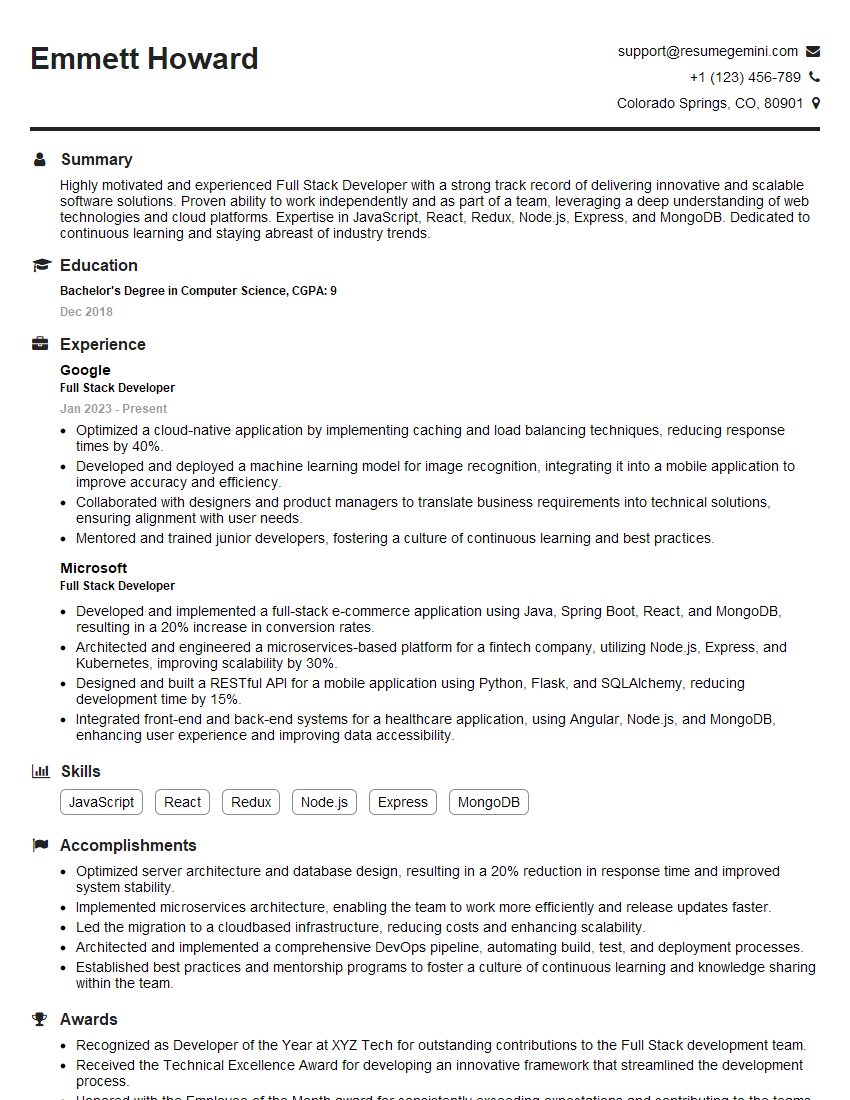
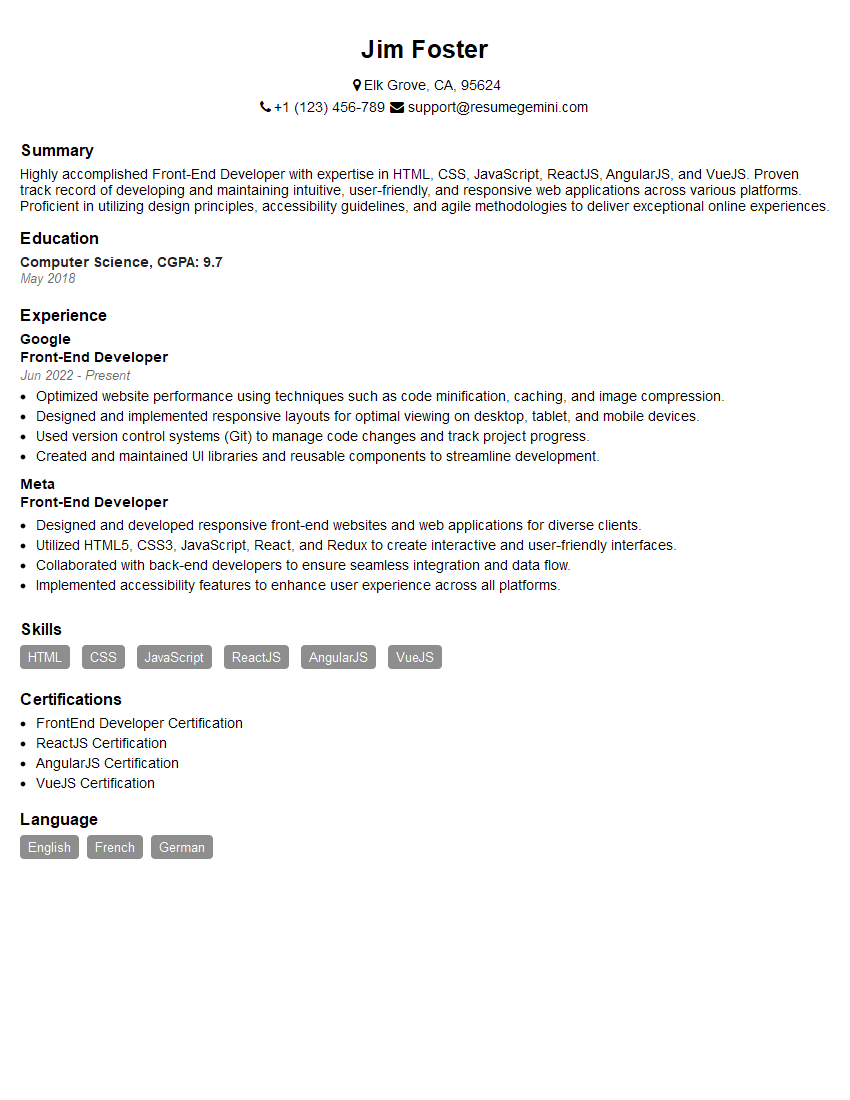
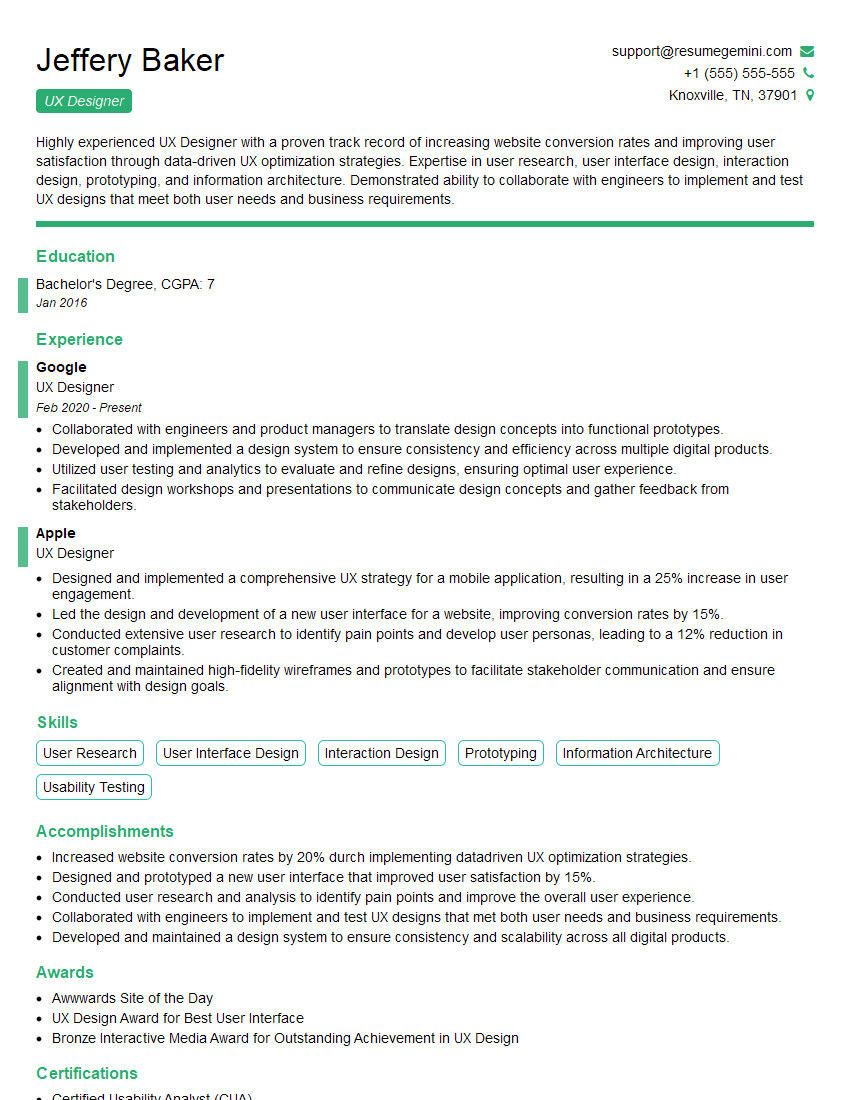
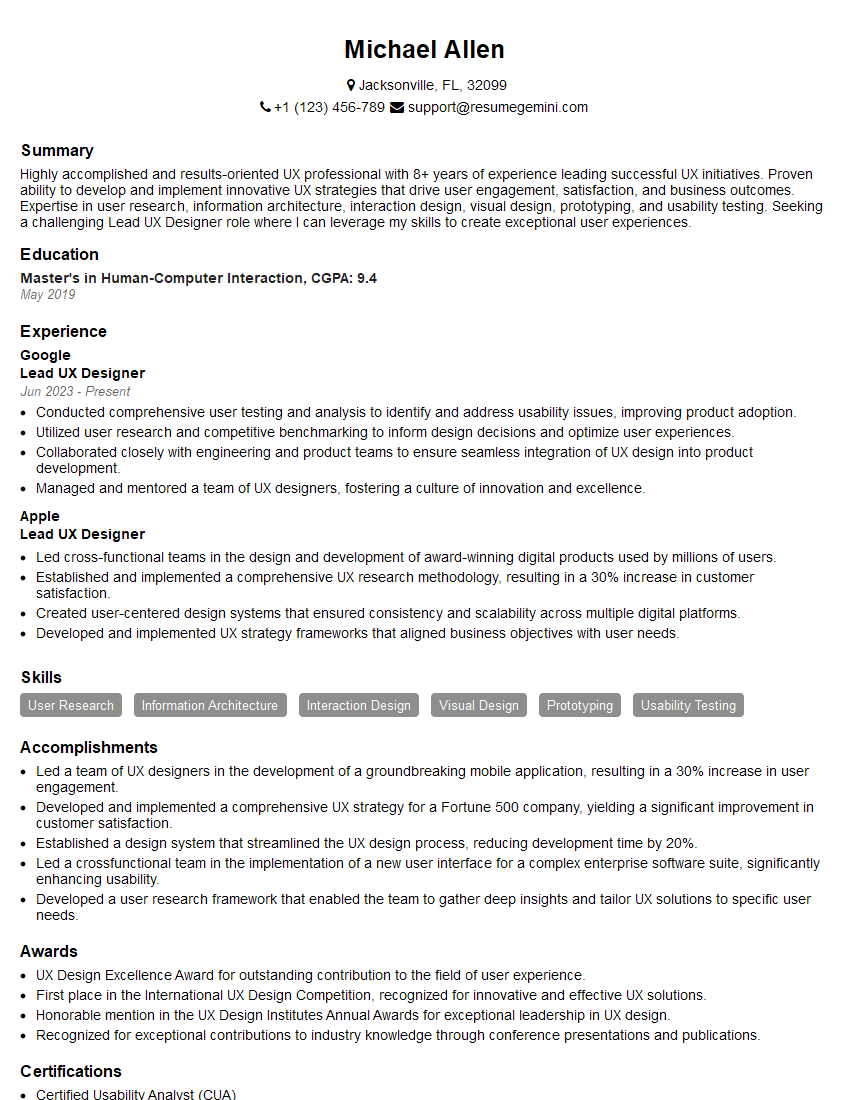
Mastering prototyping methods is crucial for a successful career in UX/UI design and related fields. A strong understanding of these techniques demonstrates your ability to translate ideas into tangible solutions and iterate effectively based on user feedback. This skill is highly valued by employers! To significantly enhance your job prospects, invest time in crafting an ATS-friendly resume that showcases your prototyping expertise. ResumeGemini is a trusted resource that can help you build a professional and impactful resume. We provide examples of resumes tailored to Prototyping Methods to help guide you. Take the next step towards your dream career – start building your resume today!

Explore more articles
Users Rating of Our Blogs
Share Your Experience
We value your feedback! Please rate our content and share your thoughts (optional).
What Readers Say About Our Blog
Very informative content, great job.
good