Interviews are more than just a Q&A session—they’re a chance to prove your worth. This blog dives into essential Punters’ Analysis interview questions and expert tips to help you align your answers with what hiring managers are looking for. Start preparing to shine!
Questions Asked in Punters’ Analysis Interview
Q 1. Explain the concept of Kelly Criterion and its application in punters’ analysis.
The Kelly Criterion is a formula used to determine the optimal size of a bet. It’s not about guaranteeing wins, but maximizing long-term growth by balancing risk and reward. Imagine you have a system that predicts outcomes with a certain probability of success. The Kelly Criterion calculates the fraction of your bankroll you should bet to optimize your returns over many bets. It considers your edge (the difference between your estimated win probability and the bookmaker’s odds), aiming to grow your capital steadily without excessive risk of ruin.
Formula: f = (bp – q) / b
Where:
f= fraction of bankroll to betb= decimal odds – 1 (e.g., odds of 2.5 would be 1.5)p= your estimated probability of winningq= 1 – p (your estimated probability of losing)
Example: You believe a horse has a 60% chance of winning (p = 0.6), and the bookmaker offers odds of 2.0 (b = 1.0). Then, f = (1.0 * 0.6 – 0.4) / 1.0 = 0.2. This means you should bet 20% of your bankroll on that horse. Crucially, the Kelly Criterion is highly sensitive to the accuracy of your probability estimate (p). An overestimation of your edge can lead to significant losses.
In punters’ analysis, the Kelly Criterion helps manage risk effectively. It is not a foolproof system and requires accurate probability estimations; inaccurate estimates can lead to substantial losses, highlighting the importance of rigorous data analysis and model validation.
Q 2. Describe different types of betting markets and their associated risks.
Betting markets offer various ways to wager on sporting events. The most common include:
- Match Result (1X2): Betting on which team will win (1), draw (X), or lose (2). Risk: Relatively straightforward, but outcomes can be unpredictable, especially in closely matched contests.
- Handicap Betting: One team starts with a virtual advantage or disadvantage. Risk: Requires understanding point spreads and how they affect outcomes. Can be complex, particularly in sports with variable scoring.
- Over/Under Betting: Betting on whether the combined score of both teams will be above or below a specified total. Risk: Dependent on accurate prediction of scoring patterns and potential outliers. Can be affected by external factors like weather.
- Asian Handicap: Similar to handicap betting but offers more granular options, often mitigating draws. Risk: More nuanced understanding required than standard handicap betting.
- Correct Score: Predicting the exact final score. Risk: High risk, low reward as the chances of accurately predicting the precise score are very low.
Associated risks across all markets include:
- Bookmaker margins: Bookmakers always build a profit margin into their odds.
- Unexpected events: Injuries, refereeing decisions, or external factors can drastically alter outcomes.
- Statistical Fluctuations: Random variation and luck are inherent in sports.
- Model inaccuracy: Any predictive model will have limitations and inaccuracies.
Q 3. How do you identify and mitigate biases in sports data?
Identifying and mitigating biases in sports data is crucial for accurate punters’ analysis. Biases can stem from various sources, including:
- Selection bias: Data may only reflect games with specific characteristics (e.g., high-profile matches).
- Confirmation bias: We tend to favor information confirming pre-existing beliefs.
- Survivorship bias: Analyzing only successful teams or players, neglecting those who failed.
- Data recording errors: Inconsistent data collection methods can introduce errors.
Mitigation strategies:
- Data cleaning and validation: Scrutinize data for inconsistencies and outliers.
- Robust statistical methods: Employ methods less sensitive to outliers (e.g., robust regression).
- Control variables: Include factors that could influence outcomes (e.g., weather, injuries).
- Cross-validation: Test models on different datasets to ensure generalizability.
- Blind testing: Avoid looking at the outcome during model development.
- Regular model updates: Incorporate new information to keep models relevant.
For example, if analysing home advantage, consider including factors like crowd size and refereeing bias in addition to merely examining home win percentages.
Q 4. What are some common statistical methods used in punters’ analysis?
Several statistical methods are commonly used in punters’ analysis:
- Regression analysis: Models the relationship between variables (e.g., team statistics and match outcomes).
- Poisson regression: Predicts the number of goals or points scored in a match.
- Logistic regression: Predicts the probability of a binary outcome (e.g., win or loss).
- Time series analysis: Analyzes data over time to identify trends and patterns.
- Markov chains: Model transitions between states (e.g., team form).
- Bayesian methods: Integrate prior knowledge with new data to improve predictions.
Choosing the right method depends on the specific question and the nature of the data. For instance, Poisson regression is suitable for modelling the number of goals, while logistic regression is ideal for predicting win probabilities. Combining methods often provides a more robust approach.
Q 5. Explain the difference between expected value and implied probability.
Expected Value (EV) represents the average return you expect from a bet over many repetitions. It’s calculated by multiplying the potential profit by the probability of winning, and subtracting the potential loss multiplied by the probability of losing.
Implied Probability is the probability of an outcome as implied by the bookmaker’s odds. It represents the bookmaker’s assessment of the likelihood of an event.
Difference: EV is your assessment of profitability, considering your own probability estimate. Implied probability reflects the bookmaker’s assessment, built into the odds. You find a value bet when your EV is positive, meaning your estimated probability of winning is higher than what is implied by the bookmaker’s odds.
Example: You estimate a 60% chance of a horse winning (p=0.6). The bookmaker offers odds of 2.0 (implying a 50% probability). If you bet $10 and win, your profit is $10. If you lose, you lose $10. Your EV = (0.6 * $10) – (0.4 * $10) = $2. This indicates a positive expectation, despite the bookmaker’s implied probability.
Q 6. How do you assess the accuracy and reliability of different data sources?
Assessing data source reliability is critical. I consider several factors:
- Source reputation: Established, reputable providers generally offer more reliable data.
- Data coverage: Comprehensive datasets are preferred over sparse ones.
- Data accuracy: Check for inconsistencies, errors, and biases in the data.
- Data granularity: Finer-grained data (e.g., individual player statistics) can lead to more accurate models.
- Data updates: Frequent updates ensure the data remains relevant.
- Transparency: Understanding data collection methods helps assess potential biases.
- Cross-referencing: Compare data from multiple sources to identify discrepancies and enhance reliability.
For instance, using multiple sources to corroborate player injury reports offers a more reliable assessment than relying on a single source alone. Comparing the same statistic from different data providers reveals potential discrepancies and aids in identifying the most reliable source.
Q 7. Describe your experience with various statistical software packages (e.g., R, Python).
I have extensive experience with both R and Python for statistical analysis. In R, I regularly use packages like glmnet for regularized regression, caret for machine learning tasks, and ggplot2 for data visualization. My Python skills encompass using libraries such as scikit-learn, pandas for data manipulation, statsmodels for statistical modelling, and matplotlib and seaborn for visualization.
I’m comfortable performing various tasks, including data cleaning, exploratory data analysis (EDA), model building, validation, and reporting. My choice of language often depends on the specific project requirements. For example, R’s specialized statistical packages are advantageous for particular analyses, while Python’s versatility and integration with other tools prove beneficial in larger projects involving data processing and automation.
Beyond these packages, I’m also proficient in SQL for database management and have experience with cloud computing platforms for handling large datasets.
Q 8. How do you build and evaluate predictive models for sports outcomes?
Building predictive models for sports outcomes involves a multi-step process combining statistical modeling with domain expertise. First, we gather relevant historical data, such as team statistics, player performance, weather conditions, and even injury reports. Then, we select appropriate features (variables) that are likely to influence the outcome. This might include things like points scored per game, win percentages against specific opponents, or home-field advantage.
Next, we choose a suitable predictive model. Common choices include logistic regression (for binary outcomes like win/loss), Poisson regression (for count data like goals scored), or more complex models like neural networks or gradient boosting machines. The choice depends on the data and the complexity we’re willing to handle. We then train the model using the historical data, optimizing its parameters to minimize prediction errors.
Model evaluation is crucial. We use techniques like cross-validation to assess the model’s performance on unseen data, preventing overfitting (where the model performs well on training data but poorly on new data). Key metrics include accuracy, precision, recall, and the AUC (Area Under the Curve) of the ROC (Receiver Operating Characteristic) curve. We also compare the performance of different models to select the best one for our needs. For instance, we might compare a simple logistic regression model against a more sophisticated Random Forest model to determine which offers the better predictive power while balancing model complexity.
Q 9. Explain your understanding of overround and its impact on profitability.
Overround, also known as the bookmaker’s margin, is the inherent advantage built into the odds offered by betting companies. It ensures that the bookmaker makes a profit regardless of the outcome of an event. Imagine a simple coin toss with two outcomes: heads or tails. A fair representation would offer odds of 2.0 (or even money) for each outcome. However, a bookmaker might offer odds of 1.95 for both heads and tails. This seemingly small difference adds up. If the bookmaker takes bets of £100 on heads and £100 on tails, they pay out £195 regardless of the outcome, making a profit of £5 (or 2.5% overround).
The impact of overround on profitability is significant. The higher the overround, the lower the potential for long-term profit for the punter. To be consistently profitable, punters must identify value bets – bets where the implied probability based on the odds is lower than their own assessment of the true probability of the event occurring. Essentially, you need to find odds that are ‘better’ than the true odds, accounting for the bookmaker’s margin. Successfully exploiting this edge is crucial for long-term success in betting.
Q 10. How do you handle missing data in your analysis?
Missing data is a common challenge in sports analytics. The way we handle it depends on the nature and extent of the missingness. Simple methods include deletion – removing observations with missing values. However, this can lead to bias if the missingness is not random. For example, if injury reports are missing more often for less prominent players, simply deleting these rows would skew our analysis.
More sophisticated techniques involve imputation. This is where we fill in missing values based on other available data. Common imputation methods include mean/median imputation (replacing missing values with the average or median of the existing values), k-nearest neighbors imputation (using the values of similar observations), or more advanced techniques like multiple imputation, which creates multiple plausible imputed datasets to account for uncertainty in the missing values. The choice of method depends on the type of data (categorical vs. numerical), the pattern of missingness, and the potential impact on the analysis. Careful consideration of the implications of each method is vital to avoid introducing bias into our models.
Q 11. Describe your experience with data visualization and communication of findings.
Data visualization is crucial for communicating complex findings effectively. I use a variety of tools, including Python libraries like Matplotlib, Seaborn, and Plotly, to create informative and visually appealing charts and graphs. For example, I might use scatter plots to explore the relationship between two variables, or line graphs to track performance over time. Bar charts and histograms are useful for summarizing categorical and numerical data respectively. Interactive dashboards, built using tools like Tableau or Power BI, allow for more dynamic exploration of the data.
Beyond visuals, clear and concise written reports are essential. These reports summarize my findings, explain the methodology, and discuss the implications of the results. For stakeholders who may not have a statistical background, I focus on delivering insights in a simple, non-technical language. Using analogies and real-world examples helps to make the analysis more accessible and engaging. Ultimately, the goal is to translate complex data into actionable information that guides decision-making.
Q 12. How do you identify and exploit arbitrage opportunities?
Arbitrage opportunities exist when the odds offered by different bookmakers for the same event create a scenario where a bet on all possible outcomes guarantees a profit, regardless of the actual result. For example, consider a football match between Team A and Team B. Bookmaker X offers odds of 2.10 for Team A to win, 3.50 for a draw, and 4.00 for Team B to win. Bookmaker Y offers odds of 2.00 for Team A, 3.20 for a draw and 3.80 for Team B. By carefully calculating the implied probabilities, we might find a combination of stakes across the different bookmakers which would guarantee a profit no matter which outcome actually occurred. This situation allows us to profit from the discrepancy in the odds rather than relying on predicting the outcome accurately.
Identifying these opportunities requires constantly monitoring odds across multiple bookmakers using specialized software or scraping tools. The window of opportunity for arbitrage is often short-lived as bookmakers adjust their odds quickly. Successful exploitation also requires careful management of risk and a deep understanding of the rules and regulations of different betting platforms.
Q 13. Explain your understanding of different types of betting strategies.
Betting strategies range from simple to highly complex. A common approach is value betting, focusing on identifying bets where the perceived probability exceeds the implied probability from the odds. Other strategies include:
- Arbitrage betting: exploiting discrepancies in odds across different bookmakers.
- Scalping: placing small, quick bets to capitalize on small fluctuations in odds.
- Matched betting: using free bets and bonuses to guarantee profits.
- System betting: following predefined betting rules to manage risk and stake size.
- Kelly Criterion: a mathematical approach to determine optimal bet size based on expected return and probability.
The choice of strategy depends on individual risk tolerance, capital, and available resources. It’s crucial to understand the strengths and weaknesses of each strategy before implementation. Rigorous record-keeping and disciplined money management are essential aspects of any successful betting strategy.
Q 14. How do you incorporate qualitative factors into your quantitative analysis?
Incorporating qualitative factors into quantitative analysis enhances the predictive power of our models. While statistical models are powerful, they often lack the nuance of human judgment. For instance, a team’s morale after a significant loss or a player’s fitness level despite official reports might have a considerable effect on performance, but these aspects aren’t always readily quantifiable.
We incorporate qualitative information through various means: expert opinion might be elicited to assess the impact of such factors, assigning weighted scores to reflect their potential influence. News articles, social media sentiment analysis, or even in-depth scouting reports can be used to gain insights and supplement numerical data. The key is to find a systematic way to translate this qualitative information into numerical values that can be integrated into our quantitative models. For example, we might create a ‘morale index’ based on news reports and social media sentiment. This index, combined with traditional metrics, could provide a more comprehensive picture of a team’s readiness for a particular match and improves the predictive accuracy.
Q 15. Describe your experience with different machine learning algorithms for sports prediction.
My experience with machine learning in sports prediction spans several algorithms, each with its strengths and weaknesses. I’ve extensively used logistic regression for binary classification problems like predicting win/loss outcomes. Its simplicity and interpretability are valuable for understanding feature importance. For example, I’ve used it to model the impact of home advantage, recent form, and player statistics on match results in soccer. I’ve also incorporated support vector machines (SVMs), particularly effective when dealing with high-dimensional data, such as analyzing player performance metrics across various games. Random forests provide robust predictions by averaging the results of multiple decision trees, reducing overfitting and improving accuracy. I’ve utilized these to predict point spreads in basketball, incorporating factors like team injuries and momentum. Finally, neural networks, especially recurrent neural networks (RNNs) like LSTMs, are powerful tools for analyzing time-series data like player performance trends over seasons. These have proven particularly useful in predicting long-term player performance and team trajectory. The choice of algorithm always depends on the specific sport, available data, and desired prediction horizon.
Career Expert Tips:
- Ace those interviews! Prepare effectively by reviewing the Top 50 Most Common Interview Questions on ResumeGemini.
- Navigate your job search with confidence! Explore a wide range of Career Tips on ResumeGemini. Learn about common challenges and recommendations to overcome them.
- Craft the perfect resume! Master the Art of Resume Writing with ResumeGemini’s guide. Showcase your unique qualifications and achievements effectively.
- Don’t miss out on holiday savings! Build your dream resume with ResumeGemini’s ATS optimized templates.
Q 16. How do you assess the profitability of a betting strategy?
Assessing the profitability of a betting strategy involves a rigorous process that goes beyond simply looking at win rates. The key metric is Return on Investment (ROI). This calculates the net profit relative to the total investment. A positive ROI indicates profitability. To calculate ROI, we use the formula: ROI = (Net Profit / Total Investment) * 100. For example, if you invest $1000 and make a net profit of $150, your ROI is 15%. However, ROI alone is insufficient. We also need to consider the Kelly Criterion, a formula to determine the optimal stake size based on the probability of winning and the odds offered. This helps manage risk and maximize long-term growth. Furthermore, rigorous backtesting is essential, simulating the strategy on historical data to assess its performance under various market conditions. Finally, statistical significance testing should be applied to ensure that observed profits aren’t simply due to chance.
Q 17. Explain your understanding of value betting.
Value betting centers on identifying situations where the bookmaker’s odds don’t accurately reflect the true probability of an event. If our calculated probability is higher than the implied probability from the odds, we have a value bet. For example, if our analysis suggests a team has a 60% chance of winning, but the bookmaker offers odds implying a 50% chance, we have identified value. The implied probability is calculated as 1 / decimal odds. Let’s say the odds are 2.0, the implied probability is 1/2.0 = 50%. By consistently identifying and exploiting these value bets, we aim for long-term profitability, even with occasional losses. This requires deep understanding of the sport, statistical modeling, and effective odds comparison across different bookmakers.
Q 18. How do you manage risk in your betting strategy?
Risk management is paramount in sports betting. I employ several strategies: Stake management, primarily using the Kelly Criterion (as mentioned above), dictates the optimal bet size based on the probability of success and potential returns. This prevents significant losses in case of unfavorable outcomes. Diversification involves spreading bets across different events and sports, reducing the impact of any single losing bet. Bankroll management is crucial: a strict system limits the amount wagered to a predefined percentage of the total bankroll (e.g., 1-5%). This prevents devastating losses even during extended losing streaks. Stop-loss limits set a predefined level of acceptable losses for a session or a period. This ensures disciplined exiting of the market before significant losses accumulate. Regularly reviewing and adapting the risk management strategy based on performance and market conditions is also key.
Q 19. How do you stay updated with the latest developments in sports betting?
Staying updated is crucial. I subscribe to reputable sports news outlets, follow expert analysts and commentators, and actively participate in relevant online communities and forums. I leverage data providers that offer real-time statistics and advanced analytics. Statistical databases and academic publications provide insightful research on sports analytics, which informs my own modeling techniques. Furthermore, continuously monitoring bookmaker odds, line movements, and trading volumes allows me to identify potential shifts in market sentiment and adjust my strategies accordingly.
Q 20. Describe your experience with database management and SQL.
I have extensive experience with database management, particularly using SQL. I’m proficient in designing and managing relational databases to store and retrieve large volumes of sports data, including match results, player statistics, team performance metrics, and betting odds. My SQL skills enable me to perform complex queries to extract relevant information for analysis and model building. For example, I can efficiently retrieve data on a specific team’s performance against specific opponents over a given period or analyze the correlation between various player statistics and game outcomes. This data forms the backbone of my predictive models and is crucial for backtesting and refining my strategies.
Q 21. Explain your understanding of time series analysis and its application in sports betting.
Time series analysis is vital for understanding trends and patterns in sports data, which often exhibit temporal dependencies. For instance, a team’s recent performance influences its future outcomes. Techniques like ARIMA modeling can forecast future performance based on historical data. I use this to predict future goals scored, points in basketball, or even player performance. Exponential smoothing provides a weighted average of past observations, giving more weight to recent data. I’ve used this to identify momentum shifts in teams. Furthermore, long short-term memory (LSTM) networks, a type of recurrent neural network, are exceptionally effective for capturing long-term dependencies in time series data. This allows me to predict long-term player performance trajectories and even season-long team outcomes. The application of time series analysis significantly enhances the predictive power of my betting strategies.
Q 22. How do you account for home advantage in your models?
Home advantage is a significant factor in sports betting, consistently influencing match outcomes. In my models, I account for it in several ways. Firstly, I incorporate a dedicated ‘home advantage’ variable, typically a numerical value representing the average goal difference or win percentage boost a team receives when playing at home, derived from historical data. This value can vary depending on the sport and league; for instance, a football team might gain a 0.5-goal advantage on average playing at home compared to away.
Secondly, I utilize a more sophisticated approach by including interaction effects in my models. This means examining whether a team’s performance differs significantly at home compared to away, considering factors like squad strength, opponent quality and even weather conditions which may affect home crowd support.
For example, a strong team that typically performs well regardless of location might only see a small home advantage boost. Conversely, a weaker team might show a disproportionately higher boost when playing at home, leveraging the crowd’s support to improve their performance dramatically. By capturing these nuanced interactions, I can achieve a much more accurate prediction.
Q 23. How do you handle the impact of injuries on team performance?
Injuries are crucial to consider, as they significantly impact team performance. My approach involves a multi-step process: First, I collect comprehensive injury data from reliable sources such as official team websites and reputable sports news outlets. This data includes the nature of the injury, the expected recovery time, and the player’s importance to the team (e.g., starting position, key roles).
Then, I incorporate this information into the model using several techniques. A simple method involves assigning a numerical weight or score to each player based on their historical performance and importance. The absence of a key player might then reduce the team’s overall predicted performance by a specific amount. A more complex strategy involves using machine learning algorithms that can learn the impact of different injury scenarios on past team performance.
For instance, the absence of a star striker might significantly reduce a team’s goal-scoring potential, and this impact is quantified and integrated into the prediction. Continuous updates to the injury database allow the model to adapt quickly to dynamic changes in team lineups.
Q 24. How do you interpret odds and calculate implied probabilities?
Odds represent the bookmaker’s assessment of the probability of an outcome. To calculate implied probabilities, we need to account for the bookmaker’s margin. Let’s take a simple example with a two-outcome event (e.g., a football match with two possible outcomes: home win or away win).
Suppose a bookmaker offers odds of 2.0 for a home win and 3.0 for an away win. To calculate the implied probabilities, we first find the decimal odds reciprocals: 1/2.0 = 0.5 (home win) and 1/3.0 = 0.33 (away win). These represent the bookmaker’s implied probabilities *before* considering their margin.
However, the sum (0.5 + 0.33 = 0.83) is less than 1. The difference represents the bookmaker’s profit margin. To get the *true* implied probabilities, we need to normalize these values: The probability of a home win is 0.5 / 0.83 ≈ 0.60 and the probability of an away win is 0.33 / 0.83 ≈ 0.40. This method reveals the bookmaker’s belief in the likelihood of each outcome, and you can compare those probabilities against your model’s predictions to identify potentially valuable betting opportunities.
Q 25. Describe your experience with A/B testing in a betting context.
A/B testing in betting involves comparing the performance of two different models or strategies simultaneously. This helps determine which approach yields superior results. For example, I might test two different models for predicting match outcomes: Model A which uses only statistical data, and Model B which incorporates sentiment analysis from social media.
I would then deploy both models concurrently on a subset of matches, tracking their performance using metrics like ROI (Return on Investment) and accuracy. By comparing their performance using statistical tests, I can determine if there’s a significant difference and which model is more profitable. This systematic approach allows for data-driven decisions regarding model selection or adjustments, ensuring continuous improvement in prediction accuracy and profitability. It is vital to select a sufficiently large sample size in order to draw statistically significant conclusions.
Q 26. Explain your understanding of Bayesian methods and their application to sports betting.
Bayesian methods are particularly useful in sports betting because they allow us to incorporate prior knowledge and update our beliefs as we get new data. Unlike frequentist methods that focus on point estimates, Bayesian methods provide probability distributions over parameters. This means, instead of just saying a team has a 60% chance of winning, a Bayesian approach tells us the entire distribution of probabilities considering uncertainty.
For example, we might start with a prior belief about a team’s ability based on past performance. After each game, we update this belief based on the observed outcome, incorporating new evidence. This iterative updating process allows us to refine our predictions over time. In practice, this involves using algorithms like Markov Chain Monte Carlo (MCMC) to sample from posterior distributions. Bayesian methods are particularly powerful when dealing with limited data or when there’s significant uncertainty around the parameters. They also provide a robust framework for handling model uncertainty and making informed decisions under conditions of risk.
Q 27. How do you evaluate the effectiveness of different model parameters?
Evaluating model parameters is crucial for building accurate and profitable models. I use a variety of techniques. Firstly, I perform sensitivity analysis. This involves systematically changing one parameter at a time while observing the impact on the model’s overall performance. This helps identify parameters that have a large impact on predictions, allowing us to focus optimization efforts on these.
Secondly, I rely on cross-validation techniques like k-fold cross-validation. This involves splitting the data into multiple folds, training the model on some folds, and testing it on others. This helps assess the model’s generalizability and prevent overfitting. I then analyze metrics such as precision, recall, F1-score, and AUC to measure performance, providing a holistic view of predictive power.
Finally, I use regularization techniques like L1 or L2 regularization to prevent overfitting by penalizing complex models and encouraging simpler ones that are less prone to overfitting on the training data. This often results in improved performance on unseen data.
Q 28. Describe your experience with backtesting and forward testing betting strategies.
Backtesting and forward testing are crucial steps in validating betting strategies. Backtesting involves testing a strategy on historical data to evaluate its past performance. This provides an initial assessment of potential profitability but should be treated cautiously due to potential biases in historical data.
Forward testing, on the other hand, involves testing the strategy on real-time data, which offers a more realistic evaluation of performance. It eliminates look-ahead bias and provides a more accurate measure of profitability. For example, I might backtest a strategy on data from the previous 5 years and then forward-test it over the next 6 months. A successful strategy should demonstrate consistent profitability in both backtests and forward tests.
However, I am very aware of the dangers of over-optimization when backtesting, as finding parameters which work perfectly on historical data does not guarantee success in forward testing. Therefore, thorough forward testing is always crucial, and I usually run multiple forward tests with different parameters to check for robustness. If a strategy performs well under various market conditions and using a range of parameters it increases confidence in its reliability.
Key Topics to Learn for Punters’ Analysis Interview
- Data Collection & Cleaning: Understanding various data sources (odds, results, form guides), techniques for data cleaning and handling missing values, and ensuring data accuracy for reliable analysis.
- Statistical Modeling: Applying statistical methods like regression analysis, probability distributions, and hypothesis testing to identify trends and patterns in racing data. Practical application: building predictive models for race outcomes.
- Performance Metrics & Evaluation: Defining key performance indicators (KPIs) for evaluating model accuracy and profitability. Understanding concepts like ROI, accuracy rates, and precision/recall.
- Visualisation & Presentation: Effectively communicating insights through clear and concise visualizations (charts, graphs) and presenting findings in a professional manner to stakeholders.
- Bias Detection & Mitigation: Recognizing and addressing potential biases within data and models to ensure fair and accurate predictions. Understanding the limitations of models and the importance of critical evaluation.
- Programming & Tools: Proficiency in relevant programming languages (e.g., Python, R) and statistical software packages for data manipulation, analysis, and model building.
- Market Understanding: Demonstrating a solid grasp of the racing industry, betting markets, and the factors influencing race outcomes. This includes understanding different betting types and odds formats.
Next Steps
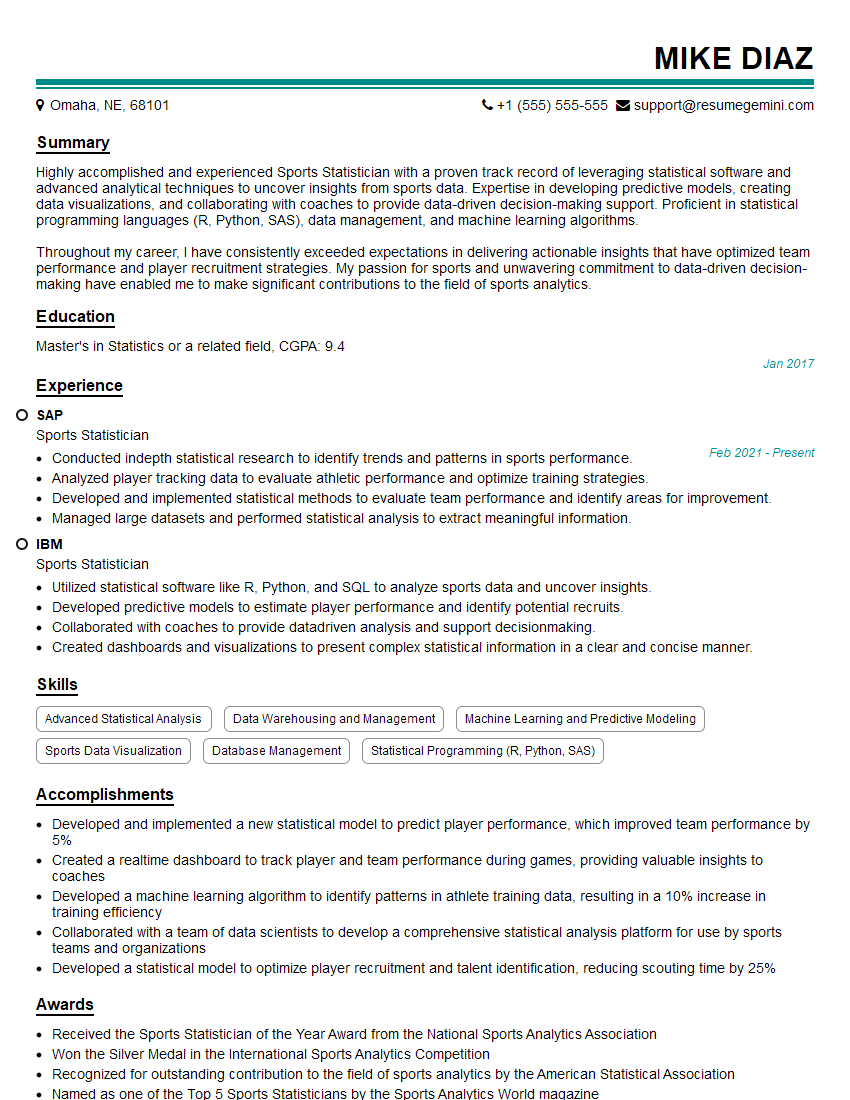
Mastering Punters’ Analysis opens doors to exciting and lucrative career opportunities in the sports analytics and betting industries. To maximize your chances, crafting an ATS-friendly resume is crucial. This ensures your application gets noticed by recruiters. We strongly encourage you to utilize ResumeGemini to build a professional and impactful resume that showcases your skills and experience effectively. Examples of resumes tailored to Punters’ Analysis roles are available to help guide you through the process.
Explore more articles
Users Rating of Our Blogs
Share Your Experience
We value your feedback! Please rate our content and share your thoughts (optional).
What Readers Say About Our Blog
Very informative content, great job.
good