Cracking a skill-specific interview, like one for Radar Imaging, requires understanding the nuances of the role. In this blog, we present the questions you’re most likely to encounter, along with insights into how to answer them effectively. Let’s ensure you’re ready to make a strong impression.
Questions Asked in Radar Imaging Interview
Q 1. Explain the difference between SAR and GPR.
Both SAR and GPR are ground-based radar systems, but they differ significantly in their applications and the targets they image. SAR (Synthetic Aperture Radar) is an airborne or spaceborne system used to create high-resolution images of the Earth’s surface, even under adverse weather conditions. It uses the motion of the radar platform to synthesize a large antenna aperture. GPR (Ground Penetrating Radar), on the other hand, is a ground-based system used to image subsurface structures. It sends electromagnetic pulses into the ground and analyzes the reflections to identify different layers and objects.
Think of it this way: SAR is like taking a high-resolution photograph of the landscape from an airplane, while GPR is like using sonar to map the layers beneath the sea floor but on land.
Q 2. Describe the principles of synthetic aperture radar (SAR).
SAR cleverly uses the movement of the radar platform (e.g., an airplane or satellite) to create a synthetic aperture – an antenna much larger than the physical antenna onboard the platform. As the platform moves, the radar repeatedly illuminates the same target area from slightly different angles. These signals are then processed using sophisticated algorithms to combine the information, effectively simulating the resolution that a much larger physical antenna would provide. This allows SAR to achieve exceptionally high resolution, even from a relatively small antenna.
Imagine taking a series of slightly offset photographs of the same object from different perspectives. You can then combine these photos to create a higher-resolution image than any single photo could provide. SAR does something similar, but instead of light, it uses radio waves.
Q 3. How does ground penetrating radar (GPR) work?
GPR transmits short pulses of electromagnetic energy into the ground. These pulses travel downwards and are reflected back towards the surface when they encounter changes in the dielectric properties of the subsurface materials. These changes can be caused by different soil types, buried objects, or geological formations. The reflected signals are then received by the GPR antenna, and their time of arrival and amplitude are used to construct an image of the subsurface.
A good analogy is using ultrasound to image a fetus. GPR uses electromagnetic waves instead of sound waves, but the principle is similar: sending out signals, receiving the reflections, and then processing those signals to create an image of the internal structure.
The processing involves techniques such as migration and velocity analysis to accurately position the reflections in the subsurface and compensate for the varying speed of the electromagnetic waves in different materials. This allows geologists, archaeologists, and engineers to identify underground features such as pipes, cables, or geological layers.
Q 4. What are the limitations of radar imaging?
Radar imaging, while powerful, has several limitations. One major limitation is the effect of clutter – unwanted reflections from objects that are not the target of interest. This can make it difficult to identify specific targets in complex environments. Another limitation is attenuation – the weakening of the radar signal as it travels through the medium (e.g., the atmosphere for SAR, or the ground for GPR). This attenuation can limit the depth of penetration for GPR and reduce the quality of images, especially at longer ranges for SAR. Furthermore, radar images can be susceptible to speckle noise, which appears as granular texture in the image and can be challenging to interpret.
Additionally, the interpretation of radar images requires specialized expertise. The images are often complex and require considerable knowledge of the imaging system and the specific environment being imaged to accurately interpret features.
Q 5. Explain the concept of range resolution in radar.
Range resolution refers to the ability of a radar system to distinguish between two targets located at different distances (ranges) from the radar. It is directly related to the bandwidth of the transmitted radar signal. A wider bandwidth yields finer range resolution, allowing the radar to distinguish between closely spaced targets along the range direction.
The formula for range resolution is approximately:
Range Resolution ≈ c / (2B)
where c is the speed of light and B is the bandwidth of the transmitted signal.
For example, a radar with a larger bandwidth will be able to distinguish between targets that are closer together than a radar with a smaller bandwidth.
Q 6. What is azimuth resolution and how is it achieved?
Azimuth resolution refers to the ability of a radar system to distinguish between two targets located at different angles (azimuth) from the radar. In SAR, azimuth resolution is achieved by synthesizing a large antenna aperture using the motion of the radar platform. The longer the synthetic aperture, the finer the azimuth resolution.
Unlike range resolution, which is determined by the signal bandwidth, azimuth resolution in SAR is dependent on the platform velocity and the length of the synthetic aperture. It’s a clever way to get great resolution using signal processing.
Azimuth Resolution ≈ λR / (2L)
where λ is the radar wavelength, R is the range to the target, and L is the length of the synthetic aperture. This formula shows that a longer synthetic aperture (longer flight path) leads to better azimuth resolution.
Q 7. Describe different types of radar waveforms and their applications.
Different radar waveforms are designed to optimize performance for specific applications. Some common types include:
- Chirp waveforms: These waveforms use a frequency that changes linearly over time. They allow for high range resolution and good range ambiguity performance. Common in SAR systems.
- Linear Frequency Modulation (LFM) waveforms: A specific type of chirp waveform widely used because of its efficiency in achieving high range resolution.
- Noise waveforms: These use a wideband noise signal with good ambiguity properties. They’re robust against interference and often used in applications needing high clutter rejection.
- Pulse-Doppler waveforms: Used to measure both range and Doppler velocity. This is crucial for moving target indication (MTI) and weather radar applications.
The choice of waveform depends heavily on the application. For example, high-resolution imaging needs chirp waveforms, while weather radar needs pulse-Doppler waveforms. The design considerations often involve a trade-off between range resolution, range ambiguity, and clutter rejection.
Q 8. Explain the process of radar data processing and image formation.
Radar data processing and image formation is a multi-step process that transforms raw radar signals into visually interpretable images. Think of it like taking a blurry photo and then enhancing it to reveal sharp details. It starts with the radar transmitting a signal and receiving the echoes reflected from various targets. This raw data is complex, containing information about the target’s distance, velocity, and reflectivity.
The process typically involves:
- Range Compression: This step uses matched filtering to sharpen the return signals, improving range resolution. Imagine focusing a blurry photo—this step makes the objects appear clearer along the distance dimension.
- Doppler Processing (for moving targets): If the radar is using a pulsed Doppler technique, this step helps separate moving targets from stationary clutter. This is like isolating specific frequencies in music to enhance the clarity of a particular instrument.
- Azimuth Compression: This step improves the resolution in the along-track direction. This is analogous to sharpening the focus of a photograph to improve details horizontally.
- Image Formation: Finally, the processed data is arranged into a two-dimensional image, where each pixel’s intensity represents the backscattered power from the corresponding area. This is the final product, similar to having a completely clear and focused photo ready to analyze.
Different radar modes (e.g., SAR, ISAR) utilize variations of these steps to produce specific types of images.
Q 9. What are common noise sources in radar imaging and how are they mitigated?
Noise is the enemy of clear radar images. It’s like static on a radio—it obscures the desired signal. Common noise sources in radar imaging include:
- Thermal Noise: This is inherent electronic noise caused by random thermal motion of electrons in components. Think of it as the background hum in an empty room.
- Clutter: Unwanted echoes from the ground, vegetation, buildings, or other objects besides the target of interest. This is like unwanted sounds in a recording – you only want the instrument playing.
- Atmospheric Attenuation: The signal weakens as it travels through the atmosphere due to absorption and scattering. This is like fog reducing the visibility of an object.
- Multipath Propagation: Signals can bounce off multiple surfaces before reaching the radar, leading to ghost images. Think of an echo effect where a signal is reflected multiple times.
Mitigation techniques involve various filtering techniques, such as:
- Spatial Filtering: Eliminates noise by averaging neighboring pixels. Similar to using an image editing tool to smooth out a grainy picture.
- Adaptive Filtering: Tailors the filter to match local noise characteristics, improving noise suppression while preserving detail.
- Clutter Suppression Techniques: These techniques, such as moving target indication (MTI) or space-time adaptive processing (STAP), aim to distinguish between desired signals and clutter.
Q 10. Discuss different radar image processing techniques (e.g., filtering, speckle reduction).
Radar image processing techniques are crucial for enhancing image quality and extracting meaningful information. These techniques can be categorized broadly as:
- Filtering: As mentioned earlier, filtering techniques like spatial and adaptive filtering remove noise and improve image clarity.
- Speckle Reduction: Speckle is a granular noise inherent in coherent radar images. It’s a result of the interference between multiple backscattered signals. It’s like looking at a surface under laser lighting – you see random spots rather than a uniform texture. Techniques to reduce speckle include:
- Averaging filters: Simple but effective for reducing speckle noise, however, this approach also reduces resolution.
- Multi-look processing: Combining multiple images acquired from slightly different viewpoints effectively reduces speckle. Think of taking multiple photos from similar positions and averaging the images to diminish graininess.
- Wavelet filtering: Advanced technique that preserves details better than simple averaging while reducing speckle.
- Geometric Correction: This corrects for distortions in the radar image due to radar platform motion or Earth curvature.
- Segmentation and Classification: These techniques divide the image into different regions corresponding to different land cover or target types.
The choice of technique depends on the specific application and the nature of the noise and distortions in the radar data.
Q 11. How do you perform radar calibration and what are the challenges?
Radar calibration is essential to ensure accurate measurements of target characteristics. It involves removing systematic errors and biases from the radar data to obtain a true representation of the scene. This is like calibrating a measuring scale to ensure accurate readings.
Calibration involves several steps:
- Antenna Pattern Calibration: Determining the radar antenna’s radiation pattern to correct for variations in sensitivity across different angles.
- Receiver Gain Calibration: Correcting for variations in the radar receiver’s gain over frequency and time.
- Range Calibration: Determining the exact relationship between the time delay of the returned signal and the range to the target.
- Doppler Calibration: Ensuring accurate measurements of target velocity.
Challenges in calibration include:
- Environmental Factors: Changes in atmospheric conditions can affect the radar signal.
- System Stability: The radar system’s parameters may drift over time.
- Lack of Calibration Targets: Finding suitable targets with known characteristics can be challenging.
Q 12. Explain the concept of polarimetry in radar imaging.
Polarimetry in radar imaging involves measuring the polarization state of the transmitted and received radar signals. Think of it like analyzing the orientation and intensity of light waves to get more information about the object that reflects that light. Instead of just measuring the intensity of the backscattered signal (like in conventional radar), polarimetry measures the complete scattering matrix, which describes how a target modifies the polarization of the incident wave. This matrix contains four elements or polarimetric channels that define how the target interacts with horizontally and vertically polarized waves.
Different target types exhibit distinct polarimetric signatures, providing much richer information about the target’s physical properties, such as shape, orientation, and surface roughness. This allows for better target classification and identification. For example, a smooth surface like water might reflect differently than a rough surface like a forest.
Q 13. How is radar data geo-referenced and what are the challenges?
Geo-referencing radar data involves assigning geographic coordinates (latitude, longitude, and elevation) to each pixel in the radar image. This allows the radar image to be overlaid on other geographic data, such as maps or satellite imagery. Think of it like adding a grid of location information onto the image to pinpoint exactly where each part of the image was taken.
The process usually involves:
- Determining the radar platform’s trajectory: Accurate knowledge of the radar’s position and orientation throughout the data acquisition is critical. This often involves using GPS or inertial navigation systems.
- Using ground control points: These are points on the ground whose geographic coordinates are known. They are identified in both the radar image and a map, allowing for geometric transformation of the radar image.
- Applying geometric corrections: This step accounts for various distortions, like Earth curvature, radar platform motion, and atmospheric effects.
Challenges include:
- Accuracy of positioning data: Errors in GPS or INS data can lead to inaccuracies in geo-referencing.
- Difficulty in identifying ground control points: This can be difficult in areas with little or no distinctive features.
- Dealing with distortions: Correcting for geometric distortions can be complex, especially in challenging terrains or environments.
Q 14. What are the different types of radar targets and their radar signatures?
Radar targets exhibit diverse characteristics depending on their physical properties and the radar’s operating frequency. We can broadly classify them into:
- Point Targets: These are small targets compared to the radar’s resolution, such as aircraft, vehicles, and buildings. Their radar signature is often characterized by a single, relatively strong echo.
- Distributed Targets: These are larger targets that extend over multiple radar resolution cells, such as forests, fields, and cities. Their radar signature is more complex and spread out over multiple pixels. This leads to diverse backscattering intensities that reflect the characteristics of the surface and the subsurface, depending on frequency.
- Surface Targets: These include extended surfaces like the ground, sea, or ice. Their radar signatures are influenced by surface roughness, slope, and dielectric constant.
The radar signature, or backscatter, depends on the target’s:
- Physical Properties: Size, shape, material composition, and surface roughness.
- Orientation: The angle of the target relative to the radar.
- Radar Parameters: Frequency, polarization, incidence angle.
Understanding target types and their signatures is essential for applications like target identification, remote sensing, and surveillance.
Q 15. Describe various applications of SAR in different fields (e.g., Earth observation, defense).
Synthetic Aperture Radar (SAR) is a powerful remote sensing technique that uses microwave energy to create high-resolution images of the Earth’s surface, regardless of weather conditions or time of day. Its versatility makes it applicable across various fields:
- Earth Observation: SAR is crucial for monitoring deforestation, mapping land use changes, assessing agricultural yields, and studying glacial movements. For example, repeated SAR acquisitions can reveal subtle changes in terrain elevation caused by landslides or glacier flow, providing vital information for disaster management and environmental monitoring.
- Defense: In military applications, SAR is invaluable for reconnaissance and surveillance. It can penetrate cloud cover and foliage, providing clear images of enemy installations or troop movements. SAR imagery is also used for target identification and damage assessment following military operations.
- Oceanography: SAR excels at observing ocean surface features like waves, currents, and oil slicks. The backscatter from the ocean surface is sensitive to these features, providing insights valuable for weather forecasting, maritime safety, and environmental protection.
- Disaster Response: After natural disasters such as earthquakes or floods, SAR can quickly map affected areas, helping rescue teams locate survivors and assess the extent of damage. This rapid assessment is critical for efficient resource allocation and aid delivery.
Career Expert Tips:
- Ace those interviews! Prepare effectively by reviewing the Top 50 Most Common Interview Questions on ResumeGemini.
- Navigate your job search with confidence! Explore a wide range of Career Tips on ResumeGemini. Learn about common challenges and recommendations to overcome them.
- Craft the perfect resume! Master the Art of Resume Writing with ResumeGemini’s guide. Showcase your unique qualifications and achievements effectively.
- Don’t miss out on holiday savings! Build your dream resume with ResumeGemini’s ATS optimized templates.
Q 16. Explain the applications of GPR in different fields (e.g., civil engineering, archaeology).
Ground Penetrating Radar (GPR) uses high-frequency electromagnetic waves to image subsurface features. Unlike SAR, which operates in the air, GPR is typically used on or very near the ground surface. Its applications span diverse fields:
- Civil Engineering: GPR is used extensively for locating underground utilities (pipes, cables), assessing the integrity of pavements and bridge decks, and detecting voids or cracks in foundations. This helps prevent damage during construction projects and ensures infrastructure safety.
- Archaeology: Archaeologists use GPR to locate buried structures, artifacts, and features without the need for extensive excavation. This non-destructive technique allows for efficient site investigation and helps preserve historical sites. Imagine discovering the outline of an ancient Roman villa beneath a modern-day field – this is where GPR shines.
- Environmental Science: GPR is used to study soil stratigraphy, detect buried contaminants, and monitor groundwater levels. This helps in site remediation efforts and environmental impact assessments.
- Forensic Science: In criminal investigations, GPR can be used to locate buried bodies or evidence, providing crucial information for solving cases.
Q 17. What are the advantages and disadvantages of different radar systems?
Different radar systems have their own strengths and weaknesses, largely dictated by their operating frequency, pulse characteristics, and antenna design.
- High-Frequency Radar: Offers high resolution, but has limited range and penetration capability. Think of it like a detailed close-up photograph – excellent detail but only covering a small area.
- Low-Frequency Radar: Offers long range and good penetration through obstacles (e.g., vegetation, ground), but with lower resolution. This is analogous to a wide-angle lens, capturing a vast area but with less detail.
- Pulse-Doppler Radar: Provides information about target range and velocity, ideal for tracking moving objects like aircraft. Think of it as being able to see not just where something is, but also where it’s going.
- FM-CW Radar: Offers high accuracy in range measurements, but is usually limited in range. This is great for short-range applications where very precise distance measurements are needed, like in automotive collision avoidance systems.
The choice of radar system always depends on the specific application requirements; high resolution might be more important for some applications while long range or penetration might be more critical for others.
Q 18. Explain the concept of inverse synthetic aperture radar (ISAR).
Inverse Synthetic Aperture Radar (ISAR) is a technique used to image moving targets, typically aircraft or ships. Unlike SAR which uses the motion of a platform (like an aircraft or satellite) to synthesize a large aperture, ISAR uses the target’s motion relative to the radar to create a synthetic aperture.
Imagine the radar as a stationary observer, and the target aircraft as rotating slightly. By observing the changes in the radar return signal as the target rotates, the radar can construct a two-dimensional image of the target, revealing its shape and structure. This is particularly useful in identifying and classifying targets.
The key difference between SAR and ISAR lies in the source of motion. In SAR, the platform moves, while in ISAR, the target moves. The processing techniques involved in constructing the image are fundamentally similar.
Q 19. How do you handle ambiguities in radar data?
Ambiguities in radar data can arise due to range and Doppler ambiguities. Range ambiguity occurs when multiple targets have the same apparent range, but are located at different distances. Doppler ambiguity occurs when multiple targets have the same apparent Doppler frequency shift.
Several techniques can be employed to handle ambiguities:
- Increasing Pulse Repetition Frequency (PRF): Higher PRF reduces range ambiguity but increases Doppler ambiguity.
- Using Multiple PRFs: Employing multiple PRFs in a staggered fashion can help resolve both range and Doppler ambiguities.
- Space-time Adaptive Processing (STAP): This advanced technique is used to suppress clutter and interference, reducing ambiguities that result from these sources.
- Using Multiple Transmit Frequencies: This allows separation of targets based on their unique frequency response.
The choice of method depends on the specific radar system design and the nature of the radar environment. It often involves a trade-off between range and Doppler resolution.
Q 20. Describe your experience with radar data analysis software (e.g., ENVI, MATLAB).
I have extensive experience with radar data analysis software, including ENVI and MATLAB. In my previous role, I utilized ENVI for processing large SAR datasets, performing geometric corrections, speckle filtering, and classification tasks. I was proficient in using ENVI’s tools for feature extraction and analysis of land cover changes, generating reports to support environmental impact assessments.
MATLAB has been invaluable for more complex signal processing tasks. I’ve developed custom algorithms for target detection and classification in SAR imagery, using MATLAB’s signal processing toolbox and image processing toolbox. For example, I wrote a script using fft() and filter() functions to perform clutter suppression in noisy SAR data before feature extraction. %Example MATLAB code snippet[x,y] = meshgrid(1:100, 1:100);z = x.*y + randn(100,100);filtered_z = medfilt2(z,[3 3]); %End of MATLAB code snippet
My experience with these tools extends to both the preprocessing and analysis stages of the radar data processing workflow.
Q 21. What is your experience with radar system design and implementation?
My experience with radar system design and implementation includes involvement in several projects. In one project, I was responsible for designing and simulating a Ku-band Doppler radar system for wind profiling. This involved using simulation software to model the radar’s performance characteristics and optimize the system parameters for achieving high-accuracy wind speed measurements. I also participated in the selection of suitable components, antenna design, and signal processing algorithm development.
In another project, I contributed to the development of a compact X-band SAR for deployment on unmanned aerial vehicles (UAVs). This involved working with a multidisciplinary team encompassing RF engineers, mechanical engineers and software engineers to design a lightweight and robust system capable of high-resolution imaging. My role focused on the signal processing architecture, including pulse compression, motion compensation, and image formation algorithms. I was also involved in field testing and evaluation of the system, using real-world data to validate our design choices.
These experiences have provided me with a solid understanding of the challenges and complexities involved in designing and implementing high-performance radar systems.
Q 22. Explain your knowledge of different radar frequency bands and their applications.
Radar systems operate across various frequency bands, each with unique properties affecting their applications. The choice of frequency band depends on factors such as desired range resolution, penetration capabilities, atmospheric effects, and target characteristics.
- HF (High Frequency) 3-30 MHz: These longer wavelengths offer significant atmospheric penetration, making them suitable for over-the-horizon radar (OTHR) applications. Think of them as being able to ‘see’ around the curvature of the Earth, useful for detecting distant aircraft or ships.
- VHF (Very High Frequency) 30-300 MHz: Also capable of reasonable atmospheric penetration, VHF radars are often employed in air traffic control and weather surveillance. Their larger antennas contribute to broader coverage areas.
- UHF (Ultra High Frequency) 300 MHz – 3 GHz: A versatile band used in many applications. UHF radars offer a balance between range and resolution, making them suitable for both ground-based and airborne systems. Examples include airport surveillance radars and some types of weather radars.
- L band (1-2 GHz): Frequently used in satellite-based Earth observation. The longer wavelengths help penetrate vegetation, making it effective for monitoring soil moisture and forestry.
- S band (2-4 GHz): A popular choice for weather radar and airborne early warning (AEW) systems. It offers a good balance of performance parameters.
- C band (4-8 GHz): Widely used in weather radar, air traffic control, and maritime radar. It strikes a balance between resolution and range.
- X band (8-12 GHz): Offers high resolution but is more susceptible to atmospheric attenuation. Often used in short-range applications such as automotive radar and police speed guns.
- Ku band (12-18 GHz): Used in satellite communication and some high-resolution ground-based radars, offering excellent range resolution but with higher atmospheric losses.
- Ka band (18-26.5 GHz): Highest resolution available, ideal for very detailed imagery but severely affected by weather, suitable for applications requiring extremely high resolution like automotive radar and high-precision mapping.
In summary, the selection of the optimal radar frequency band involves a careful trade-off between several factors, ultimately driving the suitability of the technology for a specific application.
Q 23. How do you evaluate the performance of a radar system?
Evaluating radar system performance requires a multi-faceted approach, focusing on key metrics that capture its capabilities and limitations.
- Range Resolution: The ability to distinguish between two closely spaced targets in range. It’s directly related to the signal bandwidth.
- Azimuth Resolution: The ability to distinguish between two closely spaced targets in azimuth (angle). This is influenced by antenna beamwidth.
- Sensitivity: The minimum detectable signal strength, crucial for detecting weak targets at longer ranges. Often expressed as minimum detectable signal (MDS).
- Accuracy: The precision of target position measurement. Errors can stem from various factors, including atmospheric effects and system noise.
- Clutter Rejection: The ability to suppress unwanted signals (e.g., ground clutter, rain) that might mask target returns. Techniques like Moving Target Indicator (MTI) and clutter cancellation filters are employed.
- False Alarm Rate: The frequency of false alarms – instances where noise or clutter are misinterpreted as targets.
- Probability of Detection (Pd): The probability that a target will be detected given its signal-to-noise ratio (SNR).
- Probability of False Alarm (Pfa): The probability that noise or clutter will be incorrectly identified as a target.
These metrics are often analyzed using Receiver Operating Characteristic (ROC) curves, which plot Pd against Pfa for varying detection thresholds. A good radar system balances high Pd with low Pfa.
Practical considerations include the environmental conditions during testing, the types of targets used for evaluation, and the calibration of the system. A thorough assessment needs to consider all these aspects to achieve an accurate performance evaluation.
Q 24. Describe your experience working with different radar platforms (e.g., airborne, spaceborne).
My experience encompasses various radar platforms, each presenting unique challenges and opportunities.
- Airborne Radar: I’ve worked extensively with airborne radar systems, particularly those used in remote sensing applications. These systems demand high stability, precise pointing mechanisms, and sophisticated motion compensation techniques to correct for the aircraft’s movement. One project involved calibrating and deploying an airborne SAR system for high-resolution mapping of glacial regions, where the challenging environment demanded robust system design and signal processing techniques.
- Spaceborne Radar: Spaceborne radar presents significant design considerations, prioritizing power efficiency, radiation hardness, and robust data management. The vast distances necessitate powerful transmitters and sensitive receivers. I’ve been involved in analyzing data from spaceborne synthetic aperture radar (SAR) missions to study deforestation patterns. The immense volumes of data necessitated the application of advanced processing and data compression techniques.
- Ground-based Radar: I’ve also worked with ground-based radars for meteorological applications. These systems often operate continuously, requiring reliable infrastructure and advanced algorithms for data analysis and processing. For instance, I was involved in the development of an automated system for detecting and tracking severe weather phenomena, requiring real-time data processing and alert generation capabilities.
Each platform presents distinct advantages and disadvantages. Airborne systems offer flexibility in terms of coverage area but are more susceptible to environmental conditions. Spaceborne systems provide consistent global coverage but have limitations in terms of temporal resolution. Ground-based systems are often more cost-effective but are limited in geographical coverage.
Q 25. Discuss your understanding of radar target detection and classification.
Radar target detection and classification are crucial aspects of radar signal processing. Detection involves identifying the presence of a target amidst noise and clutter, while classification involves determining the target’s type and characteristics.
- Detection: This is typically achieved using thresholding techniques. A signal exceeding a predefined threshold is considered a potential target. More sophisticated methods incorporate Constant False Alarm Rate (CFAR) detectors, which dynamically adjust the threshold to maintain a constant false alarm rate regardless of the noise level.
- Classification: This is a more complex task, often involving feature extraction from the radar signal. These features might include target range, Doppler velocity, radar cross-section (RCS), and polarimetric characteristics. Machine learning techniques such as Support Vector Machines (SVMs) or neural networks are frequently used to classify targets based on these features.
Examples of target classification include distinguishing between aircraft, ships, ground vehicles, and weather phenomena. The choice of classification algorithm and features depends on the specific application and the types of targets being considered. For example, in a maritime environment, wave height and sea clutter characteristics are important to consider while classifying ships. In airport surveillance, the classification system should be able to differentiate between different aircraft based on their size and speed.
Advanced techniques such as high-resolution range-Doppler processing and polarimetric analysis provide richer feature sets to enhance classification accuracy.
Q 26. How do you interpret radar images and extract meaningful information?
Interpreting radar images requires understanding the radar’s characteristics and the principles of radar imaging. The process involves identifying features, recognizing patterns, and extracting meaningful information.
- Understanding Image Characteristics: This includes recognizing the effects of different radar parameters (frequency, polarization, incidence angle) on the image appearance. For instance, side-looking airborne radar (SLAR) images often exhibit geometric distortions, which require geometric correction techniques.
- Feature Identification: This involves identifying specific objects or features in the image, such as buildings, roads, vegetation, or targets of interest. This often requires domain expertise and knowledge of the imaged area.
- Pattern Recognition: Identifying patterns and textures in the image can provide valuable information about the area’s characteristics. For example, different land cover types can be identified based on their backscatter characteristics.
- Data Extraction: Quantitative information can be extracted from radar images using image processing techniques, such as measurements of target size, area, or distance.
For instance, interpreting a SAR image of a forested area involves recognizing the different backscatter patterns associated with different tree species or densities. This understanding can be used to estimate forest biomass or monitor deforestation.
Advanced techniques such as image segmentation, object detection, and change detection can be used to automate the interpretation process and extract more complex information.
Q 27. Describe your experience with radar data visualization and presentation.
Effective visualization and presentation of radar data are critical for conveying complex information clearly and concisely. My experience involves employing a variety of tools and techniques.
- Software Tools: I’m proficient in using specialized radar processing and visualization software such as ENVI, ArcGIS, and MATLAB. These tools allow for advanced image processing, analysis, and 3D visualization.
- Image Processing: I regularly use image processing techniques like filtering, enhancement, and geometric correction to improve the quality and interpretability of radar images.
- Data Representation: I tailor the representation of data to the specific audience and purpose. This might involve creating maps, graphs, charts, or interactive dashboards to effectively communicate key findings.
- 3D Visualization: For complex datasets or scenarios, 3D visualization techniques are employed to enhance understanding. This can involve generating 3D terrain models from DEM data obtained from radar imagery.
For example, in presenting findings from a SAR mission to a non-technical audience, I might focus on visually appealing maps highlighting key features, rather than complex technical graphs. For a more technical audience, I would include more detailed analyses and processing steps.
The key is to select appropriate visualization methods that accurately represent the data and effectively communicate the intended message to the target audience.
Q 28. Explain your experience working on radar projects involving multi-sensor data fusion.
Multi-sensor data fusion combines data from multiple sensors to produce a more comprehensive and accurate representation of a scene than any single sensor could provide on its own. My experience in this area focuses on integrating radar data with other sources such as optical imagery, LiDAR, and other sensor modalities. This enhances the quality, accuracy, and information content of the final product.
- Data Registration: A critical first step is accurately registering the data from different sensors to a common coordinate system. This ensures that information from different sensors can be combined meaningfully. Techniques like image correlation and geometric transformations are employed.
- Data Integration: Different data fusion techniques can be used depending on the specific application and data characteristics. These include pixel-level fusion, feature-level fusion, and decision-level fusion.
- Algorithm Development: I’ve developed algorithms for combining radar and optical data to improve land cover classification. Radar data, especially SAR, can provide information on terrain structure even under cloud cover, while optical imagery provides detailed spectral information about the surface. The fusion of these data sources enhances the accuracy of land cover classification compared to relying on either sensor alone.
For example, in urban mapping, fusing radar data (which penetrates buildings to a certain extent) with optical imagery (which provides high-resolution details of visible surfaces) can create a more complete 3D model of the urban environment. This enhanced understanding assists in applications like urban planning and disaster response.
The effectiveness of multi-sensor data fusion depends on careful selection of sensors, appropriate fusion techniques, and rigorous validation of the results. It often requires substantial expertise in image processing and data analysis.
Key Topics to Learn for Radar Imaging Interview
- Fundamentals of Radar: Understand basic radar principles, including signal transmission, reflection, and reception. Explore different types of radar (e.g., pulsed, continuous wave).
- Signal Processing Techniques: Master concepts like matched filtering, pulse compression, and Doppler processing. Know how these techniques improve image quality and resolution.
- Image Formation: Learn the various methods for forming radar images, including range-Doppler processing, synthetic aperture radar (SAR) techniques, and inverse synthetic aperture radar (ISAR) techniques.
- Radar Cross Section (RCS): Understand how the RCS of targets impacts image formation and interpretation. Explore factors affecting RCS and its calculation methods.
- Calibration and Compensation: Familiarize yourself with techniques used to calibrate radar systems and compensate for various sources of error, improving image accuracy.
- Radar System Design: Gain a basic understanding of the components of a radar system and how they interact to produce images. Consider antenna design, transmitter/receiver characteristics, and signal processing hardware.
- Image Interpretation and Analysis: Develop skills in interpreting radar images, identifying features, and extracting meaningful information. Practice analyzing various types of radar imagery (e.g., SAR, ISAR).
- Applications of Radar Imaging: Be prepared to discuss applications relevant to your target role, such as remote sensing, weather forecasting, autonomous vehicles, or medical imaging. Highlight your understanding of the specific challenges and solutions within those applications.
- Common Challenges & Problem-Solving: Practice troubleshooting potential issues in radar image acquisition and processing. Think about how you would approach problems like noise reduction, clutter rejection, and target detection.
Next Steps
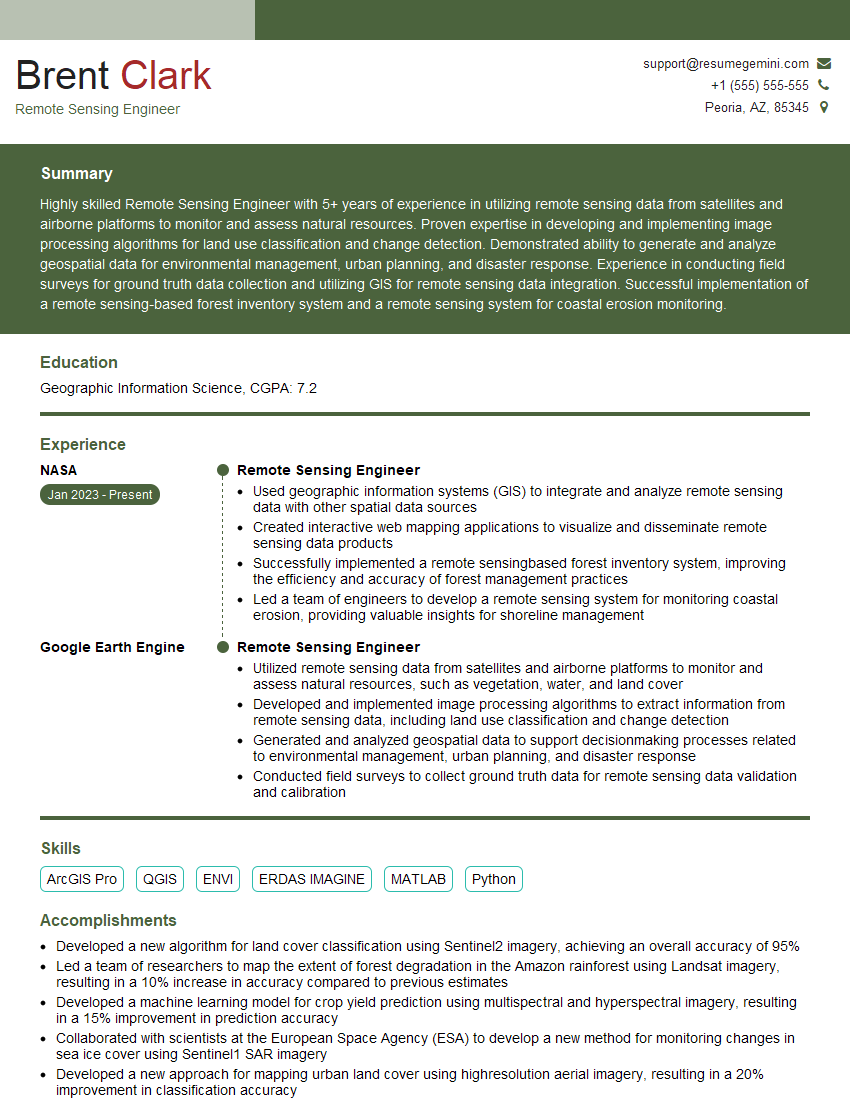
Mastering radar imaging opens doors to exciting and impactful careers in various high-tech fields. To maximize your job prospects, it’s crucial to present your skills effectively. An ATS-friendly resume is key to getting your application noticed by recruiters. ResumeGemini is a trusted resource to help you craft a professional and impactful resume that highlights your expertise in radar imaging. Examples of resumes tailored to Radar Imaging are available to help guide you.
Explore more articles
Users Rating of Our Blogs
Share Your Experience
We value your feedback! Please rate our content and share your thoughts (optional).
What Readers Say About Our Blog
Very informative content, great job.
good